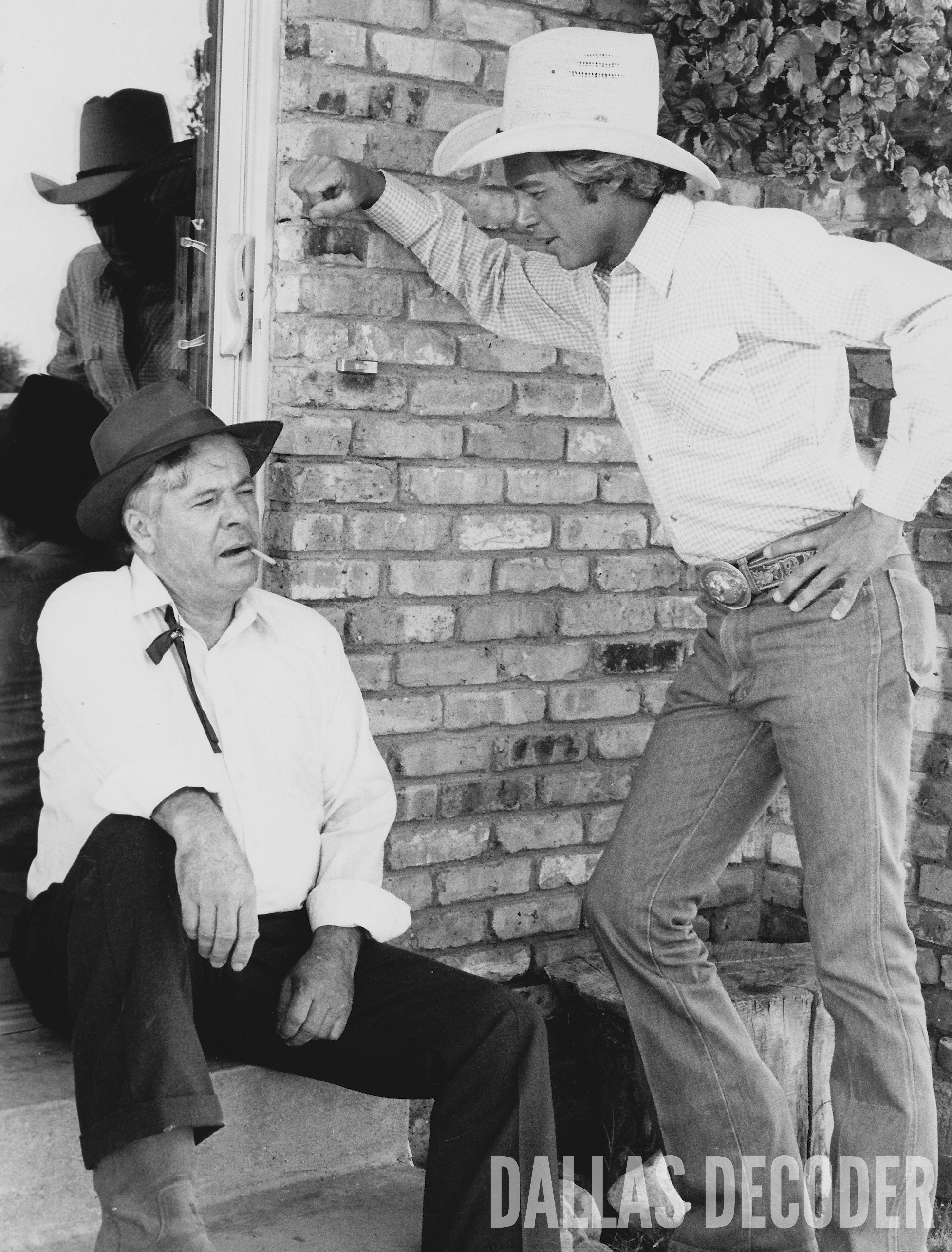
Amos (William Windom), Ray’s long-lost daddy, turns up on the doorstep of his son (Steve Kanaly) in this 1980 publicity shot from “The Fourth Son,” a fourth-season “Dallas” episode.
Between the Lines and Behind the Scenes of "Dallas"
Amos (William Windom), Ray’s long-lost daddy, turns up on the doorstep of his son (Steve Kanaly) in this 1980 publicity shot from “The Fourth Son,” a fourth-season “Dallas” episode.
Facing the truth
In “The Fourth Son,” a fourth-season “Dallas” episode, Jock (Jim Davis) visits Ray (Steve Kanaly), who asks him to sit at the patio table outside his newly built home.
JOCK: Your father came to see me today.
RAY: My father?
JOCK: Yeah. Afraid he put the squeeze on me.
RAY: Jock, I’m sorry. I’m real sorry. I tried to get rid of him.
JOCK: Ray, I don’t know whether you know it or not, but your mother and I were real close friends.
RAY: Yes, sir, I know.
JOCK: I met her in England during World War II. I was in the Army Air Corps, and she was a nurse.
RAY: She used to talk about those nursing days a lot. Seems like the only time in her life she ever felt useful.
JOCK: The fact is, Ray, your mother and I had an affair. But it was, it was special. Oh, she knew all about Ellie. I knew about her fiancé, Amos Krebs. But it was wartime, and our feelings were…. Well, let’s just say that we were two lonely people.
RAY: Jock, you don’t have to explain a thing to me.
JOCK: Afraid I do. I was sent to France and she was shipped back home. We said goodbye. We knew it was over. We thought that was the best thing to do. We never kept in touch after that until –
RAY: Till I showed up on your doorstep. [Smiles]
JOCK: [Smiles] I was glad to have you. Still am.
RAY: Jock, let me handle my father. He’s not your problem. He’s mine.
JOCK: Ray, I don’t know how to put this, so I’ll just spit it out. He’s not your daddy. I am.
RAY: [Looks away, then at Jock; clenches his jaw] Did Krebbs tell you that?
JOCK: He provided proof. Don’t suppose he needed to. I know it’s the truth. I just, I just feel it. I don’t know why in the world I never realized it before.
RAY: You tell Miss Ellie yet?
JOCK: Not yet, but….
RAY: Then what are you going to do about it?
JOCK: What do you want me to do?
RAY: No disrespect to you, Jock, I’d just as soon you leave things the way they are.
JOCK: You understand, Ray, that you’ve got a lot at stake here.
RAY: Jock, I’d be proud to be recognized as your son. But you know what kind of problems that could cause for you and your family. And the pressure it might put between you and Miss Ellie. If it’s all right with you, I’m just happy to leave things just the way they are.
JOCK: You’re saying it’s my decision?
RAY: I want to do what’s best for you. It’s all I care about.
Rising son
In “The Fourth Son’s” third act, Jock tells Ray he’s his father, a fact the Ewing patriarch didn’t discover until earlier in the episode but a truth he’s probably always known, deep down. The scene is beautifully written and performed, and no matter how often I watch it, it always moves me. “Dallas” simply doesn’t get better than this.
The sequence opens with Jock’s Lincoln Town Car kicking up dust as it comes down the gravel road toward Ray’s newly constructed rambler. Director Irving J. Moore brings us into the car for a close-up of Jim Davis, who looks serious as always but more pensive than usual. The Ewing patriarch is in the driver’s seat, but it isn’t clear where this journey is going to take him. You can feel the uncertainty.
When Jock parks the car and gets out, Ray puts down the ax he’s using to chop wood, takes the older man by the arm and leads him to the patio table. “Come on out of the sun,” Ray says, and with that single, small gesture, we’re reminded both of Jock’s mortality and the ranch foreman’s abiding affection for his boss and mentor.
Scriptwriter Howard Lakin’s dialogue in the conversation that follows is so good because it tells us so much. Almost every line signals something more than what’s actually being said.
Ray recalls his mother’s memories of her nursing days (“Seems like the only time in her life she ever felt useful.”) and we realize what a sad, unfulfilled life this woman must have led. He suggests telling the truth about his paternity could cause problems for Jock’s “family” and we known precisely what family member he’s referring to. Jock reminds Ray he’s “got a lot at stake here” and the line – along with the slight smile from Davis that accompanies it – lets us know how impressed Jock is with Ray’s willingness to sacrifice his right to share in the Ewing riches.
Davis is wonderful in this scene – strong and solemn, yet full of love and pride – and so is Steve Kanaly, who wears the mantle of plainspoken humility so convincingly, I wonder how much “acting” is taking place here. I don’t know if Davis and Kanaly were friends in real life, but my goodness, in this exchange, they make me believe in the respect their characters feel for each other.
Matters of Honor
She never let him forget
The crux of Jock and Ray’s conversation – Jock wants to acknowledge Ray as his son, while Ray is “happy to leave things just the way they are” – reflects “The Fourth Son’s” broader theme, which is how doing the honorable thing sometimes means hurting others.
We see this at the end of the episode, when Jock summons Ray and the Ewings to the Southfork living room and tells them the ranch’s longtime foreman is the product of a wartime affair Jock confessed to Miss Ellie long ago. For Jock, acknowledging Ray is the right thing to do, but Ellie’s stony expression makes it clear her husband’s past indiscretion still hurts.
In the same spirit, Ray’s willingness to keep his paternity secret echoes the decision his mother, Margaret, made years earlier. For her, not telling Jock about Ray was a necessary sacrifice – but how did that affect Amos?
When we meet him in “The Fourth Son,” he’s a loathsome figure – character actor William Windom is perfectly unsavory in the role – but was Amos always this awful? Lakin’s dialogue suggests the character had a hard-knock life: He was a bastard son and a “4-F” who wasn’t physically qualified to serve his country, and then his fiancée came home from the war pregnant with another man’s child.
Yet Amos married Margaret anyway. Why? Was he willing to give Margaret his name and raise Ray as his own because he felt sorry for her? Or was it because he loved her? Either way, did he end up abandoning his family because the reality of the situation proved too difficult? At one point, Amos tells Jock, “I know she was in love with you. She never let me forget it.” The mystery of what really happened in Kansas lingers.
Questions of integrity and sacrifice also figure into Bobby’s storyline, where he must choose between keeping Jock’s commitment to Mort Wilkinson, a longtime Ewing Oil client, and honoring a deal Bobby himself made with Brady York. At one point, Bobby is ready to abandon Wilkinson – until he’s told Jock sealed the deal 20 years earlier with nothing more than a handshake. “That makes it sacred,” Bobby says.
The subplot where Mr. Eugene helps Bobby expose Sally’s dirty dealings also offers a play on “The Fourth Son’s” central theme. Eugene gives Bobby “carte blanche” to seek retribution from Sally, but the old man warns him: “You remember this: I plan to keep her.” A few moments later, while gazing at a framed picture of Sally, Eugene says, “What God and money hath joined together, let no man put asunder.”
Fathers and Sons and Fathers and Sons
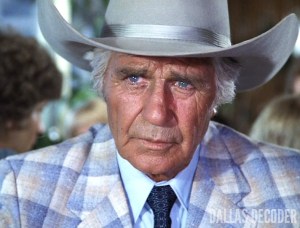
Grand father
Ultimately, “The Fourth Son” is an episode about fatherhood, which becomes one of the “Dallas” franchise’s most resilient themes, particularly in TNT’s new series.
Interestingly, the story told here wasn’t planned: According to Barbara Curran’s 2005 book “Dallas: The Complete Story of the World’s Favorite Prime-Time Soap,” Kanaly had grown frustrated with his role by the end of the third season, so the producers decided to make his character Jock’s illegitimate son to keep the actor from leaving the show. In retrospect, it seems like this is the direction “Dallas” was headed in all along. (Remember the classic second-season episode “Triangle,” when Jock gave Ray a plot of Southfork land?)
The irony is that while the “The Fourth Son” succeeds in rooting Ray more firmly in the “Dallas” mythos, it ends up doing just as much to burnish Jock’s reputation. After this episode, there are four Ewing sons but still only one father, and watching the way he acknowledges Ray makes us better understand why Jock is so revered.
Grade: A+
________________________________________________________________________________________________________________________________________________
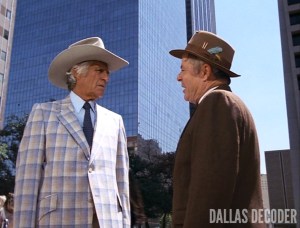
His two dads
‘THE FOURTH SON’
Season 4, Episode 7
Airdate: December 12, 1980
Audience: 27.9 million homes, ranking 1st in the weekly ratings
Writer: Howard Lakin
Director: Irving J. Moore
Synopsis: The sinking of the Bullocks’ tanker almost forces Bobby to stiff one of Ewing Oil’s longtime clients. When Bobby discovers J.R. and Sally faked the loss of the oil aboard the tanker, he turns the tables on them. Ray’s father Amos arrives and announces Ray’s real father is Jock, who welcomes Ray into the family.
Cast: E.J. André (Eugene Bullock), Barbara Bel Geddes (Miss Ellie Ewing), Joanna Cassidy (Sally Bullock), John Crawford (Mort Wilkinson), Jim Davis (Jock Ewing), Patrick Duffy (Bobby Ewing), Ted Gehring (Brady York), Linda Gray (Sue Ellen Ewing), Larry Hagman (J.R. Ewing), Susan Howard (Donna Culver), Ken Kercheval (Cliff Barnes), Leigh McCloskey (Mitch Cooper), Jeanna Michaels (Connie), Victoria Principal (Pam Ewing), Charlene Tilton (Lucy Ewing), William Windom (Amos Krebbs)
“The Fourth Son” is available on DVD and at Amazon.com and iTunes. Watch the episode and share your comments below.
This summer, the “Dallas” fans at Dallas Decoder and Cook In/Dine Out are offering “Dallas Drinks,” a series of cocktails inspired by the characters from TNT’s new series. This week: The Christopher, a drink that’s spicier than you might expect – just like Jesse Metcalfe’s character.

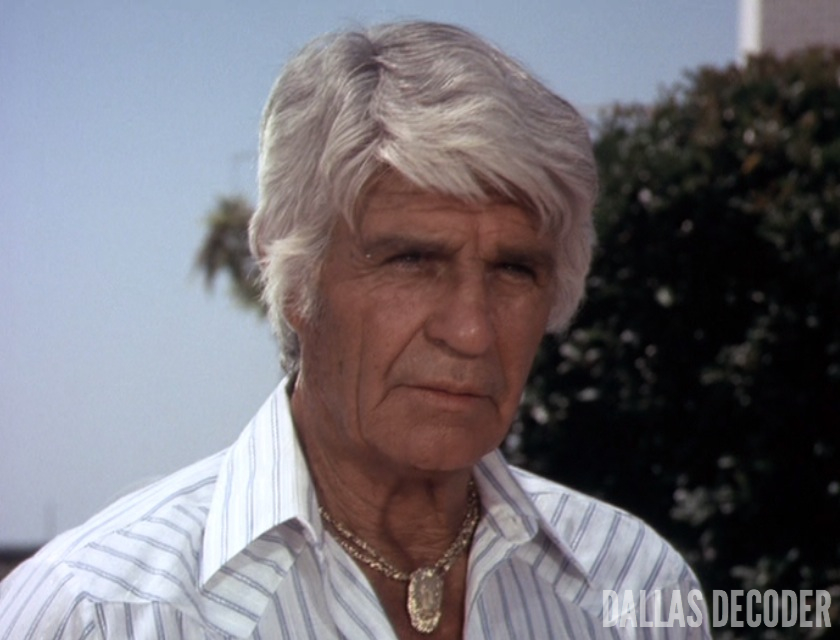
Lion king
In the famous painting of Jock that hangs at Southfork (and later, Ewing Oil) after the character’s death, he wears his signature gold medallion. The lion’s head, which dangles on a chain around Jock’s neck, reminds the world of his role as father of the Ewing pride.
When Jock was alive, sometimes his own family needed the reminder.
Jim Davis is first shown wearing the lion’s head in the fourth-season episode “The Venezuelan Connection,” when an enraged Jock chases down Bobby in the Southfork driveway after discovering his youngest son has bought a refinery.
“Why in the hell didn’t you check with me first?” Jock demands.
“There wasn’t time, Daddy. I had to move fast,” Bobby responds.
“Move fast? So fast you didn’t have time to talk to me?”
Similar scenes unfold in other fourth-season episodes. In “The Prodigal Mother,” Jock is wearing the medallion when he makes a dismissive remark about Mitch and Lucy stands up to him, and in “Executive Wife,” the lion’s head is hanging around Jock’s neck when Ray suggests he should check with Bobby before taking millions of dollars out of the company to invest in a land deal.
In that instance, Jock lets Ray know he’s still top dog (er, cat) at Ewing Oil.
“Let me tell you something, Ray,” he says. “Ewing Oil is mine. I started it. I worked it. I made it what it is today. And if Bobby or anybody else don’t like the way I do things, they know what they can do.”
As Jock speaks, the medallion around his neck catches the Texas sunlight, drawing the viewer’s attention and helping to illuminate the Ewing patriarch’s message. There’s no doubt: Jock may be a lion in winter, but he’s still a lion.
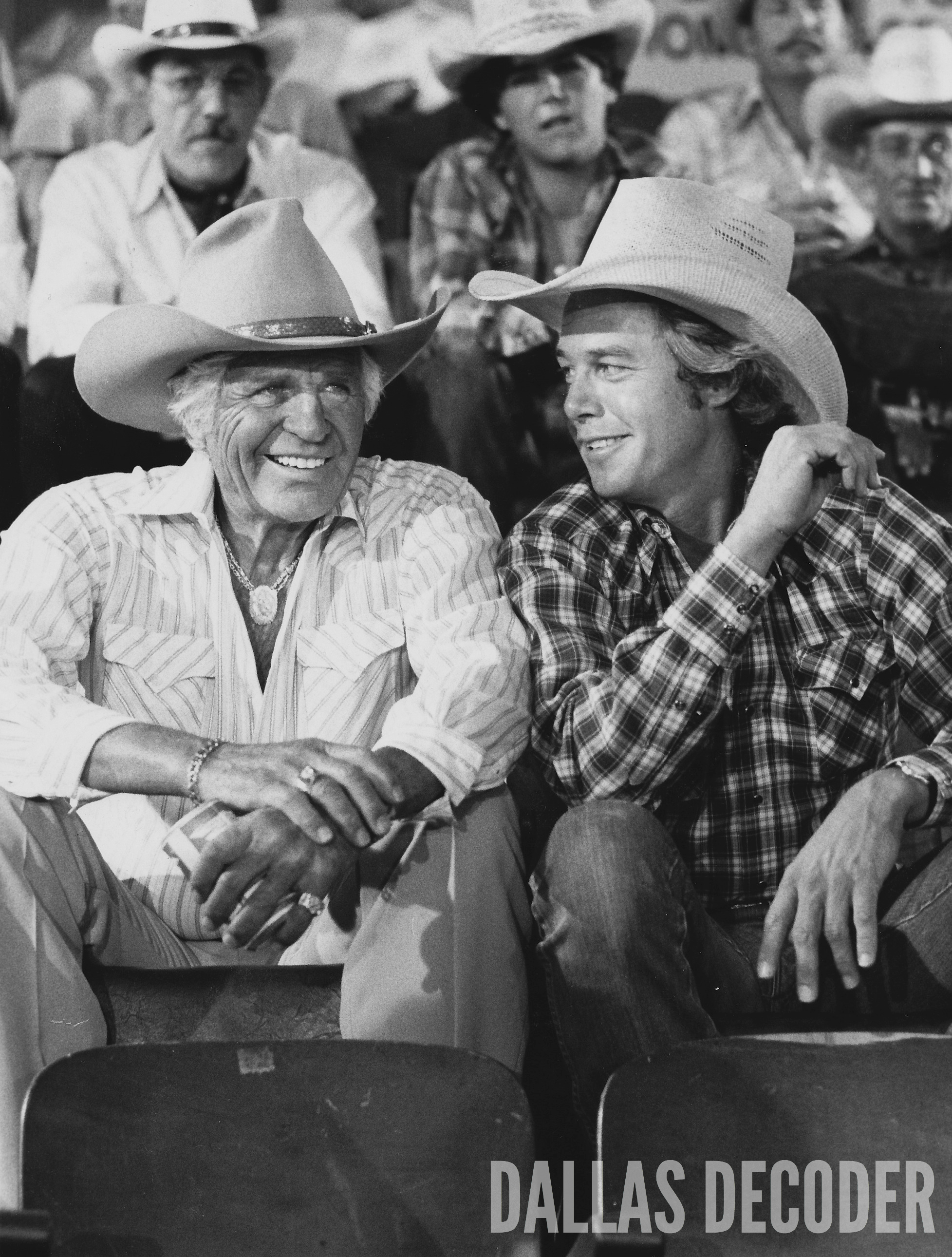
Jock and Ray (Jim Davis, Steve Kanaly) attend a Fort Worth cattle auction in this 1980 publicity shot from “The Venezuelan Connection,” a fourth-season “Dallas” episode.
Telling it like it is
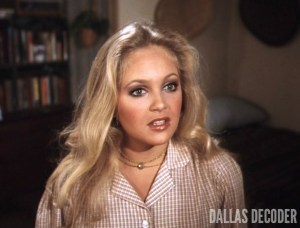
In “The Venezuelan Connection,” a fourth-season “Dallas” episode, Lucy (Charlene Tilton) talks to Mitch (Leigh McCloskey) while he puts away dishes in his kitchen.
MITCH: Lucy, look, it was nice of you to come here, but you’ve gotta understand one thing: being rich is a way of life for you. I’ll never have that kind of money.
LUCY: Well, I don’t care about that.
MITCH: Well, I do!
LUCY: Well, why should you?
MITCH: I can’t compete with your fancy friends with their automobiles and their trips off to Acapulco.
LUCY: Well, why do you have to compete with them? They live like that. So what? Can’t you just accept it? They accepted you.
MITCH: Because I was with you!
LUCY: Well, so wouldn’t it be the same way with your friends? They’d accept me only because I was with you. Look, things will change. It’ll be different when they get to know you better. They’ll accept you.
MITCH: Look, I don’t give a damn about their acceptance! [Slams his fist on the table]
LUCY: You know what? You’re the one who’s the snob. With all that medical stuff you study in school, you sure don’t know much about people. [Walks toward the door, turns back to face Mitch] You know, it’s funny. I came here to apologize because I thought we had a good thing going on. But now I wonder if we do. Because if you can’t like me the way I like you, without caring about anything or anyone else, then I don’t even want to know you. Maybe you’re not the man I thought you were.
She leaves, slamming the door behind her.
Gone with the window
“The Venezuelan Connection” feels like the first half of one of “Dallas’s” two-part episodes. There’s a lot of setup here but not a lot of payoff.
In the main storyline, Bobby hires May-December power couple Eugene and Sally Bullock to ship Venezuelan crude to Ewing Oil’s new refinery, only to learn the tanker sank en route. This is a well-executed plot twist – and there’s much more to the sinking than Bobby realizes – but he won’t discover that until the next episode.
(Quick aside: While I’m delighted to see “The Venezuelan Connection” bring back the Bullocks, who make their first appearance on “Dallas” since their debut in the third-season episode “Return Engagements,” I’m disappointed the show recasts Sally with Joanna Cassidy, who isn’t as deliciously brazen as Andra Akers, the actress who originated the role. Similarly, E.J. André isn’t quite as amusingly cantankerous in this episode as he was during his first go-round as Mr. Eugene.)
Jock and Ray’s storyline in “The Venezuelan Connection” feels incomplete, too. In the third act, a mystery man spots the Ewing patriarch and his foreman in a Fort Worth saloon and quizzes the barkeep about them, but we don’t learn the stranger’s identity – or the reason for his curiosity – until the next episode, which by the way is entitled “The Fourth Son.” (Hint, hint)
Fortunately, “The Veneuzeluean Connection” offers one genuinely satisfying moment: Lucy’s confrontation with Mitch over his abrupt departure from the Southfork pool party she threw in his honor.
In the scene, working-class Mitch tells Lucy he fled the shindig because he felt he couldn’t “compete” with her wealthy friends – an idea she finds ridiculous. “Why do you have to compete with them? They live like that. So what? Can’t you just accept it?” she asks.
This response feels mature and logical, two qualities we don’t always associate with Lucy. I also appreciate how scriptwriter Leah Markus allows the character to recognize Mitch for what he really is. As Lucy tells him, “You’re the one who’s the snob.”
Charlene Tilton is terrific in this scene, which ends with Lucy suggesting she and Mitch break up. This might make their fight seem like another one of “The Venezuelan Connection’s” unresolved plot points, but not really. For Lucy and Mitch, this is turning a point, not a cliffhanger.
Grade: B
________________________________________________________________________________________________________________________________________________
Not the same
‘THE VENEZUELAN CONNECTION’
Season 4, Episode 6
Airdate: December 5, 1980
Audience: 29 million homes, ranking 1st in the weekly ratings
Writer: Leah Markus
Director: Leonard Katzman
Synopsis: Bobby taps Eugene and Sally Bullock to ship crude to his new refinery. Jock is impressed by Bobby’s initiative, while J.R. seethes. Pam’s detective continues searching for her mother. Mitch feels uncomfortable around Lucy’s friends. Bobby learns the Bullocks’ tanker sank en route to the refinery.
Cast: E.J. André (Eugene Bullock), Tami Barber (Bev), Barbara Bel Geddes (Miss Ellie Ewing), Joanna Cassidy (Sally Bullock), Jeff Cooper (Dr. Simon Elby), Jim Davis (Jock Ewing), Patrick Duffy (Bobby Ewing), Meg Gallagher (Louella), Ted Gehring (Brady York), Linda Gray (Sue Ellen Ewing), Larry Hagman (J.R. Ewing), Jerry Haynes (Pat Powers), Richard Herd (John Mackey), Susan Howard (Donna Culver), Ken Kercheval (Cliff Barnes), Leigh McCloskey (Mitch Cooper), Jeanna Michaels (Connie), Victoria Principal (Pam Ewing), Charlene Tilton (Lucy Ewing), Janine Turner (Susan), William Windom (stranger), Morgan Woodward (Punk Anderson)
“Taste of Success” is available on DVD and at Amazon.com and iTunes. Watch the episode and share your comments below.
His blood pressure rose too
Ratings for TNT’s “Dallas” rebounded this week after dipping on Independence Day.
Approximately 3.4 million viewers watched “Truth and Consequences,”the show’s fifth episode, on July 4. Although the audience was down about 18 percent from the previous week – no surprise there, TV audiences always shrink on holidays – “Truth and Consequences” still managed to become the evening’s top original cable show and the 16th most-watched cable program of the week.
TNT’s sixth “Dallas” installment, “The Enemy of My Enemy,” did better: It scored 3.6 million viewers on July 11, including 1.3 million viewers between the ages of 18 and 49, the group advertisers pay a premium to reach. “Dallas” and USA’s “Royal Pains” tied for second place among the 18-to-49 crowd that evening; the top-rated cable show in that demographic: ESPN’s “ESPY Awards,” which was seen by 1.5 million viewers in that group.
“Dallas” is averaging 4.5 million viewers of all ages on Wednesday nights, although the numbers go up when people who record the show and watch it later are counted.
‘Who Shot J.R.?’ Still Making News
“Who Done It?,” the “Dallas” episode that reveals Kristin as J.R.’s shooter, remains one of the most memorable television moments of the past 50 years, according to a study published this week.
The 1980 broadcast ranked 44th on the memorable moments list, ahead of “events” like Chaz Bono’s participation in “Dancing with the Stars” (No. 59) and Kim Kardashian’s marriage to Kris Humphries (No. 76), but below ABC’s 1977 miniseries “Roots” (No. 36) and the Beatles’ performance on “The Ed Sullivan Show” (No. 43).
Sony Electronics and the Nielsen television research company conducted the study. The findings are based on a survey in which people were given a list of landmark TV events and asked to rank them.
News stories dominated the list: Coverage of the 9/11 terrorist attacks ranked first, followed by reporting on the 2005 Hurricane Katrina disaster (No. 2) and the 1995 verdict in the O.J. Simpson murder trial (No. 3).
Dressing ‘Dallas’
Here at Dallas Decoder, we’re big fans of Rachel Sage Kunin, costume designer for TNT’s “Dallas,” which is why we’re pleased to see her get a little love in the press.
In a new interview with the design site Artinfo, Kunin reveals why Linda Gray is her favorite cast member to dress – and why we’re unlikely to see John Ross sporting a Stetson with his business suits.
ICYMI: Gray Speaks
Ultimate Dallas’s revealing interview with Gray stirred the Ewing-verse this week, prompting us to weigh in with a call for more screen time for Sue Ellen. Of course, we weren’t the only ones. If you haven’t already done so, be sure to check out the Dallas Morning News’s blog post and Dallas Divas Derby’s wish list for the new show’s second season (No. 3: Save Sue Ellen!).
Line of the Week
“What now?”
John Ross’s exasperated response to seeing Bobby and Christopher barge into his room at the end of “The Enemy of My Enemy” made me laugh. Look, I love Bobby and Christopher, but you gotta admit: These two can be a little too Dudley Do-Right for their own good. I see why John Ross finds them a little hard to take sometimes.
Sweet and Strong
A reminder: This week’s “Dallas Drinks” offering is The Bobby, named for Patrick Duffy’s all-American hero. The recipe comes from Dallas Decoder’s favorite spouse at Cook In/Dine Out.
“Drill Bits,” a roundup of news about TNT’s “Dallas,” is published regularly. Share your comments below.
The outsider
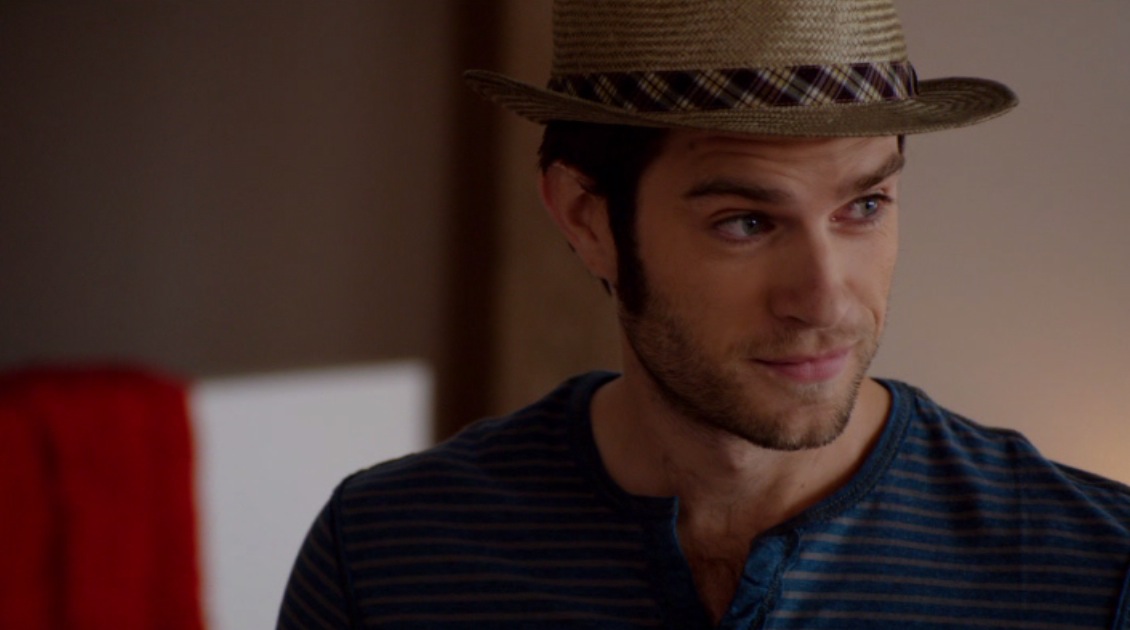
In “The Enemy of My Enemy,” Tommy comes charging into Rebecca’s apartment, grumbling about the crowd at the coffee shop he’s just returned from. “People in Texas are way too friendly. It tries my nerves,” he says.
The line reminds us that Tommy is an outsider in Dallas – and so does the hat Callard Harris wears in this scene. The headgear appears to be a straw fedora, trimmed with a plaid ribbon. Notably, it isn’t a Stetson, the style favored by the Ewing men.
In addition to offering another demonstration of Tommy’s distinctive fashion sense – he memorably wore flip-flops to Christopher and Rebecca’s wedding in “Changing of the Guard,” the first episode of TNT’s “Dallas” – the hat recalls the fedora Digger Barnes wore on the original “Dallas.”
This might be another sly homage to the old show. Like Tommy, Digger was also an outsider who coveted the Ewings’ wealth. Of course, the source of Digger’s envy was always apparent: He believed Jock “stole” Miss Ellie and cheated him out of his rightful share of Ewing Oil.
Tommy’s motivation remains a mystery – along with any other connections he and Rebecca may share with classic characters like Digger.








 Dallas Decoder