Audrey Landers, Charlene Tilton to Return to ‘Dallas’

Afton Cooper, Audrey Landers, Charlene Tilton, Dallas, Lucy Ewing, TNT

They’re back!

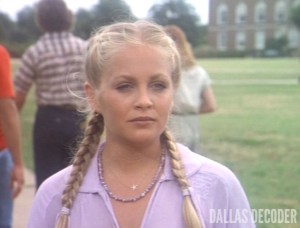
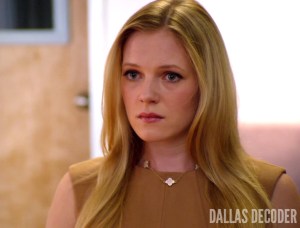
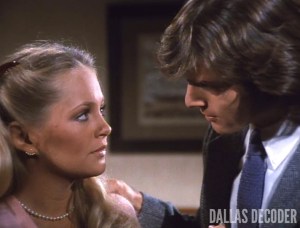
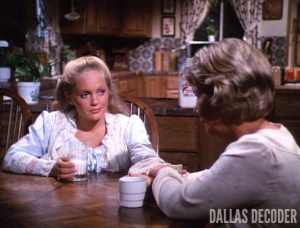
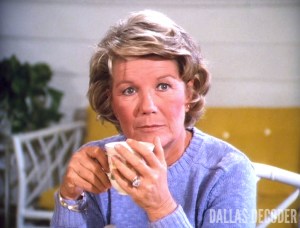
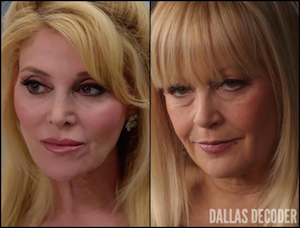
Audrey Landers and Charlene Tilton will guess star on TNT’s “Dallas” next season, Dallas Decoder has confirmed.

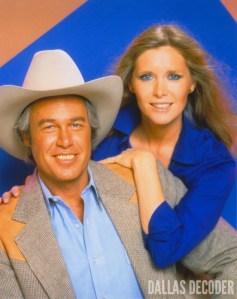
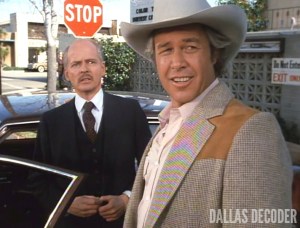
The actresses will reprise their roles of Afton Cooper and Lucy Ewing in an episode that will also feature an appearance by Steve Kanaly.

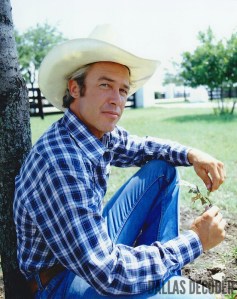
In a new interview with our site, Kanaly discusses his career playing Ray Krebbs.

Are you excited about Audrey Landers’ and Charlene Tilton’s latest visits to “Dallas”? Share your comments below and read more news from Dallas Decoder.
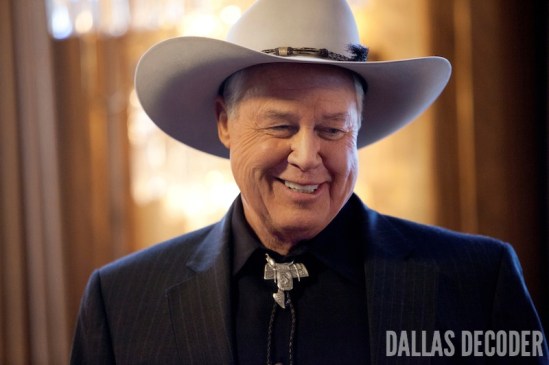
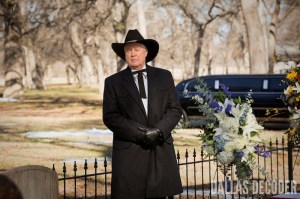
The Dallas Decoder Interview: Steve Kanaly

Dallas, J.R.'s Masterpiece, Ray Krebbs, Steve Kanaly, TNT

Steve Kanaly

Steve Kanaly will be in Texas this week to film his latest guest spot as Ray Krebbs on TNT’s “Dallas.” I spoke to him recently about what it’s been like to walk in Ray’s boots for the past 35 years — and what the future might hold for everyone’s favorite cowboy.

I’m so excited you’re going to be visiting “Dallas” again. What can you tell us about this appearance?

I’m only in a single episode at this point. I made this bad joke more than a year ago, before Larry [Hagman] passed away, that they’re going to have Ray and Lucy in whenever there’s a wedding or a funeral. And that’s pretty much been the story. This is another wedding. It’ll be a big Southfork extravaganza.

Do you have a lot of lines? Fans like me want to see more of Ray.

No, it’s not a lot of lines, but that’s heartening to hear. I’m torn. Do you say, “No, thanks”? Or do you say, “OK, thank you. I’ll continue to be part of the background”? So I end up listening to all of my friends who tell me, “Take the money! Go be part of it. Something good might come of it.” [Laughs] But it’s still a thrill to say that you’re part of this phenomenon of “Dallas.” And this is the first year they’re going to have to get along without the J.R. character, so I want to wish them luck and help where I can. If being on the show helps, then I’m happy to do it.

Would you want to become a regular on the new show?

My wife says, “Be careful what you wish for.” They’re now filming the entire series in Dallas. I love Dallas, but I also love living in Southern California. I have a whole lifestyle here that I wouldn’t want to lose. And Dallas is nice, but I’d like to just be there on occasion. I would not want to be a regular character, if they’re listening out there. I’d like to appear more often.

And Charlene Tilton will be joining you again?

Yeah. And Afton [Audrey Landers] is in this show too. I saw the script and she has a nice role. I think the producers are going to stay with the younger offsprings’ storylines and the old guys will come in from time to time. They’re not really interested in going back to what we did before. And I have a lot of people on social networks saying, “We’ve got to get Ray back. Ray’s my favorite.” It’s all very flattering. I just wish somebody at the studio would pay attention. [Laughs]

There’s also been talk about bringing back Priscilla Presley as Jenna Wade. Ray could figure into that storyline.

There’s always talk. The last time we saw Ray, he was married to Jenna and raising Bobby’s baby. So that’s what I keep telling the guys on the new show. What about Bobby’s baby? [Laughs]

Bobby’s baby is probably 25 now!

Right. I’ve got a 25-year-old that I’ve been raising over in Europe. [Laughs] If Ray Krebbs ever comes back in a big way, that would be one avenue they could pursue.

Dallas, J.R.'s Masterpiece, Ray Krebbs, Steve Kanaly, TNT

Final goodbye

Your most recent appearance on the new show was J.R.’s funeral. What was that experience like?

It was very moving. I had been to two celebrations of Larry’s life — one here at his home in Ojai, where I live, and one in Santa Monica. And they were lovely, beautiful events. But it was not a final closing for me — not like playing that scene. It was really cold that day, and something happened when we filmed that scene that never happened to me at any other time in my 44-year career. I was the first guy to speak, and we had done a couple of rehearsals, and it was real quiet because of the somber nature of the moment. And I delivered my speech and I walk off and the next person comes up, and there are eight of us that do this. Well, it’s an uncut scene that runs for eight or nine minutes. And everybody does this without a flub.

Oh, wow.

Not one. And the director came up afterwards and said, “OK, that’s great. Everybody stay where you are. We’re going to go again. We’re going to move the cameras and come in tighter.” And you know, I’ll be darned if everybody wasn’t letter perfect again. I can’t explain it. I’ve never seen this before on a film set.

Maybe Larry was smiling down on everyone.

It was my final goodbye to Larry, although I really can’t say my final goodbye. Larry was my neighbor. From my kitchen table, I can look up on this hilltop where his house was. So Larry’s on my mind every day.

That’s so nice. Let me ask you one more thing about that scene. After Sue Ellen gives her speech, she’s upset and as she returns to her seat, Ray reaches out and takes her hand. Did the director tell you to do that?

No, that was something I wanted to do. I feel so often that they don’t write these things as well as they might. There’s a lot of family interaction that should go on — like in real families — and that was just something that I wanted to add.

I noticed it when I watched the episode and thought, “Oh, that’s so sweet.” It was a small gesture, but it says so much about who Ray is.

That was it. You don’t know if they’re going to pay any attention to that or not. You want to make the most out of your moment. That’s the thing: Even when I go back and I’m doing kind of a walk-on, I want to make the most out of it.

Dallas, Ray Krebbs, Steve Kanaly

Back in the day

Let’s talk about this great character of Ray Krebbs. I’ve got to tell you: My dad loves you. You’re the reason he watched “Dallas.” He grew up loving westerns and considered Ray the last of the TV cowboys.

That’s very flattering. In my first meeting for “Dallas,” my agent told me, “Oh, there’s three male roles that you could possibly play: J.R., Bobby or this guy Ray Krebbs.” And then I saw the script. Well, here’s this cowboy that’s got a girlfriend up in the barn. He runs a ranch in Texas and flies a helicopter, and I’m thinking, “Well, hell, this is my only chance to play a western character. And what a cool one.” Because like your father and a lot of other people my age, we grew up on old westerns. It was Gene Autry and Roy Rogers and Hopalong Cassidy. And of course John Wayne and Gary Cooper and all the big film stars that played westerns. And then suddenly westerns dried up. So this was my chance to play a western character and pay homage to the blue-collar guys who work hard and try hard and don’t always get the attention.

Was that the secret of Ray’s appeal — he was someone the audience could identify with?

Yeah, very much so. And the writers and the producers always wanted to make Ray very vulnerable. Pride was his big hurdle in life. You know, he tries a lot things and he fails many times, but he kind of always bounces back. He’s always a very honest and straightforward guy. You can always trust Ray to do what he thinks is right.

Did Ray change as the show progressed?

I think there were a lot of changes in the character. The arc was over 11 years. In the beginning, Ray was pretty loose and fancy-free. In the first episode, he was J.R.’s buddy and he was up in the hayloft with this teenage girl. And then there’s the period of Ray and Donna, and then he graduates to being a Ewing. That, by the way, was a huge thing for me.

Tell me about that.

In the third year of the show, I was not happy. They were not giving Ray Krebbs anything to do, and the show was moving further away from ranch life. So I’m thinking, “Gee, I don’t need this. I have a film career I can go back to.” And Larry Hagman said, “Hey, whoa. Don’t run off here. This thing’s about to catch on. We need you.” And so we came up with some story ideas. I had one I liked, which is Ray marries a Mexican girl. They didn’t want to do that then. The other one was, Ray was an illegitimate son of Jock. So thank you, Larry, for convincing me.

Were you two good buddies?

Yeah, the whole cast was very familial. Larry, from the beginning, having had another series experience, saw that it was an ensemble show. He was looking to be at the top of the heap from the very beginning, but he also knew that we all had to work together and act as a family to promote the show and to bring out the chemistry. He was a leader in that way. And we all joined the club. We became a family. I had my life at home with my wife and children and I had my life with my “Dallas” family.

Besides Ray finding out he was Jock’s son, what are your other favorite storylines? Mine is Ray’s relationship with his cousin Mickey Trotter, and how he tries to take him under his wing the way Jock did with Ray.

The Mickey Trotter stuff was, once again, a case of: It’s Ray’s turn. When you have a big cast, it can’t always be your turn. And when it is, you can get excited about it.

Do you remember working with Timothy Patrick Murphy?

Well, sure. He was a great young guy. Always prepared. Easy to get along with. He had a nice edge to him at times. I thought he did a great job as Mickey.

I want to ask you about one of my other favorite moments, which is your performance during Bobby’s deathbed scene. There’s a shot of you just standing there, holding Susan Howard and sobbing. It never fails to move me.

For me, it really was saying goodbye to a friend [Patrick Duffy], who you love. It wasn’t hard to find that emotion. We were all pretty upset that he was not going to be on the show anymore.

Dallas, Donna Krebbs, Ray Krebbs, Steve Kanaly, Susan Howard

Ray and Donna

I mentioned Susan Howard. How did you enjoy working with her?

We got along real well. She’s a very sweet girl. She brought a lot of nice things to the show — and she’s a real Texan. Our families got along well. She was a little bossy. [Laughs] And so I would come home and I would complain to my real wife about my stage wife bossing me around. [Laughs]

Well, you know, Donna was a little bossy.

That was her character too. Ray and Donna became one unit. It was “Ray and Donna.” And you know, you sometimes wish it didn’t quite happen like that. It’s better when they’re struggling in some way.

How did you feel when they wrote her out of the show? Because as you say, you were a pair and suddenly half of you were gone.

It’s just one of those things that nobody could do anything about. There were internal issues that were going on, and from my perspective it meant that there was an opening for Ray Krebbs to branch out and do other things — other business things, a new wife, new storylines. You know, after you’ve been on a show for a long time, you’re looking for those kinds of opportunities, so it was a mixed blessing. I know she was not happy leaving. But that’s just the way it turned out.

Let me get back to one thing. We touched on this briefly, but how are you and Ray alike and how are you different?

Well, I try to be honest with everybody in my personal life. I would say that Ray was like that, a straight shooter. I’m definitely a hard worker, which Ray was. I don’t have quite the amount of pride that he did. I don’t struggle with that. Ray had kind of a violent side to him that I don’t have. But you know, Ray was a guy that I liked to be. It was fun to be Ray. I never wanted to be any of the other characters. I never wished that I was Bobby or J.R. I know Kenny Kercheval wanted to play Ray. I think he was happy to be Cliff Barnes in the end.

I think I’ve read where he auditioned for Ray. I can’t even wrap my mind around what that would have been like.

He would have been good. He’s a wonderful actor. But they let me kind of develop this character. Certainly the story had a lot to do with it, but how I wanted to play it was pretty much was what I got to do and I can thank [producer] Leonard Katzman for that. Leonard trusted me. He was the guy who kind of gave me the nod for the part to begin with. If there was a lot of Steve Kanaly in Ray or a lot of Ray in Steve Kanaly, I don’t know. They got kind of mixed up along the way.

You once did a TV Guide interview where you said people on the set would call you Ray.

Not just the set! [Laughs]

You said that that didn’t happen so much to Linda [Gray] or Larry. No one called them Sue Ellen and J.R. in real life.

Larry would call me Ray sometimes. [Laughs] This was when we were neighbors in Ojai! “Hey, Ray. Oh, I mean Steve.” So it was an enduring character, I think. And I did my homework. I went to the rodeo all the time. And I made friends with all these cowboys. I went into the cattle business. This is funny: The first week I’m on the show, this one guy, who was a Teamster captain and a cowboy, came up and said, “Well, Mr. Kanaly, you’re doing a real good job with this Ray Krebbs, but I’ve got to tell you: Around here, see, nobody wears them damn Levi’s. You got to wear Wrangler’s. You’ve got to wear boot-cut Wranglers. That’s what the real cowboys wear.” So I began to understand that there was a real fashion and you had to pay attention. The cowboys and the people who love the westerns are very critical of what they see. And if you don’t have the right jeans on, or if you wear your hat in some funny way, or if it’s an odd hat in their opinion, they’re going to notice.

Switching gears a bit: You recently filmed a guest spot for “DeVanity,” an online serial.

Yeah. The producer, Michael Caruso, sent me some material and it was a six-page scene. And I read it and said, “Hell, this is good!” And Michael told me, “Well, I wrote it for you.” So I was obligated to say yes. And it’s virtually for zero money. But all the years I ever did “Dallas,” I think the longest scene I ever had was with Barbara Bel Geddes, and it was five pages.

So besides acting, what else are you up to these days?

I’m happily married to my original wife for 38 years. We’re best buds. We’re very invested in being grandparents. We have four grandkids now and they’re all up in San Francisco, so we try to go up there once a month for at least a week or so. One of my other main things is staying healthy, so I work out every day. I do that nearby at a school where I’m a volunteer, teaching a program that has to do with sport shooting. It’s very rewarding. And I paint and play the piano. I’ve done that all of my life.

Tell me about your painting.

I do watercolor, transparent watercolors. It’s something that I’ve done for years.

It’s hard to imagine Ray Krebbs picking up a paintbrush, unless he’s whitewashing a fence maybe.

Yeah, right. I guess there’s one area where Ray and Steve are not at all alike.

Share your comments below and read more interviews from Dallas Decoder.
Dallas Parallels: Drama Mamas

Ann Ewing, Brenda Strong, Charlene Tilton, Dallas, Emma Bell, Emma Brown Ryland, Lucy Ewing, Secrets, Sins of the Father, TNT

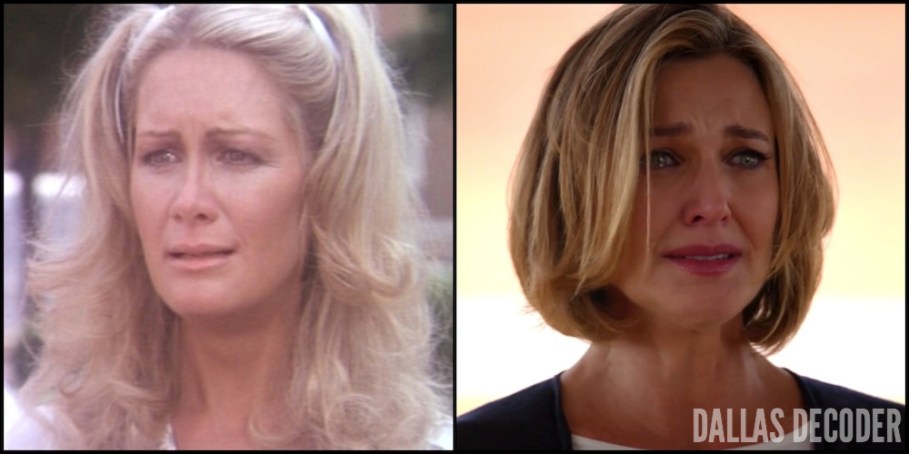
When Emma began popping pills and chasing boys on TNT’s “Dallas,” a lot of fans were reminded of Lucy’s antics on the original show. The two women share at least one more similarity: Both have strained relations with their long-lost mamas.

In the 1979 episode “Secrets,” Valene goes to Lucy’s college campus and approaches her daughter, one year after J.R. forced Val to flee Southfork without saying goodbye. At the time, J.R. lied and told Lucy that Val took off after demanding money from him, so when Lucy sees her mother again in “Secrets,” she treats her coldly and walks away. Val doesn’t give up and tries to speak to Lucy again later that day, explaining that J.R.’s extortion claim was untrue. Lucy doesn’t want to hear it. “Don’t bother, lady,” she says.

Thirty-four years later, when Ann learns her long-missing daughter Emma is living in Dallas, she approaches Emma at the stable where she’s riding her horse. This reunion turns out no better than Val and Lucy’s. It seems Ann’s ex-husband Harris kidnapped Emma and raised her to believe Ann was evil — just like J.R. snatched baby Lucy and brought her to Southfork, where she grew up being fed lies about Val. In “Sins of the Father,” Ann tries to tell Emma her side of the story, but Emma doesn’t want to listen. “This is a waste of time, Ann,” she says.

Eventually, both daughters learn to forgive their drama mamas. Lucy’s icy demeanor melts when she sees Val stand up to J.R., just like Emma has a change of heart after she hears her mother defend herself against Harris’s lies during his shooting trial. Of course, poor Lucy ends up getting hurt again when she discovers her parents got remarried without bothering to tell her. Something tells me that’s one problem Emma will never encounter.


‘Don’t Bother, Lady’

Charlene Tilton, Dallas, Lucy Ewing, Secrets

Bothered

In “Secrets,” a third-season “Dallas” episode, Lucy (Charlene Tilton) finds Valene (Joan Van Ark) waiting for her in the college campus parking lot.

LUCY: Hi. You’re still here, Mama. I thought you’d have gotten your money and gone by now.

VAL: Lucy, I wrote to you and I explained that I did not take any money from J.R.

LUCY: Why should I believe that?

VAL: Because it’s true. But I know that I have got a lot more explaining to do to you.

LUCY: Don’t bother. It really doesn’t matter to me.

VAL: Honey, I know how you must feel.

LUCY: Oh, no, you don’t. You don’t know anything about me. [Turns away]

VAL: I know that I gave birth to you. And that I love you very much.

LUCY: You love me like you love my daddy? You ran off and left him too.

VAL: No, I never did. We just never had a chance.

LUCY: [Begins to cry] We had a chance, all right. We were all together at the ranch. We could’ve made it. Except it got too rough for you two, so you both ran off. That’s funny. It was too rough for you, but it was all right to leave me there.

VAL: Well, that was your home and you were brought up there. I knew that Miss Ellie would take care of you. They love you.

LUCY: Oh, yeah. According to you, everybody loves me. Why don’t I feel like they do? Why do I feel like I don’t belong to anybody?

VAL: [Tries to touch Lucy, who smacks away her hand] Darling, listen, I know it’s hard for you to understand, but you do belong to your daddy and me.

LUCY: I’ll tell you something, lady. I hurt sometimes, but I can handle that. What I can’t handle is you coming back again and making me think I really do have a mama. And then one day, finding out you’re gone again. So don’t bother, lady. Don’t even try.

VAL: [Crying] Oh, my baby.


‘This is a Waste of Time, Ann’

Dallas, Emma Bell, Emma Brown Ryland, Sins of the Father, TNT

Wasted

In “Sins of the Father,” a second-season “Dallas” episode, Ann and Emma (Brenda Strong, Emma Bell) sit across from each other at a police station conference table.

ANN: I know you’re angry. But I just wanted to talk to you.

EMMA: Using the police to get me here wasn’t very helpful.

ANN: The police brought you here because your father kidnapped you.

EMMA: Rescued me.

ANN: [Sighs] I understand you’ve probably spent your whole life hating me.

EMMA: Never gave you much thought, actually.

ANN: Emma, when you were born, there was a lot going on.

EMMA: This is a waste of time, Ann.

ANN: Your father’s had your whole life to convince you I’m a monster. Please, just give me five minutes to try and prove I’m not. What did he tell you about me?

EMMA: He told me you were a drug-addicted, depressed, hopeless mess.

ANN: I was. When you were born, I was lost and confused and hated myself because your father made me believe I should.

EMMA: Don’t blame him for your failings.

ANN: I took tranquilizers to try and push away that pain. To stay in the marriage, to be a good mother. But it made things worse. And I started falling down this dark hole, farther and farther until I lost sight of who I was, and what really mattered: You. I’m so sorry. When I lost you, I died inside.

EMMA: You seem to have recovered quite nicely.

ANN: [Sighs, pulls a keepsake box from her bag, sits it on the table] I spent years looking for you. Praying that you were still alive. [Emma opens the box, examines the mementos and newspaper clippings inside] I never stopped loving you, Emma.

EMMA: [Closes the box] I think you’ve confused love with guilt. I’ve lived a great life with my father. If you care about me at all, you’ll leave me alone. And you’ll stop what you’re trying to do to him. [Pushes the box across the table toward Ann] Now I’d really appreciate it if you’d leave.

What do you think of Valene and Ann’s attempts to reconcile with their daughters? Share your comments below and read more “Dallas Parallels.”

The Best & Worst of Dallas: Season 6

There’s lots to love and little to loathe about “Dallas’s” sixth season.

Performances

Dallas, Linda Gray, Sue Ellen Ewing

Oh, darlin’

Every cast member shines during Season 6, but Linda Gray’s performance during Sue Ellen’s alcoholic spiral makes her first among equals. Sue Ellen doesn’t just lose her self-respect; she comes close to losing her life when she drives drunk and crashes J.R.’s car. What impresses me most about Gray is how she keeps the audience rooting for Sue Ellen, even when she makes mistakes. What an amazing performance.

Bobby Ewing, Dallas, Patrick Duffy

Still our hero

Give it up for Patrick Duffy too. If you were surprised to see Bobby unleash his inner junkyard dog on the most recent season of TNT’s “Dallas,” then check out Season 6 of the original series, which marks the first time the character reveals his ferocious side. The “Dallas” writers take Bobby to a very dark place during the yearlong contest for Ewing Oil, but Duffy makes sure we never forget he’s still the Bobby Ewing we know and love. Bravo.

Storylines

Speaking of J.R. and Bobby’s contest: It’s too early for me to call this “Dallas’s” all-time greatest plot — I still have eight more seasons to revisit — but it’s hard to imagine anything surpassing the battle royale between the brothers Ewing. The reason the storyline succeeds isn’t the premise, which — let’s face it — is more than a little implausible. (A major corporation splits in half for a year to determine which of its top two executives should be in charge?) No, this arc works because it involves every character and showcases their complexities. Is it surprising to see Bobby play dirty or to witness J.R. wracked with guilt at season’s end? Sure, yet it never feels out of character for them. “Dallas” is always at its best when the characters, not the writers, drive the narrative, and that’s never been truer than it is here.

Episodes

Dallas, J.R. Ewing, Larry Hagman, Linda Gray, Sue Ellen Ewing

Power hour

This is the first season that I’ve reviewed in which none of the episodes received anything less than a “B” grade. For the record: Year 6 consists of 28 hours, and I handed out nine “B’s,” 16 “A’s” and three (!) “A+’s.” My favorite is “Penultimate,” a powerful hour of television that deals with the fallout from Sue Ellen’s accident and leaves us wondering: What’s more destructive — her addiction to booze or her addiction to J.R.?

Scenes

The final moments in “Tangled Web” never fail to give me chills. We’re with Sue Ellen every step of the way when she walks across Holly’s driveway, enters the house and sees her in bed with J.R. (Trivia: My readers tell me when this scene was broadcast in 1983, it was scored, but for whatever reason the music doesn’t appear on the DVD. I’d love to see the original version, but I must say: The lonely sounds of Sue Ellen’s heels clicking and clacking help make this scene so effective.) More great moments: Cliff comes to terms with his guilt over Rebecca’s death (this is Ken Kercheval at his most brilliant) and three scenes that showcase the incomparable Barbara Bel Geddes — Miss Ellie predicts the future for Sue Ellen, eulogizes Jock a the Oil Baron’s Ball and testifies at the hearing to overturn his will.

Hands down, my least favorite scene: In “A Ewing is a Ewing,” J.R. comes on to Holly and she tells him “no,” but he has sex with her anyway. Was this really necessary to demonstrate J.R.’s villainy?

Supporting Players

Dallas, Mickey Trotter, Timothy Patrick Murphy

Transformer

Do you despise cocky Mickey Trotter when he arrives at the beginning of Season 6? Are you surprised when he tries to save Sue Ellen at the end of the year? If you answer “yes” to the first question and “no” to the second, then credit Timothy Patrick Murphy, who does a nice job turning Mickey from a punk into a prince over the course of the season. Also, thanks to Murphy, Lucy finally gets a leading man worthy of Charlene Tilton’s charm.

Props

Jock’s portrait is introduced during “Dallas’s” fifth season, but the show makes magnificent use of it throughout Season 6. Jock looms in the background of so many crucial scenes, including the will reading, which marks one of the few occasions when all of the Ewings are together in one room (even Gary’s there!), and J.R. and Ray’s fistfight in “Ewing Inferno,” when all hell breaks loose — literally. TNT, take note: This is how you use a portrait to help keep alive a character’s memory.

Costumes

Dallas, Donna Krebbs, Susan Howard

Red hat mama

I love Pam’s upswept hairdo and western dress in “Barbecue Three,” her print skirt in “Brothers and Sisters” and Afton’s navy blouse/white skirt combo in “The Ewing Blues,” but my favorite fashion statement is made by Susan Howard, who sports a striking red hat when Donna attends the inaugural meeting of the Texas Energy Commission (also “Barbecue Three”). Eat your heart out, Katherine Wentworth!

Quips

Throughout Season 6, Larry Hagman zings like no one else. Here’s J.R. to Holly, upon spotting her lounging around her pool with a shirtless stud: “Traveling with the intellectual set, I see.” To Mickey, after the young man announces he’s a Trotter, not a Krebbs: “Oh, well. I’m bound to sleep more soundly tonight knowing that.” To Katherine, upon hearing she has something to discuss with him: “Oh, don’t tell me. Not Cliff Barnes. I couldn’t handle that.” In the end, though, my favorite quip comes from Sue Ellen, who is aghast when J.R. criticizes Pam for giving “aid and comfort to the opposition” during the hearing to overturn Jock’s will. “Opposition?” Sue Ellen says. “J.R., that’s your mother.”

What do you love and loathe about “Dallas’s” sixth season? Share your comments below and read more “Best & Worst” reviews.

Critique: ‘Dallas’ Episode 130 — ‘Penultimate’

Barbara Bel Geddes, Dallas, Linda Gray, Miss Ellie Ewing, Penultimate, Sue Ellen Ewing

Mama’s here

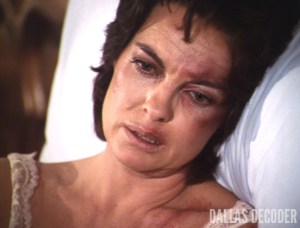
“Penultimate” is an hour of misery and pain, but it contains love too. The story begins where “Dallas’s” previous episode ends, when Sue Ellen drives drunk and crashes J.R.’s car. The accident leaves her with a broken arm and some scrapes and bruises, while passenger Mickey Trotter fares much worse: He slips into a coma after his spinal cord is injured. This leads to tense scenes, like the one where Lucy calls Sue Ellen a “lousy drunk” and blames her for the crash. Mostly, though, “Penultimate” depicts the Ewings and Krebbses as people who are willing to set aside old hurts and day-to-day grievances to help each other get through a crisis. It’s the kind of thing we routinely witness on this show, yet it never fails to move me.

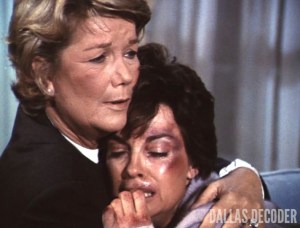
Howard Lakin’s smart script ensures Sue Ellen remains a sympathetic figure, even though it seems like she did indeed cause the accident. Lakin gives us a scene where a guilt-ridden Sue Ellen apologizes to Lucy and pleads for forgiveness, and even though Lucy refuses to listen, other characters don’t hesitate to show Sue Ellen compassion. The crucial moment comes in the first act, when a sore, stiff Sue Ellen comes home from the hospital and goes to her bedroom with Miss Ellie, who offers to help her change into a nightgown. When Sue Ellen begins to cry, Ellie takes her into her arms and holds her close. It’s a touching scene, and also a clever one. If Ellie is willing to forgive Sue Ellen, why shouldn’t we?

Of course, Linda Gray keeps the audience on Sue Ellen’s side too. Throughout “Penultimate,” Gray carries herself like a woman full of regret; we never doubt that Sue Ellen feels terrible about what she’s done. It doesn’t hurt that she looks awful. Sue Ellen’s face is purple and swollen, her arm is in a cast and in the first few scenes, her sweater is torn and stained with blood. How can you not feel bad for this woman? In the same spirit, how can you not admire Gray? Remember, “Penultimate” was made in an era when television audiences demanded gloss and glamour from their favorite actresses, so Gray’s willingness to be seen in such an unflattering light feels like an act of courage. (Other stars soon followed Gray’s lead. The year after “Penultimate” aired, Farrah Fawcett wore a black eye when she played a battered wife in the TV movie “The Burning Bed.”)

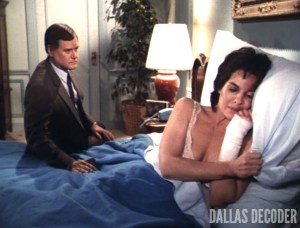
Gray’s most impressive performance in “Penultimate” comes in the final scene, when J.R. enters his bedroom late at night and finds Sue Ellen waiting up for him. She calmly asks why he remarried her if he had no intention of being faithful, and when he begins to speak, she cuts him off. “Stop it! Stop it! I don’t want to hear any more from you!” she shouts. But J.R. continues, telling Sue Ellen that he never meant to hurt her. “Believe me when I say that I love you. I truly love you,” he says. Larry Hagman’s delivery is sincere, but Gray is the one we can’t take our eyes off of. When J.R. professes his love, Gray turns away from Hagman and faces the camera. She’s silent, yet her expression tells us how tormented Sue Ellen feels at that moment. Despite the pain J.R. has caused her, is there any doubt she loves him too?

Cry, Cry Again

Charlene Tilton, Dallas, Lucy Ewing, Penultimate

Tracking her tears

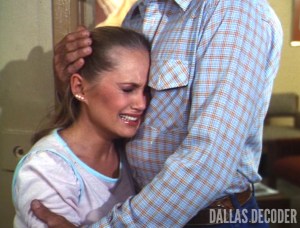
Charlene Tilton supplies “Penultimate” with its other emotional highpoints. After Lucy lashes out at Sue Ellen and calls her a drunk, she bursts into tears and collapses into Ray’s arms. Later, Lucy is with Ray, Donna and Aunt Lil when the doctor informs them Mickey will probably be paralyzed. Once again, Lucy weeps. Both scenes remind us how Tilton always rises to the occasion when she’s given good material, which happens too infrequently on “Dallas.” I also admire how Steve Kanaly makes us feel every ounce of Ray’s anger and frustration over the tragedy that has befallen Mickey, as well as the guilt consuming Ray over bringing his cousin to Texas in the first place. The other performer to watch in these scenes is Kate Reid, who doesn’t have a lot of dialogue, but who doesn’t need any. Her sad, solemn expression says it all.

Not all of the scenes in “Penultimate” are quite so agonizing. When J.R. goes to Holly’s house to confront her over her attempt to ruin his marriage, we expect J.R. to be full of rage. Instead, he plays it cool, politely offering to give up his share of Harwood Oil — if Holly pays him $20 million, that is. Holly balks, and so J.R. leaves her with a not-so-subtle threat. “Holly, you won a hand in a game of poker,” he says. “You’re seeing me in a mood that you’ll never see again. I strongly advise you to take advantage of it, because considering what it’ll cost if you don’t” — here, Hagman pauses — “twenty million dollars will be chickenfeed.”

Later, Bobby urges Holly not to give J.R. the money until after the contest for Ewing Oil ends. Frankly, of all the surprising moves Bobby makes during the sixth season, this one shocks me most. It’s one thing for Bobby to blackmail George Hicks, the crooked energy regulator, or to stage a sting against Walt Driscoll, J.R.’s accomplice in the illegal Cuban oil deal. But after all the suffering the battle for Ewing Oil has caused, Bobby is still willing to wheel and deal to win the contest? Maybe Pam is right. Maybe her husband really has changed.

Hear the Trumpets

Dallas, Donna Krebbs, Ray Krebbs, Steve Kanaly, Susan Howard

Eye to eye

Like all great “Dallas” episodes, “Penultimate” is a creative achievement on multiple levels. Along with the strong performances and writing, Richard Lewis Warren’s underscore is essential to the episode’s success. In several scenes, a few piano keys give way to the mournful blaring of trumpets. It fits the somber mood perfectly, not that any of us should be surprised. Warren’s music never gets in the way of the storytelling but helps it along, which is why he’s one of my favorite “Dallas” composers.

“Penultimate” also offers some of the sixth season’s niftiest camerawork. The episode opens at the site of the car accident, as an ambulance pulls away and a tow truck backs up to J.R.’s overturned Mercedes. Southfork looms in the distance, lit up in the black sky, until the camera slowly zooms in for a close-up. I also like how director Nick Havinga opens one scene with a tight shot of the Ewings’ liquor cart. In the background, Sue Ellen enters the room and gradually comes into focus as she approaches the booze and reaches for a bottle. Havinga also plays with our depth perception in a shot in the hospital where Kanaly stands in the foreground and exchanges dialogue with Susan Howard, whose position in the background makes Donna look like she’s a few feet shorter than Ray.

Lakin and Havinga also do a nice job keeping the audience in the dark about the extent of Sue Ellen and Mickey’s injuries when “Penultimate” begins. The first scene in the emergency room shows a medical team tending to an unseen patient. Amid the beeps and whirs of the machinery, one of the doctors drops references to irregular breathing patterns and a possible spinal injury. “Looks like there’s a bad fracture in the right leg,” a nurse announces. Says the doctor: “Yeah, we’ll worry about that later. Right now, let’s just try to keep this patient alive.” Moments later, we see J.R. escort a shaken Sue Ellen into a hospital corridor, and only then do we realize Mickey is the patient in critical condition.

This turns out to be the episode’s most suspenseful moment. The only other mystery presented here is the identity of the driver of the car that struck Sue Ellen and Mickey’s vehicle, which won’t be revealed until the next episode. Indeed, “Penultimate” serves mostly as a prelude to that installment — not that I’m complaining. The season’s plot lines may not advance much during this hour, but the characters do. Isn’t that more interesting anyway?

Grade: A+

_______________________________________________________________________________________________________________________________________________

Dallas, Mickey Trotter, Timothy Patrick Murphy

Critical condition

‘PENULTIMATE’

Season 6, Episode 27

Airdate: April 29, 1983

Audience: 19 million homes, ranking 3rd in the weekly ratings

Writer: Howard Lakin

Director: Nick Havinga

Synopsis: While Mickey lies in a coma, doctors determine he’ll likely be paralyzed. Sheriff Washburn tells J.R. that Sue Ellen will be charged with manslaughter if Mickey dies. Ray urges Washburn to find the driver of the car that struck Sue Ellen and Mickey’s vehicle. After J.R. invites Holly to buy him out of her company, Bobby urges her to delay her payment to him until the contest for Ewing Oil is over. Cliff pressures Pam not to give Bobby the drill bit.

Cast: John Beck (Mark Graison), Barbara Bel Geddes (Miss Ellie Ewing), Lois Chiles (Holly Harwood), Roseanna Christiansen (Teresa), Barry Corbin (Sheriff Fenton Washburn), Michael Cornelison (Dr. Snow), Patrick Duffy (Bobby Ewing), Eric Farlow (Christopher Ewing), Linda Gray (Sue Ellen Ewing), Larry Hagman (J.R. Ewing), Alice Hirson (Mavis Anderson), Susan Howard (Donna Krebbs), Steve Kanaly (Ray Krebbs), Howard Keel (Clayton Farlow), Ken Kercheval (Cliff Barnes), Joe Maross (Dr. Blakely), Timothy Patrick Murphy (Micheky Trotter), Victoria Principal (Pam Ewing), Kate Reid (Lil Trotter), Danone Simpson (Kendall), Charlene Tilton (Lucy Ewing), Deborah Tranelli (Phyllis), Morgan Woodward (Punk Anderson), John Zaremba (Dr. Harlan Danvers)

“Penultimate” is available on DVD and at Amazon.com and iTunes. Watch the episode and share your comments below.

Critique: ‘Dallas’ Episode 125 — ‘The Sting’

Ben Piazza, Dallas, Ray Krebbs, Steve Kanaly, Sting

Stung

Which Ewing brother do you root for in “The Sting”? I cheer for Bobby at the top of the hour, when he thwarts J.R.’s illegal sale of 100 million barrels of oil to Cuba. It’s nice to see Bobby finally outfox J.R., who’s been riding high in their fight for control of Ewing Oil. Of course, once Bobby secures his victory, my sympathies shift to J.R. With his plot foiled, J.R. finds himself at the mercy of Garcia, the unscrupulous middleman in the Cuban deal. How can you not feel for sorry for the old boy as he squirms under Garcia’s thumb?

The effortless switching in the role of underdog makes “The Sting” an especially clever episode of “Dallas.” I also love the terrific opening sequence, which picks up where “Caribbean Connection,” the previous hour, left off. J.R.’s crony Walt Driscoll rushes out of his motel room, cash-stuffed briefcase in hand, as he heads to the airport to complete the Cuban deal. As he pulls out of the parking lot in his big Oldsmobile, Ray’s pickup truck suddenly strikes it. With Driscoll distracted, Bobby emerges from the crowd of sidewalk gawkers and switches the briefcase with the replica he commissioned in “Caribbean Connection.” Bobby then follows Driscoll to the airport, where he watches as security guards discover a stash of guns in the briefcase and haul him away.

These are fun, exciting scenes. Jerrold Immel’s tingling underscore, which is also heard when Southfork goes up in flames in the sixth-season finale, lends the sequence a sense of mystery. The music fits the action beautifully since we don’t know what Bobby’s up to until the guns are finally revealed. The establishing shots are crucial too. Imagine if Larry Elikann, the director, and Fred W. Berger, the editor, hadn’t shown Driscoll placing his briefcase on the passenger seat when he gets into his car. We’d have no idea what Bobby is doing when he reaches inside the car and switches the real case with the fake one. I also like how “The Sting” plays on the audience’s familiarity with “Dallas.” The moment we see a white pickup’s fender enter the frame, we know instantly whose truck this is.

The other keys to the success of this sequence: Ben Piazza and Steve Kanaly. Piazza, one of the great “Dallas” guest stars, is believably bewildered as the hapless, in-over-his-head Driscoll. I kind of feel bad for the guy when Ray rams his Oldsmobile, and again when those hulking security guards find the guns in his case. Kanaly, in the meantime, is a hoot. What a kick to see Ray pretend to be the kind of straight-and-narrow, by-the-book yokel who insists on flagging down a cop after a fender bender. Kanaly looks like he’s having a ball here, as well as in two other scenes. In the first, a very drunk Ray and Bobby stumble home after celebrating their coup. Later, Ray confronts J.R. and confirms his role in the sting against him. The scene reminds us that this is Ray’s victory as much as it is Bobby’s.

Speaking of J.R.: “The Sting” showcases Larry Hagman too. He gives some of his best performances when J.R.’s back is to the wall, as this episode demonstrates J.R. is flustered when he finds Driscoll behind bars, enraged when he discovers Bobby undermined him and desperate when he tries to salvage the deal with Garcia. David Paulsen’s script also gives Hagman one great line after another. I love when J.R. refuses to bail out Driscoll, telling him, “I wouldn’t give you the dust off my car.” Later, after he’s ended another frustrating phone call with Garcia, J.R. looks up from his desk and sees Holly striding into his office. “When it rains, it pours,” he says, rubbing his temple. Hagman delivers another great line when Katherine drops by Ewing Oil and tells J.R. the two of them have something to talk about. “Oh, don’t tell me. Not Cliff Barnes. I couldn’t handle that,” he says.
“The Sting” also does a nice job exploring Bobby and Pam’s increasingly awkward separation. Miss Ellie and Clayton bump into Pam while she’s dining with Mark in a restaurant, resulting in an uncomfortable moment for everyone. (In one of the show’s most amusing understatements, Ellie tells Clayton, “In many ways, Dallas is a very small place.”) Later, when Bobby arrives at Pam’s hotel room to pick up Christopher for the weekend, the topic of Pam’s date with Mark comes up. Katherine inserts herself into the conversation. “Bobby, it’s not the way it sounds. … Pam was just trying to help Cliff,” she says. This prompts Pam to snap, “Katherine, stop it! I don’t have anything to hide.”

“The Sting” is also remembered as the episode where Lucy finally tells Mickey she was once raped. Charlene Tilton delivers a tender, moving performance, and so does Timothy Patrick Murphy, who makes his character’s sweetness every bit as believable as the cockiness he exhibited when he joined the show. I also like the exchange where Lucy and Mickey share their first kiss. “Lucy, I never asked a girl if I could kiss her. I just always did it. I’m not real sure what to do right at this moment,” he says. Is there any doubt this is Lucy’s most charming romance?

The other highlight of “The Sting”: Elikann’s direction, which is much more artful than what we usually see on “Dallas.” In addition to his work in the opening sequence, I love when Elikann has Patrick Duffy and Hagman lock eyes and shout at each other in the scene where J.R. confronts Bobby. I also like how J.R.’s roll in the hay with Serena ends with him popping a bottle of champagne, and then the scene switches to a waiter popping a cork in the restaurant where Pam and Mark are dining. Interestingly, although Elikann directed several “Knots Landing” episodes and the “Dallas: The Early Years” TV movie, “The Sting” is the only “Dallas” episode he helmed. Perhaps an exchange between Hagman and “Dallas” creator David Jacobs holds a clue. Elikann’s name comes up in the audio commentary on the “Reunion, Part 2” DVD, which was recorded in 2004. Jacobs remembers the director being “very gruff” and tells Hagman that Elikann recently died. “Did he?” Hagman responds. “Good.” He was kidding … I think.

Grade: A

_______________________________________________________________________________________________________________________________________________

Charlene Tilton, Dallas, Lucy Ewing, Mickey Trotter, Timothy Patrick Murphy

Good romance

‘THE STING’

Season 6, Episode 22

Airdate: March 11, 1983

Audience: 23.1 million homes, ranking 1st in the weekly ratings

Writer: David Paulsen

Director: Larry Elikann

Synopsis: Bobby plants guns in Driscoll’s case, which leads to Driscoll’s arrest at the airport. Garcia, Driscoll’s contact in Puerto Rico, demands $10 million from J.R. to complete the Cuban oil deal. Holly vows revenge against J.R. when she discovers the deal is in jeopardy. Katherine offers to spy on Bobby for J.R. After telling him about her past, Lucy and Mickey make love. Pam and Mark’s deepening relationship angers Bobby.

Cast: Mary Armstrong (Louise), John Beck (Mark Graison), Barbara Bel Geddes (Miss Ellie Ewing), Stephanie Blackmore (Serena), Morgan Brittany (Katherine Wentworth), Lois Chiles (Holly Harwood), Roseanna Christiansen (Teresa), Henry Darrow (Garcia), Patrick Duffy (Bobby Ewing), Fern Fitzgerald (Marilee Stone), Linda Gray (Sue Ellen Ewing), Larry Hagman (J.R. Ewing), Susan Howard (Donna Krebbs), Steve Kanaly (Ray Krebbs), Howard Keel (Clayton Farlow), Ken Kercheval (Cliff Barnes), Audrey Landers (Afton Cooper), Timothy Patrick Murphy (Mickey Trotter), Russ Marin (Matthew), Ben Piazza (Walt Driscoll), Victoria Principal (Pam Ewing), John Reilly (Roy Ralston), Debbie Rennard (Sly), Paul Sorensen (Andy Bradley), Don Starr (Jordan Lee), Charlene Tilton (Lucy Ewing), Morgan Woodward (Punk Anderson)

“The Sting” is available on DVD and at Amazon.com and iTunes. Watch the episode and share your comments below.

Dallas Scene of the Day: ‘It’s Up to Me to Run This Family’

Barbara Bel Geddes, Charlene Tilton, Dallas, Lucy Ewing, Mama Dearest, Miss Ellie Ewing

Late show

In “Mama Dearest,” a sixth-season “Dallas” episode, Miss Ellie and Lucy (Barbara Bel Geddes, Charlene Tilton) sit at the Southfork kitchen table late at night.

LUCY: Was what J.R. did really so wrong?

ELLIE: It was wrong because of why he did it. Only to get the best of Bobby. And it hurt a lot of our friends at the same time.

LUCY: But it was a business deal, wasn’t it?

ELLIE: Yes, it was.

LUCY: You know how I feel about J.R. I mean, I hardly ever approve of anything he does.

ELLIE: Lucy, you’re very troubled about this. Why?

LUCY: Well, Granddaddy would have known that something like this could happen. He knew how J.R. operated. He had to take that into account when he decided that J.R. and Bobby should compete for Ewing Oil. Granddaddy was a very smart man. Especially when it came to business.

ELLIE: [Smiles] Yes, he was.

LUCY: Then how can you try and change what he wanted done?

ELLIE: It’s very difficult for me, Lucy.

LUCY: Well, then don’t do it. I’m sure it’s all turning out just the way Granddaddy expected it.

ELLIE: [Smiles] Oh, Lucy. I know how much you loved him. I did too. And I respected his judgment. I found him very wise. But even when he was alive, things didn’t always work out the way he planned. But then he was around to make the changes and straighten everything out. It’s gone wrong. And he’s not around to fix it.

LUCY: Grandma, are you sure you’re doing what’s right?

ELLIE: No. No, I’m not sure. I don’t want to go against your granddaddy’s wishes. But he’s not here anymore. And it’s up to me to run this family.

Lucy reaches across the table and touches Ellie’s arm.

Critique: ‘Dallas’ Episode 116 — ‘Mama Dearest’

Barbara Bel Geddes, Dallas, Mama Dearest, Miss Ellie Ewing

Mother knows best?

In “Mama Dearest,” Miss Ellie embarks on a quest to break Jock’s will and stop J.R. and Bobby’s contest for Ewing Oil. This causes the alliances within the family to shift, sometimes dramatically. J.R. and Bobby both oppose Ellie’s efforts, but when J.R. suggests the brothers join forces to defeat their mother, Bobby refuses. J.R. isn’t on his own, though: He gets support from Sue Ellen and Lucy, who believes the competition for the company should play out the way Jock intended. In the meantime, Pam rushes to support Ellie, which strains her marriage to Bobby.

Some of these reactions are surprising, but all of them make sense. I believe J.R. would be the first to recognize that it would be in his best interest to call a temporary truce with Bobby, just as I believe Bobby would be reluctant to join J.R. because he doesn’t trust him. Likewise, Pam’s allegiance to Ellie feels reasonable, although I suspect Pam’s response has more to do with her own opposition to the contest than it does with her concern for mother-in-law’s emotional wellbeing. More often than not, Pam is a pragmatist.

Lucy’s support for J.R. is unexpected, of course, but notice how she never lets him know she’s in his corner. Even if Lucy agrees with J.R., she isn’t going to give him the satisfaction of knowing it. Instead, Lucy confides her feelings in Ellie. This conversation occurs late at night, when Lucy sits with her grandmother at the Southfork kitchen table and gently questions her decision to break the will. Charlene Tilton, in a lovely performance, manages to convey Lucy’s almost-childlike belief in her grandfather’s infallibility, as well as her confidence that he knew what he was doing when he decided to pit J.R. and Bobby against each other. “I’m sure it’s all turning out just the way Granddaddy expected,” Lucy says. It’s nice to see this character growing up and becoming wiser.

Barbara Bel Geddes, the actress at the heart of “Mama Dearest,” is terrific in this exchange too. She avoids eye contact with Tilton, which helps convey Ellie’s uncertainty about whether her legal challenge is appropriate. Even at the end of the conversation, when Lucy reaches across the table and touches Ellie’s arm, Bel Geddes looks away. Contrast this with her performance in the scene where J.R. joins Ellie for breakfast on the Southfork patio. He tries to turn on the charm, but Mama doesn’t fall for it. “You get a good night’s sleep?” J.R. asks. Ellie looks at him and coolly says, “J.R., I don’t think you really care how I slept last night.” It’s a telling moment: Even if Ellie isn’t sure she’s doing the right thing, she’s smart enough to know she shouldn’t let J.R. know she has doubts. Mama probably would have made a good poker player.

Another great scene in “Mama Dearest” belongs to Patrick Duffy, who also directed this episode. After a frustrated Bobby takes off for a nighttime drive to collect his thoughts, he returns home and finds Pam waiting up for him. Bobby tells her that he’s upset over her decision to support Ellie, and then he explains why he wants the contest to continue. Duffy’s delivery is impassioned; he makes a fist and practically shakes it at the camera as he speaks. The words are as important as the delivery. Here’s his speech:

“Pam, you don’t understand what drove Jock Ewing. And I don’t think you really understand what drives me, either. When I was at the university, making the football team just wasn’t enough. I had to be varsity. I had to be captain. I had to make All-Southwest Conference — and I did! I did all of that. When you and I met, I wasn’t just a roadman for Ewing Oil. I was the best roadman for any oil company. Because that’s what Daddy expected. And that’s what I expect from myself. And J.R. and I are a lot alike because he’s not going to take second best either. You see, that’s why Daddy turned away from Gary. The Ewings must succeed, and Gary didn’t care about that, but Pam, J.R. and I do! Now, Daddy chose that the future of Ewing Oil is going to be in the hands of the son strong enough to run it. And that’s the way it’s gonna be.”

This monologue, besides being one of the highlights of Arthur Bernard Lewis’s script, helps demonstrate why the contest for Ewing Oil is such a satisfying storyline. Bobby is usually the yin to J.R.’s yang, but notice how he doesn’t mention J.R. until almost the end of the speech. This time, Bobby isn’t simply reacting to J.R.’s schemes. For the youngest Ewing son, the contest is as much about proving himself worthy of his father’s expectations as it is stopping J.R. from committing some heinous act. The scene reminds us that Bobby is a pretty interesting character in his own right.

Of course, J.R. remains the most fascinating figure of all in “Mama Dearest.” Throughout this episode, Larry Hagman gives us the feeling his character is genuinely frightened by the prospect that Ellie might stop the contest and sell Ewing Oil out from under him. Notice how J.R. loses his cool with Ellie at the beginning of the episode, after she’s announced her decision to challenge the will, and later when he realizes she’s getting advice from Clayton. (Is it a coincidence that the last time we saw J.R. this rattled occurred after he ran into Clayton and Rebecca at the French restaurant?) I also think it’s telling the lengths he’ll go to shore up support from the other Ewings. When J.R. is trying to persuade Bobby to join him in fighting their mother, he tells him, “We may battle a lot, but I just want you to remember: You’re my brother, and I love you.” The “l word” isn’t one J.R. uses a lot. Later, J.R. stands behind Sue Ellen as she gazes into a mirror and promises she’ll one day be mistress of Southfork and share his power. He really knows how to tell other people what they want to hear, doesn’t he?

J.R. also figures into “Mama Dearest’s” funniest scene, when he arrives at Holly’s home and discovers she runs Harwood Oil from her bedroom. (“You know as many oil deals are made in bedrooms as in boardrooms,” she purrs. The line would be a groaner if Lois Chiles didn’t look like she was having so much fun delivering it.) This is one of those “Dallas” moments that I recall watching as a kid, although my memory turned things around: I mistakenly remembered Holly keeping a bed in her office, not a desk in her bedroom. Either way, I can’t help but wonder why J.R. never followed suit. Imagine how much easier life would have been for ol’ J.R. if the Ewing Oil executive suite had come equipped with a mattress.

Grade: A

_______________________________________________________________________________________________________________________________________________

Bobby Ewing, Dallas, Mama Dearest, Patrick Duffy

Rising son?

‘MAMA DEAREST’

Season 6, Episode 13

Airdate: December 31, 1982

Audience: 15.2 million homes, ranking 24th in the weekly ratings

Writer: Arthur Bernard Lewis

Director: Patrick Duffy

Synopsis: Miss Ellie asks lawyer Brooks Oliver to help her break Jock’s will. Pam sides with Ellie, straining her marriage to Bobby. J.R. orders Holly to cancel her military contracts so she can refine his crude. Donna urges her fellow energy commissioners to not restore J.R.’s variance to pump excess oil. Bobby pressures the cartel to uncap the Wellington property so he can compete with J.R. Cliff buys a townhouse.

Cast: Barbara Bel Geddes (Miss Ellie Ewing), Paul Carr (Ted Prince), Lois Chiles (Holly Harwood), Karlene Crockett (Muriel Gillis), Patrick Duffy (Bobby Ewing), Bobbie Ferguson (Terri), Linda Gray (Sue Ellen Ewing), Larry Hagman (J.R. Ewing), Susan Howard (Donna Krebbs), Steve Kanaly (Ray Krebbs), Howard Keel (Clayton Farlow), Ken Kercheval (Cliff Barnes), Audrey Landers (Afton Cooper), James Karen (Elton Lawrence), Julio Medina (Henry Figueroa), Donald Moffat (Brooks Oliver), Timothy Patrick Murphy (Mickey Trotter), George O. Petrie (Harv Smithfield), Robert Pinkerton (Elliot), Priscilla Pointer (Rebecca Wentworth), Victoria Principal (Pam Ewing), Debbie Rennard (Sly), Danone Simpson (Kendall), Arlen Dean Snyder (George Hicks), Paul Sorensen (Andy Bradley), Joan Staley (Ms. Stockwood), Don Starr (Jordan Lee), Charlene Tilton (Lucy Ewing), Deborah Tranelli (Phyllis), Morgan Woodward (Punk Anderson)

“Mama Dearest” is available on DVD and at Amazon.com and iTunes. Watch the episode and share your comments below.

Critique: ‘Dallas’ Episode 115 — ‘Barbecue Three’

Barbecue Three, Dallas, J.R. Ewing, Larry Hagman

Mr. Right

In “Barbecue Three,” J.R. finally reveals his plan to win the contest for Ewing Oil: He begins flooding the market with cut-rate gasoline, hoping to drive up his half of the company’s profits. This ignites a firestorm within the cartel, prompting Cliff and a band of angry oilmen to come to the annual Southfork barbecue and demand J.R. stop lowering prices. The Ewings don’t like what J.R.’s doing either, but to everyone’s surprise, they close ranks around him when the confrontation with the cartel threatens to turn violent. “If you want to get to J.R., you’re going to have to come through us,” Bobby tells the group.

Like Ellie’s defense of J.R. in the fifth-season classic “Waterloo at Southfork,” this is another example of the Ewings circling the wagons against outsiders, one of “Dallas’s” hallmarks. There’s another reason this scene is satisfying: For once, J.R. isn’t wrong. Sure, he pulled some dirty tricks to get his hands on the crude he needed to produce all that cheap gas, but the cartel has no right to complain about it. J.R. is selling his product at a lower price than his competitors. Who are they to tell him to stop? (On another note: Why doesn’t Marilee Stone join her fellow cartel members in confronting J.R.? Surely it isn’t because she’s a woman. If you ask me, Marilee is much more intimidating than mild-mannered Jordan Lee, who stands alongside Cliff in this scene.)

To be fair, the other characters’ objections to J.R.’s scheme feel a little more justified than the cartel’s. Before the barbecue, Bobby complains J.R. will show “huge short-term profits and deplete our reserves,” which seems like a reasonable concern. Meanwhile, Donna, now a member of the Texas Energy Commission, becomes irritated when her fellow regulators backtrack on their opposition to J.R. As Donna explains to Punk Anderson, “Some of the members of the commission have political ambitions. They’re not about to vote against lower gasoline prices, even if it means conserving our oil reserves.” Fair enough, although the comment feels a little hypocritical coming from the widow of a governor and the stepmother of a senator.

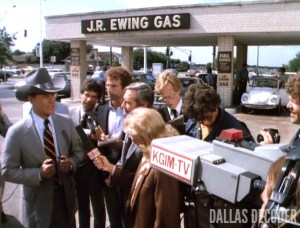
Indeed, Arthur Bernard Lewis’s script covers so many different reactions to J.R.’s cheap gas gambit — his family, his competitors in the cartel and the politicians all weigh it —“Barbecue Three” feel like a lesson in capitalism. Lewis even manages to reflect the consumers’ point of view, albeit subtly. J.R. announces his cut-rate gas plan at the opening of the first J.R. Ewing-branded gas station, where we see a couple of attendants lowering the per-gallon price from $1.21 to 89 cents. Later, the TV news coverage shows long lines of motorists waiting to fill up. There’s also a scene where Sly, J.R.’s secretary, tells her boss she thinks what he’s doing is “terrific” and hopes he can “keep it up.” (Seeing Deborah Rennard deliver this line, I couldn’t help but imagine Sly’s everyday working-class drudgeries: fighting traffic during morning rush hour, standing in line at the bank to deposit her paycheck, shopping for bargains at The Store.)

“Barbecue Three” also delivers two Lucy/Mickey scenes that showcase the nice chemistry between Charlene Tilton and Timothy Patrick Murphy. In the first, Mickey asks Lucy on a date, only to be introduced to her cold shoulder. Later, at the barbecue, he tries again to charm her and begins to realize her snobbish demeanor masks deeper problems. Patrick Duffy also has several good moments in this episode, including a monologue in which Bobby promises Pam he won’t lose the fight for Ewing Oil: “Daddy taught me a lot of tricks in my early days with the company. Things that I hated doing. But I learned. And I learned real good. And I can get right down in the mud if I have to.” It’s a nice reminder that Bobby’s recent discovery of his inner junkyard dog on TNT’s “Dallas” has precedence.

I also appreciate the details in “Barbecue Three.” The scene leading up to the first Texas Energy Commission meeting is expertly executed. Director Leonard Katzman shows us Ray and Donna (looking chic in her red hat) arriving at the municipal building and being greeted by a throng of news reporters, which helps lend the moment a sense of drama and suspense. You get the feeling something big is about to happen, a notion that’s reinforced by the sight of so many familiar oil industry leaders in the audience. And even though the “Dallas” producers actually make us sit through the commission members reciting the pledge of allegiance, it really doesn’t slow down the momentum. Later, when J.R. is planning his press conference, I like his brief exchange with his public relations chief. Sometimes you get the feeling Ewing Oil has no other employees besides the people who work in J.R. and Bobby’s executive suite, so it’s nice to see the show acknowledge that the Ewing brothers don’t do everything themselves.

There are a couple of nice touches during the barbecue sequences too. Debra Lynn Rogers, who played Toni, the woman Ray flirted with during the previous season’s “Barbecue Two,” plays the role again in this episode, except now she’s dancing with Mickey. Meanwhile, Peyton E. Park, who played Larry, the Ewings’ caterer in “Barbecue Two,” reprises the role here. In “Barbecue Three,” we also meet a woman who appears to be Jordan’s wife. He introduces her as Evelyn, although in the third-season episode “Paternity Suit,” Jordan seemed to refer to his spouse as “Sara.” Is this a continuity error, or are they two different women? If it’s the latter, I have to wonder: Between Sara, Kristin and now Evelyn, is Jordan trying to give J.R. a run for his money as “Dallas’s” biggest lothario?

Grade: A

_______________________________________________________________________________________________________________________________________________

Barbecue Three, Dallas, J.R. Ewing, Larry Hagman

Gasman cometh

‘BARBECUE THREE’

Season 6, Episode 12

Airdate: December 17, 1982

Audience: 21.8 million homes, ranking 1st in the weekly ratings

Writer: Arthur Bernard Lewis

Director: Leonard Katzman

Synopsis: The Texas Energy Commission revokes J.R.’s variance but faces public backlash when he opens a chain of popular cut-rate gas stations. Holly asks Bobby to help her get J.R. out of her company. Mickey realizes Lucy is troubled. After angry oilmen confront J.R. at the Ewing Barbecue, Miss Ellie vows to go to court to break Jock’s will and sell Ewing Oil.

Cast: E.J. André (Eugene Bullock), Barbara Bel Geddes (Miss Ellie Ewing), Lois Chiles (Holly Harwood), Patrick Duffy (Bobby Ewing), Ken Farmer (oilman), Fern Fitzgerald (Marilee Stone), Linda Gray (Sue Ellen Ewing), Larry Hagman (J.R. Ewing), Alice Hirson (Mavis Anderson), Susan Howard (Donna Krebbs), Steve Kanaly (Ray Krebbs), James Karen (Elton Lawrence), Howard Keel (Clayton Farlow), Ken Kercheval (Cliff Barnes), Audrey Landers (Afton Cooper), Julio Medina (Henry Figueroa), Peyton E. Park (Larry), Timothy Patrick Murphy (Mickey Trotter), Priscilla Pointer (Rebecca Wentworth), Victoria Principal (Pam Ewing), Debbie Rennard (Sly), Debra Lynn Rogers (Toni), Kirk Scott (Buchanan), Danone Simpson (Kendall), Arlen Dean Snyder (George Hicks), Don Starr (Jordan Lee), Robert Swick (Ewing Oil employee), Charlene Tilton (Lucy Ewing), Deborah Tranelli (Phyllis), Morgan Woodward (Punk Anderson)

“Barbecue Three” is available on DVD and at Amazon.com and iTunes. Watch the episode and share your comments below.

Let’s Party Tonight on #DallasChat

Bobby Ewing, Charlene Tilton, Dallas, Lucy Ewing, Patrick Duffy, Ray Krebbs, Steve Kanaly

Party people

I’ll host Dallas Decoder’s next #DallasChat on Twitter on Monday, July 1, from 9 to 10 p.m. Eastern time. Our theme: “Parties, People, Places.”

I’ll tweet a question every few minutes. Each question will be numbered and include the hashtag #DallasChat, so your responses should do the same. A sample exchange:

Q1. On the original #Dallas, which tradition did you prefer: the Oil Baron’s Ball or the Ewing Barbecue? #DallasChat

A1. Neither! I preferred the Ewing Rodeo. Love them cowboys. #DallasChat

Feel free to respond to what other people are saying and to engage in “side conversations” of your own.

Two tips:

• During the chat, enter #DallasChat in Twitter’s search field. This will help you watch the search results so you can follow the conversation. Click “All” to see all the related tweets.

• Don’t forget to include the hashtag #DallasChat in each tweet you send so others can see your contributions to the conversation.

I look forward to hearing your thoughts. See you tonight!