Critique: ‘Dallas’ Episode 108 — ‘Jock’s Will’

Bobby Ewing, Dallas, Jock's Will, J.R. Ewing, Larry Hagman, Patrick Duffy

Let the games begin

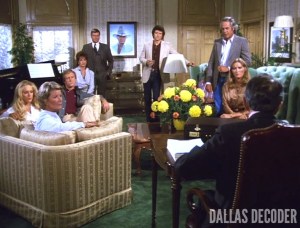
At the end of “Jock’s Will,” the Ewings gather in the Southfork living room to hear Harv Smithfield read the family patriarch’s last will and testament. Everyone is present — even Gary, who has flown in from “Knots Landing” for the occasion. The scene is tense, dramatic and historic. Besides being one of the few times we see almost all of the original cast members in the same place at the same time, this also marks the beginning of “Dallas’s” greatest storyline: J.R. and Bobby’s epic battle for control of Ewing Oil.

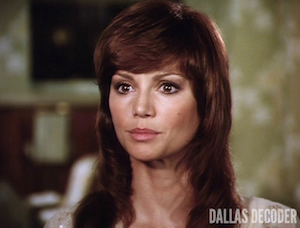
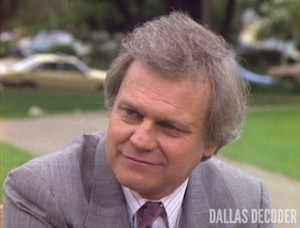
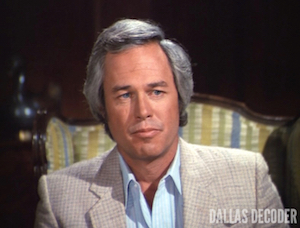
The scene, which lasts about seven minutes, is also a showcase for Michael Preece, one of the original “Dallas’s” most skilled directors. He begins with a wide shot of the actors positioned in front of George O. Petrie, who sits at a desk that seems to have magically appeared in the living room for this scene. (I suppose the desk is like the Ewings’ television set, which only pops up when the plot calls for someone in the family to watch it.) Only four actors here have dialogue: Barbara Bel Geddes, Larry Hagman, Patrick Duffy and Petrie, who delivers almost 700 words, far more than any of the others. Even though the rest of the cast is silent, we never question what their characters are thinking, thanks to Preece’s reaction shots. When Harv announces Gary’s inheritance comes with strings attached, we see Ted Shackelford clench his jaw. Charlene Tilton’s eyes bulge when Lucy learns she’s become a multi-millionaire. Victoria Principal’s jaw drops when Pam realizes Bobby is going to have to fight J.R. for the company.

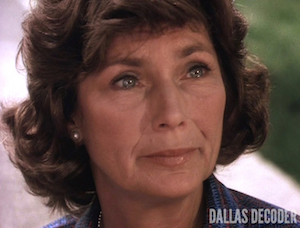
Bel Geddes gets the most dramatic response. When Ellie hears Jock’s line that Ewing Oil can only be run by “the man that wants it the most,” she furrows her brow and whispers gravely, “Oh, Jock. No.” I wonder: What are Preece and scriptwriter David Paulsen are trying to convey here? Is Ellie afraid Jock is about to return control of the company to J.R., whom she recently ousted from the president’s chair? Or does she sense — even before Harv announces it — that Jock is about to pit their sons against each other?

(In the same spirit, the announcement of the contest forces us to reconsider the end of “Where There’s a Will,” when J.R. sneaks a peek at Jock’s will. In that scene, J.R.’s reaction — “Thank you, Daddy, thank you” — leads us to believe Jock has left him the company. In “Jock’s Will,” the audience finally catches up and learns what J.R. did: that Jock wants him to compete with Bobby for control of Ewing Oil. So why does J.R. thank his daddy? Is he so confident he’ll beat Bobby that he considers the contest a mere formality? Or could it be that J.R. simply loves a good fight, and he’s thanking Jock for giving him one?)

As far as the contest itself: Some might see Jock’s decision to not choose a successor as a copout, but I believe it fits his character perfectly. Of course the old man would want his sons to duke it out to determine, once and for all, who is the better businessman. The contest also ends up producing some of the best storytelling seen on “Dallas,” as well as “Knots Landing.” (But don’t take my word for it: Hill Place, an always-interesting TV and movie blog, recently published a thorough examination of the long-range ramifications of Jock’s will on both shows.)

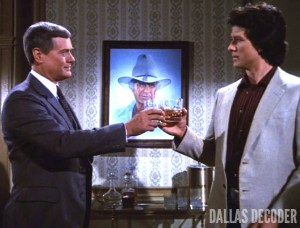
There’s also quite a bit of poignancy to the end of the will-reading scene. Jock’s final words are ominous: He declares that if J.R. or Bobby die before the contest is over, the remaining son will automatically take over the company. This prompts J.R. to turn to his younger brother, raise a glass of bourbon and say, “Well, Bobby, to your good health and very long life.” Three seasons later, after Duffy’s character had been killed off, J.R.’s toast seemed prescient. Now that Hagman is gone, the line feels bittersweet. I also can’t help but note the parallels between Jock’s will, which leads to the high point in their rivalry, and the letter that Bobby reads at the end of the new “Dallas’s” second season, which effectively brings their warring to an end.

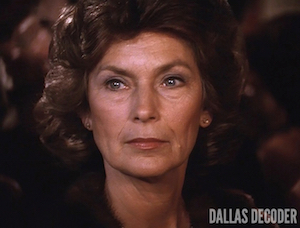
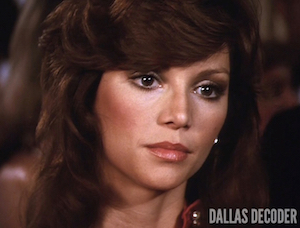
The other highlight of “Jock’s Will” is the courtroom scene where the Ewing patriarch is declared dead. As the judge announces his decision (“The judgment of this court is that John Ross Ewing Sr. died in a place unknown, in the jungles of South America”), Preece gives us a tight shot of each Ewing seated in the gallery: First Pam, then Bobby, J.R., Sue Ellen and finally Ellie. Everyone looks stricken — and none more so than Mama, whose tears flow freely — but don’t overlook Bruce Broughton’s mournful background music, which also lends this scene power.

Other good scenes in “Jock’s Will” include the sequences set in Kansas, where Ray’s struggle to connect with cocky Mickey strains his relationship with Donna. I also like J.R. and Sue Ellen’s night on the town (especially the nifty overhead shot that Preece gives us of Hagman and Linda Gray on the nightclub dance floor), as well as the scene where the couple sets the date for their second wedding. Or, to be more precise: J.R. sets the date by presenting Sue Ellen with an invitation to their first wedding, with the original date (February 15, 1970) scratched out and the new one (December 3, 1982) penciled in.

I can’t help but think there’s plenty of room on that invitation for a third wedding date. How sad that we never got to see it.

Grade: A

_______________________________________________________________________________________________________________________________________________
Barbara Bel Geddes, Bobby Ewing, Charlene Tilton, Dallas, Donna Krebbs, Gary Ewing, George O. Petrie, Harv Smithfield, J.R. Ewing, Linda Gray, Larry Hagman, Lucy Cooper, Miss Ellie Ewing, Patrick Duffy, Ray Krebbs, Steve Kanaly, Sue Ellen Ewing, Susan Howard, Ted Shackelfod

Gang’s all here

‘JOCK’S WILL’

Season 6, Episode 5

Airdate: October 29, 1982

Audience: 23.6 million homes, ranking 1st in the weekly ratings

Writer: David Paulsen

Director: Michael Preece

Synopsis: The Ewings have Jock declared legally dead and learn his will sets up a yearlong contest between J.R. and Bobby for control of Ewing Oil. J.R. and Sue Ellen set a wedding date. Ray and Donna bring Mickey home with them to Southfork. Pam urges Lucy to snap out of her depression.

Cast: Robert Ackerman (Wade Luce), Tyler Banks (John Ross Ewing), Barbara Bel Geddes (Miss Ellie Ewing), Roseanna Christiansen (Teresa), George Cooper (Lee Evans), Patrick Duffy (Bobby Ewing), Phyllis Flax (Mrs. Chambers), Linda Gray (Sue Ellen Ewing), Larry Hagman (J.R. Ewing), Alice Hirson (Mavis Anderson), Peter Hobbs (Judge Karns), Susan Howard (Donna Krebbs), Steve Kanaly (Ray Krebbs), Ken Kercheval (Cliff Barnes), Kenneth Kimmins (Thornton McLeish), Audrey Landers (Afton Cooper), Timothy Patrick Murphy (Mickey Trotter), George O. Petrie (Harv Smithfield), Priscilla Pointer (Rebecca Wentworth), Victoria Principal (Pam Ewing), Kate Reid (Lil Trotter), Dale Robertson (Frank Crutcher), Ted Shackelford (Gary Ewing), Don Starr (Jordan Lee), Charlene Tilton (Lucy Cooper), Morgan Woodward (Punk Anderson)

“Jock’s Will” is available on DVD and at Amazon.com and iTunes. Watch the episode and share your comments below.
The Dal-List: Classic ‘Dallas’s’ 10 Most Memorable Monologues

Ann Ewing, Brenda Strong, Dallas, TNT, Trial and Error

Testify!

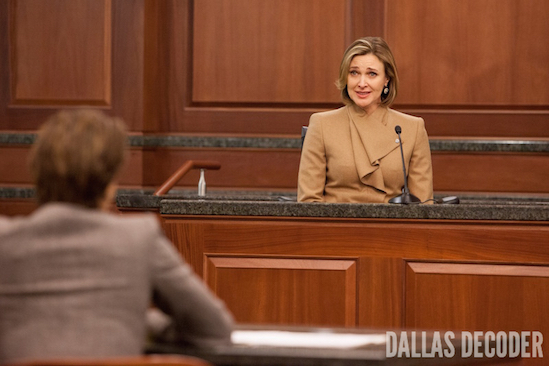
Few will forget the courtroom testimony that Ann (Brenda Strong) delivered at the end of “Trial and Error,” last week’s “Dallas” episode. Here’s a look at the Barneses’ and Ewings’ 10 most memorable monologues from the original series and its “Knots Landing” spinoff.

Barbara Bel Geddes, Dallas, Miss Ellie Ewing

Curses!

10. Miss Ellie’s lament. With the Ewing empire on the brink of collapse, Miss Ellie (Barbara Bel Geddes) goes to the site of Jock’s first strike and curses his memory. “Damn it all, Jock. You couldn’t have been an insurance salesman. Or a shoe salesman. No, you had to have oil in your blood. In your heart. And now … our sons are fighting for their lives.” It’s one of the better moments from one of the show’s better later episodes. (“Judgment Day”)

Dallas, Pam Ewing, Victoria Principal

She remembers mama

9. Pam’s discovery. Pam (Victoria Principal), believing Rebecca Wentworth is her long-lost mother, confronts the Houston matron in her opulent home. “I found you. You’re alive. And I’m so happy. I don’t know how to tell you how happy I am,” she says through tears. With every line, Principal seems to reveal a little more of herself, so much so that by the end of the speech, her lip quivers uncontrollably. Bravo. (“The Prodigal Mother”)

Dallas, Priscilla Pointer, Rebecca Barnes Wentworth

Runaway mom

8. Rebecca’s confession. After denying her identity, Rebecca (Priscilla Pointer) sits with Pam on a park bench and tells her the truth: She is, in fact, Pam’s mother. “I never divorced Digger,” Rebecca says as her voice begins to crack. “I was afraid that if I tried, he’d find me, and drag me back to that awful life. Pamela, I saw a chance for happiness, and I took it. Don’t blame me for that.” Pointer’s delivery is hauntingly beautiful. (“The Prodigal Mother”)

Dallas, Gary Ewing, Knots Landing, Ted Shackelford

No beach bum

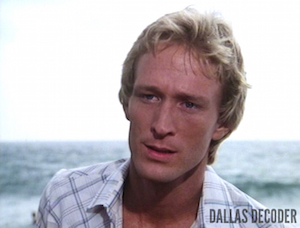
7. Gary’s mea culpa. Gary (Ted Shackelford) begs Lucy to stay in Knots Landing and apologizes for his past sins, telling her he’s trying hard to be a better man. “I’m not a loser anymore,” Gary says. At one point, he becomes tongue-tied, as if he can’t find the words to convey his guilt and regret. In the DVD commentary, Shackelford laughs and suggests he paused because he couldn’t remember his next line. No matter. It still works. (“Home is For Healing”)

Dallas, Linda Gray, Sue Ellen Ewing

Bye bye, love

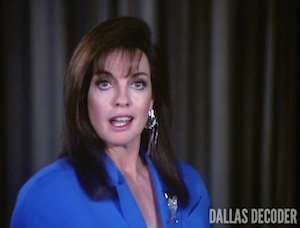
6. Sue Ellen’s kiss-off. In Linda Gray’s “Dallas” departure, Sue Ellen shows J.R. the scandalous movie she’s made about their marriage – and vows to screen it for the public only if he misbehaves. “If I feel that you’re not doing right by John Ross … or if I get up on the wrong side of the bed one morning. Or if I’m simply bored – then I’ll release the movie. And then, J.R., you will be the laughingstock of Texas.” Corny? Sure, but also mighty triumphant – and darn memorable. (“Reel Life”)

Cliff Barnes, Dallas, Ken Kercheval

Never too late

5. Cliff’s regret. My favorite Ken Kercheval scene: Cliff summons Miss Ellie to a park and apologizes for perpetuating his father’s grudge against the Ewings. “Digger was wrong, and I was wrong. If it’s not too late. I’d like to make peace. I’d like to ask you to forgive me,” Cliff says. In an interview with Dallas Decoder, Kercheval fondly recalled his friendship with Bel Geddes. What a shame these two pros didn’t get more screen time together. (“Brother Can You Spare a Child?”)

Dallas, Jim Davis, Jock Ewing

American dad

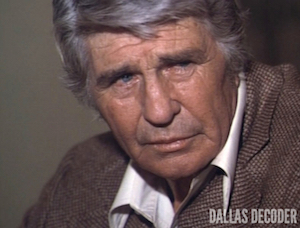
4. Jock’s plea. After Pam suffered her first heartbreaking miscarriage, Jock (Jim Davis) sat at her bedside and begged her and Bobby not to leave Southfork. “Us Ewings, we’re just not an easy family to live with, as you found out. We’ve had things our way for so long that maybe – well, maybe it got in the way of our being just people. I guess that you don’t have no reason to really care, but I want to keep my family together.” Who knew the old man could be so soft? (“Barbecue”)

Dallas, Ray Krebbs, Steve Kanaly

He knows father best

3. Ray’s tribute. Ray (Steve Kanaly) tries to make Miss Ellie accept Jock’s death by reminding her of his humanity. “He was a man, just like anybody else. He had friends. He had lots of friends. But he had enemies, too. He was human, ambitious. He knew that the oil game was rough, hardball all the way. But he wanted what was best for his wife, and for his sons. And he did what he thought was right.” The most honest eulogy Jock ever received. (“Acceptance”)

Dallas, J.R. Ewing, Larry Hagman

Honor thy daddy

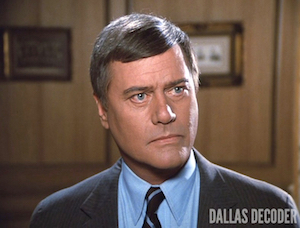
2. J.R.’s promise. J.R. (Larry Hagman), after slipping into a depression over Jock’s death, addresses a portrait of his father. “I’m back, Daddy. And nobody’s going to take Ewing Oil away from me. Or my son, or his son. I swear to you. By God, I’m going to make you proud of me.” The combination of Hagman’s conviction, scriptwriter David Paulsen’s dialogue and Bruce Broughton’s rousing score never fails to give me chills. (“The Phoenix”)

Bobby Ewing, Dallas, Patrick Duffy

Exit the hero

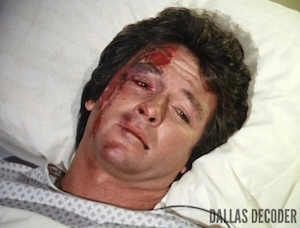
1. Bobby’s goodbye. As Bobby (Patrick Duffy) lay dying in his hospital bed, he bids his family farewell. To Miss Ellie: “Oh, Mama. I’m sorry.” To Pam: “All that wasted time. We should’ve been married.” He seems to be looking at J.R. when he delivers his last words: “Be a family. I love you so much.” Duffy has never been better, and when the monitor flatlines and Principal leaps? Fuhgeddaboudit! Yes, the scene’s emotional impact is diminished somewhat by the fact it turned out to be a dream. Still, does “Dallas” get better than this? (“Swan Song”)

Which “Dallas” monologues moved you most? Share your choices below and read more “Dal-Lists.”

Critique: ‘Dallas’ Episode 63 – ‘The Prodigal Mother’

The lady in Houston

The lady in Houston

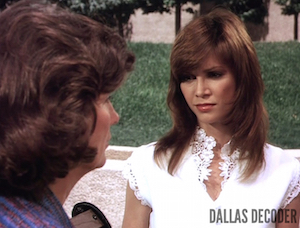
“The Prodigal Mother” reminds me of one of those “women’s pictures” from the 1950s. The episode marks the end of Pam’s search for her long-lost mother, and it’s as gorgeously soapy as anything Douglas Sirk directed. I love it.

More than anything, “The Prodigal Mother” is distinguished by two big, memorable monologues. This is the first script from David Paulsen, who became one of “Dallas’s” most prolific scribes, and boy, does he knock it out of the park with these speeches.

The first speech comes when Pam visits Rebecca Wentworth, the fabulously wealthy woman that Pam’s private detective has identified as Rebecca Barnes, whom Pam and Cliff believed died long ago. In the scene, Rebecca’s maid escorts Pam into the fern-festooned solarium inside her Houston mansion. Rebecca, draped in what appears to be sea-green satin, stands at the other end, leaning against a column. “Won’t you come in?” she says. It’s the kind of thing people only say in movies.

Victoria Principal steps forward and begins Pam’s speech, which is worth recalling it in its entirety:

I’ve rehearsed it a dozen times. Now the words just won’t come out. I know who you are. When I was a child, I used to think about you every day: My mother, who died and went to heaven. And I used to wonder what you were like. What you smelled like. Sometimes, I even thought I could remember. When Digger told us that you died, I could never really accept that. But when Digger was dying and told us about you and Hutch McKinney, I don’t exactly know why, but somehow I knew that you were still alive. And I’ve been searching for you since that day. Everybody told me I shouldn’t. That it was useless. My brother and my husband said that I’d just be more hurt when I found out that you were really dead. But I found you. You’re alive. And I’m so happy. I don’t know how to tell you how happy I am.

Principal’s delivery is really lovely. It feels very brave: With every line, the actress seems to reveal a little more of herself, so much so that by the end of the monologue, her lip looks like it’s quivering uncontrollably. Principal does this a lot during her crying scenes on “Dallas,” and while I sometimes find it a bit much, I don’t here. Here, it’s perfect.

Mama Said

The daughter in Dallas

The daughter in Dallas

“The Prodigal Mother’s” other big speech comes toward the end of the episode, when Rebecca takes Pam on a stroll through the park and and finally admits she is her mother. I remember watching this scene as a child and being struck by Rebecca’s line about how she “closed a door” in her mind. That line has always stuck with me.

Just as Principal shines during her monologue, Priscilla Pointer does a terrific job delivering hers. Like Barbara Bel Geddes, Pointer is a New York stage veteran who knows how to tone things down for the more intimate confines of television. Pointer’s mannerisms and expressions never feel anything less than natural. She will always be one of my favorite “Dallas” actresses.

I also love how the scene between Pam and Rebecca sounds. When it begins, it’s so quiet – almost eerily so. Aside from the dialogue, the only thing we hear are the women’s heels on the sidewalk and a few birds chirping in the distance. It’s as if the whole world has come to a standstill, and for these two characters, I suppose it has.

And even though Rebecca did an awful thing by abandoning her two small children, this scene makes it impossible for me to dislike her. For this, Paulsen deserves a lot of credit. His dialogue humanizes Rebecca, particularly when she explains why she never divorced Digger. “I was afraid that if I tried, he’d find me, and drag me back to that awful life,” she says. Based on what we know about bitter, miserable Digger, can we honestly blame her? Rebecca might not deserve our respect, but after this scene, she’s at least entitled to some of our sympathy.

Of course, the most haunting part of Pam and Rebecca’s exchange is how it foreshadows Pam’s own tragic character arc, which I hope TNT’s “Dallas” will someday resolve. Imagine seeing Principal sitting on a park bench with Jesse Metcalfe as Pam explains why she abandoned Christopher and Bobby, all those years ago. If done well, it would be even more powerful than what we witness in “The Prodigal Mother.”

Party Lines

The grand sweep

The grand sweep

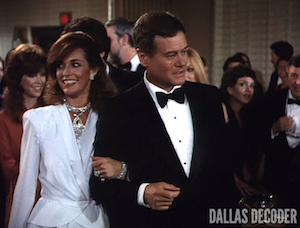
In another Sirkian masterstroke, before Rebecca comes clean to Pam, Paulsen’s script has the woman run into each in the most glamorous of settings: the black-tie fundraiser for gubernatorial candidate Dave Culver, which the Ewings attend. I love how Irving J. Moore directs the sequence, positioning his camera in the crowd as the Ewings arrive with a grand, all-smiles, glad-handing sweep through the ballroom.

Moore also allows the viewer to eavesdrop on the characters as they comment on the action around them. My favorite exchange begins when Sue Ellen slyly points out the guest of honor is “about as liberal a politician as the state of Texas allows. Ewing money usually never flows in that direction.” J.R.’s response that “Ewing money always flows in the direction of power” is perfect – and perfectly plausible.

“The Prodigal Mother’s” other great scene is its last. Pam, having just agreed to keep Rebecca’s identity secret, comes to Cliff’s apartment to tell him what she learned during her visit to Houston. As expected, Cliff, who believes Pam shouldn’t be digging up the past, doesn’t try to conceal his indifference.

“So, do we have a mother?” he asks.

Pam is silent. Cliff again asks what she learned during her trip.

Finally, she lies and tells him her detective was mistaken. Principal then delivers the episode’s final line, which is its best. “The lady in Houston,” she says, “was just a lady in Houston.”

Oh, that line gets me every time. What sacrifice! What noble suffering! What exquisite agony!

What a great episode.

Grade: A+

________________________________________________________________________________________________________________________________________________

Benchwarmers

Benchwarmers

‘THE PRODIGAL MOTHER’

Season 4, Episode 9

Airdate: January 2, 1981

Audience: 28.1 million homes, ranking 2nd in the weekly ratings

Writer: David Paulsen

Director: Irving J. Moore

Synopsis: Pam’s detective tracks down her mother: Rebecca Wentworth, the wife a wealthy Houston industrialist. Rebecca tearfully admits her real identity to Pam but says she doesn’t want her ill husband to know the truth. Lucy proposes to Mitch, who accepts.

Cast: Barbara Bel Geddes (Miss Ellie Ewing), Michael Bell (Les Crowley), Karlene Crockett (Muriel Gillis), Jim Davis (Jock Ewing), Patrick Duffy (Bobby Ewing), Tom Fuccello (Senator Dave Culver), Linda Gray (Sue Ellen Ewing), Larry Hagman (J.R. Ewing), Jerry Haynes (Pat Powers), Richard Herd (John Mackey), Susan Howard (Donna Culver), Steve Kanaly (Ray Krebbs), Ken Kercheval (Cliff Barnes), John Martin (Herbert Wentworth), Leigh McCloskey (Mitch Cooper), Priscilla Pointer (Rebecca Wentworth), Victoria Principal (Pam Ewing), Don Starr (Jordan Lee), Charlene Tilton (Lucy Ewing), Morgan Woodward (Punk Anderson)

“The Prodigal Mother” is available on DVD and at Amazon.com and iTunes. Watch the episode and share your comments below.