Critique: ‘Dallas’ Episode 162 — ‘Killer a Large’

Bobby Ewing, Dallas, Donna Culver Krebbs, Killer at Large, Patrick Duffy, Ray Krebbs, Steve Kanaly

Reflected glory

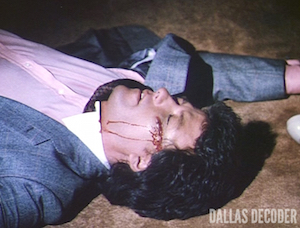
“Dallas’s” seventh season winds down with half the cast once again gunning for J.R. In the final scene, an unseen assailant enters the darkened Ewing Oil offices and fires three shots into the back of J.R.’s chair, except he isn’t sitting there — good-guy brother Bobby tumbles to the floor. It’s one of “Dallas’s” greatest fake-outs, establishing the template that TNT’s sequel series would later use to keep viewers on their toes.

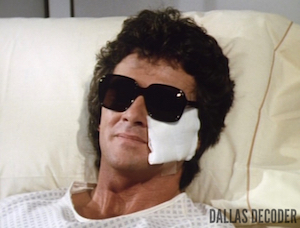
The problem is “Who Shot Bobby?” mimics “Who Shot J.R.?” too closely. What begins as a wink to “Dallas’s” most famous moment quickly becomes an imitation, and not a particularly good one. “Killer at Large,” the eighth-season opener, begins with Afton discovering Bobby moments after he’s shot. It’s not unlike the cleaning lady finding J.R. in 1980, although Afton’s reaction isn’t quite as campy. (No high-pitched shrieks and dropped feather dusters here.) We also see the Ewings assemble at Dallas Memorial Hospital to keep vigil for Bobby, just like they did with J.R., and both victims ultimately survive their shootings, but not without complications: J.R. is paralyzed while Bobby is blinded.

I’m sure fans appreciated the homage when “Killer at Large” debuted. It had been years since the “Who Shot J.R.?” episodes aired, so it was probably a kick to relive the mystery, this time with Bobby as the victim. Thirty years later, though, the remake comes off as uninspired. The producers don’t even bother to film Bobby being rushed out of the Ewing Oil lobby and into the waiting ambulance; they merely recycle the four-year-old footage of J.R. on the stretcher. Not helping matters: Most of the actors in “Killer at Large” look bored, and the mystery surrounding the shooter’s identity isn’t all that mysterious. Two characters — Peter and Edgar — are cleared by the end of the episode, leaving Sue Ellen, Cliff and Katherine as the remaining suspects. Was there any doubt in 1984 how that would turn out?

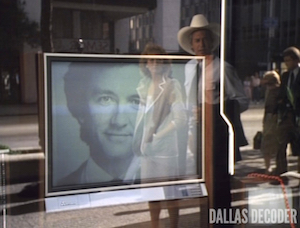
The episode isn’t a total wash. I like director Leonard Katzman’s shot of Ray and Donna spotting the TV news report about Bobby’s shooting while standing near a downtown department store window. Just think: Most of us probably watched this episode in 1984 on that kind of bulky TV set. It’s also fun to see Dennis Haysbert — the future President Palmer on “24” — cast in one of his first TV roles as Bobby’s doctor, although I’m more intrigued when Karen Radcliffe pops up as a nurse. Radcliffe will return to “Dallas” three years later as the nightingale who helps Pam run away after her car accident; should we assume she’s playing the same character in both appearances? I also like when Pam runs into Katherine in the hospital parking lot and refuses to allow her inside to see Bobby. It’s always nice to see Pam use her backbone to stand up for the people she cares about, not nag them.

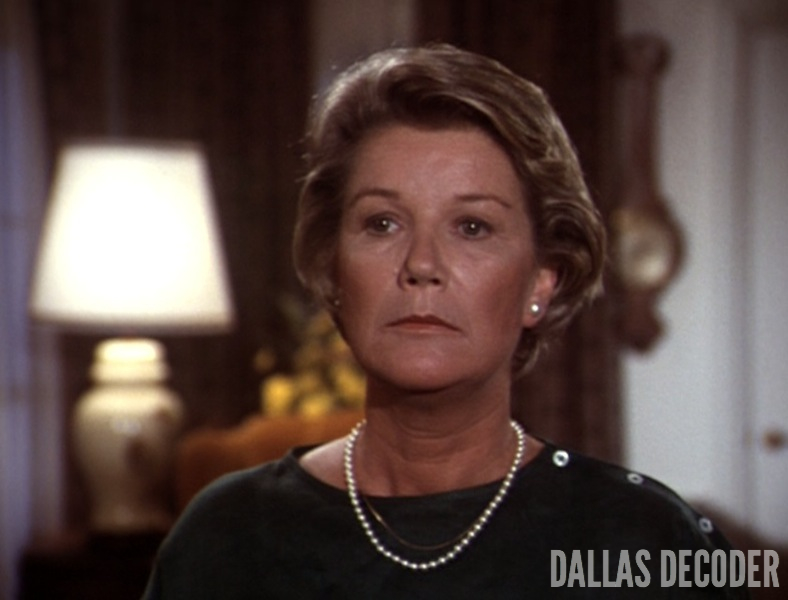
“Killer at Large” also is notable as the first “Dallas” episode that doesn’t feature Barbara Bel Geddes in the opening credits. She departed the series at the end of the previous season, although Donna Reed won’t show up as her replacement for a few more episodes. Meanwhile, Howard Keel and Priscilla Beaulieu Presley get promoted to the title sequence in this episode, while Travilla begins his two-year run as the show’s costume designer. He makes his mark almost immediately: The actresses look a little more stylish than usual, especially Fern Fitzgerald, who sports slit sleeves when Marilee confronts J.R., and Audrey Landers, who wears a striking red hat and suit during Afton’s farewell to Cliff.

Afton’s poignant departure, by the way, is this episode’s other saving grace. It’s the rare example of a “Dallas” character receiving a decent sendoff, and even though Landers’ character isn’t as iconic as any of the Ewings or Barneses, her goodbye nonetheless signals the end of an era. “Killer at Large” is an eighth-season premiere, and it feels like it. “Dallas” is beginning to lose steam after almost a decade on the air, and so as Afton gives Cliff the kiss-off and heads for the door, I can’t help but think: This lady is getting out while the getting’s good.

Grade: C

_______________________________________________________________________________________________________________________________________________
Bobby Ewing, Dallas, Killer at Large, Patrick Duffy

Lazy eye

‘KILLER AT LARGE’

Season 8, Episode 1

Airdate: September 28, 1984

Audience: 22.4 million homes, ranking 1st in the weekly ratings

Writer: Arthur Bernard Lewis

Director: Leonard Katzman

Synopsis: The shooting blinds Bobby, who is hospitalized while the police search for the assailant. J.R., believing he was the target, names Edgar as a prime suspect and is surprised when police tell him Edgar has an alibi. Sue Ellen reluctantly returns to J.R.’s bedroom, where she hides a gun. Afton leaves Cliff, who can’t recall his whereabouts during the shooting. Pam and Jenna rush to Bobby’s side while Katherine makes plans to move to Houston.

Cast: Morgan Brittany (Katherine Wentworth), Martin E. Brooks (Edgar Randolph), Cora Cordona (Pearl), Patrick Duffy (Bobby Ewing), Fern Fitzgerald (Marilee Stone), Jenny Gago (Nurse), Gerald Gordon (Dr. Carter), Linda Gray (Sue Ellen Ewing), Larry Hagman (J.R. Ewing), Dennis Haysbert (Dr. Forbes), Rose Ann Holloway (Irene), Susan Howard (Donna Krebbs), Steve Kanaly (Ray Krebbs), Ken Kercheval (Cliff Barnes), Audrey Landers (Afton Cooper), Shalane McCall (Charlie Wade), J.T. O’Connor (Patterson), Priscilla Beaulieu Presley (Jenna Wade), Victoria Principal (Pam Ewing), Karen Radcliffe (Jane), Debbie Rennard (Sly), Jill Scroggin (Sally), Sherril Lynn Rettino (Jackie Dugan), Mitchell Ryan (Captain Merwin Fogerty), Randy Tallman (Dr. Halperson), Charlene Tilton (Lucy Ewing)

“Killer at Large” is available on DVD and at Amazon and iTunes. Watch the episode and share your comments below.
Critique: ‘Dallas’ Episode 161 — ‘End Game’

Bobby Ewing, Dallas, End Game, Patrick Duffy

Best shot

The “End Game” cliffhanger is still powerful, especially when you watch the entire episode. In scene after scene, we’re led to believe everyone is gunning for J.R., just like they were four years earlier. The momentum builds until the final moments, when an unseen figure steps off the Ewing Oil elevator, enters J.R.’s office and fires three shots into the back of his chair. The feeling of shock that once accompanied the sight of Bobby slumping to the floor has long since faded, but it’s been replaced with something more satisfying — an appreciation for how much care the producers put into crafting “Dallas’s” grandest fake-out.

It’s also worth revisiting “End Game” to be reminded of how many iconic moments it contains. Two showcase Larry Hagman at his gleeful best. In one, J.R. cracks wise when Katherine glares at him after storming out of Bobby’s office (“You know, she has a nasty temper”). Later, J.R. shows up at Barnes-Wentworth and reveals he engineered Cliff’s spectacular offshore drilling implosion. Hagman delivers a string of classic one-liners, including “You needed slapping down, Cliff” and “Tomorrow morning, the janitor’s going to come in here and sweep you out with the rest of the trash. Unless, of course, you do the honorable thing, get in the elevator, go up to the roof and jump off, huh?” (Bless Ken Kercheval, who manages to make the audience feel sorry for Cliff, even as we bask in J.R.’s triumph.)

Hagman’s other great scene displays J.R.’s darker side. He sits with Sue Ellen and Peter at the Oil Baron’s Club and calmly reveals he arranged Peter’s arrest on drug charges after finding out about Sue Ellen’s affair with the young man. When J.R. offers to keep Peter out of jail if Sue Ellen resumes her wifely duties, Peter drops his “Mr. and Mrs. Ewing” act and exclaims, “Don’t do it, Sue Ellen!” J.R.’s response — “So now it’s ‘Sue Ellen’? — reminds us that for once, he’s the spouse who’s been deceived. It’s also striking how Hagman and Linda Gray never take their eyes off each other in this scene. Make no mistake: This is a showdown between J.R. and Sue Ellen; Peter is nothing more than a pawn to them.

“End Game” also offers a mercifully speedy resolution to the Miss Ellie kidnapping subplot, although I’ll never understand why the producers didn’t leave Jessica on the lam through the end of the season. She would have made a fine suspect in the “who shot Bobby?” mystery, no? Also, after everything Jessica put Ellie and Clayton through, it would have been nice to finally see the couple’s long-delayed wedding, but maybe the shot of J.R. and Bobby preparing to walk Ellie down the aisle is all we need. Just think: This is Ellie’s last appearance until Donna Reed takes over the role, so if Barbara Bel Geddes hadn’t eventually returned to “Dallas,” this would have been our farewell to the beloved actress.

“End Game” does mark the final appearances of Christopher Atkins as Peter and Barry Corbin as Sheriff Washburn. The episode also boasts its share of oddities, including the reflection of a crewmember in a glass panel in the Ewing Oil reception area (you’ll spot him at 47-minute, 32-second mark), and a somewhat unusual scene in which Pam tells little Christopher about the mess she’s made of her life. “You don’t understand any of this, do you?” she asks. Gazing up at her, he whispers, “No.” My friend at Hill Place Blog is convinced Eric Farlow ad-libbed this line; the child is so caught up in Victoria Principal’s performance, he speaks from the heart. It’s a sweetly honest moment on a show that could have used more of them this season.

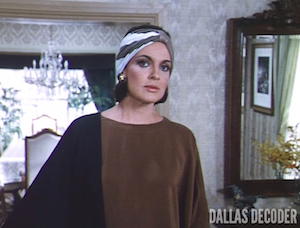
The episode’s other unexpected moment comes a little earlier, when Sue Ellen and Pam are having a heart-to-heart in the Southfork living room. Seeing how depressed her friend is, Sue Ellen offers to take Pam to a movie to cheer her up but says she wants to go upstairs and change first. In the next scene, Sue Ellen returns to the living room dressed to the nines — she’s ditched her perfectly acceptable sweater and slacks for a runway-ready flowing dress, complete with a turban. It’s one of the most epic costume changes in “Dallas” history, and it leaves me wondering: What’s a bigger tragedy in “End Game” — Bobby’s shooting or the notion that Sue Ellen would wear such a gorgeous outfit to a dark theater where no one could see it?

Grade: A

_______________________________________________________________________________________________________________________________________________

Dallas, End Game, Linda Gray, Sue Ellen Ewing

Turban legend

‘END GAME’

Season 7, Episode 30

Airdate: May 18, 1984

Audience: 21.8 million homes, ranking 1st in the weekly ratings

Writer: Arthur Bernard Lewis

Director: Leonard Katzman

Synopsis: Miss Ellie is rescued and returns to Southfork, where she marries Clayton while Jessica is put in a sanitarium. Pam takes Christopher and leaves town after finding out about Bobby and Jenna’s engagement. Bobby once again rejects Katherine. J.R. reveals he set up Cliff, who goes on a bender and misses the news that his offshore oil wells finally came in. J.R. also reveals he set up Peter, forcing Sue Ellen to return to their bedroom in exchange for keeping her ex-lover from going to jail. An unseen assailant enters Ewing Oil and fires three shots into J.R.’s chair, where Bobby is seated.

Cast: Mary Armstrong (Louise), Christopher Atkins (Peter Richards), Barbara Bel Geddes (Miss Ellie Ewing), Patrick Duffy (Bobby Ewing), Morgan Brittany (Katherine Wentworth), Billy Green Bush (Deputy Rockwell), Roseanna Christiansen (Teresa), Pat Colbért (Dora Mae), Barry Corbin (Sheriff Fenton Washburn), Eric Farlow (Christopher Ewing), Linda Gray (Sue Ellen Ewing), Larry Hagman (J.R. Ewing), Susan Howard (Donna Krebbs), Steve Kanaly (Ray Krebbs), Omri Katz (John Ross Ewing), Howard Keel (Clayton Farlow), Ken Kercheval (Cliff Barnes), Audrey Landers (Afton Cooper), Shalane McCall (Charlie Wade), Bill Morey (Leo Wakefield), Dennis Patrick (Vaughn Leland), Priscilla Beaulieu Presley (Jenna Wade), Victoria Principal (Pam Ewing), Debbie Rennard (Sly), Sherril Lynn Rettino (Jackie Dugan), Gene Ross (Bull Dawson), Danone Simpson (Kendall), Alexis Smith (Lady Jessica Montfort), Don Starr (Jordan Lee), Charlene Tilton (Lucy Ewing), Deborah Tranelli (Phyllis), John Zarema (Dr. Harlan Danvers)

“End Game” is available on DVD and at Amazon.com and iTunes. Watch the episode and share your comments below.
#DallasChat Daily: What Were ‘Dallas’s’ Best/Worst Recasts?

Barbara Bel Geddes, Claude Earl Jones, Clifton James, Colleen Camp, Dallas, Dan Ammerman, David Ackroyd, David Wayne, Digger Barnes, Donna Reed, Dr. David Gordon, Dr. Harlan Danvers, Duke Carlisle, Gary Ewing, James Canning, Jenna Wade, John Zaremba, Josef Rainer, Keenan Wynn, Kristin Shepard, Margaret Michaels, Mary Crosby, Miss Ellie Ewing, Morgan Fairchild, Pam Ewing, Philip Levien, Priscilla Beaulieu Presley, Sam Anderson, Ted Shackelford, Victoria Principal

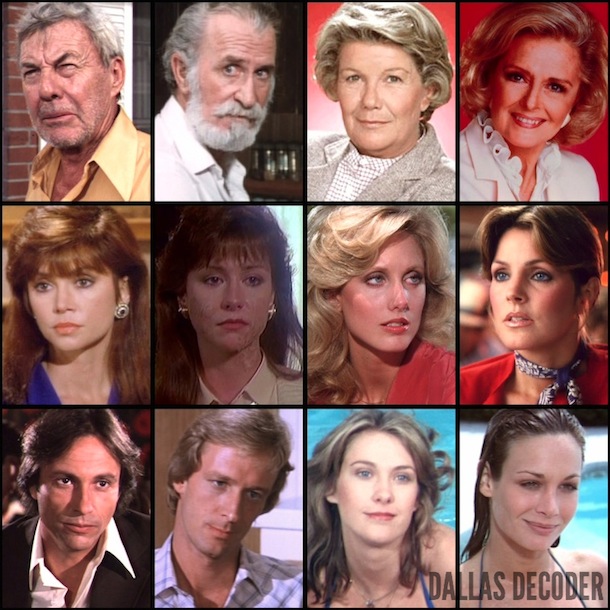
“Dallas” recast several roles over the years. Which ones worked? Which ones failed?

Among the choices: Miss Ellie (played by Barbara Bel Geddes and Donna Reed), Gary (David Ackroyd, Ted Shackelford), Pam (Victoria Principal, Margaret Michaels), Digger (David Wayne, Keenan Wynn) and Kristin (Colleen Camp, Mary Crosby). There were also three Jennas: Morgan Fairchild, Priscilla Beaulieu Presley and Francine Tacker, who isn’t pictured because I couldn’t squeeze her into the collage.

Additional choices: Dr. Harlan Danvers (Dan Ammerman, John Zaremba), Jimmy Monahan (James Canning, Philip Levien) Duke Carlisle (Claude Earl Jones, Clifton James) and Dr. David Gordon, who was played by Josef Rainer on the original show and Sam Anderson on the TNT series.

Your #DallasChat Daily question: What were “Dallas’s” best and worst recasts?

Share your comments below and join other #DallasChat Daily discussions.

Dallas Parallels: Requiems for the Heavyweights

Dallas Parallels - Requiems for the Heavyweights 1

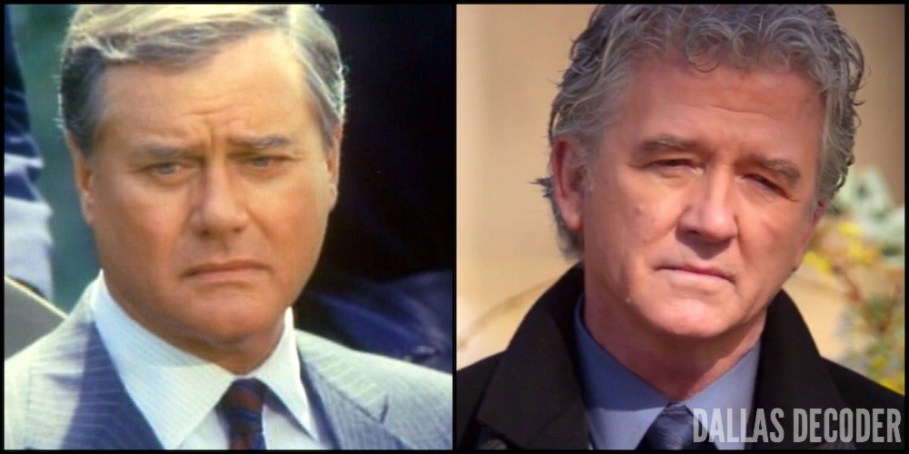
The funerals of J.R. and Bobby Ewing were filmed 28 years apart, but they draw upon similar themes, including the idea that grief and anger are sometimes indistinguishable. The episodes also show how each brother becomes unmoored when he loses the other, demonstrating how essential their relationship is to the “Dallas” mythology.

Bobby’s funeral is seen in “The Family Ewing,” the original show’s ninth-season opener, and even though his death later turns out to be part of Pam’s dream, it still packs punch. The episode begins with the Ewings returning home from the hospital after Bobby said goodbye to them from his deathbed. The characters retreat to different corners of the ranch (Miss Ellie and Clayton to their bedroom, Donna and Ray to their living room, etc.), where they begin to cope with the painful reality that the family’s favorite son is gone. Barbara Bel Geddes, who returns to “Dallas” in this episode after relinquishing her role to Donna Reed during the previous season, delivers an especially moving portrait of quiet resolve as Ellie begins making Bobby’s funeral preparations.

Of course, no one is more devastated than J.R., who sits in the Southfork living room and silently buries his head in his hands. Moments later, when Sue Ellen arrives home from a shopping spree, cheerfully unaware of the tragedy that took place in her absence, J.R. becomes enraged. For him, breaking the news of Bobby’s death to his wife becomes an opportunity to vent his pent-up marital frustrations. “All you ever think about is yourself!” he shouts. (I also love how Larry Hagman unleashes his Texas accent when J.R. asks Sue Ellen, “Where the hell were yew?”) J.R.’s cruel tendencies are also on display when he encounters Gary and Ray the next day, but Hagman wisely balances his character’s hostility with tender performances, including the scene where J.R. goes into John Ross’s bedroom to be near his son.

“J.R.’s Masterpiece,” last year’s exquisite funeral episode from TNT’s “Dallas,” continues the franchise’s grand tradition of sending its characters off in style. The episode includes a sequence where the Ewings return to Southfork after confirming J.R.’s death in the Mexican morgue (shades of “The Family Ewing” scene that shows the Ewings coming home from the hospital). Later, as the characters prepare for J.R.’s funeral, Bobby exhibits the same kind of behavior that J.R. did in “The Family Ewing.” Bobby is terse with Gary when he sees him at Southfork, and he’s unusually cool to Ray when he runs into him at the memorial service. J.R.’s death also prompts Bobby to finally acknowledge his lingering resentment toward Ann for keeping so many secrets from him during their marriage. In a powerful performance from Patrick Duffy, Bobby erupts (“I’m pissed!”) at Ann on the night before J.R.’s funeral, leaving her feeling as stunned as Sue Ellen did when J.R. shouted at her in “The Family Ewing.”

The two funeral scenes also share similarities, although the differences might outweigh the parallels. Bobby’s burial takes place in a Southfork pasture and includes all of the Texas Ewings, except for Lucy. (Charlene Tilton had departed the series at the end of the previous season and wasn’t invited back for “The Family Ewing.”) J.R.’s burial also takes place on Southfork, and even though the crowd at his funeral is smaller than Bobby’s, I’m less surprised by who’s absent (James, Cally), than by who’s present (no offense Carmen and Drew, but you’re not family; I’ll give Elena and Emma a pass since they’re linked to Christopher and Ann). Also, we don’t see any of the eulogies for Bobby, while J.R.’s mourners deliver one memorable tribute after another, including Sue Ellen’s heartbreaking speech.

Perhaps most notably, “The Family Ewing” and “J.R.’s Masterpiece” both end with one brother paying tribute to the other when no one else is around. In the 1985 episode, after the mourners have left Bobby’s burial site, J.R. stands alone at his brother’s casket, expresses regrets for “all the fights” and finally tells him, “I love you. I do.” Flash forward to “J.R.’s Masterpiece.” After Bobby receives the mysterious letter that J.R. wrote before he died, he retreats to his empty bedroom, pours himself a glass of his brother’s bourbon and says he knew J.R. would have one more trick up his sleeve. “It is a good one. I love you, brother,” he says.

It’s every bit as haunting and as beautiful as J.R.’s tribute to Bobby almost three decades earlier. How I wish it were just another dream.


‘I Love You. I Do.’

Dallas, Family Ewing, J.R. Ewing, Larry Hagman

Sad dream

In “The Family Ewing,” a ninth-season “Dallas” episode, J.R. (Larry Hagman) stands alone near Bobby’s casket at the end of his funeral.

J.R.: Bobby, I never told you how much you meant to me. All the fights, all the time butting heads with one another … I’m sorry we were never closer. I wish … I wish I’d taken the time to tell you how much I love you. I do. And tell Daddy I love him too. Bye, Bobby. I’ll miss you.


‘I Love You, Brother’

Bobby Ewing, Dallas, J.R.'s Masterpiece, Patrick Duffy, TNT

Hard truth

In “J.R.’s Masterpiece,” a second-season “Dallas” episode, Bobby (Patrick Duffy) enters J.R.’s bedroom after reading a letter he wrote before he died, pours himself a glass of bourbon and sits at the foot of the bed.

BOBBY: I knew you’d have at least one more left up your sleeve, J.R. It is a good one. [Chuckles softly] I love you, brother. [Sobs, takes a drink]


How do you think J.R. and Bobby’s funerals compare to each other? Share your comments below and read more “Dallas Parallels.”

Dallas Cliffhanger Classics: Season 8

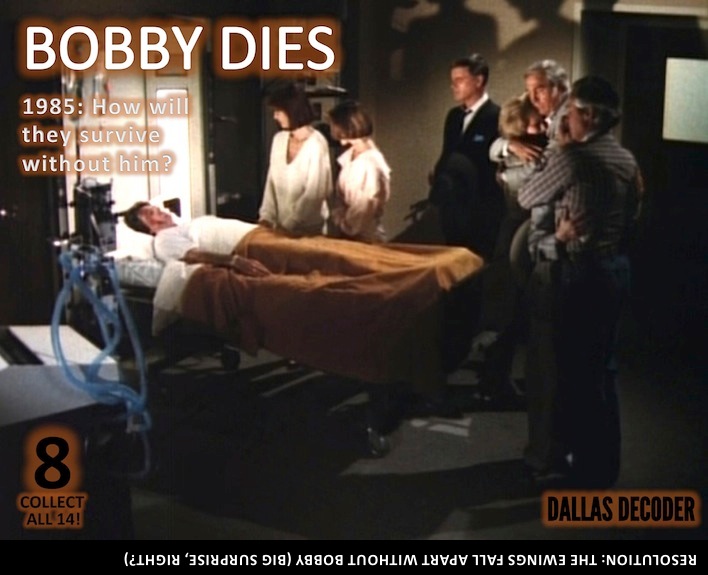
Dallas Decoder celebrates “Dallas’s” classic cliffhangers with weekly summertime flashbacks. Collect all 14 images and share them with your friends.

Bobby Ewing, Clayton Farlow, Dallas, Donna Krebbs, Donna Reed, Howard Keel, Jenna Wade, J.R. Ewing, Larry Hagman, Miss Ellie Farlow, Patrick Duffy, Pam Ewing, Priscilla Presley, Ray Krebbs, Steve Kanaly, Susan Howard, Victoria Principal

Dallas Styles: Miss Ellie’s Pearls

Don’t mess with Mama

The second-season episode “Survival” features one of my all-time favorite “Dallas” moments: the scene where Miss Ellie points a shotgun at a snoopy newspaper reporter and orders him off Southfork.

The confrontation demonstrates how the Ewings, a thoroughly modern family, cling to old values like defending their land. The shotgun, a symbol of the American frontier, is a crucial prop in the scene – but so are the pearls around Ellie’s neck.

Until characters like Peg Bundy and Roseanne Connor smashed the stereotype in the 1980s, pearls were one of television’s most enduring symbols of motherhood. Donna Reed and Barbara Billingsley wore them while doing housework and mediating domestic disputes in 1950s sitcoms, and Barbara Bel Geddes continued the tradition when “Dallas” began in 1978.

Miss Ellie wears pearls a lot during the show’s second season, when “Dallas” is establishing her character as the show’s wise matriarch. The white beads help reinforce the pearls of wisdom Ellie is forever dispensing to her family.

But the necklace is never more important than it is in “Survival,” when Ellie answers the front door at Southfork to find a reporter seeking comment about the crash of the Ewings’ plane with J.R. and Bobby aboard. Ellie doesn’t take kindly to this intrusion, ordering Ray to fetch the shotgun from the hall closet.

Without the necklace, Ellie is just a little woman holding a gun. Add the pearls and she becomes wife, mother and fierce protector of her family.

Ellie doesn’t wear her pearls as often in “Dallas’s” later years (although Reed sports them when she plays Ellie during the show’s eighth season) and we never see the character wield a shotgun after this episode.

That’s OK, because at that point, we know not to mess with Miss Ellie.