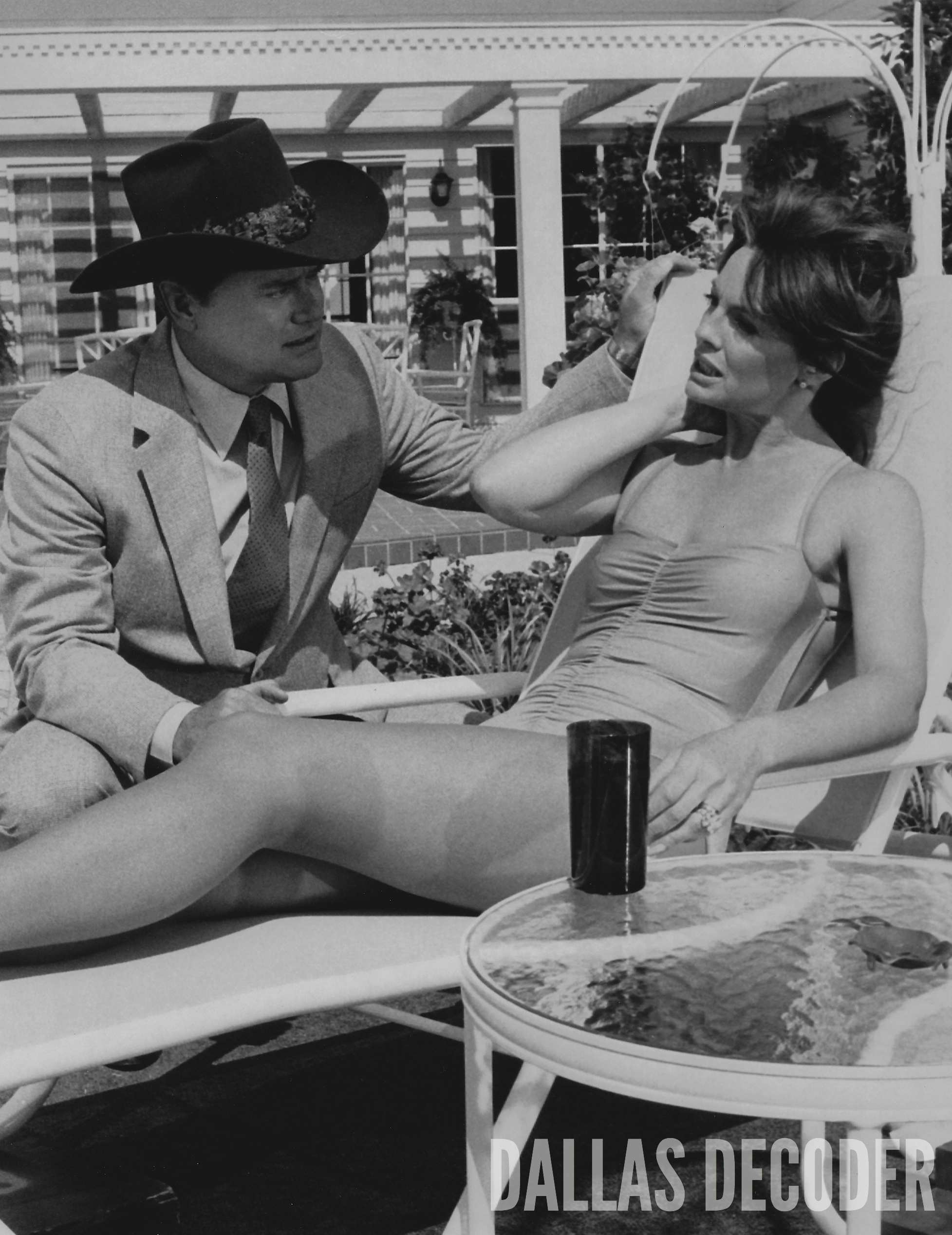
J.R. and Sue Ellen (Larry Hagman, Linda Gray) are seen in this 1979 publicity shot from “Whatever Happened to Baby John? Part 1,”“Dallas’s” third-season opener.
Between the Lines and Behind the Scenes of "Dallas"
J.R. and Sue Ellen (Larry Hagman, Linda Gray) are seen in this 1979 publicity shot from “Whatever Happened to Baby John? Part 1,”“Dallas’s” third-season opener.
Oh, snap!
In “Whatever Happened to Baby John, Part 1,” “Dallas’s” third-season opener, J.R. (Larry Hagman) sits next to Sue Ellen (Linda Gray), who is lounging near the Southfork pool, reading Texas Homes magazine.
J.R.: Darling, I wish you’d try and take a little more interest in things.
SUE ELLEN: Interest? In what?
J.R.: Well, to start with, our child.
SUE ELLEN: [Flips a page] I don’t think he’s exactly suffering from lack of attention.
J.R.: You wanted that child so much, and now you just don’t seem to care at all.
SUE ELLEN: [Flips a page] Of course, I do.
J.R.: Well, it doesn’t look like it. That’s what I’m saying.
SUE ELLEN: Appearances can very often be deceiving.
J.R.: Honey, I know how – I know how hard this has been for you. How difficult the time it was to quit drinking and go cold turkey and I just want you to know that I admire you for it, Sue Ellen.
SUE ELLEN: [Looks up from the magazine] My drinking was never a problem. I kept trying to tell everybody that.
J.R.: And what I’m saying is, if we try, if we really try, we can solve all our other problems – and I want you to know I am going to try. I really am. [Takes the magazine from her, pulls a ring box out of his pocket] Sweetheart, I got a little present for you this morning. I dropped in a store downtown. [Opens the box] Jeweler calls it a maternity ring. [He holds open the box, smiling.]
SUE ELLEN: You bought me once, J.R. – and you can’t do it anymore. I am no longer for sale.
She snaps shut the box, gets up and walks away.
Meet the press
J.R., how do you do it?
During “Dallas’s” first two seasons, you neglect your wife, mistreat your mistress, forge your daddy’s will, ruin your mama’s reunion with her long-lost brother, sabotage one brother’s attempt to reconcile with his wife and child, drive another brother out of the family business, ruin your rival’s political career and frame him for murder, attempt to blackmail a closeted gay man into marrying your niece and try – twice – to ensnare your sister-in-law in a compromising position.
Yet as “Dallas’s” third season begins, I can’t help but feel sorry for you as you struggle to be a better husband to Sue Ellen, only to be rebuffed at every turn.
What’s wrong with me?
I realize J.R.’s motivation for wanting to save his marriage isn’t altogether altruistic. The character is obsessed with his reputation, and now that his wife has given birth, he undoubtedly wants his family – and Dallas society – to see him as a loving husband and doting father.
On the other hand, Sue Ellen’s near-death experience in the second-season finale, “John Ewing III, Part 2,” seemed to stir long-forgotten feelings that remain strong in this installment. Never before has J.R.’s concern for Sue Ellen seemed this heartfelt.
You have to give Larry Hagman a lot of credit. Can you think of another actor who could make J.R. this sympathetic, even after all the terrible things he’s done?
Toward the end of “Whatever Happened to Baby John? Part 1,” when J.R. finally runs out of patience and forces his frigid wife to accompany him to the hospital to pick up the child, it seems like he’s reverting to his mean, old ways.
But when J.R. and Sue Ellen arrive at Dallas Memorial and learn the baby is missing, he exhibits more uncharacteristic selflessness when he calls Southfork to share the news with Miss Ellie, who responds by saying she’ll have Lucy and Pam brought home.
“That’s a good idea,” J.R. says.
Wait, what?
J.R. Ewing is concerned about his bratty niece and least favorite sister-in-law?
Never mind what’s wrong with me.
J.R., what’s wrong with you?
Grade: B
________________________________________________________________________________________________________________________________________________
Mr. Nice Guy
‘WHATEVER HAPPENED TO BABY JOHN? PART 1’
Season 3, Episode 1
Airdate: September 21, 1979
Audience: 16.1 million homes, ranking 19th in the weekly ratings
Writer: Camille Marchetta
Director: Leonard Katzman
Synopsis: While her baby remains hospitalized, Sue Ellen returns to Southfork, where she resists J.R.’s attempts to be kind toward her. When the couple goes to the hospital to bring the child home, they’re stunned to learn he has been kidnapped.
Cast: John Ashton (Willie Joe Garr), Barbara Bel Geddes (Miss Ellie Ewing), Jim Davis (Jock Ewing), Patrick Duffy (Bobby Ewing), Meg Gallagher (Louella), Linda Gray (Sue Ellen Ewing), Larry Hagman (J.R. Ewing), Steve Kanaly (Ray Krebbs), Ken Kercheval (Cliff Barnes), Sheila Larken (Priscilla Duncan), Jeanna Michaels (Connie), Cliff Murdock (Lieutenant Simpson), George O. Petrie (Harv Smithfield), Randolph Powell (Alan Beam), Victoria Principal (Pam Ewing), Charlene Tilton (Lucy Ewing), Sandy Ward (Jeb Ames)
“Whatever Happened to Baby John? Part 1” is available on DVD and at Amazon.com and iTunes. Watch the episode and share your comments below.
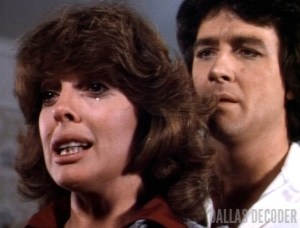
Daddy issues
In “John Ewing III, Part 2,” “Dallas’s” second-season finale, Bobby and Sue Ellen (Patrick Duffy, Linda Gray) are seated on the bed in her room at the sanitarium, where she tells him she wants to come home.
BOBBY: [Holding her hand] Sue Ellen, they can help you here.
SUE ELLEN: They can’t help me.
BOBBY: It takes time. You have to give them a chance.
SUE ELLEN: [Stands, walks away from the bed] Yeah, time. Sure. Why not? That’s all I have, is time. That’s what I do all day, is try to figure out what I’m gonna do with my time. I wake up in the morning and I think, “What am I gonna do all day till I go to sleep – alone?”
BOBBY: Sue Ellen. [Looks away, then looks back at her]
SUE ELLEN: [Turns to face him] Am I embarrassing you, Bobby?
BOBBY: No. Yeah. Yes, you are a little, yeah.
SUE ELLEN: I sleep alone a lot, after J.R.’s been out with his sluts, comes home smelling like their perfume, and I just pretend I’m asleep – just blot the whole thing out.
BOBBY: [Stands and grabs her arm] Then why aren’t you having this conversation with him? Confront him with it.
SUE ELLEN: Oh I have, Bobby. I have often. But your brother has that wonderful knack of finding one’s weak spot – the Achilles’ heel. Takes the knife and goes right up to the hilt.
BOBBY: Sue Ellen, what is your Achilles’ heel?
SUE ELLEN: [Turns, walks away] Your mama and your daddy, and Pamela and Lucy, and even you. You think it’s Southfork, the Ewing money, the Ewing name. But you’re wrong. [Walks back to him, touches his face] If I’d only met you first, Bobby, I would’ve married you instead of J.R. You are so kind and strong and loving. Just like a man should be. [Begins crying, kisses him] You are so understanding, Bobby. [Turns away] My men are not understanding.
BOBBY: Your men? Sue Ellen, what are you talking about?
SUE ELLEN: Oh, Bobby. I have something the doctors won’t ever find a cure for. Let’s see, how am I gonna explain this to you? Your life is so simple. Pamela loves you, and you love Pamela. And I really do love J.R. But you know what? J.R. doesn’t love me. But I wanted to have his baby so bad. I even thought we would adopt a baby, but J.R. put a stop to that. Then I thought, “Well, Sue Ellen, just go out and get yourself pregnant.” And that’s what I did. And I just thought, “But maybe I can hurt J.R., hurt him real bad.” Instead, all I did was hurt me and my little baby – and the baby’s father.
BOBBY: You went out and got pregnant? Sue Ellen, what are you saying?
SUE ELLEN: Yeah, but it could’ve been J.R.’s. Chances are it’s J.R.’s.
BOBBY: [Turns her around to face him] Sue Ellen!
SUE ELLEN: [Crying harder] But Bobby, he hardly makes love to me anymore.
BOBBY: Who is the father of your baby?
SUE ELLEN: Cliff Barnes. Now do you see? That’s why no one can help me. No one in the world can help me. [She collapses into his arms.]
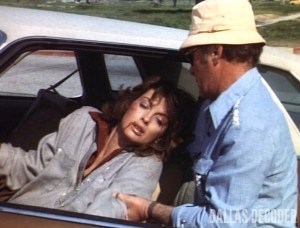
Crash test mommy
What a difference a year makes!
Sue Ellen has just four lines in “Digger’s Daughter,” “Dallas’s” first episode, but “John Ewing III, Part 2,” which debuted 369 days later, features the character in almost every other scene.
My favorite: When Sue Ellen tells Bobby that Cliff may be the father of her unborn child. This really isn’t a conversation as much as it is a monologue. For four-and-a-half uninterrupted minutes, Linda Gray delivers almost 500 words of heart-wrenching dialogue. It’s a tour-de-force performance, and it makes me appreciate how far Gray has come from those first-season episodes, when all she had to do was gaze adoringly at J.R.
The most surprising moment during Sue Ellen’s monologue comes when she kisses Bobby. No matter how many times I see the scene, the kiss is always a little startling. I used to find it odd how Patrick Duffy barely reacts to it, but I’ve decided it’s because the kiss isn’t a romantic gesture as much as it is an expression of Sue Ellen’s desperate loneliness.
Gray dominates “John Ewing III, Part 2,” but the other actors have good moments, too.
Larry Hagman’s performance in the final scene, when J.R. and Bobby sit at Sue Ellen’s bedside, is one of his most memorable. Despite all the rotten stuff J.R. does in the second season, it’s hard not to be moved when Hagman purses his lips, shuts his wet eyes and bows his head. J.R. has never seemed more human.
Ken Kercheval is equally moving in the penultimate scene, when Cliff sees Sue Ellen’s baby in the incubator and tearfully collapses into Pam’s arms. Like Duffy in Bobby’s scene with Sue Ellen, Victoria Principal doesn’t have much to do here, but she makes the most of it. I like how the actress moves from exasperation when Pam first spots Cliff in the hospital corridor to tears when he begins sobbing.
That Duffy and Principal shift so effortlessly from “Dallas’s” stars when the series begins to supporting roles in this episode reflect the cast’s evolution into a true ensemble.
What a difference a year makes, indeed.
Grade: A
________________________________________________________________________________________________________________________________________________
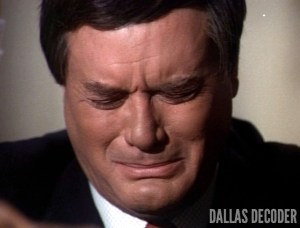
Crying, shame
‘JOHN EWING III, PART 2’
Season 2, Episode 24
Airdate: April 6, 1979
Audience: 17.8 million homes, ranking 11th in the weekly ratings
Writer: Arthur Bernard Lewis
Director: Leonard Katzman
Synopsis: In the sanitarium, Sue Ellen bribes a nurse for booze, escapes and is injured in a car crash. Her doctors are forced to prematurely deliver her son, whom Jock names John Ross Ewing III. J.R. weeps as the lives of Sue Ellen and the baby hang in the balance.
Cast: Dimitra Arliss (Nurse Hatton), Barbara Bel Geddes (Miss Ellie Ewing), Karlene Crockett (Muriel Gillis), Jim Davis (Jock Ewing), Patrick Duffy (Bobby Ewing), Meg Gallagher (Louella), Ellen Geer (Dr. Krane), Linda Gray (Sue Ellen Ewing), Michael C. Gwynne (Dr. Rogers), Heidi Hagman (receptionist), Larry Hagman (J.R. Ewing), Peter Horton (Wayne), Dawn Jeffory (Annie Driscoll), Sherril Lynn Katzman (Susan), Ed Kenney (Senator Newberry), Ken Kercheval (Cliff Barnes), Jeanna Michaels (Connie), Victoria Principal (Pam Ewing), Alan Rachins (Dr. Miller), Charlene Tilton (Lucy Ewing)
“John Ewing III, Part 2” is available on DVD and at Amazon.com, iTunes and TNT.tv. Watch the episode and share your comments below.
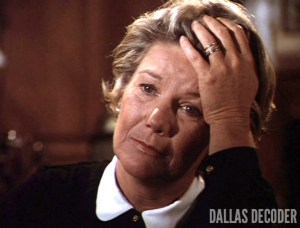
Mama tried
In “John Ewing III, Part 1,” a second-season “Dallas” episode, Miss Ellie (Barbara Bel Geddes) sits at the piano in the Southfork living room, talking to J.R. (Larry Hagman).
ELLIE: You were a small child, J.R., when I stopped interfering in your life. For some time now, I’ve been thinking that wasn’t a very wise decision. But just because I didn’t say anything doesn’t mean I haven’t watched and seen. You’re power hungry. [J.R., standing behind Ellie, throws back his head and sighs.] You’re like your daddy in that. But he has redeeming qualities. His love for his sons, for one. I don’t know that you have any redeeming qualities, J.R. Is there anyone you love?
J.R.: [Standing at the bar] I love Sue Ellen.
ELLIE: From the day you brought that girl into this house, you’ve neglected her. First with the business, then with other women. You didn’t even bother to be discreet most of the time. I don’t know why she didn’t leave you years ago.
J.R.: Don’t you?
ELLIE: I know money’s important to Sue Ellen – and power. But she loves you, J.R. She always has. You just never gave her half a chance.
J.R.: I don’t wanna talk about this anymore.
ELLIE: Sue Ellen’s in trouble, J.R., and your child’s life is in danger. You must do something about it.
J.R.: [Sips a drink] It’s too late. [Leaves]
ELLIE: I gave you up too soon, J.R. I should have held onto you a little longer.
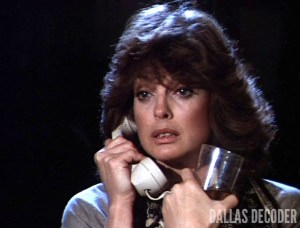
Indulged
To the list of recurring themes explored on “Dallas” – sibling rivalry, class warfare, the pitfalls of co-habitation – add this: the dangers of indulgence.
The Ewings enjoy life’s luxuries, but they also indulge each other’s bad behavior. This is particularly true for Sue Ellen, whose drinking problem grows progressively worse during the second season while everyone else politely looks away.
In “John Ewing III, Part 1,” the first half of the two-part season finale, we see how hard it is for the family to break this bad habit.
When Bobby and Pam discover Sue Ellen passed out drunk on the side of the road, they bring her home and Bobby forces the family to finally admit Sue Ellen’s drinking has gotten out of control. Jock and Miss Ellie tell J.R. he must help his wife – yet they refuse to confront Sue Ellen, even after she gets drunk again and tumbles down the Southfork stairs.
“I’ve got to stop wearing those ridiculously high-heeled shoes,” Sue Ellen says while recovering in her hospital room. “My baby’s much more important than fashion.”
“Well, sounds like a good idea to me,” Jock says.
“You must try and be more careful,” Ellie agrees.
I find myself wanting to reach through the screen and shake both Jock and Ellie. Don’t humor Sue Ellen; help her!
Not surprisingly, the family responds to Lucy’s worsening drug habit by repeating many of the mistakes they make with Sue Ellen.
When Lucy shows up on Ray’s doorstep, high-as-a-kite and slurring her words, his first instinct is to sober her up. “You don’t want Jock and Miss Ellie seeing you like this,” he says.
Ray seeks help from Bobby, who takes the same approach. Bobby stands with Lucy in the Southfork driveway and urges her to “go in that house just as if there’s nothing in the world wrong with you.”
By the end of the episode, good-guy Bobby has persuaded Lucy to stop abusing her pills. Yet I can’t help thinking if he really wanted to earn his white-knight bona fides, he’d get his family to kick their habit of enabling each other’s bad behavior.
Grade: B
________________________________________________________________________________________________________________________________________________
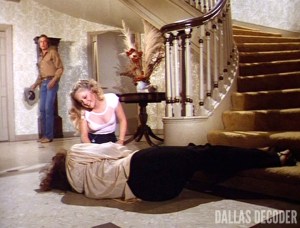
Girls gone wild
‘JOHN EWING III, PART 1’
Season 2, Episode 23
Airdate: March 30, 1979
Audience: 17.5 million homes, ranking 14th in the weekly ratings
Writer: Camille Marchetta
Director: Leonard Katzman
Synopsis: A drunken Sue Ellen falls down the Southfork stairs but neither she nor her unborn child are hurt. J.R., realizing he can no longer ignore his wife’s alcoholism, has her committed to a sanitarium. Lucy is taking drugs, but Bobby persuades her to stop.
Cast: Barbara Bel Geddes (Miss Ellie Ewing), Jim Davis (Jock Ewing), Patrick Duffy (Bobby Ewing), Meg Gallagher (Louella), Ellen Geer (Dr. Krane), Linda Gray (Sue Ellen Ewing), Larry Hagman (J.R. Ewing), Peter Horton (Wayne), Dawn Jeffory (Annie Driscoll), Steve Kanaly (Ray Krebbs), Sherril Lynn Katzman (Susan), Ed Kenney (Senator Newberry), Ken Kercheval (Cliff Barnes), Jeanna Michaels (Connie), Victoria Principal (Pam Ewing), Charlene Tilton (Lucy Ewing)
“John Ewing III, Part 1” is available on DVD and at Amazon.com, iTunes and TNT.tv. Watch the episode and share your comments below.
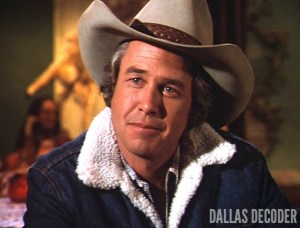
In the beginning
In “The Outsiders,” a second-season “Dallas” episode, Donna (Susan Howard) has drinks at the Longhorn Bar with Ray (Steve Kanaly), whom she met the night before.
RAY: I realized I sat around here talking about myself last night. I don’t know anything about you.
DONNA: Well, there’s not a lot to tell, really. My name is Donna. I’m, uh, 28. I was born in Marshall, Texas.
RAY: [Smiles] Marshall?
DONNA: Yeah, you know that little place close to Shreveport?
RAY: Sure, sure.
DONNA: And you know, I really don’t know what I’m doing here with you.
RAY: Oh well, maybe it’s just my rugged western charm, huh?
DONNA: [Laughs] No, no, I don’t think that’s what it is. No, um, I think it’s the fact that you didn’t try and hit on me last night.
RAY: Well, I wasn’t looking for that. I didn’t think you were, either.
DONNA: Well, tell me, what are you looking for?
RAY: I don’t know. Nothing complicated. Maybe just a happy ending. [Drinks]
DONNA: You and everybody else. [Pauses] Why do you think, uh, that it’s so difficult for people to have a happy ending?
RAY: Well, it could be the ending depends on the start. Beginning with somebody that you could end up happy with.
DONNA: Well, that would be terrific. I mean, you know, if things didn’t change – but they do. I mean, they always do.
The waitress arrives with their drinks. Ray thanks her.
RAY: We sure are getting serious here all of a sudden.
DONNA: Oh, I don’t want to get serious. No. [Raises her glass] To fun.
RAY: Yeah, I could use a lot of that. To fun.
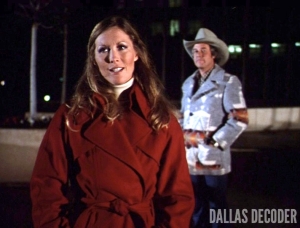
Lady and the saddle tramp
“The Outsiders” is an interesting meditation on politics and marriage. It was made more than three decades ago, but it feels refreshing in ways other “Dallas” episodes do not.
For years, we’ve watched one real-life political wife after another humiliated by their philandering husbands. “The Outsiders” offers a role reversal: Donna Culver, the young bride of political elder Sam Culver, is the cheating spouse.
Donna may not be a good wife, but she isn’t a bad person, either. She turns to Ray because she feels sexually unfulfilled. Donna is 28, while her husband is probably supposed to be in his 60s of 70s. (In real life, when “The Outsiders” debuted, Susan Howard and John McIntire, the actors who play Donna and Sam, were 35 and 71, respectively.)
I like how “Dallas” doesn’t try to justify Donna’s indiscretion by making Sam a bad guy. In fact, the show goes out of its way to depict the marriage as loving, even if it isn’t physical. Sam and Donna are also partners in a way that feels wonderfully progressive: Sam, a onetime governor who still wields a lot of influence in state politics, boasts about how he makes no decision without first consulting Donna.
(You might even say the Culvers’ marriage presages the real-life union of Bill and Hillary Clinton. Sam’s bragging about his wife’s intelligence and political savvy recalls Bill Clinton’s famous pledge in 1992 that voters who elected him would get “two for the price of one.”)
Sam and Donna’s sense of partnership isn’t lost on Sue Ellen. When J.R. suggests Donna is probably physically neglected, Sue Ellen retorts, “If they never made love, J.R., she has much more than I have. He cares about her. He takes her advice and he listens to her.”
“The Outsiders” concludes with Ray and Donna’s heart-wrenching farewell, but but my favorite moment in this episode comes in an earlier scene, when they sit in a bar and she asks him why “happy endings” seem so elusive.
This conversation is nicely written by Leonard Katzman and beautifully performed by Steve Kanaly and Susan Howard, who is rivaled only by Patrick Duffy when it comes to delivering breathy, soul-searching dialogue.
With this episode, Howard becomes a welcome addition to the “Dallas” constellation. Her performance leaves us wanting more, and fortunately, we won’t have to wait long for Donna’s return.
Grade: A
________________________________________________________________________________________________________________________________________________
Old man out
‘THE OUTSIDERS’
Season 2, Episode 22
Airdate: March 16, 1979
Audience: 14.2 million homes, ranking 28th in the weekly ratings
Writer: Leonard Katzman
Director: Dennis Donnelly
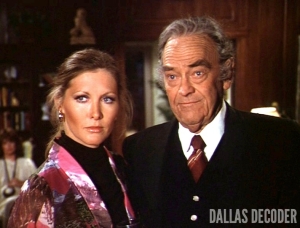
Synopsis: When J.R. learns Ray is sleeping with Donna Culver, the young wife of political elder Sam Culver, he tries to blackmail her into persuading Sam to oust Cliff from his government perch. Instead, Donna ends the affair and comes clean to Sam, who forgives her and backs Cliff.
Cast: Barbara Bel Geddes (Miss Ellie Ewing), Jim Davis (Jock Ewing), Patrick Duffy (Bobby Ewing), Fern Fitzgerald (Marilee Stone), Meg Gallagher (Louella), Linda Gray (Sue Ellen Ewing), Larry Hagman (J.R. Ewing), Susan Howard (Donna Culver), Dawn Jeffory (Annie Driscoll), Steve Kanaly (Ray Krebbs), Joan Lancaster (Linda Bradley), John McIntire (Governor Sam Culver), Jeanna Michaels (Connie), Victoria Principal (Pam Ewing), Clint Ritchie (Bud Morgan), Charlene Tilton (Lucy Ewing)
“The Outsiders” is available on DVD and at Amazon.com and iTunes. Watch the episode and share your comments below.

You go, girl
By today’s standards, “Dallas” isn’t a “gay” show. Southfork never hosts a “Brokeback Mountain”-esque love story. There are no same-sex office romances at Ewing Oil. Dusty Farlow wears ascots to keep dust out of his face, not because he’s fabulous.
Yet “Dallas” is very much a show with gay sensibilities. It regularly explores themes – empowerment, identity, gender roles – that resonate with gay audiences, and often in ways that are surprisingly smart.
I didn’t catch a lot of this while watching the show in the 1980s, when I was a pretty confused gay kid. But when I think about those years now, I wonder if “Dallas’s” gay subtext helps explain its appeal to me. Maybe my middle-school gaydar was stronger than I realized.
Kit, But Not Much Kaboodle
“Dallas” makes subtle references to homosexuality in early episodes like “Election,” when J.R. questions Cliff’s close relationship with his male campaign manager, and “Call Girl,” when J.R. creates a scandal by making it look like Pam is involved in a three-way relationship with a man and another woman.
The show stops dancing around the issue in “Royal Marriage,” the 1979 episode where Kit Mainwaring, an oil-and-cattle heir who is secretly gay, breaks his engagement to Lucy and comes out of the closet. This episode, which reflects the ’70s trend toward “socially conscious” television (see also: “All in the Family,” “Lou Grant,” et. al.), is handled with surprising sophistication, making Kit one of prime-time television’s breakthrough gay characters.
Kit is also a footnote: “Dallas” ran 14 seasons and produced 357 episodes, yet he is the only character whose homosexuality is ever acknowledged on the show.
There are only fleeting gay allusions in later episodes. During the sixth season, Lucy wonders if John Ross’s camp counselor Peter Richards is gay because he doesn’t want to date her (she doesn’t realize Peter is in love with Sue Ellen), but the show never again identifies a character as being gay.
This isn’t altogether surprising. Prime-time television mostly retreated to the closet during the AIDS hysteria in the 1980s. Also, once “Dallas” became television’s most-watched show, it embraced its escapist bent and pretty much stopped doing “issues” stories. Both factors probably explain why the producers notoriously dropped plans to make villainess Angelica Nero a lesbian during the 1985-86 season.
Sue Ellen: Icon – and Avatar
The absence of gay characters on “Dallas” doesn’t mean the show lacks characters and storylines gay audiences could identify with. Consider Sue Ellen, whose boozing, philandering and sharp tongue make her an icon among gay fans who love camp.
But Sue Ellen shouldn’t be treated only as a joke. If you consider her arc during the course of the series, she makes an ideal avatar for gay audiences.
When “Dallas” begins, Sue Ellen is the show’s most sexually repressed character. In the first-season episode “Spy in the House,” she tries to spark J.R.’s interest with a sexy negligee, only to have him cast it aside and accuse her of being unladylike. J.R.’s rejection sends Sue Ellen into the shadows, where she finds sexual fulfillment with other men and develops her drinking problem. This double life must have felt familiar to gay men and women who spent the ’70s and ’80s trapped in the closet.
By the end of the Reagan era, when AIDS was galvanizing gay people and giving the gay rights movement new momentum, Sue Ellen finally begins pulling herself together. She quits drinking, embarks on a successful business career and leaves J.R. for good.
During Linda Gray’s final appearance on the show in 1989, Sue Ellen turns the tables on J.R. and tells him off, one last time (“You will be the laughingstock of Texas.”). All “Dallas” fans cheered this moment, but for gay viewers, I suspect it had special meaning. Sue Ellen was standing up to her oppressor at a time when many gay Americans were beginning to do the same – in the voting booth, in the workplace, in the streets.
There’s Something About Gary
“Dallas’s” gay viewers might see themselves in other characters, too.
The series often explores the theme of confused identities. Two notable examples: Pam and Ray each learn they were raised by people who aren’t their biological fathers, and for both characters, this discovery triggers a lot of angst.
“Dallas’s” recurring theme of estranged fathers and sons is probably familiar to a lot of gay men. At various points, Jock has tense relations with each of the Ewing boys, especially Gary.
In fact, the dialogue during Gary’s homecoming in the second-season “Reunion” episodes makes me wonder if the producers were considering making the character gay. Pam points out Gary is “different.” Bobby calls him “gentle.” Lucy says she hopes Val will “straighten” him out. Was this coded language, dropped into the scripts to lay the groundwork for Gary’s eventual coming out?
Maybe, maybe not. But a gay Ewing is an interesting idea to contemplate.
Are you listening, TNT?
Do you consider “Dallas” a gay-friendly show? Share your comments below and read more opinions from Dallas Decoder.








 Dallas Decoder