TNT’s ‘Dallas,’ a Good Show Poised for Greatness

Once and future kings

Once and future kings

TNT’s “Dallas” is a good show on the verge of becoming a great one. It has the potential to surpass the original “Dallas” in overall quality, much like “Star Trek: The Next Generation” is now more highly regarded than its 1960s precursor. Of course, it took Captain Picard and his crew awhile to hit their stride, and this new brood of Ewings is going to need time to find their bearings, too.

TNT has produced 10 one-hour “Dallas” episodes and will show them on Wednesday nights, beginning June 13. I’ve seen the first seven entries and was impressed with all of them, especially the pilot, “Changing of the Guard,” which beautifully captures the old “Dallas” spirit.

The episodes that follow are more of a mixed bag. Each one is solidly entertaining, with good performances and gorgeous cinematography (Rodney Charters, get your Emmy submission ready), but the pacing is a bit frenetic. The new show moves at the speed of Twitter, offering a torrent of plot twists that are genuinely surprising but leave the audience little time to get to know the characters.

Hagman Still Has It

Hands down, the best thing about the new show is the man who was the best thing about the old one: Larry Hagman, whose return as J.R. Ewing is everything I hoped it would be. The actor is now in his 80s and looks every bit of it, but as viewers will discover, Hagman still has it. Yes, the hair is thinner, the voice is raspier and the eyebrows are out of control, but the twinkle in Hagman’s eye hasn’t dimmed a bit.

To its credit, TNT doesn’t try to conceal Hagman’s age. In fact, the show seems to embrace it. In one scene in “Changing of the Guard,” director Michael M. Robin allows the camera to linger for a moment on J.R.’s wrinkled hands. It’s a small gesture, but at a time when television seems more obsessed with youth than ever, it’s downright bold.

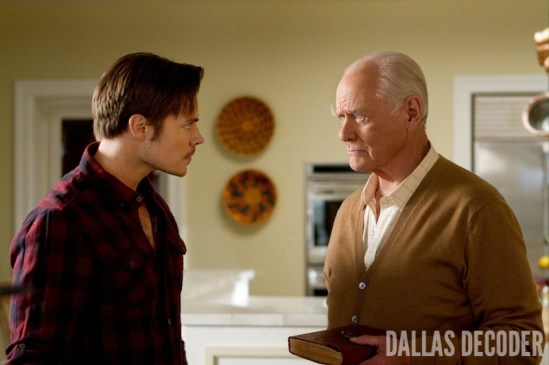
In later episodes, the show deals with J.R.’s age rather playfully. At one point, the character begins using a walker – not because he needs it, but because he wants to make Bobby feel sorry for him. In another scene, we see J.R. shuffling around the Southfork kitchen in a cardigan sweater, making breakfast for Bobby and Ann, Bobby’s new wife. It seems like a warm moment, until you stop and realize the cuddly old man dishing up scrambled eggs is secretly plotting against everyone at the table.

Patrick Duffy, who returns as Bobby, uses his more “mature” appearance to his advantage, too. Duffy’s silver hair imbues Bobby with instant authority, allowing the actor to command every scene he’s in. Duffy has always been “Dallas’s” unsung hero, but now his gravitas is readily apparent. He makes a worthy heir to Jim Davis’s spot at the head of the Ewing dinner table.

The real revelation, though, is Linda Gray, who once again plays Sue Ellen. She doesn’t have nearly enough to do in TNT’s first seven episodes, but when Gray appears, she lights up the screen. The show has cast Sue Ellen in the role of elder stateswoman, but the truth is, Gray is still “Dallas’s” leading lady, even if the producers haven’t realized it yet.

Mr. Henderson, Presented

Among the new cast, no actor will be watched more closely than Josh Henderson, who portrays John Ross, J.R. and Sue Ellen’s son. I’m not going to make the inevitable comparisons to Hagman because, hey, there’s only one of him. Instead, I prefer to ponder Henderson’s similarities to another young actor who got his start at Southfork: Brad Pitt, who played a long-forgotten teenage character on “Dallas” a quarter century ago.

Henderson reminds me a lot of Pitt, not during his “Dallas” days but a little later, when he was making movies like “Thelma & Louise.” Like Pitt in that film, Henderson has an effortless, seductive charm. He is boyish and dangerous at once, and even when he’s up to no good, you can’t help but find him alluring. Maybe comparisons to Hagman aren’t so unfair after all.

I’m also impressed with the other members of TNT’s ensemble: Jesse Metcalfe, who delivers several moving performances as Christopher, Bobby’s strong-but-sensitive son; Brenda Strong, who is casually elegant as Ann; and Julie Gonzalo, who does a nice job keeping the audience on its toes in her role as Rebecca, Christopher’s mysterious fiancée.

My favorite newcomer, though, is Jordana Brewster, who plays Elena, the young geologist torn between John Ross and Christopher. Brewster carries herself with the same kind of confidence and youthful wisdom Victoria Principal did during the original “Dallas’s” earliest episodes. Brewster makes me care about Elena, even when the role is underwritten. This show is lucky to have her.

People Before Plots

While “Dallas’s” new actors are good, their characters need a little work. For example, I’m not sure why John Ross is so antagonistic, aside from the fact that’s what the narrative demands.

This is the classic trap soap operas fall into: The writers allow the plots to dictate the characters’ behavior, something the original “Dallas” skillfully avoided. Think about it: Unless you’re a “Dallas” diehard, you probably don’t remember the specifics of J.R.’s schemes, but chances are you haven’t forgotten about his relationships with his family.

The new show hasn’t quite figured out viewers care more people than plots. The twist-a-minute storytelling style doesn’t give the new characters time to become knowable, relatable people. It also leaves little room for warmth, which was such an important part of the fabric of the original series.

Bobby always forgave J.R. for stabbing him in the back because, well, they were brothers, and that’s what brothers do (on TV, at least). The new show emphasizes the rivalry between cousins John Ross and Christopher, but I never get the impression they feel anything for each other but animosity.

Honoring the Past

Cynthia Cidre, the creative force behind TNT’s “Dallas, has pledged to honor the original show’s history, and she mostly follows through. Cidre seems to understand the “Dallas” mythology, with its emphasis on the conflicts between conservation and capitalism and its depiction of modern people defending old values like land and family.

Cidre also upholds many of the longtime “Dallas” traditions. During the first few episodes, for example, we see a Southfork wedding, a Ewing barbecue and a black-tie ball. I’m also pleased to hear so many references to Principal’s character Pam, “Dallas’s” original heroine, as well as Jock and Miss Ellie (although I’m no fan of the cheap-looking portrait of Jim Davis and Barbara Bel Geddes that now hangs in the Southfork living room).

At other times, I wonder how closely this show’s writers watched the old “Dallas” episodes before they began cranking out their scripts. The TNT show’s major storyline revolves around John Ross’s fight to drill on Southfork’s Section 18, which we learn in the pilot is brimming with oil. Fine, but why not make it a battle over oil-soaked Section 40, which has been rooted in “Dallas” lore since the original show’s second season?

Mostly, the small stuff trips up the writers. Duffy’s character is referred to as “Robert James Ewing,” not “Bobby James Ewing,” as he was known throughout the original series. I’m the first to admit the overwhelming majority of viewers won’t notice or care, but details like this matter to me – especially when you consider the character’s name is the first line of the first episode of the first “Dallas” series. (Pam: “Bobby James Ewing, I don’t believe you!”).

And yes, I know the original “Dallas” didn’t always honor its own continuity, either. This is the show that infamously wrote off an entire season as Pam’s dream, after all. But this is also why TNT’s “Dallas” should work harder to avoid flubs. The new series shouldn’t be content to be as good as the old one. It should strive to be better.

My gut tells me that’ll happen, and I’m sure I’ll one day remember TNT’s “Dallas” as fondly as I recall the show that spawned it. But first, the writers need to slow things down and pay a little more attention to their characters – and for goodness sakes, learn their names!

Are you looking forward to “Dallas’s” debut? Share your comments below and read more opinions from Dallas Decoder.
Dallas Scene of the Day: ‘It’s Gonna Take Me Time, Jock’

Barbara Bel Geddes, Dallas, Jim Davis, Jock Ewing, Power Play

Pillow talk

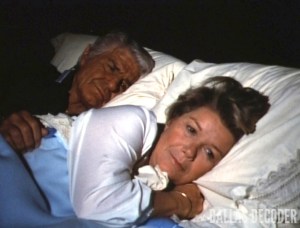
In “Power Play,” a third-season “Dallas” episode, Jock and Miss Ellie (Jim Davis, Barbara Bel Geddes) are in bed as he rubs her back.

JOCK: You know, everything’s under control at the office now that Bobby’s there. Why don’t we go down to Ruidoso tomorrow and watch Punk Anderson work out his 2-year-olds? We just might spend the night at the lodge, the one with the river.

ELLIE: I don’t know, Jock.

JOCK: I can’t ever remember missing one of his annual barbecues. We’ve had some wonderful times, haven’t we, Ellie?

ELLIE: Yes, we have.

JOCK: Then you’ll go?

ELLIE: [Turns to face him] Jock, I, I don’t know if I’m up to a big social event yet.

JOCK: Doctor says you’re doing just fine.

ELLIE: There’ll be too many people. Too many questions. Probably well-meaning questions or maybe just inquiring glances. It’s gonna take me time, Jock. Please understand.

JOCK: Sure. [He kisses her hand and she turns away from him.] Good night.

Dallas Scene of the Day: ‘Not Like We Used To’

Barbara Bel Geddes, Dallas, Jim Davis, Jock Ewing, Love and Marriage

Picture imperfect

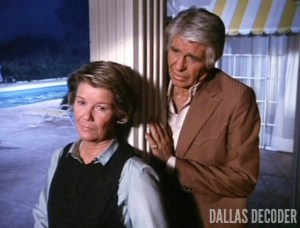
In “Love and Marriage,” a third-season “Dallas” episode, Jock (Jim Davis) finds Miss Ellie (Barbara Bel Geddes) on the Southfork patio, gazing at the night sky.

JOCK: You all right, Miss Ellie? Get you a sweater or something?

ELLIE: No, Jock. Thanks.

JOCK: Well, it’s getting kind of nippy out. Be winter soon.

ELLIE: Too soon.

JOCK: Well, it’s sure quiet here around tonight. Even Lucy’s out.

ELLIE: It’s too quiet. I like it better when there’s family around. We’re all drifting apart, Jock. It’s not at all the way I pictured it.

JOCK: How did you picture it, Miss Ellie?

ELLIE: Oh, I don’t know. Seeing it the way it was when the boys were growing up. Only there’d be our grandchildren. The two of us here with the boys and their families. One very large, happy family.

JOCK: Well, we’ve got Lucy, little baby John, Bobby, J.R. Gary’s doing fine in California. Bobby’s going into business with J.R. It’ll give us more time to be together. To do the things that we’ve talked about and never did.

ELLIE: Maybe that’s something else we pictured that won’t ever happen.

JOCK: Why not, Miss Ellie? I loved you all these years and I want to end up my life with you. It’s a time of life that I’ve been looking forward to.

ELLIE: I wish I could feel that way.

JOCK: But you should Ellie. No matter what else has happened, we’ve still got each other. Remember that.

ELLIE: Not like we used to. [She walks away.]

Critique: ‘Dallas’ Episode 43 – ‘Return Engagements’

Dallas, Gary Ewing, Joan Van Ark, Return Engagements, Ted Shackelford, Valene Ewing

Talk about baggage

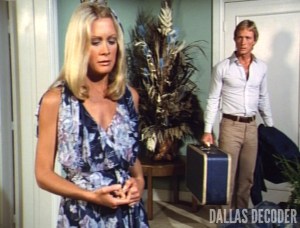
“Return Engagements” is an exercise in efficient storytelling. During the course of this episode, Gary and Valene reunite, remarry, reconcile with his family and decide to relocate to Southern California. Who says “Dallas” is slow-paced?

Much of this feels rushed and underwritten, but there are some exceptions, beginning with the monologue Miss Ellie delivers when she announces her intention to buy a house for the newlyweds. Val points out how much her mother-in-law has already done for her and Gary. “Miss Ellie, we owe you so much. You raised Lucy,” she says.

“Yes, I raised her,” Ellie begins. “I raised her because the Ewings made it impossible for you to raise her. But I shouldn’t have. I should’ve fought them. I didn’t. I did nothing. Do you think my giving you a house is fair payment? I don’t. If you want to refuse it, refuse it because the gift is small. Otherwise, take it. Please take it.”

Scriptwriter David Jacobs’ dialogue here is flawless. Short, declarative statements (“I didn’t. I did nothing.”), delivered with conviction by Barbara Bel Geddes. What a shame these two didn’t collaborate more frequently. It would’ve been wonderful to see Bel Geddes deliver more of Jacobs’ words.

Another lovely moment: Immediately after Ellie’s speech, there’s a knock on Val’s front door and Bobby opens it, revealing Jock. “I believe I have a son getting married here today,” the Ewing patriarch says as he steps into the room. “I’d like to attend the ceremony, if I’m welcome.”

I can’t help but get a little lump in my throat when I watch this scene. Jim Davis delivers his line quietly, almost sheepishly. Jock’s guilt has humbled him.

Also good in this episode: Ted Shackelford, who makes his first appearance as Gary, and Joan Van Ark, who is always wonderful as Val, even if the couple’s reunion is a little pat. Perhaps “Return Engagements” suffers because Jacobs was busy getting ready for “Knots Landing,” which debuted a week after this episode aired?

Interestingly, the most entertaining couple in this episode isn’t the spinoff-bound newlyweds, it’s shipping magnate Eugene Bullock and Sally, his gold-digging young wife. The Bullocks are a plot device – Sally offers Kristin a glimpse of the future she believes she’ll have if she succeeds in becoming Mrs. J.R. Ewing – but E.J. André is a hoot as crotchety Mr. Eugene and Andra Akers is delicious as bitchy Sally.

Maybe they should’ve gotten a spinoff, too.

Grade: B

________________________________________________________________________________________________________________________________________________

Dallas, Joan Van Ark, Return Engagements, Valene Ewing

Willing victim

‘RETURN ENGAGEMENT’

Season 3, Episode 14

Airdate: December 20, 1979

Audience: 20.3 million homes, ranking 2nd in the weekly ratings

Writer: David Jacobs

Director: Gunnar Hellström

Synopsis: Gary returns to Dallas and with Miss Ellie’s encouragement, proposes to Val, who accepts. J.R., who is on a “business trip” with Kristin, races home to stop the ceremony but arrives too late. Ellie’s gift to the newlyweds: a house in Knots Landing, a Southern California suburb.

Cast: E.J. André (Eugene Bullock), Andra Akers (Sally Bullock), Barbara Bel Geddes (Miss Ellie Ewing), Mary Crosby (Kristin Shepard), Jim Davis (Jock Ewing), Patrick Duffy (Bobby Ewing), Linda Gray (Sue Ellen Ewing), Larry Hagman (J.R. Ewing), Steve Kanaly (Ray Krebbs), Ken Kercheval (Cliff Barnes), Terry Lester (Rudy Millington), Jeanna Michaels (Connie), Victoria Principal (Pam Ewing), Ted Shackelford (Gary Ewing), Charlene Tilton (Lucy Ewing), Joan Van Ark (Valene Ewing)

“Return Engagement” is available on DVD and at Amazon.com and iTunes. Watch the episode and share your comments below.

Critique: ‘Dallas’ Episode 42 – ‘Mother of the Year’

Dallas, Linda Gray, Mother of the Year, Sue Ellen Ewing

Prodigal mother

Larry Hagman directed “Mother of the Year,” and despite his limited experience behind the camera (Hagman’s most notable pre-“Dallas” directing credit: “Beware! The Blob”), he makes this episode the third season’s most inventive entry.

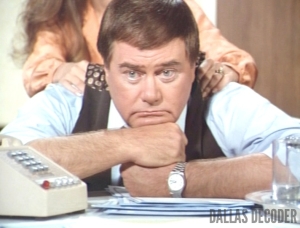
Consider the moment J.R. learns he’s struck oil in the Pacific. Hagman opens the scene with J.R. staring at his office telephone, awaiting news from Hank Johnson, his man in Asia, while Kristin massages his shoulders.

The phone rings. Kristin answers.

“It’s the Associated Press,” she announces. “They want to know something about an oil well.”

J.R. takes the receiver, tenses his shoulders, rises from his chair.

“What? Well, now, I, I haven’t got a confirmation on that yet,” he stammers.

Another line buzzes. Kristin answers. It’s Hank.

J.R. puts the AP on hold, takes Hank’s call.

“Where the hell have you been?” he demands.

In the background: A drumbeat begins building – slow, steady.

Bum.

Bum.

Bum.

“What?” J.R. asks Hank. “Yee-ha! We hit!”

Folksy strings join the drums as J.R. switches back to the other line.

“Yes, that’s a confirmation,” he says. “Absolutely. A strike in the Pacific – maybe the biggest one ever yet! Yeah, you can quote me. J.R. Ewing!”

The scene is clever because Hagman constructs it like an oil strike: The news about J.R.’s “hit” trickles in over the phone lines – slow but steady – before finally producing his joyful rupture.

I also appreciate Hagman’s attention to detail. He is an honest-to-goodness Texan and has a good ear for how these people talk – or at least how we expect them to.

Before Sue Ellen arrives for the Daughters of the Alamo luncheon, Hagman allows us to eavesdrop as the socialites gossip around the buffet table (“I can hardly believe what she was wearing to that formal dinner party!”).

Hagman also proves to be generous with his fellow cast mates. Barbara Bel Geddes, Jim Davis, Ken Kercheval and Victoria Principal all have nice scenes here, although “Mother of the Year” is mostly a showcase for Linda Gray.

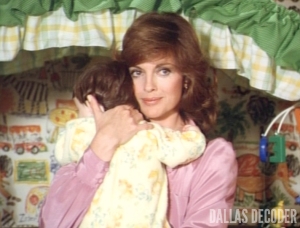
Sue Ellen gets two – count ’em, two! – scenes with Dr. Elby, and when she finally picks up baby John at the end of the episode, it’s a powerful moment.

By the time the closing credits roll, there’s no doubt: Sue Ellen might be “Dallas’s” mother of the year, but director-of-the year honors go to Larry Hagman.

Grade: A

________________________________________________________________________________________________________________________________________________

Dallas, J.R. Ewing, Mother of the Year, Larry Hagman,

Someday his wells will come in

‘MOTHER OF THE YEAR’

Season 3, Episode 13

Airdate: December 14, 1979

Audience: 19.6 million homes, ranking 7th in the weekly ratings

Writer: Rena Down

Director: Larry Hagman

Synopsis: To prevent Ewing Oil from having to drill on Southfork, Jock decides to sell the Asian leases. Before the sale, the company hits a gusher. J.R. stops funding Cliff’s campaign. After fighting with Cliff, Sue Ellen shows interest in her baby, leaving Pam feeling as if she has “lost” another child.

Cast: Barbara Bel Geddes (Miss Ellie Ewing), Jocelyn Brando (Mrs. Reeves), Jeff Cooper (Dr. Simon Elby), Mary Crosby (Kristin Shepard), Jim Davis (Jock Ewing), Patrick Duffy (Bobby Ewing), Linda Gray (Sue Ellen Ewing), Larry Hagman (J.R. Ewing), Steve Kanaly (Ray Krebbs), Ken Kercheval (Cliff Barnes), Joan Lancaster (Linda Bradley), Jeanna Michaels (Connie), Dennis Patrick (Vaughn Leland), Randolph Powell (Alan Beam), Victoria Principal (Pam Ewing), Charlene Tilton (Lucy Ewing)

“Mother of the Year” is available on DVD and at Amazon.com and iTunes. Watch the episode and share your comments below.

Dallas Styles: Jock’s Bathrobe

‘Ellie Saves the Day’

Is it a coincidence Jim Davis wears a bathrobe during some of Jock’s most vulnerable moments on “Dallas?”

In “Survival,” Jock is clad in a beige terrycloth robe when he overhears Miss Ellie’s confrontation with a Dallas Press reporter and learns the plane carrying J.R. and Bobby has crashed. The usually rock-like Jock crumbles upon hearing the news. “Damn it, Ellie,” he says with wet eyes. “Both of them. Why?”

In “Ellie Saves the Day,” Jock is wearing a different robe – this one appears to be dark blue with white dots – when he learns J.R.’s risky Asian oil deal has brought the Ewing empire to the brink of collapse. It’s a moment of reckoning for Jock. At one point, he buries his face in his giant hand and tells Bobby, “I trained J.R. and taught him everything he knows. Gave him the fever for big business. But I never taught him when to stop.”

The bathrobes are crucial props in both scenes. Davis cuts such an imposing figure, it’s hard to forget he was almost 70 when “Dallas” began. The robes help the actor humanize his character, reminding us Jock is in his twilight, even if he doesn’t look or act like it.

Appropriately, the bathrobe also helps Ellie – and “Dallas” viewers – come to terms with Jock’s loss. In the fifth-season episode “Acceptance,” Ellie finally stops denying Jock’s death and walks into his closet, where she tenderly touches his clothes. Hanging among them: that blue-and-white-dotted robe, reminding us once again that Jock really was mortal.

Critique: ‘Dallas’ Episode 41 – ‘Ellie Saves the Day’

Barbara Bel Geddes, Dallas, Ellie Saves the Day, Miss Ellie Ewing

Savior

“Ellie Saves the Day” is essential viewing for anyone who loves “Dallas” and its mythology. The story brings the Ewings to the brink of financial ruin, and their darkest hour turns out to be one of the show’s finest. This is a great episode.

The plot of is straightforward – the Ewings discover J.R. has secretly mortgaged Southfork, and they must scramble to raise the money to pay the banks – but the subtext is rich. There are allusions to the consequences of codependence and parallels to the real-life economic morass of the 1970s. These themes prove resilient.

In many ways, “Ellie Saves the Day” is the flip side of “The Kristin Affair,” which aired six weeks earlier in the fall of 1979. “The Kristin Affair” is also a classic episode, but it is relatively breezy, while “Ellie Saves the Day” is moodier, broodier and ultimately, more satisfying.

‘I Never Taught Him When to Stop’

Dallas, Ellie Saves the Day, J.R. Ewing, Larry Hagman

Sinner

“Ellie Saves the Day” opens with J.R. panicked because he has hasn’t struck oil in Asia and the deadline to pay the Southfork mortgage is looming. The crisis leaves him gloomy and full of self-pity. “I’ll write you a nice reference,” he tells Kristin.

Seeing J.R. this way invites us to consider the roots of his greed. To say the character is power hungry tells only half the tale. J.R. really craves Jock’s respect, and he believes boosting Ewing Oil’s size and stature is the only way to earn it. For J.R., power is a means to an end.

Unfortunately, J.R. becomes addicted to his own ambition. In “The Kristin Affair,” he gets drunk with dreams of making Ewing Oil “the biggest, most powerful independent in Texas” and mortgages Southfork to finance his overseas drilling venture. It’s a risky scheme, and when it finally unravels in “Ellie Saves the Day,” it’s not unlike watching a drunkard coming off a bender. This idea is reinforced by the five o’clock shadow that shows up on Larry Hagman’s face in the third act.

Make no mistake: J.R. is as compulsive as Sue Ellen. She is an alcoholic, but he is powerless over his own ego, and just as the Ewings indulge her, they also enable him. Jock alludes to this in “Ellie Saves the Day” when he discovers the mortgage scheme and tells Bobby, “I trained J.R. and taught him everything he knows. Gave him the fever for big business. But I never taught him when to stop.”

‘Sweat and Hope and Dreams’

Bobby Ewing, Dallas, Ellie Saves the Day, Jim Davis, Jock Ewing, Patrick Duffy

Humbled

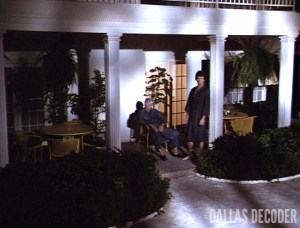
This is just one achingly poignant scene in an episode full of them. In another, Bobby finds Jock sitting alone on the Southfork patio in the dark of night. Bobby sees his father is worried and tells him he can “start over” if Ewing Oil collapses, but Jock waves him off. “Not enough time left for me to do that,” Jock says, and as we watch his silvery hair catch the moonlight, we know he’s probably right.

Jock is nothing if not realistic. “It’s not the oil business that I’m worried about,” he tells Bobby. “There’s just no way that you can build another Southfork. Not in six lifetimes.”

Bobby, true to his nature, doesn’t give up. He implores his father to persuade the banks to extend their loan. “We’ll try, Bobby. We’ll try,” Jock responds. “But this feels like the end of 40 years of sweat and hopes and dreams.”

Jim Davis and Patrick Duffy’s performances in this scene are beautiful, and so is the dialogue. “Ellie Saves the Day” was written by Arthur Bernard Lewis, perhaps “Dallas’s” best scriptwriter, and David Michael Jacobs, who apparently is not the same person as “Dallas” creator David Jacobs. Regardless, Lewis and this second David Jacobs demonstrate they understand better than most what makes “Dallas” tick.

Gunnar Hellström’s direction during Jock and Bobby’s conversation is also inspired. It is intensely quiet, with the faint sound of crickets in the background and a 17-second, longer-than-it-seems pause at the beginning of the scene.  Hellström shrouds Davis and Duffy in blackness, making them look a bit like actors in a stage play. This is fitting, given how Jock and Bobby’s conversation – with all those references to the passage of time, respect and failed dreams – feels like something out of “Death of a Salesman.”

Hellström concludes the scene by slowly pulling back the camera, leaving us with a wide shot of Jock and Bobby, dressed in their pajamas and brooding over what the next day might bring. Never before have these big men seemed humbler.

‘It’s Time That Southfork Repaid Those Debts’

Barbara Bel Geddes, Dallas, Ellie Saves the Day, Miss Ellie Ewing

Capped

The somber tone of “Ellie Saves the Day” reflected the national mood in 1979, when gas shortages and the Three Mile Island meltdown were seen as signs of American decline. For some people in today’s audiences, these themes will still resonate.

Jock’s “six lifetimes” line also reminds us the collapse of Ewing Oil and the foreclosure of Southfork wouldn’t be equal losses. These twin institutions define “Dallas” and its characters, but the ranch is by far the more precious of the two. It’s no accident Miss Ellie, “Dallas’s” moral center, personifies Southfork, while the corrupt J.R. embodies the company. (It’s also no surprise the virtues of drilling on Southfork will again be debated during TNT’s new “Dallas” series.)

From this vantage point, “Ellie Saves the Day” resembles a parable about the inequities in American capitalism and conservationism. In the real world, we rush to relax our environmental standards when the economy suffers – even President Obama has weakened clean-air rules – just as Ellie decides to bail out Ewing Oil by lifting the generations-old embargo against drilling on the ranch.

As she tells Jock at the end of this episode, “Forty years ago, Ewing Oil paid off the mortgage on Southfork – and saved it. Now I think it’s time that Southfork repaid those debts.”

‘I May Never Forgive You for This, J.R.’

Barbara Bel Geddes, Dallas, Ellie Saves the Day, Miss Ellie Ewing

Giant

Barbara Bel Geddes’ performance in “Ellie Saves the Day” might be her best during the series. She delivers her lines with her trademark quiet conviction, but I also love the way she carries herself. Bel Geddes might be small, but her grace makes her a giant.

This is best illustrated in the final scene, when Miss Ellie refuses to use Vaughn Leland’s pen to sign away the mineral rights to her family’s land. If we saw another actress do this, it might make Ellie seem petty. When Bel Geddes does it, it’s a moment of triumph.

Of course, this scene also exposes the just-below-the-surface flawed logic in “Ellie Saves the Day.”

To make the storyline work, the producers fiddle with the show’s continuity: When “Dallas” begins, Ewing Oil and Southfork seem to operate independently of each other, but at the beginning of the third season, they suddenly are referred to as subsidiaries of “Ewing Enterprises,” a parent company that is rarely mentioned again after this season. From this perspective, the Ewings kind of get what they deserve. Who in their right mind makes the family home dependent on the family business?

Another quibble: In the episode’s closing moments, when Ellie is leaving the Ewing Oil office, she glances at her eldest son and says, “I may never forgive you for this, J.R.” Bel Geddes’ face isn’t shown when she delivers the line, which sounds like it was dubbed in after the scene was filmed. I don’t know why the people who made “Ellie Saves the Day” felt the line was needed. Imagine if Ellie had simply turned to J.R. and cut him a withering look. Her silence would have been more unsettling than anything she might have said.

Regardless, the fact Ellie is unmerciful toward J.R. is telling. It lets us know she may be able to save Southfork and Ewing Oil, but she knows she can’t save her son’s soul. He’s too far gone for that.

Grade: A+

________________________________________________________________________________________________________________________________________________

Barbara Bel Geddes, Dallas, Ellie Saves the Day, Miss Ellie Ewing, Ray Krebbs, Steve Kanaly

Thinker

‘ELLIE SAVES THE DAY’

Season 3, Episode 12

Airdate: November 30, 1979

Audience: 18.5 million homes, ranking 13th in the weekly ratings

Writers: David Michael Jacobs and Arthur Bernard Lewis

Director: Gunnar Hellström

Synopsis: The Ewings learn J.R. mortgaged Southfork to finance his Asian deal. To stave off foreclosure, Miss Ellie decides to allow Ewing Oil to drill on the ranch.

Cast: Barbara Bel Geddes (Miss Ellie Ewing), Mary Crosby (Kristin Shepard), Jim Davis (Jock Ewing), Patrick Duffy (Bobby Ewing), Linda Gray (Sue Ellen Ewing), Larry Hagman (J.R. Ewing), Steve Kanaly (Ray Krebbs), Ken Kercheval (Cliff Barnes), Jeanna Michaels (Connie), Dennis Patrick (Vaughn Leland), Randolph Powell (Alan Beam), Victoria Principal (Pam Ewing), Don Starr (Jordan Lee), Charlene Tilton (Lucy Ewing), Jimmy Weldon (Sy Stevens)

“Ellie Saves the Day” is available on DVD and at Amazon.com and iTunes. Watch the episode and share your comments below.

Critique: ‘Dallas’ Episode 40 – ‘The Heiress’

Charlene Tilton, Dallas, Heiress, Lucy Ewing

Fickle finger

“The Heiress” focuses on Lucy, and it’s one of the weakest entries during “Dallas’s” third season. This isn’t a coincidence.

At this point during the show’s run, the producers can’t decide who they want Lucy to be. Sometimes, she is a troublemaking teenager who blackmails Pam (“Lessons”) and runs away from home (“Runaway”). At other times, she is a sweet young woman who deals gracefully with a broken engagement (“Royal Marriage”) and struggles to forgive her deadbeat mama (“Secrets”).

In “The Heiress,” Lucy is all over the place. We see her seduce Alan Beam, which is a pretty grownup thing for a college freshman to do, but we also see Jock ground her for getting too many speeding tickets, which is not. Lucy’s zig-zagging from childhood to adulthood and back again is dizzying.

I don’t blame Charlene Tilton. She’s a spirited actress, and when she’s given good material, she’s one of “Dallas’s” most charismatic performers. I admire Tilton’s work in many episodes, especially “Royal Marriage.”

But in “The Heiress,” Tilton is given a weak script and bad direction. When I watch the episode, I get the feeling she’s trying her best, but there’s only so much she can do.

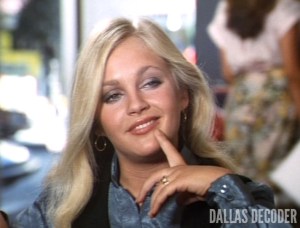
Consider the scene where Lucy goes to Alan’s office to flirt with him. At one point, Tilton fixes an unblinking gaze on Randolph Powell and rests her chin on her left index finger. I suppose director Leslie H. Martinson thought this would be seductive, as if Lucy is sizing up Alan and imagining what it would be like to sleep with him, but it comes off looking like an exaggerated gesture out of a Mae West movie.

Later, when Alan takes Lucy to a swanky piano bar, Tilton delivers her lines with such girlish enthusiasm, the scene takes on a creepy tone. It’s almost as if Powell’s character is robbing the cradle – in the most prurient sense. Not helping matters: the “Dallas” makeup artists pancake Tilton’s cherub face in this scene, making her look like a child playing dress-up.

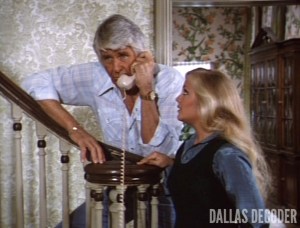
“The Heiress” also leaves me feeling embarrassed for other “Dallas” cast members, including Larry Hagman and Jim Davis, who are each given sitcommy scenes involving faked phone calls in the Southfork foyer.

Of course, both actors are given lots of great scenes in future episodes. Tilton’s opportunities are much more limited, which is a real shame. She deserves better.

Grade: C

________________________________________________________________________________________________________________________________________________

Charlene Tilton, Dallas, Heiress, Jim Davis, Jock Ewing, Lucy Ewing

Call a script doctor!

‘THE HEIRESS’

Season 3, Episode 11

Airdate: November 23, 1979

Audience: 17.7 million homes, ranking 8th in the weekly ratings

Writer: Loraine Despres

Director: Leslie H. Martinson

Synopsis: Lucy pursues and seduces Alan after witnessing another staged fight between him and J.R. Cliff moves closer toward running for Congress and vows to win back Sue Ellen. Bobby learns about Ewing Oil’s Asian venture but J.R. won’t reveal his financing.

Cast: Barbara Bel Geddes (Miss Ellie Ewing), Joe Bratcher (Harry Shaw), Charles Cooper (Harry Shaw), Jeff Cooper (Dr. Simon Elby), Karlene Crockett (Muriel Gillis), Mary Crosby (Kristin Shepard), Jim Davis (Jock Ewing), Patrick Duffy (Bobby Ewing), Walker Edmiston (Roy Tate), Linda Gray (Sue Ellen Ewing), Larry Hagman (J.R. Ewing), Eugene Jackson (Pianist), Laura Johnson (Betty Lou Barker), Ken Kercheval (Cliff Barnes), Joan Lancaster (Linda Bradley), George O. Petrie (Harv Smithfield), Randolph Powell (Alan Beam), Victoria Principal (Pam Ewing), Charlene Tilton (Lucy Ewing), Marcus Wyatt (Jimmy)

“The Heiress” is available on DVD and at Amazon.com and iTunes. Watch the episode and share your comments below.

The Art of Dallas: ‘Mastectomy, Part 2’

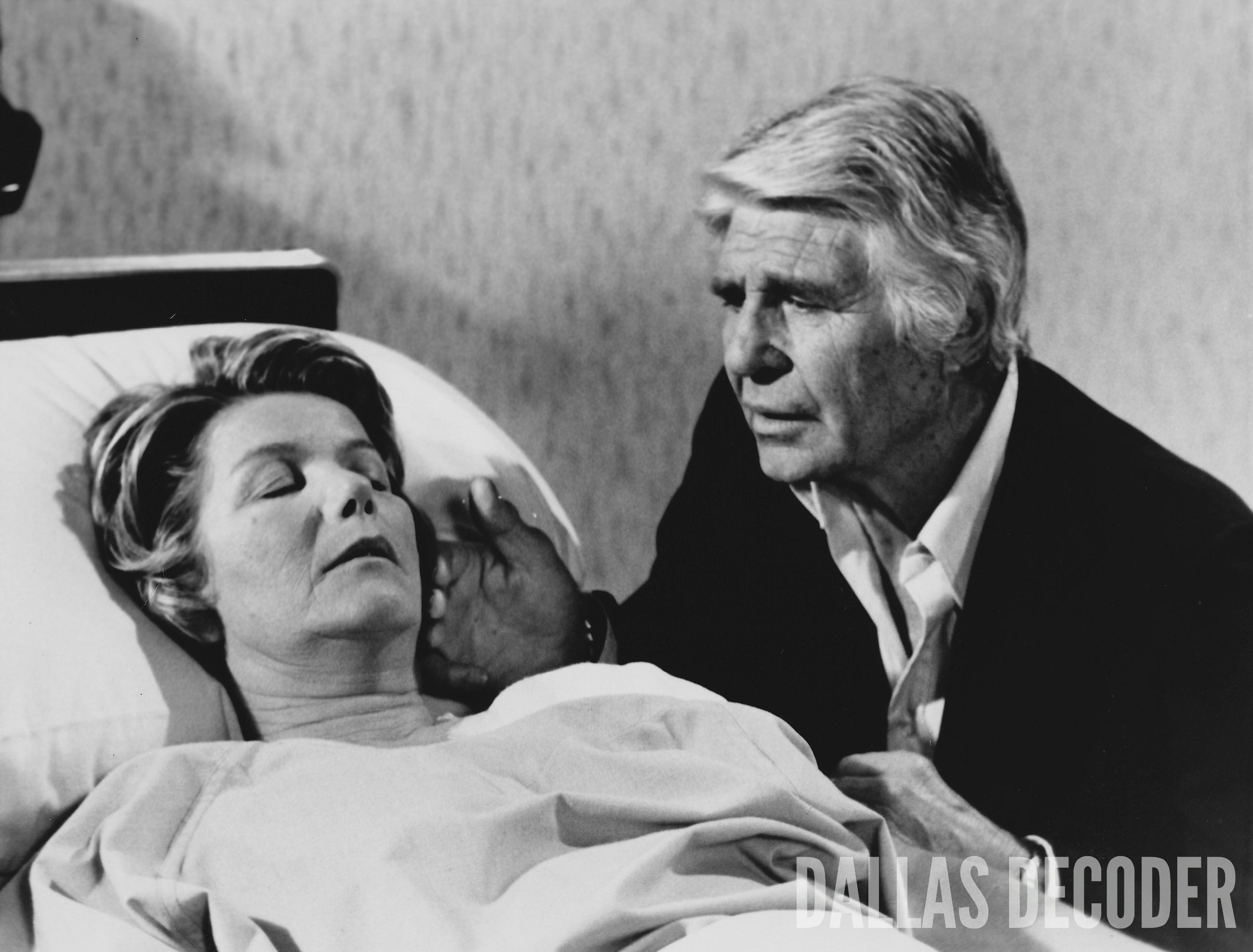
After her cancer surgery, Miss Ellie (Barbara Bel Geddes) is comforted by Jock (Jim Davis) in this 1979 publicity shot from “Mastectomy, Part 2,” a third-season “Dallas” episode.

Dallas Scene of the Day: ‘Jock, I’m Deformed’

Barbara Bel Geddes, Dallas, Mastectomy Part 2, Miss Ellie Ewing

First, you cry

In “Mastectomy, Part 2,” a third-season “Dallas” episode, Jock (Jim Davis) enters his bedroom to find Miss Ellie (Barbara Bel Geddes) on the floor, crying.

JOCK: My God, Ellie. What’s wrong?

ELLIE: Go away, Jock.

JOCK: I wanna help. I can’t leave you like this.

ELLIE: Nothing, nothing fits.

JOCK: I’m telling you, it’ll be all right. It doesn’t matter.

ELLIE: Why doesn’t it matter? Because I’m not young anymore? Don’t you think I care the way I look? Don’t you care?

JOCK: I care for you, Ellie. You. I’m just so happy that you’re alive. Nothing else matters. Nothing at all.

ELLIE: Doesn’t it? Jock, I’m deformed. Doesn’t that matter?

JOCK: You are not deformed, Ellie. If you lost an arm or a leg, I’d suffer that loss with you, too. But it wouldn’t change anything between us.

ELLIE: I’m not talking about an arm or a leg. I’m talking about my breasts. What do you know about that?