Critique: ‘Dallas’ Episode 14 – ‘Survival’

Bobby Ewing, Dallas, J.R. Ewing, Larry Hagman, Patrick Duffy, Survival

Crash of the titans

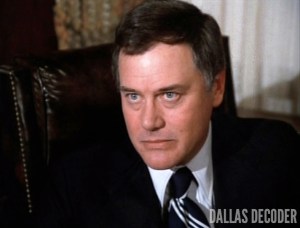
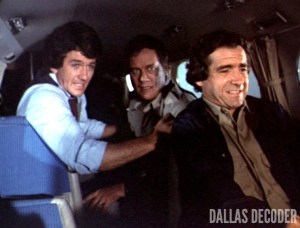
Larry Hagman and Patrick Duffy appear three times in “Survival:” twice in the first act, when J.R. and Bobby board the Ewings’ private plane and when the aircraft begins its descent into Louisiana swampland, and again in the final scene, when the brothers return to Southfork, battered and bruised.

It’s a testament to the strength of “Dallas’s” ensemble that the show’s biggest stars aren’t missed that much. “Survival” seems designed to showcase “Dallas’s” other cast members, and they make the most of it – particularly Barbara Bel Geddes and Jim Davis, who do some of their finest work in this episode.

In one of my all-time favorite “Dallas” scenes, a tense Miss Ellie is talking with Ray in the Southfork foyer when someone knocks on the door. She opens it to find a snoopy newspaper reporter seeking a quote about the crash.

“Ray, get me the shotgun out of the hall closet,” Ellie says. Holding the gun, she tells the reporter, “Anybody on my land, without invitation, is a trespasser. So unless I see your tail heading out of here right now – and fast – I’m going to blow it off.”

I love the sight of Ellie, wearing pearls, wielding a shotgun and forcing a stranger off her property. The words and images are quintessential “Dallas:” modern people defending old values like land and family.

(TNT’s “Dallas” revival appears to pay homage to this scene in promos for its first episode, when elegant Brenda Strong, playing Southfork’s new lady of the manor, is shown cocking a shotgun.)

In another great “Survival” scene, Jock stands on the darkened Southfork patio and orders Ray to join the search party for J.R. and Bobby. “No matter how it turns out, dead or alive, bring my boys home,” Jock says.

Davis delivers the line with characteristic solemnity, but he pauses briefly before and after the “dead or alive” part, as if Jock has to muster the courage to utter the words. It’s a nice, gravity-adding touch.

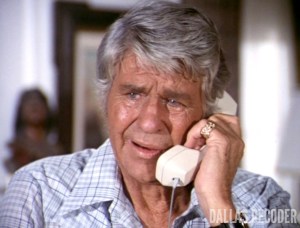
Davis also does a nice job at the end of the episode, when Jock receives Ray’s call and learns J.R. and Bobby are alive. With quivering lips and wet eyes, he tells the ranch foreman to “bring them home.”

If you’re able to watch Davis here and not get choked up yourself, you’re a tougher “Dallas” fan than me.

Grade: A

________________________________________________________________________________________________________________________________________________
Dallas, Jim Davis, Jock Ewing, Survival

Call waiting

‘SURVIVAL’

Season 2, Episode 9

Airdate: November 12, 1978

Audience: 15.6 million homes, ranking 18th in the weekly ratings

Writers: D.C. Fontana and Richard Fontana

Director: Irving J. Moore

Synopsis: The Ewings’ plane crashes with J.R. and Bobby aboard. The family spends a tense night at Southfork awaiting word of their fate. Ray brings the brothers home, bruised but otherwise OK.

Cast: Barbra Babcock (Liz Craig), Barbara Bel Geddes (Miss Ellie Ewing), Jim Davis (Jock Ewing), Patrick Duffy (Bobby Ewing), Linda Gray (Sue Ellen Ewing), Larry Hagman (J.R. Ewing), Andy Jarrell (Ken Jackson), Steve Kanaly (Ray Krebbs), Ken Kercheval (Cliff Barnes), Victoria Principal (Pam Ewing), Charlene Tilton (Lucy Ewing), John Zaremba (Dr. Harlan Danvers)

“Survival” is available on DVD and at Amazon.com and iTunes. Watch the episode and share your comments below.
Dallas Scene of the Day: ‘We’ve Chosen Our Sides’

Bobby Ewing, Dallas, Election, Pam Ewing, Victoria Principal

Running mates

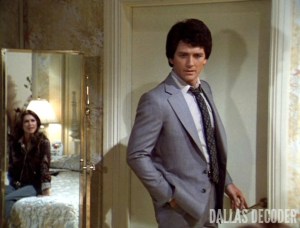
In “Election,” a second-season “Dallas” episode, Bobby and Pam (Patrick Duffy, Victoria Principal) are in their bedroom, discussing her decision to help Cliff’s campaign against a Ewing-backed candidate for state senate.

BOBBY: [Walks toward Pam, who is seated on their bed] Pamela, do you understand what this election means to my family?

PAM: Oh, I understand exactly what it means to your family. It’s a way to get back at my brother!

BOBBY: Now you’re being simplistic Pamela, and you know it. Besides, your brother hasn’t exactly had a hands off policy when it comes to us, now has he?

PAM: Well, what do you expect him to do? If he doesn’t do something, the Ewing family is going to control everyone and everything!

BOBBY: Oh stop it, Pamela! You’re starting to sound like that knee-jerk radical brother of yours. [Begins to leave the room]

PAM: If being a knee-jerk radical means being against exploitation, corruption and greed, I’m proud to be one!

BOBBY: [Walks back toward Pam] Exploitation and corruption of who, of what? Look, my daddy built an empire here because he was smarter than the next guy, and he worked harder – and he was luckier. But anybody with the same qualifications can do the same thing.

PAM: [Stands and faces Bobby] That’s easy to say when you’re born rich. It’s the others Cliff’s worried about!

BOBBY: Oh, Cliff talks a great game but when it comes right down to it, he can play just as dirty as the rest of them.

PAM: [Pauses, then lowers her voice] Well, we see things differently, don’t we?

BOBBY: What I see, Pamela, is what this is doing to us.

PAM: [Sits back down] Well, we’ve chosen our sides.

BOBBY: No. No, not this time. This time, I think we were born into them.

Dallas Scene of the Day: ‘Those Weekly Wild Parties’

Bobby Ewing, Dallas, Double Wedding, Pam Ewing, Patrick Duffy, Victoria Principal

Easy as pious

In “Double Wedding,” a second-season “Dallas” episode, Bobby (Patrick Duffy), emerges from the Southfork swimming pool and tells Pam (Victoria Principal) about his meeting earlier in the day with the church elders.

BOBBY: [Drying off with a towel] Honey, you should’ve met that building committee. They were more interested in whether or not you and I were going to come to their church than they were if there’s enough room for each of the boys to sleep in the dorm.

PAM: [Mischievously] Do I sense a game plan?

BOBBY: [Grabs her arms and faces her] Well honey, I will adopt my most pious expression but you are going to have to cancel those weekly wild parties of yours. Now, I know it’s going to be hard, but Mr. and Mrs. Ewing are going to become pillars of the community – until the contract’s signed.

PAM: [Mock seriousness] I don’t know. I look forward to those wild parties!

BOBBY: I know you do. [Kisses her]

The Art of Dallas: ‘Old Acquaintance’

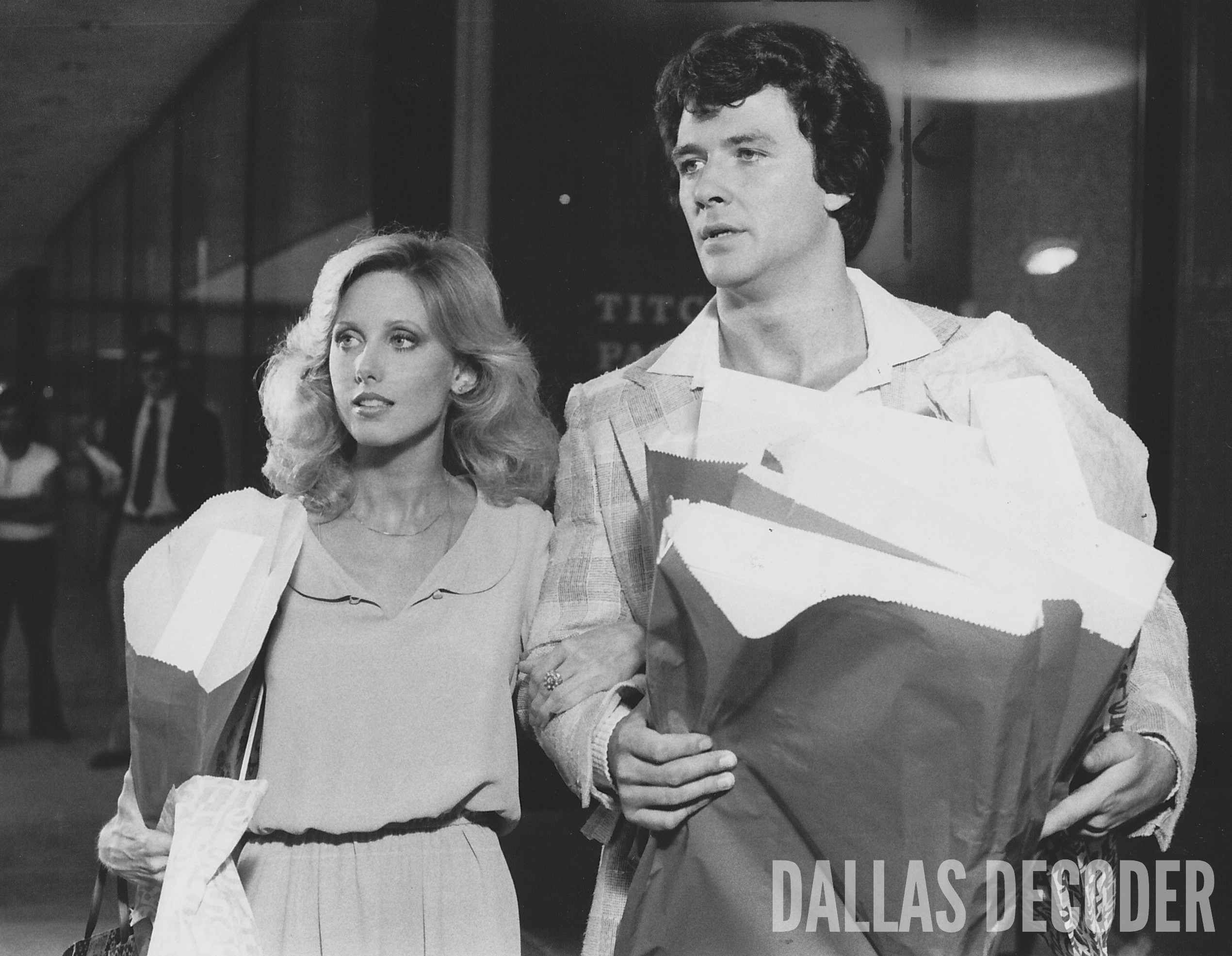
Jenna and Bobby (Morgan Fairchild, Patrick Duffy) shop in this 1978 publicity shot from “Old Acquaintance,” a second-season “Dallas” episode.

‘Dallas’s’ Grand Opening

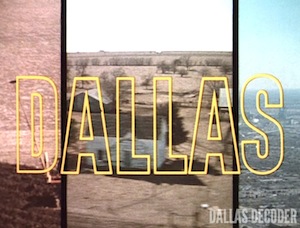
Dallas, opening credits, three-way split, title

Three, three, three

Here’s how I know “Dallas’s” opening credits are special: My husband Andrew never fast-forwards through them.

Andrew watches “Dallas” on DVD, which is how he has consumed a lot of other classic television over the years. With those other shows, whether it’s “Star Trek” or “Sex and the City,” Andrew almost never sits through the opening credits. As he puts it, once you’ve heard Captain Kirk explain the Enterprise’s five-year mission or seen Carrie Bradshaw get splashed by that bus, you really don’t need to experience it again.

For Andrew, “Dallas” is different. He says the title sequence is an essential part of the viewing experience because it puts you in the right frame of mind for each episode.

I agree, of course. For my money, “Dallas” title sequence is television’s all-time best. Jerrold Immel’s driving theme music is a huge part of the credits’ appeal, but so is the iconic three-way split screen used during most of the show’s run.

The sequence was designed by Wayne Fitzgerald, whose other credits include the opening titles for series such as “Matlock” and “Quincy” and movies like “The Godfather, Part II” and “Chinatown.”

“Dallas” is his masterpiece.

The scenes Fitzgerald chose are perfect because they depict the real-life Dallas in all its contradictory glory. He shows us how the city is big enough to host a major-league football team, but raw enough that tractors still roam its countryside. It’s home to glass skyscrapers and long stretches of highway, but it also has herds of cattle and soggy oil fields.

The three-way split screen is also ideal for the cast shots because it signals how multi-faceted the characters are. The images often change from season to season, but we usually see Linda Gray smiling nicely in one screen, while looking pensive and sultry in the other two. For several seasons, Patrick Duffy is depicted as a shirtless grimacer, a cowboy-hatted yelper and a butterfly-collared worrier.

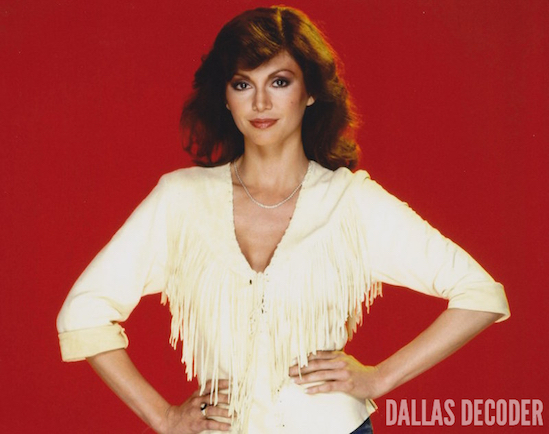
Larry Hagman is usually all smiles in his screens — which is entirely appropriate, since J.R. grins whether he’s savoring a sweet victory or knifing an enemy in the back — while Victoria Principal’s middle screen is almost always that same shot of her walking across a Southfork pasture wearing a plaid shirt and blue jeans.

“Dallas’s” titles carry other meanings too. I don’t think it’s a coincidence the shape of each actor’s middle screen suggests the sloped angles of an oil derrick. More obviously, the titles also let the audience know which actors and characters to invest in.

For example, we know it’s time to start paying closer attention to Sue Ellen and Ray when Linda Gray and Steve Kanaly are added to the credits at the beginning of the second season. Similarly, Ken Kercheval — like Gray and Kanaly, a regular from the beginning — finally gets the title-sequence treatment during the third season.

“Dallas” throws viewers for a loop toward the end of its run, when producers abandon the split-screen in favor of a single shots. Ho-hum. Producers also begin adding actors to the credits the moment they arrive on the show. It doesn’t feel like “Dallas.”

TNT apparently hasn’t decided how to handle the opening credits for its new “Dallas” series, which will debut in June. Jason Matheson, a Minneapolis TV and radio host and a huge “Dallas” fan, raised the question on Twitter last week, prompting a debate over whether TNT should revive the sliding split-screen or find a fresh design for the titles.

I’ll respect whatever decision TNT makes, but it would be a lot of fun to see a new version of those iconic titles.

After all, the classic “Dallas” had television’s grandest opening — and that’s not the kind of thing you close the door on lightly.

What’s your favorite part of “Dallas’s” opening credits? Share your comments below and read more features from Dallas Decoder.

Pam Ewing, Prime-Time Pioneer

Dallas, Pam Ewing, Victoria Principal

O, pioneer!

If re-watching “Dallas’s” first season taught me anything, it’s this: Pam Ewing is one of prime-time television’s pioneering women.

No, really.

When “Dallas” begins, Pam isn’t the Miss Goody Two-Boots many of us remember from the show’s heyday. She’s spunkier, scrappier – and more sexual.

The show makes no secret of the fact Pam isn’t a virgin when she marries Bobby.

In “Digger’s Daughter,” the first episode, J.R. tells his younger brother that Ray, Pam’s ex-boyfriend, has bragged for years about her prowess in the bedroom. Later, in “Barbecue,” the season finale, J.R. ticks off a list of Pam’s past lovers (“Just offhand, she’s known Jack what’s-his-name and Ray Krebbs….”), before dismissing her as “trash, just plain trash.”

In this instance, Bobby belts J.R., but Pam’s reputation doesn’t seem to faze him otherwise. As Bobby tells Ray at the end of the first episode, “Pamela’s past is none of my business. She was not my wife in the past – but she is now.”

Bobby’s attitude is refreshing, but so is Pam’s. She’s never afraid to let her husband know she enjoys sex. In “Spy in the House,” for example, Pam suggestively invites Bobby to help her “try out” their new living quarters.

This makes Pam much different from her sister-in-law Sue Ellen, who feels sexually neglected by J.R. but is almost too afraid to tell him.

Breaking Barriers

Bobby and Pam’s healthy sex life makes them unlike most other couples on television during the 1970s – something Victoria Principal points out during the 2004 “Dallas” reunion special.

Standing next to Patrick Duffy, the actress recalls how unusual it was for them “to portray two happily married people who celebrated their physicality – and who were good vertically and horizontally.”

Yet Pam never seems to get a fair shake from television historians.  (Maybe because “Dallas” is a soap opera?)

When the barrier-breaking women of ’70s television are recalled, the focus is almost always on the characters who pursued careers (“The Mary Tyler Moore Show”), expressed opinions (“Maude”) and raised children alone (“Alice,” “One Day at a Time”).

On “All in the Family,” Gloria Stivic was pretty frisky and “The Bob Newhart Show’s” Emily Hartley seemed to enjoy having sex with her husband, but their experiences were played for laughs.

Pam Ewing is probably the first woman on a prime-time drama who was sexually fulfilled – and not ashamed of it.  She helped make possible “The Good Wife” and other contemporary shows that aren’t afraid to depict women enjoying their sex lives.

Praising Principal

In interviews over the years, Principal has suggested she likes Pam best during “Dallas’s” first season – and when you watch these episodes, it shows. The actress is wonderful – confident, relaxed, charming. She supplies “Dallas” with heart.

Pam’s independent streak continues during the second season, when the character resumes her retail career – a decision that leaves Jock aghast. (“What does she need a job for? Ewing women don’t work!”)

But Pam changes during the third season, when she embarks on an all-consuming quest to give birth – reinforcing the old-fashioned notion that a woman’s fulfillment lies in motherhood.

The evolution in Pam’s character can probably be traced to the departure of “Dallas” creator David Jacobs, who essentially handed over the show’s creative reigns to producer Leonard Katzman after its first season.

Jacobs is a genius at writing for strong women characters, as he demonstrated with his next series, the “Dallas” spinoff “Knots Landing.” Under Katzman, “Dallas’s” depiction of women’s sexuality is different. When women are seen enjoying sex, it’s often under illicit circumstances (J.R.’s mistresses, Sue Ellen’s affairs).

J.R.’s increased popularity with audiences also alters Pam’s character. As he grows nastier, the producers try to counterbalance him by making Pam nobler (read: boring).

But no matter who Pam becomes, we shouldn’t lose sight of who she is when “Dallas” begins – and the trail she blazes during those fascinating first five episodes.

How do you feel about Pam Ewing? Share your comments below and read more opinions from Dallas Decoder.

Dallas Scene of the Day: ‘Of Course We’re Not Enemies’

Dallas, J.R. Ewing, Larry Hagman, Lessons

His alone

In “Lessons,” a first-season “Dallas” episode, J.R. (Larry Hagman) sits on his office sofa and chats with Bobby (Patrick Duffy).

J.R.: I want to tell you how you filled your daddy’s heart with joy when you decided to settle down and come into the business with me.

BOBBY: Well, that’s just it. I’m in the business. I think I have a right to know everything there is to know.

J.R.: Do you? Well, it’s not as simple as that. [Gets up and moves to his desk]

BOBBY: I don’t see why, J.R. We’re brothers – we’re not enemies. [Sits on the desk’s edge]

J.R.: No, of course we’re not enemies. But while you were out there sowing your wild oats, I was learning the business. While you were out there playing football and winning all those honors and everything – I’m not saying there’s anything wrong with that – but I was here, busting my butt under our father. And let me tell you, he’s not an easy man to work for.

BOBBY: I think I can appreciate that.

J.R.: Can you? [Sits and leans back in his chair] And in the last few years, you’ve been out there spreading the b’s around, wining and dining friends of Ewing Oil, and hanging out with fancy women and, in general, being charming. I’ve been making the company work – and I’ve been making it grow.

BOBBY: Well, that’s true enough. Ever since I can remember, all you ever thought about was running Ewing Oil. Seems to me you’re doing the thing you love best.

J.R.: I am. Yeah, I truly am. [Chuckles] But what I’m trying to say is this: I’ve had to make decisions and I’ve had to make deals that the man who runs the company has to make. And that’s my business – and mine alone. [Leans forward] And as long as I’m running this company, Bobby, that’s the way it’s going to stay. Does that answer your question?

BOBBY: Oh yeah. Answered a few of ’em I didn’t even ask. [Leaves as J.R. chuckles]

Dallas Styles: Bobby’s Leather Jacket

Bobby Ewing, Dallas, Digger's Daughter, Patrick Duffy

‘Digger’s Daughter’

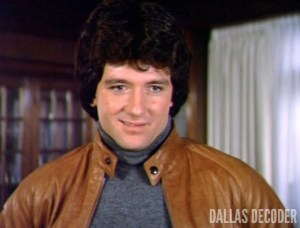
Bobby Ewing’s leather motorcross jacket isn’t as well known as J.R.’s Stetsons or Miss Ellie’s sack dresses, but it’s every bit as durable.

Patrick Duffy is sporting the snap-collared jacket when we meet Bobby in Act I, Scene I of “Dallas’s” Episode 1, “Digger’s Daughter.” The jacket, like the red convertible Bobby is driving, lets the audience know this is a cool young dude.

Bobby Ewing, Dallas, Decline and Fall of the Ewing Empire, Patrick Duffy

‘The Decline and Fall of the Ewing Empire’

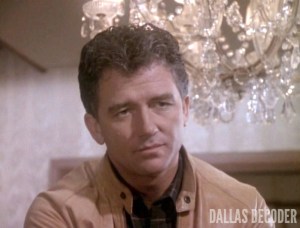
The jacket is metaphorical in other ways, too. We hear Pam’s famous line in this scene (“Your folks are gonna throw me right off that ranch”) and we wonder: Are the Ewings going to tan Bobby’s actual hide when they discover he has married a Barnes?

The jacket pops up periodically after “Digger’s Daughter,” including during the sixth-season episode “Caribbean Connection,” when Bobby sneaks into a motel room to gather dirt on one of J.R.’s cronies. This is a very un-Bobby thing to do, so the leather jacket becomes the perfect prop to telegraph his rebellious streak.

Interestingly, even after Duffy leaves “Dallas,” the jacket doesn’t.

Dack Rambo seems to sport the same brown leather during the Duffy-less dream season, a subtle hint to the audience that Rambo’s character, cousin Jack Ewing, was supposed to fill Bobby’s role as “Dallas’s” resident hero.

Duffy wears a leather motorcross in “Dallas’s” final two episodes, “The Decline and Fall of the Ewing Empire” and “Conundrum,” including in the latter’s last freeze frame. The color of this jacket isn’t warm, so I’m not sure it’s the same one Duffy wore during the previous seasons.

The color change is fitting: By the time “Dallas” ends, the show has faded considerably. Why shouldn’t Bobby’s jacket do the same?

Dallas Scene of the Day: ‘… Put You Up to This, Miss Barnes?’

Dallas, Digger's Daughter, J.R. Ewing, Larry Hagman, Pam Ewing, Victoria Principal

Not-so-grand-tour

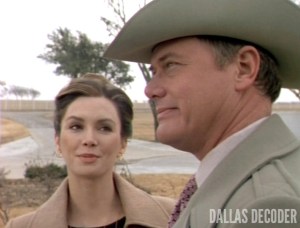
In “Digger’s Daughter,” “Dallas’s” first episode, J.R. (Larry Hagman) shows Pam (Victoria Principal) around the Southfork grounds.

J.R.: Did your brother put you up to this, Miss Barnes?

Pam looks stunned.

J.R.: Well, I don’t think that’s an unusual question to ask, Miss Barnes.

PAM: [Angrily] Mrs. Ewing. Excuse me, please.

She begins to walk away. J.R. grabs her arm. She stops.

J.R.: Perhaps it would be more appropriate to ask what sort of settlement you’d require to annul this farce.

PAM: Let go of my arm.

J.R.: I’m willing to spend some money now to avoid any inconvenience. But if you insist upon being driven away – which you surely will be – you’re going to come out of this without anything, honey.

Bobby (Patrick Duffy) approaches.

BOBBY: Hi there. What’s going on?

J.R.: Oh, just talking a little business.

BOBBY: Mama don’t like business talk with supper on the table, J.R.

J.R.: [Chuckles] Well, you know Mama. She’s so old-fashioned.

BOBBY: [To Pam] Come on, honey. Let’s go.

J.R. smiles as he watches them walk away.