Drill Bits: ‘Dallas’ is on DVD. Go Ahead and Get Carried Away.

Dallas, John Ross Ewing, Josh Henderson, No Good Deed, TNT

Arrested development

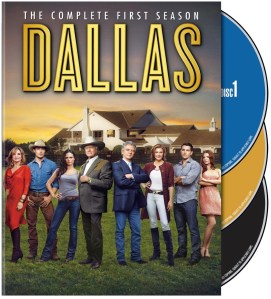
The first season of TNT’s “Dallas” was released on DVD last week. It has all 10 episodes and 2 hours of bonus material, including some Larry Hagman goodness you’ve never seen before.

In other words: Take a day off work. You’re going to need it.

The extras feature more than 25 deleted scenes, including three sequences starring Hagman. My favorite: a moving exchange from “Family Business” in which J.R. promises Ann he’ll protect Sue Ellen from Harris. I won’t give away anything else here, but trust me: This scene alone is worth the price of admission.

A lot of this unused footage will help you see the characters more clearly. Examples: We finally get to see the moment Sue Ellen decides to run for governor, as well as a wonderful exchange where Christopher talks about what it was like for him to grow up as Bobby’s son. The latter scene features beautiful performances from Jesse Metcalfe and Patrick Duffy, who described it as one of his favorite first-season moments during my brief chat with him last year.

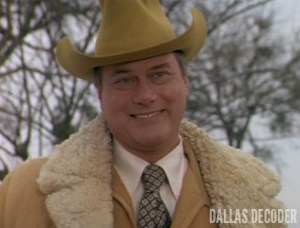
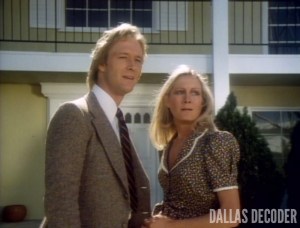
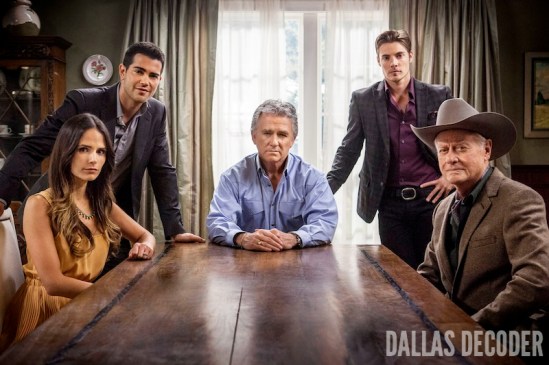
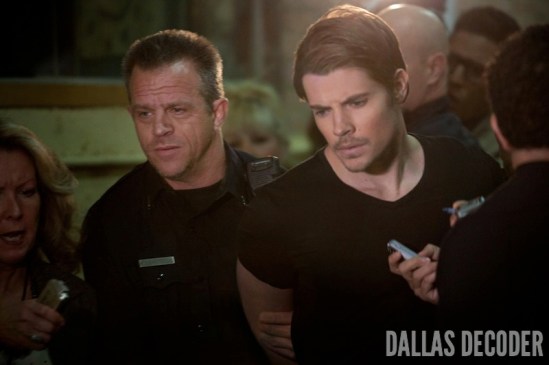
Curiously, the deleted scenes don’t include the one with Josh Henderson from the publicity shot above, which TNT released to promote “No Good Deed,” the episode where John Ross is arrested for Marta’s murder. We also don’t get to see J.R. and Sue Ellen’s dance from “The Last Hurrah,” although given the number of fans who are clamoring for it, something tells me it won’t stay buried forever.

(We do, however, get to see Elena’s visit to a bank, where she scans a plaque listing the board of directors. Sue Ellen’s name is there, along with production designer Richard Berg and other members of the “Dallas” crew.)

The DVD’s other highlight: an audio commentary from executive producers Cynthia Cidre and Michael M. Robin, who do a nice job explaining how much work – and love – went into making the “Changing of the Guard” pilot. Robin, the episode’s director, calls the scene where Bobby visits J.R. in the nursing home one of the highlights of his career, while Cidre reveals it took 10 hours to film the episode’s fantastic dinner scene.

The bonus material also includes new segments on the making of the first season and “Dallas” lore. Also included: the behind-the-scenes production videos that were posted on the “Dallas” website last year, including costume designer Rachel Sage Kunin’s fun “Dressing Dallas” piece.

I could go on, but really, why are you still reading this? Go get the DVD and see for yourself!

Life After J.R.

“Dallas’s” second season begins two weeks from tonight, and the press is beginning to publish stories about what we’ll see. The best preview so far comes from Entertainment Weekly’s Karen Valby, who reports Hagman filmed five episodes before his death on November 23. An extra scene that had been cut from an earlier episode will be inserted into the sixth installment, while Episode 7, which Cidre handwrote in the days after Hagman’s death, will explain J.R.’s absence. His funeral will be seen in Episode 8, which TNT will telecast Monday, March 11.

“Drill Bits,” a roundup of news about TNT’s “Dallas,” is published regularly. Share your comments below.
A Very Merry Thank You

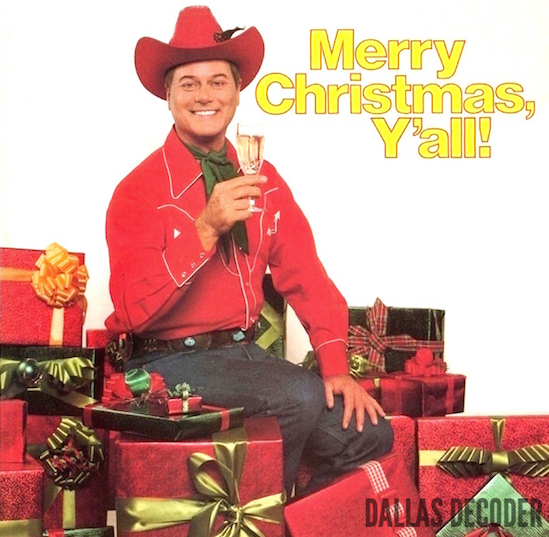
Christmas, Dallas, Larry Hagman, J.R. EwingWith the holidays upon us, I want to take a moment to thank everyone who reads Dallas Decoder. Your support is the gift that keeps giving, and I appreciate it.
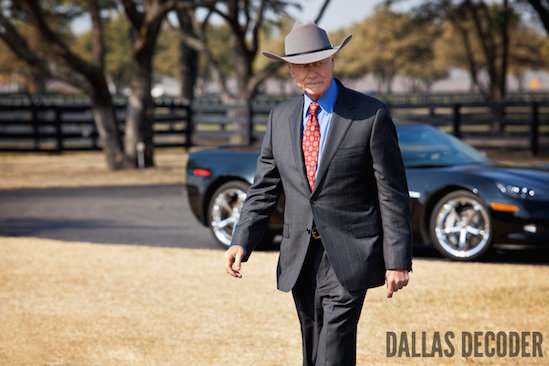


Special thanks go to the folks who share their thoughts in the comments section of each post. Reading your feedback is always the highlight of my day. Your opinion counts as much as mine, and I always learn a lot from you. I feel fortunate to have so many smart, thoughtful and polite readers.

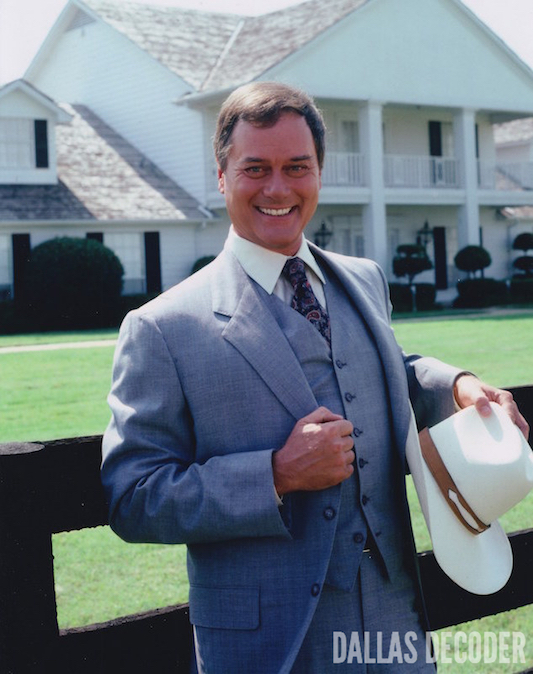
In many ways, this is a bittersweet holiday season for “Dallas” fans. We all feel saddened by Larry Hagman’s death, but I know the community we’re building here at Dallas Decoder will do its part to keep his memory alive next year and beyond. (By the way: The terrific image of Hagman you see here comes from a 1981 People magazine cover.)

So thank you again. I’m going to take a break from posting for a few days, but I’ll be back soon. Until then, have safe and happy holidays.

Dallas Decoder Asks: How Should J.R. die?

Dallas, J.R. Ewing, Larry Hagman, TNT

Exit the hero

J.R. Ewing’s funeral will be seen in the “Dallas” episode that airs Monday, March 11, TNT confirmed yesterday. But how should the legendary character die? And what’s the best way to honor Larry Hagman, the actor who portrayed J.R. for more than three decades? Dallas Decoder asked four members of the original show’s creative team to share their ideas.


GOOD NIGHT, LOVER BOY

Despres

Despres

There’s only one way J.R. should die: He’s got to be shot by a jealous husband. He’s J.R. Ewing – how else could he die? The husband could be a character from the original series or it could be someone new. The show could build a new “Who Shot J.R.?” mystery around the shooting. If he isn’t shot, he should die in the bed of one of his mistresses. No matter how the show kills him off, J.R. shouldn’t die a hero. He should be the villain you love to hate, right until the very end.

Loraine Despres, writer, 1979 to 1980; credits include “Who Done It?”, the episode where Kristin is revealed as J.R.’s shooter


ONE LAST SHOT

Lakin

Lakin

J.R. survived being shot 40 years ago. Maybe this time the bullet hits the mark. Yeah, shameless. But why not? Even if cynics hate the idea, it’ll create buzz and it might just be the best chance of bringing in new viewers to the show. J.R. was TV’s greatest villain and deserves some villainous payback. The funeral? Could be a three-episode event with every former important cast member they can find. Cliff pouring bourbon on J.R.’s grave? Priceless. This is the biggest franchise event imaginable. I also wouldn’t hesitate using flashbacks if at all possible. It may not please the producers who surely would prefer original material but I think viewers would love it.

Howard Lakin, writer, 1980 to 1982; producer/writer, 1988 to 1991; credits include “The Fourth Son,” the episode where Jock discovers he’s Ray’s father 


QUICKLY AND QUIETLY

Preece

Preece

You could always have J.R. called out of town and then have his plane go down, but I would have it play out that he’s been hiding the fact that he has cancer – although you don’t have to say “cancer” necessarily. Remember, when the new show opened, J.R. was in a nursing facility, so it’s possible he’s been ill and no one knew it. There could be scenes of the family reacting to the news that he died suddenly and finding out he hid his illness from them. Whatever scenario the show goes with, they shouldn’t drag it out too long. I don’t think they should do what the original series did with Jim Davis, when they sent Jock to South America for an extended period. With J.R., I think you have to allow him to pass away quickly and quietly.

Michael Preece, director, 1981 to 1991; credits include “Acceptance,” the episode where Miss Ellie comes to terms with Jock’s death


NO TIME TO KILL

Seidman

Seidman

I could never kill off J.R.! I’d have forces bearing down on him that we think have caused his death (in an explosion, perhaps?). No body or a body that of course can’t be identified. And then, every once in a while, a story comes up in which a shady businessman in Hong Kong lost everything to a mysterious figure, or a big deal was made in London that ripped off illegal investors but made some mysterious figure, Mr. X, a ton of money. Is it J.R.? Is he traveling the world, destroying his enemies to the benefit of himself and his family as they receive benefits out of the blue that suddenly save themselves and their company? We’ll never know. We can only hope. These stories would occur for generations, giving him immortality. That’s how I’d write off J.R. Ewing – by never writing him off.

Lisa Seidman, writer, 1989 to 1991; credits include “The Decline and Fall of the Ewing Empire,” the episode where J.R. loses Ewing Oil to Cliff


Now it’s your turn: How would you kill off J.R.? Share your comments below and read more news from Dallas Decoder.

The Dallas Decoder Interview: Michael Preece

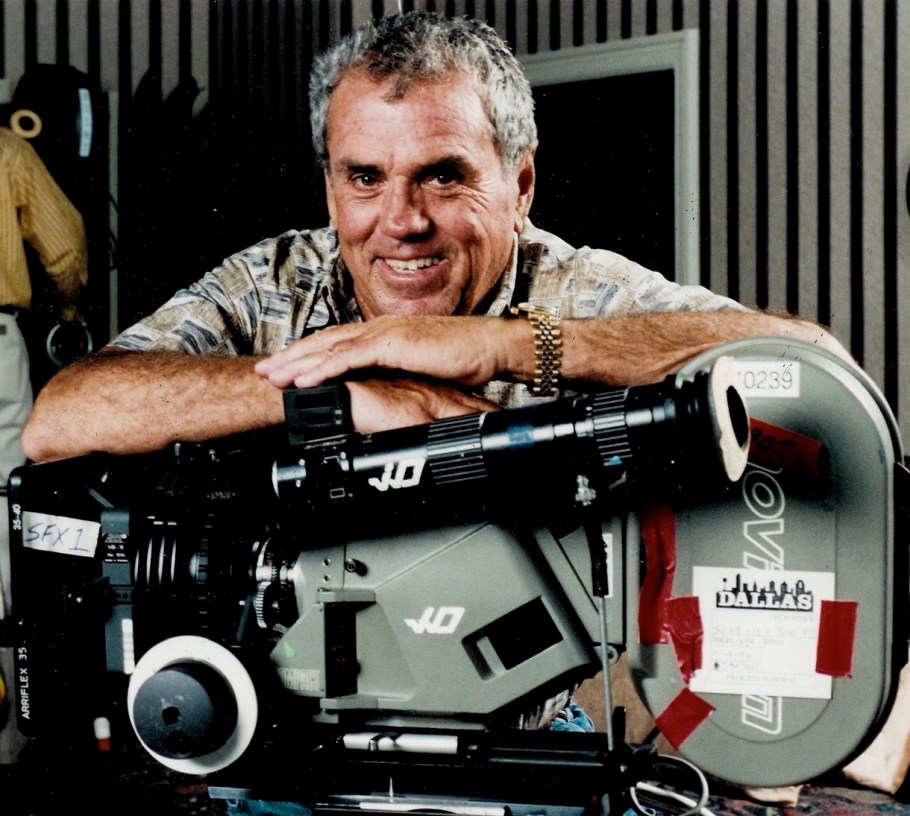
Michael Preece

Michael Preece

No one “shot” J.R. Ewing more often than Michael Preece, who directed more than 60 episodes of the original “Dallas” series. He graciously agreed to share some of his memories of working on the show and with its biggest star, Larry Hagman.

You probably worked with Larry Hagman more than any other director. How much direction did he need when he was playing J.R.?

There was a saying on the set that “Dallas” was director-proof. Larry knew his character. He had a tendency to go a little bigger than was needed, so you’d try to curb him a little bit. Or if he didn’t know his lines well, sometimes he would have them written on cue cards and I’d say, “Larry, you sound like you’re reading it.” But basically, he needed very little direction – and that was true of much of the cast. They made it easy.

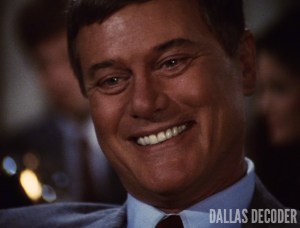
Larry Hagman in “Changing of the Guard”

Larry Hagman in “Changing of the Guard”

Did you two ever have disagreements about how a scene should be played?

Once in awhile, but usually Larry would win. Sometimes we would need an interpretation of something and would call [executive producer] Leonard Katzman because I didn’t know what was going to happen in the next episode and Leonard did. But usually that was worked out before we started shooting. I never had an argument with Larry or Patrick [Duffy] or Linda [Gray]. Not one.

It sounds like it was a pleasant set to work on.

It was a wonderful atmosphere. And jokes, all day long. We never got a clean rehearsal, but when it came time to shoot, the cast would play it perfectly. Most television shows go to 7 o’clock or 8 o’clock at night. With “Dallas,” we’d be leaving the [studio] lot for the day when people on other shows were just breaking for lunch.

Do you have a favorite scene you remember directing?

One scene stands out to me more than any other: when Barbara Bel Geddes goes into the kitchen and throws around the pots and pans after she realizes Jock is really dead. And the dining room scene prior to that, where she’s just sitting there thinking and the other people at the table are just babbling on.

That whole episode is wonderful!

Those dining room scenes were always chaotic. The boys – I call them the boys, Larry and Patrick – would always flick food at each other during rehearsal. So the night before we did that scene, Barbara called me and said, “You know, Michael, tomorrow is going to be difficult for me. Would you ask the boys to behave?” So I made the mistake of going to Larry and Patrick the next day. I said, “You know, this is a very important scene for her, so please, no fooling around.” And they said, “Don’t worry. We’re pros.” So we start the scene – this isn’t a rehearsal, we’re rolling – and the camera’s slowly moving in on Barbara and suddenly a pea hits her. I think it was right in the forehead.

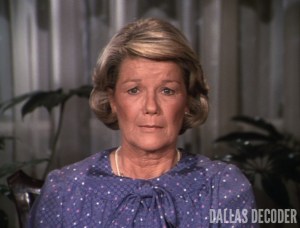
Barbara Bel Geddes in “Acceptance”

Barbara Bel Geddes in “Acceptance”

Oh no!

She never broke. She just kept on acting. And she came back later and said, “I’m going to get you boys!” She had a terrific sense of humor. She loved to swear. I mean, she wasn’t like a sailor and she didn’t swear in anger so much, but she could get her swear words out.

It’s funny to imagine Miss Ellie cursing. She must have been fun to work with.

She was very professional. I would make a point of looking up her old movies and then I’d go up to her and I’d say, “Remember you worked with so and so.” She loved it. She’d tell stories about working with Hitchcock or someone else. A lot of those pictures, I’d never seen them. I learned about them from her.

What was it like when it came time to shoot the scene of her smashing the dishes? That must have been difficult.

Yeah, but only because it had to be precise. She didn’t want to do it over and over because she was crying, and you had to build up that momentum. I remember shooting it quite simply. But “Dallas” was shot very simply anyway. It wasn’t very artistic film-wise.

Was that frustrating? Did you ever think, “Gosh, I wish I could do something more creative here”?

Yeah, very much so. But “Dallas” was basically talking heads. We were able to make a shot once of someone coming out of the elevator, and then they go into one of the offices, and then they go into another office and then they come out [to the reception area] again. All in one shot. And when you see it, you don’t think, “Oh, wow, how’d they do that?” It didn’t draw attention, but it was different.

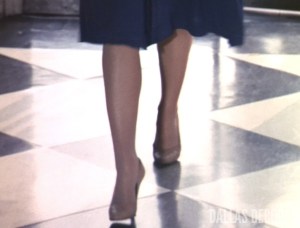
Mary Crosby’s legs in “Full Circle”

Mary Crosby’s legs in “Full Circle”

That reminds me: One of my favorite shots from one of your episodes is the scene where Mary Crosby’s character comes back to town and the first time we see her, the camera is following her legs across a hotel lobby.

I’m glad you remember that! We shot that at the Ambassador Hotel in Los Angeles. They wanted her return to be a little mysterious, so the script read something like, “She’s standing at the desk and turns and you see it’s Mary Crosby.” I remember thinking, “My, she has nice legs. Let’s follow her legs.” You don’t plan something like that.

You mentioned Leonard Katzman a little earlier. He really brought his own vision to the show, didn’t he?

Len would take situations that his family was going through and use them in the plot. I’d sit in on a story meeting and he’d say, “My daughter did this the other night. Let’s put that in a script and give it to Lucy.” Len and I were pretty close, and he would take things from my family too. He was always writing from real-life experiences, whether it was his own or mine or someone else’s. I think that’s the case with a lot of writers – they use what they know best.

It’s interesting to see “Dallas” being made without him. What do you think of the new show?

I want to see more of Larry and Patrick and Linda. I think the kids are good. I think some of them look too much alike, to be honest. [“Dallas” creator] David Jacobs said they should have switched and made Bobby’s son the bad one and J.R.’s son the good one. I thought that was a good idea when I heard it. But [the producers] wanted all-new ideas and new writers and directors, which I completely understand and kind of agree with.

Really?

Yeah. If they hired the writers and directors [from the original], you’d have a lot of, “Well, you know in the old days, we used to do it this way.” That’s the last thing you want to hear. [Laughter] I got into the business a long time ago – 1955 – and I remember hearing people say, “Oh, it’s not like the good old days.” And here it is many years later, people are still saying, “Oh, it’s not like the good old days!”

Well, I agree with you. I’d like to see more of the original stars too. It’s going to be hard to imagine “Dallas” without Larry Hagman.

He could still light up a screen. There are very few people like that. Steve McQueen, Clint Eastwood, Marlon Brando – they had that quality. Larry had it too.

Share your comments below and read more interviews from Dallas Decoder.

The Dallas Decoder Interview: David Jacobs

David Jacobs

David Jacobs

Before J.R. Ewing appeared on our television screens, he existed in the mind of David Jacobs. I was honored last week to speak to Jacobs, who shared his memories of creating “Dallas” and its most famous character, as well as working with the actor who brought J.R. to life, Larry Hagman.

I’ve been thinking a lot about this amazing character, J.R. Ewing, since Larry Hagman’s death. How did you envision J.R. when you created him?

I envisioned him the way he became but not as radical; Larry brought something of his own to the role right away. In the first “Dallas” script [after Pam turns the tables on J.R.], Larry’s last line is, “Well, I underestimated the new Mrs. Ewing. I’ll never make that mistake again.” And the script says he smiles. But Larry didn’t smile. He laughed. It was a small laugh, but he laughed. And that changed it. He took possession of the character at that moment. Because the smile would have said, “Oh, I have a worthy adversary,” whereas the laugh meant, “Hold onto your hats, this is going to be fun.”

It’s funny to think Hagman wasn’t the first choice for the role.

We originally offered it to Robert Foxworth. The producers and I had a conference call with him and he wanted to know why J.R. was the way he was. And we said, you know, he’s made 10 times as much money for the family as his father ever did, yet his father still likes his brother better. Then Foxworth said, “Well, how are you going to make him more sympathetic?” And everyone in the room looked at me to answer that question. At me – this was probably the first conference call I’d been on in my life, and they were waiting for me to answer. And I said, “Well, we’re not. J.R. believes the way business works is, you screw them before they screw you. And he likes that. The process. He loves it.”

Was anyone else considered for the role?

No. After Foxworth passed, Barbara Miller, who was in charge of casting, said Larry Hagman wanted to come in. And my first reaction was, Larry Hagman? He was the Major [on “I Dream of Jeannie”]. I knew he was a good actor because I had seen him in “Harry & Tonto,” where he was just wonderful. And he has a very small role in “Fail Safe,” but it made a big impression on me. He was the translator [who tells the president of the United States about a nuclear disaster]. And Larry walks down the corridor to the president’s office and raises his hand to knock on the door – and he doesn’t. He smooths his hair back with his hand and takes a breath, and then he knocks. I always remembered that gesture.

J.R. (Larry Hagman) in 1978

J.R. (Larry Hagman) in 1978

But you didn’t think he was right for J.R.?

It was more like, “He really wants this role? Hmm.” So he came in the next day. I was sitting in [producer] Phil Capice’s office, with Phil and Mike Filerman, the executive I developed “Dallas” with, and of course Lenny Katzman. My back was to the doorway, and I noticed they all were looking past me, startled, almost. And I turned around and there, in the door was Larry Hagman, in a Stetson and boots. And he came in the room, in character with his Dallas accent. And within two minutes there was never any question J.R. would be played by anyone else.

Oh, wow! I don’t think I’ve heard this story.

It was an amazing performance. You know, he was an established actor. We wouldn’t have asked him to read for the role, but he did read in a sense. He just auditioned in character – for just a few minutes. And then he was back to being Larry Hagman. It was really shrewd of him – intuitively genius.

Now that Hagman’s gone, will you be sad to see this character you created come to an end?

Well, I’m sad that Larry’s gone. Yes, I created the character. And yes, I knew in the phone call with Foxworth the kind of unapologetic villain he should be. But don’t get me wrong: that guy belonged to Hagman. The synergy that created the character of J.R. was the synergy of actor and role more than it was the writer and the actor.

Do you have ideas about how you’d kill him off?

No. I haven’t thought about it. Who knows? I might come up with something brilliant if I thought about it. You know, when they brought back the show [on TNT], I thought about things that I would do differently, but Larry’s death is too fresh. It’s too raw.

How do you think J.R.’s death will affect the new show?

A lot of people have asked me that. I think they’ll probably get a [ratings] bump when they air the episodes that deal with J.R.’s death. But after that, to be perfectly honest, I think the “next generation” has to step up – like every “next generation.” I definitely think the show has the ingredients to stand on its own. Maybe they’re a little afraid of it, but maybe this will get them to do it.

Kind of like the mama bird pushing her baby out of the nest?

Exactly. And of course J.R.’s going to cast a shadow over it forever. But we’ll see.

Gary and Val (Ted Shackelford, Joan Van Ark) in 1979

Gary and Val (Ted Shackelford, Joan Van Ark) in 1979

How do you feel about Gary and Val’s upcoming visit to the new “Dallas”? You played with those characters for 14 seasons on “Knots Landing.” Now they’re going to be in the hands of other writers.

It’s OK. I’m not like [Aaron] Sorkin, whose characters speak Sorkinese and it’s brilliant. I always wrote very stylized dialogue and let fine actors like Joan Van Ark and Ted Shackelford make the words theirs. They’ll still be Val and Gary. So I don’t worry about it.

What do you think Leonard Katzman, the original “Dallas’s” longtime producer, would think of the new show?

He’d hate it.

Really? Why?

He just would. He hated the [original show’s “dream” season] after he’d walked away from it. That season has taken a rap that I don’t believe it deserves. It was trying to freshen up the act. But Leonard hated it.

Well, what about you? Do you like the new show?

I do. It’s great to see Southfork in H.D. and widescreen. Beautiful. I do wish they would slow things down. Mike and I were talking recently and said we could’ve gotten 10 shows from the first five. [Laughter] And not by stretching, but by making it more complex and by making the stories less plot-driven and more character-driven. I think it was Chekov who said plot is character. Whoever said it, I agree with.

Do you think there’s any chance of “Knots Landing” coming back?

No, I don’t think so. “Knots Landing” never had the ratings and the international appeal that “Dallas” had. “Knots” recreated would have to be five younger families living on the cul-de-sac – and not related to the older characters. Because if they were related it wouldn’t be believable. “Knots Landing” was always the hardest show to write because unlike “Dallas,” the conflict wasn’t built into the structure. You always wanted to ask the question: Why don’t they just move out? Why don’t they just stop talking to their neighbors like neighbors everywhere?

Getting back to “Dallas”: Your pilot script is dated December 10, 1977. Thirty-five years later, we’re still watching this show. How does that make you feel?

You know, while it was on the air, it was sort of a guilty pleasure because I wasn’t running it. It was my first show. Afterward I ran “Knots Landing” and my other shows, and “Dallas” was in the hands of Lenny Katzman. But later on, I realized “Dallas” really was the model for all the shows that came after it. Before “Dallas,” there was a great fear of serialization in prime time. Mike and I thought continuing drama was exactly the right form for television. And the form of “Dallas” became the model for all the continuing dramas that followed and are now dominant. So it really did change television in a very not-so-subtle, real way. And I like that.

Well, I know I speak for a lot of fans when I say we’re thankful to you for creating this really fun, fantastic show.

And I’m thankful to Larry Hagman. His loss means something to me. He was a nice man. He was a terrific actor. Absolutely underrated. But God knows he left this earth doing what he loved. A lot of us might wish to go that same way. So I’m glad I was able to provide him with the vehicle that he would use to display his great talent, and I’m certainly grateful to him for being the driving force of a show that has meant a lot to me.

Share your comments below and read more interviews from Dallas Decoder.

Goodbye, Larry Hagman

Dallas, J.R. Ewing, Larry Hagman

Farewell

Larry Hagman has died. Share your memories of him in the comments section below. I’ll share mine soon.

The Dallas Decoder Interview: Howard Lakin

Howard Lakin

Howard Lakin penned several “Dallas” episodes as a freelancer in the early 1980s, then returned to the series as a writer and producer for its final three seasons. To my delight, he agreed to share his memories of working on the show, as well as his thoughts on the TNT revival.

You wrote some of my favorite “Dallas” episodes, beginning with “The Fourth Son,” the one where Ray discovers Jock is his father. What do you remember about making it?

Not too much, honestly. But my own dad was adopted so I’m sure I was able to find plenty of emotional traction in the Jock-Ray relationship. And I think that also might have been a factor later on when I got to plot the J.R.-Vanessa Beaumont-James Beaumont illegitimate son story.

That’s interesting. Did that happen a lot – your drawing on your own family experiences when writing for the Ewings?

In some of the subtle details, maybe. But not in any real core way.

How did it feel when you’d see “Written by Howard Lakin” appear on screen?

Funny to think back on it. But I was in my 20s during my first three-year stint as a freelance writer for “Dallas” and most of my close friends were not TV watchers. Even my wife wasn’t much of a TV watcher so it was kind of hard to muster up a feeling of self-importance when I saw my name onscreen! Although secretly … yeah, it was cool.

J.R. (Larry Hagman) in “Sunrise, Sunset”

Did you have favorite characters to write for?

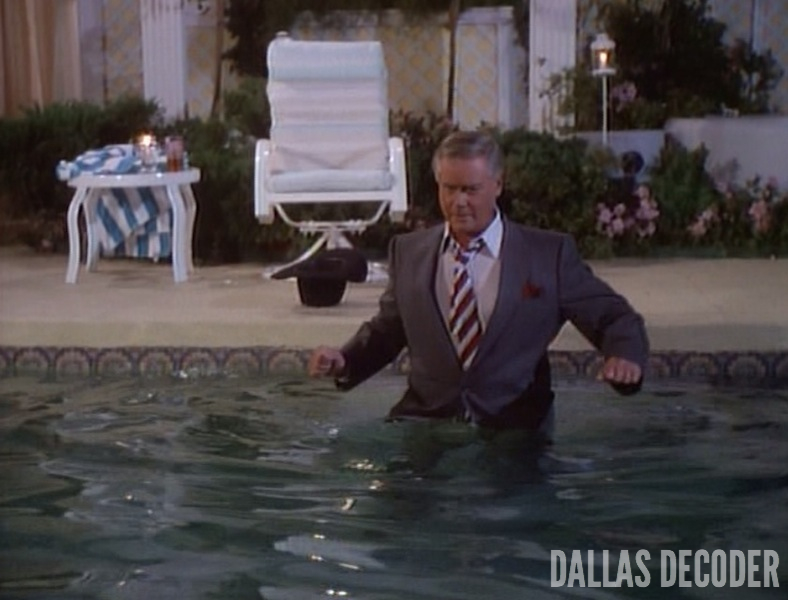
Don’t know why this came to mind, but I remember this one scene I wrote for J.R. where he had to walk into a swimming pool fully clothed in order to cut a deal. [“Sunrise, Sunset” during Season 13 – Ed.] But when I saw the dailies, Larry Hagman had ad-libbed a kind of Texas strip tease before getting wet. Off came his hat slowly, off came his watch slowly, out came his wallet, almost seductively. Larry Hagman gave J.R. such character nuance that writing J.R. was fun; whatever I brought to the table, Larry made it better. That said, I also especially enjoyed writing Sue Ellen. Her long character trajectory was one of the most engaging to work on.

Any favorite “Dallas” episodes?

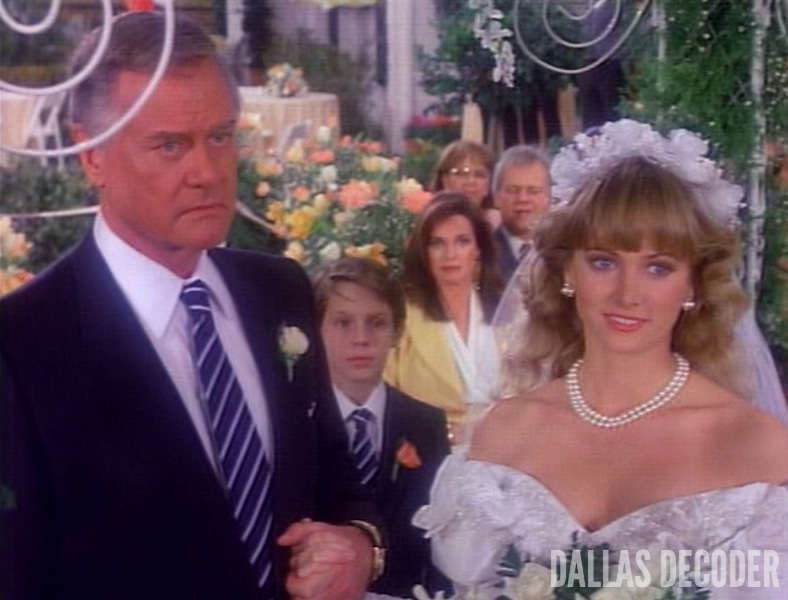
“Wedding Bell Blues” always pops into my head. It was the first “Dallas” episode I both wrote and produced and it marked a change for the show. “Dallas’s” ratings were being impacted by fresh new competition in the late 1980s. These new shows had a much faster pace and a lot more flash. [Producers] Len Katzman and Art Lewis both wanted to keep the show moving forward so it was agreed we’d try to change with the times. “Wedding Bell Blues” was the first step in the process. I guess the feeling at the time was that if we were going to grow old, it wasn’t going to be a rocking chair thing. We were going to take some chances and go down fighting.

J.R. and Cally (Hagman, Cathy Podewell) in “Wedding Bell Blues”

I love “Wedding Bell Blues”! That’s the episode where a storm strands everyone at Southfork on the night of J.R. and Cally’s wedding. It’s probably one of the most light-hearted “Dallas” episodes.

Larry Hagman directed the episode and really had fun with it.

Were there times you’d see one of your scenes after it was filmed and think, “Wow, that’s not how I envisioned it when I wrote it?”

Not really, not that I can remember. More credit to Len Katzman. He was that rare exec producer who came up the hard way, sweeping out sound stages as a teenager – I think I have that right – followed by decades of hands-on experience. He had a great grasp not just of his own job but he really understood the intricacies and elements of everyone else’s job. And in an industry that is known for “creative conflict,” he had a calming influence, it seemed, on everyone. This translated into a “no surprises” kind of show when it came time to look at the rough cut.

What was it like to work on “Dallas” toward the end of its run? It seems like a lot of fans are critical of the final years. What’s your response?

Instead of focusing on negatives, because in a weird way that just tarnishes the show’s overall reputation, I’d love to hear about some upbeat takeaways from the show’s later episodes now that 20-plus years have passed. What was fun, what made folks feel, what do they still remember with fondness, you know? After 20 years, it might be time to look back and re-visit the good stuff. Personally, having experienced both the glory years and the do-not-go-gentle-into-that-good-night years, I prefer the latter. CBS, Lorimar and Elvis had left the building. Len had won the right to bring the ship home all on his own and in terms of working conditions, it had the most relaxed vibe of any show I ever worked on.

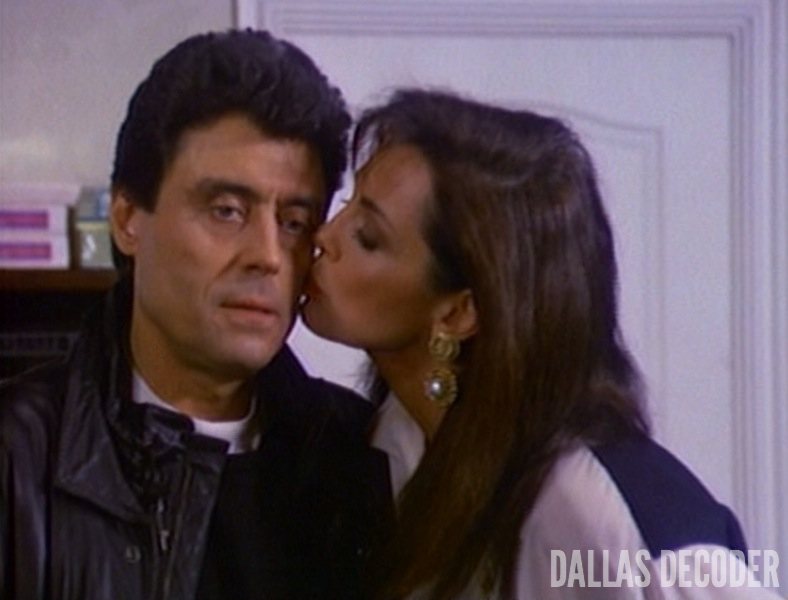
Don and Sue Ellen (Ian McShane, Linda Gray) in “The Serpent’s Tooth”

Do you have a favorite storyline from those final years of the show? Something you think worked really well?

Off the top of my head, I think …well, I don’t know if these were the story lines that worked best but I really enjoyed crafting the three romances which featured Bobby-April, J.R.-Vanessa, and especially Sue Ellen and Don Lockwood because I was determined that Sue Ellen should have a powerful, positive walk-off ending. I really enjoyed Ian McShane. He was fun to work with and a cool dude – aside from being an awesome actor. Gayle Hunnicutt was a class act and a nice person to boot. And Sheree Wilson did a good job with the long romantic build-up and payoff in Paris with Patrick Duffy.

If the show had been renewed for a 15th season, do you have any idea what storylines you might have pursued? Any idea how the cliffhanger with J.R.’s “suicide” attempt would have been resolved?

I don’t remember any discussion of “what if” so I can’t help you there. If we had known there was going to be a 15th season, I doubt very much that the suicide storyline would have been used at all.

You’ve talked in past interviews about how every “Dallas” character reflected some facet of Leonard Katzman’s personality. Can you talk a little more about that?

It’s just my opinion. But here’s an example: Art Lewis and I would sit with Len for endless hours in his dark office, windows shut, stuffy as hell, hashing out stories. I would have mock arguments with Art, each of us taking the story choices in different directions. Len would just listen. More argument, Len would just listen. Ideas, ideas, how a character should react, what would Bobby do, whatever, then at some point Len would literally swivel in his chair so we couldn’t see his face – this could last for five seconds or two minutes. Then he’d swivel back and give us a satisfied smile and let us know which of our many ideas were correct according to the grid through which he saw the whole arc of the show. It was like he could slip into the skin of each character.

Any thoughts on what Mr. Katzman might make of the new TNT series? And what do you think of the show?

I definitely like the new show. It’s really remarkable how it remains true to the spirit and mythology of the original and yet adds all this new good stuff. Can’t speak for Len Katzman but I know he’d be very pleased with its success.

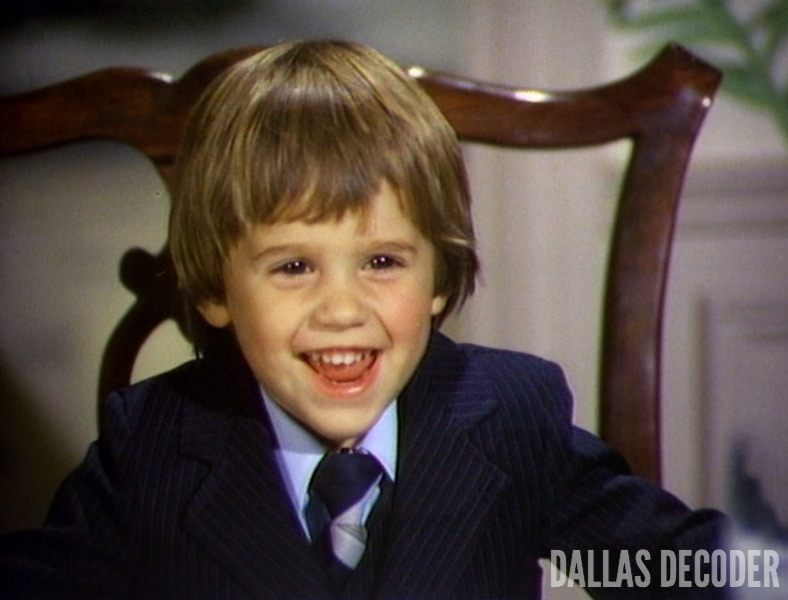
John Ross (Tyler Banks) in “Head of the Family”

It’s funny: One of the first episodes you wrote, “Head of the Family,” ends with little John Ross sitting in Jock’s chair at the head of the Southfork dinner table. It kind of predicts the whole TNT series!

Damn, I totally forgot about that.

You’re now a rare book dealer. How did that come about?

Showbiz, especially episodic work, is so adrenaline-driven that I really needed ways to chill. Before I got my MFA degree at UCLA film school, I got a degree in lit from Antioch College. Charles Dickens, Jane Austen, Thomas Hardy – read everything they wrote. Decided to collect their first editions. Built such a good collection that eventually it morphed into Lakin & Marley Rare Books here in San Francisco.

You just published a novel. What can you tell us about it?

It’s brand new, called “California Noir.” You can buy it on Amazon or ask for it at your local bookshop. It’s an emotional thriller, equal parts suspense and romance. Don’t want to do any spoilers so, in classic TV shorthand, think of it as “Dallas” meets “Casablanca,” a film noir novel that’s just as much a love story as it is a mystery to be solved.

Getting back to “Dallas:” The series has now spanned several decades. What do you think is the secret of its enduring appeal?

Live long enough and you can end up literally watching hundreds and hundreds of television series, many absolutely brilliant, most the usual re-mix or formula. “Dallas” is much more saga than series. Its narrative is expansive, and larger than life and convoluted in a good way. From my point of view, what makes it endure is also what makes it iconic. I mean, despite its oversized Texas storytelling, anti-heroic bluster and Dickensian cast of characters, there is still so much to care about on a human level and a whole lot of universality in how it deals with complex family love, family business and family conflict. That’s my take on it anyway.

Share your comments below and read more interviews from Dallas Decoder.

Drill Bits: TNT’s ‘Dallas’ Saddles Up for Season 2

Battle Lines, Bobby Ewing, Christopher Ewing, Dallas, Elena Ramos, Jesse Metcalfe, John Ross Ewing, Jordana Brewster, Josh Henderson, J.R. Ewing, Larry Hagman, Patrick Duffy, TNT

Mark your calendars

TNT’s “Dallas” won’t return with new episodes until January 28 – that’s 113 days from today, not that I’m obsessive enough to keep track of such things – but details about the second season are beginning to emerge:

Casting. Yesterday, TV Line reported Judith Light will join the cast as “an authoritative and controlling battle-ax who will fight to the death to protect the people she loves.” Speculation is the recurring character, whose name hasn’t been announced, will be the mother of Brenda Strong’s Ann Ewing.

It seems Ann’s wing of the family tree is growing: In the summer, TNT announced plans to elevate first-season guest star Mitch Pileggi, who plays Ann’s ex-husband/punching bag Harris Ryland, to a regular cast member in Season 2. And in a recent Ultimate Dallas chat, showrunner Cynthia Cidre confirmed another new character – Emma Brown, played by “Walking Dead” actress Emma Bell – will be Ann’s daughter.

Still no word on who’ll portray Drew Ramos, Elena’s brother, who Cidre discussed in an August TV Guide interview.

Storylines. In a press release last week, TNT revealed what we’ll see during the show’s two-hour season premiere:

Sue Ellen’s run for governor will be threatened by the secret that she bribed a medical examiner to help get John Ross off the hook for murder. Ryland will come to Ann claiming to have news about her daughter. Christopher will head to Des Moines to find the real Becky Sutter, while the woman he married will start to show her true colors as Cliff Barnes’ daughter. And J.R. will team up with John Ross to take over Sue Ellen’s loan to Elena and, in turn, gain total control over Christopher and John Ross’ new startup company, Ewing Energies.

Dallas, Enemy of My Enemy, Harris Ryland, Linda Gray, Mitch Pileggi, Sue Ellen Ewing

Back for more

Elsewhere, during a red carpet interview last month, Jesse Metcalfe said the second season will offer “some unexpected deaths” (egad!), while Patrick Duffy told TV Guide the aforementioned Becky Sutter will be “jumping into bed with people.”

Meanwhile, tweets from Texas, where production on the second season began two weeks ago, suggest Christopher and Elena (Metcalfe and Jordana Brewster) will have a Southfork swimming pool scene, while John Ross (Josh Henderson) and Christopher will be spending plenty of time at the nifty new offices of Ewing Energies.

Also: the Dallas Morning News spotted Strong and Henderson filming a scene at a Dallas art gallery, where Ann “commissioned a painting for her new offices,” as well as a sequence where one of the new characters takes a helicopter ride.

Returning favorites. Dallas Decoder readers will recall Ken Kercheval recently told us he’ll appear in at least one second-season episode. There also have been reports Audrey Landers will reprise her role as Afton, the mother of Julie Gonzalo’s character, Pamela Rebecca Barnes. Cidre has also promised Linda Gray will be in all 15 second-season episodes.

Sue Ellen vs. Carrie

TNT will show “Dallas’s” second season on Monday nights at 9, where its competition will include the CW’s “The Carrie Diaries,” which is slated to take over “Gossip Girl’s” time slot in January. The “Sex and the City” prequel follows Carrie Bradshaw’s teenage years in the 1980s and stars hyphenate-phobic AnnaSophia Robb as the title character. In the Sue Ellen-vs.-Carrie showdown, our money is on Miss Texas.

‘Dallas’ on DVD

If you need a refresher on the first season of TNT’s “Dallas,” don’t worry: the DVD will go on sale beginning January 8 (that’s just 92 days from today – again, not that we’re keeping track).
Extras will include deleted scenes, audio commentary on the “Changing of the Guard” pilot, “Ewing Family Love Oak” and “Dressing Dallas” featurettes and a “Who Shot J.R.?” retrospective.

In addition, TNT will show episodes from “Dallas’s” first season during the weekend before Season 2 starts.

Cidre Speaks

In a new profile, Cidre tells the Hollywood Reporter the show that inspired her most when she was younger was “The Avengers,” while her guilty pleasure is “The People’s Court.”

The “Dallas” executive producer also reveals she doesn’t “love” writing. “It’s a language thing, it comes out backwards. I know exactly what I want to say, it’s just hard for me to find the words.”

Honey, we know the feeling.

“Drill Bits,” a roundup of news about TNT’s “Dallas,” is published regularly. Share your comments below.

… And We’re Back

Announcement - And We're Back copy

Nice to be back

After taking a breather in August, Dallas Decoder is back.

This week, I’ll post “Best & Worst” reviews for each of the original “Dallas’s” first three seasons, as well as my wrap-up of the TNT series’ inaugural season.

Next week, I’ll resume critiquing the classic show’s episodes, picking up where I left off in the middle of the fourth season. I also plan to add some new features and drop older ones – and then before you know it, 2013 will be here and it’ll be time to dive back into TNT’s “Dallas,” which is slated to begin its second season in January.

I want to take this opportunity to thank everyone who reads Dallas Decoder. Your support means a lot to me. I hope you’ll continue to read and share your feedback – and if you haven’t already done so, please consider “liking” Dallas Decoder on Facebook and following us on Twitter and Pinterest.

Enjoy Labor Day and I’ll see you back here tomorrow!

The Dallas Decoder Interview: Ken Kercheval

Ken Kercheval

TNT’s “Dallas” just finished its first season with three big revelations: Cliff Barnes is Rebecca’s father (!), the mastermind behind her scheme (!!), and the owner of a really cool jet (!!!). Ken Kercheval, Cliff’s real-life alter ego, graciously spoke to me this week about his iconic character and what the future might hold for the Barneses and the Ewings.

So tell me: What’s it like to be playing Cliff Barnes again after all these years?

Same old, same old. I know this guy pretty well so it’s just like putting on the same set of clothes that you wore a few years back.

When the producers invited you to reprise the role, did they talk to you about the direction they were planning to take Cliff?

The only thing they said is that he had gone off and become very, very, very rich. Richer than the Ewings. That’s it. That’s absolutely all I know.

Cliff has done a pretty mean thing, using his daughter to get back at the Ewings – including his nephew Christopher. What do you think of that?

Damned if I know. I swear, I don’t have a clue. [The producers] are very, very close-mouthed about where they’re going with it.

Will you be back next season?

I will be. So far they only have four episodes written and I know I’m in the fourth one. I’ll be filming that at the very beginning of November, and then I go to England to do the Irving Berlin musical “White Christmas.”

Maybe you’ll get to work with Linda Gray again. You two always had great chemistry.

She’s always fun to work with. She knows what she’s doing. I think [the writers] should rekindle Cliff and Sue Ellen’s love affair.

Cliff in “The Last Hurrah” (Photo credit: Zade Rosenthal/TNT)

I think that would be great.

I do too!

You two filmed a scene this season that was cut before TNT showed the episode [“The Last Hurrah”] on television. Can you tell us what we missed?

There’s a scene outside the opera house where we’re walking along [and] I’ve offered [Sue Ellen] my financial support for her running for governor. And she says she has to turn it down. And I [say], “Why? Have you got a better offer?” And I just stop her and say, “J.R. is absolutely never going to change. Don’t bank on [him] because the man will never change.”

It’s a shame we didn’t get to see that. Hopefully when the first season is released on DVD, the scenes that were edited out will be included as extras.

Maybe. I never could figure out why they were cut. To begin with, the one scene was replaced by the birthing of that calf.

What did you make of that?

I thought, what’s that relevant to? I didn’t understand it. But, you know, it’s not my place to understand it. I think the writers are extremely clever. And I know that Cynthia [Cidre, the executive producer] told me that her team of writers sat down and watched every single episode that had ever been filmed of the [original] show. I said, “I hope they got paid well.” That’s a lot of work.

What was it like to film the airport hangar scene where Rebecca is revealed as Cliff’s daughter?

Cold. Very, very, very cold. But it was nice working with Julie [Gonzalo, who plays Rebecca]. She’s so good! Among the younger cast, she’s the only one besides [Jesse Metcalfe, who plays Christopher] that I’ve done a scene with.

You think highly of Cynthia Cidre, too.

She’s fantastic. Oh, she is one smart woman. She really knows what she’s doing.

If we can go back in time for a minute, you and Larry Hagman are the only actors who were regulars during all 14 seasons of the original “Dallas.” Do you have favorite scenes from the old show that stand out?

When I first reunited with my mom [Rebecca Wentworth, played by Priscilla Pointer], I think, is my favorite scene.

The “licorice scene” where Cliff tearfully offers his mother her favorite candy. I love that one too.

That was a powerful scene for me.

You also had one with Barbara Bel Geddes, where Cliff sits with Miss Ellie on a park bench and basically makes amends for the whole Barnes-Ewing feud.

Oh, definitely. I remember that scene very well because we almost never worked together. [Before filming] I went to her trailer and we were going over the lines and I said, “Well, right here, when I say this line, can you turn and look at me?” And she thought about it and said, “Well, I don’t think that would be right, Kenny.” So then when we filmed the scene, I delivered that line and she didn’t look at me so I didn’t say my next line. And so finally she looked at me. And when the scene was over, she said, “You dirty dog. I told you I didn’t want to look at you and you tricked me into looking at you!”

Barbara was my best friend on the show, off stage. My very best friend. She’d say, “Kenny, if you were just a little bit older or I was a little bit younger….”

When you were playing Cliff the first time around, did you like him?

Yeah, I did. I really did. I thought he was a nice guy too. J.R. was coming after my ass all the time, so I was always had to defend myself. If I did something that wasn’t quite right, it’s because I had to.

Well, now Cliff seems to have the upper hand. I’m looking forward to seeing what his next move will be.

I am too!

Share your comments below and read more interviews from Dallas Decoder.