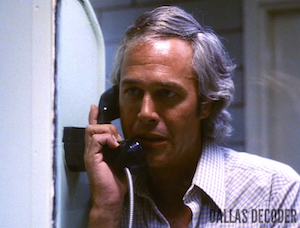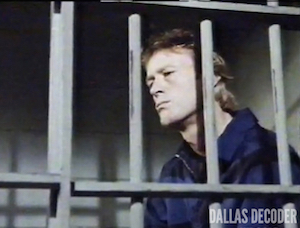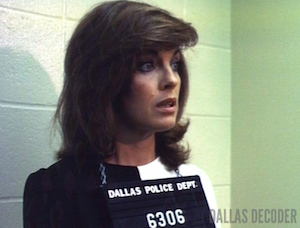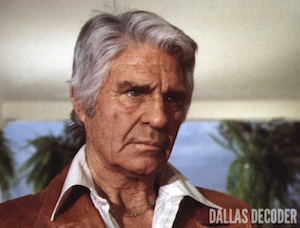
The Dal-List: Classic ‘Dallas’s’ 10 Most Memorable Monologues

Ann Ewing, Brenda Strong, Dallas, TNT, Trial and Error

Testify!

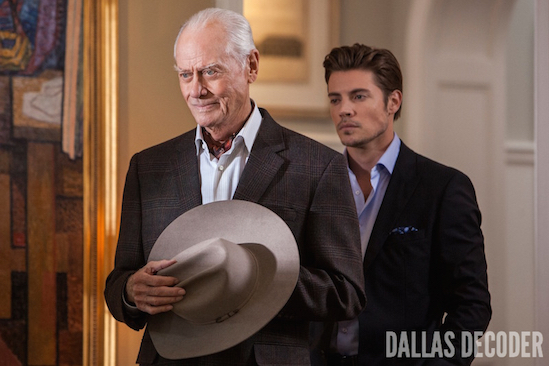
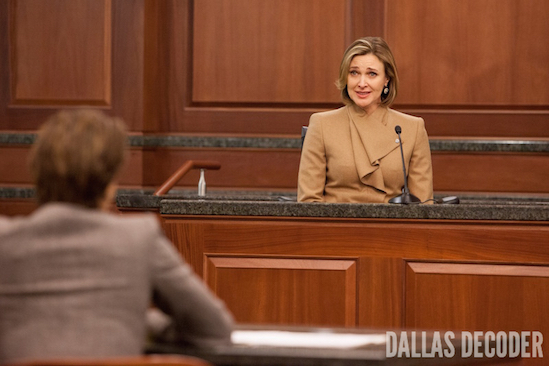
Few will forget the courtroom testimony that Ann (Brenda Strong) delivered at the end of “Trial and Error,” last week’s “Dallas” episode. Here’s a look at the Barneses’ and Ewings’ 10 most memorable monologues from the original series and its “Knots Landing” spinoff.
Barbara Bel Geddes, Dallas, Miss Ellie Ewing

Curses!

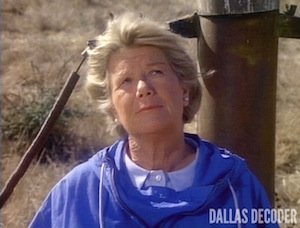
10. Miss Ellie’s lament. With the Ewing empire on the brink of collapse, Miss Ellie (Barbara Bel Geddes) goes to the site of Jock’s first strike and curses his memory. “Damn it all, Jock. You couldn’t have been an insurance salesman. Or a shoe salesman. No, you had to have oil in your blood. In your heart. And now … our sons are fighting for their lives.” It’s one of the better moments from one of the show’s better later episodes. (“Judgment Day”)
Dallas, Pam Ewing, Victoria Principal

She remembers mama

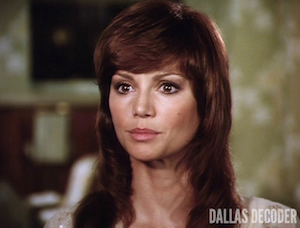
9. Pam’s discovery. Pam (Victoria Principal), believing Rebecca Wentworth is her long-lost mother, confronts the Houston matron in her opulent home. “I found you. You’re alive. And I’m so happy. I don’t know how to tell you how happy I am,” she says through tears. With every line, Principal seems to reveal a little more of herself, so much so that by the end of the speech, her lip quivers uncontrollably. Bravo. (“The Prodigal Mother”)
Dallas, Priscilla Pointer, Rebecca Barnes Wentworth

Runaway mom

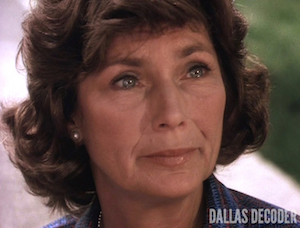
8. Rebecca’s confession. After denying her identity, Rebecca (Priscilla Pointer) sits with Pam on a park bench and tells her the truth: She is, in fact, Pam’s mother. “I never divorced Digger,” Rebecca says as her voice begins to crack. “I was afraid that if I tried, he’d find me, and drag me back to that awful life. Pamela, I saw a chance for happiness, and I took it. Don’t blame me for that.” Pointer’s delivery is hauntingly beautiful. (“The Prodigal Mother”)
Dallas, Gary Ewing, Knots Landing, Ted Shackelford

No beach bum

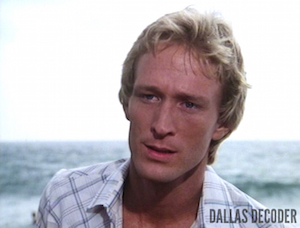
7. Gary’s mea culpa. Gary (Ted Shackelford) begs Lucy to stay in Knots Landing and apologizes for his past sins, telling her he’s trying hard to be a better man. “I’m not a loser anymore,” Gary says. At one point, he becomes tongue-tied, as if he can’t find the words to convey his guilt and regret. In the DVD commentary, Shackelford laughs and suggests he paused because he couldn’t remember his next line. No matter. It still works. (“Home is For Healing”)
Dallas, Linda Gray, Sue Ellen Ewing

Bye bye, love

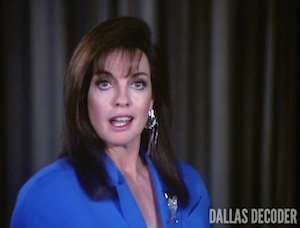
6. Sue Ellen’s kiss-off. In Linda Gray’s “Dallas” departure, Sue Ellen shows J.R. the scandalous movie she’s made about their marriage – and vows to screen it for the public only if he misbehaves. “If I feel that you’re not doing right by John Ross … or if I get up on the wrong side of the bed one morning. Or if I’m simply bored – then I’ll release the movie. And then, J.R., you will be the laughingstock of Texas.” Corny? Sure, but also mighty triumphant – and darn memorable. (“Reel Life”)
Cliff Barnes, Dallas, Ken Kercheval

Never too late

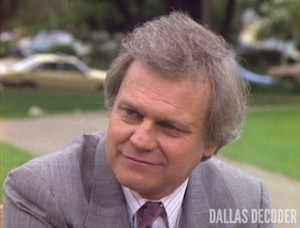
5. Cliff’s regret. My favorite Ken Kercheval scene: Cliff summons Miss Ellie to a park and apologizes for perpetuating his father’s grudge against the Ewings. “Digger was wrong, and I was wrong. If it’s not too late. I’d like to make peace. I’d like to ask you to forgive me,” Cliff says. In an interview with Dallas Decoder, Kercheval fondly recalled his friendship with Bel Geddes. What a shame these two pros didn’t get more screen time together. (“Brother Can You Spare a Child?”)
Dallas, Jim Davis, Jock Ewing

American dad

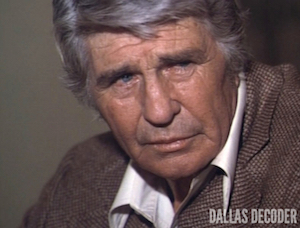
4. Jock’s plea. After Pam suffered her first heartbreaking miscarriage, Jock (Jim Davis) sat at her bedside and begged her and Bobby not to leave Southfork. “Us Ewings, we’re just not an easy family to live with, as you found out. We’ve had things our way for so long that maybe – well, maybe it got in the way of our being just people. I guess that you don’t have no reason to really care, but I want to keep my family together.” Who knew the old man could be so soft? (“Barbecue”)
Dallas, Ray Krebbs, Steve Kanaly

He knows father best

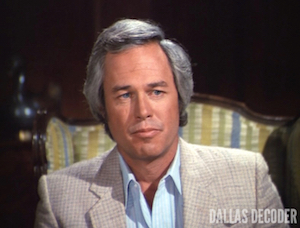
3. Ray’s tribute. Ray (Steve Kanaly) tries to make Miss Ellie accept Jock’s death by reminding her of his humanity. “He was a man, just like anybody else. He had friends. He had lots of friends. But he had enemies, too. He was human, ambitious. He knew that the oil game was rough, hardball all the way. But he wanted what was best for his wife, and for his sons. And he did what he thought was right.” The most honest eulogy Jock ever received. (“Acceptance”)
Dallas, J.R. Ewing, Larry Hagman

Honor thy daddy

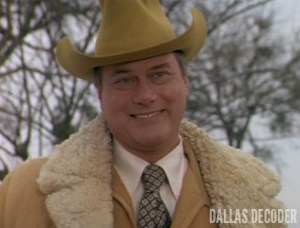
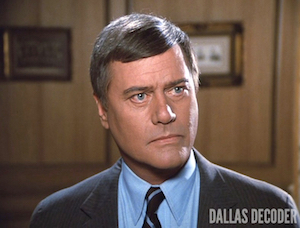
2. J.R.’s promise. J.R. (Larry Hagman), after slipping into a depression over Jock’s death, addresses a portrait of his father. “I’m back, Daddy. And nobody’s going to take Ewing Oil away from me. Or my son, or his son. I swear to you. By God, I’m going to make you proud of me.” The combination of Hagman’s conviction, scriptwriter David Paulsen’s dialogue and Bruce Broughton’s rousing score never fails to give me chills. (“The Phoenix”)
Bobby Ewing, Dallas, Patrick Duffy

Exit the hero

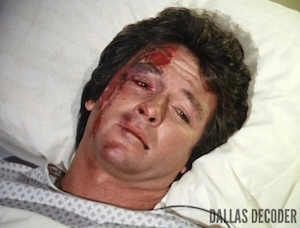
1. Bobby’s goodbye. As Bobby (Patrick Duffy) lay dying in his hospital bed, he bids his family farewell. To Miss Ellie: “Oh, Mama. I’m sorry.” To Pam: “All that wasted time. We should’ve been married.” He seems to be looking at J.R. when he delivers his last words: “Be a family. I love you so much.” Duffy has never been better, and when the monitor flatlines and Principal leaps? Fuhgeddaboudit! Yes, the scene’s emotional impact is diminished somewhat by the fact it turned out to be a dream. Still, does “Dallas” get better than this? (“Swan Song”)

Which “Dallas” monologues moved you most? Share your choices below and read more “Dal-Lists.”
The Dal-List: The 5 Most Egregious Ewing Arrests

Ann Ewing, Bobby Ewing, Brenda Strong, Christopher Ewing, Dallas, False Confessions, Jesse Metcalfe, Patrick Duffy, TNT

Family tradition

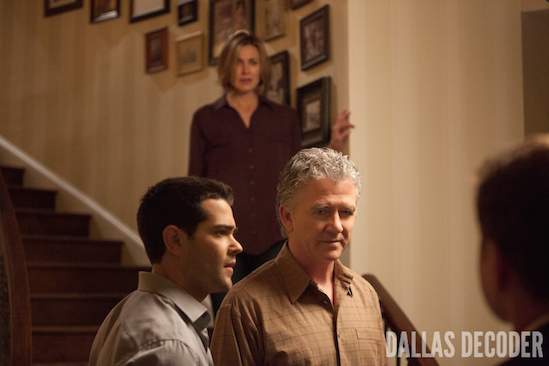
In “False Confessions,”  TNT’s latest “Dallas” episode, Bobby (Patrick Duffy) tries to protect Ann by telling the police he shot Harris. Like John Ross’s arrest for Marta’s murder last season, this latest incident is part of an old tradition of Ewings getting in trouble for crimes they didn’t commit. Here’s a look at the five most egregious Ewing arrests from the original “Dallas” and “Knots Landing.”

Cally Harper Ewing, Cathy Podewell, Dallas, J.R. Ewing, Larry Hagman

Under the gun

5. The Ewing: J.R. (Larry Hagman)

The crime: Cally Harper’s “rape”

The arrest: When J.R. went to Arkansas on a hunting trip, he met backwoods beauty Cally and became smitten. After they spent the night together, her shotgun-toting brothers showed up, followed quickly by Sheriff Hanks, who charged J.R. with rape.

The real criminal: J.R. was guilty of many things, but his relationship with Cally was consensual. The real bad guys were Hanks, who refused to allow J.R. to make a single phone call from jail, and the justice of the peace, who sentenced him to 10 years in prison. Of course, J.R. did himself no favors when he interrupted his trial to declare, “You people got to be kidding. Hell, I can buy this whole town with the change I got in my pocket!”

Level of egregiousness (scale of 1 to 10): J.R.’s arrest gets a 5, but the egregiousness of this silly storyline deserves a big, fat 10.

Dallas, Ray Krebbs, Steve Kanaly

Dial “M” for murder?

4. The Ewing: Ray Krebbs (Steve Kanaly)

The crime: Mickey Trotter’s death

The arrest: After Ray’s cousin Mickey was paralyzed in a car crash, someone pulled the plug on his life support system. The police arrested Ray, who had blocked the door to Mickey’s hospital room so the doctors and nurses couldn’t revive him.

The real criminal: In dramatic testimony at Ray’s trial, his aunt Lillian Trotter, Mickey’s mother, confessed she wanted her son to die with dignity and decided to pull the plug. Lil didn’t have the strength to do it, so she asked Ray to help her. Ever the obedient nephew, Ray obliged.

Level of egregiousness: 6. Ray was technically guilty and the judge sentenced him to five years in the state penitentiary – but immediately suspended the sentence because he said Ray was such a nice guy. Seems like sound legal reasoning to me.

Gary Ewing, Knots Landing, Ted Shackelford

He usually loves bars

3. The Ewing: Gary (Ted Shackelford)

The crime: Ciji Dunne’s murder

The arrest: Gary befriended Ciji, an aspiring singer, but when her star began to rise, his self-esteem began to plummet. Gary went on a bender and woke up the next morning on the Knots Landing beach, not far from Ciji’s seaweed-strewn body. The police suspected he killed her during a booze-fueled rage and hauled him off to jail.

The real criminal: Chip Roberts, Ciji’s boyfriend. Eventually the cops figured out Chip murdered Ciji when she became pregnant with his child and refused to have an abortion. Ciji had also discovered Chip was really a con artist named Tony Fenice.

Level of egregiousness: 7. The Knots Landing police should’ve known better than to arrest Gary. All they had to do was call Sheriff Washburn back in Braddock. He could’ve told them: Never arrest a Ewing!

Dallas, Linda Gray, Sue Ellen Ewing, Who Shot J.R.?

Ready for her close-up

2. The Ewing: Sue Ellen (Linda Gray)

The crime: J.R.’s shooting

The arrest: There was no shortage of suspects when an unseen assailant gunned down J.R. in his office. When Jock discovered the weapon in J.R. and Sue Ellen’s bedroom closet, he turned it over to the cops, who decided it was all the proof they needed to arrest Sue Ellen for the crime.

The real criminal: Kristin Shepard, Sue Ellen’s sister, who wanted to get back at J.R. for trying to run her out of town. Sue Ellen figured out Kristin had framed her by planting the gun in the closet. (But no one ever answered the question: How did Kristin know Jock would go snooping there?)

Level of egregiousness: 8. Arresting Sue Ellen was a travesty of justice! The only way she’d ever shoot J.R. would be if he – oh, I don’t know – tossed one of her lovers off a high-rise balcony. But what are the odds of something like that happening?

Dallas, Jim Davis, Jock Ewing

Jailhouse Jock

1. The Ewing: Jock (Jim Davis)

The crime: Hutch McKinney’s murder

The arrest: When Ray began building a home on Southfork, the construction crew uncovered the remains of the long-missing McKinney, one of Ray’s predecessors as ranch foreman. Sheriff Washburn’s investigation determined McKinney had been shot with Jock’s gun, not long after Jock and McKinney had had a knock-down-drag-out brawl in a local saloon.

The real criminal: Digger Barnes, who killed McKinney when he discovered he had impregnated Digger’s wife Rebecca and was planning to run away with her. Digger confessed his crime on his deathbed, where he also told Pam that McKinney was her biological father.

Level of egregiousness: 11. Throw Jock Ewing in jail? That’s something you just don’t do. When a reporter asked the old man how he felt about being arrested, Jock huffed, “I’m mad as hell, boy.” Who could blame him?

Which Ewing arrests do you consider the most egregious? Share your choices below and read more “Dal-Lists.”
After ‘Dallas’: 7 Shows That Aired in TV’s Best Time Slot

Monday Mornings, TNT

Who the hell are these people?

Stick around after “Dallas” tonight and you’ll see the debut of “Monday Mornings,” a weekly medical drama that – in the words of TNT’s press release – “follows the lives of doctors as they push the limits of their abilities and confront their personal and professional failings.” Back in the ’80s, the post-“Dallas” time slot – Friday nights at 10 – was some of the hottest real estate in prime time. Do you remember the other shows that tried to ride J.R.’s coattails to the top of the Nielsen charts?

“Falcon Crest”

Vintage

Vintage

Well, of course you remember this one. “Falcon Crest” debuted December 4, 1981, and followed “Dallas” on Friday nights for almost its entire nine-season run. (CBS bumped the show to Thursdays for its final four episodes.) The series starred the great Jane Wyman as the indomitable Angela Channing, who ruled the Northern California wine country the way J.R. ruled Big D. Wyman’s co-stars included Lorenzo Lamas, whose playboy Lance Cumson was the John Ross Ewing of his day. “Falcon Crest” also starred Robert Foxworth, a fine actor who turned down the role of J.R. in 1978 because he feared the character wasn’t likable enough. For this, we thank him.

“Capitol”

Washington women

Women at war

Wasn’t “Capitol” a daytime soap opera, you ask? Yes it was. But on March 26, 1982, three days before the serial joined CBS’s afternoon lineup (where it was sandwiched between “As the World Turns” and “Guiding Light”), “Capitol” got a one-hour preview after “Dallas.” The show was set in Washington, D.C., and told the story of two families: the McCandlesses and the Cleggs, who fought over politics the way the Barneses and the Ewings feuded over oil. Instead of old coots like Jock and Digger, “Capitol” gave us two grand dames: Constance Towers as Clarissa McCandless and Carolyn Jones – a.k.a. Morticia Addams – as Myrna Clegg. How progressive!
“Knots Landing”

Three’s a crowd, Gary

Three’s a crowd, Gary

“Dallas” and “Knots Landing” were made to go together, but the spinoff followed its parent in CBS’s lineup exactly once: October 29, 1982. That evening, Gary (Ted Shackelford) visited “Dallas” for the reading of Jock’s will, and the story continued on a special “Knots Landing” episode in which J.R. (Larry Hagman) canoodled with his middle brother’s latest squeeze Abby (Donna Mills). If CBS’s goal was to goose “Knots Landing’s” numbers, the plan worked: That week, “Dallas” finished first in the ratings and “Knots Landing” finished fourth. It was “Knots Landing’s” most-watched episode ever and the first time the show cracked Nielsen’s top 10.

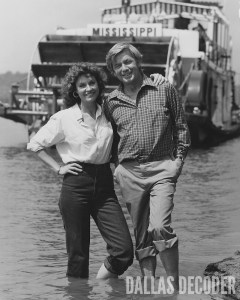
“The Mississippi”

All wet

All wet

When “Falcon Crest” finished its second season early, CBS used the post-“Dallas” time slot to try out “The Mississippi,” which began a six-week run on March 25, 1983. The series starred “The Waltons” dad Ralph Waite as Ben Walker, a tugboat captain who also fought crime with help from sidekick Stella McMullen (Linda G. Miller). “The Mississippi” was an instant hit and earned its own slot on CBS’s fall 1983 schedule: Tuesday nights at 8. But without the benefit of a “Dallas” lead-in, “The Mississippi’s” audience dried up. (Oh, stop groaning. You knew that was coming.) In 1997, Waite appeared on Hagman’s “Orleans,” another CBS riverboats-and-crime drama.

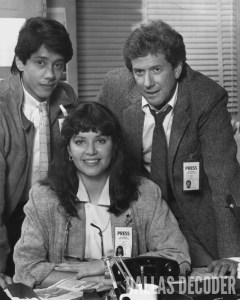
“Hard Copy”

Get them rewrite!

Get them rewrite!

“Hard Copy” starred Michael Murphy as Andy Omart, a scribe for the Los Angeles Morning Post; Wendy Crewson as fellow newshound Blake Calisher; and Dean Devlin as David Del Valle (or was it David Del Valle as Dean Devlin?), a cub reporter. Also featured: George O. Petrie – a.k.a. Ewing family consigliere Harv Smithfield – as Scoop Webster. CBS launched “Hard Copy” after Super Bowl XXI (Giants stomp the Broncos, 39 to 20) in January 1987, where it bombed. In May, the network moved the show to Fridays, where it followed summertime “Dallas” reruns and bombed again. CBS stopped the presses for good six weeks later.

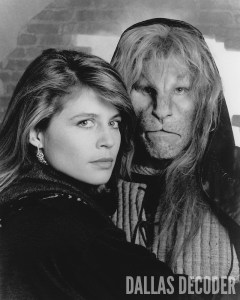
“Beauty and the Beast”

Once upon a time

Once upon a time

If you remember “Beauty and the Beast” airing before “Dallas,” you’re right. But before the romantic fantasy/action show moved to the pre-Southfork slot, CBS aired its pilot after “Dallas’s” 11th season premiere on September 25, 1987. You’ll recall that was the night Pam was rescued from her fiery car crash. Perhaps CBS thought seeing Pam wrapped in bandages would help viewers mentally prepare to meet Vincent (Ron Perlman), the lion-like creature who made Catherine Chandler (Linda Hamilton) swoon. Vincent’s face was hidden in all the show’s pre-debut publicity, including TV Guide’s fall preview; the hairy mug wasn’t revealed until the premiere.

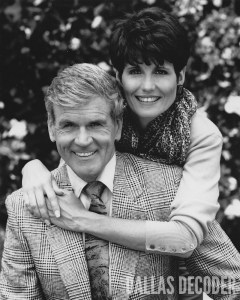
“Sons & Daughters”

Circle unbroken?

Circle unbroken?

“Dallas’s” final dance partner, “Sons & Daughters,” debuted January 4, 1991, four months before the Ewings rode off into the sunset. The “Parenthood”-style series starred Don Murray as Bing Hammersmith, the patriarch of a quirky family that included Lucie Arnaz as his eldest daughter Tess. CBS planned to call the show “The Hammersmiths” and pair it with Murray’s previous series, “Knots Landing,” on Thursdays, but when Fox shifted its red-hot “The Simpsons” to that night, CBS changed the title to “Sons & Daughters” and shifted it to Fridays. “Sons & Daughters” was set in Portland, Oregon – just like “Monday Mornings.” We’ve come full circle, folks.

What did you enjoy watching after “Dallas” on Friday nights? Share your memories below and read more features from Dallas Decoder.

‘Dallas’s’ Second Season Gets Off to a Promising Start

Dallas, John Ross Ewing, Josh Henderson, J.R. Ewing, Larry Hagman, TNT

Lessons learned

At one point during “Dallas’s” second-season premiere, J.R. offers Sue Ellen a sly grin and declares, “I never learn my lesson.” Maybe not, but the people who make “Dallas” seem to have learned theirs. This has been a good show from the beginning, but diehards like me couldn’t help but feel bothered by some of the historical flubs in the first-season plotlines (don’t get us started on those Southfork mineral rights) or the fact that our beloved Linda Gray was missing from two whole episodes.

Thankfully, those days appear to be over. The two-hour premiere, which TNT will telecast Monday, January 28, does a nice job giving “Dallas” devotees the stuff we crave. The first shot of the first scene is none other than Sue Ellen – a signal, I hope, that Gray will have a prominent role this year. The opener also offers the first Southfork swimming pool scene in 22 years, references to two long-unseen “Dallas” characters, and a fleeting-but-much-appreciated mention of an institution that was significant to the old show’s mythology. Someone’s been doing their homework.

Best of all, J.R. gets lots of screen time in the extended premiere, which is actually two one-hour episodes (“Battle Lines” and “Venomous Creatures”) that TNT will telecast back-to-back. Larry Hagman filmed a handful of episodes before his death last November, and in these first two hours, he’s as great as ever. Hagman’s scenes with Patrick Duffy will make you chuckle, while his exchanges with Gray will leave you reaching for the tissues. The magic is still there.

Of course, as much as I love watching my old favorites, it’s also good to see “Dallas” cultivating its next generation of stars. Josh Henderson has become a worthy heir to Hagman’s badassery, although he now has competition from an unexpected source: Julie Gonzalo, who is a hellion in heels as Cliff’s vengeful daughter. I’m also pleased to report the premiere gives Jordana Brewster some meaningful scenes. Brewster remains one of the best actors in this ensemble; she makes Elena feel like the kind of person you might know in real life, which – let’s face it – doesn’t always happen on shows like this. Henderson and Gonzalo might get the juicy lines, but Brewster and Jesse Metcalfe, her equally good leading man, keep “Dallas” grounded.

The premiere also establishes the battle for Ewing Energies as the season’s main story arc and introduces us to the sleek Ewing Energies set, which looks absolutely nothing like the offices seen on the old show. (Please note: This isn’t a complaint.) A nifty subplot focuses on Christopher’s foray into racecar driving, and we also learn Ann’s dark secret, a storyline that has more than a few holes but nonetheless offers a nice showcase for Brenda Strong.

Other highlights include our first glimpse of the mysterious new character Emma Brown, played by Emma Bell, who was so memorable as the doomed Amy on “The Walking Dead.” (I wonder: Does Bell find zombies or Ewings more cannibalistic?) We also meet Harris Ryland’s mother Judith, played to the hilt by Judith Light. Yes, Light is only three years older than Mitch Pileggi, who plays Harris. It’s too early to know if audiences are going to buy this, but if anyone can pull it off, it’s Light.

The real question is how “Dallas” will fare once it runs out of episodes featuring Hagman. This week, TV Guide reported the show will write out its star with a “Who Killed J.R.?” mystery that will echo the old “Dallas’s” most famous cliffhanger. Whether or not this idea is really brilliant or really lousy will depend on the execution, but it’s a good sign the show is bringing back so many favorites for J.R.’s funeral and memorial service. The guest list will include Deborah Shelton, who played J.R.’s longest-running (three seasons!) mistress Mandy, and Cathy Podewell, who portrayed his second wife Cally, along with four characters who require no explanation: Gary (Ted Shackleford), Lucy (Charlene Tilton), Ray (Steve Kanaly) and Cliff (Ken Kercheval).

This group includes some of “Dallas’s” most iconic figures. Watching them come together to mourn – or celebrate – the death of the biggest icon of all is bound to be great television. It will never satisfy all of “Dallas’s” hardcore fans, but you have to hand it to the people who make the show. At least they’re trying.

What do you want to see during “Dallas’s” second season? Share your comments below and read more opinions from Dallas Decoder.

The Dallas Decoder Interview: David Jacobs

David Jacobs

David Jacobs

Before J.R. Ewing appeared on our television screens, he existed in the mind of David Jacobs. I was honored last week to speak to Jacobs, who shared his memories of creating “Dallas” and its most famous character, as well as working with the actor who brought J.R. to life, Larry Hagman.

I’ve been thinking a lot about this amazing character, J.R. Ewing, since Larry Hagman’s death. How did you envision J.R. when you created him?

I envisioned him the way he became but not as radical; Larry brought something of his own to the role right away. In the first “Dallas” script [after Pam turns the tables on J.R.], Larry’s last line is, “Well, I underestimated the new Mrs. Ewing. I’ll never make that mistake again.” And the script says he smiles. But Larry didn’t smile. He laughed. It was a small laugh, but he laughed. And that changed it. He took possession of the character at that moment. Because the smile would have said, “Oh, I have a worthy adversary,” whereas the laugh meant, “Hold onto your hats, this is going to be fun.”

It’s funny to think Hagman wasn’t the first choice for the role.

We originally offered it to Robert Foxworth. The producers and I had a conference call with him and he wanted to know why J.R. was the way he was. And we said, you know, he’s made 10 times as much money for the family as his father ever did, yet his father still likes his brother better. Then Foxworth said, “Well, how are you going to make him more sympathetic?” And everyone in the room looked at me to answer that question. At me – this was probably the first conference call I’d been on in my life, and they were waiting for me to answer. And I said, “Well, we’re not. J.R. believes the way business works is, you screw them before they screw you. And he likes that. The process. He loves it.”

Was anyone else considered for the role?

No. After Foxworth passed, Barbara Miller, who was in charge of casting, said Larry Hagman wanted to come in. And my first reaction was, Larry Hagman? He was the Major [on “I Dream of Jeannie”]. I knew he was a good actor because I had seen him in “Harry & Tonto,” where he was just wonderful. And he has a very small role in “Fail Safe,” but it made a big impression on me. He was the translator [who tells the president of the United States about a nuclear disaster]. And Larry walks down the corridor to the president’s office and raises his hand to knock on the door – and he doesn’t. He smooths his hair back with his hand and takes a breath, and then he knocks. I always remembered that gesture.

J.R. (Larry Hagman) in 1978

J.R. (Larry Hagman) in 1978

But you didn’t think he was right for J.R.?

It was more like, “He really wants this role? Hmm.” So he came in the next day. I was sitting in [producer] Phil Capice’s office, with Phil and Mike Filerman, the executive I developed “Dallas” with, and of course Lenny Katzman. My back was to the doorway, and I noticed they all were looking past me, startled, almost. And I turned around and there, in the door was Larry Hagman, in a Stetson and boots. And he came in the room, in character with his Dallas accent. And within two minutes there was never any question J.R. would be played by anyone else.

Oh, wow! I don’t think I’ve heard this story.

It was an amazing performance. You know, he was an established actor. We wouldn’t have asked him to read for the role, but he did read in a sense. He just auditioned in character – for just a few minutes. And then he was back to being Larry Hagman. It was really shrewd of him – intuitively genius.

Now that Hagman’s gone, will you be sad to see this character you created come to an end?

Well, I’m sad that Larry’s gone. Yes, I created the character. And yes, I knew in the phone call with Foxworth the kind of unapologetic villain he should be. But don’t get me wrong: that guy belonged to Hagman. The synergy that created the character of J.R. was the synergy of actor and role more than it was the writer and the actor.

Do you have ideas about how you’d kill him off?

No. I haven’t thought about it. Who knows? I might come up with something brilliant if I thought about it. You know, when they brought back the show [on TNT], I thought about things that I would do differently, but Larry’s death is too fresh. It’s too raw.

How do you think J.R.’s death will affect the new show?

A lot of people have asked me that. I think they’ll probably get a [ratings] bump when they air the episodes that deal with J.R.’s death. But after that, to be perfectly honest, I think the “next generation” has to step up – like every “next generation.” I definitely think the show has the ingredients to stand on its own. Maybe they’re a little afraid of it, but maybe this will get them to do it.

Kind of like the mama bird pushing her baby out of the nest?

Exactly. And of course J.R.’s going to cast a shadow over it forever. But we’ll see.

Gary and Val (Ted Shackelford, Joan Van Ark) in 1979

Gary and Val (Ted Shackelford, Joan Van Ark) in 1979

How do you feel about Gary and Val’s upcoming visit to the new “Dallas”? You played with those characters for 14 seasons on “Knots Landing.” Now they’re going to be in the hands of other writers.

It’s OK. I’m not like [Aaron] Sorkin, whose characters speak Sorkinese and it’s brilliant. I always wrote very stylized dialogue and let fine actors like Joan Van Ark and Ted Shackelford make the words theirs. They’ll still be Val and Gary. So I don’t worry about it.

What do you think Leonard Katzman, the original “Dallas’s” longtime producer, would think of the new show?

He’d hate it.

Really? Why?

He just would. He hated the [original show’s “dream” season] after he’d walked away from it. That season has taken a rap that I don’t believe it deserves. It was trying to freshen up the act. But Leonard hated it.

Well, what about you? Do you like the new show?

I do. It’s great to see Southfork in H.D. and widescreen. Beautiful. I do wish they would slow things down. Mike and I were talking recently and said we could’ve gotten 10 shows from the first five. [Laughter] And not by stretching, but by making it more complex and by making the stories less plot-driven and more character-driven. I think it was Chekov who said plot is character. Whoever said it, I agree with.

Do you think there’s any chance of “Knots Landing” coming back?

No, I don’t think so. “Knots Landing” never had the ratings and the international appeal that “Dallas” had. “Knots” recreated would have to be five younger families living on the cul-de-sac – and not related to the older characters. Because if they were related it wouldn’t be believable. “Knots Landing” was always the hardest show to write because unlike “Dallas,” the conflict wasn’t built into the structure. You always wanted to ask the question: Why don’t they just move out? Why don’t they just stop talking to their neighbors like neighbors everywhere?

Getting back to “Dallas”: Your pilot script is dated December 10, 1977. Thirty-five years later, we’re still watching this show. How does that make you feel?

You know, while it was on the air, it was sort of a guilty pleasure because I wasn’t running it. It was my first show. Afterward I ran “Knots Landing” and my other shows, and “Dallas” was in the hands of Lenny Katzman. But later on, I realized “Dallas” really was the model for all the shows that came after it. Before “Dallas,” there was a great fear of serialization in prime time. Mike and I thought continuing drama was exactly the right form for television. And the form of “Dallas” became the model for all the continuing dramas that followed and are now dominant. So it really did change television in a very not-so-subtle, real way. And I like that.

Well, I know I speak for a lot of fans when I say we’re thankful to you for creating this really fun, fantastic show.

And I’m thankful to Larry Hagman. His loss means something to me. He was a nice man. He was a terrific actor. Absolutely underrated. But God knows he left this earth doing what he loved. A lot of us might wish to go that same way. So I’m glad I was able to provide him with the vehicle that he would use to display his great talent, and I’m certainly grateful to him for being the driving force of a show that has meant a lot to me.

Share your comments below and read more interviews from Dallas Decoder.

Knots Landing Scene of the Day: ‘You Don’t Have Any Courage’

No guts, no Gary

No guts, no Gary

In “Knots Landing’s” second-season episode “The Loudest Word,” Bobby and Gary (Patrick Duffy, Ted Shackelford) sit next to each other in the hospital waiting room while Val undergoes surgery.

BOBBY: That was some phone call you made to Mama.

GARY: Yeah, I know. Sorry about that.

BOBBY: Are you better now?

GARY: Well, I’m not crazy, if that’s what you mean.

BOBBY: No, that’s not what I mean. I mean, are you better? Have you pulled yourself together? Do you know what you’re up against? Are you ready for that?

GARY: Don’t preach at me, Bobby!

BOBBY: Well, are you better or aren’t you?

GARY: I don’t know!

BOBBY: Well, you don’t have much time to find out. [Rises] If you’re gonna sit and wait that thing out, you’d better damn well be able to handle the outcome, no matter what the outcome is.

GARY: I don’t know. How can I? Would you know?

BOBBY: You’re damn right I would. I’d grit my teeth, I’d clinch my fist and rail at the injustice. But I’d be able to handle whatever came through that door. Because I couldn’t stand to live with myself if I broke down when the woman I love needed me to stand up.

GARY: Fine. You tell me how not to break, and I won’t break.

BOBBY: I’ll tell you how not to break. The same way I told Valene how not to die. Don’t. You just don’t.

GARY: I can’t handle the worst.

BOBBY: The worst is she dies, Gary. You understand that, don’t you? [Gary is silent.] Dying is the worst thing that can happen to Val. [Walks to Gary, grabs his shirt collar, forces him to his feet] Now, tell me that you know that death is the worst possibility. [Gary is still silent.] You’d rather that girl in there die than survive with a colostomy? [Releases Gary, steps away] You know, I can remember Daddy and Mama sparring with words. I was just a kid when you left, but I can still remember them talking about you. And Daddy would say that you didn’t have the Ewing guts. And Mama would say, “Well, thank goodness for that.” Because she thought you had Southworth gallantry – and that was a much better thing to have. Mama thought guts were low-grade courage, and gallantry was courage with grace. [Walks toward Gary] But she sent me here because she couldn’t stand to come herself. She probably heard it in your voice on the phone. You don’t have any kind of courage at all. And she just couldn’t bear to come here and see that for herself.

Gary walks away.

Critique: ‘Knots Landing’ Episode 26 – ‘The Loudest Word’

Enter the hero

Enter the hero

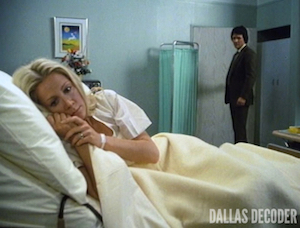
Toward the end of “The Loudest Word,” Valene Ewing lies in a hospital bed, waiting to have surgery to determine if she’ll need a colostomy. The room is dark, and so is Val’s mood. Suddenly, the door opens and in walks Bobby Ewing. In that instant, we know everything is going to be OK.

Such is Bobby’s power. He’s our hero, and when this “Knots Landing” episode debuted in February 1981, it showcased his innate goodness in a way “Dallas” hadn’t done in awhile. At the time, Bobby had gone off the rails a bit over on the parent show. His rocky tenure running Ewing Oil had just ended and he was about to embark on a political career, unaware his neglected wife Pam was contemplating having an affair.

These developments added some interesting wrinkles to Bobby’s persona, but let’s face it: The character is at his best when he’s the white knight, which is the role he fills in “The Loudest Word.”

When Bobby enters Val’s hospital room and she confesses how frightened she is, he tenderly comforts her. Later, he delivers Gary a proverbial kick in the rear, helping his older brother find the courage he needs to stand by Val when she needs him most. As an added bonus, Bobby has an exchange with Gary and Val’s neighbor Sid Fairgate – a kind of summit of prime-time soapdom’s all-around good guys. Patrick Duffy is terrific in each of these scenes. His trademark is delivering his dialogue with breathless intensity, and he does it beautifully when Bobby gives his tough-love pep talk to Gary.

Joan Van Ark and Ted Shackelford are also really good in “The Loudest Word.” Shackelford’s physical performance, in particular, is something to behold. In the scene where Gary goes berserk, the actor (it doesn’t appear to be a stunt double) destroys Gary and Val’s bedroom with frightening efficiency.

But the real star of “The Loudest Word” is scriptwriter Joseph B. Wallenstein, whose dialogue is poetic. When Karen Fairgate notices daughter Diana’s troubled response to Val’s crisis, she tells husband Sid, “I work so hard at remembering that she’s a young woman, sometimes I forget how much little girl is still left.” Another nice line: Gary recalls hearing Val’s doctor deliver her diagnosis and says, “I heard that word, ‘malignant.’ And it was the loudest word I ever heard.”

Great writing is one of “Knots Landing’s” hallmarks, and one area where it often outshines its parent show. No wonder the Ewings made so many trips west during “Dallas’s” fourth season.

Grade: B

_______________________________________________________________________________________________________________________________________________

Last of the good guys

Last of the good guys

‘THE LOUDEST WORD’

“Knots Landing” Season 2, Episode 13

Airdate: February 19, 1981

Audience: 17.8 million homes, ranking 13th in the weekly ratings

Writer: Joseph B. Wallenstein

Director: Kim Friedman

Synopsis: When Val is diagnosed with colon cancer and faces the possibility of having a colostomy, Gary falls apart. Bobby arrives and is at Gary’s side when he learns Val’s surgery was a success and a colostomy wasn’t needed.

Cast: Patrick Duffy (Bobby Ewing), James Houghton (Kenny Ward), Kim Lankford (Ginger Ward), Michele Lee (Karen Fairgate), Claudia Lonow (Diana Fairgate), Constance McCashin (Laura Avery), Donna Mills (Abby Cunningham), Don Murray (Sid Fairgate), Patricia Murray (Sandy), John Pleshette (Richard Avery), Arthur Rosenberg (Dr. Harper), Ted Shackelford (Gary Ewing), Steve Shaw (Eric Fairgate), Joan Van Ark (Valene Ewing)

“The Loudest Word” is available on DVD. Watch the episode and share your comments below.

The Dallas Decoder Guide to Politics, Ewing Style

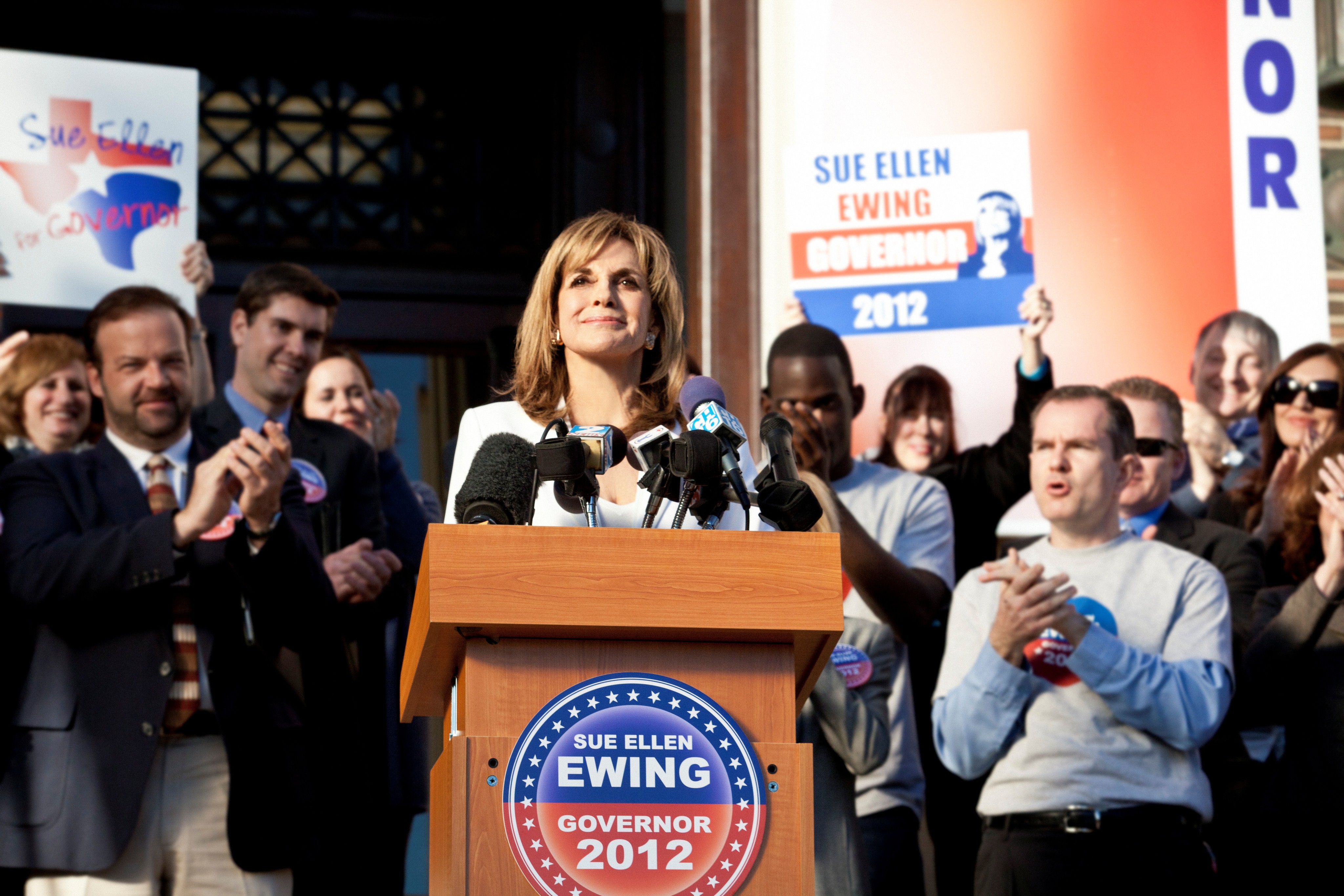
Sue Ellen is the latest Ewing to hit the hustings. (Photo credit: Bill Matlock/TNT)

The Republicans are in Tampa and the Democrats are headed to Charlotte, but the real political heavyweights are in “Dallas.” Here’s a look at some of the gladhanders, grandstanders and gurus who’ve courted the Ewings’ support – and occasionally, their wrath – on the original series, its “Knots Landing” spinoff and TNT’s “Dallas” revival.

MAYNARD ANDERSON (Peter Mark Richman)

Maynard Anderson

Anderson was an oil industry darling whose appointment to a high-ranking Department of Energy post left Jock and J.R. giddy. But Andreson’s new job was jeopardized when his shrewish wife Melissa threatened to expose his affair with Jenna Wade, Bobby’s old flame. J.R. promised to help out his pal Anderson, which meant using Jenna to try to split up newlyweds Bobby and Pam. J.R.’s ploy failed and Jenna released Bobby from her clutches (for awhile, anyway); the audience never learned if Mr. Anderson actually went to Washington.

CLIFF BARNES (Ken Kercheval)

Cliff Barnes

Cliff had a talent for attracting trouble – his college girlfriend died after a botched abortion and he was arrested for Julie Grey’s murder and Bobby Ewing’s shooting – but he never let scandal get in the way of his ambition. Despite losing bids for state senate and Congress, Cliff was appointed to several cushy gigs, including oil industry watchdog and “energy czar.” Of course, Cliff was too busy trying to beat the Ewings to hold onto any job long. As we learned in the “Dallas” finale, if J.R. hadn’t been born, Cliff would’ve been president!

ALAN BEAM (Randolph Powell)

Alan Beam

Alan was a rising star at Smithfield Bennett, the law firm that represented the Ewings, but he wasn’t afraid to stand up for what he believed in – and above all, he believed in Cliff, whose congressional campaign he managed. (Alan even had the courage to wear a “Barnes for Congress” button to Jock’s birthday dinner!) Too bad it was all a ruse: Alan really worked for J.R., who wanted to sabotage Cliff’s campaign from the inside. The plan worked like a charm, but when J.R. and Alan had a falling out, Alan became a prime suspect in J.R.’s shooting. (FYI: He didn’t do it.)

COUNCILMAN MARTIN COLE (Allen Case)

Martin Cole

When the Ewings needed a candidate to run against Cliff for state senate, they recruited Cole, a Fort Worth city councilman who had the right platform (pro-gun, anti-abortion) and connections (he was married to Senator Orloff’s niece Nancy) but the wrong personality – which is to say he had none. With Cliff gaining in the polls, Jock ordered Cole to fire his speechwriter and buy more TV time; he also instructed J.R. to take Mr. Milquetoast shopping for snazzier suits. Cole won – not because of his image makeover, but because J.R. exposed Cliff’s skeletons.

SENATOR DAVE CULVER (Tom Fuccello)

Dave Culver

Dave, the son of political legend Sam Culver, pushed through a health-care reform bill as a member of the state legislature, but once he moved to the U.S. Senate, his main duty seemed to be flying home to tell the Ewings about the doings in Washington. Interestingly, the family never seemed to mind that Dave recruited Jock for his ill-fated mission to South America. This might be because the senator was one of the Ewings’ most reliable matchmakers: Dave introduced stepmom Donna to Andrew Dowling and hooked Bobby up with Kay Lloyd.

GOVERNOR SAM CULVER (John McIntire)

Sam Culver

Sam, a onetime Texas governor and speaker of the house, was one of Texas’s most powerful men. When Cliff was running the Office of Land Management and putting the screws to the Ewings, J.R. tried to blackmail Donna Culver, Sam’s young bride, into persuading her husband to oust Cliff from his perch. Instead, Donna confessed all to Sam, who forgave his wife and threw his support behind Cliff. Sam’s devotion to Donna was admirable, but he wasn’t perfect: After his death, she discovered Sam and Jock once staged a land grab that resulted in Sam’s uncle’s suicide.

SENATOR ANDREW DOWLING (Jim McMullan)

Andrew Dowling

Dowling, possessor of the thickest head of senatorial hair this side of John F. Kerry, disagreed with lobbyist Donna Culver Krebbs on every issue, including tariffs on imported oil and U.S. intervention in Nicaragua (how topical, “Dallas”!), but that didn’t keep him from sweeping the very married, very pregnant Donna off her feet. Later, when the Justice Department was about to lay the smackdown on Ewing Oil over J.R.’s escapades in the Middle East, Dowling tipped off the family, which really should have been Dave Culver’s job, but whatever.

WALT DRISCOLL (Ben Piazza) and EDGAR RANDOLPH (Martin E. Brooks)

Walt Driscoll and Edgar Randolph

Here we have a pair of hapless, mustachioed bureaucrats: Driscoll was one of Cliff’s successors at the Office of Land Management, while Randolph was a federal contracting official. Both men were blackmailed by J.R., both tried to kill him (Driscoll with a car, Randolph with a gun) and both turned suicidal, except Randolph couldn’t do that right, either.

SENATOR BOBBY EWING (Patrick Duffy)

Bobby Ewing

When the governor appointed Dave Culver to fill an empty U.S. Senate seat, his party tried to recruit Dave’s stepmom Donna to complete his term in Austin. She demurred, so party leaders turned to Bobby, who ran for the job and won in a landslide. Bobby then hired Cliff as his legal counsel, which might explain why he seemed so unfamiliar with the term “conflict of interest.” Not only did Senator Ewing preside over an inquiry into his father’s plan to build a resort on Lake Takapa, he also participated in a state investigation into the coup J.R. financed in Asia.

GARY EWING (Ted Shackelford)

Gary Ewing

Like Cliff, Gary didn’t let his private demons keep him from taking a stab at public service. Despite a record that included drinking, gambling, an arrest for murder (Ciji Dunne) and multiple marriages (including one to Valene when she was just 15), Gary – the middle Ewing brother – decided to run for state senator in his adopted home of California. He lost, although the electoral defeat probably stung less than the fact Gary’s wife Abby was sleeping with his opponent, Peter Hollister.

J.R. EWING (Larry Hagman)

J.R. Ewing

When J.R. and Bobby were battling each other for control of Ewing Oil, J.R. tried to beat baby brother by opening a chain of cut-rate gas stations. After he plugged them on Roy Ralston’s talk show, the public clamored for J.R. to run for office (presaging Ross Perot’s use of “Larry King Live” as his political launching pad). Nothing came of this, but for awhile, Dave Culver was worried J.R. might run against him. When Dave questioned J.R.’s fitness for office (“All he knows about is oil!”), Ray reminded him about Jimmy Carter: “All he knew about was peanut farming.”

SUE ELLEN EWING (Linda Gray)

Sue Ellen Ewing

Sue Ellen is running for governor on TNT’s “Dallas,” despite the skeletons she stuffed in her closet during the original series. To recap: Sue Ellen was institutionalized for alcoholism; arrested for J.R.’s shooting; and embroiled in a series of ugly paternity suits, divorces and custody battles. Also, a drunken Sue Ellen was behind the wheel when Walt Driscoll smashed into J.R.’s car, and when J.R. was shot again, she did pull the trigger. The hits keep coming: Sue Ellen recently accepted a donation from sleazy Harris Ryland and blackmailed a coroner.

MISS ELLIE EWING FARLOW (Barbara Bel Geddes)

Miss Ellie Ewing Farlow

Miss Ellie never held office, but she was the only “Dallas”-ite who seemed to possess the political savvy needed to get things done. In her role as a leader of the civic-minded Daughters of the Alamo, she stopped high-rise apartments from being built in Mimosa Park (by the way, did Sue Ellen name that place?) and converted an abandoned building downtown into a homeless shelter. Ellie wasn’t afraid to get personal either: When Jock wanted to build a resort on Lake Takapa, she threatened to divorce him!

DONNA CULVER KREBBS (Susan Howard)

Donna Culver Krebbs

Donna was a go-to political gal: She advised stepson Dave Culver, served on the Texas Energy Commission and became an oil industry lobbyist. Like all good public servants, Donna strove for consistency: While she was married to Sam Culver, she began an affair with Ray Krebbs, then married Ray and began seeing Andrew Dowling (while pregnant with Ray’s child). Donna divorced Ray, gave birth to their daughter Margaret, married Dowling and moved to Washington – where she hopefully found the happy ending that eluded her in Dallas.

KAY LLOYD (Karen Kopins)

Kay Lloyd

When the feds discovered J.R. tried to blow up the Middle East to boost domestic oil prices (no, really), the Justice Department shut down Ewing Oil and prohibited the family from using the company name again. Bobby went to work reclaiming the name with help from Kay, a Dowling aide who lived a fabulous lifestyle (chauffered limousine, swanky apartment, designer duds) despite the meager salary she must’ve received as a Capitol Hill staffer. Bobby and Kay became an item, but the romance died when she wasn’t willing to move to Dallas. (Can you blame her?)

SENATOR HENRY HARRISON O’DELL (Howard Duff)

Henry Harrison O’Dell

To reclaim the Ewing Oil name, Bobby turned to Jock’s old friend O’Dell, a powerful senator who was eager to help – but only if Bobby agreed to buy him a retirement castle in Scotland. (It turned out O’Dell wasn’t fond of the unnamed state he represented, which he called a “mosquito-infested swamp.”) Bobby was reluctant to play O’Dell’s game until Kay told him that’s how Washington works. In the end, Bobby got the Ewing Oil name back, O’Dell got his castle – and hopefully, the senator’s constituents got a more honorable representative.

SENATOR “WILD BILL” ORLOFF (Norman Alden)

“Wild Bill” Orloff

State Senator Orloff was a friendly, backslapping good old boy who did just about anything the Ewings asked of him. Did his eagerness to please have anything to do with the fact the Ewings bought Orloff the house he shared with his pretty little wife Dorothy? Good-government crusader Cliff thought so. When J.R.’s disillusioned secretary/mistress Julie leaked a copy of the trust deed to Cliff, he exposed the Ewing-Orloff shenanigans and Orloff was forced to resign his seat. But he and Dorothy kept their house.

STEPHANIE ROGERS (Lesley-Anne Down)

Stephanie Rogers

When Cliff emerged as a public hero after leading an inquiry into an Exxon Valdez-style oil spill involving a Ewing Oil tanker (honestly, how did this company stay in business?), he toyed with the idea of running for governor. Enter Stephanie Rogers, the British-accented PR whiz who promised Cliff she would further polish his image and get him elected. When that didn’t happen, Cliff fired Stephanie, who disappeared faster than anyone could say, “Fake Alexis.”

GREG and ABBY SUMNER (William Devane, Donna Mills)

Greg and Abby Sumner

Sumner was a California state legislator running for U.S. Senate when Gary’s wife Abby offered him a campaign check from J.R. Sumner declined the money but won the seat, only to resign weeks later to go into business. Later, Sumner and Abby married and he went after an appointment as trade representative to Japan – which she got instead.

SHERIFF FENTON WASHBURN (Barry Corbin)

Fenton Washburn

Washburn was your stereotypical big-bellied Texas sheriff. Although the Ewings owned him, Washburn didn’t hesitate to exert his authority when the family ran afoul of the law: He arrested Jock for Hutch McKinney’s murder, hauled J.R. in for questioning in Kristin Shepard’s death and threatened to arrest Sue Ellen for manslaughter after the car accident that paralyzed Mickey Trotter. He responded slowly when Miss Ellie was kidnapped, which might explain why the next time the Ewings needed the police, there was a new sheriff in town: Burnside (Ken Swofford).

GOVERNOR MARK WHITE (Himself)

Mark White

White attended the 1985 Ewing Rodeo, giving him the distinction of being the only real-life politician to appear on “Dallas.” (Rival soap “Dynasty” once hosted Gerald Ford and Henry Kissinger.) Of course, White’s cameo ended up being part of Pam’s dream, which might explain why his speech to the rodeogoers was so hilariously brief (“Thank you. Thank you. It’s really great to be with y’all up here today. Thank you.”). Think about it: a politician who limits public pronouncements to just 16 words? If that’s not a dream, I don’t know what is.

What has “Dallas” taught you about politics? Share your comments below and read more “Dallas Decoder Guides.”

The Art of Dallas: ‘No More Mr. Nice Guy, Part 2’

Jock (Jim Davis) welcomes Gary (Ted Shackelford) home to Southfork in this 1980 publicity shot from “No More Mr. Nice Guy, Part 2,” a fourth-season “Dallas” episode.

Knots Landing Scene of the Day: ‘Stay, Lucy. Stay the Week.’

Charlene Tilton, Dallas, Gary Ewing, Home is For Healing, Joan Van Ark, Knots Landing, Lucy Ewing, Ted Shackelford, Valene Ewing

Surfside summit

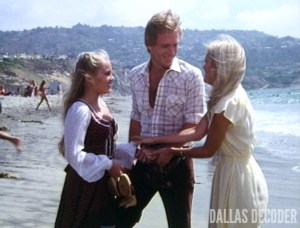
In “Home is For Healing,” a first-season “Knots Landing” episode, Lucy and Valene (Charlene Tilton, Joan Van Ark) are having a heart-to-heart while strolling along the beach when they spot Gary (Ted Shackelford) running toward them.

GARY: Lucy! Lucy!

LUCY: Daddy.

GARY: I don’t want you to go. No, no. Just let me say this. I know I ran away from you and Mama a lot. I was weak. I let my brother and my father drive me away, and I ran. I was a drunk and a gambler and a loser. Well, I may not be all that terrific now, but I’m not a loser anymore. I’m working. And I’m not drinking and I’m not gambling. And instead of running away from the important things, I try to run toward them. Now, I may blow them every now and then, but at least I face them and look them in the eye. [He pauses.] Now, what happened the last couple of days is that we all had plans. You and Mama were gonna be little girl and tending mother. And I was gonna be a father, capital “F.” Well, I guess we just forgot to get to know each other.

LUCY: Daddy –

GARY: I said, “no credit cards” because using your grandfather’s credit cards would screw up your values and our future as a family. What I should have said was, “Please don’t use the credit cards because it makes me feel bad.”

LUCY: Daddy, I get it.

GARY: What?

LUCY: You were right. We forgot to get to know each other.

GARY: Stay, Lucy. Stay the week.

VAL: Hey, you know what I wanna do now?

GARY: What?

VAL: I’ve dreamed of doing this since we moved in here.

LUCY: What, Mama?

VAL: Go running in the ocean with you.

LUCY: We’ve been walking in it.

VAL: No, I mean really in it. Up to your knees and running.

LUCY: It’s too cold.

VAL: Oh, no it isn’t. Watch!

She runs into the surf, tosses her shoes onto the beach.

GARY: Come on. Come on, honey. [He rolls up his pants and walks into the ocean.]

LUCY: It’s too cold.

GARY: Hey, it’s only cold for a minute. [Lucy lays her shoes on the beach, grabs Gary’s extended hand] Right!

The three join hands and run through the waves.