Who Snubbed J.R.? Emmy, That’s Who

Dallas, Larry Hagman, J.R. Ewing, TNT, Venomous Creatures

Give the devil his due

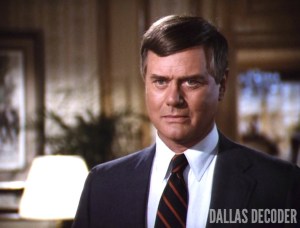
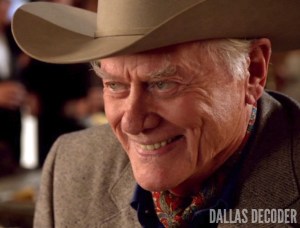
Emmy has always been one of the few gals capable of resisting J.R.’s charms, so it should come as no surprise to learn Larry Hagman won’t be honored with a special tribute during this year’s ceremony. And yet it does. I’m shocked, actually.

I figured if anyone would receive extra recognition during the Emmy broadcast’s traditional “In Memoriam” segment, it would be Hagman. His death last fall ended a five-decade television career that includes two of the medium’s most enduring franchises, “Dallas” and “I Dream of Jeannie,” and one of pop culture’s defining moments: the “Who Shot J.R.?” phenomenon.

But I was wrong. Yesterday, the producers of this year’s Emmy show, which CBS will air Sunday, announced they’ll highlight four performers during the memorial segment — James Gandolfini, Cory Monteith, Jean Stapleton and Jonathan Winters — along with Gary David Goldberg, who created and produced “Family Ties.”

I have no problem with these five people receiving special treatment. I’ve enjoyed their work. But why couldn’t Hagman be honored too? Presumably, he’ll be included in a clip reel of other notable deaths from the past year — but that’s not enough. He deserves much more.

This wouldn’t be so galling if it wasn’t part of an unfortunate pattern with the Academy of Television Arts and Sciences, which seems to go out of its way to ignore Hagman. He was nominated twice for his role as J.R. during the 1980s, losing both times. This year, Hagman was a contender for a supporting actor nomination for his work on TNT’s “Dallas” revival, but he failed to make the cut.

And now Emmy has snubbed him again.

I’ve written before about how much Hagman has meant to me, but that’s not what this is about. I don’t need to see him win a trophy or receive an awards show tribute to validate my affection for him.

No, this is about what Hagman has meant to television. When J.R. Ewing entered our living rooms in 1978, prime-time dramas were populated with characters like Kojak, Quincy and Pa Ingalls. J.R. was unlike anyone we had encountered before, and Hagman did a masterful job capturing all of the character’s complexities and contradictions. His performance taught the industry that the good guys needn’t always win, that audiences could find immense satisfaction in stories about humanity’s darker impulses.

So isn’t it a shame that on the night the industry comes together to celebrate its achievements, Hagman’s contributions will probably be reduced to a few seconds during a clip reel?

Earlier this week, as I watched the latest episode of “Breaking Bad” — as thrilling an hour of television as any I’ve witnessed — I thought: This is “Dallas’s” legacy. I’m not suggesting J.R. ever came close to being as monstrous as Walter White. J.R. was a scoundrel; Walt is a sociopath. But do you doubt for a minute that Walt would exist if J.R. hadn’t come first?

From what I’ve read, Hagman wasn’t much bothered by the fact that he never won an Emmy. But I am, and so I hope the academy’s bigwigs will change their minds and add a special tribute to him during the Emmy show. For that matter, I also hope they’ll induct Hagman into the academy’s Hall of Fame next year.

I mean, come on. Isn’t it time for Emmy to finally give J.R. a shot?

Do you feel Larry Hagman deserves Emmy recognition? Share your comments below and read more opinions from Dallas Decoder.
Tonight’s #DallasChat is Dedicated to the One We Love

We miss you!

We miss you!

Dallas Decoder’s next #DallasChat on Twitter will be held Monday, September 16, from 9 to 10 p.m. Eastern. In honor of Larry Hagman’s birthday (he was born September 21, 1931), our theme will be “Lovin’ Larry” and will focus on Hagman, his career and the character he immortalized, J.R. Ewing.

Here’s how it’ll work: I’ll tweet a question every five minutes or so. Each question will be numbered and include the hashtag #DallasChat, so your responses should do the same. A sample exchange:

Q1. Besides J.R. Ewing, what’s your favorite Larry Hagman role? #DallasChat

A1. I loved Mr. Hagman’s short-lived 1990s series “Orleans.” He was really good as Judge Charbonnet. #DallasChat

Here are two pointers:

• During the chat, enter #DallasChat in Twitter’s search field. This will help you watch the search results so you can follow the conversation. Click “All” to see all the related tweets.

• Include the hashtag #DallasChat in each tweet you send so others can see your contributions to the conversation. Feel free to start side conversations of your own, but please include #DallasChat in those tweets too.

A reminder: Twitter limits the number of tweets that users can send during a given hour, so I’m unable to respond to everyone’s responses, but I’ll favorite them as they roll in. Please know how much I appreciate everyone’s contributions to #DallasChat.

I hope this will be another special #DallasChat discussion. Please join us!

The Dal-List: Sue Ellen’s 10 Most Memorable Moments (So Far)

Dallas, J.R.'s Masterpiece, Linda Gray, Sue Ellen Ewing, TNT

Mourning star

Sue Ellen WeekAs the indomitable Sue Ellen Ewing, Linda Gray has captivated television audiences since “Dallas’s” 1978 debut. Sue Ellen Week continues with this list of the character’s greatest moments from her first 35 years.

Brian Dennehy, Dallas, Linda Gray, Luther Frick, Sue Ellen Ewing, Winds of Vengeance

Command performance

10. Lady sings the blues. Crazed cuckold Luther Frick (Brian Dennehy) holds the Ewings hostage in the Southfork living room and forces Sue Ellen to don her Miss Texas bathing suit and sing for him. Humiliating? Yes, but it also demonstrates Sue Ellen’s willingness to do what’s needed to help her family survive a crisis. Moreover, this is one of Gray’s gutsiest — and smartest — performances. I especially love the final scene: After Jock and Bobby rescue everyone, Sue Ellen grabs her coat and exits the room, head held high. It’s an early glimpse of the character’s resilience: No matter what indignities may be visited upon Sue Ellen, she almost always walks away a lady.

Dallas, Linda Gray, Mother of the Year, Sue Ellen Ewing

Mama’s here

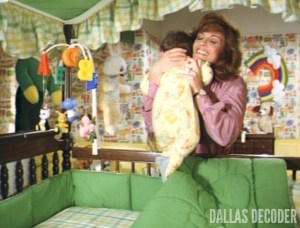
9. Embracing motherhood. When John Ross is born, Sue Ellen comes down with a Southfork-sized case of post-partum depression — and who can blame her? She’s emotionally devastated by her ongoing struggle with alcoholism, the collapse of her marriage to J.R. and her doomed affair with Cliff, who dumped her to preserve his political viability. With help from her shrink Dr. Elby, Sue Ellen finally realizes how much “little John” needs her, so she goes home, picks up the boy and holds him for only the second time since his birth, 13 (!) episodes earlier. It’s a powerful moment — and it sends baby-obsessed sister-in-law Pam running away in tears, so bonus points for that.

Dallas, Guilt by Association, Linda Gray, Sue Ellen Ewing, TNT

Set ’em up, Sue

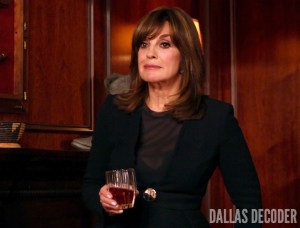
8. Defeating the governor. When Sue Ellen discovers smirktastic Governor McConaughey suppressed evidence that would exonerate the Ewings in the investigation into their rig explosion, she glides into his office, pours a drink and announces she’s going to expose his malfeasance. McConaughey is not pleased. “You can never trust a drunk,” he seethes. Sue Ellen agrees, but says that’s beside the point as she places the glass on his desk and slides it toward him. “This drink, governor, is for you. You’re going to need it. Because now that I have the goods on you, you’re going to do what I want.” Dayum! Our gal really did learn at the feet of the master, didn’t she?

Dallas, Linda Gray, Sue Ellen Ewing

Clean and sober

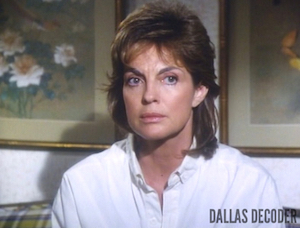
7. On the couch. After Sue Ellen hits rock bottom, J.R. once again commits her to a sanitarium, where she receives treatment from tough-love therapist Dr. Gibson (the terrific Bibi Besch). In an insightful exchange, Sue Ellen tries to blame her drinking problem on her parents and J.R. — until the good doctor sets her straight: “Sue Ellen, I don’t think it matters whose fault it is. What matters is where you go from here.” When Besch delivers this line, watch Gray’s eyes; it’s almost as if you can see the light go on inside Sue Ellen’s head. This moment marks the beginning of one of “Dallas’s” most satisfying storylines: Sue Ellen’s journey of self-discovery. Too bad it turned out to be Pam’s dream.

Dallas, J.R. Returns, Linda Gray, Sue Ellen Ewing

She’s the boss

6. Joining the oil business. After a five-year absence, J.R. returns to Dallas and stages an elaborate scheme (does he do any other kind?) to persuade Bobby to buy back Ewing Oil from Cliff. The plan works like a charm … but wait! Baby brother has a trick up his sleeve too: He sells half the company to his new business partner — Sue Ellen, who can’t resist needling her ex-husband when she reveals her new career to him. “I was thinking about all the fun pillow talks we’ll have … about gushers and dry holes,” Sue Ellen says with a wink. The master is justifiably impressed. As she walks away, he turns to John Ross and says, “Your mama’s a hell of a woman.” We couldn’t agree more.

Dallas, Linda Gray, Mandy Winger, Deborah Shelton, Sue Ellen Ewing

You tell her, honey

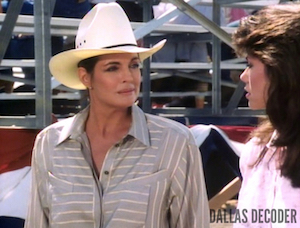
5. Schooling Mandy. At the Ewing Rodeo, a newly sober Sue Ellen turns a corner — literally and figuratively — when she runs into Mandy Winger (Deborah Shelton), J.R.’s latest extra-marital squeeze. Sue Ellen treats Mandy with compassion, urging her to get away from J.R. before he destroys her. When Mandy refuses to listen and turns to leave, Sue Ellen grabs her by the arm and delivers a hard truth: “Isn’t it strange how the mistress always thinks she’s smarter than the wife? If she’s so smart, why is she the mistress?” In the hands of another actress, this scene might have come off like another catty soap opera confrontation, but Gray infuses the material with power and poignancy.

Dallas, Linda Gray, Rock Bottom, Sue Ellen Ewing

Oh, Sue Ellen

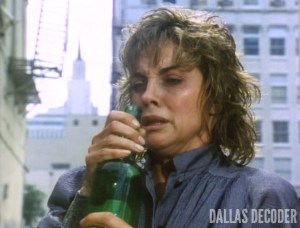
4. Hitting bottom. Sue Ellen tries to comfort J.R. after Bobby’s funeral, but he responds with devastating cruelty, sending her on her worst bender ever. Over the course of the next day or so, Sue Ellen’s purse, car and wedding ring are stolen, leaving her wandering the streets. She winds up in a cheap motel, where she catches a glimpse of herself in the mirror and shouts, “J.R. is right. They’re all right. You are disgusting. I hate you!” Finally, she stumbles into an alley, where she’s so desperate for a sip of booze that she accepts a swig from a bag lady’s bottle. I love how Sue Ellen’s outfit symbolically unravels along with her identity, but more than anything, I love Gray’s riveting, no-holds-barred performance.

Dallas, J.R. Ewing, Linda Gray, Larry Hagman, New Beginnings, Sue Ellen Ewing

Union of equals

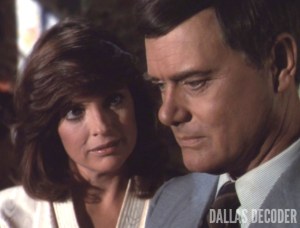
3. A night to remember. Not long after recovering from his shooting, J.R. comes home and finds Sue Ellen asleep in the Southfork nursery, having dozed off while rocking John Ross. The couple put their son to bed and retreat to their own room, where they quietly reminisce about the early days of their courtship, reminding each other why they fell in love in the first place. Besides serving as a rare moment of peace for two characters who are usually at war, this scene shows how Gray is Hagman’s equal in every way. Think about it: It’s one thing to see J.R. and Sue Ellen lobbing insults at each other, but to make their love feel authentic and believable? That takes real talent. Lucky for us, Gray and Hagman had it in spades.

Dallas, Linda Gray, Sue Ellen Ewing, Who Done It?, Who Shot J.R.?

Triumph!

2. Catching Kristin. When Sue Ellen is arrested for shooting J.R., the Ewings toss her off Southfork — but our heroine refuses to give up. Sue Ellen gets out of jail, figures out she’s being framed and heads to the ranch to reveal the truth to J.R. As it turns out, the real culprit is visiting the ranch too — and when Sue Ellen spots her, Gray delivers the most famous line in “Dallas” history: “It was you, Kristin, who shot J.R.” Eighty-three million viewers watched this scene on the night it debuted. It was the cliffhanger resolution the world had been waiting for, but more importantly, it was the moment Sue Ellen returned to Southfork and to J.R.’s side — the place she always belonged.

Dallas, J.R.'s Masterpiece, Linda Gray, TNT

She is us

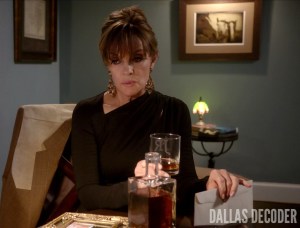
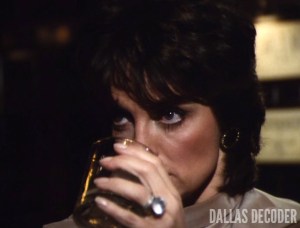
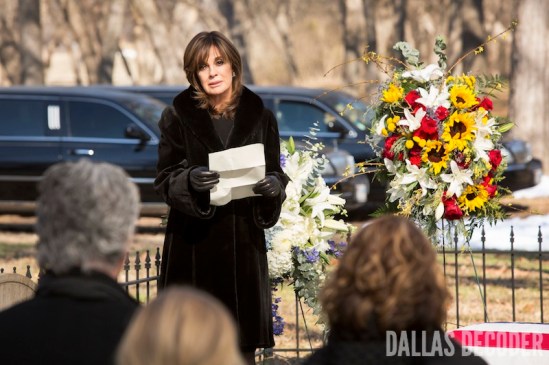
1. Mourning J.R. No one takes J.R.’s death harder than the woman he loved more than any other. On the night before his funeral, Sue Ellen goes into his bedroom, caresses a framed photograph from their wedding and drowns her sorrows with glass after glass of his bourbon, ending two decades of sobriety. The next day, when the Ewings gather at the cemetery to bury J.R., Sue Ellen confesses her relapse and delivers a haunting eulogy for the man she calls “the love of my life.” Gray is mesmerizing in these scenes, which draw upon the remarkable 35-year history between J.R. and Sue Ellen. Her deeply moving, Emmy-caliber performance also unites “Dallas” fans in shared catharsis. Through her, we were able to express the grief we felt after the death of our hero. It’s the moment Sue Ellen became our avatar. Then again, isn’t that what she’s always been?

Now it’s your turn. Share your choices for Sue Ellen’s most memorable moments below and read more “Dal-Lists.”

Tonight, #DallasChat Shines a Spotlight on Sue Ellen

Dallas, Linda Gray, Sue Ellen Ewing, TNT

Star of the show

Dallas Decoder’s next #DallasChat on Twitter will be held Monday, September 9, from 9 to 10 p.m. Eastern. Since this is Sue Ellen Week, our #DallasChat theme will be “Celebratin’ Sue Ellen” and will focus on Linda Gray’s iconic character.

Here’s how it’ll work: I’ll tweet a question every five minutes or so. Each question will be numbered and include the hashtag #DallasChat, so your responses should do the same.

A sample exchange:

Sue Ellen WeekQ1. What is your all-time favorite scene featuring Sue Ellen? #DallasChat

A1. I love when Sue Ellen delivers the eulogy at J.R.’s funeral. Linda Gray is amazing in that scene! #DallasChat

Here are two pointers:

• During the chat, enter #DallasChat in Twitter’s search field. This will help you watch the search results so you can follow the conversation. Click “All” to see all the related tweets.

• Include the hashtag #DallasChat in each tweet you send so others can see your contributions to the conversation. Feel free to start side conversations of your own, but please include #DallasChat in those tweets too.

A reminder: Twitter limits the number of tweets users can send during a given hour, so I’m unable to respond to everyone’s responses, but I’ll favorite them as they roll in. Please know how much I appreciate everyone’s contributions.

This promises to be a special edition of #DallasChat. I hope you can join us!

The Best & Worst of Dallas: Season 6

There’s lots to love and little to loathe about “Dallas’s” sixth season.

Performances

Dallas, Linda Gray, Sue Ellen Ewing

Oh, darlin’

Every cast member shines during Season 6, but Linda Gray’s performance during Sue Ellen’s alcoholic spiral makes her first among equals. Sue Ellen doesn’t just lose her self-respect; she comes close to losing her life when she drives drunk and crashes J.R.’s car. What impresses me most about Gray is how she keeps the audience rooting for Sue Ellen, even when she makes mistakes. What an amazing performance.

Bobby Ewing, Dallas, Patrick Duffy

Still our hero

Give it up for Patrick Duffy too. If you were surprised to see Bobby unleash his inner junkyard dog on the most recent season of TNT’s “Dallas,” then check out Season 6 of the original series, which marks the first time the character reveals his ferocious side. The “Dallas” writers take Bobby to a very dark place during the yearlong contest for Ewing Oil, but Duffy makes sure we never forget he’s still the Bobby Ewing we know and love. Bravo.

Storylines

Speaking of J.R. and Bobby’s contest: It’s too early for me to call this “Dallas’s” all-time greatest plot — I still have eight more seasons to revisit — but it’s hard to imagine anything surpassing the battle royale between the brothers Ewing. The reason the storyline succeeds isn’t the premise, which — let’s face it — is more than a little implausible. (A major corporation splits in half for a year to determine which of its top two executives should be in charge?) No, this arc works because it involves every character and showcases their complexities. Is it surprising to see Bobby play dirty or to witness J.R. wracked with guilt at season’s end? Sure, yet it never feels out of character for them. “Dallas” is always at its best when the characters, not the writers, drive the narrative, and that’s never been truer than it is here.

Episodes

Dallas, J.R. Ewing, Larry Hagman, Linda Gray, Sue Ellen Ewing

Power hour

This is the first season that I’ve reviewed in which none of the episodes received anything less than a “B” grade. For the record: Year 6 consists of 28 hours, and I handed out nine “B’s,” 16 “A’s” and three (!) “A+’s.” My favorite is “Penultimate,” a powerful hour of television that deals with the fallout from Sue Ellen’s accident and leaves us wondering: What’s more destructive — her addiction to booze or her addiction to J.R.?

Scenes

The final moments in “Tangled Web” never fail to give me chills. We’re with Sue Ellen every step of the way when she walks across Holly’s driveway, enters the house and sees her in bed with J.R. (Trivia: My readers tell me when this scene was broadcast in 1983, it was scored, but for whatever reason the music doesn’t appear on the DVD. I’d love to see the original version, but I must say: The lonely sounds of Sue Ellen’s heels clicking and clacking help make this scene so effective.) More great moments: Cliff comes to terms with his guilt over Rebecca’s death (this is Ken Kercheval at his most brilliant) and three scenes that showcase the incomparable Barbara Bel Geddes — Miss Ellie predicts the future for Sue Ellen, eulogizes Jock a the Oil Baron’s Ball and testifies at the hearing to overturn his will.

Hands down, my least favorite scene: In “A Ewing is a Ewing,” J.R. comes on to Holly and she tells him “no,” but he has sex with her anyway. Was this really necessary to demonstrate J.R.’s villainy?

Supporting Players

Dallas, Mickey Trotter, Timothy Patrick Murphy

Transformer

Do you despise cocky Mickey Trotter when he arrives at the beginning of Season 6? Are you surprised when he tries to save Sue Ellen at the end of the year? If you answer “yes” to the first question and “no” to the second, then credit Timothy Patrick Murphy, who does a nice job turning Mickey from a punk into a prince over the course of the season. Also, thanks to Murphy, Lucy finally gets a leading man worthy of Charlene Tilton’s charm.

Props

Jock’s portrait is introduced during “Dallas’s” fifth season, but the show makes magnificent use of it throughout Season 6. Jock looms in the background of so many crucial scenes, including the will reading, which marks one of the few occasions when all of the Ewings are together in one room (even Gary’s there!), and J.R. and Ray’s fistfight in “Ewing Inferno,” when all hell breaks loose — literally. TNT, take note: This is how you use a portrait to help keep alive a character’s memory.

Costumes

Dallas, Donna Krebbs, Susan Howard

Red hat mama

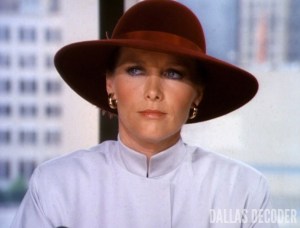
I love Pam’s upswept hairdo and western dress in “Barbecue Three,” her print skirt in “Brothers and Sisters” and Afton’s navy blouse/white skirt combo in “The Ewing Blues,” but my favorite fashion statement is made by Susan Howard, who sports a striking red hat when Donna attends the inaugural meeting of the Texas Energy Commission (also “Barbecue Three”). Eat your heart out, Katherine Wentworth!

Quips

Throughout Season 6, Larry Hagman zings like no one else. Here’s J.R. to Holly, upon spotting her lounging around her pool with a shirtless stud: “Traveling with the intellectual set, I see.” To Mickey, after the young man announces he’s a Trotter, not a Krebbs: “Oh, well. I’m bound to sleep more soundly tonight knowing that.” To Katherine, upon hearing she has something to discuss with him: “Oh, don’t tell me. Not Cliff Barnes. I couldn’t handle that.” In the end, though, my favorite quip comes from Sue Ellen, who is aghast when J.R. criticizes Pam for giving “aid and comfort to the opposition” during the hearing to overturn Jock’s will. “Opposition?” Sue Ellen says. “J.R., that’s your mother.”

What do you love and loathe about “Dallas’s” sixth season? Share your comments below and read more “Best & Worst” reviews.

Critique: ‘Dallas’ Episode 131 — ‘Ewing Inferno’

Dallas, Ewing Inferno, J.R. Ewing, Larry Hagman

Surprise, surprise

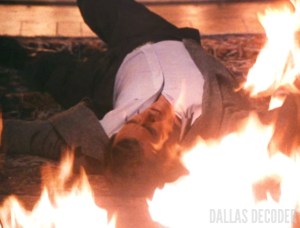
“Ewing Inferno” famously ends with J.R., Sue Ellen, Ray and John Ross trapped inside Southfork as fire sweeps through the house. I wonder: When this episode debuted in 1983, did anyone doubt all four characters would escape the blaze? After all, three of them appear in the opening credits and the fourth is a child; by the conventions of 1980s television, their survival seems assured. Not that I’m complaining. This may not be “Dallas’s” most suspenseful cliffhanger, but it does put a poetic punctuation mark on the sixth season. After a year in which everything goes to hell for the Ewings, what could be more fitting than seeing them surrounded by flames?

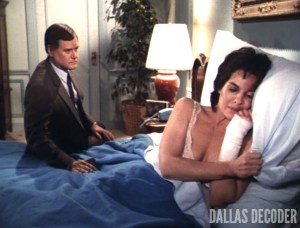
Besides, it’s not like “Ewing Inferno” doesn’t deliver its share of surprises, especially where J.R. is concerned. When the episode begins, he’s business as usual, demanding $20 million from Holly to leave her company. Later, in one of their classic clashes, J.R. lobs such ugly insults at Pam that she slaps him. (“Damn, I hate that woman,” he says as she stomps away.) Then, in the second act, J.R. has an honest-to-goodness epiphany. He brings little John Ross into the bedroom to give Sue Ellen a goodnight kiss, only to find her passed out, an empty bottle of booze at her side. J.R. sends the boy away, sits on the bed and gazes at his wife. “I know you’ll never trust me again, Sue Ellen,” he says. “But I love you. … We should’ve had a wonderful life together. What have I done to you?” The monologue brings to mind the second-season finale, when J.R. sits at the hospital bedside of a comatose Sue Ellen and laments the turn their marriage has taken. Now here he is, four years later, delivering a similar speech. As Miss Ellie wondered a few episodes ago: Doesn’t he ever learn?

Perhaps he does. In the next scene, Bobby comes home and finds J.R. alone in the Southfork living room. The mood is somber, serious. Bobby asks how Sue Ellen is doing. “Not good,” J.R. responds. He tells Bobby that he’s been thinking “real hard” about their fight for Ewing Oil, and the toll it has taken on the people around them. Both brothers’ marriages have suffered. Miss Ellie is heartbroken. Rebecca Wentworth is dead. Mickey Trotter is dying. “I’m not sure that this fight between us is worth what it cost the family,” J.R. says. Bobby is stunned and asks J.R. if he wants to end the contest. J.R.’s response: “By my calculation, I’m way ahead of you, but I really don’t give a damn.”

I really don’t give a damn. Not since J.R. slipped into his deep depression after Jock’s death has our hero seemed so unmoored.

‘Into Oblivion’

Dallas, Ewing Inferno, Linda Gray, Sue Ellen Ewing

But not oblivious

J.R. and Bobby don’t get around to finishing this conversation, but no matter. There’s no doubt J.R. has been humbled. Consider the third act’s final scene. After ordering Teresa to lock up the liquor, J.R. finds Sue Ellen getting drunk in the living room, having swiped a bottle of burgundy from the kitchen. The confrontation that follows plays like something out of “Who’s Afraid of Virginia Woolf?” As J.R. stands still and stares ahead, Sue Ellen circles him, a glass in one hand, the wine bottle in the other, and releases her fury. She references his marital sins (“Did you find someone new to sleep with today? Or did you have to rely on one of your old mistresses?”) and tells him he “ruined” her life. Then, to show how she has stopped giving a damn, Sue Ellen moves closer to J.R. and whispers, “Now, why don’t you do one kind little thing for me, hmm? Unlock the liquor, because I’m going to drink myself into oblivion.”

Linda Gray and Larry Hagman are magnificent in this scene. Every one of her lines drips with acid, while his stoic expression makes this a cathartic moment for the audience. J.R. doesn’t fight back because he knows he’s wrong. He accepts Sue Ellen’s punishing words because he deserves them. Even at the end of the scene, when Sue Ellen flings the bottle at him and it smashes against the wall, J.R. barely flinches. Where his wife is concerned, J.R. simply doesn’t have any fight left in him — although as the big red stain on the wallpaper foreshadows, a different kind of battle is about to come to him.

‘The Last Person in the World’

Dallas, Ewing Inferno, J.R. Ewing, Larry Hagman, Ray Krebbs, Steve Kanaly

Daddy’s watching

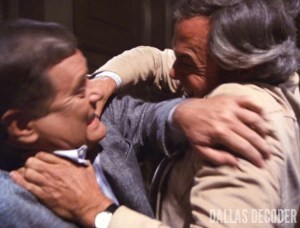
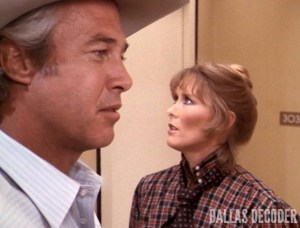
J.R.’s chastening during the course of “Ewing Inferno” is thorough but incomplete. In the final scene, when Ray arrives at Southfork to confront him, J.R. offers his half-brother a typically frosty greeting. “Ray, you’re about the last person in the world I needed to see tonight,” he says. I usually laugh when Hagman delivers a line like this, but there’s nothing funny about J.R.’s dark mood. Before long, the two men are scuffling, and even though the fight scene isn’t exactly credible — stuntmen are clearly substituting for Hagman and Steve Kanaly in the wide shots, J.R. knocks out Ray with a plastic telephone — there’s something deeply poignant about Ray’s attempt to avenge Mickey and J.R.’s determination to rescue his family once the fire starts. How can you not feel moved when he notices the blaze, cries out for his wife and son and braves the flames to try to save them?

Also, consider this: For two seasons, J.R. and Ray have each struggled to honor the dead father they worshipped. J.R. tries to do it through business, while Ray tries to emulate Jock by taking Mickey under his wing, just like Jock did with young Ray. I suppose that’s why it’s so fitting that J.R. and Ray’s fight occurs under the watchful gaze of Jock’s portrait, which looms in the background of so many crucial scenes during the sixth season, including the will reading and J.R. and Sue Ellen’s spat after she catches him in bed with Holly. What hath Jock wrought?

‘Our Marriage Doesn’t Work’

Bobby Ewing, Dallas, Ewing Inferno, Patrick Duffy

Cry, Bobby

For all its poignancy, the true cliffhanger in “Ewing Inferno” has nothing to do with the Southfork fire. The question I’m left asking is this: What will Bobby do? After J.R. offers to call off their fight, Bobby receives a phone call from Pam, who tells him she’s decided to give him the Tundra Torque, the experimental drill bit he needs to move forward with his Canadian oil venture. Since the deal is a guaranteed blockbuster, it will almost certainly allow Bobby to clinch victory over J.R. Bobby now has a dilemma: Should he make peace with his brother, or should he see the contest through until the end, knowing he has what it takes to finally beat J.R.?

By the end of the episode, Bobby’s decision isn’t clear, although his conversation with Katherine in the next-to-last scene suggests he will indeed use the drill bit. Regardless, I wish scriptwriter Arthur Bernard Lewis had paid more attention to this subplot and shown Bobby weighing his choices. After a season of tough ethical compromises, wouldn’t this be Bobby’s biggest decision yet?

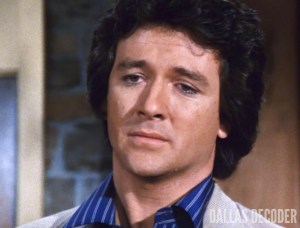
On the other hand: Lewis has a lot of narrative ground to cover, and he does a nice job bringing the other storylines to a climactic finish. The cast does good work too. The scene where Pam tells Bobby she wants a divorce (“Our marriage doesn’t work anymore”) is very moving, especially when that single tear begins its slow journey down Patrick Duffy’s cheek. I also love when Pam tells Cliff and Katherine that she’s decided to give Bobby the drill bit. What’s more fun: Ken Kercheval’s combustible response or Morgan Brittany’s sly smirk? The guest stars shine too: Kate Reid is mesmerizing when she delivers Aunt Lil’s weary monologue, Ben Piazza is the profile in agony when Driscoll visits Mickey’s bedside, and thanks to Barry Corbin, I feel every bit of Sheriff Washburn’s frustration when Ray goes rogue during the investigation into Mickey’s accident.

Like so many other “Dallas” episodes during the sixth season, “Ewing Inferno” also makes me appreciate the technical expertise behind the camera. Fred W. Berger, the editor, won an Emmy for this episode. Surely director Leonard Katzman deserves one too. In the fourth act, I like how he shows J.R. escorting Dr. Danvers out of the bedroom, through the hall and down the stairs into the foyer. The sequence establishes how these spaces fit together, so that during the fire, when J.R. races up the steps and collapses, we understand his proximity to his wife and son.

You also have to admire Katzman’s lack of restraint. According to Barbara A. Curran’s 2004 book “Dallas: The Complete Story of the World’s Favorite Prime-Time Soap,” Katzman built a replica of the Southfork foyer, just so he could burn it down for this episode’s final scene. That’s pretty spectacular, even if it isn’t all that suspenseful.

Grade: A+

_______________________________________________________________________________________________________________________________________________

Dallas, Ewing Inferno, J.R. Ewing, Larry Hagman

Welcome to Hell

‘EWING INFERNO’

Season 6, Episode 28

Airdate: May 6, 1983

Audience: 20.3 million homes, ranking 2nd in the weekly ratings

Writer: Arthur Bernard Lewis

Director: Leonard Katzman

Synopsis: J.R. offers to end the contest for Ewing Oil. Pam decides to divorce Bobby but gives him the Tundra Torque, enraging Cliff. Driscoll kills himself after revealing he drove the car that struck Sue Ellen and Mickey’s vehicle because he thought J.R. was behind the wheel at the time. After Ray learns of Driscoll’s role in the crash, he gets into a fight with J.R. During the scuffle, Southfork catches fire, trapping J.R., Sue Ellen, Ray and John Ross.

Cast: Tyler Banks (John Ross Ewing), John Beck (Mark Graison), Barbara Bel Geddes (Miss Ellie Ewing), Morgan Brittany (Katherine Wentworth), Lois Chiles (Holly Harwood), Roseanna Christiansen (Teresa), Barry Corbin (Sheriff Fenton Washburn), John Devlin (Clouse), Patrick Duffy (Bobby Ewing), Eric Farlow (Christopher Ewing), Linda Gray (Sue Ellen Ewing), Larry Hagman (J.R. Ewing), Susan Howard (Donna Krebbs), Steve Kanaly (Ray Krebbs), Howard Keel (Clayton Farlow), Ken Kercheval (Cliff Barnes), Audrey Landers (Afton Cooper), Kate Reid (Lil Trotter), Ben Piazza (Walt Driscoll), Victoria Principal (Pam Ewing), Debbie Rennard (Sly), Danone Simpson (Kendall), Charlene Tilton (Lucy Ewing), Deborah Tranelli (Phyllis), John Zaremba (Dr. Harlan Danvers)

“Ewing Inferno” is available on DVD and at Amazon.com and iTunes. Watch the episode and share your comments below.

Celebrate Your Love of Labor Tonight on #DallasChat

Dallas, Josh Henderson, TNT

Working boys

Dallas Decoder’s next #DallasChat on Twitter will be held Monday, August 26, from 9 to 10 p.m. Eastern time. Since Labor Day is next week, our theme will be “Work It, Y’all” and will focus on “Dallas’s” depiction of careers and workplaces.

As usual, I’ll tweet a question roughly every five minutes. Each question will be numbered and include the hashtag #DallasChat, so your responses should do the same. Here’s a sample exchange:

Q1. Where would you rather work: Ewing Energies or Southfork ranch? #DallasChat

A1. What difference does it make? You’re bound to get dirty either way. #DallasChat

A few pointers:

• During the chat, enter #DallasChat in Twitter’s search field. This will help you watch the search results so you can follow the conversation. Click “All” to see all the related tweets.

• Include the hashtag #DallasChat in each tweet you send so others can see your contributions to the conversation. Feel free to start side conversations of your own, but be sure to include #DallasChat in those tweets too.

• Twitter limits the number of tweets each users can send an hour, so I’m unable to respond to everyone’s answers. I’ll reply to some and “favorite” the others, but please know how much I appreciate everyone’s participation.

This promises to be a fun conversation. Please join us!

Critique: ‘Dallas’ Episode 130 — ‘Penultimate’

Barbara Bel Geddes, Dallas, Linda Gray, Miss Ellie Ewing, Penultimate, Sue Ellen Ewing

Mama’s here

“Penultimate” is an hour of misery and pain, but it contains love too. The story begins where “Dallas’s” previous episode ends, when Sue Ellen drives drunk and crashes J.R.’s car. The accident leaves her with a broken arm and some scrapes and bruises, while passenger Mickey Trotter fares much worse: He slips into a coma after his spinal cord is injured. This leads to tense scenes, like the one where Lucy calls Sue Ellen a “lousy drunk” and blames her for the crash. Mostly, though, “Penultimate” depicts the Ewings and Krebbses as people who are willing to set aside old hurts and day-to-day grievances to help each other get through a crisis. It’s the kind of thing we routinely witness on this show, yet it never fails to move me.

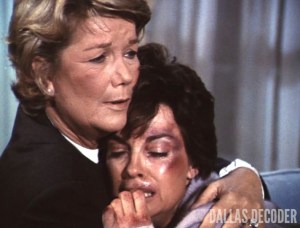
Howard Lakin’s smart script ensures Sue Ellen remains a sympathetic figure, even though it seems like she did indeed cause the accident. Lakin gives us a scene where a guilt-ridden Sue Ellen apologizes to Lucy and pleads for forgiveness, and even though Lucy refuses to listen, other characters don’t hesitate to show Sue Ellen compassion. The crucial moment comes in the first act, when a sore, stiff Sue Ellen comes home from the hospital and goes to her bedroom with Miss Ellie, who offers to help her change into a nightgown. When Sue Ellen begins to cry, Ellie takes her into her arms and holds her close. It’s a touching scene, and also a clever one. If Ellie is willing to forgive Sue Ellen, why shouldn’t we?

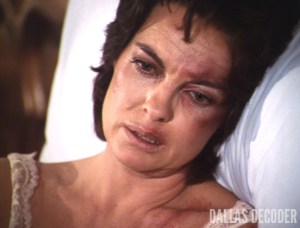
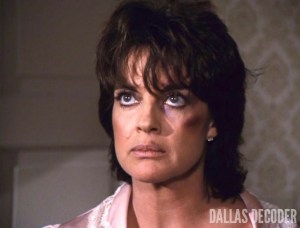
Of course, Linda Gray keeps the audience on Sue Ellen’s side too. Throughout “Penultimate,” Gray carries herself like a woman full of regret; we never doubt that Sue Ellen feels terrible about what she’s done. It doesn’t hurt that she looks awful. Sue Ellen’s face is purple and swollen, her arm is in a cast and in the first few scenes, her sweater is torn and stained with blood. How can you not feel bad for this woman? In the same spirit, how can you not admire Gray? Remember, “Penultimate” was made in an era when television audiences demanded gloss and glamour from their favorite actresses, so Gray’s willingness to be seen in such an unflattering light feels like an act of courage. (Other stars soon followed Gray’s lead. The year after “Penultimate” aired, Farrah Fawcett wore a black eye when she played a battered wife in the TV movie “The Burning Bed.”)

Gray’s most impressive performance in “Penultimate” comes in the final scene, when J.R. enters his bedroom late at night and finds Sue Ellen waiting up for him. She calmly asks why he remarried her if he had no intention of being faithful, and when he begins to speak, she cuts him off. “Stop it! Stop it! I don’t want to hear any more from you!” she shouts. But J.R. continues, telling Sue Ellen that he never meant to hurt her. “Believe me when I say that I love you. I truly love you,” he says. Larry Hagman’s delivery is sincere, but Gray is the one we can’t take our eyes off of. When J.R. professes his love, Gray turns away from Hagman and faces the camera. She’s silent, yet her expression tells us how tormented Sue Ellen feels at that moment. Despite the pain J.R. has caused her, is there any doubt she loves him too?

Cry, Cry Again

Charlene Tilton, Dallas, Lucy Ewing, Penultimate

Tracking her tears

Charlene Tilton supplies “Penultimate” with its other emotional highpoints. After Lucy lashes out at Sue Ellen and calls her a drunk, she bursts into tears and collapses into Ray’s arms. Later, Lucy is with Ray, Donna and Aunt Lil when the doctor informs them Mickey will probably be paralyzed. Once again, Lucy weeps. Both scenes remind us how Tilton always rises to the occasion when she’s given good material, which happens too infrequently on “Dallas.” I also admire how Steve Kanaly makes us feel every ounce of Ray’s anger and frustration over the tragedy that has befallen Mickey, as well as the guilt consuming Ray over bringing his cousin to Texas in the first place. The other performer to watch in these scenes is Kate Reid, who doesn’t have a lot of dialogue, but who doesn’t need any. Her sad, solemn expression says it all.

Not all of the scenes in “Penultimate” are quite so agonizing. When J.R. goes to Holly’s house to confront her over her attempt to ruin his marriage, we expect J.R. to be full of rage. Instead, he plays it cool, politely offering to give up his share of Harwood Oil — if Holly pays him $20 million, that is. Holly balks, and so J.R. leaves her with a not-so-subtle threat. “Holly, you won a hand in a game of poker,” he says. “You’re seeing me in a mood that you’ll never see again. I strongly advise you to take advantage of it, because considering what it’ll cost if you don’t” — here, Hagman pauses — “twenty million dollars will be chickenfeed.”

Later, Bobby urges Holly not to give J.R. the money until after the contest for Ewing Oil ends. Frankly, of all the surprising moves Bobby makes during the sixth season, this one shocks me most. It’s one thing for Bobby to blackmail George Hicks, the crooked energy regulator, or to stage a sting against Walt Driscoll, J.R.’s accomplice in the illegal Cuban oil deal. But after all the suffering the battle for Ewing Oil has caused, Bobby is still willing to wheel and deal to win the contest? Maybe Pam is right. Maybe her husband really has changed.

Hear the Trumpets

Dallas, Donna Krebbs, Ray Krebbs, Steve Kanaly, Susan Howard

Eye to eye

Like all great “Dallas” episodes, “Penultimate” is a creative achievement on multiple levels. Along with the strong performances and writing, Richard Lewis Warren’s underscore is essential to the episode’s success. In several scenes, a few piano keys give way to the mournful blaring of trumpets. It fits the somber mood perfectly, not that any of us should be surprised. Warren’s music never gets in the way of the storytelling but helps it along, which is why he’s one of my favorite “Dallas” composers.

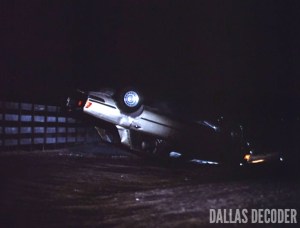
“Penultimate” also offers some of the sixth season’s niftiest camerawork. The episode opens at the site of the car accident, as an ambulance pulls away and a tow truck backs up to J.R.’s overturned Mercedes. Southfork looms in the distance, lit up in the black sky, until the camera slowly zooms in for a close-up. I also like how director Nick Havinga opens one scene with a tight shot of the Ewings’ liquor cart. In the background, Sue Ellen enters the room and gradually comes into focus as she approaches the booze and reaches for a bottle. Havinga also plays with our depth perception in a shot in the hospital where Kanaly stands in the foreground and exchanges dialogue with Susan Howard, whose position in the background makes Donna look like she’s a few feet shorter than Ray.

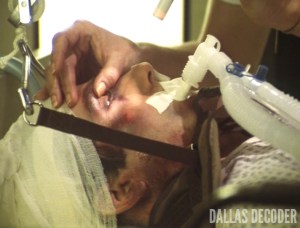
Lakin and Havinga also do a nice job keeping the audience in the dark about the extent of Sue Ellen and Mickey’s injuries when “Penultimate” begins. The first scene in the emergency room shows a medical team tending to an unseen patient. Amid the beeps and whirs of the machinery, one of the doctors drops references to irregular breathing patterns and a possible spinal injury. “Looks like there’s a bad fracture in the right leg,” a nurse announces. Says the doctor: “Yeah, we’ll worry about that later. Right now, let’s just try to keep this patient alive.” Moments later, we see J.R. escort a shaken Sue Ellen into a hospital corridor, and only then do we realize Mickey is the patient in critical condition.

This turns out to be the episode’s most suspenseful moment. The only other mystery presented here is the identity of the driver of the car that struck Sue Ellen and Mickey’s vehicle, which won’t be revealed until the next episode. Indeed, “Penultimate” serves mostly as a prelude to that installment — not that I’m complaining. The season’s plot lines may not advance much during this hour, but the characters do. Isn’t that more interesting anyway?

Grade: A+

_______________________________________________________________________________________________________________________________________________

Dallas, Mickey Trotter, Timothy Patrick Murphy

Critical condition

‘PENULTIMATE’

Season 6, Episode 27

Airdate: April 29, 1983

Audience: 19 million homes, ranking 3rd in the weekly ratings

Writer: Howard Lakin

Director: Nick Havinga

Synopsis: While Mickey lies in a coma, doctors determine he’ll likely be paralyzed. Sheriff Washburn tells J.R. that Sue Ellen will be charged with manslaughter if Mickey dies. Ray urges Washburn to find the driver of the car that struck Sue Ellen and Mickey’s vehicle. After J.R. invites Holly to buy him out of her company, Bobby urges her to delay her payment to him until the contest for Ewing Oil is over. Cliff pressures Pam not to give Bobby the drill bit.

Cast: John Beck (Mark Graison), Barbara Bel Geddes (Miss Ellie Ewing), Lois Chiles (Holly Harwood), Roseanna Christiansen (Teresa), Barry Corbin (Sheriff Fenton Washburn), Michael Cornelison (Dr. Snow), Patrick Duffy (Bobby Ewing), Eric Farlow (Christopher Ewing), Linda Gray (Sue Ellen Ewing), Larry Hagman (J.R. Ewing), Alice Hirson (Mavis Anderson), Susan Howard (Donna Krebbs), Steve Kanaly (Ray Krebbs), Howard Keel (Clayton Farlow), Ken Kercheval (Cliff Barnes), Joe Maross (Dr. Blakely), Timothy Patrick Murphy (Micheky Trotter), Victoria Principal (Pam Ewing), Kate Reid (Lil Trotter), Danone Simpson (Kendall), Charlene Tilton (Lucy Ewing), Deborah Tranelli (Phyllis), Morgan Woodward (Punk Anderson), John Zaremba (Dr. Harlan Danvers)

“Penultimate” is available on DVD and at Amazon.com and iTunes. Watch the episode and share your comments below.

Critique: ‘Dallas’ Episode 129 — ‘Things Ain’t Goin’ Too Good at Southfork’

Dallas, Linda Gray, Sue Ellen Ewing, Things Ain't Goin' Too Good at Southfork

The bottom

Linda Gray always hits her marks on “Dallas,” but she’s especially effective when Sue Ellen is hitting the bottle. Unlike so many other actors who go overboard playing drunks, Gray is precise: never too slurry, never too silly, never too sullen. She gets it right, every time. Because her performances are so convincing, the audience never loses sight of Sue Ellen’s humanity, ensuring she remains a sympathetic character. This is a creative achievement, but it’s something else too: Given “Dallas’s” popularity, I’m convinced Gray has contributed to our understanding of alcoholism as a disease. I often refer to Sue Ellen as a heroine, but when you think about it, the same thing can be said of Linda Gray.

I offer these observations because Gray’s heartbreaking depiction of Sue Ellen’s fall from the wagon in “Things Ain’t Goin’ Too Good at Southfork” is one of the milestone moments in the life of the character. The episode opens where the previous one left off, with Sue Ellen spying J.R. in bed with Holly Harwood. Sue Ellen flees to a cocktail lounge, where she takes her first drink since the end of the third season. And then she has another, and then another. Sue Ellen drinks so much that the bar manager cuts her off, which sends her running into the arms of Clayton, who gently rejects her advances but allows her to spend the night in his hotel room. The next morning, Sue Ellen is embarrassed and promises Clayton she won’t drink again. Yet before he knows it, she has emptied one of his vodka bottles. Eventually, Ellie retrieves her troubled daughter-in-law and brings her home to Southfork, where Sue Ellen is once again full of regret. “Miss Ellie, I just want you to know that I never meant to hurt you,” she says.

The more Sue Ellen drinks in this episode, the more her spirit deteriorates. She goes from giggly in the bar to flirty in Clayton’s hotel room to depressed at Southfork. Her pattern with alcohol — relapse, recovery, repeat — mimics the rhythms of her marriage, which is an endless series of rifts and reconciliations. Listen to what Sue Ellen tells Clayton in this episode while she’s nursing her hangover. “I believed him,” she says, referring to J.R. “He promised me there would be no games, and no other women. And I did believe him until last night. I saw him with my very own eyes, and all those vows and promises didn’t mean anything.” This dialogue reminds us that alcohol isn’t Sue Ellen’s only addiction; she’s powerless where J.R. is concerned too.

On the Rocks

Dallas, J.R. Ewing, Larry Hagman, Things Ain't Goin' Too Good at Southfork

Caught

As we watch Sue Ellen’s spiral in this episode, we know she’s eventually going to have to come face to face with J.R. It’s the moment we dread and anticipate at once. Scriptwriter Leonard Katzman wisely saves the confrontation for the next-to-last scene, when J.R. arrives home and finds Sue Ellen drinking in the living room. By this point, the booze has lost its numbing properties. She lets J.R. have it (“You bastard!”) and tells him she knows he slept with Holly. J.R. tries to deny he cheated, believing his wife only saw his car parked outside of Holly’s house. Soon, he realizes Sue Ellen knows the ugly truth. Her rage turns to tears, and when J.R. tries to comfort her, she tosses her drink in his face, grabs his car keys and rushes out of the room.

This is a short scene, lasting less than two minutes, but it tells us so much about the characters, as well as the actors who play them. When the scene begins, we want Sue Ellen to give J.R. hell, and Gray doesn’t disappoint. Her voice is full of incredulity and also clarity, even as she slurs her words. But then her voice cracks, and we realize Sue Ellen is in too much pain for this to be a moment of triumph. Seeing Gray go from wrathful to weepy is one of the episode’s most moving moments. Larry Hagman is impressive too, of course. J.R. is stunned to discover Sue Ellen knows he cheated with Holly, but listen closely to the inflection in his voice when he says, “Sue Ellen, don’t fly off the handle. I can explain all of this.” It’s always hard to know what J.R. is really thinking at a given moment, but in this instance, Hagman makes me the believe his character isn’t trying to save his own skin as much as he’s trying to shield Sue Ellen from more pain. J.R.’s love for his wife is clear, even if his respect for their marriage isn’t.

Collision Course

Barbara Bel Geddes, Dallas, Miss Ellie Ewing, Things Ain't Goin' Too Good at Southfork

No saving the day this time

“Things Ain’t Goin’ Too Good at Southfork” is a whimsical title for an episode that’s anything but. The director is Gunnar Hellström, who also helmed the third-season classic “Ellie Saves the Day,” another dark hour in Ewing family history. In that chapter, J.R.’s business dealings brought the family to the brink of financial disaster. This time around, the fallout from his scheming is personal. J.R.’s own marriage suffers, and so do the relationships of most of the show’s other couples.

The first act includes a terrific scene where Pam, who has left Bobby because she feels he’s too preoccupied with defeating J.R., confronts her husband about his relationship with her sister Katherine. Bobby says Katherine is nothing more than a friend — and then he asks Pam if she can say the same thing about her relationship with Mark Graison. It’s a damning moment for Pam, who admits she is confused about her feelings toward Mark, but it’s a great moment for Bobby, whose righteousness feels absolutely justified when he calls out his wife’s hypocrisy. (To that end: Does anyone do marital indignation better than Patrick Duffy?)

Later, Ellie is understandably rattled when she shows up at Clayton’s hotel room and finds Sue Ellen there, drunk and wearing nothing more than one of Clayton’s dress shirts. Barbara Bel Geddes does a beautiful job conveying Ellie’s quiet dismay here, but the actress is at her best a few moments later when Ellie gives Sue Ellen a much-needed dose of tough love. “Sue Ellen, now you listen to me,” Bel Geddes says, grabbing Gray by the arms and glaring at her. “Get into bed and sleep. Try to sober up. And then we’re taking you home!”

By the end of this episode, the war for Ewing Oil touches Lucy and Mickey’s lives too. The young lovers are grilling hamburgers on the Southfork patio and playfully planning their future when Sue Ellen staggers out of the house after her fight with J.R. She climbs behind the wheel of his Mercedes and begins to drive away, prompting Lucy to order Mickey to stop Sue Ellen before she hurts someone. Mickey hops into the passenger seat and pleads with Sue Ellen to pull over. She refuses, and as the Mercedes exits the Southfork driveway, another car strikes the vehicle, flipping it on its side. Freeze frame, roll credits — and if you’re watching this scene on DVD, try to resist the temptation to flip over the disc and immediately begin watching the next episode.

Wrecked

Charlene Tilton, Dallas, Lucy Ewing, Mickey Trotter, Things Ain't Goin' Too Good at Southfork, Timothy Patrick Murphy

What future?

Sue Ellen and Mickey’s accident puts a dramatic punctuation mark on “Things Ain’t Goin’ Too Good at Southfork,” even as it demonstrates the limits of ’80s era television production. When the car begins to roll, a chain attached to the vehicle can be seen on the underside. I assume the chain played some role in creating the stunt, and even though it probably wasn’t noticeable on analog TVs three decades ago, it’s as clear as day when I watch this episode today. Similarly, the car accident is shot from a wide angle so we never get a close-up of Sue Ellen and Mickey inside the Mercedes — except for a the moment of impact, when we catch a glimpse of the stuntmen sitting in for Gray and Timothy Patrick Murphy.

But these are quibbles. The car wreck remains about as fitting an ending as I can imagine. It perfectly encapsulates how the Ewings’ world is beginning to crash down around them. And when you stop and think about it, the whole episode is the “Dallas” equivalent of rubbernecking: No matter how much misery the Ewings experience during the course of this hour, we can’t bring ourselves to look away.

Grade: A+

_______________________________________________________________________________________________________________________________________________

Dallas, Things Ain't Goin' Too Good at Southfork

The upside of down

‘THINGS AIN’T GOIN’ TOO GOOD AT SOUTHFORK’

Season 6, Episode 26

Airdate: April 15, 1983

Audience: 20 million homes, ranking 3rd in the weekly ratings

Writer: Leonard Katzman

Director: Gunnar Hellström

Synopsis: Sue Ellen resumes drinking and seeks comfort from Clayton, which drives a wedge between him and Miss Ellie. Later, Mickey tries to stop Sue Ellen from driving drunk, but their vehicle is involved in a serious accident. Pam returns home, where Katherine denies being interested in Bobby. Cliff pressures Pam to side with him in the fight over the Tundra Torque.
Cast: Barbara Bel Geddes (Miss Ellie Ewing), Morgan Brittany (Katherine Wentworth), Delores Cantú (Doris), Lois Chiles (Holly Harwood), Roseanna Christiansen (Teresa), Patrick Dollaghan (bartender), Patrick Duffy (Bobby Ewing), Eric Farlow (Christopher Ewing), Linda Gray (Sue Ellen Ewing), Larry Hagman (J.R. Ewing), Susan Howard (Donna Krebbs), Steve Kanaly (Ray Krebbs), Howard Keel (Clayton Farlow), Ken Kercheval (Cliff Barnes), Kenneth Kimmins (Thornton McLeish), Audrey Landers (Afton Cooper), Timothy Patrick Murphy (Mickey Trotter), Victoria Principal (Pam Ewing), Kate Reid (Lil Trotter), Debbie Rennard (Sly), Charlene Tilton (Lucy Ewing), Deborah Tranelli (Phyllis)

“Things Ain’t Goin’ Too Good at Southfork” is available on DVD and at Amazon.com and iTunes. Watch the episode and share your comments below.

On Tonight’s #DallasChat Menu, a Dish Best Served Cold

Dallas, Harris Ryland, Mitch Pileggi, TNT

Almond ploys

Dallas Decoder’s next #DallasChat on Twitter will be held Monday, August 19, from 9 to 10 p.m. Eastern time. The topic: “Vengeance is Ours,” which means we’ll be discussing retribution, one of “Dallas’s” most enduring themes.

As usual, I’ll tweet a question roughly every five minutes. Each question will be numbered and include the hashtag #DallasChat, so your responses should do the same. A sample exchange:

Q1. J.R. crossed a lot of people on the original “Dallas.” What’s the meanest act of revenge against him? #DallasChat

A1. When Holly ruined his marriage by arranging for Sue Ellen to see them in bed together. What a vicious thing to do! #DallasChat

A few pointers:

• During the chat, enter #DallasChat in Twitter’s search field. This will help you watch the search results so you can follow the conversation. Click “All” to see all the related tweets.

• Include the hashtag #DallasChat in each tweet you send so others can see your contributions to the conversation. Feel free to start side conversations of your own, but be sure to include #DallasChat in those tweets too.

• Twitter limits the number of tweets each users can send an hour, so I’m unable to respond to everyone’s answers. I’ll reply to some and “favorite” the others, but please know how much I appreciate everyone’s participation.

This should be another fun discussion. I hope you can join us!