To honor Julie Gonzalo’s kick-ass performance on TNT’s “Dallas,” Dallas Decoder and Cook In/Dine Out offer a new Pamela-inspired “Dallas Drinks” cocktail.

Between the Lines and Behind the Scenes of "Dallas"
To honor Julie Gonzalo’s kick-ass performance on TNT’s “Dallas,” Dallas Decoder and Cook In/Dine Out offer a new Pamela-inspired “Dallas Drinks” cocktail.
Feel that ratings momentum!
“Dallas’s” audience has grown for the second week in a row. The TNT drama’s latest episode, “Trial and Error,” was seen by 2.5 million viewers on February 18, up from the 2.4 million who watched the previous week’s telecast.
The “Trial and Error” audience included about 890,000 viewers between ages 18 and 49, a group advertisers pay a premium to reach.
TNT shows “Dallas” on Monday nights at 9, where it faces stiff competition from the broadcast networks and other cable channels. This week, “Dallas’s” rivals included CBS’s “2 Broke Girls” (10.3 million viewers), Fox’s “The Following” (8.4 million) and History’s “American Pickers” (4.4 million).
But DVR users are giving “Dallas” a big boost each week. The two-hour season premiere was seen by 4 million viewers within a week of its January 28 debut, up 36 percent from the number who watched on opening night.
DVR users who recorded Season 2’s third hour, “Sins of the Father,” and watched it within three days of its premiere boosted the audience to 2.9 million viewers, while DVR users pushed the audience for the fourth episode, “False Confessions,” to 3.1 million viewers over a three-day period.
Is She Back?
Everyone is buzzing about Jesse Metcalfe’s new interview with TV Guide, in which he drops a big hint about you-know-who’s possible return to Southfork. Is this the news “Dallas” diehards have been longing to hear?
Now It Can Be Told
If you’ve read Edward McPherson’s fascinating essay on “Dallas” in the Paris Review, then you know – wait, stop. What do you mean you haven’t read it?
The two-part piece, published in December, traces the evolutions of Dallas the city and “Dallas” the TV show. It pays special attention to the echoes between the assassination of John F. Kennedy in 1963 and the shooting of J.R. Ewing in 1980, examining how each incident shaped the way people see Dallas and the way Dallasites see themselves. McPherson, who grew up in Big D, will give you a new appreciation for all things Dallas, but don’t take my word for it. Go read Part 1 and Part 2. I’ll wait.
OK, now that you’ve enjoyed McPherson’s piece (I told you it was good, didn’t I?), you know that he spent time last fall on the set of TNT’s “Dallas,” where he got to observe production and meet the cast and crew. He even exchanged a fist bump (!) with Larry Hagman.
McPherson also describes how he helped the folks behind the scenes come up with a few words of dialogue. Now it can be told: The episode McPherson observed being filmed was “False Confessions,” which TNT telecast last week, and the scene that he contributed to is the one where Christopher interrupts John Ross’s conversation with Elena’s drilling foreman, Bubba, played by Matthew Posey. McPherson’s line, which Posey delivered: “But we’ve got a problem.”
“It was a total throwaway line, but fun nonetheless,” McPherson told me last week. He said he’s happy the episode has finally been shown, adding that he was “quite good about keeping the spoilers to myself.”
McPherson also said he’d love to hear what “Dallas” fans think of his essay, so be sure to share your feedback in the comments sections that accompany parts 1 and 2.
“Drill Bits,” a roundup of news about TNT’s “Dallas,” is published regularly. Share your comments below.
Judge not
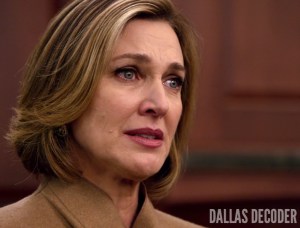
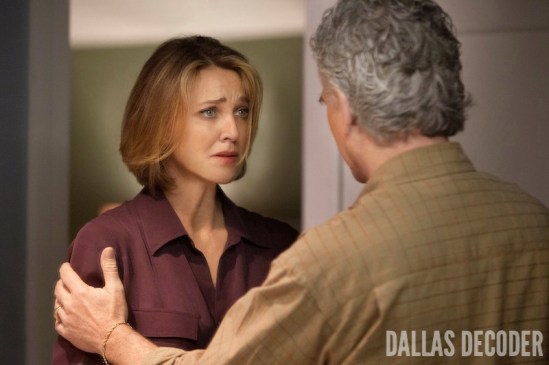
In “Trial and Error,” a second-season “Dallas” episode, Ann (Brenda Strong) testifies before her attorney Lou (Glenn Morshower) and a packed courtroom.
ANN: I was a tall, awkward girl. Most of my life, I felt ugly. My mother took me to doctors when I hit puberty so they would make me stop growing. No one had really ever paid any attention to me until Harris. My family didn’t have much money. And Harris took me to fancy restaurants, stores, bought me nice clothes. We were happy. He had grown up in a suffocating home. His father had committed suicide before he was born. And his mother controlled his every breath. Harris kept telling me how good I was for him, that I brought life into the dark of his life. Then his mother began to interfere. Nothing I could do was right. She made fun of the fact that I had never gone to college. She put ideas in his head about me, that I was a gold-digger, that I was seeing other men. And he believed her. So he began trying to control me the way he had always been controlled. If I picked the wrong blouse, picked up the wrong fork, did my hair a certain way, he’d shout at me. I began to realize that the marriage had been a mistake. When I found out I was pregnant, I felt trapped. By the time Emma was born, I felt like I was drowning. I was diagnosed with post-partum depression and put on medication. I had a difficult time being a young mother. I’m sorry. But I did not leave my daughter at home alone! I left Emma with Judith so I could go see a divorce lawyer. But Judith lied to Harris for her own twisted purposes. And then Harris found out about my plans to divorce him, and he forced me to see a psychiatrist to put me on more medication.
LOU: Tell us what happened at the state fair.
ANN: Emma was 18 months old. Harris and his mother were particularly cruel to me the night before, so that morning, I took a few more pills than I should’ve. I couldn’t think straight, but I couldn’t stand to be in that house another minute, so I took Emma to the fair. It was so very hot. I remember being so thirsty, so I left her in her stroller and went to get a soda. Only a couple minutes passed. I turned back, and she was gone. I had stepped away from my baby for only a few moments and she’d been kidnapped. God had punished me by taking my baby.
Last stand
“Trial and Error” gives us the last scenes that Larry Hagman filmed as J.R. Ewing, including his poignant reconciliation with turncoat son John Ross, as well as a spirited clash with Sue Ellen that recalls the couple’s stormier days. But as much as I cherish these final, dwindling moments with my hero, I can’t deny that “Trial and Error” belongs to Brenda Strong. The actress is superb throughout this episode, especially when Ann testifies during her trial. Strong delivers more than 400 words of dialogue, and each one feels achingly real. It’s one of the most moving speeches in “Dallas” history.
Since the new “Dallas” began I’ve rooted for Ann, a modern Texas woman who is every bit as comfortable in pearls and heels as she is in boots and jeans. One of my favorite scenes during the show’s first season was Ann’s showdown with Harris, when she tricked him into confessing to money laundering and other crimes, then slugged him and warned him to stay away from her family. This is why I was so troubled when Ann shot Harris two episodes ago. A punch is one thing, but Harris doesn’t deserve a bullet to the chest. No one does.
“Trial and Error” marks the beginning of Ann’s redemption, although it feels like something even bigger is happening. Ann isn’t really being tried for shooting Harris; she’s on trial for being an imperfect wife and mother. The show isn’t asking us to forgive Ann as much as it’s asking us to accept her humanity. The character’s testimony, the highlight of “Dallas” newcomer John Whelpley’s script, is the crucial moment. During the course of this four-minute scene, Ann recalls being a tall, awkward girl who found love with Harris, only to have his controlling mother Judith undermine her. She also remembers giving birth to Emma and struggling with motherhood, then having the child snatched from her during a fateful visit to the state fair. It’s wrenching.
I suspect many members of the “Dallas” audience nod silently when they watch Ann’s testimony. The situations she describes might be melodramatic, but the feelings they evoke are easily recognizable. When Ann recalls how Judith made fun of her for not going to college, or how Harris chastised her for using the wrong fork at dinner, how can you not think about a time in your own life when you were made to feel inadequate? Likewise, if you’re a mom or dad, do Ann’s memories of Emma’s abduction remind you of a time when you made a parenting mistake? You’d have to reach far back into Ewing family lore – perhaps to Sue Ellen’s sanitarium meltdown during the original show’s third season – to find a “Dallas” monologue that yields so many genuine emotions.
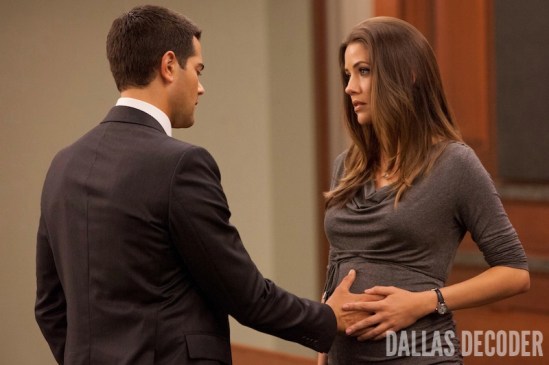
Strong’s beautifully measured, heartfelt delivery provides “Trial and Error” with its moment of catharsis, but there are many other scenes I like. Several involve Jesse Metcalfe and newcomer Emma Bell. No one does impassioned earnestness better than Metcalfe, as we witness in the nice sequence where Christopher urges Emma to give Ann another chance. Metcalfe is also touching when the camera cuts to Christopher during Ann’s testimony and we see that his eyes are wet, as well as in the scene where Christopher puts his hand on Pamela’s pregnant belly and feels their unborn twins. Bell, in the meantime, reveals herself to be the rare actress who requires no dialogue to shine. Emma is a mostly a silent observer in the courtroom, but never once do we question what she’s thinking. Bell lets us see the doubt and confusion tormenting her character.
Millicent Shelton, a first-time “Dallas” director, also gives us some priceless courtroom reaction shots from Judith Light, who made her own mark in television with a classic witness stand breakdown on “One Life to Live” in 1979. While Light nibbles the scenery, Mitch Pileggi goes in another direction, offering expressions and gestures that seem to reveal Harris’s humanity. Notice how Pileggi bows his head when Ann mentions how Harris’s father committed suicide before he was born. Am I the only one who feels sorry for Harris at that moment?
I’m not sure why we never see Bobby testify on his wife’s behalf (or why he isn’t facing his own obstruction of justice trial for falsely confessing to Harris’s shooting). In the same spirit, it’s tempting to knock “Dallas” for offering up Sue Ellen (a disgraced politician) and Pamela (a recent murder suspect) as Ann’s character witnesses, but I’ll resist the urge because I like how it reminds us of the parallels between these flawed heroines. An especially nice touch: When Ann mentions suffering from post-partum depression after Emma’s birth, the camera cuts to Sue Ellen, who must be one of television’s most notorious sufferer of that disorder.
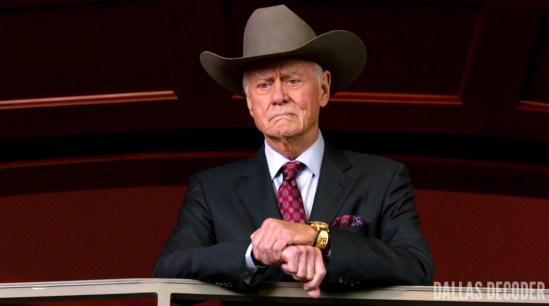
“Trial and Error” also gets a lift from Hagman, who filmed some of his scenes for this episode just days before his death last November – not that you’d know it by watching him here. Consider the shot of J.R. observing John Ross from the mezzanine inside the courthouse. Isn’t it amazing how Hagman can exert so much authority, just by standing silently? I also love J.R.’s quip-filled scene with John Ross in the men’s room (“We dinosaurs are known to bite”), even if it’s an odd place to stage their reconciliation, as well as the exchange where Sue Ellen gives her ex-husband a piece of her mind (“Fathers are supposed to take the high road when it comes to their sons. Forgive John Ross!”). J.R.’s surprise encounter with Cliff is old-school “Dallas” fun too, although I wish Hagman and Ken Kercheval could’ve done the scene face to face instead of over the phone.
This isn’t Hagman’s final “Dallas” appearance. A J.R. scene that was left over from a previous episode has reportedly been inserted into the next hour, “Blame Game,” although we probably won’t know what the moment entails until TNT telecasts it next week. This made watching “Trial and Error” a bit surreal. I wondered: Is J.R.’s exchange with Sue Ellen the last time we’ll see him share the screen with Linda Gray, or will we get one more chance to revel in their magic? What about Bobby and John Ross? Have we already seen J.R.’s final scenes with them too?
This feeling has plagued fans like me all season long, actually. Watching “Dallas” and knowing that our hero will soon go away is the worst of all possible spoilers. Part of me still refuses to believe it’s going to come true.
Grade: B
_______________________________________________________________________________________________________________________________________________
Her day in court
‘TRIAL AND ERROR’
Season 2, Episode 5
Telecast: February 18, 2013
Writer: John Whelpley
Director: Millicent Shelton
Synopsis: Ann proves she shot Ryland and goes on trial. During her testimony, she reveals her struggles as a young mother but refutes Harris’s accusation of neglecting Emma. The jury finds Ann guilty. Cliff tells J.R. that John Ross betrayed him, but Sue Ellen persuades J.R. to forgive their son. Christopher softens toward Pamela, who rejects John Ross’s romantic overtures. Drew is arrested for transporting stolen goods.
Cast: John Athas (Ellis), Kuno Becker (Drew Ramos), Emma Bell (Emma Brown), Carlos Bernard (Vicente Cano), Holt Boggs (state trooper), Jordana Brewster (Elena Ramos), Brett Brock (Clyde Marshall), Candice Coke (Tamera Carson), Patrick Duffy (Bobby Ewing), Rick Espaillat (Dr. LaFont), Wilbur Fitzgerald (Judge Wallace Tate), Julie Gonzalo (Pamela Barnes), Linda Gray (Sue Ellen Ewing), Larry Hagman (J.R. Ewing), Josh Henderson (John Ross Ewing), Ken Kercheval (Cliff Barnes), Judith Light (Judith Ryland), Jesse Metcalfe (Christopher Ewing), Glenn Morshower (Lou Bergen), Kevin Page (Bum), Mitch Pileggi (Harris Ryland), Brenda Strong (Ann Ewing), Brian Thornton (Detective Miles Danko), Rebekah Turner (jury foreman)
“Trial and Error” is available at DallasTNT.com, Amazon.com and iTunes. Watch the episode and share your comments below.
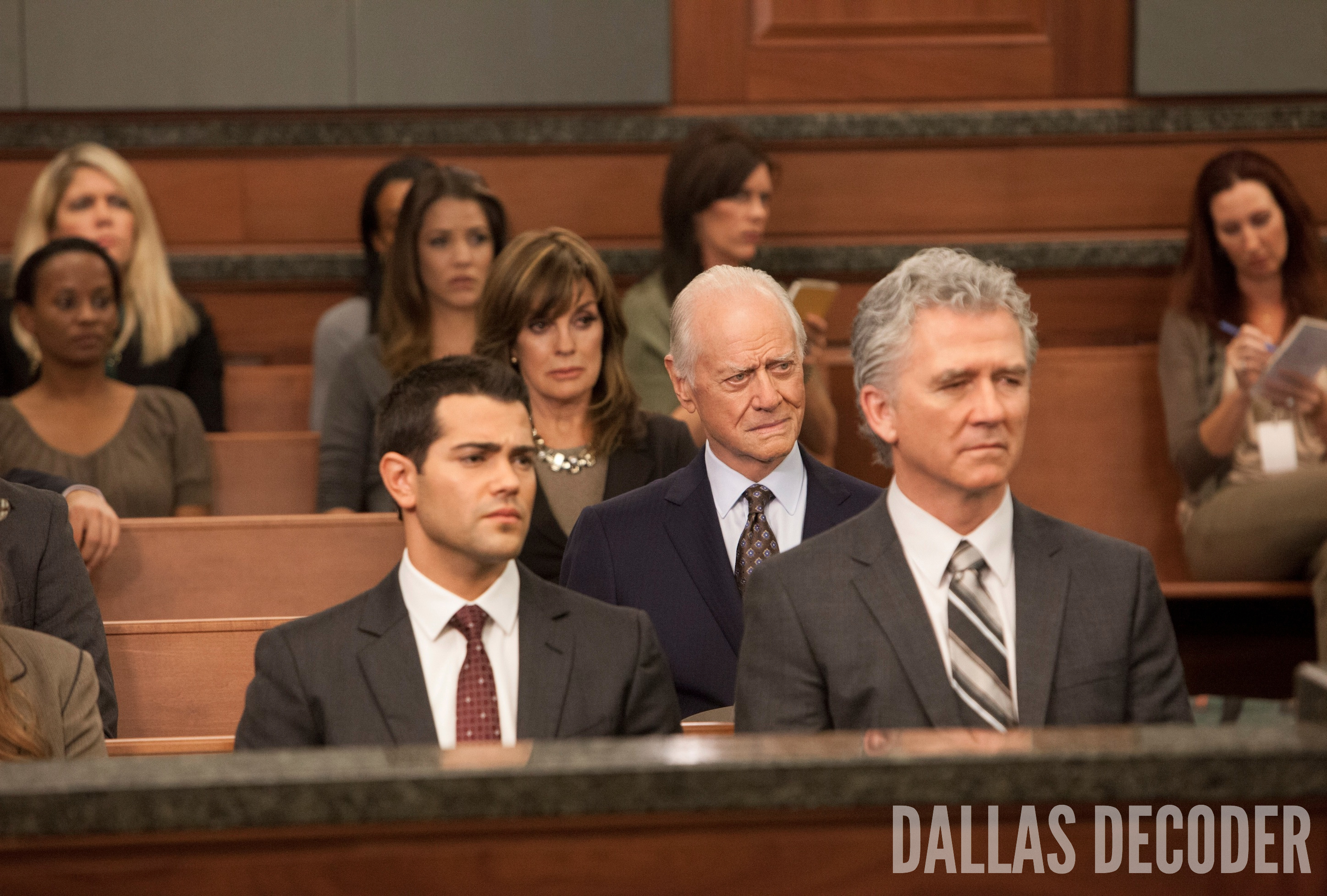
Gang’s all here
The Ewings go to court in “Trial and Error,” TNT’s latest “Dallas” episode, and if past is prologue, the experience will be as enlightening as it is entertaining. Here’s what we learned about the Texas legal system from watching the original “Dallas.”
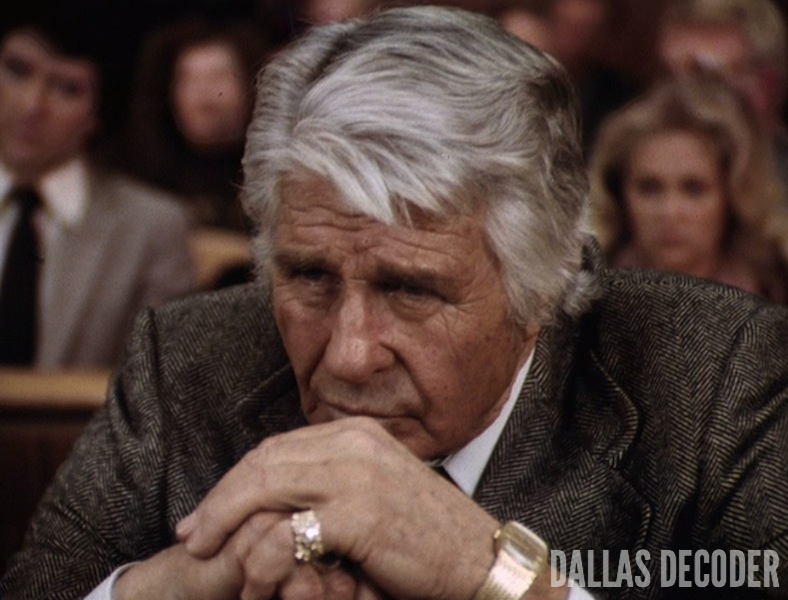
Rush to judgment
Justice is swift. (Except when it isn’t.) When someone in the Ewing camp is accused of a crime, the wheels of justice either spin super fast – or grind to a halt. Jock (Jim Davis) was charged with killing Hutch McKinney and indicted a week later, and then his trial lasted all of one day. But when Bobby’s girlfriend Jenna Wade went on trial for murdering Naldo Marchetta, the case dragged on for 11 episodes – almost a third of that season!
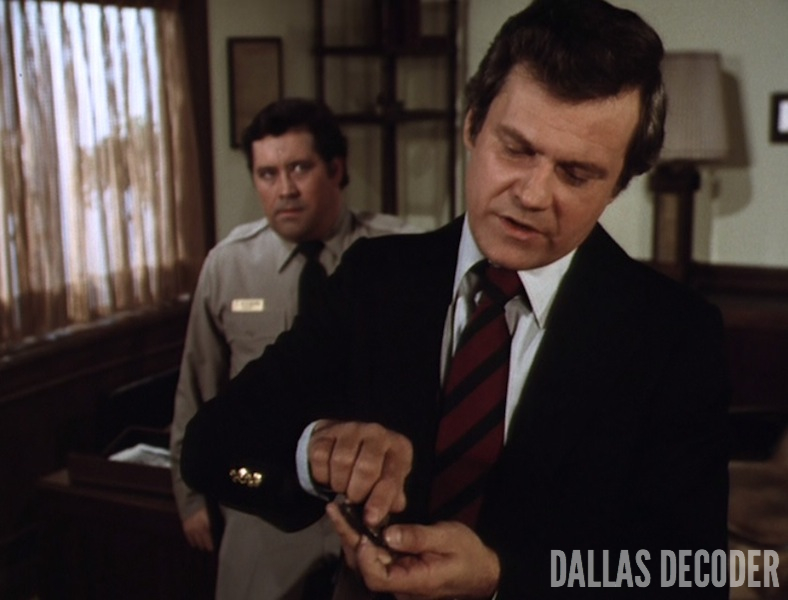
Snide and prejudice
What conflict of interest? When Jock’s case went to trial, the assistant prosecutor was – drumroll, please – Cliff Barnes (Ken Kercheval). Did it matter that Cliff’s father was once Jock’s business partner? Or that Cliff’s sister was married to Jock’s son? Of course not! Look, if Senator Bobby Ewing could preside over a legislative inquiry into J.R.’s shady dealings, surely Cliff could prosecute Jock without prejudice. Right?
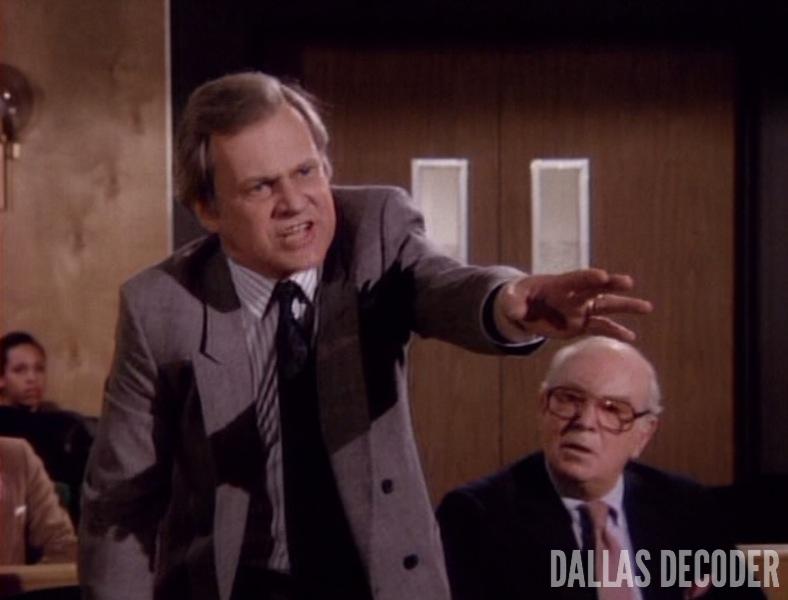
Cliff jumping
What courtroom etiquette? You know how Christopher has a penchant for courtroom outbursts on TNT’s “Dallas”? Uncle Cliff had the same habit on the old show. Remember when he interrupted a Ewing Oil ownership hearing by loudly telling opponent Jack Ewing, “This is all a setup by J.R. Ewing! You are here to cheat me!” The judge vowed to eject Cliff, but of course he didn’t. Do TV judges ever follow through on that threat?
Chamber of commerce
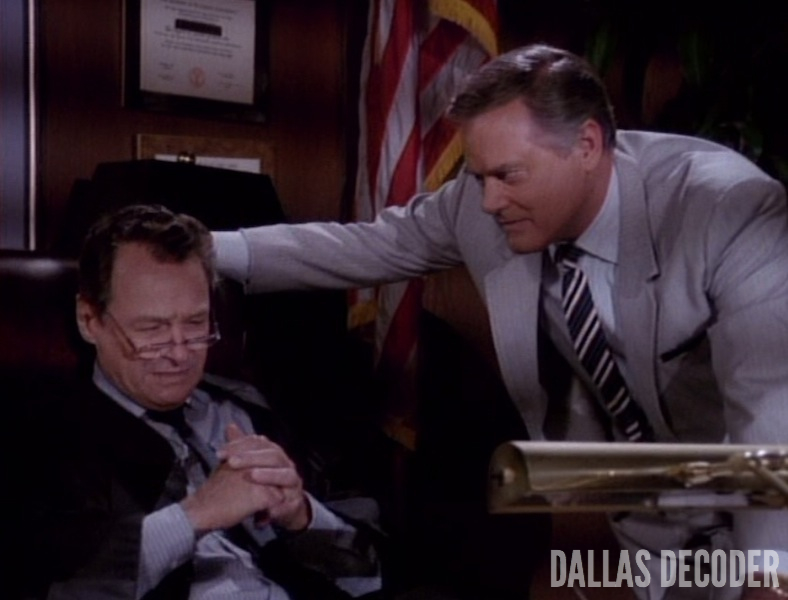
Judges are for bribing. J.R. (Larry Hagman) never met a judge he didn’t try to influence. When Cliff tried to weasel his way into Ewing Oil, J.R. gave Judge Loeb (Jerry Hardin) some valuable stock tips in exchange for an injunction stalling Cliff’s case. Of course, these things sometimes backfired. When J.R. tried to pressure Jenna’s judge, the judge jacked up her bail to $2 million. Silly jurist. That’s what the Ewings call “pocket change.”
Mr. Cool
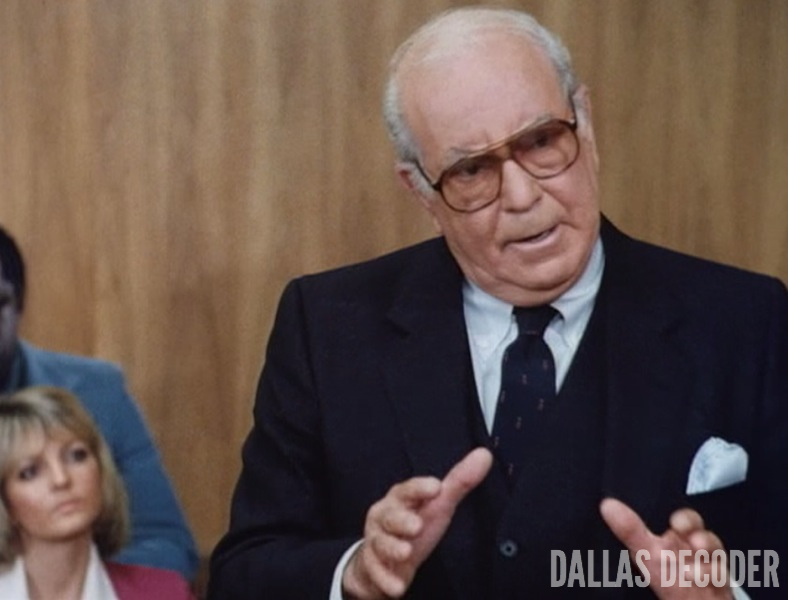
Scotty Demarest: Texas’s Matlock. Whenever the Ewings landed in hot legal water, they summoned Scotty (Stephen Elliott), an ultra-cool legal eagle whose disarming drawl added a few extra syllables to every word. Scotty’s best stunt: putting accused shooter Jenna on the witness stand and asking her to activate the gun’s “sy-luntz-uh.” She couldn’t, giving “Dallas” its own if-it-doesn’t-fit-you-must-acquit moment.
Spectacles of justice
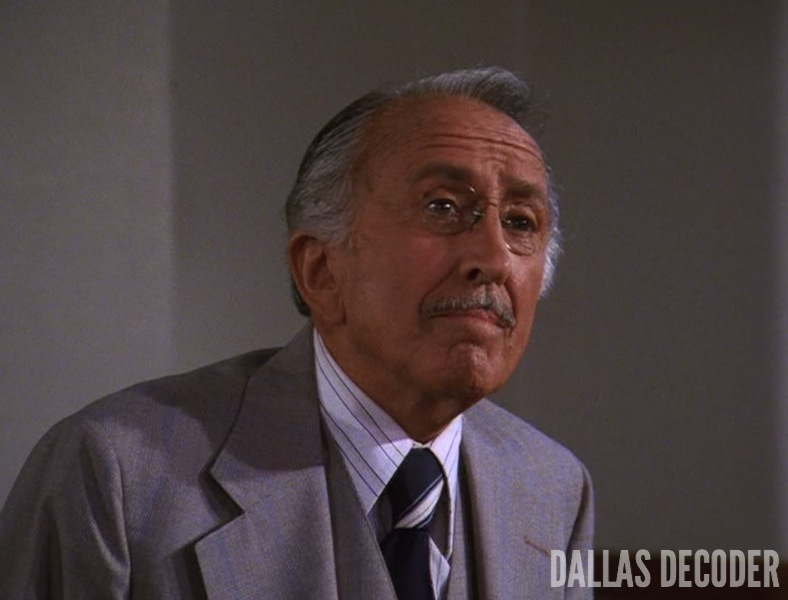
Harv Smithfield was cool too. Who didn’t love Harv (George O. Petrie), the Ewings’ loyal consigliere? He wasn’t quite as flamboyant as Scotty, but he had a flair for legal theatrics nonetheless. I mean, is it me or did Harv only trot out his lawyerly pince-nez spectacles when he was in court? The other remarkable thing about Harv: He was highly ethical. So how’d he manage to stay on the Ewing payroll for so long?
He must object
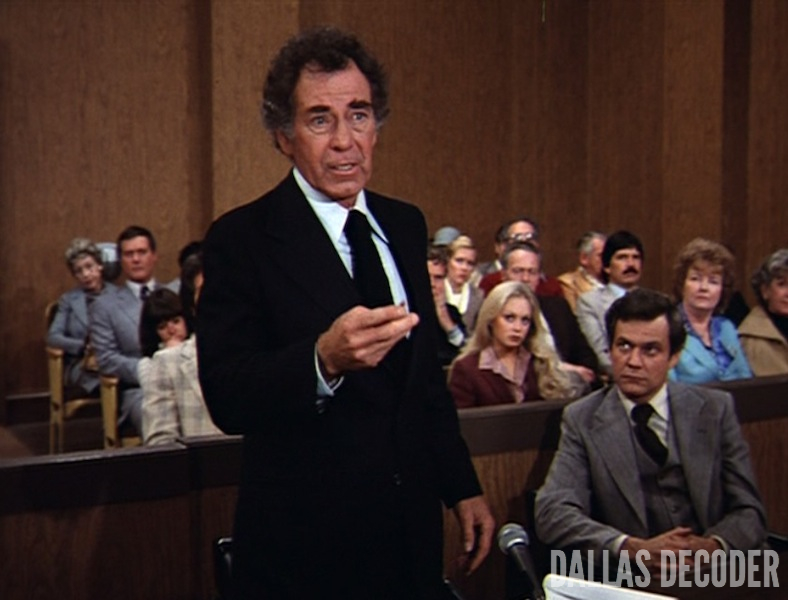
Don’t forget about Cole Young! Cole (Walter Brooke) helped acquit Cliff of Julie Grey’s murder through sheer incredulity. During J.R.’s three-minute testimony against Cliff, Cole objected five times. Cole was especially outraged when he thought the prosecutor was being mean to Pam on the witness stand. As Cole put it: “I protest that, not only as an officer of this court but as a citizen of the great state of Texas!” You tell ’em, Cole!
He’ll smell ya later
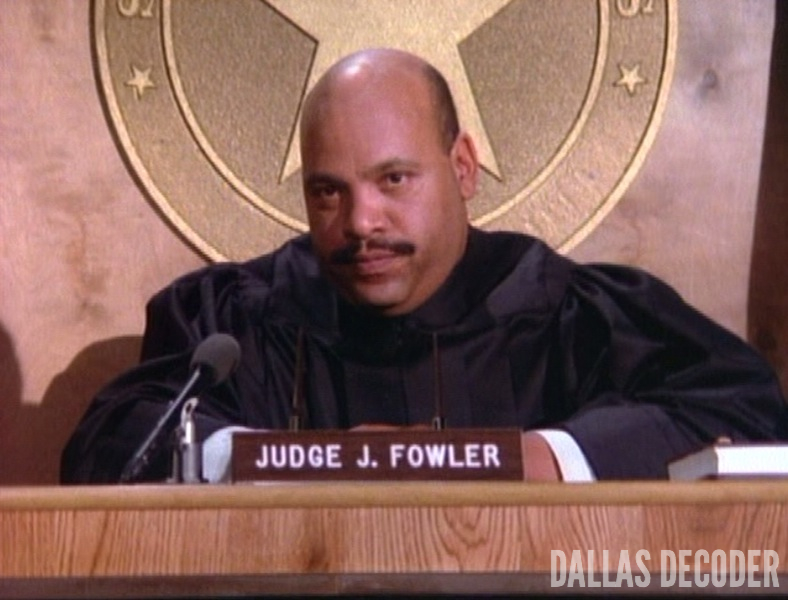
Trials are for stargazing. In addition to Brooke, who famously gave Dustin Hoffman career advice in “The Graduate” (“plastics!”), “Dallas” also gave us stars-in-the-making, including Steven Williams (the boss on “21 Jump Street”) as the bailiff during Ray’s trial for Mickey Trotter’s death and James Avery (Will Smith’s Uncle Phil on “The Fresh Prince Bel-Air”) as the judge in one of little Christopher’s many custody hearings.
Might want a stack of those, just in case
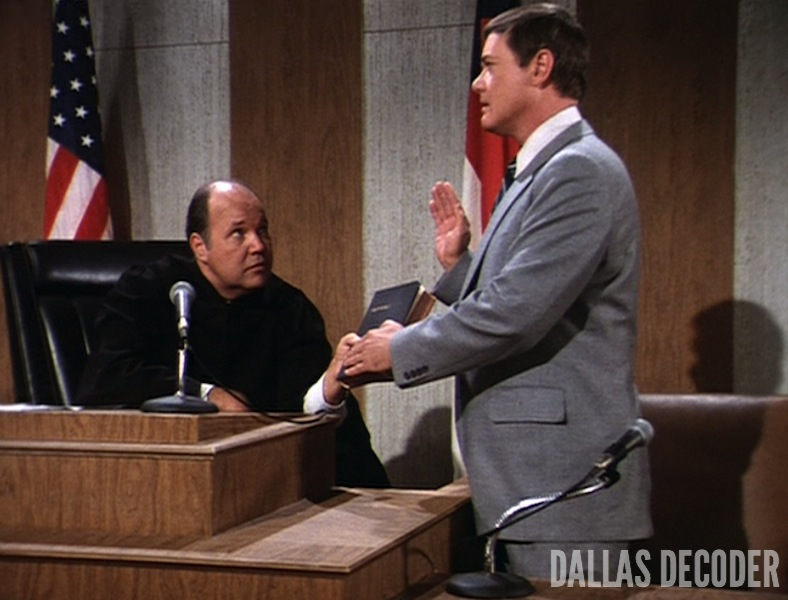
Testify! The amazing thing about the Ewings: They often told the truth in court. For example, Bobby allowed the sordid story of Christopher’s paternity to come out during his final custody fight for the boy. J.R. even delivered potentially damaging testimony against his daddy at Jock’s trial, although he declined to drag Sue Ellen’s name through the mud at their first divorce hearing. Who says miracles don’t happen in “Dallas”?
What have the Ewings taught you about the justice system? Share your comments below and read more “Dallas Decoder Guides.”
Too little too late?
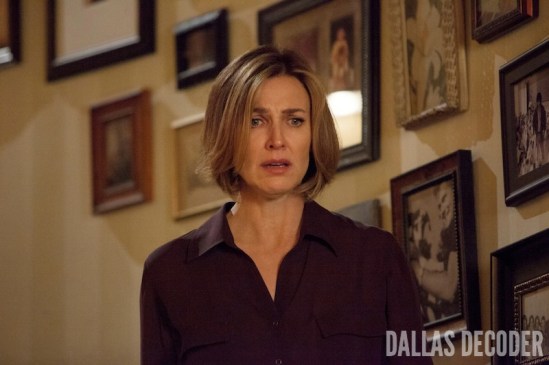
Here are the questions we’re pondering as we await tonight’s telecast of “Trial and Error,” TNT’s latest “Dallas” episode.
• Will the police believe Ann or Harris? In last week’s episode, “False Confessions,” Bobby (Patrick Duffy) tried to protect Ann by confessing to shooting Harris. Meanwhile, as Harris lay in a coma, his mother Judith (Judith Light) vowed revenge. “I will make sure Bobby goes to jail, take him from Ann the way she took you from me,” she whispered into her son’s ear. After Bobby was arrested and freed on $1 million bail, Ann (Brenda Strong) persuaded him to recant his confession, then told family lawyer Lou (Glenn Morshower) the truth: that she shot Harris. There was just one problem: When Harris (Mitch Pileggi) woke up and the police asked him to name his assailant, he lied. “It was Bobby Ewing,” Harris said as Judith smiled. So which Ewing will go on trial – Bobby or Ann?
• Has Pamela ruined all of her relationships? After J.R. and Frank conspired to expose Pamela’s role in Tommy’s death, Cliff (Ken Kercheval) turned the tables on them. Cliff framed Frank (Faran Tahir) for the shooting, then persuaded his “son” to fall on his sword for the good of the Barnes family. When Frank went before the judge, he lied and said he shot Tommy – then admitted to killing Becky, swallowed a poison pill and died. Elsewhere, Pamela (Julie Gonzalo) – sensing that John Ross (Josh Henderson) was falling for her – rejected his offer to help, while Christopher (Jesse Metcalfe) was outraged to see her beat the rap for Tommy’s death. So, to recap: Pamela has angered her father, alienated her lover and made her estranged husband madder than ever. Can any of her relationships be saved?
• Will John Ross regret betraying J.R.? J.R. (Larry Hagman) learned John Ross was “cavorting” with Pamela and ordered him to stop, but John Ross refused and turned to Cliff, tipping him off that Frank was in cahoots with J.R. What will happen when J.R. learns his son sold him out?
• Will Elena strike oil? John Ross bribed Elena’s foreman to sabotage the Henderson drilling site, hoping it will cause her to miss the deadline to strike oil and repay her loan to Sue Ellen (Linda Gray). Unfortunately for John Ross, Elena’s brother Drew (Kuno Becker) realized the foreman was up to no good and fired him. Will this give Elena (Jordana Brewster) time to get her project back on track – or will Sue Ellen end up calling in the loan and seizing Elena’s share of Ewing Energies?
• What’s Drew up to? Speaking of Elena’s brother: Clyde (Brett Brock), John Ross’s private eye, watched Drew go to the outskirts of Dallas, where he met a truck driver and had a cryptic conversation about “the boss” they share. The driver tossed Drew the keys, and then Drew climbed into the truck and drove away. Where was he headed – and who is his mysterious employer?
What “Dallas Burning Questions” are on your mind? Share your comments below and watch TNT’s “Dallas” tonight.
Boss mom
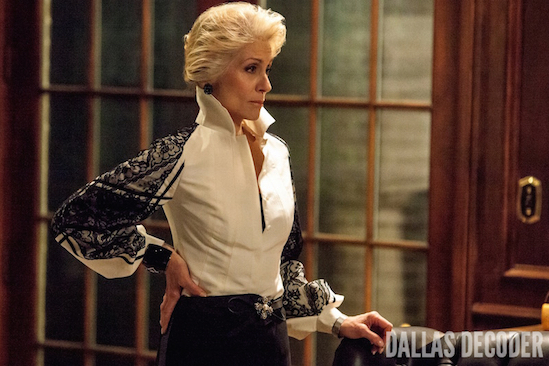
Judith Light is making quite a mark on TNT’s “Dallas,” where her cunning character, Judith Brown Ryland, exerts enormous influence over equally sadistic son Harris. Of course, Mrs. Ryland isn’t this franchise’s first meddlesome mama. Here’s a look at five others from the original “Dallas” and its “Knots Landing” spinoff, ranked in order from least intrusive to most.
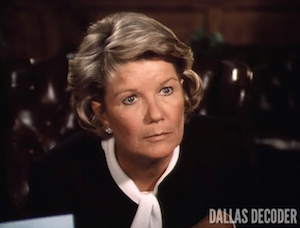
Boys’ mama
5. Miss Ellie Ewing. Miss Ellie (Barbara Bel Geddes) spent most of her time quietly fretting about her sons and their wives, but occasionally she couldn’t help but stick her nose in their business. Like the time she called out J.R. for allowing Sue Ellen’s drinking to spiral out of control. Or the time she suggested the newly divorced Sue Ellen stop dating Cliff. Or the time she pressured Ray – gently, of course – into confessing his financial failings. Did the Ewings mind Miss Ellie’s interference? I doubt it. I mean, look at that woman’s kind face. How could anyone ever get mad at Mama?
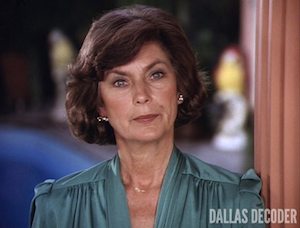
Mommy’s revenge
4. Rebecca Wentworth. For a long time, Rebecca (Priscilla Pointer), Cliff and Pam’s mom, wasn’t meddlesome enough: She abandoned her kids when they were little and allowed them to believe she was dead. Once Cliff and Pam grew up, Rebecca re-entered their lives and tried to make up for lost time, but she overcorrected a bit, like the time she told Cliff to stop seeing Sue Ellen. Later, while Cliff was recovering from a suicide attempt, Rebecca browbeat him into resuming his war against the Ewings, even buying him his own oil company so he’d have a platform to launch his attacks. Gee, thanks Mom.
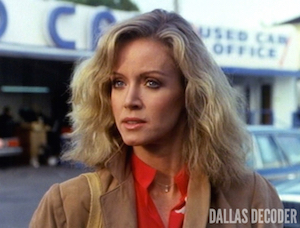
Maternal affairs
3. Abby Cunningham. Abby (Donna Mills) was a pretty good mom, although sometimes she was more smothering than mothering. Remember when she ordered daughter Olivia to stop seeing Harold Dyer, just because he was in the mob? Or how about when Olivia suspected Abby of killing her crush, Peter Hollister? Abby didn’t really do it, but the fact that Olivia thought Abby was capable of murder tells you what kind of mom she could be. Then there was the time Abby flipped out after discovering Olivia was using drugs. Oh, Abby. It was the ’80s. Girls just wanted to have fun!
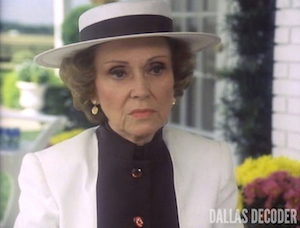
Mother wants best
2. Patricia Shepard. This one warrants a psychological dissertation. Patricia (Martha Scott), mother to Sue Ellen and Kristin, only wanted the best for her girls – and I mean that literally. When J.R. was courting Sue Ellen, Patricia didn’t think he was rich enough. Of course, once they wed, Patricia came around – so much so that when Sue Ellen began to lose interest in her marriage, Patricia began grooming Kristin to replace her as the next Mrs. J.R. Ewing. Weird! Later, Patricia softened and even made amends with Sue Ellen – but that turned out to be part of Pam’s dream. Thanks for nothing, Pam.
Serial mom
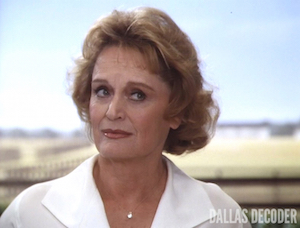
1. Lady Jessica Montford. This loony lady could out-meddle them all. Jessica (Alexis Smith) was the biological mother of Dusty Farlow, although he grew up believing she was his aunt (don’t ask). Jessica committed all manner of evil in Dusty’s name, including murdering a bunch of people to ensure he’d inherit a big chunk of Westar stock. Her killing spree was pretty heinous, but if you ask me, Jessica’s vilest crime was the time she knocked out Miss Ellie and stuffed her in a car trunk. Sorry Lady Jessica, but when you did that, you broke Dallas Decoder’s cardinal rule: Never mess with Mama!
Which “Dallas” mamas do you consider most meddlesome? Share your choices below and read more “Dal-Lists.”
Relax. The numbers will go up.
More viewers made time for “Dallas” this week.
TNT’s telecast of the latest episode, “False Confessions,” was seen by 2.4 million viewers on Feb. 11. The audience grew almost 10 percent from the previous week’s telecast.
“Dallas” is also getting a healthy boost from DVR users. The two-hour season opener – comprised of back-to-back telecasts of “Battle Lines” and “Venomous Creatures” – was seen by 2.9 million viewers on January 28, although the audience soared to 3.7 million when people who recorded the show and watched it a few days later were counted.
The second season’s third episode, “Sins of the Father,” was seen by 2.2 million viewers on Feb. 4, but by the end of the week, DVR users had increased the audience to 2.9 million.
“Dallas’s” first season averaged 4.2 million viewers on Wednesday nights last summer, although DVR users boosted its weekly haul to 6.1 million.
In last week’s edition of “Drill Bits,” TV ratings expert Marc Berman said a decline was expected since “Dallas” is now being telecast on Mondays in the winter, when it faces tougher competition on the broadcast networks.
Strong Speaks
Dallas Decoder was lucky to participate in a press call last week with Brenda Strong, who dished on her character Ann’s recent shooting of ex-husband Harris, “Dallas’s” ratings, working with Larry Hagman and more. If you haven’t already read it, be sure to check it out.
“Drill Bits,” a roundup of news about TNT’s “Dallas,” is published regularly. Share your comments below.
Family man
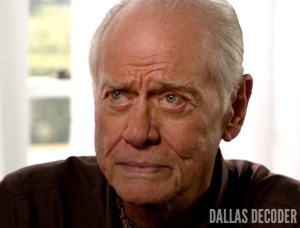
In “False Confessions,” a second-season “Dallas” episode, J.R. (Larry Hagman) is standing at his bedroom window, ending a phone call, when John Ross (Josh Henderson) enters.
JOHN ROSS: What’s going on?
J.R.: Bobby got arrested for shooting Harris Ryland.
JOHN ROSS: You serious? [Steps forward] You think that will help us get him out of Ewing Energies?
J.R.: You still got a lot to learn, boy. [Slides his cell phone in his pocket] When the family’s in trouble, we don’t take advantage.
JOHN ROSS: You got a problem with me?
J.R.: You damn right I do. [Steps forward] I hear you’ve been cavorting with Pamela Barnes. What do fathers say? I’m not mad, I’m just disappointed? Well, I am both.
JOHN ROSS: Who I cavort with ain’t none of your business.
J.R.: It is when her last name is Barnes. [Sits] What do you want with Christopher’s scraps anyway?
JOHN ROSS: I’m working her.
J.R.: And apparently not learning from your mistakes. You already got in bed with one crazy woman in that Marta. Not a good idea to get in bed with another one.
JOHN ROSS: I’ve got a plan to get her shares of Ewing Energies after the divorce.
J.R.: You let that Barnes girl get a piece of our company and you’re inviting a vampire into our home. She’ll suck the life out of us. That’s why I’ve seen to it that there won’t be a divorce.
JOHN ROSS: How’s that?
J.R.: I made a deal with Cliff’s man Frank. We’ve got a plan to take Pamela out of the picture.
JOHN ROSS: You must be getting senile in your old age, Daddy, because I’m the one calling the shots here. Remember?
J.R.: You asked me to teach you every dirty trick I know so we can take Ewing Energies. I teach by example.
JOHN ROSS: What do you and Frank plan on doing to Pamela?
J.R.: You got feelings for this girl?
JOHN ROSS: No.
J.R.: Then why do you care?
J.R. Ewing here
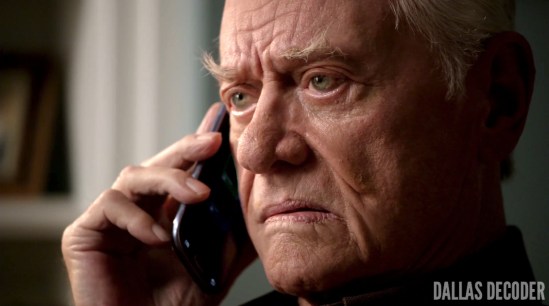
You can feel the hate in “False Confessions.” This episode takes an unapologetically dark view of the Barnes/Ewing feud, which is fitting since the conflict has been going on for so long now it seems Biblical. The epic scope of Taylor Hamra’s script makes this one of “Dallas’s” most satisfying hours this season, which is a real achievement when you consider Larry Hagman appears in just three scenes, and never once does he come face to face with Ken Kercheval. Since Cliff isn’t expected to resurface until J.R.’s midseason funeral, this probably means we’ll never see these old enemies clash again. A sad thought, but one we better start getting used to.
More than anything, “False Confessions” demonstrates how much Cliff has changed. Yesterday’s needy neurotic has become today’s guileful Godfather. How? Why? When? The new “Dallas” has never spelled this out, which makes it tough for longtime fans to figure out what turned Cliff so … evil. I suppose it’s up to each of us to fill in the gaps ourselves, so here’s my theory: After the original “Dallas” ended and J.R. slipped into depression and isolation, Cliff lost his biggest distraction in life, liberating him to focus on building an empire of his own. He’s become one of the world’s richest men, but he’s still hell-bent on beating the Ewings for the same reason Mitt Romney kept running for president – because after you’ve conquered the rest of the world, what else is left?
Whatever the reason for Cliff’s metamorphosis, there’s no denying that “Fatal Confessions” turns him into “Dallas’s” most tragic figure. Cliff pulls out the stops to protect Pamela from prosecution – probably because he loves her, but also because she’s so crucial to his plot against the Ewings. To make matters worse, he forces his “son” Frank to fall on his sword, again to keep his revenge scheme moving forward. It’s hard to not see the parallels with Cliff’s father Digger, who relied on his son to settle his scores with the Ewings, just like Cliff has done with his own children. Of course, Digger was a broken drunk, while Cliff is global titan – but that only makes Cliff seem smaller.
This much is certain: Kercheval is as watchable as ever. I loved his flamboyant performances on the old show; you never knew how Kercheval would approach a scene, which made him “Dallas’s” most electric actor. Now, as the more restrained Cliff, Kercheval turns out to be just as fascinating. Consider the tense scene where Cliff persuades Frank to “do the honorable thing” and kill himself. I would never have dreamed Cliff could be this cold and calculating, but man, does Kercheval sell it. (Credit also goes to costume designer Rachel Sage Kunin, who has cleverly replaced Cliff’s flashy pocket squares with dark jackets and turtlenecks. It’s like an outward manifestation of the darkness that has consumed him.)
Not that Cliff is altogether unrecognizable in “False Confessions”: When he sees the TV news report about the police recovering Tommy’s body, his response (“Son of a bitch!”) brings to mind some of his exasperated reactions to J.R.’s one-upmanship from long ago. We also see a flash of the old Cliff’s shortsightedness in the great scene where John Ross comes to him, offering to betray J.R., only to be turned away because Cliff would never trust a Ewing. Contrast this with J.R. himself, who in the previous episode didn’t hesitate to enlist Frank in his plot against Pamela. Cliff might be richer, but J.R. will always be smarter.
Speaking of J.R.: Hamra deserves much praise for giving Hagman something to do besides deliver zingers. The exchange where J.R. comforts Bobby (“No baby brother of mine is going to spend his twilight years in jail”) showcases the effortless warmth between Hagman and Patrick Duffy, while once again casting J.R. in the unlikely role he’s come to play so well: defender of the family. Something similar happens in the equally wonderful scene where J.R. chastises John Ross for wanting to use Bobby’s misfortune for their gain. Not only does this echo a sweet moment from the original series, when J.R. told little John Ross it would be wrong to take advantage of Uncle Bobby after his shooting, it also recalls my favorite J.R./John Ross scene from last season. Back then, the roles were reversed: John Ross was the one who pleaded with J.R. to show “a little decency” where the cancer-stricken Bobby was concerned.
Hamra’s script includes many other nice touches that summon the show’s history and enduring themes of family and honor. I love when Sue Ellen recalls for John Ross how she was “nearly destroyed” when she got caught in the middle of J.R. and Cliff’s war. I also love the line where Cliff tells John Ross he only agreed to see him out of respect for his mother. There’s also Faran Tahir’s surprisingly heartbreaking performance during Frank’s jailhouse meeting with Cliff, as well as Judith Light’s big scene, when her character Judith comforts the comatose Harris. I know this one is supposed to creep me out, but heaven help me I find it kind of touching.
Stephen Herek, a first time “Dallas” director, makes “False Confessions” a technical achievement as much as anything. The autopsy-triggered musical montage is superbly executed, culminating in the new “Dallas’s” best fakeout (the cops were coming to arrest Frank, not Pamela!) since the end of “Changing of the Guard,” when we discovered J.R. was in cahoots with Marta. I also love the crosscutting between the scene where Ann finally admits to shooting Harris and the moment Harris wakes up and fingers Bobby for the crime.
While we’re on the subject of Bobby: His top-of-the-hour confession to shooting Harris has all the casualness of someone admitting to leaving the cap off the milk carton. I’m also bothered by Ann’s response, which is to say she has none. As difficult as it is for me to accept that this strong, loving wife would resort to shooting her ex-husband, it’s even harder for me to believe she’d allow Bobby to take the rap for it. I’m glad when Ann finally pipes up at the end of the episode, but I wonder if this is going to be enough to make the audience forgive her.
When I asked Brenda Strong about this last week, she expressed her confidence in the show’s writers to redeem Ann, saying they “are holding the big picture in mind.” I suppose that’s enough for me to give them the benefit of the doubt. After all, they haven’t done much to disappoint me this season.
Grade: A
_______________________________________________________________________________________________________________________________________________

Changed man
‘FALSE CONFESSIONS’
Season 2, Episode 4
Telecast: February 11, 2013
Writer: Taylor Hamra
Director: Stephen Herek
Audience: 2.4 million viewers on February 11
Synopsis: To protect Ann, Bobby confesses to shooting Harris. Later, Bobby recants his confession, but when Harris emerges from his coma, he tells the police that Bobby was the shooter. Drew fires Bubba, the foreman that John Ross bribed to sabotage Elena’s drilling project. After Frank digs up Tommy’s body and tells J.R. about John Ross and Pamela’s relationship, J.R. orders his son to stay away from her. Cliff has Tommy’s murder pinned on Frank and persuades him to commit suicide.
Cast: Amber Bartlett (Jill), Kuno Becker (Drew Ramos), Jordana Brewster (Elena Ramos), Brett Brock (Clyde Marshall), Pam Dougherty (Judge Barbara Hirsch), Akai Draco (Sheriff Derrick), Patrick Duffy (Bobby Ewing), Alex Fernandez (Roy Vickers), Mike Gassaway (Henry Mott), Julie Gonzalo (Pamela Barnes), Linda Gray (Sue Ellen Ewing), Larry Hagman (J.R. Ewing), Josh Henderson (John Ross Ewing), Danny Hunter (Judge Leonard Knox), Ken Kercheval (Cliff Barnes), Judith Light (Judith Ryland), Marcua M. Mauldin (Detective Ronnie Bota), Jesse Metcalfe (Christopher Ewing), Mitch Pileggi (Harris Ryland), Matthew Posey (Bubba), Brenda Strong (Ann Ewing), Faran Tahir (Frank Ashkani), Brian Thornton (Detective Miles Danko)
“False Confessions” is available at DallasTNT.com, Amazon.com and iTunes. Watch the episode and share your comments below.









 Dallas Decoder