‘Dallas’s’ Second Season Gets Off to a Promising Start

Dallas, John Ross Ewing, Josh Henderson, J.R. Ewing, Larry Hagman, TNT

Lessons learned

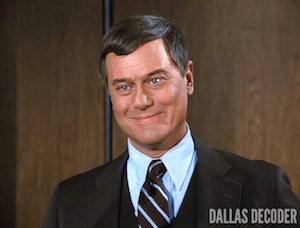
At one point during “Dallas’s” second-season premiere, J.R. offers Sue Ellen a sly grin and declares, “I never learn my lesson.” Maybe not, but the people who make “Dallas” seem to have learned theirs. This has been a good show from the beginning, but diehards like me couldn’t help but feel bothered by some of the historical flubs in the first-season plotlines (don’t get us started on those Southfork mineral rights) or the fact that our beloved Linda Gray was missing from two whole episodes.

Thankfully, those days appear to be over. The two-hour premiere, which TNT will telecast Monday, January 28, does a nice job giving “Dallas” devotees the stuff we crave. The first shot of the first scene is none other than Sue Ellen – a signal, I hope, that Gray will have a prominent role this year. The opener also offers the first Southfork swimming pool scene in 22 years, references to two long-unseen “Dallas” characters, and a fleeting-but-much-appreciated mention of an institution that was significant to the old show’s mythology. Someone’s been doing their homework.

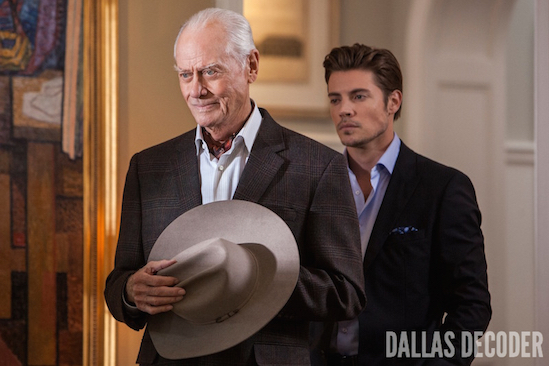
Best of all, J.R. gets lots of screen time in the extended premiere, which is actually two one-hour episodes (“Battle Lines” and “Venomous Creatures”) that TNT will telecast back-to-back. Larry Hagman filmed a handful of episodes before his death last November, and in these first two hours, he’s as great as ever. Hagman’s scenes with Patrick Duffy will make you chuckle, while his exchanges with Gray will leave you reaching for the tissues. The magic is still there.

Of course, as much as I love watching my old favorites, it’s also good to see “Dallas” cultivating its next generation of stars. Josh Henderson has become a worthy heir to Hagman’s badassery, although he now has competition from an unexpected source: Julie Gonzalo, who is a hellion in heels as Cliff’s vengeful daughter. I’m also pleased to report the premiere gives Jordana Brewster some meaningful scenes. Brewster remains one of the best actors in this ensemble; she makes Elena feel like the kind of person you might know in real life, which – let’s face it – doesn’t always happen on shows like this. Henderson and Gonzalo might get the juicy lines, but Brewster and Jesse Metcalfe, her equally good leading man, keep “Dallas” grounded.

The premiere also establishes the battle for Ewing Energies as the season’s main story arc and introduces us to the sleek Ewing Energies set, which looks absolutely nothing like the offices seen on the old show. (Please note: This isn’t a complaint.) A nifty subplot focuses on Christopher’s foray into racecar driving, and we also learn Ann’s dark secret, a storyline that has more than a few holes but nonetheless offers a nice showcase for Brenda Strong.

Other highlights include our first glimpse of the mysterious new character Emma Brown, played by Emma Bell, who was so memorable as the doomed Amy on “The Walking Dead.” (I wonder: Does Bell find zombies or Ewings more cannibalistic?) We also meet Harris Ryland’s mother Judith, played to the hilt by Judith Light. Yes, Light is only three years older than Mitch Pileggi, who plays Harris. It’s too early to know if audiences are going to buy this, but if anyone can pull it off, it’s Light.

The real question is how “Dallas” will fare once it runs out of episodes featuring Hagman. This week, TV Guide reported the show will write out its star with a “Who Killed J.R.?” mystery that will echo the old “Dallas’s” most famous cliffhanger. Whether or not this idea is really brilliant or really lousy will depend on the execution, but it’s a good sign the show is bringing back so many favorites for J.R.’s funeral and memorial service. The guest list will include Deborah Shelton, who played J.R.’s longest-running (three seasons!) mistress Mandy, and Cathy Podewell, who portrayed his second wife Cally, along with four characters who require no explanation: Gary (Ted Shackleford), Lucy (Charlene Tilton), Ray (Steve Kanaly) and Cliff (Ken Kercheval).

This group includes some of “Dallas’s” most iconic figures. Watching them come together to mourn – or celebrate – the death of the biggest icon of all is bound to be great television. It will never satisfy all of “Dallas’s” hardcore fans, but you have to hand it to the people who make the show. At least they’re trying.

What do you want to see during “Dallas’s” second season? Share your comments below and read more opinions from Dallas Decoder.
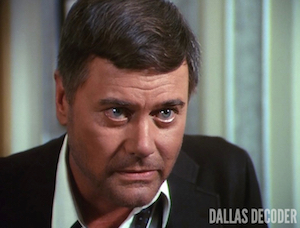
The Best & Worst of Dallas: Season 5

“Dallas’s” fifth season was dandy, save for a few disappointments.

Performances

Barbara Bel Geddes, Dallas, Miss Ellie Ewing

Walk to remember

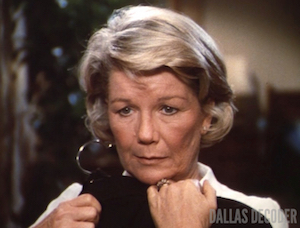
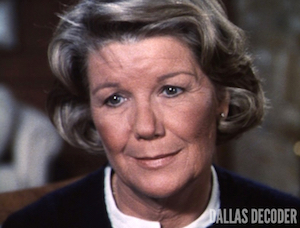
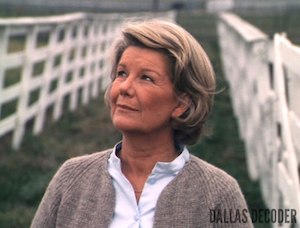
Barbara Bel Geddes delivers one tour-de-force performance after another as the grieving Miss Ellie. Everyone remembers the scene where Mama smashes the dishes in the Southfork kitchen, but Bel Geddes also shines in quiet moments like the one where Ellie takes that mournful stroll across the ranch. I’ve said it before, but it bears repeating: Bel Geddes can say more with one look than most actors can with a whole script.

Dallas, J.R. Ewing, Larry Hagman

Ewing blues

Runners up: Larry Hagman and Patrick Duffy both break my heart as the brothers Ewing struggle – in very different ways – to deal with Jock’s death (J.R. falls apart, Bobby falls in line). Meanwhile, Linda Gray does a beautiful job conveying Sue Ellen’s conflicting emotions as a recent divorcee. I understand her confusion: It’s nice to see Sue Ellen on her own, but I also want her to reunite with the soul mate she’s left behind at Southfork.

Storylines

I love to watch J.R. scheme his way back into Sue Ellen’s heart. This is another fascinating performance from Hagman, who keeps us guessing about J.R.’s motivation: Does he really love his ex-wife, or is he merely trying to get his hands on John Ross’s Ewing Oil voting shares? My guess is it’s a little from Column A and a little from Column B. One thing is certain: Seeing J.R. pick off Sue Ellen’s suitors (Dusty, Clayton, Cliff), one by one, is a hoot.

Weakest storyline: Pam’s mental breakdown. Victoria Principal does a nice job depicting her character’s despair, but this isn’t the heroic Pam I fell in love with during “Dallas’s” early years. Thankfully, she gets her groove back toward the end of the season, when she lays down the law to creepy Roger and helps Bobby solve the mystery of Christopher’s paternity. And while we’re on the subject: They may not be Nick and Nora, but isn’t it fun watching Bobby and Pam figure out that J.R. didn’t father Christopher? (The season’s best plot twist, by the way.)

Episodes

Adoption, Bobby Ewing, Dallas, Linda Gray, Patrick Duffy, Sue Ellen Ewing

Adopt or cry

“Adoption” is one classic scene after another. Donna socks it to Bonnie. Bobby asks Sue Ellen to sign the affidavit. Sue Ellen tosses the necklace at J.R. and proclaims their relationship is “sick, sick, sick!” This is another great script from Howard Lakin, but don’t overlook Hagman, who sat in the director’s chair for this episode and once again proved he’s as gifted behind the camera as he is in front of it.

My least favorite episode: “The Maelstrom,” in which Lucy discovers Roger’s shrine to her and responds by making love to him. Come on, “Dallas.” Charlene Tilton deserves better. So do we.

Scenes

This is always the toughest category to choose a winner, and Season 5 is no exception. Among the contenders: J.R. and Dusty’s Cotton Bowl showdown, Ellie’s confrontation with the cartel and J.R.’s soliloquy in front of Jock’s painting. In the end, I’m going with “The Search” scene where the Ewing sons break the news to Mama that Daddy isn’t coming home. I don’t know who moves me more here: Bel Geddes, Hagman, Duffy or Steve Kanaly. Beautiful performances all around.

Supporting Players

Afton Cooper, Audrey Landers, Dallas

Hot stuff

No one impresses me as much as Audrey Landers. This is the season Afton breaks J.R.’s grip and comes into her own as one of the show’s heroines. There’s no doubt she deserves a better mate than Cliff, but I love how Afton humanizes him – and you can’t deny Landers’ chemistry with Ken Kercheval. As an added bonus, Landers delivers several hot musical numbers this year, including that sultry rendition of “All of Me” in “The Phoenix.”

Runners up: Morgan Brittany, who debuts in Season 5 as scheming Katherine Wentworth and begins laying the groundwork for the havoc she’ll wreak in later years; Fern Fitzgerald, whose Marilee Stone becomes J.R.’s equal in every way; Barry Nelson as Sue Ellen’s sympathetic lawyer Arthur Elrod; Claude Earl Jones as Wally Hampton, J.R.’s co-conspirator in the plot to sabotage Cliff’s career; and Lindsay Bloom as Bonnie, the sad-sack barfly who beds Ray.

Costumes

Clayton Farlow, Dallas, Howard Keel

Hello, handsome

Virtually every “Dallas” diva sports a fur coat during Season 5, but the full-length number Susan Howard dons during Donna’s barroom brawl is the most meaningful. Among the dudes, no one wears suits better than dapper Howard Keel. I especially love when Clayton shows up at Sue Ellen’s townhouse in pinstripes and an open collar shirt, the same look Josh Henderson often sports on TNT’s “Dallas.”

At the other end of the spectrum: What’s with Sue Ellen’s culottes during Season 5? You get the feeling the character spent every episode standing in front of her closet, trying to decide between skirts and pants and choosing to compromise by wearing both. No wonder she became a politician.

Quips

“You getting good mileage on Donna’s car?” – J.R.’s cheery query to Ray in “Five Dollars a Barrel” cracked me up. Only Larry Hagman could turn a throwaway line into a hilarious putdown.

What do you love and loathe about “Dallas’s” fifth season? Share your comments below and read more “Best & Worst” reviews.

Dallas Scene of the Day: ‘You’re a Cold and Insensitive Man’

Now he's done it

Now he’s done it

In “Goodbye, Cliff Barnes,” “Dallas’s” fifth-season finale, Miss Ellie (Barbara Bel Geddes) is in the Southfork living room when Rebecca (Priscilla Pointer) arrives.

ELLIE: Rebecca, what a surprise.

REBECCA: This is not a social call, Ellie.

ELLIE: Rebecca, what’s the matter?

REBECCA: Maybe Digger was right. When I was married to him, I was too young or too stupid to realize it.

ELLIE: What are you talking about?

REBECCA: Digger never had a chance. Jock was too shrewd, too strong and too fast. And now it’s happening between J.R. and Cliff. It’s the same fight all over again.

ELLIE: Rebecca, will you please calm down and tell me what’s happened?

REBECCA: When I found out that Cliff was using Wentworth funds, I fired him. I think it’s time you did the same with J.R. He used Ewing funds to destroy my son. Cliff is in Dallas Memorial, in a coma.

J.R. and Sue Ellen (Larry Hagman, Linda Gray) enter.

SUE ELLEN: [Steps toward Rebecca] My God.

REBECCA: J.R. set him up. He lost everything. Last night, he tried to kill himself.

SUE ELLEN: No.

ELLIE: Rebecca, I’m so sorry. If there’s anything I can do.

REBECCA: I don’t want your help. I’m here to warn you: The Barnes-Ewing feud is still going on! It’s always been an uneven fight. The rich Ewings against the poor Barneses. Well, now it’s even. I swear I’ll break the Ewing family – and I have the money to do it. [Leaves]

SUE ELLEN: I have to go the hospital and see Cliff.

J.R.: [Grabs her arm] No, Sue Ellen.

SUE ELLEN: I have to! [Leaves]

ELLIE: [Steps toward J.R.] I want to hear it from you, J.R. Did Rebecca tell me the truth?

J.R.: Yes, she did.

ELLIE: And you drove Cliff to attempt suicide?

J.R.: How was I to know he was going to do a dumb thing like that?

ELLIE: You don’t care, do you?

J.R.: I told you before, Mama. I couldn’t stand the idea of him being with Sue Ellen. Now I didn’t force him to embezzle from Wentworth Tool and Die. I didn’t force him to get into a deal that he didn’t check and double check. If that man is dying, it’s because of his own greed. Not me.

ELLIE: You’re a cold and insensitive man, J.R. And I’m going to remove you as president of Ewing Oil just as soon as Bobby gets back.

J.R.: Well, you don’t know it yet, but you won’t be able to do that. I’m going to go find Sue Ellen and talk some sense into her. [Leaves]

Critique: ‘Dallas’ Episode 103 – ‘Goodbye, Cliff Barnes’

Cliffhanger

Cliffhanger

“Goodbye, Cliff Barnes” leaves the title character’s fate up in the air after he tries to kill himself, making this the most literal of all “Dallas” cliffhangers. For a long time, I also considered it one of the show’s least satisfying season finales. Was there ever any doubt Cliff would survive?

I now realize that’s not the real question here. Cliff is merely a supporting player in the bigger story of “Dallas’s” fifth season: J.R.’s fight to reclaim Sue Ellen and John Ross. As the year draws to a close, everything is going his way – until Cliff, depressed over being beaten by J.R. yet again, overdoses on tranquilizers. Suddenly, J.R.’s grand plan to reunite his family looks like it’s going to collapse.

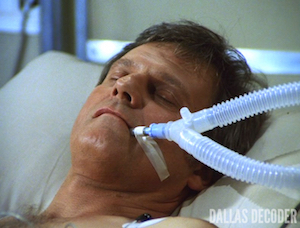
The final scene is telling. J.R. and a guilt-ridden Sue Ellen hover at the hospital bedside of the comatose Cliff. “If Cliff dies, I don’t think I’ll ever be able to marry you,” she says. Larry Hagman inhales, and as the frame freezes and the executive producer credit flashes, the image we’re left with isn’t Cliff with that tube coming out of his mouth; it’s a shot of an anxious – and possibly conscience-stricken – J.R.

You have to admit: This is a pretty nifty trick by the people who made the show. Cliff is the character who might be dying, but J.R. is the one we’re worried about. This cliffhanger is also the act of confident storytellers. Although “Dallas’s” ratings dropped during the 1981-82 season from the “Who Shot J.R.?”-inflated highs of the previous year, it was still the most popular show on television. The producers knew they didn’t need a gimmicky finale to keep the audience hooked.

Of course, even though “Goodbye, Cliff Barnes” keeps the focus on Hagman, don’t overlook Ken Kerchval. He delivers his most moving performance since Cliff’s reunion with Rebecca at the end of the previous season. Kercheval is especially heartbreaking in the scene where Cliff begs Sue Ellen to take him back. “I know I can start over. I know I can build a new life if you’ll just believe in me and love me,” he says through sobs. This is why I love Kercheval: He’s never afraid to show us Cliff at his most pathetic. Kercheval is probably “Dallas’s” bravest actor.

Linda Gray does a beautiful job in this scene too. Tears streak her face when Sue Ellen rejects Cliff’s plea and tells him she has accepted J.R.’s marriage proposal. “Cliff, I don’t want to see you again. Please go,” she says. Bruce Broughton’s background music, which includes those exquisite strings, adds to this scene’s tragic spirit. (I also love Gray’s breathy delivery in the episode’s final moments. “If Cliff dies, I don’t think I’ll ever be able to marry you” is one of those bits of “Dallas” dialogue I like to go around quoting, not because it’s such a great line but because it’s so much fun to imitate Gray’s performance. Try it yourself sometime.)

Two other scenes in “Goodbye, Cliff Barnes” mine “Dallas’s” rich history. In the first, Cliff gets drunk in a dive bar, evoking memories of Digger’s debut in “Dallas’s” first episode. Later, Rebecca storms into Southfork, confronts Miss Ellie and points out how the Barnes men always seem to end up carrying torches for Ewing women. It’s a great moment not just because Barbara Bel Geddes and Priscilla Pointer are such fun to watch, but also because it’s nice to see their characters finally acknowledge the complicated history they share.

Other highlights: The glamorous shot of J.R. and Sue Ellen kissing after a night at the symphony. The fun scenes of Bobby and Pam chasing down clues about Christopher’s paternity in Los Angeles (even if Pam forgives Bobby a little too easily for initially lying about the child’s identity). Howard Keel’s nice performance in the scene where Clayton scuttles his plan to propose to Sue Ellen.

None of this makes “Goodbye, Cliff Barnes” the show’s best cliffhanger, but it’s certainly much better than I remembered. Then again, that’s turned out to be true for much of the fifth season. These episodes are three decades old, but they still manage to surprise me. It’s another reason “Dallas” is such a durable show.

Grade: B

_______________________________________________________________________________________________________________________________________________

Dark of the moon

Dark of the moon

‘GOODBYE, CLIFF BARNES’

Season 5, Episode 26

Airdate: April 9, 1982

Audience: 27.9 million homes, ranking 1st in the weekly ratings

Writer: Arthur Bernard Lewis

Director: Irving J. Moore

Synopsis: Sue Ellen accepts J.R.’s marriage proposal and breaks the news to Cliff, who tries to kill himself by overdosing on tranquilizers. After Rebecca vows revenge, Miss Ellie promises to oust J.R. as Ewing Oil’s president. Bobby and Pam learn Farraday, not J.R., fathered Christopher. Lucy tells Muriel that Roger raped her.

Cast: Tyler Banks (John Ross Ewing), Barbara Bel Geddes (Miss Ellie Ewing), Karlene Crockett (Muriel Gillis), Patrick Duffy (Bobby Ewing), Phyllis Flax (Mrs. Chambers), Fern Fitzgerald (Marilee Stone), Linda Gray (Sue Ellen Ewing), Larry Hagman (J.R. Ewing), Susan Howard (Donna Krebbs), Bob Hoy (Detective Howard), Steve Kanaly (Ray Krebbs), Howard Keel (Clayton Farlow), Ken Kercheval (Cliff Barnes), Audrey Landers (Afton Cooper), Priscilla Pointer (Rebecca Wentworth), Victoria Principal (Pam Ewing), Charlene Tilton (Lucy Cooper)

“Goodbye, Cliff Barnes” is available on DVD and at Amazon.com and iTunes. Watch the episode and share your comments below.

The Dallas Decoder Interview: Aaron Allen

Aaron Allen

Aaron Allen

Aaron Allen wrote “Collateral Damage,” one of the standout episodes from the new “Dallas’s” first season, as well as “Venomous Creatures,” the second half of the two-hour season premiere, airing Monday, January 28 on TNT. I spoke to him last week about what we can expect from the Ewings this year.

“Dallas’s” second season is almost here. How is this year going to compare to Season 1?

In broad terms, the first season was about the battle for Southfork. The second season is going to be more about the battle for Ewing Energies. Thematically, the first season was about the characters finding out who they were. Like Christopher, because he’s adopted, felt like he had to prove himself to be a Ewing. And John Ross was kind of conflicted: “Should I be the person my father expects me to be? Or should I be my own person?” And then by the end of the first season, both characters were kind of crystallized into what they were going to be. John Ross had his heart broken by Elena and embraced his bad side, while Christopher felt like he had proven himself. So in the second season, now that these people know who they are, we’re going to see they’ve embraced their destinies and they’re using that to their advantage.

When you look back on Season 1, what do you think worked well? What, if anything, are the writers doing differently?

Some of the later episodes in the first season really worked because you saw all the Ewings banding together to fight one foe. There’s just something energizing about that. So we’ve taken that into consideration, and I think we’ve got a lot more scenes where it’s the family kind of working together toward something. But once they’ve fought off the bad guys, they’re just going to be cannibalizing each other once again.

Dallas Decoder Interview - Aaron Allen 2

J.R. in “Venomous Creatures” (Skip Bolen/TNT)

What about Larry Hagman’s death? I know you can’t give away plot details, but generally speaking, how is the show dealing with this loss?

Larry was an incredible guy and we’ll all miss him very much. Not only was he an incredible human being, but he was an incredible character to write for. When he passed, we knew we had a responsibility to the fans to pay tribute to him and to respect his character, and I believe we have. But even though he’s gone, he’s still very much part of the story. We have some really fun, delicious storylines that are going to come out of this.

Something tells me Hagman would appreciate that. Did you get to work with him very closely?

I didn’t have a ton of direct contact with him. He wasn’t in my first episode from Season 1 very much because he was going through a lot of his treatment at that time. But my first episode in Season 2 is actually a very heavy Larry episode, so I got to see him work quite a bit. And he was just a joy to work with. Everybody loved him. He joked around with everybody. He was a delight.

Well, J.R. has never been more fascinating. Everyone always refers to him as the villain of “Dallas,” but to me he’s the hero, and I think we see that on the new show.

It’s a balance because J.R. loves his family, and he’ll do whatever it takes to protect them. But sometimes that means doing terrible things to other people. That’s my favorite kind of bad guy, the one who has sympathetic qualities. I think J.R. was a very sympathetic character.

Do you have other favorite characters to write for?

Well, speaking of villains, I love writing for Harris Ryland. I mean, he’s a villain, plain and simple. When it comes down to the Ewings versus the world, it’s helpful to have him around. He’s really a devil.

And in “Venomous Creatures,” we’re going to meet his mother, played by Judith Light.

She’s a hoot. Her character chews the scenery. Judith’s a terrific actress to work with. Just watching her swing for the fences with her character was a lot of fun. I think fans will love her.

Her casting raised some eyebrows because she’s only a few years older than Mitch Pileggi. What do you make of that?

[Laughter] I don’t think it really matters in the end. An example would be Harrison Ford and Sean Connery in “Indiana Jones and the Last Crusade.” I think there was only a 12-year age difference between those two. People bought that. I think people will definitely buy this too. We wanted there to be something a little strange about Harris and Judith’s relationship, so I think the casting plays in our favor there.

Switching gears for a moment, can you talk a little bit about how the writing process on “Dallas” works?

On our show and most others, you have a staff of writers starting with the executive producers at the top. On our staff we have eight writers. Cynthia Cidre, who developed and runs the show, guides the writing process, along with Robert Rovner, the other writing EP. For the first few weeks of the season, we all sit around a big table and talk about the storylines, the characters and generally where we’re going. And then we start breaking down each episode individually, and that takes a couple of weeks. And then one writer is assigned to write the script for each episode, and as that writer is working on his or her script, the other writers are talking about the next episode.

Once a script is written, how long does it take to produce it?

Well, then you go into pre-production, which takes about a week. You’re meeting with the director, you’re going through the script, you go and scout locations. And then you start production, which lasts about seven or eight days.

It sounds relentless.

It all happens pretty fast. One of the thrilling things about working in TV is that you write something and then a month later it’s filmed, whereas in feature films it can take years to get things done.

Getting back to the show itself, were you a fan of the original “Dallas”?

I’m 31, so when the original show was on, I was too young to be among the target audience. But I’ve always a big fan of the brand of the show – the big family soap opera. I loved “Six Feet Under.” I loved “Big Love.” And I was always conscious of “Dallas.” It was such a phenomenon. I knew it was a huge part of pop culture, like when “The Simpsons” did “Who Shot Mr. Burns?” So I always understood where that came from. But it wasn’t really until I got the job on the new show that I went back and watched a bunch of episodes of the old one. And the whole “Who Shot J.R.?” thing was great. I also liked the storyline when John Ross was kidnapped from the hospital, and when Pam wanted to be a mother to little John Ross and Bobby had to gently remind her it wasn’t her baby. I love the emotional stories.  The business stories can sometimes make my head hurt!

You mentioned “Big Love,” which you wrote for before joining “Dallas.” I’ve always thought there were parallels between those shows. Both are about big western families with lots of secrets.

Yeah, absolutely. I think the Henricksons and the Ewings would definitely respect one another because of the value they place on family. It’s that us-versus-them mentality. When the Henricksons were under attack, they would set aside all their bickering and it was them against the people trying to persecute them. The Ewings are the same way.

And I think J.R. might’ve appreciated having more than one wife at a time.

[Laughter] Yeah, I think he could have flourished in that environment.

Share your comments below and read more interviews from Dallas Decoder.

Oh, ‘Pioneers’! Soaps Tribute is a Sprint Down Memory Lane

Knots Landing, Michele Lee, PBS

Along came Polly

“There’s not a show on right now, at this moment, that isn’t soap,” Joan Van Ark declares during PBS’s “Pioneers of Television” tribute to the nighttime soap operas of the 1980s. She’s referring to the emergence of serialization as the dominant form of storytelling in prime time, and so she has a point. Carrie and Brody, Walt and Jesse, Don and Peggy. On television, no one’s story ends anymore.

This would seem to be the most enduring legacy of the ’80s soaps, but Van Ark’s trenchant observation is the closest “Pioneers” comes to addressing it. The 52-minute retrospective, which most PBS stations will air tomorrow night, recalls three shows – “Dallas,” “Dynasty” and “Knots Landing” (sorry “Falcon Crest” fans) – through the usual mix of talking heads and old clips. But with lots of ground to cover and so little time to do it, the interviews become sound bites and the clips become snips. This is a sprint down memory lane.

“Dallas” fans will appreciate the prominence given to Larry Hagman, who recorded his interview before his death last fall. We also get to hear from Patrick Duffy, Linda Gray and Charlene Tilton, although some of their stories and the scenes that accompany them will be all-too-familiar to “Dallas” diehards. Prepare to see Kristin pump J.R. full of lead for the umpteenth time, and to hear again how that bogus Irish Spring commercial provided the cover to film the dead Bobby’s reanimation in Pam’s shower. Isn’t it time to let the “Dallas” cast reminisce about something other than the show’s cliffhangers?

There are a few surprises. I had forgotten how Hagman’s role as a slick Texas businessman in the 1974 flick “Stardust” helped him slide into J.R.’s boots four years later. It’s also fun to see photos of the young, dreamy Hagman, and to hear him recall how he and Joan Collins dated as teenagers. Wisely, the “Pioneers” producers also give Hagman the last word, and his too-humble assessment of his performance as J.R. allows the program to end on a graceful, poignant note.

The most interesting moment overall comes when narrator Ryan Seacrest (yes, him) points out the ’80s soap were “among the whitest shows on television.” “Dynasty” is justly praised for casting Diahann Carroll in a starring role, and we’re reminded that “Knots Landing” once moved an African American family, the Williamses, onto the cul-de-sac, only to shift the characters to the backburner. Lynne Moody, who played Pat Williams, recalls how she grew frustrated with her lack of screen time and asked the “Knots Landing” producers to let her out of her contract. They agreed. Her tone suggests she regrets that decision a little now.

Unfortunately, “Pioneers” ignores the influence the soaps had on television’s depiction of women, which is probably the genre’s other significant legacy. Victoria Principal’s Pam Ewing was one of the medium’s first sexually liberated heroines, and “Dynasty” and “Knots Landing” deserve credit for showing women could be every bit as savvy as men in the world of big business. But “Pioneers” breezes past all that and instead gives us the usual blather about shoulder pads and catfights. At least we get to hear Michele Lee’s “Pollyanna speech” from “Knots Landing,” which feels more resonant today than it did two decades ago.

It might also have been nice if the producers had invited some of the stars of today’s prestige serials to comment on the ’80s soaps, the way Tina Fey paid tribute to Mary Tyler Moore and Lucille Ball during last week’s “Pioneers” tribute to comedic women. If nothing else, PBS should have let us hear from some of the stars of its own hit soap, “Downton Abbey.” After all, if it wasn’t for Bobby and Pam, would there be a Matthew and Mary?

Most PBS stations will broadcast “Pioneers of Television: Primetime Soaps” on Tuesday, January 22, at 8 p.m. Eastern. Watch the show, share your comments below and read more opinions from Dallas Decoder.
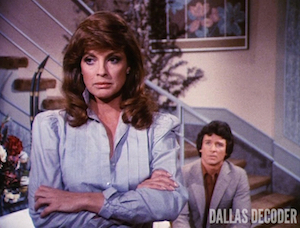
Dallas Scene of the Day: ‘… Just Like Anybody Else’

Requiem for a heavyweight

Requiem for a heavyweight

In “Dallas’s” fifth-season episode “Acceptance,” Ray and Miss Ellie (Steve Kanaly, Barbara Bel Geddes) sit in the Southfork living room.

RAY: Some very peculiar things have been happening here at Southfork. I know Jock being gone has been on everybody’s mind. The whole family. Yet nobody seems to talk to you about him. And that’s not right.

ELLIE Ray, I don’t need to talk about Jock. And I’d rather not.

RAY: Miss Ellie, maybe you don’t need to talk about him, but I do. He’s been on my mind a lot lately. Almost all the time. I keep remembering things, like how I used to look up to him when I was a kid. How I idolized him. I goofed something up, though, and he’d chew me up one side and down the other. And I thought, how could somebody I idolized act like that? And now I know he was concerned about me. He was teaching me. He knew when to be firm and he knew when to be affectionate. He was all those things. Mostly, I guess I just thought he was almost perfect. And then I remember running into this guy in a bar, and he called Jock a land-grabbing crook.

ELLIE: If you’re trying to justify what Donna said, I don’t want to hear it.

RAY: Miss Ellie, I belted that guy right on the spot. As for Donna, I think you ought to know that she’s just about decided not to write her book.

ELLIE: Well, good.

RAY: The thing is, though, that guy in the bar, he may have had his reasons. I didn’t think so then. I thought of Jock as almost like a God. But he wasn’t. He was a man, just like anybody else. He had friends. He had lots of friends. But he had enemies, too. He was human, ambitious. He knew that the oil game was rough, hardball all the way. But he wanted what was best for his wife, and for his sons. And he did what he thought was right. He’d be the last man in the world who’d ever want us to put him on a pedestal. Miss Ellie, there’s never going to be another man like Jock. Not for me, not for you. He was my father, and your husband. But the truth is, until we start remembering him like he really was, we’re never going to be able to do justice to his memory.

Ellie rises and leaves.

Critique: ‘Dallas’ Episode 102 – ‘Acceptance’

The emperor's clothes

The emperor’s clothes

The scene everyone remembers from “Acceptance” is the one where the grieving Miss Ellie goes on a rampage in the Southfork kitchen, smashing every dish in sight before tearfully collapsing onto the floor. This is a big, dramatic moment and it never fails to give me chills, but it’s not the only great performance we get from Barbara Bel Geddes in this episode. The quiet moments that come before Ellie’s breakdown are just as moving. They deserve to be remembered too.

More than anything, “Acceptance” is about the journey Ellie takes before she comes to terms with Jock’s death. It begins when Ray visits Ellie on another rainy night at Southfork and suggests she forgive Donna for wanting to write an unflattering book about Jock. Steve Kanaly’s monologue consists of more than 350 words, and he delivers every one beautifully. I also love how Bel Geddes holds her own against Kanaly, even though she is almost completely silent. The look on Bel Geddes’ face tells us everything we need to know. Ellie isn’t really mad at Donna. She’s angry because the husband she loved has died and left her alone.

Virtually every scene that follows demonstrates how Bel Geddes can say more with a smile or a furrowed brow than most actors can with a script full of dialogue. Watch how her expression changes in the scene where Punk invites Ellie to accompany him and Mavis to the Oil Barons Ball. Bel Geddes is so sweet in the way Ellie politely declines Punk’s invitation, but once he tells her about the plan to introduce a memorial scholarship in Jock’s name, her expression shifts to shock, hurt and sadness, all within a matter of seconds. How does she do that?

The poignant moments keep coming. A pensive Ellie strolls around the Southfork grounds, recalling the walk she takes in the classic “Ellie Saves the Day.” She visits the stables and lovingly strokes Blazer, Jock’s horse. “You miss him too, don’t you?” she says. And the biggest heartbreaker of all: when Ellie stands in Jock’s bedroom closet and gently touches his clothes. (In a nice touch, the producers appear to have stocked this set with pieces from Jim Davis’s “Dallas” wardrobe, including the powder blue suit he memorably sported in “Runaway” and the white-dotted bathrobe he wore during the third season.)

Of course, as good as Bel Geddes is, she gets plenty of support from director Michael Preece, who always brings out the best in the “Dallas” cast, and Will Lorin, whose script is full of details that ring true. My favorite of these moments comes in the second act, when Lucy enters Ellie’s bedroom to announce Punk’s arrival. “Tell him I’ll be right there. Offer him a drink,” Ellie says. Offer him a drink. It’s a small line, but it tells us so much about Ellie’s devotion to keeping up appearances, even when she’s in mourning. This is exactly what we expect a woman of Ellie’s generation and stature to tell her granddaughter when company arrives.

Ellie’s struggle reaches its crescendo when she has her breakdown in the kitchen. The sequence begins with the Ewings gathered in the Southfork dining room. As the other characters chatter (listen closely and you’ll hear J.R. and Pam being cordial to each other), Preece slowly zooms in on Ellie’s face as she notices Jock’s empty chair at the other end of the table. Quickly and quietly, she excuses herself and goes into the kitchen, where she orders Teresa to leave. Suddenly, Ellie is overcome with emotion and begins smashing the dishes.

When I interviewed the wonderful Michael Preece last month, he told me Bel Geddes didn’t want to do multiple takes because the material was so gut-wrenching. When you watch the scene, you can tell the actress is taking care to hit her marks. In hindsight, her sense of caution works well. Yes, Ellie is a woman exploding with grief, but she’s also someone whose instinct is to always remain composed. Of course she’d hesitate a little before knocking over a stack of plates.

(Watching this scene, I’m also reminded of a famous sequence from the 1970s sitcom “Good Times,” when Esther Rolle’s Florida Evans, another matriarch in mourning, slams a glass punchbowl onto her kitchen floor. The dialogue is similar too. Florida: “Damn, damn, damn!” Ellie: “Damn you, Jock!”)

In “Acceptance’s” final scene, Ellie visits the Krebbses and gives Donna’s book her blessing. It brings to mind the final moments in the fourth-season episode “Ewing vs. Ewing,” when Ellie stands in Ray and Donna’s living room and asks Jock to forgive her for almost destroying their marriage. That scene, one of the last times Bel Geddes and Davis appeared together, ends with their characters declaring their love for each other. This time around, the moment of satisfaction comes when Ellie finally acknowledges that her husband is dead. “I know that Jock’s not coming back, but I have my memories of him,” she says. “And my memories are forever.”

So are great performances like this.

Grade: A

_______________________________________________________________________________________________________________________________________________

Forever

Forever

‘ACCEPTANCE’

Season 5, Episode 25

Airdate: April 2, 1982

Audience: 29.1 million homes, ranking 2nd in the weekly ratings

Writer: Will Lorin

Director: Michael Preece

Synopsis: Miss Ellie accepts Jock’s death and gives Donna’s book her blessing. Afton tries to comfort Cliff after Rebecca fires him. J.R. romances Sue Ellen. Bobby helps the police catch Farraday’s killers. Mitch moves to Atlanta.

Cast: Tyler Banks (John Ross Ewing), Barbara Bel Geddes (Miss Ellie Ewing), Patrick Duffy (Bobby Ewing), Phyllis Flax (Mrs. Chambers), Jonathan Goldsmith (Joe Smith), Linda Gray (Sue Ellen Ewing), Larry Hagman (J.R. Ewing), Susan Howard (Donna Krebbs), Bob Hoy (Detective Howard), Steve Kanaly (Ray Krebbs), Ken Kercheval (Cliff Barnes), Audrey Landers (Afton Cooper), Leigh McCloskey (Dr. Mitch Cooper), Priscilla Pointer (Rebecca Wentworth), Victoria Principal (Pam Ewing), Debbie Rennard (Sly), Tom Stern (Detective White), Charlene Tilton (Lucy Cooper), Morgan Woodward (Punk Anderson), H.M. Wynant (Ed Chapman)

“Acceptance” is available on DVD and at Amazon.com and iTunes. Watch the episode and share your comments below.

Dallas Scene of the Day: ‘You’re a Ewing. Remember That.’

He's right, you know

He’s right, you know

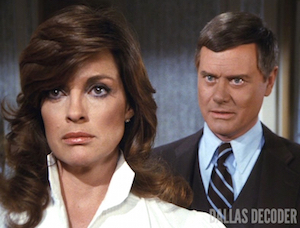
In “Dallas’s” fifth-season episode “The Investigation,” Sue Ellen (Linda Gray) opens her door and finds J.R. (Larry Hagman), who breezes into her living room.

J.R.: Sue Ellen, I’ve been trying to get in touch with you.

SUE ELLEN: I know.

J.R.: Well, what’s the matter honey? What’s wrong?

SUE ELLEN: I just didn’t feel like talking to anybody. [Closes the door, walks past him, stops]

J.R.: Well, a lot of people have let you down lately. You leaned heavily on Clayton and he took off. And then there’s Cliff Barnes. [Chuckles] What can anybody say about Cliff Barnes?

SUE ELLEN: [Turns to face him] You know about Cliff?

J.R.: Yes.

SUE ELLEN: How?

J.R.: Well, it was an oil deal, honey. That’s my business. [Steps closer] Sue Ellen, listen to me. You belong with people who really care about you. And you’re going to be in trouble as long as you put your trust in outsiders.

SUE ELLEN: I don’t know, J.R. [Turns away]

J.R.: [Steps closer] You’re a Ewing. Remember that. I’ve hurt you so much in the past, and I’m sorry. I love you. You know that. We’re the same kind. We have our shortcomings, our faults. But we look at the world the same way. There are no two people that are meant for each other more than you and I.

SUE ELLEN: J.R., you’re confusing me.

J.R.: [Puts his hand on her shoulder, turns her toward him] Don’t be confused. It’s time for you to come home. To Southfork. To your husband.

Critique: ‘Dallas’ Episode 101 – ‘The Investigation’

Revealing

Reveling

By the end of “The Investigation,” Cliff’s world is collapsing around him. He’s lost Sue Ellen and his fortune. He’s also on the verge of losing his job, now that his mother knows he’s embezzled millions of dollars from the family business. This is when J.R. arrives at Cliff’s office to revel in his misery – and to reveal he engineered Cliff’s fall.

“How does it feel, Cliff?” J.R. asks. “A couple of days ago, you owned my oilfield. You were going to marry my wife. You were expecting a big gusher. Oh yeah, millionaire time – that’s what it was. And now you’re over your head in debt and the only property you own is a dry hole north of Lubbock.” Larry Hagman pauses here before delivering J.R.’s final verbal kick in the teeth. “You have succeeded in becoming the perfect failure,” he says with a chuckle. “I don’t believe it. I just don’t believe it.”

This is the most brutal takedown on “Dallas” yet. Heaven help me, I cheer the whole time I watch it.

Maybe I love the scene because Hagman and Ken Kercheval are so good in it. The glint in Hagman’s eye has never been brighter, while Kercheval shows nice restraint as poor, defeated Cliff. Or maybe I love the scene because – despite the sympathy I feel for Cliff – he kind of has it coming. Earlier in the fifth season, when the roles were reversed and J.R. was the one who had been backed into a corner, Cliff gloated over J.R.’s misfortune. He should have known better.

But ultimately, I think the main reason I enjoy seeing J.R. destroy Cliff is because the prize isn’t the usual cocktail of wealth, power and pride. It’s love. Since Jock’s death during the middle of the season, J.R. has been fighting to win back Sue Ellen and their son. Yes, his efforts created plenty of collateral damage: J.R. drove both Dusty and Clayton out of Sue Ellen’s life, he blackmailed Bobby, and now he’s ruined Cliff. But even though his methods are harsh, J.R. is fighting for a high purpose: reuniting his family. How can you begrudge him that?

This is why I also adore the wonderful scene that closes “The Investigation,” when J.R. visits Sue Ellen and tells her it’s time to come home. Hagman shows us J.R.’s sincere side for a change, and Linda Gray does a nice job conveying Sue Ellen’s confusion, but what I like best about this scene is scriptwriter Bruce Shelly’s dialogue. “You’re a Ewing. Remember that,” J.R. tells Sue Ellen. “I’ve hurt you so much in the past, and I’m sorry. I love you. You know that. We’re the same kind. We have our shortcomings, our faults. But we look at the world the same way. There are no two people that are meant for each other more than you and I.” Have truer words been spoken on this show?

I also have to hand it to director Irving J. Moore, who generates genuine suspense during Bobby and Pam’s rescue of Lucy. The sequence where Lucy, bound and gagged in the back room of Roger’s studio, struggles to knock over the lamp and signal for help is one of those moments where I find myself talking to my TV. (“Hurry Lucy!”)

Later, Charlene Tilton is given a nice showcase when Lucy and Mitch finally acknowledge it’s time to divorce. The characters admit they were always wrong for each other and agree the marriage’s failure is no one’s fault. Shelly’s dialogue is a little hokey (Lucy: “Sometimes love isn’t enough”), but Tilton delivers it with so much heart, I don’t mind. It’s a lovely performance.

The scene takes place in Lucy’s hospital room, so Tilton doesn’t wear a lot of makeup and her hair is straight. It brings to mind the teenaged Lucy we met when “Dallas” began. The contrast is striking: Even though Tilton looks more girlish than she’s appeared in years, her character has never seemed more grownup.

Grade: A

_______________________________________________________________________________________________________________________________________________

Revealing

Revealing

‘THE INVESTIGATION’

Season 5, Episode 24

Airdate: March 26, 1982

Audience: 28 million homes, ranking 1st in the weekly ratings

Writer: Bruce Shelly

Director: Irving J. Moore

Synopsis: Cliff is rebuffed by Sue Ellen and defeated by J.R., who reclaims the original Barnes-Ewing oilfield that Cliff took from him. Bobby learns Farraday was a drug dealer who was killed by his suppliers. Bobby and Pam rescue Lucy, who says goodbye to Mitch.

Cast: Fern Fitzgerald (Marilee Stone), Barbara Bel Geddes (Miss Ellie Ewing), Morgan Brittany (Katherine Wentworth), Jack Collins (Russell Slater), Patrick Duffy (Bobby Ewing), Phyllis Flax (Mrs. Chambers), Jonathan Goldsmith (Joe Smith), Linda Gray (Sue Ellen Ewing), Larry Hagman (J.R. Ewing), Susan Howard (Donna Krebbs), Bob Hoy (Detective Howard), Steve Kanaly (Ray Krebbs), Ken Kercheval (Cliff Barnes), Arthur Malet (Forest), Leigh McCloskey (Dr. Mitch Cooper), Priscilla Pointer (Rebecca Wentworth), Victoria Principal (Pam Ewing), Dennis Redfield (Roger Larson), Tom Stern (Detective White), Charlene Tilton (Lucy Ewing), Deborah Tranelli (Phyllis)

“The Investigation” is available on DVD and at Amazon.com and iTunes. Watch the episode and share your comments below.