Tonight, #DallasChat Honors the Master

Dallas, False Confessions, J.R. Ewing, Larry Hagman, TNT

The one we love

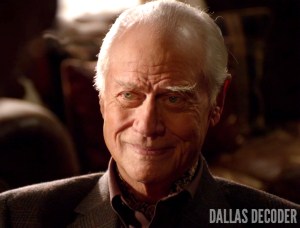
Our next #DallasChat on Twitter will be held Monday, November 18, from 9 to 10 p.m. Eastern time. Since the first anniversary of Larry Hagman’s death is later this week, we’ll honor him with a special J.R.-themed discussion. The title: “The Master.”

Here’s how #DallasChat works: I tweet a question roughly every five minutes for one hour. Each question is numbered and includes the hashtag #DallasChat, so your responses should do the same.

A sample exchange:

Q1. What was Larry Hagman’s all-time funniest line as J.R. Ewing? #DallasChat

A1. When he told Lucy she should get her plastic surgeon husband to design her a new face … without a mouth! #DallasChat

Two pointers:

• During the discussion, enter #DallasChat in Twitter’s search field. This will help you watch the search results so you can follow the conversation. Click “All” to see all the related tweets.

• Include the hashtag #DallasChat in each tweet you send so others can see your contributions to the conversation. Feel free to start side conversations of your own, but be sure to include #DallasChat in those tweets too.

This will be another memorable chat. I hope you can participate!
Dallas Scene of the Day: ‘… Some Kind of Stud Service’

Dallas, Larry Hagman, Oil Baron's Ball, J.R. Ewing

Tables turned

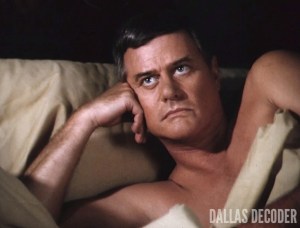
In “The Oil Baron’s Ball,” a seventh-season “Dallas” episode, J.R. and Sue Ellen (Larry Hagman, Linda Gray) are in bed, surrounded by darkness.

J.R.: Where you going?

SUE ELLEN: [Sits up, turns on the lamp] Back to my room.

J.R.: Back to your room? [Rests his head on his hand] After tonight, we’ll be sleeping together.

SUE ELLEN: What makes you think that?

J.R.: [Smiles] The way you came in here. You wanted me as much as I ever wanted you.

SUE ELLEN: Well, that’s only partially true.

J.R.: Well, all our problems are over.

SUE ELLEN: Not quite. You see, J.R., I have no desire to live with you. Now, granted, from time to time, I may need you. And if and when that happens, then I’ll be back. [Smiles] But that’s all. That’s as close to being married as we will ever be. [Pulls her negligee straps onto her shoulders, stands and walks toward the door]

J.R.: I’ll be damned if you can come in here and use me like some kind of stud service.

SUE ELLEN: [Turns to face him] What other possible use would I have for you? Good night. [Pulls the door closed behind her]

Critique: ‘Dallas’ Episode 139 — ‘The Oil Baron’s Ball’

Dallas, Linda Gray, OIl Baron's Ball, Sue Ellen Ewing

Open door policy

J.R. and Sue Ellen’s relationship takes a lot of twists over the years, but nothing fascinates me more than when she starts emulating him. It begins during Linda Gray’s final seasons on the original “Dallas,” when Sue Ellen becomes a wheeler-dealer in business, and it continues on TNT’s sequel series, when we see her reach into J.R.’s bag of tricks to defeat enemies like Governor McConaughey. In “The Oil Baron’s Ball,” Sue Ellen’s transformation into J.R.’s protégé is still a few years away, but this episode nonetheless offers a glimpse of where Gray’s character is headed. By the end of the hour, we see just how much Sue Ellen is learning at the feet of the master.

Gray has three notable scenes in this episode. In the first, Sue Ellen is strolling through a park when she notices all the happy young couples surrounding her. Eventually, she comes across a group of attractive, shirtless men playing football and stops to watch. Writer-director Leonard Katzman shows the game in slow motion, allowing the camera to linger on the players. There’s no doubt what this scene is supposed to represent: Sue Ellen’s sexual desires, which have gone unfulfilled since she moved out of J.R.’s bedroom several episodes earlier. By today’s standards, the football scene seems a little campy — especially when all those half-naked, straight-from-the-80s hunks start falling all over each other — but it also strikes me as surprisingly progressive. Here’s “Dallas,” easily one of the era’s most chauvinistic TV shows, taking a moment to acknowledge that women don’t exist solely to please men; they have needs of their own. How can you not admire that?

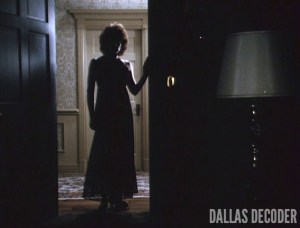
As soon as the football scene ends, Katzman cuts to Southfork that night, where J.R. is reading in bed. Suddenly, the door opens, revealing Sue Ellen’s silhouette. “Do you want something?” he asks. She strides into the room, flings the door closed behind her and climbs onto the bed. “Yes, I want something,” she says, taking the book out of J.R.’s hand and kissing him aggressively as the screen fades to black. The next time we see the couple, Sue Ellen is turning on the bedside lamp as a beaming J.R. watches from under the covers. When she tells him she’s going back to her room, he’s confused. Sue Ellen explains: “You see, J.R., I have no desire to live with you. Now, granted, from time to time, I may need you. And if and when that happens, then I’ll be back. But that’s all. That’s as close to being married as we will ever be.” J.R. is furious and accuses her of treating him like “some kind of stud service.” Her response: “What other possible use would I have for you?”

This is a terrific scene for a lot of reasons, beginning with Gray’s playfully sultry delivery. It’s a moment of triumph for Sue Ellen — and Gray savors every second of it. Indeed, consider how far her character has come: In “Spy in the House,” “Dallas’s” third episode, a sexually neglected Sue Ellen buys a negligee, hoping to get J.R.’s attention; when he calls it “cheap” and walks out on her, she collapses in tears. Sue Ellen soon begins turning to other men, but “The Oil Baron’s Ball” marks the first time we see her take charge of her sexual relationship with J.R. It puts her on the same page as Pam, who is the original “Dallas’s” most sexually liberated woman (occasionally incurring her own husband’s wrath). Perhaps more anything, J.R. and Sue Ellen’s bedroom scene is an exercise in poetic justice: The man who has treated countless mistresses as sexual playthings now gets a taste of his own medicine — and from his wife, no less.

Sue Ellen’s most J.R.-like moment in “The Oil Baron’s Ball” is yet to come. In the third act, our newly empowered heroine visits Windsor Meadow and sends John Ross to summon Peter, the camp counselor to whom she finds herself increasingly attracted. Sue Ellen asks Peter to escort Lucy to this year’s Oil Baron’s Ball, although it’s pretty obvious that Sue Ellen really wants Peter for herself, not for her niece. Peter is reluctant to accept — the young man harbors a secret crush on Sue Ellen and has never even met Lucy — but every time he comes up with an excuse to not go, Sue Ellen is one step ahead of him. When Peter tells her that he would feel out of place at the ball, she responds there’s no place he wouldn’t fit in perfectly. When he says he doesn’t own a dark suit, Sue Ellen reveals she has already arranged for him to visit J.R.’s tailor to be fitted for a tuxedo, compliments of her. Peter has no choice but to say yes, demonstrating once again how much she has learned from her husband. Sue Ellen has always had a manipulative streak, but her use of charm, confidence and gifts to bend Peter’s will comes straight from J.R.’s playbook.

The rest of “The Oil Baron’s Ball” is a mix of heavy drama and light moments. The episode picks up where the previous hour left off, with Lil taking the stand in Ray’s trial and revealing he did indeed pull the plug on Mickey, but only because she couldn’t bring herself to do it. This is a fake-out worthy of TNT’s “Dallas” (admit it: you thought Lil was the culprit), and Kate Reid does a nice job delivering her character’s monologue. The most moving moment, though, comes when Donna tells Ray that even though she believes he had no right to take Mickey’s life, she doesn’t want him to go prison for it. I love this scene because Susan Howard is so good in it — she makes me feel very ounce of Donna’s anguish — and also because it clearly spells out the character’s dilemma of reconciling her personal beliefs with her desire to stand by her husband.

Still, I can’t help but think this conversation between Ray and Donna should have occurred at the beginning of the “who killed Mickey?” mystery, not at the end. For that matter, I also wish this storyline should had been wrapped up in the previous episode, “Ray’s Trial.” No sooner has the judge handed down Ray’s sentence — parole, not jail (naturally) — then Ray and Donna are dancing at the glittery ball. It’s odd to see these characters move on so quickly. Likewise, we never see Lil bid farewell to the Krebbses; after the verdict is announced, Reid simply vanishes from “Dallas” (although she does pop up again briefly a few years later). After the trial, wouldn’t it have been nice to see Ray, Donna, Lil and Lucy visit Mickey’s grave? Besides giving the audience a sense of closure, it would have served as a nice bookend to the memorable Amos Krebbs’s funeral scene a year earlier, when the Trotters were introduced.

Even if the juxtaposition between the courtroom and the ball is jarring, I must admit: The latter scenes are awfully fun. Ken Kercheval somehow manages to make Cliff seem both humbled and overbearing in the instant when the character is named oilman of the year, and the clash between the Ewing and Barnes/Wentworth women in the powder room is delicious. Above all, I love the bon mots J.R. drops during the course of the ball. When Pam arrives and drops by the Ewing table, J.R. delights in re-introducing her to Bobby’s date, Jenna Wade. Bobby tells him to cut it out, but J.R. can’t help himself. “Well, for those who don’t have a program, I’m just going to have to announce the names of all the players, aren’t I?” he says. Larry Hagman’s smile is even more mischievous than usual.

Later, when J.R. sees how uncomfortable Bobby, Pam and Jenna are around each other, he declares this is going to be “one of the great nights of my life.” Leave it to Sue Ellen to put him in his place. “Nothing brings out the best in you like other peoples’ unhappiness,” she says. The line makes me think: Perhaps J.R. has a thing or two to learn from her too.

Grade: B

_______________________________________________________________________________________________________________________________________________

Dallas, Donna Krebbs, Oil Baron's Ball, Ray Krebbs, Steve Kanaly, Susan Howard

At last

‘THE OIL BARON’S BALL’

Season 7, Episode 8

Airdate: November 18, 1983

Audience: 23 million homes, ranking 2nd in the weekly ratings

Writer and Director: Leonard Katzman

Synopsis: After Lil testifies that Ray pulled the plug on Mickey at her request, Ray is found guilty but given parole. Sue Ellen treats J.R. like a sexual plaything and persuades Peter to escort Lucy to the Oil Baron’s Ball. At the ball, Pam and Jenna clash and Cliff is named oilman of the year.

Cast: Charles Aidman (Judge Emmett Brocks), Christopher Atkins (Peter Richards), John Beck (Mark Graison), Morgan Brittany (Katherine Wentworth), Delores Cantú (Doris), Roseanna Christiansen (Teresa), Glenn Corbett (Paul Morgan), Patrick Duffy (Bobby Ewing), Linda Gray (Sue Ellen Ewing), Larry Hagman (J.R. Ewing), Susan Howard (Donna Krebbs), Richard Jaeckel (Assistant District Attorney Percy Meredith), Steve Kanaly (Ray Krebbs), Omri Katz (John Ross Ewing), Ken Kercheval (Cliff Barnes), Audrey Landers (Afton Cooper), Timothy Patrick Murphy (Mickey Trotter), Priscilla Presley (Jenna Wade), Victoria Principal (Pam Ewing), Kate Reid (Lil Trotter), Debbie Rennard (Sly), Charlene Tilton (Lucy Ewing), Deborah Tranelli (Phyllis), Debi Sue Voorhees (Caroline), Morgan Woodward (Punk Anderson)

“The Oil Baron’s Ball” is available on DVD and at Amazon.com and iTunes. Watch the episode and share your comments below.

Dallas Parallels: She Bangs

Ann Ewing, Brenda Strong, Dallas, Fat Lady Singeth, Linda Gray, Sins of the Father, Sue Ellen Ewing, TNT

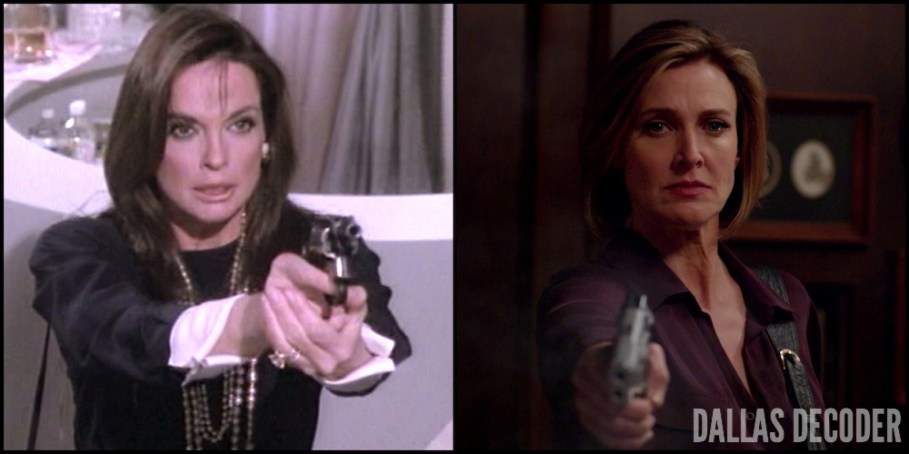
Talk about a shocking twist! In “Sins of the Father,” one of the new “Dallas’s” second-season episodes, Ann discovers her ex-husband Harris kidnapped their daughter Emma when she was a child and raised her on his own. Ann goes to Harris’s home to confront him, and before you know it, she has shot the schmuck and left him for dead.

The scene brings to mind the original “Dallas’s” 11th season finale, “The Fat Lady Singeth,” which opens after J.R. has taken John Ross and stashed him at a private school so Sue Ellen can’t find him. In that episode’s final scene, Sue Ellen goes to J.R.’s hotel room and demands to know the boy’s location. The couple begins to argue, and before all is said and done, Sue Ellen has shot J.R.

Besides the gunfire, the two scenes share a few other similarities. When Ann goes to see Harris, she finds him seated in his den, reading papers. When Sue Ellen shows up at J.R.’s hotel room, he’s sitting on a sofa, reading the newspaper. In both sequences, the man gets up and crosses the room to the bar with the woman in tow. The two scenes also demonstrate Harris and J.R.’s cruelty. Harris taunts Ann, reciting the precious moments from Emma’s childhood that Ann missed. “I took that away from you,” he says. J.R. isn’t quite that vicious, but he boasts about how he outsmarted Sue Ellen when she was searching for the missing John Ross. “I was one step ahead of you,” J.R. says.

The scenes contain major differences too. Sue Ellen’s lover Nick accompanies her to J.R.’s, while Ann is alone when she goes to Harris’s. Sue Ellen shoots J.R. three times — using his gun — after Nick plunges to his death while scuffling with J.R. on the balcony. Ann, on the other hand, brings her own gun to Harris’s and fires once. The biggest difference: After Ann shoots Harris, she turns, leaves and goes home to Southfork, where she allows Bobby to confess to the shooting to protect her. In contrast, when Sue Ellen shoots J.R., she immediately dials the police to report the crime.

Ultimately, Harris and J.R. both survive their shootings, and Ann and Sue Ellen both get away with their crimes. Ann goes on trial and is sent to prison, but she gets off on parole. J.R. declines to press charges against Sue Ellen to spare John Ross from the spectacle of a trial. Will we see either woman pick up a gun again? It’s hard to say with Sue Ellen, but not Ann. After all, she recently received a dove-hunting gun — bequeathed to her by J.R. in his will.


‘I Was One Step Ahead of You’

Dallas, Fat Lady Singeth, J.R. Ewing, Larry Hagman

Mean

In “The Fat Lady Singeth,” J.R. (Larry Hagman) is seated in his hotel room, reading the newspaper, when Sue Ellen (Linda Gray) knocks on the door.

J.R.: Who is it?

SUE ELLEN: J.R., it’s me.

J.R.: Go away, Sue Ellen. I got nothing to talk to you about. [Tosses aside the paper, rises and walks toward the door]

SUE ELLEN: Let me in!

J.R.: I knew it was your man asking around about John Ross. But I was one step ahead of you, wasn’t it?

Nick (Jack Scalia) kicks open the door and enters the room, followed by Sue Ellen.

SUE ELLEN: Where is my son, you bastard?

J.R.: Where you’ll never find him.

NICK: That’s not good enough. Where is he?

J.R.: None of your damn business, Pearce.

NICK: I’m making it my business. [As they approach J.R., he steps backward to the bar.] Now do you tell me, or do I start taking you apart? [J.R. reaches for the phone. Nick smacks it out of his hand.] You’re one sorry excuse for a man.

J.R.: Get out of here.

NICK: Not without some answers. And believe me, I will truly enjoy kicking the crap out of you.

SUE ELLEN: Where is he, J.R.?

J.R.: [Pulls a handgun from behind the bar] You’re trespassing. If I have to use this, the law will be on my side, so get the hell out here.

NICK: You don’t have the guts to use it.

J.R.: Call off your gigolo, honey.

Nick lunges for J.R. and they scuffle, leaving the handgun on the floor. As Sue Ellen screams, they wind up on the balcony, where Nick plunges over the side of the railing. Sue Ellen picks up the handgun, aims at J.R. and shoots three times. She walks to the phone and dials.

SUE ELLEN: I’d like to report a double murder. This is Sue Ellen Ewing.


‘I Took That Away From You’

Dallas, Harris Ryland, Mitch Pileggi, Sins of the Father, TNT

Meaner

In “Sins of the Father,” Ann (Brenda Strong) enters the Ryland home, where Harris (Mitch Pileggi) is seated in the living room, reading papers.

HARRIS: [Tosses the papers on the coffee table] Emma’s a pretty amazing girl, isn’t she? She holds a hell of a grudge, though. Me and Mama raised her right.

ANN: Why? Why did you take her from me?

HARRIS: [Slaps his knee, rises] You know, last time we talked, you were wearing a wire. So if we’re going to continue this conversation, I’m going to have to — [Ann sighs and spreads her arms as Harris feels her body] Now, if I remember correctly — [She unbuttons her blouse and shows him her chest. He smiles.]

ANN: Why’d you take her?

HARRIS: I just did what you didn’t have the guts to follow through on. [Steps away, grabs his glass off the table, walks to the bar]

ANN: That’s a lie. It destroyed me! Did you hate me that much?

HARRIS: Oh, Annie. It all worked out for the best. Besides, she’s a grown woman. There’s nothing you can do about it anyway. [Pours himself a drink]

ANN: Just tell the truth for once in your miserable life. Why?

HARRIS: You really have to ask?

ANN: I want to hear you say it.

HARRIS: Because you were about to leave me. And after all I did for you, turning a gangly, raw-bone girl into a proper woman.

ANN: Broken puppet.

HARRIS: There was no way you were going to make a fool out of me by leaving. You had to pay a price. And the look on your face right now? It’s priceless.

ANN: Go on.

HARRIS: [Smiles] Oh, you still like the pain, don’t you? How’s it going to help to hear about what you lost? Is it going to get you back any of Emma’s first steps? Or her dance recitals? Or any of those birthdays? Is it going to get you even one of those nights, snuggled up to her, telling her bedtime stories while she fell asleep? No. Because I took that away from you. Forever. See? Hearing that didn’t help at all, now did it?

ANN: Oh, it helped a lot. [Pulls a gun from her purse, shoots him, walks away]

What do you think of Sue Ellen and Ann’s gunplay? Share your comments below and read more “Dallas Parallels.”

Today at 4 p.m.: ‘The Best of #DallasChat’

Dallas, Larry Hagman, Sins of the Father, TNT

Simply the best

Our next #DallasChat on Twitter will be Monday, November 11, from 4 to 5 p.m. Eastern time. I’m holding this week’s discussion a little earlier than usual so readers from other time zones can participate. I’ll also be asking some of my favorite questions from previous chats, so our theme will be “The Best of #DallasChat.”

Here’s how #DallasChat works: I tweet a question roughly every five minutes for one hour. Each question is numbered and includes the hashtag #DallasChat, so your responses should do the same. A sample exchange:

Q1. Which “Dallas” character could use a dunking in the Southfork swimming pool? #DallasChat

A1. Judith Ryland, of course. If she floats, we’ll know if she’s really a witch. #DallasChat

Two pointers:

• During the discussion, enter #DallasChat in Twitter’s search field. This will help you watch the search results so you can follow the conversation. Click “All” to see all the related tweets.

• Include the hashtag #DallasChat in each tweet you send so others can see your contributions to the conversation. Feel free to start side conversations of your own, but be sure to include #DallasChat in those tweets too.

This is going to be a fun chat. Don’t miss it!

Dallas Scene of the Day: ‘Same Old J.R.’

Dallas, Holly Harwood, Lois Chiles, Ray's Trial

Goodbye girl

In “Ray’s Trial,” a seventh-season “Dallas” episode, J.R. (Larry Hagman) is seated in a cocktail lounge, drinking alone, when Holly (Lois Chiles) approaches.

HOLLY: [Smiling] J.R.

J.R.: Oh, lord.

HOLLY: I was hoping I’d run into you.

J.R.: Would you please leave, Holly?

HOLLY: I just heard the most astounding news — that you and Bobby are going to run Ewing Oil side by side. [She sits across from him.] Share and share alike.

J.R.: Well, news travels fast in this town.

HOLLY: A good story like that? Hard to keep bottled up.

J.R.: You heard the story and you told me about it. Now, I really want to be alone. [A waitress brings him a fresh drink.]

HOLLY: Looks like the only friend you have left is in that glass. I just think it’s wonderful that despite all your manipulations, despite all your crooked deals, despite your hitting me up for 20 million bucks to get you out of my company — despite all that — you still couldn’t beat Bobby.

J.R.: Holly, I don’t feel that I owe you any kind of an explanation. But since you’re not going to leave my table, maybe I can shut you up by giving you a little inside information: Bobby and I agreed to split up the company long before the accounting.

HOLLY: [Smiling] Maybe you did. But the way I heard it, you were going to double-cross Bobby. It was Bobby that agreed to share Ewing Oil with you, not the other way around.

J.R.: Well, I must compliment you on the quality of your spies.

HOLLY: I still have some people in this town who owe me favors.

J.R.: Well, since I don’t think you slept with Punk or Harv Smithfield, it must have been one of the auditors. Or all of them, as the case may be.

HOLLY: Same old J.R. Losing has done nothing for your soul. But I’m happy that you lost because you cost me the one thing in the whole world that I ever really wanted.

J.R.: Bobby.

HOLLY: [Smiling] Yes.

J.R.: Well, he’s free now, honey. You can go after him — free as a bird.

HOLLY: You made that impossible.

J.R.: I did?

HOLLY: You mean because of that one night I spent in your bed? Oh, my saintly brother. [Holly begins to leave. He stops her.] Darlin’, I’d like to make a little toast: to the fact that you will never, ever be my sister-in-law. And I want to thank you too, for reminding me how ethical my brother is. It’s a flaw in his character that eventually will cause his downfall in the oil industry. I’m not finished yet, honey. Not by a long shot. Thank you. I’m feeling better.

She walks away.

Critique: ‘Dallas’ Episode 138 — ‘Ray’s Trial’

Dallas, Ray Krebbs, Ray's Trial, Steve Kanaly

His day in court

I always remembered the mystery surrounding Mickey Trotter’s death as boiling down to a single question: Did Ray or Lil pull the plug on him? Last week, when I re-watched “Ray’s Trial” for the first time in a few years, I realized “Dallas” also poses a second, more complicated question: Did Mickey want to live or die? Ray and Lucy each offer different answers during the course of the episode, and technically, both of their statements are accurate. Does that mean both statements are also true? I’m not sure anyone can answer that definitively, which makes the storyline feel a lot more interesting than I previously gave it credit for.

To appreciate this aspect of “Ray’s Trial,” it’s worth remembering two crucial scenes from the preceding episodes. In “My Brother’s Keeper,” when Mickey is struggling to come to grips with his paralysis, he pulls Ray aside and tells him, “The idea of living like a vegetable with some damn machine keeping me alive disgusts me. It’s the worst horror I can imagine. … If it happens, I hope and pray that no one’s going to let me live that way.” Later, in “The Quality of Mercy,” Mickey’s mood brightens when he realizes Lucy is determined to stand by him despite the fact that he’ll never walk again. “Who knows? Maybe we’ll get married yet,” Mickey tells her.

But this is “Dallas,” so of course that never happens. When Mickey slips into a coma, his respirator is disconnected off-screen by either Ray or Lil, the two people with him at the time. The district attorney charges Ray, although the show goes out of its way to drop hints that the real culprit is Lil and Ray is only covering up for her. “Dallas” doesn’t solve the mystery until the next episode, allowing the audience to spend “Ray’s Trial” pondering what Mickey wanted, which turns out to be the more interesting question anyway. At the top of the hour, Ray meets with his lawyer and recalls Mickey’s “worst horror” comment, holding this up as evidence that Mickey preferred death to being kept alive via medical machinery. Later, when Lucy testifies at Ray’s trial, she recalls the marriage plans she and Mickey were making before he slipped into the coma. “He wanted to live. He really did,” she says.

Once again, these are two characters offering two technically accurate but fundamentally different answers to the question of whether Mickey wanted to live or die. Who you choose to believe may come down to where you stand on the issue of euthanasia, which is where “Ray’s Trial” ultimately falls short. Scriptwriter Arthur Bernard Lewis doesn’t devote much time to examining the moral implications of Mickey’s death, which is somewhat surprising considering the difference of opinion Ray and Donna apparently bring to the issue. At one point, Ray tells his lawyer, “What I did was not immoral.” This seems to put him at odds with Donna, whose personal beliefs are hinted at in the previous episode when she declares, “Nobody has the right to play God.” So why doesn’t “Ray’s Trial” give us a scene of husband and wife debating the issue?

Even if the material feels incomplete, Steve Kanaly makes the most of it. In my recent interview with him, Kanaly recalled growing up watching westerns and admiring actors like Gary Cooper. The comment must have lodged itself in the back of my mind because when I watched “Ray’s Trial” a few days later, I was struck by how much Kanaly reminds me of Cooper. The actors share similarly quiet, dignified mannerisms, and both are able to say a lot without uttering a single line of dialogue. In Kanaly’s case, watch his haunted eyes in this episode and you’ll see everything that the script doesn’t tell us about what Ray is feeling.

The other performer to watch is Charlene Tilton, who appears only twice but makes a lasting impression. She does a beautiful job delivering Lucy’s tearful testimony, which supplies “Ray’s Trial” with its moment of emotional catharsis. My favorite scene, though, comes a few moments later, when Donna comforts Lucy in the courthouse corridor after Lucy reluctantly testifies against Ray. This is a brief scene and the script doesn’t give Tilton much dialogue, but none is needed. Her anguished expression says it all. The courtroom scenes also feature a couple of old pros — Richard Jaeckel as prosecutor Percy Meredith and Glenn Corbett as Paul Morgan, Ray’s defense lawyer — as well as a young Steven Williams, who appears here as a bailiff and later plays the police captain on “21 Jump Street.”

This episode’s other notable moments include Mark Graison’s polo match, which might be “Dallas’s” most thrilling horseback riding sequence since Jock Ewing surged across the Southfork plains at the beginning of the second-season classic “Bypass.” “Ray’s Trial” also marks Lois Chiles’ final appearance as Holly Harwood. In her last scene, Holly approaches J.R. in a cocktail lounge and taunts him over losing the battle for Ewing Oil. Besides giving Chiles one last opportunity to spar with Larry Hagman, I like how this scene mimics J.R. and Holly’s first on-screen encounter, which also takes place in a cocktail lounge.

The other highlight of “Ray’s Trial” is the arrival of Priscilla Presley, who makes her “Dallas” debut as Jenna Wade. It’s a fine first appearance, although it includes a bit of a curiosity. In one of Presley’s scenes, Bobby pulls up in front of Jenna’s home as she approaches the sidewalk. He invites her to join him for lunch, but when director Michael Preece offers us a close-up shot of Bobby’s car radio, we see the clock reads “5:45.” From this, we can deduce one of two things: Either Ewings eat lunch very late, which makes them a lot different than you and me, or Bobby has yet to figure out how to set the clock in his car, in which case he’s just like us.

Grade: B

_______________________________________________________________________________________________________________________________________________

Dallas, Jenna Wade, Priscilla Presley, Ray's Trial

Hello again

‘RAY’S TRIAL’

Season 7, Episode 7

Airdate: November 11, 1983

Audience: 22.4 million homes, ranking 2nd in the weekly ratings

Writer: Arthur Bernard Lewis

Director: Michael Preece

Synopsis: Ray goes on trial and frustrates Donna with his reluctance to defend himself. Bobby runs into Jenna, who now works as a waitress. J.R. woos the cartel.

Cast: Charles Aidman (Judge Emmett Brocks), Christopher Atkins (Peter Richards), John Beck (Mark Graison), Morgan Brittany (Katherine Wentworth), Lois Chiles (Holly Harwood), Glenn Corbett (Paul Morgan), Michael Cornelison (Dr. Snow), Patrick Duffy (Bobby Ewing), Eric Farlow (Christopher Ewing), Fern Fitzgerald (Marilee Stone), Steven Fuller (bailiff), Tony Garcia (Raoul), Linda Gray (Sue Ellen Ewing), Larry Hagman (J.R. Ewing), Susan Howard (Donna Krebbs), Richard Jaeckel (Assistant District Attorney Percy Meredith), Steve Kanaly (Ray Krebbs), Omri Katz (John Ross Ewing),  Howard Keel (Clayton Farlow), Ken Kercheval (Cliff Barnes), Audrey Landers (Afton Cooper), Joseph R. Maross (Dr. Blakely), Andrea McCall (Tracy Anders), Priscilla Presley (Jenna Wade), Victoria Principal (Pam Ewing), Kate Reid (Lil Trotter), Paul Sorensen (Andy Bradley), Don Starr (Jordan Lee), Charlene Tilton (Lucy Ewing)

“Ray’s Trial” is available on DVD and at Amazon.com and iTunes. Watch the episode and share your comments below.

Dallas Parallels: Foxes in the Henhouse

Battle Lines, Dallas, Digger's Daughter, Pamela Barnes, Pam Ewing, TNT, Victoria Principal

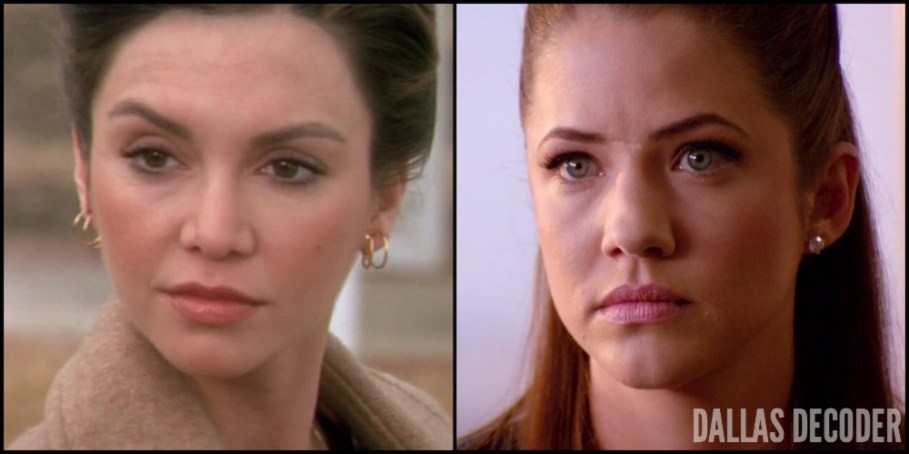
It’s one of the new “Dallas’s” greatest moments: Soon after Rebecca Sutter Ewing reveals that she’s actually Pamela Rebecca Barnes, she receives a visit from J.R. Ewing. He vows to run her out of town, just like he did with her namesake aunt. Says J.R.: “You’re not the first Pam to fox her way into the henhouse. I’m 1 for 1 on flushing out Pamelas. And I plan on being 2 for 2.”

The scene, which appears in “Venomous Creatures” (Season 2, Episode 2), brings to mind one of the famous moments from the original “Dallas:” J.R.’s clash with Pam in “Digger’s Daughter” (Season 1, Episode 1). Like the 2013 version, the 1978 edition also ends with J.R. delivering an ominous threat: “I’m willing to spend some money now to avoid any inconvenience. But if you insist upon being driven away — which you surely will be — you’re going to come out of this without anything, honey.”

More similarities: In both scenes, J.R. refers to Cliff, although not by name. In “Digger’s Daughter,” he asks Pam, “Did your brother put you up to this, Miss Barnes?” In “Venomous Creatures,” he tells Pamela, “I’m just here to look my enemy in the eye. And since your daddy is about 2 feet shorter than I am, I guess you’ll have to do.” Also, marriage is a subtext of both scenes: The older episode begins soon after Bobby and Pam’s wedding, while the newer segment shows Christopher and Pamela facing off in divorce court.

More than anything, the two scenes showcase the genius of Larry Hagman. In “Digger’s Daughter,” Hagman is still getting to know his character, but he’s already figured out that playing J.R. will require a healthy dose of mischief. I love when Bobby interrupts J.R. and Pam’s conversation and reminds his older brother that “Mama don’t like business talk with supper on the table.” Hagman breaks into a wide grin as he delivers J.R.’s next line: “Well, you know Mama. She’s so old-fashioned.” By 2013, Hagman’s sense of humor was as sharp as ever. Witness his parting line to Frank, Pamela’s pseudo-brother/henchman: “How does it feel to be a poodle?”

I also admire how both of Hagman’s co-stars equate themselves in these scenes. Victoria Principal brims with righteous indignation when J.R. tries to buy off Pam; it’s an early display of the on-screen magic she and Hagman would perfect during the next decade. Julie Gonzalo displays a spark with the actor too, suggesting she would’ve become a worthy sparring partner. It’s a shame that promise will never be realized, but aren’t we lucky we got to see one last showdown between J.R. and a fox named Pamela?


‘You’re Going to Come Out of this Without Anything, Honey’

Dallas, Digger's Daughter, J.R. Ewing, Larry Hagman

A threat

In “Digger’s Daughter,” “Dallas’s” first episode, J.R. (Larry Hagman) shows Pam (Victoria Principal) around the Southfork grounds.

J.R.: Did your brother put you up to this, Miss Barnes?

Pam looks stunned.

J.R.: Well, I don’t think that’s an unusual question to ask, Miss Barnes.

PAM: [Angrily] Mrs. Ewing. Excuse me, please.

She begins to walk away. J.R. grabs her arm. She stops.

J.R.: Perhaps it would be more appropriate to ask what sort of settlement you’d require to annul this farce.

PAM: Let go of my arm.

J.R.: I’m willing to spend some money now to avoid any inconvenience. But if you insist upon being driven away — which you surely will be — you’re going to come out of this without anything, honey.

Bobby (Patrick Duffy) approaches.

BOBBY: Hi there. What’s going on?

J.R.: Oh, just talking a little business.

BOBBY: Mama don’t like business talk with supper on the table, J.R.

J.R.: [Chuckles] Well, you know Mama. She’s so old-fashioned.

BOBBY: [To Pam] Come on, honey. Let’s go.

J.R. smiles as he watches them walk away.


‘I’m 1 for 1 on Flushing Out Pamelas’

Dallas, J.R. Ewing, Larry Hagman, TNT, Venomous Creatures

A promise

In “Venomous Creatures,” a second-season “Dallas” episode, J.R. visits Pamela (Julie Gonzalo) in the Barnes Global boardroom.

PAMELA: What are you doing here, J.R.?

J.R.: I’m just here to look my enemy in the eye. And since your daddy is about 2 feet shorter than I am, I guess you’ll have to do.

PAMELA: I must have done something right to deserve a visit from you.

J.R.: Congratulations on your win in court. Now divorce court, if you want some tips, I can offer you a few. I’m an expert authority.

PAMELA: I already have my experts.

J.R.: Oh, and if you’ve got it in your pretty little head to go after Ewing Energies in the divorce, you won’t be dealing with Christopher. You’ll be dealing with me.

PAMELA: You’re not a part of that company.

J.R.: No, no. But I’m part of that family. You’re not the first Pam to fox her way into the henhouse. I’m 1 for 1 on flushing out Pamelas. And I plan on being 2 for 2.

What do you think of J.R.’s clashes with Pam and Pamela? Share your comments below and read more “Dallas Parallels.”

The Dallas Decoder Interview: Steve Kanaly

Dallas, J.R.'s Masterpiece, Ray Krebbs, Steve Kanaly, TNT

Steve Kanaly

Steve Kanaly will be in Texas this week to film his latest guest spot as Ray Krebbs on TNT’s “Dallas.” I spoke to him recently about what it’s been like to walk in Ray’s boots for the past 35 years — and what the future might hold for everyone’s favorite cowboy.

I’m so excited you’re going to be visiting “Dallas” again. What can you tell us about this appearance?

I’m only in a single episode at this point. I made this bad joke more than a year ago, before Larry [Hagman] passed away, that they’re going to have Ray and Lucy in whenever there’s a wedding or a funeral. And that’s pretty much been the story. This is another wedding. It’ll be a big Southfork extravaganza.

Do you have a lot of lines? Fans like me want to see more of Ray.

No, it’s not a lot of lines, but that’s heartening to hear. I’m torn. Do you say, “No, thanks”? Or do you say, “OK, thank you. I’ll continue to be part of the background”? So I end up listening to all of my friends who tell me, “Take the money! Go be part of it. Something good might come of it.” [Laughs] But it’s still a thrill to say that you’re part of this phenomenon of “Dallas.” And this is the first year they’re going to have to get along without the J.R. character, so I want to wish them luck and help where I can. If being on the show helps, then I’m happy to do it.

Would you want to become a regular on the new show?

My wife says, “Be careful what you wish for.” They’re now filming the entire series in Dallas. I love Dallas, but I also love living in Southern California. I have a whole lifestyle here that I wouldn’t want to lose. And Dallas is nice, but I’d like to just be there on occasion. I would not want to be a regular character, if they’re listening out there. I’d like to appear more often.

And Charlene Tilton will be joining you again?

Yeah. And Afton [Audrey Landers] is in this show too. I saw the script and she has a nice role. I think the producers are going to stay with the younger offsprings’ storylines and the old guys will come in from time to time. They’re not really interested in going back to what we did before. And I have a lot of people on social networks saying, “We’ve got to get Ray back. Ray’s my favorite.” It’s all very flattering. I just wish somebody at the studio would pay attention. [Laughs]

There’s also been talk about bringing back Priscilla Presley as Jenna Wade. Ray could figure into that storyline.

There’s always talk. The last time we saw Ray, he was married to Jenna and raising Bobby’s baby. So that’s what I keep telling the guys on the new show. What about Bobby’s baby? [Laughs]

Bobby’s baby is probably 25 now!

Right. I’ve got a 25-year-old that I’ve been raising over in Europe. [Laughs] If Ray Krebbs ever comes back in a big way, that would be one avenue they could pursue.

Dallas, J.R.'s Masterpiece, Ray Krebbs, Steve Kanaly, TNT

Final goodbye

Your most recent appearance on the new show was J.R.’s funeral. What was that experience like?

It was very moving. I had been to two celebrations of Larry’s life — one here at his home in Ojai, where I live, and one in Santa Monica. And they were lovely, beautiful events. But it was not a final closing for me — not like playing that scene. It was really cold that day, and something happened when we filmed that scene that never happened to me at any other time in my 44-year career. I was the first guy to speak, and we had done a couple of rehearsals, and it was real quiet because of the somber nature of the moment. And I delivered my speech and I walk off and the next person comes up, and there are eight of us that do this. Well, it’s an uncut scene that runs for eight or nine minutes. And everybody does this without a flub.

Oh, wow.

Not one. And the director came up afterwards and said, “OK, that’s great. Everybody stay where you are. We’re going to go again. We’re going to move the cameras and come in tighter.” And you know, I’ll be darned if everybody wasn’t letter perfect again. I can’t explain it. I’ve never seen this before on a film set.

Maybe Larry was smiling down on everyone.

It was my final goodbye to Larry, although I really can’t say my final goodbye. Larry was my neighbor. From my kitchen table, I can look up on this hilltop where his house was. So Larry’s on my mind every day.

That’s so nice. Let me ask you one more thing about that scene. After Sue Ellen gives her speech, she’s upset and as she returns to her seat, Ray reaches out and takes her hand. Did the director tell you to do that?

No, that was something I wanted to do. I feel so often that they don’t write these things as well as they might. There’s a lot of family interaction that should go on — like in real families — and that was just something that I wanted to add.

I noticed it when I watched the episode and thought, “Oh, that’s so sweet.” It was a small gesture, but it says so much about who Ray is.

That was it. You don’t know if they’re going to pay any attention to that or not. You want to make the most out of your moment. That’s the thing: Even when I go back and I’m doing kind of a walk-on, I want to make the most out of it.

Dallas, Ray Krebbs, Steve Kanaly

Back in the day

Let’s talk about this great character of Ray Krebbs. I’ve got to tell you: My dad loves you. You’re the reason he watched “Dallas.” He grew up loving westerns and considered Ray the last of the TV cowboys.

That’s very flattering. In my first meeting for “Dallas,” my agent told me, “Oh, there’s three male roles that you could possibly play: J.R., Bobby or this guy Ray Krebbs.” And then I saw the script. Well, here’s this cowboy that’s got a girlfriend up in the barn. He runs a ranch in Texas and flies a helicopter, and I’m thinking, “Well, hell, this is my only chance to play a western character. And what a cool one.” Because like your father and a lot of other people my age, we grew up on old westerns. It was Gene Autry and Roy Rogers and Hopalong Cassidy. And of course John Wayne and Gary Cooper and all the big film stars that played westerns. And then suddenly westerns dried up. So this was my chance to play a western character and pay homage to the blue-collar guys who work hard and try hard and don’t always get the attention.

Was that the secret of Ray’s appeal — he was someone the audience could identify with?

Yeah, very much so. And the writers and the producers always wanted to make Ray very vulnerable. Pride was his big hurdle in life. You know, he tries a lot things and he fails many times, but he kind of always bounces back. He’s always a very honest and straightforward guy. You can always trust Ray to do what he thinks is right.

Did Ray change as the show progressed?

I think there were a lot of changes in the character. The arc was over 11 years. In the beginning, Ray was pretty loose and fancy-free. In the first episode, he was J.R.’s buddy and he was up in the hayloft with this teenage girl. And then there’s the period of Ray and Donna, and then he graduates to being a Ewing. That, by the way, was a huge thing for me.

Tell me about that.

In the third year of the show, I was not happy. They were not giving Ray Krebbs anything to do, and the show was moving further away from ranch life. So I’m thinking, “Gee, I don’t need this. I have a film career I can go back to.” And Larry Hagman said, “Hey, whoa. Don’t run off here. This thing’s about to catch on. We need you.” And so we came up with some story ideas. I had one I liked, which is Ray marries a Mexican girl. They didn’t want to do that then. The other one was, Ray was an illegitimate son of Jock. So thank you, Larry, for convincing me.

Were you two good buddies?

Yeah, the whole cast was very familial. Larry, from the beginning, having had another series experience, saw that it was an ensemble show. He was looking to be at the top of the heap from the very beginning, but he also knew that we all had to work together and act as a family to promote the show and to bring out the chemistry. He was a leader in that way. And we all joined the club. We became a family. I had my life at home with my wife and children and I had my life with my “Dallas” family.

Besides Ray finding out he was Jock’s son, what are your other favorite storylines? Mine is Ray’s relationship with his cousin Mickey Trotter, and how he tries to take him under his wing the way Jock did with Ray.

The Mickey Trotter stuff was, once again, a case of: It’s Ray’s turn. When you have a big cast, it can’t always be your turn. And when it is, you can get excited about it.

Do you remember working with Timothy Patrick Murphy?

Well, sure. He was a great young guy. Always prepared. Easy to get along with. He had a nice edge to him at times. I thought he did a great job as Mickey.

I want to ask you about one of my other favorite moments, which is your performance during Bobby’s deathbed scene. There’s a shot of you just standing there, holding Susan Howard and sobbing. It never fails to move me.

For me, it really was saying goodbye to a friend [Patrick Duffy], who you love. It wasn’t hard to find that emotion. We were all pretty upset that he was not going to be on the show anymore.

Dallas, Donna Krebbs, Ray Krebbs, Steve Kanaly, Susan Howard

Ray and Donna

I mentioned Susan Howard. How did you enjoy working with her?

We got along real well. She’s a very sweet girl. She brought a lot of nice things to the show — and she’s a real Texan. Our families got along well. She was a little bossy. [Laughs] And so I would come home and I would complain to my real wife about my stage wife bossing me around. [Laughs]

Well, you know, Donna was a little bossy.

That was her character too. Ray and Donna became one unit. It was “Ray and Donna.” And you know, you sometimes wish it didn’t quite happen like that. It’s better when they’re struggling in some way.

How did you feel when they wrote her out of the show? Because as you say, you were a pair and suddenly half of you were gone.

It’s just one of those things that nobody could do anything about. There were internal issues that were going on, and from my perspective it meant that there was an opening for Ray Krebbs to branch out and do other things — other business things, a new wife, new storylines. You know, after you’ve been on a show for a long time, you’re looking for those kinds of opportunities, so it was a mixed blessing. I know she was not happy leaving. But that’s just the way it turned out.

Let me get back to one thing. We touched on this briefly, but how are you and Ray alike and how are you different?

Well, I try to be honest with everybody in my personal life. I would say that Ray was like that, a straight shooter. I’m definitely a hard worker, which Ray was. I don’t have quite the amount of pride that he did. I don’t struggle with that. Ray had kind of a violent side to him that I don’t have. But you know, Ray was a guy that I liked to be. It was fun to be Ray. I never wanted to be any of the other characters. I never wished that I was Bobby or J.R. I know Kenny Kercheval wanted to play Ray. I think he was happy to be Cliff Barnes in the end.

I think I’ve read where he auditioned for Ray. I can’t even wrap my mind around what that would have been like.

He would have been good. He’s a wonderful actor. But they let me kind of develop this character. Certainly the story had a lot to do with it, but how I wanted to play it was pretty much was what I got to do and I can thank [producer] Leonard Katzman for that. Leonard trusted me. He was the guy who kind of gave me the nod for the part to begin with. If there was a lot of Steve Kanaly in Ray or a lot of Ray in Steve Kanaly, I don’t know. They got kind of mixed up along the way.

You once did a TV Guide interview where you said people on the set would call you Ray.

Not just the set! [Laughs]

You said that that didn’t happen so much to Linda [Gray] or Larry. No one called them Sue Ellen and J.R. in real life.

Larry would call me Ray sometimes. [Laughs] This was when we were neighbors in Ojai! “Hey, Ray. Oh, I mean Steve.” So it was an enduring character, I think. And I did my homework. I went to the rodeo all the time. And I made friends with all these cowboys. I went into the cattle business. This is funny: The first week I’m on the show, this one guy, who was a Teamster captain and a cowboy, came up and said, “Well, Mr. Kanaly, you’re doing a real good job with this Ray Krebbs, but I’ve got to tell you: Around here, see, nobody wears them damn Levi’s. You got to wear Wrangler’s. You’ve got to wear boot-cut Wranglers. That’s what the real cowboys wear.” So I began to understand that there was a real fashion and you had to pay attention. The cowboys and the people who love the westerns are very critical of what they see. And if you don’t have the right jeans on, or if you wear your hat in some funny way, or if it’s an odd hat in their opinion, they’re going to notice.

Switching gears a bit: You recently filmed a guest spot for “DeVanity,” an online serial.

Yeah. The producer, Michael Caruso, sent me some material and it was a six-page scene. And I read it and said, “Hell, this is good!” And Michael told me, “Well, I wrote it for you.” So I was obligated to say yes. And it’s virtually for zero money. But all the years I ever did “Dallas,” I think the longest scene I ever had was with Barbara Bel Geddes, and it was five pages.

So besides acting, what else are you up to these days?

I’m happily married to my original wife for 38 years. We’re best buds. We’re very invested in being grandparents. We have four grandkids now and they’re all up in San Francisco, so we try to go up there once a month for at least a week or so. One of my other main things is staying healthy, so I work out every day. I do that nearby at a school where I’m a volunteer, teaching a program that has to do with sport shooting. It’s very rewarding. And I paint and play the piano. I’ve done that all of my life.

Tell me about your painting.

I do watercolor, transparent watercolors. It’s something that I’ve done for years.

It’s hard to imagine Ray Krebbs picking up a paintbrush, unless he’s whitewashing a fence maybe.

Yeah, right. I guess there’s one area where Ray and Steve are not at all alike.

Share your comments below and read more interviews from Dallas Decoder.

Dallas Scene of the Day: ‘You and Me Together. Brothers.’

Bobby Ewing, Check and Mate, J.R. Ewing, Larry Hagman, Patrick Duffy

Daddy wins

In “Check and Mate,” a seventh-season “Dallas” episode, J.R. (Larry Hagman), Bobby (Patrick Duffy), Punk (Morgan Woodward) and Harv (George O. Petrie) are in Harv’s office, listening as Gerber (John Hostetter), the auditor, announces the results of the Ewing Oil contest.

GERBER: All right, that takes care of the breakdown on a section-by-section basis.

J.R.: Now let’s hear the totals.

GERBER: All right. These totals are accurate to the close of business yesterday. Mr. Bobby Ewing has improved the assets he was initially given by the sum of $24,160,000.

J.R.: Well, that’s a pretty good year’s work, Bobby.

PUNK: And Mr. J.R. Ewing?

GERBER: J.R. Ewing has improved the assets he was given by the sum of $40,220,000.

J.R. chuckles, throws up his hands.

PUNK: Well, now, that’s a fair margin. J.R.’s clearly the winner.

HARV: Yes. Congratulations, J.R.

J.R.: Thank you, Harv. Thank you.

PUNK: Now, boys. What about this letter?

HARV: Well, it pleases me to say that even before they knew about the letter, the boys had already agreed to split the company, no matter who won the contest.

PUNK: That’s what Bobby said, and then J.R. confirmed that yesterday. Right, J.R.?

J.R.: [Rises from his seat, goes to the bar] Well, yes. There’s some truth in the idea that were going to share the company —

PUNK: J.R.!

J.R.: But that was in the aftermath of what happened at Southfork. It was very special circumstances. [Fixing himself a drink] Both Bobby and I were, oh, highly emotional at the time.

HARV: [Answering the buzzing intercom] What is it, Janet? I told you I didn’t want to be interrupted.

JANET: There’s a gentleman out here who says it’s urgent he talk to Bobby Ewing.

BOBBY: Would you ask him to come in, please, Harv? [Rises from his seat, goes to the door]

J.R.: Could that wait, Bob?

BOBBY: No, it can’t, J.R. [Bobby opens the door and shakes the hand of his visitor: Thornton (Kenneth Kimmins).] Thornton.

THORNTON: I got here as fast as I could.

BOBBY: You had me a little worried. Everybody, I’d like you to meet Thornton McLeish. He’s my partner in those Canadian frozen fields that I was involved with. [Punk, Harv, Gerber and Thornton exchange hellos.] I asked Thornton to come down here because I — well, Thornton, why don’t you explain it to them?

THORNTON: When Bobby invested with us, we were sure our fields would come in — and come in big. What we couldn’t tell was when they’d come in. And that was crucial to Bobby because of this contest he had with his brother. Hello, J.R. [J.R. nods] Things looked pretty grim there for awhile, but Bobby not only stuck it out, he was instrumental in persuading another company—Barnes-Wentworth—to provide us with a special drill that would solve some of the problems we had.

J.R.: Well, I assume there’s a point to all this?

THORNTON: Oh, I’m sorry, J.R. I’ll cut it short. I just want to give Bobby his check for $26 million. [Reaches into his jacket pocket, pulls out a check and hands it to Bobby]

PUNK: Twenty-six million!

THORNTON: It’s his share of the profits in the Canadian fields. The drill bit worked. The test well came in gushing and we just sold out to the majors. That was the original deal. [Bobby smiles.]

PUNK: Well, this means that you win the contest, Bobby.

J.R.: The hell it does. The contest is over. The winner’s been declared.

BOBBY: Harv, correct me if I’m wrong, but I believe the contest doesn’t officially close until the end of business today.

HARV: [Smiles] That’s right.

BOBBY: So I still have time to enter this check into my books. [Harv nods. Bobby hands the check to Gerber.] Mr. Gerber.

PUNK: Congratulations, Bobby. [They shake hands.]

HARV: Good work, Bobby. Good work.

J.R.: [Chuckling] Well, I’ll be damned. I’ve never been a sore loser. [Slaps Bobby on the back] Congratulations on your win, Bobby. Not that it makes any difference. I mean, we had decided to be partners, right? Huh?

BOBBY: Punk, if you don’t mind, I’d like to keep Daddy’s letter for myself.

PUNK: You betcha. [Hands him the letter]

J.R.: Bob, you’ve never gone back on a deal. We are partners, right? Just the way Daddy wanted it.

PUNK: [To Bobby] Jock would be proud of you.

BOBBY: [Pauses] Yeah, J.R. It’s going to be just like Daddy wanted.

PUNK: Good boy.

J.R.: [Chuckles, slaps him on the back again] Good, good. That’s just fine. Now, Harv, since there’s no loose threads hanging around, why don’t you draw up some papers, make this legal. We’ll be in tomorrow, to sign them. Get rid of the old business and on with the new. Now, Bob, like I said, just the way Daddy wanted it, you and me together. Brothers.

J.R. puts his arm around Bobby and smiles. Bobby doesn’t.