Revealed
Josh Henderson is a revelation in “Like Father, Like Son.” I’ve admired Henderson’s work on “Dallas” from the beginning, but I didn’t know he was capable of the kind of performance he delivers in this episode. In some scenes, I want to reach through my screen and break John Ross in two; in others, my heart breaks for him. This reminds me of the early days of the original series, when we were beginning to discover what J.R. Ewing and Larry Hagman were made of. John Ross is becoming as bad as J.R.; will we one day say Henderson is as good as Hagman? Time will tell, but what a thrilling prospect to consider.
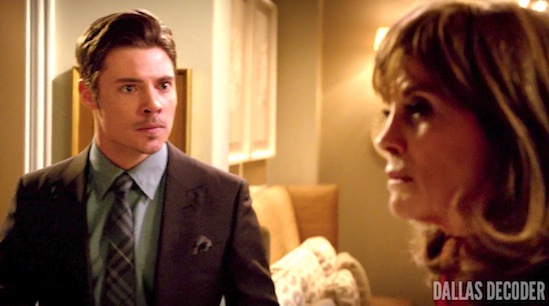
The dramatic highpoint in “Like Father, Like Son” is the scene where John Ross confronts Sue Ellen over her betrayal. This is a two-minute emotional roller coaster, and Henderson brings us along for the whole gut-wrenching ride. We feel everything John Ross does: his rage when he storms into his mother’s house, his incredulity when she accuses him of cheating, his disappointment when he realizes how drunk she is. I especially love when John Ross holds up Sue Ellen’s bottle of booze and says, “Why are you doing this to yourself again, huh?” It’s one of the best lines in Julia Cohen’s taut script because it shows how much John Ross cares about Sue Ellen while inviting us to consider what it must have been like for him to grow up with an alcoholic mother. As much time as I’ve devoted to “Dallas” over the years, I’m not sure that’s something I’ve thought much about until now.
Of course, nothing gives me chills like the moment John Ross slams his hand on Sue Ellen’s kitchen counter and exclaims, “I am not my father!” Henderson delivers the line with such uncontrolled force, it feels like the most genuine thing John Ross has ever said. Indeed, his statement is very true: John Ross loves J.R. and takes pride in being his son, as evidenced by the fact that he runs around wearing Daddy’s wristwatch. But I believe John Ross sees himself as being a better man than J.R. We witnessed this in the first-season classic “Family Business,” when John Ross urged J.R. to return ownership of Southfork to the cancer-stricken Bobby, and we see it again in this episode, when John Ross rejects Candace’s overtures. (Would J.R. have turned down the advances of a comely secretary?) This is why Sue Ellen’s accusations sting her son more than we might have expected.
Yet no matter how much John Ross might want to think of himself as being “better” than J.R, he can’t resist all of his dark impulses: At the end of “Like Father, Like Son,” John Ross takes advantage of Sue Ellen’s relapse by blackmailing Judge Blackwell to send her to rehab against her will. (Blackwell: “You certainly are just like your father.” John Ross: “You hear that enough, eventually you start to believe it.”) Is John Ross doing this because it will help his mother, or because it will make it easier for him to take Ewing Global public and seize control of the company? Perhaps we’ll never know, and maybe in John Ross’s mind, there’s no difference. I’m not sure J.R. saw too many distinctions when he committed Sue Ellen to a sanitarium during the original “Dallas.” Yes, J.R. knew his wife needed help for her alcoholism, but he was also eager to get her out of the way before she spilled their marital secrets to the rest of the family.
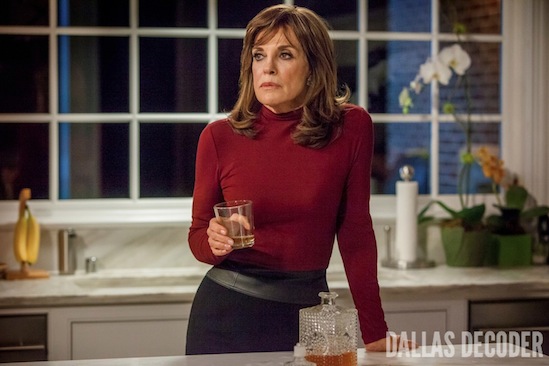
Regardless of John Ross’s motivation, I admire Henderson’s willingness to take his character into such dark territory. I also have to hand it to Linda Gray, who fearlessly takes Sue Ellen back to her roots. In the confrontation with John Ross, Sue Ellen stands in her kitchen, drinking openly; there’s no more discreet nipping from the flask. This is not the confident, successful Sue Ellen we’ve come to know; this is the old-school, deeply vulnerable Sue Ellen. She lashes out at John Ross and blames him for her problems (“You did this to me!”), just like she used to do with J.R. I’ve gotten so used to seeing Gray play Sue Ellen as a functional alcoholic, it’s surprising to see the character lose control like this.
The most startling moment: John Ross denies he’s cheating and Sue Ellen screams, “Bullshit!” Did you ever dream you’d see Miss Texas use this kind of language? It’s shocking, and yet it makes perfect sense: The love of Sue Ellen’s life is dead, her relationship with her son is broken, and now she’s back on the bottle. Sue Ellen’s entire identity is slipping away; of course her sense of decorum would go with it. I also love Gray’s reaction shots during this sequence. As John Ross loses control and gets choked up, so does Sue Ellen. Just as our hearts break for John Ross, so does hers. It’s similar to what Gray did in “J.R.’s Masterpiece,” when she became the audience’s avatar and allowed us to express our grief through her. Will someone please give this woman an Emmy already?
Together, Sue Ellen’s relapse and John Ross’s descent into full-fledged J.R.-dom fit with the broader theme of “Like Father, Like Son,” which shows how the “Dallas” characters struggle to break old patterns. We also see this when Ann urges Emma to find a man who will love her and not use her for sex. The pained expression on Emma Bell’s face at the end of this scene suggests Ann’s words have sunk in, but of course Emma later has, ahem, relations with John Ross in exchange for the file he wants on the judge. (After he satisfies her — without ever undressing himself, notably — she tells him, “Now go home and kiss your wife.” This might be “Dallas’s” naughtiest moment ever.) Even Bobby gives in to his baser instincts, using his new position as the railroad commissioner to threaten Nicolas. I suppose I should chastise “Dallas” for once again taking a dim view of public service, but at least Bobby isn’t patronizing Judith’s brothel like most of the other political figures on this show.
There’s much more to like about “Like Father, Like Son,” especially the slow-motion sequence that director Steve Robin gives us at the end of the episode, when John Ross walks away from Bobby after telling him he’s going to use Sue Ellen’s power of attorney in his bid to take Ewing Global public. Unlike Patrick Duffy’s slow-mo walk during Season 2, which felt so triumphant, Henderson’s version is positively chilling. I also love Jesse Metcalfe’s adorable scenes with Dallas Clark (yes, that’s his name), the child actor who plays little Michael, as well as Metcalfe’s charming rapport with AnnaLynne McCord’s Heather. McCord has proven an especially welcome addition to this show. I know a lot of fans watch “Dallas” for escapism, but isn’t it nice to see Heather experience a real-life problem like finding last-minute child care?
This episode’s other highlight: The dueling boys’ and girls’ nights out on the town, although just once, I’d like to see television characters in these kinds of settings have to shout at each other over the sound of the music, the way people do in real-life nightclubs. As my husband Andrew pointed out, the sequence with the women brings a touch of “Sex and the City” to “Dallas,” except one of the ladies is cheating with the other’s husband, and a third is trying to prove it. By the way: Cynthia Addai-Robinson brings an undeniable sense of cool to her scenes as Jasper, Elena’s private eye. How much fun would it be to see her go toe to toe with Kevin Page’s Bum (who is sadly missing from this episode, along with Mitch Pileggi’s Harris)?
Meanwhile, some fans are wondering how Carter McKay, George Kennedy’s character from the original “Dallas’s” final seasons, has a grandson as old as Hunter, who is introduced in this episode as one of John Ross’s childhood friends. As far as we know, Tracey and Tommy, Carter’s children, didn’t have kids of their own. In light of this episode’s boardroom showdown, there’s also confusion in Fan Land about the ownership of Ewing Global and how it’s divided. I, too, wish the show handled these details better, so my only advice to fellow fans — and I know this won’t satisfy many of you — is to just go with it.
My other gripe has to do with Harris’s accordion file. It’s become a treasure trove for storyline purposes, so I wish the show had made it an updated version of J.R.’s infamous “red file” instead; it would have been another nifty way to keep Larry Hagman’s spirit alive. Then again, Josh Henderson is doing a pretty good job of doing that on his own.
Grade: A
_______________________________________________________________________________________________________________________________________________

Slipping away
‘LIKE FATHER, LIKE SON’
Season 3, Episode 6
Telecast: March 31, 2014
Audience: 1.82 million viewers on March 31
Writer: Julie Cohen
Director: Steve Robin
Synopsis: Bobby gives control of his Ewing Global shares to Christopher and, in his new role as railroad commissioner, vows to scrutinize Nicolas’s Texas holdings. Elena hires a private eye to follow John Ross and discovers he’s cheating with Emma. John Ross’s childhood friend, Hunter McKay, gives him the idea of taking Ewing Global public. John Ross gets support from Nicolas, who aims to take control of the company once it goes public, and also Sue Ellen, but when she gets the impression John Ross is cheating with Candace, she votes against her son, incurring his wrath. John Ross blackmails a judge into having Sue Ellen committed to rehab against her will and tells Bobby he has her power of attorney, which gives him her vote to take the company public.
Cast: Cynthia Addai-Robinson (Jasper), Emma Bell (Emma Ryland), Donny Boaz (Bo McCabe), Jordana Brewster (Elena Ramos), Dallas Clark (Michael), Jude Demorest (Candace), Juan Pablo Di Pace (Nicolas Treviño), Patrick Duffy (Bobby Ewing), Julie Gonzalo (Pamela Ewing), Linda Gray (Sue Ellen Ewing), Josh Henderson (John Ross Ewing), Rick Herod (Judge Blackwell), Fran Kranz (Hunter McKay), Jesse Metcalfe (Christopher Ewing), Bryan Pitts (paramedic), Brenda Strong (Ann Ewing), Kenneisha Thompson (police officer)
“Like Father, Like Son” is available at DallasTNT.com, Amazon.com and iTunes. Watch the episode and share your comments below.












 Dallas Decoder