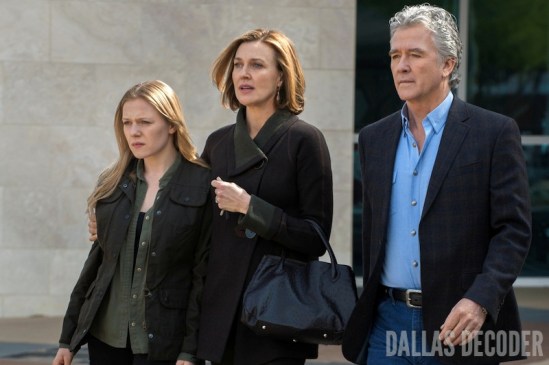
Drill Bits: ‘Dallas’ Season 2 Arrives on DVD

Ann Ewing, Bobby Ewing, Brenda Strong, Dallas, Emma Bell, Emma Ryland, Patrick Duffy, TNT

They’re here

“Dallas’s” second season arrives on DVD today, and not a moment too soon. Fans now have less than two weeks to catch up with the Ewings before TNT begins televising Season 3 on Monday, February 24. It’s a good thing many of us have a long weekend coming up. We’re going to need it.

The four-disc set, which sells for $39.98, includes all 15 second-season episodes, along with lots of extras. The highlights:

An extended version of “J.R.’s Masterpiece.” The instant-classic funeral episode offers about six minutes of extra footage, including Ann’s eulogy, which is based on a conversation Brenda Strong had with Larry Hagman before he died.

The latter nugget is one of the tidbits you’ll hear from executive producers Cynthia Cidre and Michael M. Robin on the audio commentary. Other revelations: Cidre and Patrick Duffy initially believed Bobby shouldn’t speak at the funeral, and the scene where the Ewings arrive in Nuevo Laredo to retrieve J.R.’s body was filmed at the Fort Worth stockyards.

More than 15 deleted scenes. In one sequence, Bobby comes onto the Southfork patio and finds J.R. listening to his ex-wife being interviewed on the radio. Says J.R.: “You just missed it, Bob. Sue Ellen called me a philanderer — on the radio. I’m not saying I don’t deserve it. I’m just surprised she didn’t used a dirtier word.” You’ll also see Ann and Bobby discuss Christopher’s search for Pam. “I think that sometimes the past is best left alone. … I’d just hate for Pam to cause you or Christopher any more pain,” Ann says.

Cast interviews. The cast’s panel discussion at last year’s Paley Fest television festival is included, along with a feature where the actors recall working with Hagman. (Robin’s tribute is especially moving.) Also included: an interview that Hagman recorded around the time the new “Dallas” debuted in 2012. In a particularly poignant moment, he praises his new co-stars and says, “We’ve got four wonderful young actors that are going to drag me through another 13 years. At least I hope to hell they will.”

As if the DVD isn’t enough, TNT also announced plans yesterday to televise every episode from “Dallas’s” first two years before Season 3 begins. The 25-hour marathon starts Sunday, February 23, at 8 p.m.
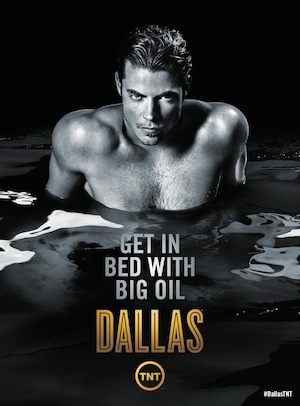
Dallas, John Ross Ewing, Josh Henderson

You dirty boy

Presenting Mr. Henderson

TNT set hearts aflutter last week when it shared sexy shots of Elena (Jordana Brewster), Pamela (Julie Gonzalo), John Ross (Josh Henderson) and Christopher (Jesse Metcalfe) on Facebook and Twitter and asked “Dallas” fans which character should be the “face” of the show’s third-season advertising campaign.

The winner: John Ross, whose image received 31,000 “likes” on Facebook and 360 “favorites” on Twitter. Something tells me his daddy would be awfully proud.

I’ve posted all four images on Dallas Decoder’s Facebook and Pinterest pages. Which one do you like best?

Look Who’s Talking

The “Dallas” cast will soon be making the talk-show rounds to promote the third-season premiere. Last week, the folks who operate Linda Gray’s Facebook page announced she’ll appear soon on NBC’s “Today,” CNN’s “Piers Morgan Tonight,” Bravo’s “Watch What Happens Live” and Katie Couric’s syndicated show.

Of course, if you can’t wait to hear the scoop on “Dallas,” check out the highlights from Gray’s recent conversation with Dallas Decoder and other bloggers.

“Drill Bits,” a roundup of news about TNT’s “Dallas,” is published regularly. Share your comments below.
Dallas Decoder’s Woman of the Year: Linda Gray

Dallas, Linda Gray, Sue Ellen Ewing, TNT

Brunette on the couch

Good actors make you believe. Great actors make you feel. In 2013, Linda Gray made us feel every emotion Sue Ellen Ewing experienced — the disappointment over losing the election, the shame over losing her sobriety, the heartbreak over losing J.R. Gray shone all season long, but especially in “J.R.’s Masterpiece,” the funeral episode where she bared her soul and became the audience’s avatar. Through her, we were able to express our own grief over the death of our hero. When Sue Ellen called J.R. the love of her life and touched his casket, it wasn’t just the climax of a great performance. It was a moment of shared catharsis for “Dallas” fans.

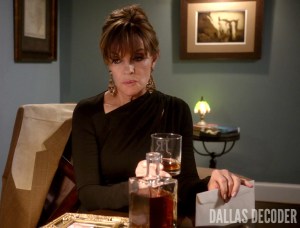
Linda Gray is Dallas Decoder’s Woman of the Year because no one else moved us, delighted us and impressed us quite like she did. Sue Ellen has been “Dallas’s” heroine for a long time, but in 2013, Gray stepped into the void created by the death of Larry Hagman, her longtime friend and co-star. Like Hagman — and like Dame Maggie Smith, one of Gray’s own idols — Gray creates thrilling television just by showing up. Consider the “J.R.’s Masterpiece” scene where Sue Ellen sits in J.R.’s bedroom and takes her first drink in 20 years. It was a mesmerizing moment — just as moving if not more so than the graveside eulogy — and yet Gray never uttered a single line of dialogue. The scene consisted of little more than Sue Ellen, a bottle of bourbon, an old wedding picture, an unopened love letter and that sad, sad song (Tara Holloway’s “The Bottom”) playing in the background. That’s it. But when Gray is your star, what more is needed?

To be fair, Gray gets plenty of support from the rest of the “Dallas” cast — as strong an ensemble as any working in television today — and the people behind the scenes, including Michael M. Robin, who directed “J.R.’s Masterpiece” and has a knack for eliciting wonderful performances from his actors. Gray’s most crucial collaborator, though, is probably showrunner Cynthia Cidre, who gave her some of her best material ever as Sue Ellen. Between the two of them, Gray and Cidre showed us Sue Ellen in all her complex, contradictory glory: The fiercely protective mama bear. The take-no-prisoners businesswoman. The struggling alcoholic. And most fascinating of all: the playful flirt, whose vibrant sexuality at age 70-something makes Sue Ellen a prime-time pioneer.

Looking Back

Choosing Gray as Woman of the Year will come as no surprise to Dallas Decoder readers. By now, my admiration for this actress and her character are no secret. Gray was kind enough to grant me an interview a few months ago, and the hour or so that I spent sitting at my dining room table, talking to her on the phone, remains one of the great experiences I’ve had since starting this website. But please know this: My affection for Gray is rooted in my genuine respect for what she has achieved as an actress. Like Sue Ellen, she has worked hard for her success.

Consider: Sue Ellen had to fight for her place in the world. She was not born into the Ewing family, and marriage to J.R. offered public prestige but private pain. For years, he neglected Sue Ellen’s needs and dismissed her potential, and she turned to the bottle to cope with her unhappiness. But the ex-beauty queen’s spirit ran deeper than anyone knew, including Sue Ellen herself. Eventually, she conquered her demons and won the admiration of the other Ewings, including J.R.

Gray’s career has had its ups and downs too. During “Dallas’s” earliest days, she was notoriously dismissed as “the brunette on the couch” and excluded from the show’s opening credits. Slowly, the producers noticed her talent and chemistry with Hagman and beefed up her role. At the height of “Dallas’s” popularity, Gray even picked up an Emmy nomination for best dramatic actress. By the time she departed the original show at the end of its 12th season, Sue Ellen rivaled J.R. as “Dallas’s” most popular character. (It’s no coincidence the show plunged from 26th to 43rd in the yearly Nielsen rankings after Gray left.)

Yet when TNT brought “Dallas” back last year, it felt a little like déjà vu all over again — and not in a good way. The producers struggled to find a place for Sue Ellen in the storyline, leaving her out of two early episodes altogether. Fans were outraged, and the Powers That Be soon learned the same lesson their predecessors did: Don’t mess with Miss Texas. In Season 2, Sue Ellen once again became a force to be reckoned with, wheeling and dealing against the Ewings’ enemies, even as she wrestled privately with her old demons and J.R.’s loss.

Moving Forward

Some of my fellow fans are concerned about Sue Ellen’s future. Cidre has confirmed the character will continue drinking when “Dallas” begins its new season in February, and I get the feeling Sue Ellen’s problems are going to get worse before they get better. But I’m not worried. For one thing, I’m confident Gray is going to continue to deliver great performances, no matter what she is called upon to do. I also believe Sue Ellen will eventually get back on track and start moving forward again. She’s come too far to turn back for good.

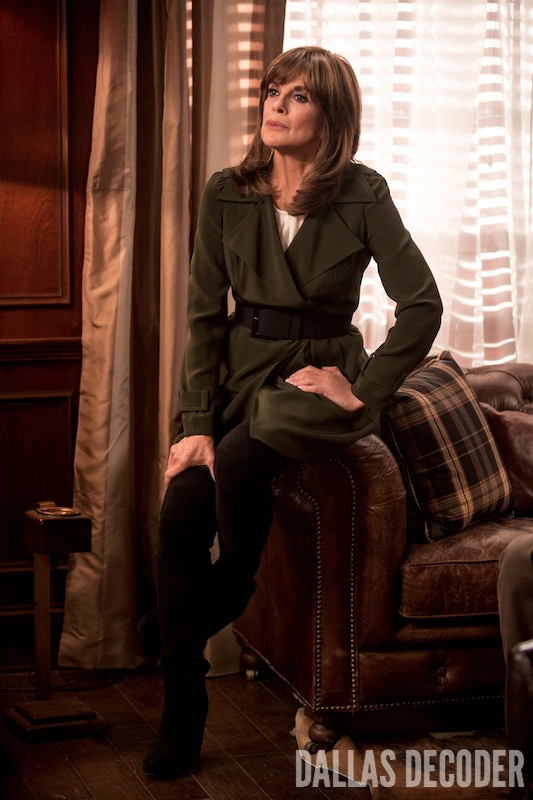
Just look at the above TNT publicity still, which comes from the 2013 episode “A Call to Arms.” It shows Sue Ellen seated on the edge of the sofa in the Southfork den, where she’s helping her fellow Ewings formulate a plan to fight back against their latest foes. She wears a determined expression and looks like she’s about to spring into action, which is precisely what happens in that scene. The photo tells us everything we need to know about this actress and the character she has embodied for so many years. Linda Gray is still the brunette on the couch, except now the brunette is the star of the show and her character is helping to call the shots.

Don’t mess with Miss Texas.

Share your comments about Linda Gray and Sue Ellen Ewing below and read Dallas Decoder’s list of the year’s other VIPS.

Who Should Be Dallas Decoder’s Person of the Year?

Brenda Strong, Cynthia Cidre, Dallas, Jesse Metcalfe, Jordana Brewster, Josh Henderson, Julie Gonzalo, Linda Gray, Michael M. Robin, Patrick Duffy

Who’ll it be?

It’s almost time to announce Dallas Decoder’s Person of the Year, a designation I give to the individual — or individuals — I feel made the most important contribution to the “Dallas” franchise during the past 12 months.

In 2012, I chose Larry Hagman for the inaugural honor in recognition of his work during TNT’s first season of “Dallas.” This year’s award may go to another actor or someone from behind the scenes, or it could go to a group of people. (It’s a lot like Time magazine’s version, although mine is much more prestigious, don’t you think?)

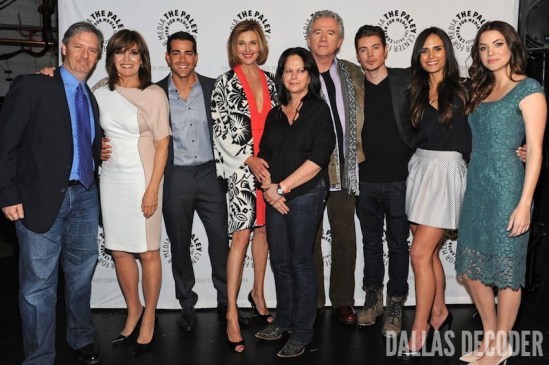
Contenders include the “Dallas” VIPs pictured above: Executive Producer Michael M. Robin, Linda Gray, Jesse Metcalfe, Brenda Strong, Executive Producer Cynthia Cidre, Patrick Duffy, Josh Henderson, Jordana Brewster and Julie Gonzalo.

Before I reveal my selection, I want to hear your choices. Share them in the comments section below, post them on Dallas Decoder’s Facebook page or tweet them to @DallasDecoder.

I’ll reveal Dallas Decoder’s Person of the Year for 2013 during my next #DallasChat on Monday, December 16. I hope to see you there.

The Dallas Decoder Interview: Linda Gray

Dallas, Linda Gray, Sue Ellen Ewing

Linda Gray

Sue Ellen WeekI interviewed Linda Gray! It was an amazing experience — Gray was fun, insightful and extremely generous with her time. I’m so excited to share our conversation as part of Dallas Decoder’s Sue Ellen Week.

I’d like to begin with something that I’ve waited my whole life to say to you, which is this: “Hello, darlin’.”

[Laughs] I love that. Yes, I’ve heard that a couple of times before.

Well, when I was a kid, I wanted to grow up to be J.R., so to be able to say that to you now is a dream come true.

Oh, that’s so sweet. Thank you so very much.

OK, now that we’ve gotten that out of the way, you’re about to do something you’ve never done before, which is to start production on a new season of “Dallas” without Larry Hagman. How are you feeling about that?

It’s tricky because I know he’s not on the planet, but on the set, he’s very much there. He’s kind of like this big presence, looming over us and smiling. And I think what the writers may do — and underline “may” — is have something where J.R. Ewing made some oil deal 20 years ago that will come back and have reverberations on the characters today. So I think Larry will always be there — and he doesn’t even have to get into makeup.

So you’re not starting the season with a heavy heart?

No, not at all. Everybody is light about it because Larry was light about it. He always said he wasn’t afraid to die. And I think every single person who’s honest will say, “I’d like to go doing what I love to do.” Larry certainly achieved that. He passed playing the character he was meant to play. It was a life well lived. He charmed so many people and touched so many lives. He’s missed, but we just continue his memory.

Dallas, Linda Gray, Sue Ellen Ewing, TNT

What’s next?

And what about Sue Ellen? Any idea what she’s going to be up to next year?

I always smile when I get that question. People stop me on the street and say, “Please don’t drink anymore” or please don’t do this or please don’t do that. Honestly, until about a week before we start filming, we don’t know what’s going on.

The producers don’t sit down with you and explain Sue Ellen’s arc for the season?

No. But I prefer not knowing because sometimes, you could give something away without realizing it. Like when Sue Ellen started drinking again, I didn’t know that was coming up until days before we shot it.

I’m so glad you brought that up. The scene in “J.R.s Masterpiece” where she takes her first drink in 20 years is beautifully done.

When I opened the script for that episode and I saw, “She picks up that drink,” I thought, “Oh, no!” [Laughs] So I was just as surprised as anybody. But I spoke to some people who are in the program, and they said that if anything would make her take a drink, it would be J.R.’s death. So I said, “OK. Deep breath. Here we go.”

Was that scene hard to film?

I think we shot it at 10:30 at night or something. And the drinking scene wasn’t even planned for that day — another scene was, but it was a long scene and there was dialogue. And so the director, Mike Robin, who’s one of our executive producers, gave me a choice between shooting the scene with dialogue and the drinking scene. And I said, “It’s late, the crew’s tired, I’m tired. Everyone wants to go home. Let’s just do the drinking scene.” So it was kind of spur of the moment.

And I think I’ve heard you say you did it in only two takes.

Well, I asked Mike how long we had film-wise, and he said, “You’ve got 12 minutes.” And I said, “I’m not drinking for 12 minutes!” [Laughs] It may have been two takes. It felt like one.

I’ve got to tell you: Every time I watch it, I get a little emotional. How do you feel when you see it?

Cynthia Cidre, who’s our executive producer/writer, sent me the cut of the episode. And I was out, so I watched it on my phone. And I just started crying, crying, crying. So when I got home, I played it on my computer, and I just started crying again. I still tear up every time I see it because … I don’t know, it just goes to my heart. It’s hard for me to watch it.

Getting back to Season 3: I know you have a lot of respect for the writers, but do you have your own wish list for what you’d like to see Sue Ellen do?

The interesting thing is, I never had a wish list on the original show. I remember going in to the producers that one time and telling them that all I’m doing is drinking and having affairs and drinking some more and having more affairs. And they were patronizing to me, in a nice way. They said, “Yes, darling, but you do it so well.” [Laughs] So then in Year 9, they called me and said, “OK, we’re going to take you off the bottle, but we’re going to take you down.” And I said, “How far down?” [Laughs] And they said, “You’re going down.” So we went down, and I ended up in the alley drinking with the bag lady. And I loved that. As an actor, it’s like, “Bring it on!” And this was at a time when alcoholism wasn’t being dealt with a lot on film.

Dallas, Linda Gray, Sue Ellen Ewing, TNT

Don’t do it, darlin’!

I’m so glad you mentioned that, because when I think about the people who’ve contributed to society’s understanding of alcoholism as a disease, I think about you. Given the popularity of “Dallas,” I think you played an enormous role in that.

Well, that’s very kind. I’m just doing my job.

Well, you do it so well — and I’m not being patronizing!

[Laughs] No, that’s perfect. Thank you.

So let’s talk about Sue Ellen. My readers and I spend a lot of time debating this character, who is still so fascinating. How do you see her?

I have often said I found her to be the most interesting woman on television in the ’80s because she was so complex and complicated. And she’s still very interesting, but she’s different. When they brought the show back after 20 years, I told [the producers]: She’s got be strong. She has to be a changed woman. That’s the one comment I gave them. I know Dallas women. I have a lot of friends there. They’re extraordinarily talented, smart, gracious, generous women. And I wanted Sue Ellen to reflect that. She’s a former Miss Texas. She was married to that crazy J.R. Ewing. But she’s smarter now. She knows where all the bodies are buried. So who better to step in and start wheeling and dealing than Sue Ellen?

So you’re satisfied with where the character is today?

Oh, I love it. I feel like she’s a challenge for the writers. Bobby was always the good guy, J.R. was always the guy you loved to hate, but Sue Ellen is in this sort of gray area. This is supposition on my part, but my sense is that she keeps [the writers] on their toes.

Does it make a difference having Cynthia Cidre, a woman, as “Dallas’s” head writer?

As a woman, yes. I thought the original series was very sexist and chauvinistic.

I agree.

Oh, good. The thing I love about Cynthia is that she pulled together these amazing, amazing writers. We never had a writers’ room on the original show. Now, if somebody gets stuck and they don’t know what to do with a character or a scene, she has eight or nine other people who can interject their thoughts and their ideas. It’s so creative and collaborative.

Dallas, J.R. Ewing, Larry Hagman, Linda Gray, Sue Ellen Ewing

Big love

And what about Sue Ellen and J.R.? Why do you think they loved each other?

Oh, the most fabulous question. J.R. loved women, obviously. And he was brought up to have that trophy-wife syndrome. He wanted to marry the prettiest woman in Texas. And Sue Ellen’s mother taught her to go after the money. So with these two, it wasn’t a match made anywhere but hell. [Laughs] But — but! — through the years, I think a great, great love developed between J.R. and Sue Ellen. It was a Virginia Woolf kind of a love, kind of a dysfunctional love, but you know, marriage isn’t always wonderful and seamless and positive. I always found that idea interesting, that they didn’t begin on a high note. He was a philanderer, and she drank to anesthetize herself to the pain. But deep down — and they picked it up early on the new series — there really was love there.

I’m so glad the new show played that up. It was so sweet to see how their relationship had matured.

Cynthia told me that if Larry hadn’t passed, she had planned to end the season with a scene where J.R. and Sue Ellen go into the bedroom and shut the door. And so you would have been left with the impression that they were getting back together.

Oh, that’s so heartbreaking! That would have been wonderful.

Yeah, I just got chills when she told me that. I thought, “Oh, wouldn’t that have been just lovely?” We could’ve started all over again.

Do you think Sue Ellen loved any of the other men in her life?

I don’t think so.

Not Dusty Farlow?

He may have been the closest one, followed by Jack Scalia’s character [Nicholas Pearce]. Those are the only two that I can think of. There were so many! [Laughs]

Would you like to see Sue Ellen find someone new next season?

I don’t know. I think it could be kind of fun for her to be flirtatious with somebody, but she may not be ready for a relationship. But that’s just my take. The writers may have something else in mind. I think she’s got her hands full with that boy of hers.

Dallas, John Ross Ewing, Josh Henderson, Linda Gray, Sue Ellen Ewing, TNT

Honor thy mama

He’s a chip off the old block, isn’t he?

When we all read the final scene [of Season 2] where he goes to Emma, I thought, “You rat!” And when he had [J.R.’s] watch on, I thought, “Oh, boy. We’re in deep trouble now.” Mama has to step in.

I wonder if he’ll wear the watch next season?

I’m going to take it away from him. I’m going to ground him. He’s going to have to go to his room. No television. Nothing. [Laughs]

So how are you and Sue Ellen alike and how are you different?

Oh, boy. Let’s see. I have much more humor. My life is totally different. I’m much more … how do I even say this? It’s hard to describe yourself.

Maybe you’re not alike.

You know, I’m sitting here in my office in my home and I’m looking outside. I have an organic vegetable garden. I live on a ranch, but I don’t tell that to Texans because they would laugh. It’s only three acres. But in my mind, it’s a ranch. I’m very casual. And I have a great circle of wonderful friends and family. I have two grandsons. So my life is more … I don’t want to say normal. My life is easier than Sue Ellen’s. I do love her clothes, though. We have that in common.

Dallas, Linda Gray, Sue Ellen Ewing, TNT

Substance and style

But I bet your styles are different.

Our styles are different, yes. But I love putting on her clothes. On the set, I cannot do a scene without my high heel shoes. And even though my feet are under the desk or under the table and you don’t see them on camera, those heels make my character whole. I couldn’t wear fluffy slippers because that would not be Sue Ellen. And at the end of day, like at 10 o’clock at night, the girls will say to me, “Linda, you don’t have to wear these shoes.” And I’ll say, “I cannot do that scene without those shoes. I’m sorry.” And my feet are very sorry. But that’s how it is when I play Sue Ellen. I have to layer her. You know, when you step into the makeup chair, that’s layer number one. And then you go and have the hair done. And then you slip into the outfit. There’s a process, and for me, that’s hugely important.

I think I know the answer to this question, but I’ll ask it anyway. You’re one of the stars of “Dallas.” Are you also a fan?

I am a huge fan! I have always loved it. The original show still entertains me. I still get excited and I giggle and I laugh and I think, “Oh, I remember that scene! That was such a good scene.”

Do you watch the new show?

Oh, I watch it live!

Oh, wow. You should get on Twitter and tweet with us when we’re watching.

Somebody else told me that and I said, “What? Live tweeting?” I’m a little behind, and I know my fans get kind of upset. They’re like, “Come on, tweet more.” I don’t do it unless there’s something I can tweet about.

So what else are you a fan of? What shows and movies and actors do you like?

Well, my two favorite actors are Maggie Smith and Judi Dench. I mean, to watch them is to attend an acting class. I watch “Downton Abbey.” I watch “Homeland.” I love anything with great characters, great writing, great acting. It’s like this new Woody Allen film [“Blue Jasmine”]. I applaud him as a director so much because he keeps the camera on Cate Blanchett. And I was jealous. I was like, “Oh, man. He’s letting her go.” And she’s brilliant anyway.

That’s one of the things I loved about the old “Dallas” — those long, slow-burn reaction shots.

They’d let you play out your emotions. The new show jumps around a little more. They edit quickly. So that was new for me. Shooting in HD was new for me. But then you realize: OK, all these years have gone by. Things change. You have to change with the times.

Well, I think you and Sue Ellen are both doing a pretty terrific job changing with the times.

Oh, you sweetheart! Thank you.

Share your comments below and read more interviews from Dallas Decoder.

The Best & Worst of TNT’s Dallas: Season 2

The second season of TNT’s “Dallas” was even better than the first. Here are my laurels, along with a few darts.

Performances

Woman of the year

Wonder woman

She spent Season 1 on the sidelines, but Linda Gray became “Dallas’s” star player this year. After losing the election, Sue Ellen maneuvered her way into Ewing Energies, then fought tooth and manicured nail to save the company. Her determination took many forms: She flirted with Gary and later Ken, proving a woman in her 70s could still be playful and alluring, and blackmailed Governor McConaughey with a smile, demonstrating just how much she learned from her ex-husband. Speaking of J.R.: Gray shined brightest at his funeral, where Sue Ellen took a heartbreaking tumble off the wagon, then delivered a mesmerizing eulogy for the man she called “the love of my life.” It was a magnificent, unforgettable performance – and if there’s any justice in the world, Gray’s next big speech will be at the Emmys.

Storylines

The “Who Killed J.R.?” mystery was terrific because it allowed viewers to slide into J.R.’s boots and try to piece together the puzzle he left behind. The gun! That letter! Those cocaine shoes! How were the clues connected? This was “Dallas” at its most fun – and as an added bonus, it finally resolved Pam’s storyline and gave the character the redemption she deserved. (Pam may be dead, but please let Katherine live.) The season’s least satisfying storyline: Vicente Cano’s ambush on Southfork and the hostage crisis that ensued. This storyline did little to advance the season’s main narrative – the fight for Ewing Energies – nor did it give us much new insight into the characters. On the other hand: at least nobody made Sue Ellen sing.

Episodes

Tears of the son

Tears of the son

The beautiful, elegiac “J.R.’s Masterpiece” is landmark television. From the mournful version of the “Dallas” theme music that played under the special opening titles through the moving gravesite eulogies, scriptwriter Cynthia Cidre and director Michael M. Robin made J.R.’s death feel achingly real. This is their masterpiece. At the other end of the spectrum: “Ewings Unite!,” an uneven hour marred by J.R.’s silly will reading and Gary and Val’s drive-by reunion.

Scenes

Almost two months after watching “J.R.’s Masterpiece,” I’m still haunted by the memory of Sue Ellen getting drunk in her ex-husband’s bedroom on the night before his funeral. As Tara Holloway’s soulful rendition of “The Bottom” played, we watched Sue Ellen move around J.R.’s bed, caress a framed photo from their wedding and finally drown her sorrows with glass after glass of his bourbon. This was two-and-a-half minutes of exquisite agony. (Among the season’s other great scenes: Ann’s spellbinding testimony at her trial, Harris and Emma’s parking garage encounter, Harris’s Komodo dragon speech and the moment lusty John Ross storms off the elevator and into Pamela’s arms.)

Twists

Raw deal

Raw deal

The police discover Tommy’s body and murder weapon. John Ross warns Pamela, who frantically begins preparing to skip town as the police arrive with guns drawn. But wait! They’re not coming to arrest Pamela; they’re after Frank, who has been framed by Cliff. It was a classic “Dallas” fake-out and the season’s most surprising twist. The silliest: At J.R.’s will reading, Miss Ellie somehow takes half of Southfork from Bobby and gives it to John Ross. Howzat, Mama?

Traditions

Season 2 gave us a Southfork swimming pool scene, the return of the old Ewing Oil building and even a reference to Westar, but where were the barbecue and Oil Baron’s Ball (er, “Cattle Baron’s Ball”) episodes? On the other hand, we did get “The Furious and the Fast,” the fantastic racetrack-set episode that marked the “Dallas” directorial debut of Rodney Charters, the show’s ace cinematographer. Perhaps racecars will become a new “Dallas” tradition? I’m ready for another spin.

Villains

Evil dad

Evil dad

Steven Weber played McConaughey to smirking perfection and Mitch Pileggi and Judith Light were delicious as the evil Rylands, but Ken Kercheval scared the bejesus out of me as Cliff. The scene where he orders the destruction of the methane rig is chilling. Yet somehow, the brilliant Kercheval made sure we never lost sight of Cliff’s humanity, especially when he was arrested for J.R.’s murder. Make no mistake: Season 2 was the performance of Kercheval’s career.

Returning Favorites

Audrey Landers’ return as Afton in “Guilt and Innocence” was a hoot. Robert Rovner’s script gave Landers plenty to do, and she made the most of it: During the course of the hour, we got to see Afton badmouth Cliff (“He’s a mean drunk, that man”), flirt with John Ross, shoot daggers at Christopher and sweetly serenade Pamela with her favorite childhood lullaby. I also liked Ted Shackelford and Joan Van Ark’s return as Gary and Valene (even if Van Ark didn’t get enough to do), as well as the familiar faces who showed up in “J.R.’s Masterpiece,” especially Mandy and Cally (Deborah Shelton, Cathy Podewell), whose reminiscing about their romances with J.R. proved surprisingly poignant.

Newcomers

Welcome to Southfork

Welcome to Southfork

Each episode of “Dallas” clocks in at 42 minutes sans commercials, making screen time a commodity. It’s tempting to knock the producers for expanding the cast in Season 2 – except the newcomers are all so good! I was especially charmed by magnetic Kuno Becker, who was both smoldering and sweet as ne’er-do-well Drew, while Emma Bell knocked me out as Emma, who shifted effortlessly from sheltered princess to a pill-popping sexpot. Is there anything this actress can’t do?

Supporting Players

Like the original “Dallas,” the new show is beginning to feel like its own world, thanks to its growing population of reliable recurring characters. My favorites include steadfast Sheriff Derrick (Akai Draco), dutiful lawyer Lou Bergen (Glenn Morshower) and of course loyal private eye Bum (Kevin Page), who charmed me in his scene with Sue Ellen and moved me when he confessed his role in J.R.’s master plan. Season 2 also introduced two promising additions to the Ewing Energies secretarial pool: perky, sneaky Jill (Amber Bartlett) and statuesque Stacy (Natalie Quintanilla). The other great addition: lusty city transportation chief Alison Jones (Annie Wersching). Could she become this generation’s Marilee Stone?

Costumes

Man of style

Man of style

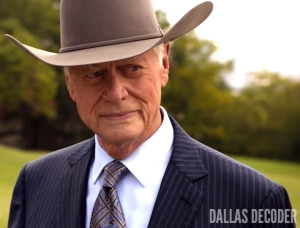
“Dallas” doesn’t just have TV’s best-dressed cast; the actors are also smartly dressed. Everyone’s “look” fits their character perfectly. Case in point: J.R., whose western jackets, dark suits and Butch Dorer hats made him Season 2’s most dashing figure. My favorite outfit: the classic pinstripes he sported in “Venomous Creatures” when he blackmailed the smarmy prosecutor. A tip of the hat to costume designer Rachel Sage Kunin. Thanks to her, our hero went out in style.

Music

The music on “Dallas” is a mix of familiar tunes like Merle Haggard’s “My Favorite Memory,” which played during J.R.’s memorial service, and oh-my-gosh-what-is-the-name-of-that-song-I-must-own-it selections like “Liar,” an unreleased number from the Unknown that was heard in “False Confessions” and “Legacies.” My favorite: “My Time Has Come,” the driving rock anthem from the Bowery Riots that played when Bobby did that cool slow-motion walk away from Cliff at the end of “Love and Family.” It was the ideal song to showcase Bobby at his badass best.

Props

Ugly truth

Ugly truth

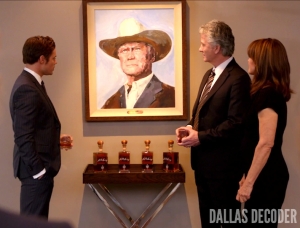
I’m tempted to choose Christopher’s Miller Lite bottle or all those Microsoft Surface tablets as best props, but instead I’ll go with J.R.’s handsome bourbon decanter, which the three people he loved most – Bobby, Sue Ellen and Christopher – all drank from after his death. Worst prop? That’s easy: The awful painting of J.R. unveiled at the end of “Legacies.” Where’s J.R.’s nose? What happened to his right shoulder? My plea to the producers: Fix this before Season 3 starts.

Hashtags

Since so much of my “Dallas” viewing experience now takes place in the Twitterverse, it seems appropriate to honor the hashtags of Season 2: #BubbaNotEarl #ByeByeCloudDrive #Clonazepam #ContinuedLegalSubterfuge #EminentDomain #FentonWashburnEsquire #HighImpactPressureMoldedCocaine #HighVelocityBloodSplatter #HornedFrogsVsMustangs #HotelColon #JudgeRhonda #KomodoDragons #MoralsClause #NuevoLaredo #PatriciaBarrett #RickyRudd #RIPKatherine?

Quips

This category is always the toughest and Season 2 is no different. What to choose? Sue Ellen’s putdown of Afton (“She’s drama, John Ross.”)? Val’s greeting to Sue Ellen (“Once a bitch, always a bitch.”)? Vicente’s observation after realizing the Ewing cousins have traded romantic partners (“You Ewing boys share after all! I love it!”)? John Ross’s not-fit-for-print philosophy on romance (“Love is for [kitty cats]”)? In the end, I’ll go with the master. J.R.’s encounter with Pamela: “You’re not the first Pam to fox her way into the henhouse.” Oh, J.R. We’ll never stop missing you.

What do you love and loathe about the second season of TNT’s “Dallas”? Share your comments below and read more “Best & Worst” reviews.

Critique: TNT’s ‘Dallas’ Episode 18 – ‘J.R.’s Masterpiece’

Dallas, J.R. Ewing, J.R.'s Masterpiece, Larry Hagman, TNT

Still here

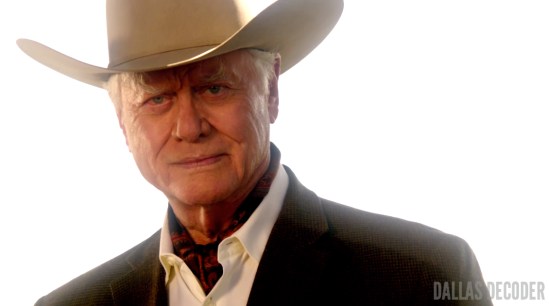
It isn’t quite accurate to call “J.R.’s Masterpiece” the first “Dallas” episode without J.R. Ewing. Our hero is present, even if he isn’t physically there. We see Larry Hagman in the special opening credits, which offer a moving, mournful version of Jerrold Immel’s classic theme music and memorably end with J.R. disappearing into white light. Beyond that, we feel J.R.’s spirit in every scene, every line, every breath. It’s gratifying and even a little exhilarating to see the show honor this character so thoroughly. This will be remembered as the hour that Cynthia Cidre, Michael M. Robin and seemingly everyone else associated with “Dallas” rose to the occasion – and then surpassed it.

The two most unforgettable moments in “J.R.’s Masterpiece” belong to Linda Gray. In the first, Sue Ellen enters J.R.’s bedroom on the night before his funeral and removes from her purse the letter he sent her before his death. She sits at his table, looks at a framed photograph from their second wedding and smiles. Then she notices J.R.’s decanter of bourbon, emblazoned with his name. With the sad country tune “The Bottom” playing in the background, Sue Ellen pours herself a glass and contemplates it for a few moments, just like she did with the wineglass in “Venomous Creatures,” an earlier second-season episode. On that occasion, J.R. arrived on her doorstep and gave her the encouragement she needed to resist temptation. This time around, he isn’t here to save her. And so Sue Ellen downs the bourbon. Hard. And then she pours herself another glass. And then another.

It’s a tense, wrenching scene on its own, but I also appreciate how it echoes one of my favorite moments from TNT’s other great “Dallas” episode, the first-season entry “Family Business.” In that scene, J.R. sits at the same table, glances at a picture of Miss Ellie and takes a swig of bourbon before signing the Southfork deed over to Bobby. In a show where the booze flows as freely as ever, both scenes are about J.R. and Sue Ellen turning to the bottle to find courage they can’t muster on their own. He needs it to do the right thing, she needs it to just get through the night.

Seeing Sue Ellen fall off the wagon is tough for me and other longtime “Dallas” fans who remember how hard she fought to get sober. But I’m also the first to admit that her relapse makes riveting television. I have no idea where “Dallas” will take Gray’s character after “J.R.’s Masterpiece,” but my guess is she won’t return to the path of self-destruction. Sue Ellen isn’t the woman she used to be. She’s wiser, more confident, more aware. We see this during the episode’s other great moment: her mesmerizing eulogy at J.R.’s gravesite, where she confesses her relapse to the other Ewings. “I’m a bit drunk right now,” she says. This line startles me even more than the one at the top of the hour, when the Mexican policewoman announces J.R.’s death. I don’t think we’ve ever seen Sue Ellen acknowledge her demons so forthrightly, which makes me think she’ll find the courage to reclaim her sobriety sooner rather than later.

As remarkable as Sue Ellen’s admission is, the most emotional part of her speech comes when she reads aloud J.R.’s letter. He writes, “For me to apologize now for all the wrongs I’ve done you would take up all the time I’ve got left. So I’m hoping it will suffice for me to say that I was never worthy of you.” The note ends with a request: “When I get back to Dallas, will you have dinner with me?” But that’s not what J.R. is actually asking, is it? He really wants to know if Sue Ellen will forgive him for all those “wrongs.” She knows this too, which is why it’s so heartbreaking when she kneels, touches his casket and sobs, “Yes, yes, J.R. The answer is yes.”

‘He Never Pretended’

Bobby Ewing, Dallas, J.R.'s Masterpiece, Patrick Duffy, TNT

Grand scheme

The other eulogies in Cidre’s script are beautifully written, capturing the essence of each character’s connection to J.R. with an impressive economy of words. In his speech, Bobby says, “Throughout my life, it’s pretty much been easy for me to do good, because I could always count on J.R. to do bad. … Now I have to figure out just what I’m supposed to do in this grand scheme of things.”

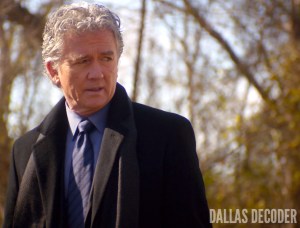
When I wrote down this line and looked at it, I realized it could be seen as Bobby’s response to J.R.’s admission last season, when he told Bobby, “I don’t know who I’d be without you.” The line acknowledged what the audience always knew – that J.R. was incapable of checking his worst impulses and needed Bobby to do it for him. Now, hearing Bobby wonder aloud what he’ll do without J.R. raises the intriguing prospect that Patrick Duffy, always the unsung hero of this franchise, will soon be able to show us other sides to his character.

In the other eulogies, Ray recalls fearing how he could never make his father proud the way J.R. did, which isn’t exactly how I remember Jock’s sentiments toward J.R. and Ray, but the speech nonetheless reflects the deep-seated insecurities that always haunted Steve Kanaly’s humble cowboy. Ted Shackelford also does a nice job delivering Gary’s single line (“Every step backwards or forward I ever took in my life was because of J.R.”), which perfectly fits his tortured character – and probably every other Ewing.

The most unexpected tribute comes from Lucy. “Things I thought were so horrible that J.R. did just seem honest now,” she says. “He never pretended to be anything other than himself.” It’s surprising to hear Lucy offer admiration for J.R., yet you can’t deny the profundity of her statement. I’m also touched by the shot Robin, the director, gives us of Lucy weeping during the funeral. Given Charlene Tilton’s well-known affection for Hagman in real life, I have no doubt those tears come from the actress’s heart.

It would be wrong to overlook the newer cast members, who are every bit as impressive as the “Dallas” veterans during this sequence. Jordana Brewster’s tears move me when Elena recalls the pep talk J.R. gave her after her father’s death (“Honey, how are you going to make your daddy proud?”), and I also appreciate Jesse Metcalfe’s Duffy-esque stoicism during Christopher’s speech, when he remembers J.R.’s attempt to comfort him after Pam abandoned the family: “I don’t know why your mama left, Christopher. Especially when she had such a good, smart little boy like you. But you’re a Ewing now. So stop crying and behave like one.”

It’s somewhat surprising that Josh Henderson has no lines at J.R.’s burial. Then again, are any needed? The dazed expression Henderson wears throughout this episode and especially at the funeral tells us everything we need to know about what John Ross is feeling.

‘What You Choose to Recall’

Dallas, J.R.'s Masterpiece, Linda Gray, Sue Ellen Ewing, TNT

The bottom

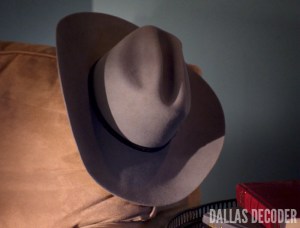
Not all of the dramatic moments in “J.R.’s Masterpiece” happen at the funeral. Duffy and Brenda Strong have a big fight scene that’s been a long time coming, as Bobby lashes out at Ann for keeping so many secrets from him during the course of their marriage. And as with all of the new “Dallas’s” best episodes, the smaller moments are touching too. Christopher comforts Sue Ellen when she breaks down in the morgue. Ray reaches for her hands as she returns to her seat after her eulogy. Bobby sits alone in J.R.’s room and notices his brother’s hat hanging on the back of the chair.

The lighter moments are welcome too. The best of these is seeing Sue Ellen commiserate with Cally and Mandy at the memorial, a surprisingly sweet scene that offers another reminder of how much Sue Ellen has grown. It’s also hard to not get a kick out of Ken Kercheval’s appearance, when Cliff crashes the memorial, ranting and raving about the Barnes/Ewing feud. As much as I’ve come to enjoy Kercheval’s performance on the new “Dallas” as the Godfather-like Cliff, it’s nice to be reminded of his character’s combustible side.

The other highlight of “J.R.’s Masterpiece”: the music. Merle Haggard’s “My Favorite Memory,” with its references to “what you choose to recall,” opens J.R.’s Petroleum Club memorial, setting the stage for the unexpectedly warm reminiscing that follows. I also like the foreboding strings at the top of the hour, when Bobby, Sue Ellen, John Ross and Christopher arrive in Mexico. Equally haunting: what sounds like Alison Krauss’s version of “Down to the River to Pray,” which is interspersed throughout the graveside eulogies. The most memorable song, though, remains Tara Holloway’s spectacular rendition of “The Bottom” during Sue Ellen’s relapse. Who will ever be able to listen to that song again without thinking of Linda Gray’s incredible performance in that scene?

As for the mystery that begins in the closing moments of “J.R.’s Masterpiece”? I’ll confess: When I read that Cidre, Robin and company planned to kill off Hagman’s character with another “Who Shot J.R.?” mystery, I cringed. I didn’t want my hero to go down in defeat. But the idea that J.R. spent his final days crafting a “masterpiece” scheme against his enemies – a grand plan that will now be carried out by his family – might mean ol’ J.R. will be able to go out on top after all.

All of the questions raised by the end of the episode are tantalizing. Why was J.R. tracking down Christopher’s “mother” – and which mother are we talking about: Kristin or Pam? Will John Ross end up using the gun that J.R. left him? Could there be significance to Christopher’s vow to help John Ross find J.R.’s killer so they can confront the bad guy (or gal) as “brothers”? What’s in the document that J.R. left for Bobby, and what should we make of Bobby’s tearful smile and last line: “I knew you’d have at least one more left up your sleeve, J.R. It is a good one. I love you brother.”

Until we get the answers, we won’t know what J.R.’s masterpiece will be. But at least we know what “Dallas’s” looks like.

Grade: A+

_______________________________________________________________________________________________________________________________________________

Dallas, J.R.'s Masterpiece, TNT

Hat tip

‘J.R.’s MASTERPIECE’

Season 2, Episode 8

Telecast: March 11, 2013

Writer: Cynthia Cidre

Director: Michael M. Robin

Audience: 3.6 million viewers on March 11

Synopsis: Bobby, Sue Ellen, John Ross and Christopher learn J.R. was shot and killed during a robbery in Mexico. Sue Ellen falls off the wagon. After the funeral, Bum reveals J.R. had been searching for Christopher’s mother and that he went to Mexico to follow a lead on Harris. J.R. also leaves a gun for John Ross and a document for Bobby, who refuses to reveal its contents to John Ross and Christopher.

Cast: Kuno Becker (Drew Ramos), Emma Bell (Emma Brown), Jordana Brewster (Elena Ramos), Mark Cuban (himself), Patrick Duffy (Bobby Ewing), Marlene Forte (Carmen Ramos), Julie Gonzalo (Pamela Barnes), Linda Gray (Sue Ellen Ewing), Castulo Guerra (Carlos del Sol), Josh Henderson (John Ross Ewing), Robert Anthony Hunt (minister), Jerry Jones (himself), Steve Kanaly (Ray Krebbs), Ken Kercheval (Cliff Barnes), Jesse Metcalfe (Christopher Ewing), Kevin Page (Bum), Hugo Perez (Dr. Garcia), Mitch Pileggi (Harris Ryland), Cathy Podewell (Cally), Mayor Mark Rawlings (himself), Tony Sears (George GIilchriest), Ted Shackelford (Gary Ewing), Deborah Shelton (Mandy), Brenda Strong (Ann Ewing), Charlene Tilton (Lucy Ewing)

“J.R.’s Masterpiece” is available at DallasTNT.com, Amazon.com and iTunes. Watch the episode and share your comments below.

Drill Bits: ‘Dallas’ is on DVD. Go Ahead and Get Carried Away.

Dallas, John Ross Ewing, Josh Henderson, No Good Deed, TNT

Arrested development

The first season of TNT’s “Dallas” was released on DVD last week. It has all 10 episodes and 2 hours of bonus material, including some Larry Hagman goodness you’ve never seen before.

In other words: Take a day off work. You’re going to need it.

The extras feature more than 25 deleted scenes, including three sequences starring Hagman. My favorite: a moving exchange from “Family Business” in which J.R. promises Ann he’ll protect Sue Ellen from Harris. I won’t give away anything else here, but trust me: This scene alone is worth the price of admission.

A lot of this unused footage will help you see the characters more clearly. Examples: We finally get to see the moment Sue Ellen decides to run for governor, as well as a wonderful exchange where Christopher talks about what it was like for him to grow up as Bobby’s son. The latter scene features beautiful performances from Jesse Metcalfe and Patrick Duffy, who described it as one of his favorite first-season moments during my brief chat with him last year.

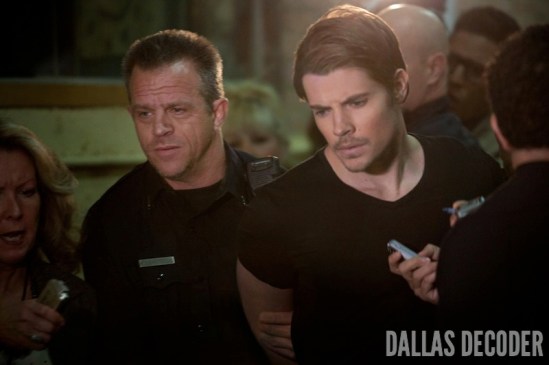
Curiously, the deleted scenes don’t include the one with Josh Henderson from the publicity shot above, which TNT released to promote “No Good Deed,” the episode where John Ross is arrested for Marta’s murder. We also don’t get to see J.R. and Sue Ellen’s dance from “The Last Hurrah,” although given the number of fans who are clamoring for it, something tells me it won’t stay buried forever.

(We do, however, get to see Elena’s visit to a bank, where she scans a plaque listing the board of directors. Sue Ellen’s name is there, along with production designer Richard Berg and other members of the “Dallas” crew.)

The DVD’s other highlight: an audio commentary from executive producers Cynthia Cidre and Michael M. Robin, who do a nice job explaining how much work – and love – went into making the “Changing of the Guard” pilot. Robin, the episode’s director, calls the scene where Bobby visits J.R. in the nursing home one of the highlights of his career, while Cidre reveals it took 10 hours to film the episode’s fantastic dinner scene.

The bonus material also includes new segments on the making of the first season and “Dallas” lore. Also included: the behind-the-scenes production videos that were posted on the “Dallas” website last year, including costume designer Rachel Sage Kunin’s fun “Dressing Dallas” piece.

I could go on, but really, why are you still reading this? Go get the DVD and see for yourself!

Life After J.R.

“Dallas’s” second season begins two weeks from tonight, and the press is beginning to publish stories about what we’ll see. The best preview so far comes from Entertainment Weekly’s Karen Valby, who reports Hagman filmed five episodes before his death on November 23. An extra scene that had been cut from an earlier episode will be inserted into the sixth installment, while Episode 7, which Cidre handwrote in the days after Hagman’s death, will explain J.R.’s absence. His funeral will be seen in Episode 8, which TNT will telecast Monday, March 11.

“Drill Bits,” a roundup of news about TNT’s “Dallas,” is published regularly. Share your comments below.

Dallas Parallels: ‘Power’ Tips

Few moments during TNT’s first “Dallas” season made me smile as much as the scene where J.R. tells John Ross, “Real power is something you take.” This was more than a great line – it was also a tribute to one of the old show’s classic sequences.

In the fourth-season episode “Executive Wife,” Bobby storms into the Cattleman’s Club and interrupts Jock’s lunch with J.R. and a couple of their buddies. The youngest Ewing son is furious because he just discovered Jock yanked millions of dollars out of the Ewing Oil coffers without telling him, even though Bobby is supposed to be running the business while J.R. recuperates from his shooting.

“You gave me the power to run that company, and damn it, I intend to run it,” Bobby fumes.

“So I gave you power, huh?” Jock huffs. “Well, let me tell you something, boy. If I did give you power, you got nothing. Nobody gives you power. Real power is something you take!”

Flash forward three decades: In the TNT episode “The Price You Pay,” J.R. delivers the “real power” line during a clandestine meeting with John Ross at Southfork, where father and son are secretly plotting to steal the ranch from Bobby. J.R. calls it the “truest thing” his daddy ever told him. (Technically Jock told Bobby, but let’s not quibble.)

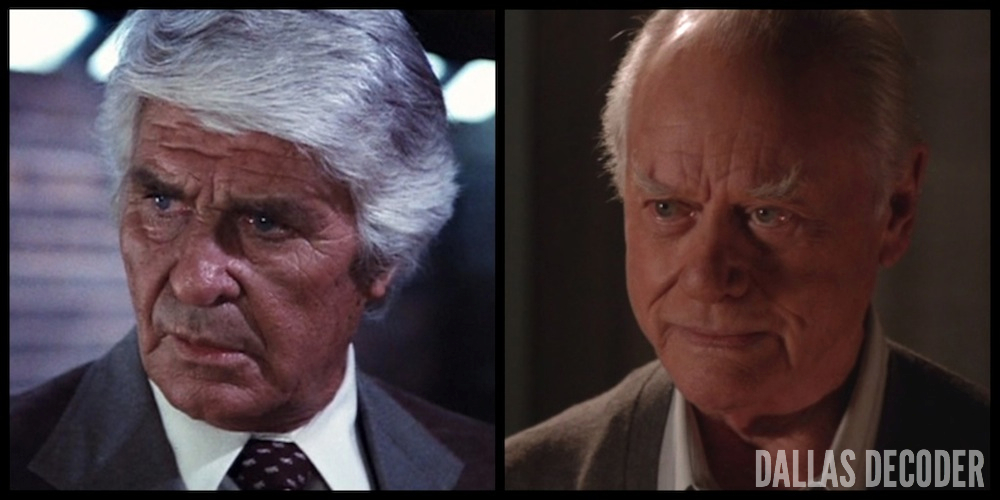
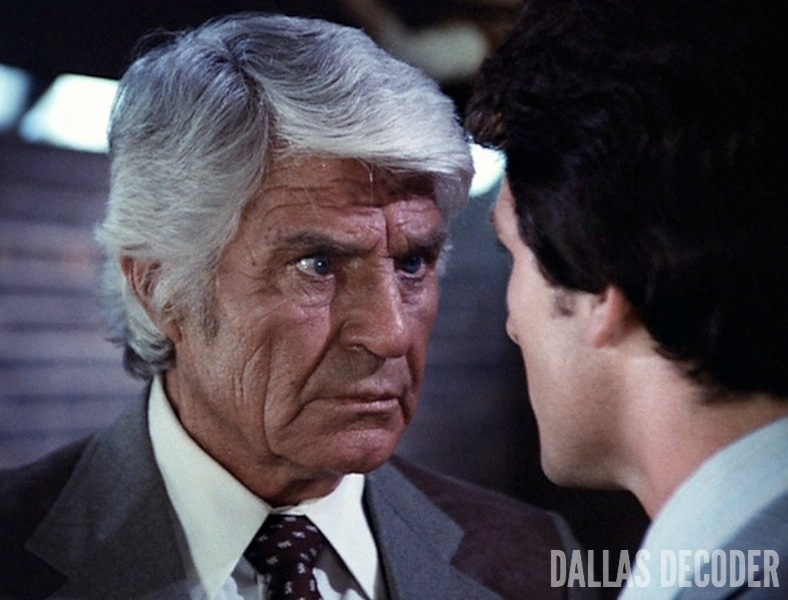
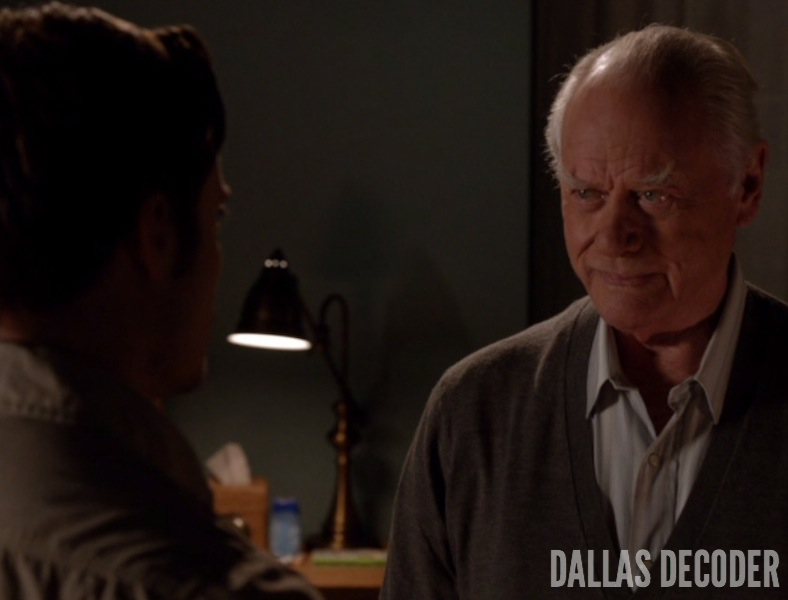
In addition to evoking Jock’s philosophy, the new scene is staged a lot like the old one. Director Michael M. Robin looks over Josh Henderson’s shoulder when he films Larry Hagman, just as Leonard Katzman shot Jim Davis while looking over Patrick Duffy’s shoulder.

But ultimately, the differences between the scenes are more revealing than the similarities. Jock delivers his “real power” line with characteristic bluntness while standing in a public space, reflecting his unapologetic, tell-it-like-it-is style. Jock was barracuda in business – and he didn’t care who knew it.

J.R. is much more cunning. He plots against his enemies behind their backs, so he shares his “real power” tip with John Ross while they are alone, shrouded in the darkness of J.R.’s bedroom. Even J.R.’s wardrobe reflects his deceptive style: He wears a cardigan sweater because he wants to give everyone the impression he’s become warm and fuzzy in old age. (Ha!)

Of course, regardless of whether the words are yelled or whispered, they still mean the same thing. Jock and J.R. are both demanding fathers who only want the best for their sons. By telling them to go out into the world and seize power for themselves, the fathers are letting the sons know they care.

It’s a tough message and it’s tough love, but it’s love nonetheless. Would the Ewings have it any other way?


‘Nobody Gives You Power …’

Like daddy …

In “Executive Wife,” a fourth-season “Dallas” episode, Bobby (Patrick Duffy) enters the Cattlemen’s Club and begins questioning J.R. (Larry Hagman) about Jock’s business deal, while Jock (Jim Davis) looks on.

JOCK: Now, you just hold on Bobby. J.R. don’t discuss my business with you or anybody else unless I tell him. You understand?

BOBBY: OK Daddy, then why didn’t you tell me? Didn’t you think I should know?

JOCK: I was gonna tell you tonight.

BOBBY: Tonight? I want those kind of things discussed with me before you act, not after. Your dealing behind my back is making me look like a fool.

JOCK: Now just what the hell are you talking about?

BOBBY: I called Les at the bank and asked him to transfer $12 million from the account.

JOCK: So what? We’ve got 100 times that much.

BOBBY: I’m talking liquid assets. Cash, Daddy, cash – and we don’t have that amount. And you know why? Because you took $10 million.

JOCK: [Rises from his seat, faces Bobby] You damn right I took it. It’s mine.

BOBBY: That money belongs to Ewing Oil.

JOCK: And who in the hell do you think Ewing Oil is? It’s me! Ewing Oil belongs to me and don’t you forget it, boy.

BOBBY: And you gave me Ewing Oil to run, in writing. And that makes you obliged to consult me before you do anything that concerns that company.

JOCK: Obliged? You’re telling me that I’m obliged to ask you how to spend my own money any damn way I see fit?

BOBBY: That’s right. You gave me the power to run that company, and damn it, I intend to run it.

JOCK: So I gave you power, huh? Well, let me tell you something, boy. If I did give you power, you got nothing. Nobody gives you power. Real power is something you take.

BOBBY: Well, I’m gonna remember that.

JOCK: You do that.

Bobby walks away.


‘… Real Power is Something You Take’

… like son

In “The Price You Pay,” TNT’s third “Dallas” episode, J.R. (Larry Hagman) shows John Ross (Josh Henderson) the leather-bound diary he uncovered in the Southfork storage barn.

J.R.: Time to get your hands dirty, son. [He hands him the diary.]

JOHN ROSS: What’s this?

J.R.: All my mama’s secrets. And you’re about to use them to get the Southfork deal moving. Your Uncle Bobby’s going to find out that you are my son, tip to tail.

JOHN ROSS: What do I have to do?

J.R.: You up for it?

JOHN ROSS: Yeah, yeah. I’m fine.

J.R.: Well, I’m going to tell you the truest thing my daddy ever told me: Nobody gives you power. Real power is something you take.

What do you think of Jock and J.R.’s philosophy on “real power?” Share your comments below and read more “Dallas Parallels.”

The Best & Worst of TNT’s Dallas: Season 1

The first season of TNT’s “Dallas” brought the Ewings back to series television after a two-decade absence. I loved it – mostly.

Performances

Dallas, J.R. Ewing, Larry Hagman, TNT

The Great One

The new “Dallas” cast divides into two categories: Larry Hagman and everyone else. As the now-elderly J.R., Hagman was sometimes mischievous, sometimes moving and always magical. Trying to figure out how Hagman does what he does is futile, so I just sit back and enjoy the ride. Nominate him in a supporting category if you must, but if Larry the Great doesn’t take home an Emmy next year, we should all raise hell.

Dallas, Julie Gonzalo, Rebecca Barnes, Rebecca Sutter, TNT

Your next queen

Among the rest of the cast, give it up for Julie Gonzalo, who made Rebecca’s desperation palpable as the character’s world collapsed in the season’s final hours. Seeing Rebecca drag around Tommy’s dead body in “Revelations” reminded me of when Abby Ewing did something similar on “Knots Landing” – which is fitting since Gonzalo seems destined to claim Donna Mills’s crown as television’s next great queen bee.

Storylines

The war for Southfork was the ideal vehicle to re-introduce “Dallas,” not just because the storyline ensnared every character – even Gary got involved – but also because it helped keep alive the memory of Miss Ellie, whose ghost looms over the new show the way Jock’s did on the old one.

The most incomplete plot: Sue Ellen’s run for governor. The character’s foray into politics can be seen as a logical outgrowth of her civic activism on the original show (remember all those Daughters of the Alamo luncheons Sue Ellen hosted?), but I wish the new series had acknowledged some of the skeletons rattling around her closet. Given Sue Ellen’s scandalous past, shouldn’t voters have been more skeptical of her candidacy?

Episodes

Dallas, John Ross Ewing, Josh Henderson, TNT

Scarred, inside and out

“Family Business,” the episode where J.R. returns the Southfork deed to Bobby, is as good as any of the best entries from the classic series. This intimate hour offered poignant performances from Hagman and Patrick Duffy, but no one moved me like Josh Henderson, especially in the scene where John Ross pours out his heart to Elena about his failure to live up to J.R.’s legend (“I spent my entire life missing him, wanting to be with him, wanting to be him.”).

“The Last Hurrah,” the Ewing barbecue episode, was the season’s biggest letdown. It brought together more original cast members than any other TNT entry – in addition to J.R., Bobby and Sue Ellen, we also saw Cliff, Ray and Lucy – yet these old favorites shared little screen time. On the other hand, allow me to defend “The Last Hurrah’s” much-maligned calf-birthing sequence, a metaphor I appreciated, even if the snarkmeisters at Entertainment Weekly didn’t.

Scenes

As fantastic as J.R. and John Ross’s tense-then-tender “shaving scene” was in “The Price You Pay,” nothing wowed me like Ann’s sting against smarmy ex-husband Harris Ryland in “Revelations.” What a great scene! I liked Brenda Strong’s character from the beginning, but this was the moment that made me love her. Somewhere, Miss Ellie is smiling.

Twists

Ann Ewing, Brenda Strong, Dallas, TNT

Great twist!

The new “Dallas’s” twist-a-minute storytelling was often too much, but not always: The moment Ann exposed the mic she was using to record Ryland’s confession was terrific, and so was the big reveal at the end of “Changing of the Guard,” when the audience learned J.R. and Marta were in cahoots.

Meanwhile, what should have been the season’s biggest twist – the revelation that Rebecca is Cliff’s daughter – was no surprise at all, at least not to “Dallas” diehards. Gonzalo’s character’s first name was a huge tipoff, and once we discovered Cliff had become a high-stakes gambler, her “Changing of the Guard” reference to her poker-playing daddy became another big clue. Still, seeing Cliff emerge from his jet in the final moments of “Revelations” – and then hearing Frank Ashkani refer to Rebecca as “Miss Barnes” – was pretty damn cool.

Cameos

Charlene Tilton’s appearance in “Collateral Damage,” when Lucy and John Ross reminisced about his boyhood antics while brunching at the Omni, was fabulous. Let this serve as the model for integrating old favorites into new storylines.

Less enthralling: The “Truth and Consequences” scene featuring Jerry Jones. Nothing against the Dallas Cowboys owner, but why remind fans of the dreadful 1998 reunion reunion movie “War of the Ewings,” which also featured a Jones cameo?

Homages

Dallas, Leonor Varela, Marta Del Sol, Veronica Martinez, TNT

Nut’s landing

The TNT series spent a lot of time honoring its predecessor. Among the best tributes: Ann’s penchant for shotguns and pearls (a la Miss Ellie), Marta’s deadly dive in “Collateral Damage” (shades of Julie Grey) and John Ross’s “Changing of the Guard” meeting with Marta at Cowboys Stadium, which evoked J.R.’s many stadium encounters in days of yore.

Of course, I’d be remiss if I didn’t also point out some of the historical liberties the new show took: Ellie’s commitment to a sanitarium after Jock’s death (when did this happen?), Grandpa Southworth giving the Ewing brothers the Southfork mineral rights (Ellie controlled them on the old show) and Cliff’s visit to Islamabad in the early 1980s (did he do it during the summer reruns?).

Villains

Carlos Bernard was effectively oily as Vicente Cano and Faran Tahir makes Frank a genuinely frightening dude, but my prize for best villain goes to Mitch Pileggi, whose Harris Ryland was creepy and charming all at once. Here’s hoping Pileggi will become the new “Dallas’s” answer to Jeremy Wendell, J.R.’s best adversary from the old show, played by the great William Smithers.

Supporting Players

Dallas, Margaret Bowman, Mrs. Henderson, TNT

Mrs. Henderson, Presented

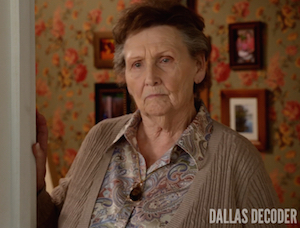
Let’s hear it for the supporting actors – many of them honest-to-goodness Texans – who didn’t log a lot of screen time but made each moment count. My favorites: Richard Dillard, who was perfectly sleazy as Bobby’s double-dealing lawyer Mitch Lobell; Glenn Morshower as Lobell’s no-nonsense replacement, Lou; Brett Brock, who had real presence as John Ross’s private eye, Clyde Marshall; Kevin Page, who was oddly endearing as J.R.’s henchman Bum; and Margaret Bowman, who was a hoot as Southfork neighbor Miss Henderson.

Music

TNT’s heavy use of music on “Dallas” might be the new show’s best innovation of all. In “Hedging Your Bets,” J.R. and Sue Ellen reunited at the Cattle Baron’s Ball to the sounds of Justin Townes Earle’s gorgeous “Midnight at the Movies,” while Adele’s “Turning Tables” was the ideal soundtrack for Christopher and Rebecca’s “Changing of the Guard” wedding sequence.

The real highlight: the instant classic montage that concluded “Family Business,” when Bobby’s collapse and Rebecca and Tommy’s gun struggle played out as Johnny Cash’s “The Man Who Came Around” boomed in the background. And while Cash’s “God’s Gonna Cut You Down” was a fine choice to end “Revelations,” I hope the show doesn’t return to that particular well for awhile.

Costumes

Dallas, Linda Gray, Sue Ellen Ewing, TNT

Cool zip

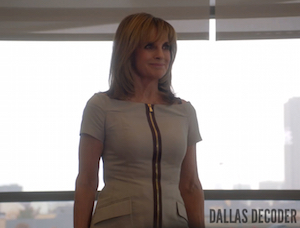
The zip-front dress Sue Ellen wore when she visited Ryland in “The Enemy of My Enemy” was the perfect garment for a woman who was exposing her vulnerabilities in a bid to help her son. I also liked how the dress showed Linda Gray, now in her 70s, could still be sexy and playful.

Sets

Loved the groovy spectrum artwork in Sue Ellen’s office. Hated the watercolor painting of Jock and Ellie that hangs in the Southfork living room.

Quips

As much as I enjoyed all the hilarious stuff that came out of J.R.’s mouth, Sue Ellen delivered the season’s best line in “No Good Deed” when she blackmailed the hapless medical examiner by reminding him, “You’ve been writing more prescriptions than Michael Jackson’s doctor – which is odd, since all of your patients are dead.”

Biggest head-scratcher: “We ain’t family, bro.” – John Ross’s putdown of Christopher in “Hedging Your Bets.”

Behind the Scenes

Much praise goes to the many talented folks on the other side of the camera, including Michael M. Robin, the most inventive director in the history of the “Dallas” franchise; cinematographer Rodney Charters, who makes the real-life Dallas look so good, the city should name a street after him; and the TNT Publicity Machine, which did a helluva job promoting the show in the months before its debut.

Of course, the biggest hat tip goes to Cynthia Cidre, the new “Dallas’s” creative force. After an uneven start, Cidre – with help from a team of talented writers – brought “Dallas” back to its roots as a character-driven family drama. Let’s hope they keep the momentum going in Season 2.

What do you love and loathe about the first season of TNT’s “Dallas”? Share your comments below and read more “Best & Worst” reviews.

Critique: TNT’s ‘Dallas’ Episode 9 – ‘Family Business’

Dallas, Family Business, J.R. Ewing, Larry Hagman, TNT

The man who came around

“Family Business” offers nothing less than the redemption of J.R. Ewing. In this deeply poignant episode, our aging antihero is called upon to face hard truths and make tough choices, and for once in his life, he does the right thing. By the time the closing credits roll, J.R. has a grown as a person. “Dallas” has grown too.

Rather brilliantly, “Family Business” ends with Johnny Cash’s “The Man Comes Around” playing under a series of chilling scenes that leave the fates of several characters hanging in the balance. J.R. is not among them, but no matter. There’s no doubt the song is meant to evoke the journey he takes in this episode, when one by one, the three people J.R. loves most – John Ross, Sue Ellen and Bobby – persuade him to end the war for Southfork.

These are moving, meaningful scenes. In the first, John Ross pleads with J.R. to give the ranch back to Bobby, prompting J.R. to ask his son, “What’s gotten into you, anyhow?” John Ross’s cutting response: “A little decency.” Later, Sue Ellen storms into the room, slaps J.R. and reminds him how his past schemes left him with “nothing.” When J.R. remains defiant (“Well, I’m back honey, and I’m gonna be bigger than ever.”), Sue Ellen’s exasperation dissolves into pity. “And you still have nothing,” she says.

Only after J.R. speaks with Bobby does he finally, fully see the light. In the scene, Bobby sits in his sickbed and gently admonishes his oldest brother, then tells him, “J.R., I love you. No matter what. You remember that.” J.R.’s face falls – and with it, so do the last vestiges of his bravado. “Well,” he says softly, “My memory’s not what it used to be either. You’re just going to have to keep telling me.”

In each of these scenes, director Michael M. Robin’s clever staging tells us as much as scriptwriter Bruce Rasmussen’s heartfelt dialogue. J.R.’s confrontation with Sue Ellen ends with him standing in front of a mirror that reflects the back of his head, a reminder that there is another side of J.R., even when he can’t see it himself. In the exchange with John Ross, J.R. sits on his bed while the younger man stands over him, symbolizing how the son has achieved moral superiority over the father. In the third scene, the positions are reversed: Bobby is in bed, while J.R. stands. This is when we know J.R., who has always been the big brother, is about to become a bigger man.

Indeed, the next time we see J.R., he is sitting alone in his bedroom, staring at the Southfork deed, a glass of bourbon to his right, his old oil-derrick model to the left. With heavy eyes, he glances at the framed picture of Miss Ellie, sips his drink, puts pen to paper and finally returns ownership of the ranch to Bobby.

The man has come around.

‘He’s J.R. Ewing’

Dallas, Family Business, John Ross Ewing, Josh Henderson, TNT

Scarred inside, too

If there is justice in television, “Family Business” will be the episode that earns Larry Hagman an Emmy next year. The actor is full of wicked charm here, but more than anything, his performance has heart. J.R. has never felt so human.

And while we’re on the subject: Is it too much to ask for Patrick Duffy to receive some Emmy recognition too? I love the sad-eyed, world-weary demeanor he brings to his scenes with Hagman, but Duffy also deserves praise for making Bobby’s seizures look and feel frighteningly real.

Among the younger actors, I’m most impressed by Julie Gonzalo, who knocks me out with Rebecca’s hopeless desperation in “Family Business’s” final scene, when Rebecca turns the gun on Tommy (“Please, please you have to go!”), as well as Josh Henderson, who shows us what John Ross is made of during his character’s confrontation with J.R.

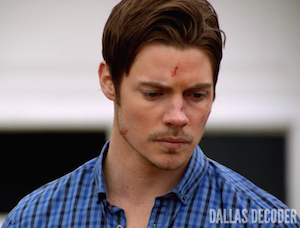
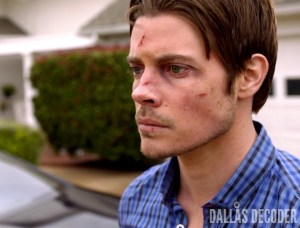
Henderson also shines when John Ross stands in the Southfork driveway and pours out his heart to Elena. “I spent my entire life missing him, wanting to be with him, wanting to be him,” John Ross says of his father. After a beat, he adds: “He’s J.R. Ewing” – letting us know the son’s mistake wasn’t that he failed to live up to his father’s legend, but that he tried in the first place. The “Dallas” makeup artists might be responsible for the cuts and bruises on John Ross’s face, but Henderson gets the credit for showing us the scars his character carries around on the inside.

Other great “Family Business” moments: Christopher reminds John Ross that Bobby was like a surrogate father to him growing up and later proposes going into business with John Ross and Elena – signaling the beginning of an intriguing story arc for the series. Meanwhile, after Harris tries to blackmail Sue Ellen – and mocks her sobriety by pouring her a glass of wine – she confides in Ann her plan to drop out of the gubernatorial race. “I would have made a good governor, don’t you think?” Sue Ellen asks through wet eyes. Has Linda Gray ever been more heartbreaking?

Speaking of Ann: Brenda Strong is wonderful in the scenes that depict her character as devoted wife and friend, but I get the biggest kick out of seeing Ann spar with her wily brother-in-law. I loved J.R. and Ann’s storage barn encounter in “The Price You Pay” and their heated exchange in “Truth and Consequences,” but the “Family Business” scene where she chases him out of Bobby’s room (“Don’t you darlin’ me!”) is the best of the lot. Strong is one of the few actors on the TNT show who can hold her own against the mighty Hagman in every way.

‘Hear the Trumpets, Hear the Pipers’

Dallas, Family Business, Julie Gonzalo, Rebecca Sutter Ewing, TNT

Have gun, will unravel

“Family Business” is a technical achievement as much as anything. Since TNT’s series began, I’ve sometimes struggled to get used to the background music, which is so different from what we heard on the old show. But the new style really works here. Rob Cairns scores several scenes in this episode with sentimental strings, which fit well with the intimate atmospherics.

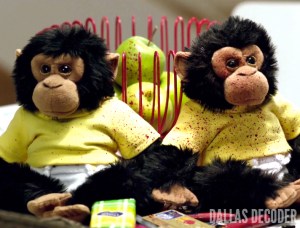
Of course, “Family Business’s” standout sequence is that Johnny Cash montage. Notice how perfectly his haunting lyrics match what we see on screen. Rebecca pulls the gun out of the safe deposit box as Cash sings, “The hair on your arms will stand up.” Tommy’s face fills the frame when we hear, “Whoever is filthy, let him be filthy still.” Bobby’s monitor flatlines as Cash’s voice booms, “Hear the trumpets, hear the pipers.” And then the punctuation: the ping of the shell casing hitting the counter as blood splatters the stuffed animals Rebecca brought home at the top of the hour.

After I saw this sequence for the first time, I went back and watched it again and again, reveling in how good it is. It reminded me of how I kept “A House Divided,” the episode where J.R. gets shot, on a seemingly endless loop when I was a kid.

But the comparison goes beyond the fact both episodes end with gunshots. The original “Dallas” was never the same after “A House Divided,” and “Family Business” feels destined to become a landmark episode too. I have a hunch we’ll one day look back and remember this as the moment the TNT series became the show we always knew it could be.

Grade: A+

_______________________________________________________________________________________________________________________________________________

Dallas, Family Business, TNT

Blood monkeys

‘FAMILY BUSINESS’

Season 1, Episode 9

Telecast: August 1, 2012

Writer: Bruce Rasmussen

Director: Michael M. Robin

Audience: 4.8 million viewers (including 3.2 million viewers on August 1, ranking 17th in the weekly cable ratings)

Synopsis: After Elena discovers a way to extract Southfork oil from a neighboring property, John Ross, Christopher and Elena form a company, Ewing Energies. When Harris tries to blackmail Sue Ellen, she decides to quit the gubernatorial race rather than submit to his scheme. Bobby is diagnosed with a cerebral aneurysm, prompting J.R. to return ownership of Southfork to him. After Bobby learns he may have to incriminate J.R. in the fraud, he suffers a seizure. Tommy is revealed to be working with Frank Ashkani, Cliff’s henchman, who tells Tommy his services are no longer required. Tommy attacks a gun-wielding Rebecca; the weapon fires during their struggle.

Cast: Jordana Brewster (Elena Ramos), Mari Deese (bank manager), Patrick Duffy (Bobby Ewing), Marlene Forte (Carmen Ramos), Julie Gonzalo (Rebecca Ewing), Linda Gray (Sue Ellen Ewing), Larry Hagman (J.R. Ewing), Callard Harris (Tommy Sutter), Josh Henderson (John Ross Ewing), John McIntosh (Dr. Bennett), Jesse Metcalfe (Christopher Ewing), Glenn Morshower (Lou), Kevin Page (Bum), Mitch Pileggi (Harris Ryland), Brenda Strong (Ann Ewing), Tina Parker (nurse), Faran Tahir (Frank)

“Family Business” is available at DallasTNT.com, Amazon.com and iTunes. Watch the episode and share your comments below.