Critique: ‘Dallas’ Episode 142 — ‘To Catch a Sly’

Dallas, Debbie Rennard, J.R. Ewing, Larry Hagman, Sly Lovegren, To Catch a Sly

Spy another day

One of the reasons J.R. Ewing is so entertaining is because he’s always a few steps ahead of the “Dallas” audience. We watch him plot and scheme, never knowing what trick he’s going to pull out of his sleeve next. That’s why the show’s seventh-season corporate espionage storyline is so unusual. From the beginning, viewers know Cliff Barnes is blackmailing J.R.’s secretary Sly into leaking Ewing Oil secrets, but J.R. is in the dark. Interestingly, this never makes Larry Hagman’s character seem weak or even vulnerable. In fact, it has almost the opposite effect, because we know once J.R. finds out who’s betraying him, there’s going to be hell to pay.

Indeed, that’s pretty much what happens in “To Catch a Sly.” When the episode begins, J.R. has just learned Cliff has a spy at Ewing Oil but he doesn’t know who it is, so he goes to work trying to root out the fink. He finally discovers Sly is the culprit in the fourth act, and in the closing moments, he confronts her. This scene begins with Sly at her desk at the end of a workday, getting ready to go home. J.R. appears in his office doorway and summons her inside. She swallows hard before entering the room, where J.R. makes small talk and begins opening a bottle of wine. “You know, you’ve been looking a little peaked lately, Sly,” he says. She tells him she’s been having “some personal problems,” adding that “it’s nothing serious.” J.R. turns toward her, hands her the glass of wine he just poured and says, “If it’s the problem I’m thinking of, it’s very serious indeed.” Uh-oh.

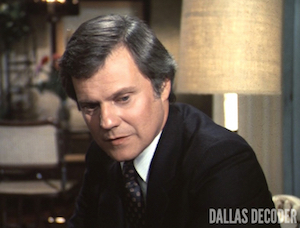
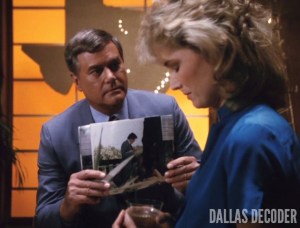
What follows is one of the great “Dallas” moments. Sly sits in one of J.R.’s guest chairs as he walks to his desk and retrieves a stack of photos that show her and Cliff during some of their secret meetings. The director, Michael Preece, keeps Debbie Rennard in the foreground as Hagman hovers in the distance, holding the pictures aloft. With this shot, Preece encapsulates the whole storyline: Here’s J.R., the businessman who’s been betrayed; Sly, the secretary who’s been forced to double-cross her boss; and Cliff, the smarmy enemy who’s stooped to a new low in his never-ending quest for vengeance. As soon as I saw how Preece framed this scene, I knew it would be the image that accompanied this critique.

As the sequence continues, J.R. slowly shuffles through the photos, showing them to Sly one by one. “You recognize anybody in these pictures?” he asks. She stares at the floor in silence. “Sure, you do,” he says. “This is you, and this is Cliff Barnes.” Hagman’s voice is calm, soft, almost melodic. It reminds me of Mister Rogers addressing an audience of children, although when J.R. speaks this way, it’s anything but reassuring. Preece, who has been focusing on the pictures in a tight close-up, pans upward and allows Hagman’s face to fill the frame. Finally, J.R. poses the question he’s been waiting to ask: “Sly, why did you betray me to that man?”

The line alleviates the tension because it suggests J.R. is going to stop torturing Sly with politeness and cut to the chase. He listens as she tearfully explains how Cliff pressured her to sneak him advanced information about J.R.’s business dealings by threatening to prevent her jailed brother from being paroled. In a clever touch, Rennard doesn’t make eye contact with Hagman until Sly says, “J.R., I love my brother. I couldn’t pass up a chance to help him.” Preece cuts to a reaction shot from J.R., whose face displays a flicker of recognition. He knows a thing or two about brotherly love, after all.

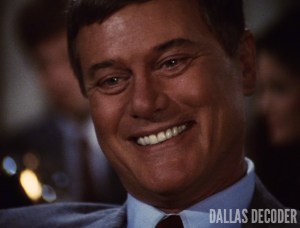
Indeed, this is the moment we know J.R. is going to show Sly mercy. He tells her that he’s pleased she didn’t try to “cover up” when he confronted her with the pictures, and then Hagman lifts the corners of his mouth, ever so slightly. You can practically see the wheels turning inside J.R.’s head. He suggests he’s going to turn Sly into a double agent, using her to feed Cliff bad information. “You’re going to set him up?” she asks. J.R. shakes his head no. “He set himself up,” he says. “What I’m going to do is bring him down — and bring him down very, very hard.”

The episode ends there, leaving us with plenty to ponder. For starters: How twisted is it that J.R. turns out to be pleased by this turn of events? He now has an excuse to go after Cliff with gusto, not that he needs one; batting around Cliff has always been J.R.’s favorite sport. For a moment, I also wondered if J.R.’s vow to “bring him down” reflected paternal feelings toward Sly. In other words: Does he want to avenge her honor after Cliff took advantage of her? Ultimately, I decided that’s not what’s happening here. I have no doubt J.R. has affection for Sly, but if he really cared about her, would he turn her into a double agent? Isn’t he treating her like a pawn, just like Cliff did?

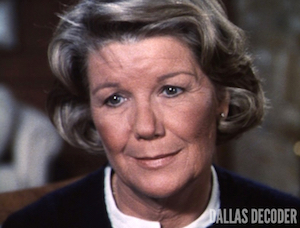
Regardless, Rennard does a nice job conveying Sly’s shame and guilt, as well as the character’s paranoia in her earlier scenes in “To Catch a Sly,” when Sly realizes J.R. is closing in on her. This episode also reminds us how much Hagman’s performance has evolved over the years. Remember: This isn’t the first time one of J.R.’s secretaries has betrayed him. In “Spy in the House,” the show’s third episode, Julie Grey sneaks a copy of Ewing Oil’s notorious “red file” to Cliff. When J.R. discovers Julie double-crossed him, he looks devastated, but Hagman offers no hint that J.R. feels personally wounded by Sly’s treachery. At this point during “Dallas’s” run, the actor had long since honed J.R.’s killer instincts, and that’s what he gives the audience here.

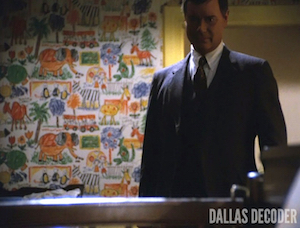
David Paulsen’s sharp script gives us lots to consider besides this final scene. For example, when J.R. drops by Cliff’s office and plants the recording device in his phone, I wondered: Would Cliff really be foolish enough to allow J.R. to use his office when he isn’t there? I decided he would be. I’ve always believed Cliff doesn’t want to beat J.R. as much as he wants to be J.R. Cliff mimics his enemy as far back as the second-season episode “For Love or Money,” when he uses one of J.R.’s own lines to break up with Sue Ellen. Cliff also emulates him when he blackmails Sly, tossing around the word “baby” the way J.R. does “darlin’.” So in “To Catch a Sly,” when J.R. shows up on Cliff’s doorstep to congratulate him on his recent victories over Ewing Oil, I can buy that Cliff is so blinded by the idea that J.R. is impressed with him that he lets down his guard and leaves him alone in his office. Besides, just because Cliff is devious doesn’t mean he’s smart.

“Dallas’s” various romantic entanglements also take interesting twists in “To Catch a Sly.” The episode opens with the newly divorced Pam awakening after sleeping with Mark for the first time, while Bobby continues to resist bedding Jenna, even though she says she wants to have sex with him. Did you ever expect to see a Ewing man insist on taking things slowly with a woman? Meanwhile, Sue Ellen’s ongoing May/December flirtation with Peter Richards leaves me feeling a little cold, at least in this episode. Until now, I’ve been intrigued by Sue Ellen and Peter’s connection, but he seems a little bratty — not to mention stalkerish — when he follows her to her appointment with hairdresser Mr. David. (By the way: Mr. David has evidently moved to new digs since the exterior of his salon doesn’t match the building used in the previous season. And where’s the valet parking?)

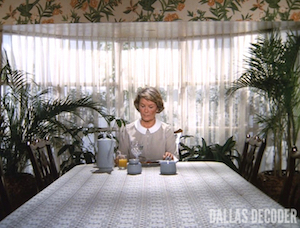
Finally, a few words about the technology displayed in “To Catch a Sly.” This episode seems to offer more than the usual share of gadgets and gizmos that were considered cutting-edge in 1983 and now seem hopelessly dated. Examples: J.R. wears a pager on his belt when he visits Cliff’s office, and after he bugs his phone, he listens to the recorded conversations on what appears to be a Sony Walkman. (How, exactly, does the little device that J.R. drops into Cliff’s receiver yield audiocassette recordings of Cliff’s calls?) Later, when Katherine goes to the library to dig up dirt on Jenna, she looks up old newspaper articles on microfiche. Finally, when J.R. brings John Ross to the Ewing Oil offices, the little boy pounds on the keyboard attached to Sly’s computer, which has a monitor that seems to display graphics in two colors: white and blue.

Look closely and you’ll also see the logo of the company that made the machine: Texas Instruments. What else would you expect from the Ewings?

Grade: A

_______________________________________________________________________________________________________________________________________________
Dallas, Debbie Rennard, J.R. Ewing, Larry Hagman, Sly Lovegren, To Catch a Sly

Busted

‘TO CATCH A SLY’

Season 7, Episode 11

Airdate: December 9, 1983

Audience: 23 million homes, ranking 3rd in the weekly ratings

Writer: David Paulsen

Director: Michael Preece

Synopsis: J.R. discovers Sly is spying on him for Cliff and decides to turn her into a double agent. Bobby is bothered when he discovers Pam slept with Mark. Katherine noses around in Jenna’s past. Sue Ellen begins planning the annual Ewing Barbecue and feels envious when Lucy expresses interest in dating Peter.

Cast: Mary Armstrong (Louise), Christopher Atkins (Peter Richards), John Beck (Mark Graison), Morgan Brittany (Katherine Wentworth), James L. Brown (Detective Harry McSween), Patrick Duffy (Bobby Ewing), Eric Farlow (Christopher Ewing), Linda Gray (Sue Ellen Ewing), Larry Hagman (J.R. Ewing), Susan Howard (Donna Krebbs), Steve Kanaly (Ray Krebbs), Omri Katz (John Ross Ewing), Sherril Lynn Katzman (Jackie Dugan), Ken Kercheval (Cliff Barnes), Lisa LeMole (Judy Baker), Edward Mallory (Stanger), Shalane McCall (Charlie Wade), Priscilla Beaulieu Presley (Jenna Wade), Victoria Principal (Pam Ewing), Debbie Rennard (Sly), Danone Simpson (Kendall), Charlene Tilton (Lucy Ewing), Deborah Tranelli (Phyllis)

“To Catch a Sly” is available on DVD and at Amazon.com and iTunes. Watch the episode and share your comments below.
Critique: ‘Dallas’ Episode 138 — ‘Ray’s Trial’

Dallas, Ray Krebbs, Ray's Trial, Steve Kanaly

His day in court

I always remembered the mystery surrounding Mickey Trotter’s death as boiling down to a single question: Did Ray or Lil pull the plug on him? Last week, when I re-watched “Ray’s Trial” for the first time in a few years, I realized “Dallas” also poses a second, more complicated question: Did Mickey want to live or die? Ray and Lucy each offer different answers during the course of the episode, and technically, both of their statements are accurate. Does that mean both statements are also true? I’m not sure anyone can answer that definitively, which makes the storyline feel a lot more interesting than I previously gave it credit for.

To appreciate this aspect of “Ray’s Trial,” it’s worth remembering two crucial scenes from the preceding episodes. In “My Brother’s Keeper,” when Mickey is struggling to come to grips with his paralysis, he pulls Ray aside and tells him, “The idea of living like a vegetable with some damn machine keeping me alive disgusts me. It’s the worst horror I can imagine. … If it happens, I hope and pray that no one’s going to let me live that way.” Later, in “The Quality of Mercy,” Mickey’s mood brightens when he realizes Lucy is determined to stand by him despite the fact that he’ll never walk again. “Who knows? Maybe we’ll get married yet,” Mickey tells her.

But this is “Dallas,” so of course that never happens. When Mickey slips into a coma, his respirator is disconnected off-screen by either Ray or Lil, the two people with him at the time. The district attorney charges Ray, although the show goes out of its way to drop hints that the real culprit is Lil and Ray is only covering up for her. “Dallas” doesn’t solve the mystery until the next episode, allowing the audience to spend “Ray’s Trial” pondering what Mickey wanted, which turns out to be the more interesting question anyway. At the top of the hour, Ray meets with his lawyer and recalls Mickey’s “worst horror” comment, holding this up as evidence that Mickey preferred death to being kept alive via medical machinery. Later, when Lucy testifies at Ray’s trial, she recalls the marriage plans she and Mickey were making before he slipped into the coma. “He wanted to live. He really did,” she says.

Once again, these are two characters offering two technically accurate but fundamentally different answers to the question of whether Mickey wanted to live or die. Who you choose to believe may come down to where you stand on the issue of euthanasia, which is where “Ray’s Trial” ultimately falls short. Scriptwriter Arthur Bernard Lewis doesn’t devote much time to examining the moral implications of Mickey’s death, which is somewhat surprising considering the difference of opinion Ray and Donna apparently bring to the issue. At one point, Ray tells his lawyer, “What I did was not immoral.” This seems to put him at odds with Donna, whose personal beliefs are hinted at in the previous episode when she declares, “Nobody has the right to play God.” So why doesn’t “Ray’s Trial” give us a scene of husband and wife debating the issue?

Even if the material feels incomplete, Steve Kanaly makes the most of it. In my recent interview with him, Kanaly recalled growing up watching westerns and admiring actors like Gary Cooper. The comment must have lodged itself in the back of my mind because when I watched “Ray’s Trial” a few days later, I was struck by how much Kanaly reminds me of Cooper. The actors share similarly quiet, dignified mannerisms, and both are able to say a lot without uttering a single line of dialogue. In Kanaly’s case, watch his haunted eyes in this episode and you’ll see everything that the script doesn’t tell us about what Ray is feeling.

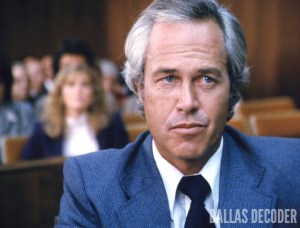
The other performer to watch is Charlene Tilton, who appears only twice but makes a lasting impression. She does a beautiful job delivering Lucy’s tearful testimony, which supplies “Ray’s Trial” with its moment of emotional catharsis. My favorite scene, though, comes a few moments later, when Donna comforts Lucy in the courthouse corridor after Lucy reluctantly testifies against Ray. This is a brief scene and the script doesn’t give Tilton much dialogue, but none is needed. Her anguished expression says it all. The courtroom scenes also feature a couple of old pros — Richard Jaeckel as prosecutor Percy Meredith and Glenn Corbett as Paul Morgan, Ray’s defense lawyer — as well as a young Steven Williams, who appears here as a bailiff and later plays the police captain on “21 Jump Street.”

This episode’s other notable moments include Mark Graison’s polo match, which might be “Dallas’s” most thrilling horseback riding sequence since Jock Ewing surged across the Southfork plains at the beginning of the second-season classic “Bypass.” “Ray’s Trial” also marks Lois Chiles’ final appearance as Holly Harwood. In her last scene, Holly approaches J.R. in a cocktail lounge and taunts him over losing the battle for Ewing Oil. Besides giving Chiles one last opportunity to spar with Larry Hagman, I like how this scene mimics J.R. and Holly’s first on-screen encounter, which also takes place in a cocktail lounge.

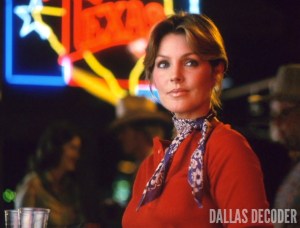
The other highlight of “Ray’s Trial” is the arrival of Priscilla Presley, who makes her “Dallas” debut as Jenna Wade. It’s a fine first appearance, although it includes a bit of a curiosity. In one of Presley’s scenes, Bobby pulls up in front of Jenna’s home as she approaches the sidewalk. He invites her to join him for lunch, but when director Michael Preece offers us a close-up shot of Bobby’s car radio, we see the clock reads “5:45.” From this, we can deduce one of two things: Either Ewings eat lunch very late, which makes them a lot different than you and me, or Bobby has yet to figure out how to set the clock in his car, in which case he’s just like us.

Grade: B

_______________________________________________________________________________________________________________________________________________

Dallas, Jenna Wade, Priscilla Presley, Ray's Trial

Hello again

‘RAY’S TRIAL’

Season 7, Episode 7

Airdate: November 11, 1983

Audience: 22.4 million homes, ranking 2nd in the weekly ratings

Writer: Arthur Bernard Lewis

Director: Michael Preece

Synopsis: Ray goes on trial and frustrates Donna with his reluctance to defend himself. Bobby runs into Jenna, who now works as a waitress. J.R. woos the cartel.

Cast: Charles Aidman (Judge Emmett Brocks), Christopher Atkins (Peter Richards), John Beck (Mark Graison), Morgan Brittany (Katherine Wentworth), Lois Chiles (Holly Harwood), Glenn Corbett (Paul Morgan), Michael Cornelison (Dr. Snow), Patrick Duffy (Bobby Ewing), Eric Farlow (Christopher Ewing), Fern Fitzgerald (Marilee Stone), Steven Fuller (bailiff), Tony Garcia (Raoul), Linda Gray (Sue Ellen Ewing), Larry Hagman (J.R. Ewing), Susan Howard (Donna Krebbs), Richard Jaeckel (Assistant District Attorney Percy Meredith), Steve Kanaly (Ray Krebbs), Omri Katz (John Ross Ewing),  Howard Keel (Clayton Farlow), Ken Kercheval (Cliff Barnes), Audrey Landers (Afton Cooper), Joseph R. Maross (Dr. Blakely), Andrea McCall (Tracy Anders), Priscilla Presley (Jenna Wade), Victoria Principal (Pam Ewing), Kate Reid (Lil Trotter), Paul Sorensen (Andy Bradley), Don Starr (Jordan Lee), Charlene Tilton (Lucy Ewing)

“Ray’s Trial” is available on DVD and at Amazon.com and iTunes. Watch the episode and share your comments below.
Critique: ‘Dallas’ Episode 108 — ‘Jock’s Will’

Bobby Ewing, Dallas, Jock's Will, J.R. Ewing, Larry Hagman, Patrick Duffy

Let the games begin

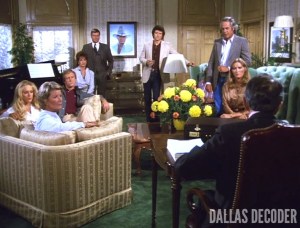
At the end of “Jock’s Will,” the Ewings gather in the Southfork living room to hear Harv Smithfield read the family patriarch’s last will and testament. Everyone is present — even Gary, who has flown in from “Knots Landing” for the occasion. The scene is tense, dramatic and historic. Besides being one of the few times we see almost all of the original cast members in the same place at the same time, this also marks the beginning of “Dallas’s” greatest storyline: J.R. and Bobby’s epic battle for control of Ewing Oil.

The scene, which lasts about seven minutes, is also a showcase for Michael Preece, one of the original “Dallas’s” most skilled directors. He begins with a wide shot of the actors positioned in front of George O. Petrie, who sits at a desk that seems to have magically appeared in the living room for this scene. (I suppose the desk is like the Ewings’ television set, which only pops up when the plot calls for someone in the family to watch it.) Only four actors here have dialogue: Barbara Bel Geddes, Larry Hagman, Patrick Duffy and Petrie, who delivers almost 700 words, far more than any of the others. Even though the rest of the cast is silent, we never question what their characters are thinking, thanks to Preece’s reaction shots. When Harv announces Gary’s inheritance comes with strings attached, we see Ted Shackelford clench his jaw. Charlene Tilton’s eyes bulge when Lucy learns she’s become a multi-millionaire. Victoria Principal’s jaw drops when Pam realizes Bobby is going to have to fight J.R. for the company.

Bel Geddes gets the most dramatic response. When Ellie hears Jock’s line that Ewing Oil can only be run by “the man that wants it the most,” she furrows her brow and whispers gravely, “Oh, Jock. No.” I wonder: What are Preece and scriptwriter David Paulsen are trying to convey here? Is Ellie afraid Jock is about to return control of the company to J.R., whom she recently ousted from the president’s chair? Or does she sense — even before Harv announces it — that Jock is about to pit their sons against each other?

(In the same spirit, the announcement of the contest forces us to reconsider the end of “Where There’s a Will,” when J.R. sneaks a peek at Jock’s will. In that scene, J.R.’s reaction — “Thank you, Daddy, thank you” — leads us to believe Jock has left him the company. In “Jock’s Will,” the audience finally catches up and learns what J.R. did: that Jock wants him to compete with Bobby for control of Ewing Oil. So why does J.R. thank his daddy? Is he so confident he’ll beat Bobby that he considers the contest a mere formality? Or could it be that J.R. simply loves a good fight, and he’s thanking Jock for giving him one?)

As far as the contest itself: Some might see Jock’s decision to not choose a successor as a copout, but I believe it fits his character perfectly. Of course the old man would want his sons to duke it out to determine, once and for all, who is the better businessman. The contest also ends up producing some of the best storytelling seen on “Dallas,” as well as “Knots Landing.” (But don’t take my word for it: Hill Place, an always-interesting TV and movie blog, recently published a thorough examination of the long-range ramifications of Jock’s will on both shows.)

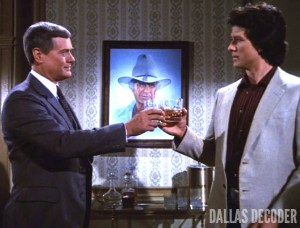
There’s also quite a bit of poignancy to the end of the will-reading scene. Jock’s final words are ominous: He declares that if J.R. or Bobby die before the contest is over, the remaining son will automatically take over the company. This prompts J.R. to turn to his younger brother, raise a glass of bourbon and say, “Well, Bobby, to your good health and very long life.” Three seasons later, after Duffy’s character had been killed off, J.R.’s toast seemed prescient. Now that Hagman is gone, the line feels bittersweet. I also can’t help but note the parallels between Jock’s will, which leads to the high point in their rivalry, and the letter that Bobby reads at the end of the new “Dallas’s” second season, which effectively brings their warring to an end.

The other highlight of “Jock’s Will” is the courtroom scene where the Ewing patriarch is declared dead. As the judge announces his decision (“The judgment of this court is that John Ross Ewing Sr. died in a place unknown, in the jungles of South America”), Preece gives us a tight shot of each Ewing seated in the gallery: First Pam, then Bobby, J.R., Sue Ellen and finally Ellie. Everyone looks stricken — and none more so than Mama, whose tears flow freely — but don’t overlook Bruce Broughton’s mournful background music, which also lends this scene power.

Other good scenes in “Jock’s Will” include the sequences set in Kansas, where Ray’s struggle to connect with cocky Mickey strains his relationship with Donna. I also like J.R. and Sue Ellen’s night on the town (especially the nifty overhead shot that Preece gives us of Hagman and Linda Gray on the nightclub dance floor), as well as the scene where the couple sets the date for their second wedding. Or, to be more precise: J.R. sets the date by presenting Sue Ellen with an invitation to their first wedding, with the original date (February 15, 1970) scratched out and the new one (December 3, 1982) penciled in.

I can’t help but think there’s plenty of room on that invitation for a third wedding date. How sad that we never got to see it.

Grade: A

_______________________________________________________________________________________________________________________________________________

Barbara Bel Geddes, Bobby Ewing, Charlene Tilton, Dallas, Donna Krebbs, Gary Ewing, George O. Petrie, Harv Smithfield, J.R. Ewing, Linda Gray, Larry Hagman, Lucy Cooper, Miss Ellie Ewing, Patrick Duffy, Ray Krebbs, Steve Kanaly, Sue Ellen Ewing, Susan Howard, Ted Shackelfod

Gang’s all here

‘JOCK’S WILL’

Season 6, Episode 5

Airdate: October 29, 1982

Audience: 23.6 million homes, ranking 1st in the weekly ratings

Writer: David Paulsen

Director: Michael Preece

Synopsis: The Ewings have Jock declared legally dead and learn his will sets up a yearlong contest between J.R. and Bobby for control of Ewing Oil. J.R. and Sue Ellen set a wedding date. Ray and Donna bring Mickey home with them to Southfork. Pam urges Lucy to snap out of her depression.

Cast: Robert Ackerman (Wade Luce), Tyler Banks (John Ross Ewing), Barbara Bel Geddes (Miss Ellie Ewing), Roseanna Christiansen (Teresa), George Cooper (Lee Evans), Patrick Duffy (Bobby Ewing), Phyllis Flax (Mrs. Chambers), Linda Gray (Sue Ellen Ewing), Larry Hagman (J.R. Ewing), Alice Hirson (Mavis Anderson), Peter Hobbs (Judge Karns), Susan Howard (Donna Krebbs), Steve Kanaly (Ray Krebbs), Ken Kercheval (Cliff Barnes), Kenneth Kimmins (Thornton McLeish), Audrey Landers (Afton Cooper), Timothy Patrick Murphy (Mickey Trotter), George O. Petrie (Harv Smithfield), Priscilla Pointer (Rebecca Wentworth), Victoria Principal (Pam Ewing), Kate Reid (Lil Trotter), Dale Robertson (Frank Crutcher), Ted Shackelford (Gary Ewing), Don Starr (Jordan Lee), Charlene Tilton (Lucy Cooper), Morgan Woodward (Punk Anderson)

“Jock’s Will” is available on DVD and at Amazon.com and iTunes. Watch the episode and share your comments below.
Critique: ‘Dallas’ Episode 104 — ‘Changing of the Guard’

Changing of the Guard, Dallas, J.R. Ewing, Larry Hagman

He’s back

“Dallas” shakes things up in its sixth-season opener, “Changing of the Guard.” Miss Ellie ousts J.R. as president of Ewing Oil and installs Bobby in his place, the company’s executive suite gets a much-needed makeover and Sue Ellen suddenly begins sporting shorter hair. This episode also introduces an intriguing newcomer: Holly Harwood, played by Lois Chiles, whose debut is the highlight of this episode.

We meet Holly when she drops by the Cattleman’s Club, where Bobby is celebrating his new job along with Jordan Lee and Marilee Stone. Jordan introduces Bobby to Holly and explains she recently inherited her company, Harwood Oil, from her late father. After she departs, Bobby observes how Holly is “mighty young” to run an oil company. “I give it maybe a year or two alive with her in charge,” Jordan responds. You have to wonder: Would these two be having this conversation if Holly were a young man?

Of course, Holly seems destined to get the last laugh. Chiles makes her second appearance in “Changing of the Guard’s” final scene, which takes place in another darkened cocktail lounge. We see Holly at a table, seated across from someone who is off-camera. “What do you say? Do we have a deal?” she asks. The other person leans into the shot. It’s J.R. “Well, it’s a very tempting offer. Especially coming from such a lovely young lady,” he says. As the conversation continues, we learn Holly wants J.R. to help her run Harwood Oil. He agrees to take the job — in exchange for a 25 percent ownership stake in the company. “You don’t come cheap, do you J.R.?” Holly purrs. His response: “You wouldn’t want me if I did, would you?”

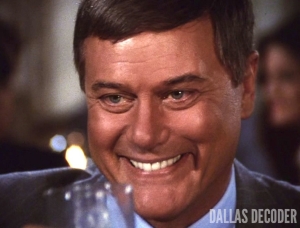
This dialogue is delicious, but I also like how director Michael Preece reveals Holly and J.R. are in cahoots by waiting a beat to bring him into the frame. It reminds me of the kind of surprises we get on TNT’s “Dallas” revival. Coincidentally, “Changing of the Guard” is the title of the new show’s first episode, which ends with the revelation that J.R. is secretly plotting with another young beauty, Marta del Sol. Both sequences also feature J.R. and the schemer toasting their underhanded alliance, and both end with Larry Hagman flashing his famous grin. (Another parallel between the new and old “Dallas”: Seeing Afton slink around Cliff’s hospital bedside in this episode presages her behavior in “Guilt and Innocence,” a recent edition of the TNT series.)

I also like how the 1982 “Changing of the Guard” doesn’t leave J.R. down after Ellie kicks him out of Ewing Oil. In this episode’s most dramatic shot, Preece shows us the top of the Ewing Oil building at night, then sweeps down to reveal a forlorn-looking J.R. gazing at it from the street. I always appreciate seeing J.R.’s vulnerable side in moments like this, but more than anything I want to see him riding high, which is why I’m glad this episode wastes no time getting him back in the saddle.

“Changing of the Guard” also resolves two of the plots left dangling at the end of the previous season. Cliff recovers from his coma after his suicide attempt — no surprise there — while Lucy learns she is indeed pregnant with Roger’s baby, which does feel like an unexpected twist. In addition, this episode offers two notable casting milestones: Danone Simpson (now known as Danone Camden) makes her first appearance as Kendall, the receptionist at Ewing Oil, while Roseanna Christiansen assumes the role of Teresa, the Southfork maid played by multiple extras during the show’s first five years. William Bassett also makes his third and final appearance as Cliff’s physician Dr. Hollister, a role Bassett originated in 1979.

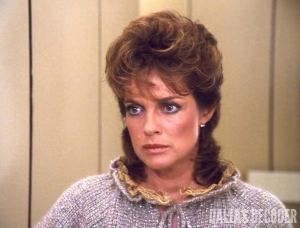
Finally, a word about Sue Ellen’s new hairdo: When the fifth-season finale “Goodbye, Cliff Barnes” ended, Sue Ellen had long, luscious locks. “Changing of the Guard” picks up moments later, yet suddenly her hair is shorter and styled much differently. She has what might now be called a mullet, although I can remember how chic everyone thought Linda Gray looked in 1982. In a newspaper interview later that year, Gray joked about the continuity error, suggesting Sue Ellen was so distraught over Cliff’s coma, she ducked out of the hospital for a quick makeover. It’s hard for me to imagine that look ever coming back into vogue again, but what do I know? I never expected to see the return of the three-piece suit, which has become one of Josh Henderson’s signatures on the new “Dallas.” Might one of his leading ladies someday sport a Sue Ellen-style mullet?

Never say never, darlin’.

Grade: B

_______________________________________________________________________________________________________________________________________________

Changing of the Guard, Dallas, Linda Gray, Sue Ellen Ewing

Snipped

‘CHANGING OF THE GUARD’

Season 6, Episode 1

Airdate: October 1, 1982

Audience: 18.7 million homes, ranking 5th in the weekly ratings

Writer: Arthur Bernard Lewis

Director: Michael Preece

Synopsis: Cliff emerges from his coma, but Sue Ellen isn’t sure she wants to marry J.R. When the Ewings vote to oust J.R. as president of Ewing Oil, he agrees to become a silent partner to Holly Harwood, who recently inherited her father’s oil company. Lucy learns she’s pregnant.

Cast: Tyler Banks (John Ross Ewing), William H. Bassett (Dr. Hollister), Barbara Bel Geddes (Miss Ellie Ewing), Lois Chiles (Holly Harwood), Roseanna Christiansen (Teresa), Karlene Crockett (Muriel), Patrick Duffy (Bobby Ewing), Eric Farlow (Christopher Ewing), Fern Fitzgerald (Marilee Stone), Phyllis Flax (Mrs. Chambers), Linda Gray (Sue Ellen Ewing), Larry Hagman (J.R. Ewing), Susan Howard (Donna Krebbs), Steve Kanaly (Ray Krebbs), Howard Keel (Clayton Farlow), Ken Kercheval (Cliff Barnes), Audrey Landers (Afton Cooper), Priscilla Pointer (Rebecca Wentworth), Victoria Principal (Pam Ewing), Debbie Rennard (Sly), Danone Simpson (Kendall), Don Starr (Jordan Lee), Charlene Tilton (Lucy Cooper), Deborah Tranelli (Phyllis)

“Changing of the Guard” is available on DVD and at Amazon.com and iTunes. Watch the episode and share your comments below.
Critique: ‘Dallas’ Episode 102 – ‘Acceptance’

The emperor's clothes

The emperor’s clothes

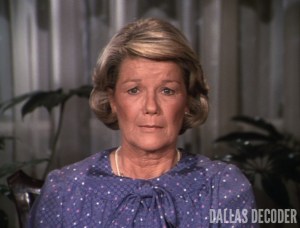
The scene everyone remembers from “Acceptance” is the one where the grieving Miss Ellie goes on a rampage in the Southfork kitchen, smashing every dish in sight before tearfully collapsing onto the floor. This is a big, dramatic moment and it never fails to give me chills, but it’s not the only great performance we get from Barbara Bel Geddes in this episode. The quiet moments that come before Ellie’s breakdown are just as moving. They deserve to be remembered too.

More than anything, “Acceptance” is about the journey Ellie takes before she comes to terms with Jock’s death. It begins when Ray visits Ellie on another rainy night at Southfork and suggests she forgive Donna for wanting to write an unflattering book about Jock. Steve Kanaly’s monologue consists of more than 350 words, and he delivers every one beautifully. I also love how Bel Geddes holds her own against Kanaly, even though she is almost completely silent. The look on Bel Geddes’ face tells us everything we need to know. Ellie isn’t really mad at Donna. She’s angry because the husband she loved has died and left her alone.

Virtually every scene that follows demonstrates how Bel Geddes can say more with a smile or a furrowed brow than most actors can with a script full of dialogue. Watch how her expression changes in the scene where Punk invites Ellie to accompany him and Mavis to the Oil Barons Ball. Bel Geddes is so sweet in the way Ellie politely declines Punk’s invitation, but once he tells her about the plan to introduce a memorial scholarship in Jock’s name, her expression shifts to shock, hurt and sadness, all within a matter of seconds. How does she do that?

The poignant moments keep coming. A pensive Ellie strolls around the Southfork grounds, recalling the walk she takes in the classic “Ellie Saves the Day.” She visits the stables and lovingly strokes Blazer, Jock’s horse. “You miss him too, don’t you?” she says. And the biggest heartbreaker of all: when Ellie stands in Jock’s bedroom closet and gently touches his clothes. (In a nice touch, the producers appear to have stocked this set with pieces from Jim Davis’s “Dallas” wardrobe, including the powder blue suit he memorably sported in “Runaway” and the white-dotted bathrobe he wore during the third season.)

Of course, as good as Bel Geddes is, she gets plenty of support from director Michael Preece, who always brings out the best in the “Dallas” cast, and Will Lorin, whose script is full of details that ring true. My favorite of these moments comes in the second act, when Lucy enters Ellie’s bedroom to announce Punk’s arrival. “Tell him I’ll be right there. Offer him a drink,” Ellie says. Offer him a drink. It’s a small line, but it tells us so much about Ellie’s devotion to keeping up appearances, even when she’s in mourning. This is exactly what we expect a woman of Ellie’s generation and stature to tell her granddaughter when company arrives.

Ellie’s struggle reaches its crescendo when she has her breakdown in the kitchen. The sequence begins with the Ewings gathered in the Southfork dining room. As the other characters chatter (listen closely and you’ll hear J.R. and Pam being cordial to each other), Preece slowly zooms in on Ellie’s face as she notices Jock’s empty chair at the other end of the table. Quickly and quietly, she excuses herself and goes into the kitchen, where she orders Teresa to leave. Suddenly, Ellie is overcome with emotion and begins smashing the dishes.

When I interviewed the wonderful Michael Preece last month, he told me Bel Geddes didn’t want to do multiple takes because the material was so gut-wrenching. When you watch the scene, you can tell the actress is taking care to hit her marks. In hindsight, her sense of caution works well. Yes, Ellie is a woman exploding with grief, but she’s also someone whose instinct is to always remain composed. Of course she’d hesitate a little before knocking over a stack of plates.

(Watching this scene, I’m also reminded of a famous sequence from the 1970s sitcom “Good Times,” when Esther Rolle’s Florida Evans, another matriarch in mourning, slams a glass punchbowl onto her kitchen floor. The dialogue is similar too. Florida: “Damn, damn, damn!” Ellie: “Damn you, Jock!”)

In “Acceptance’s” final scene, Ellie visits the Krebbses and gives Donna’s book her blessing. It brings to mind the final moments in the fourth-season episode “Ewing vs. Ewing,” when Ellie stands in Ray and Donna’s living room and asks Jock to forgive her for almost destroying their marriage. That scene, one of the last times Bel Geddes and Davis appeared together, ends with their characters declaring their love for each other. This time around, the moment of satisfaction comes when Ellie finally acknowledges that her husband is dead. “I know that Jock’s not coming back, but I have my memories of him,” she says. “And my memories are forever.”

So are great performances like this.

Grade: A

_______________________________________________________________________________________________________________________________________________

Forever

Forever

‘ACCEPTANCE’

Season 5, Episode 25

Airdate: April 2, 1982

Audience: 29.1 million homes, ranking 2nd in the weekly ratings

Writer: Will Lorin

Director: Michael Preece

Synopsis: Miss Ellie accepts Jock’s death and gives Donna’s book her blessing. Afton tries to comfort Cliff after Rebecca fires him. J.R. romances Sue Ellen. Bobby helps the police catch Farraday’s killers. Mitch moves to Atlanta.

Cast: Tyler Banks (John Ross Ewing), Barbara Bel Geddes (Miss Ellie Ewing), Patrick Duffy (Bobby Ewing), Phyllis Flax (Mrs. Chambers), Jonathan Goldsmith (Joe Smith), Linda Gray (Sue Ellen Ewing), Larry Hagman (J.R. Ewing), Susan Howard (Donna Krebbs), Bob Hoy (Detective Howard), Steve Kanaly (Ray Krebbs), Ken Kercheval (Cliff Barnes), Audrey Landers (Afton Cooper), Leigh McCloskey (Dr. Mitch Cooper), Priscilla Pointer (Rebecca Wentworth), Victoria Principal (Pam Ewing), Debbie Rennard (Sly), Tom Stern (Detective White), Charlene Tilton (Lucy Cooper), Morgan Woodward (Punk Anderson), H.M. Wynant (Ed Chapman)

“Acceptance” is available on DVD and at Amazon.com and iTunes. Watch the episode and share your comments below.
Critique: ‘Dallas’ Episode 100 – ‘Blackmail’

Dark room

Dark room

In “Blackmail,” J.R., armed with newly obtained evidence that suggests Christopher is his biological son, comes home to Southfork and enters the nursery. It’s a dark and stormy night, and the little boy is whimpering in his crib as thunder crackles outside. J.R. doesn’t comfort the child, though. He merely watches him. “Hello Christopher,” J.R. says. “You don’t know it, but I’m your daddy. I wonder how your Aunt Pam would feel about it, if she found out?”

The line is made all the more ominous by the wicked smile Larry Hagman flashes after he delivers it. We don’t discover what J.R. is plotting until later in the episode, when he tells Bobby he’ll reveal the “truth” about Christopher’s paternity unless Bobby agrees to do his bidding at Ewing Oil. This is one of J.R.’s most despicable deeds, and not just because he’s using his own child to blackmail his brother. Consider: J.R. grew up with the pain that came from knowing Jock favored Bobby over him. Yet here J.R. is many years later, following in his father’s footsteps: J.R. has one son he adores (John Ross) and another (Christopher) he’s treating as a pawn in his quest for power.

In a clever touch, “Dallas” underlines J.R.’s favoritism by evoking the third-season classic “Paternity Suit.” In that episode, J.R. receives the blood test results that prove he’s John Ross’s father and visits the nursery, where he picks up the boy for the first time. This tender moment stands in sharp contrast with J.R.’s crib-side encounter with Christopher in “Blackmail.” (And even though we’ll soon learn Christopher is not J.R.’s child, “Dallas” doesn’t abandon the theme of J.R. emulating Jock’s parenting style. Toward the end of the show’s run, J.R. learns he has an illegitimate son, James, whose arrival leaves John Ross feeling like the neglected brother.)

The nursery scene isn’t the only dark moment in “Blackmail.” Bobby discovers Farraday’s dead body inside his dingy apartment, while Roger strikes Lucy and knocks her to the floor when she tries to escape from his captivity. I love the suspenseful music that composer Richard Lewis Warren uses to score both sequences, as well as the camera work from director Michael Preece. These two also collaborate nicely in the scene where the grieving Miss Ellie sits alone at the Southfork breakfast table and breaks into tears; Warren’s music grows more mournful as Preece slowly zooms in on Barbara Bel Geddes.

Bel Geddes helps supply “Blackmail” with its other highlight: the scene where Donna sits with Ellie in the Southfork kitchen and tells her the story of how Jock and Sam Culver’s land grab a half-century earlier resulted in another man’s suicide. Ellie refuses to accept the truth and threatens to sue Donna if she includes the story in the biography of Sam she’s writing. I love how Bel Geddes goes from disbelief to rage in a matter of seconds; Susan Howard’s performance is equally heartbreaking.

This scene, perhaps more so than any other in “Blackmail,” makes me appreciate how “Dallas” eschewed gimmicks during its heyday. When I was younger, I used to watch this episode and wonder why the show didn’t bring in a special guest star or deliver a major plot twist to mark its 100th hour. Now I realize: When your cast includes great actresses like Barbara Bel Geddes and Susan Howard, who needs stunts?

Grade: A

_______________________________________________________________________________________________________________________________________________

Woman alone

Woman alone

‘BLACKMAIL’

Season 5, Episode 23

Airdate: March 19, 1982

Audience: 26.9 million homes, ranking 1st in the weekly ratings

Writer: Leonard Katzman

Director: Michael Preece

Synopsis: J.R. tells Bobby he’s Christopher’s father and vows to keep quiet if Bobby cedes control of his voting shares. Cliff moves forward with his drilling project, even after J.R. reveals the land is dry. Miss Ellie explodes when Donna asks for permission to publish the story of Jock’s land grab. Roger holds Lucy captive. The police question Bobby after Farraday is discovered dead.

Cast: Tyler Banks (John Ross Ewing), Barbara Bel Geddes (Miss Ellie Ewing), Patrick Duffy (Bobby Ewing), Fern Fitzgerald (Marilee Stone), Jonathan Goldsmith (Joe Smith), Linda Gray (Sue Ellen Ewing), Larry Hagman (J.R. Ewing), Art Hindle (Jeff Farraday), Susan Howard (Donna Krebbs), Bob Hoy (Detective Howard), Steve Kanaly (Ray Krebbs), Howard Keel (Clayton Farlow), Ken Kercheval (Cliff Barnes), Leigh McCloskey (Dr. Mitch Cooper), Pamela Murphy (Marie), Victoria Principal (Pam Ewing), Dennis Redfield (Roger Larson), Debbie Rennard (Sly), Tom Stern (Detective White), Charlene Tilton (Lucy Cooper), Deborah Tranelli (Phyllis)

“Blackmail” is available on DVD and at Amazon.com and iTunes. Watch the episode and share your comments below.
Dallas Decoder Asks: How Should J.R. die?

Dallas, J.R. Ewing, Larry Hagman, TNT

Exit the hero

J.R. Ewing’s funeral will be seen in the “Dallas” episode that airs Monday, March 11, TNT confirmed yesterday. But how should the legendary character die? And what’s the best way to honor Larry Hagman, the actor who portrayed J.R. for more than three decades? Dallas Decoder asked four members of the original show’s creative team to share their ideas.


GOOD NIGHT, LOVER BOY

Despres

Despres

There’s only one way J.R. should die: He’s got to be shot by a jealous husband. He’s J.R. Ewing – how else could he die? The husband could be a character from the original series or it could be someone new. The show could build a new “Who Shot J.R.?” mystery around the shooting. If he isn’t shot, he should die in the bed of one of his mistresses. No matter how the show kills him off, J.R. shouldn’t die a hero. He should be the villain you love to hate, right until the very end.

Loraine Despres, writer, 1979 to 1980; credits include “Who Done It?”, the episode where Kristin is revealed as J.R.’s shooter


ONE LAST SHOT

Lakin

Lakin

J.R. survived being shot 40 years ago. Maybe this time the bullet hits the mark. Yeah, shameless. But why not? Even if cynics hate the idea, it’ll create buzz and it might just be the best chance of bringing in new viewers to the show. J.R. was TV’s greatest villain and deserves some villainous payback. The funeral? Could be a three-episode event with every former important cast member they can find. Cliff pouring bourbon on J.R.’s grave? Priceless. This is the biggest franchise event imaginable. I also wouldn’t hesitate using flashbacks if at all possible. It may not please the producers who surely would prefer original material but I think viewers would love it.

Howard Lakin, writer, 1980 to 1982; producer/writer, 1988 to 1991; credits include “The Fourth Son,” the episode where Jock discovers he’s Ray’s father 


QUICKLY AND QUIETLY

Preece

Preece

You could always have J.R. called out of town and then have his plane go down, but I would have it play out that he’s been hiding the fact that he has cancer – although you don’t have to say “cancer” necessarily. Remember, when the new show opened, J.R. was in a nursing facility, so it’s possible he’s been ill and no one knew it. There could be scenes of the family reacting to the news that he died suddenly and finding out he hid his illness from them. Whatever scenario the show goes with, they shouldn’t drag it out too long. I don’t think they should do what the original series did with Jim Davis, when they sent Jock to South America for an extended period. With J.R., I think you have to allow him to pass away quickly and quietly.

Michael Preece, director, 1981 to 1991; credits include “Acceptance,” the episode where Miss Ellie comes to terms with Jock’s death


NO TIME TO KILL

Seidman

Seidman

I could never kill off J.R.! I’d have forces bearing down on him that we think have caused his death (in an explosion, perhaps?). No body or a body that of course can’t be identified. And then, every once in a while, a story comes up in which a shady businessman in Hong Kong lost everything to a mysterious figure, or a big deal was made in London that ripped off illegal investors but made some mysterious figure, Mr. X, a ton of money. Is it J.R.? Is he traveling the world, destroying his enemies to the benefit of himself and his family as they receive benefits out of the blue that suddenly save themselves and their company? We’ll never know. We can only hope. These stories would occur for generations, giving him immortality. That’s how I’d write off J.R. Ewing – by never writing him off.

Lisa Seidman, writer, 1989 to 1991; credits include “The Decline and Fall of the Ewing Empire,” the episode where J.R. loses Ewing Oil to Cliff


Now it’s your turn: How would you kill off J.R.? Share your comments below and read more news from Dallas Decoder.

The Dallas Decoder Interview: Michael Preece

Michael Preece

Michael Preece

No one “shot” J.R. Ewing more often than Michael Preece, who directed more than 60 episodes of the original “Dallas” series. He graciously agreed to share some of his memories of working on the show and with its biggest star, Larry Hagman.

You probably worked with Larry Hagman more than any other director. How much direction did he need when he was playing J.R.?

There was a saying on the set that “Dallas” was director-proof. Larry knew his character. He had a tendency to go a little bigger than was needed, so you’d try to curb him a little bit. Or if he didn’t know his lines well, sometimes he would have them written on cue cards and I’d say, “Larry, you sound like you’re reading it.” But basically, he needed very little direction – and that was true of much of the cast. They made it easy.

Larry Hagman in “Changing of the Guard”

Larry Hagman in “Changing of the Guard”

Did you two ever have disagreements about how a scene should be played?

Once in awhile, but usually Larry would win. Sometimes we would need an interpretation of something and would call [executive producer] Leonard Katzman because I didn’t know what was going to happen in the next episode and Leonard did. But usually that was worked out before we started shooting. I never had an argument with Larry or Patrick [Duffy] or Linda [Gray]. Not one.

It sounds like it was a pleasant set to work on.

It was a wonderful atmosphere. And jokes, all day long. We never got a clean rehearsal, but when it came time to shoot, the cast would play it perfectly. Most television shows go to 7 o’clock or 8 o’clock at night. With “Dallas,” we’d be leaving the [studio] lot for the day when people on other shows were just breaking for lunch.

Do you have a favorite scene you remember directing?

One scene stands out to me more than any other: when Barbara Bel Geddes goes into the kitchen and throws around the pots and pans after she realizes Jock is really dead. And the dining room scene prior to that, where she’s just sitting there thinking and the other people at the table are just babbling on.

That whole episode is wonderful!

Those dining room scenes were always chaotic. The boys – I call them the boys, Larry and Patrick – would always flick food at each other during rehearsal. So the night before we did that scene, Barbara called me and said, “You know, Michael, tomorrow is going to be difficult for me. Would you ask the boys to behave?” So I made the mistake of going to Larry and Patrick the next day. I said, “You know, this is a very important scene for her, so please, no fooling around.” And they said, “Don’t worry. We’re pros.” So we start the scene – this isn’t a rehearsal, we’re rolling – and the camera’s slowly moving in on Barbara and suddenly a pea hits her. I think it was right in the forehead.

Barbara Bel Geddes in “Acceptance”

Barbara Bel Geddes in “Acceptance”

Oh no!

She never broke. She just kept on acting. And she came back later and said, “I’m going to get you boys!” She had a terrific sense of humor. She loved to swear. I mean, she wasn’t like a sailor and she didn’t swear in anger so much, but she could get her swear words out.

It’s funny to imagine Miss Ellie cursing. She must have been fun to work with.

She was very professional. I would make a point of looking up her old movies and then I’d go up to her and I’d say, “Remember you worked with so and so.” She loved it. She’d tell stories about working with Hitchcock or someone else. A lot of those pictures, I’d never seen them. I learned about them from her.

What was it like when it came time to shoot the scene of her smashing the dishes? That must have been difficult.

Yeah, but only because it had to be precise. She didn’t want to do it over and over because she was crying, and you had to build up that momentum. I remember shooting it quite simply. But “Dallas” was shot very simply anyway. It wasn’t very artistic film-wise.

Was that frustrating? Did you ever think, “Gosh, I wish I could do something more creative here”?

Yeah, very much so. But “Dallas” was basically talking heads. We were able to make a shot once of someone coming out of the elevator, and then they go into one of the offices, and then they go into another office and then they come out [to the reception area] again. All in one shot. And when you see it, you don’t think, “Oh, wow, how’d they do that?” It didn’t draw attention, but it was different.

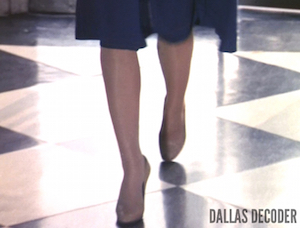
Mary Crosby’s legs in “Full Circle”

Mary Crosby’s legs in “Full Circle”

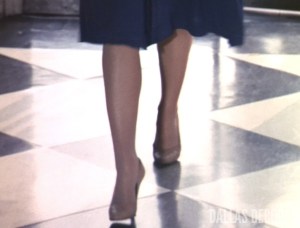
That reminds me: One of my favorite shots from one of your episodes is the scene where Mary Crosby’s character comes back to town and the first time we see her, the camera is following her legs across a hotel lobby.

I’m glad you remember that! We shot that at the Ambassador Hotel in Los Angeles. They wanted her return to be a little mysterious, so the script read something like, “She’s standing at the desk and turns and you see it’s Mary Crosby.” I remember thinking, “My, she has nice legs. Let’s follow her legs.” You don’t plan something like that.

You mentioned Leonard Katzman a little earlier. He really brought his own vision to the show, didn’t he?

Len would take situations that his family was going through and use them in the plot. I’d sit in on a story meeting and he’d say, “My daughter did this the other night. Let’s put that in a script and give it to Lucy.” Len and I were pretty close, and he would take things from my family too. He was always writing from real-life experiences, whether it was his own or mine or someone else’s. I think that’s the case with a lot of writers – they use what they know best.

It’s interesting to see “Dallas” being made without him. What do you think of the new show?

I want to see more of Larry and Patrick and Linda. I think the kids are good. I think some of them look too much alike, to be honest. [“Dallas” creator] David Jacobs said they should have switched and made Bobby’s son the bad one and J.R.’s son the good one. I thought that was a good idea when I heard it. But [the producers] wanted all-new ideas and new writers and directors, which I completely understand and kind of agree with.

Really?

Yeah. If they hired the writers and directors [from the original], you’d have a lot of, “Well, you know in the old days, we used to do it this way.” That’s the last thing you want to hear. [Laughter] I got into the business a long time ago – 1955 – and I remember hearing people say, “Oh, it’s not like the good old days.” And here it is many years later, people are still saying, “Oh, it’s not like the good old days!”

Well, I agree with you. I’d like to see more of the original stars too. It’s going to be hard to imagine “Dallas” without Larry Hagman.

He could still light up a screen. There are very few people like that. Steve McQueen, Clint Eastwood, Marlon Brando – they had that quality. Larry had it too.

Share your comments below and read more interviews from Dallas Decoder.

Critique: ‘Dallas’ Episode 76 – ‘Full Circle’

Look Mom, no grudges

Look Mom, no grudges

The famous scene from “Full Circle” – when Cliff tearfully offers his estranged mother a bowl of licorice, her favorite candy – is one of my earliest “Dallas” memories. I was 7 when this episode debuted, and I remember watching it and feeling sorry for Cliff. All these years later, the moment still moves me.

Ken Kercheval has called Cliff and Rebecca’s reconciliation his favorite “Dallas” scene, and it’s easy to see why he likes it. Kercheval is always fascinating to watch, but during the course of this four-and-a-half-minute sequence, he’s called upon to convey a whole spectrum of emotion: from nervousness to rage to mercy. The actor hits every note with precision.

The most impressive part of Kercheval’s performance might be how he seems to avoid looking at Priscilla Pointer. When I interviewed Kercheval in the summer, he talked about another of his favorite scenes – this one with Barbara Bel Geddes – and mentioned how helpful it is for actors to maintain eye contact so they can take “cues” from each other. Kercheval doesn’t appear to do that with Pointer during the “licorice scene.” This probably made the performance more challenging, but it lends the scene power. Seeing how difficult it is for Cliff to look Rebecca in the eye helps us realize how hard it is for him to face the truth about her shortcomings.

Michael Preece’s direction here is terrific – I especially like how he has Kercheval jump to his feet when Cliff calls out Rebecca’s sins – as well as Bruce Broughton’s lush score, which swells when mother and son finally embrace.

Then there’s Arthur Bernard Lewis’s clever dialogue. At the end of the scene, Lewis could have given Kercheval a straightforward line to signal Cliff’s last-minute change of heart – something like, “Wait, Mom, don’t go” – but instead, Lewis has Cliff offer her the licorice. Why? I think the line achieves two things: Having Cliff refer to candy – something so closely associated with childhood – reminds us how long it’s been since he last saw Rebecca. More importantly, the licorice symbolizes how Cliff in many ways is still the wounded little boy whose mother abandoned him.

If any other character was given a line like this (imagine J.R. or Bobby saying it), it might seem childish, but with Cliff, it’s flat-out moving. Cliff is the most revenge-prone character in “Dallas” history, yet for once in his life, he’s willing to set aside his animus. This is a moment of genuine growth for Cliff.

I also love the “Full Circle” sequence where Preece’s camera follows Mary Crosby’s legs as Kristin marches across a hotel lobby to Bruce Broughton’s jaunty score. This is a fun scene, but it’s also a little prophetic: The confidence in Crosby’s stride makes her look buoyant – and as we now know, this won’t be the last time we see Kristin float.

Grade: A

_______________________________________________________________________________________________________________________________________________

Walk to remember

Walk to remember

‘FULL CIRCLE’

Season 4, Episode 22

Airdate: April 17, 1981

Audience: 24.4 million homes, ranking 1st in the weekly ratings

Writer: Arthur Bernard Lewis

Director: Michael Preece

Synopsis: Cliff forgives Rebecca and presents Bobby’s committee with evidence linking J.R. to the counter-revolution in Asia. Kristin returns and extorts money from Jordan Lee, who believes he is the father of her newborn son. Sue Ellen runs into Dusty, who is learning to walk again. Pam is devastated to learn she cannot bear children. Lucy leaves Mitch.

Cast: Tyler Banks (John Ross Ewing), Barbara Bel Geddes (Miss Ellie Ewing), Ellen Bry (Jean), Gerald Castillo (Luis Hernandez), Mary Crosby (Kristin Shepard), Patrick Duffy (Senator Bobby Ewing), Susan Flannery (Leslie Stewart), Meg Gallagher (Louella), Linda Gray (Sue Ellen Ewing), Larry Hagman (J.R. Ewing), John Hart (Senator Carson), David Healy (Senator Harbin), Susan Howard (Donna Krebbs), Steve Kanaly (Ray Krebbs), Sherril Lynn Katzman (Jackie), Ken Kercheval (Cliff Barnes), Jared Martin (Dusty Farlow), Leigh McCloskey (Mitch Cooper), Priscilla Pointer (Rebecca Wentworth), Victoria Principal (Pam Ewing), John Randolph (Lincoln Hargrove), William Smithers (Jeremy Wendell), Don Starr (Jordan Lee), Christopher Stone (Dave Stratton), Charlene Tilton (Lucy Cooper), Jay Varela (Senator Arvilla), Joseph Warren (Senator Dickson), Morgan Woodward (Punk Anderson)

“Full Circle” is available on DVD and at Amazon.com and iTunes. Watch the episode and share your comments below.