Critique: ‘Dallas’ Episode 141 — ‘The Buck Stops Here’

Bobby Ewing, Dallas, Pam Ewing, Patrick Duffy, Victoria Principal

Round and round

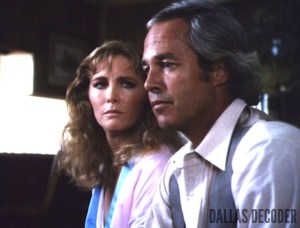
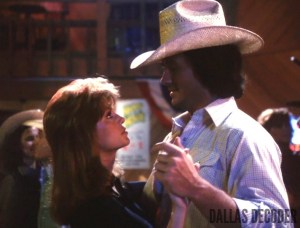
“The Buck Stops Here” memorably ends with Pam Ewing and Jenna Wade competing against each other in a mechanical bull-riding competition. It’s an appropriate metaphor for these characters, whose lives go up and down but rarely move forward. For example, during the course of this episode, we learn Pam is still hung up on ex-husband Bobby, even though she’s also in a relationship with Mark Graison. Meanwhile, Jenna has returned to town after a long absence and rekindled her romance with Bobby, but he upsets her when he asks if he’s the father of her daughter Charlie. If it feels like you’ve seen both of these stories before, it’s because you have.

Let’s start with Pam. She spends most of “Dallas’s” previous season trying to choose between Bobby and Mark, a storyline that makes her seem more than a little wishy-washy. Once Pam divorces Bobby, the writers begin to rehabilitate her character, even giving her a promising new career in the oil industry. It’s the return of the smart, confident Pam that Victoria Principal played exceedingly well during “Dallas’s” early years. Too bad it doesn’t last. In “The Buck Stops Here,” Principal’s character is back where she was a year earlier, torn between Bobby and Mark.

At least Arthur Bernard Lewis’s script makes Pam aware that she’s emotionally stuck. In the first act, Pam confides her conflicted feelings to Katherine, a scene that is probably meant to make Pam seem introspective but instead makes her seem whiny and not in control of her own emotions. At one point, Katherine tells her, “You know, sometimes I don’t understand you at all.” Pam’s response: “Sometimes I don’t understand myself at all.” The exchange brings to mind “Dallas’s” fifth season, when Pam was unable to explain the erratic behavior she exhibited before her mental breakdown — a storyline I’d just as soon not be reminded of.

The weak plotting leaves me feeling bad for Principal, an enormously appealing actress who deserves better material. Don’t get me wrong: I want Bobby and Pam back together as much as anyone, but if the show was going to insist on breaking them up, at least give Pam something better to do than to pine after her ex-husband. On the other hand: I’ll confess I get a kick out of seeing Pam and Jenna shoot daggers at each other throughout the charity rodeo and the mechanical bull-riding competition. There’s also the terrific scene where Jenna compliments Pam on her performance, telling she’s going to be “a tough act” to follow. “I am a tough act to follow,” Pam responds. On this show, have truer words been spoken?

“Dallas” struggles to come up with a fresh angle for Jenna too. The show introduces the character in the second-season episode “Old Acquaintance,” when Jenna — played by Morgan Fairchild — is depicted as a scheming heiress who tries to break up Bobby and Pam by insinuating Charlie is Bobby’s daughter. Eventually, Pam confronts Jenna and forces her to admit that Jenna’s ex-husband is the little girl’s father. In Season 3, Jenna — now played by Francine Tacker — returns briefly and once again tempts Bobby, except this time Charlie’s paternity isn’t part of the equation. So why is Bobby suddenly pestering Jenna about the issue in “The Buck Stops Here”? My guess is the producers figured audiences wouldn’t remember this subplot was resolved years earlier, although I have no idea why they think “who is Charlie’s father?” is such a compelling storyline in the first place.

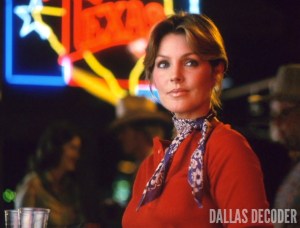
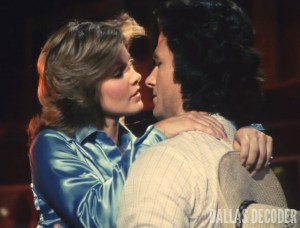
At least Jenna comes off as a little more clear-eyed than Pam. The character has felt more down-to-earth and interesting since Priscilla Presley took over the role three episodes ago. Some of this comes from the writing — Jenna has lost her fortune and is now working as a waitress to pay the bills — but some of it also comes from Presley, who instills her character with much more backbone than I remembered. In one of “The Buck Stops Here’s” best scenes, Katherine tries to bribe Jenna into moving to Houston and leaving Bobby alone. Katherine pretends she’s acting in Pam’s interest, but Jenna is savvy enough to realize Katherine wants Bobby for herself. I also like the scene where Bobby takes Jenna to dinner at the Oil Baron’s Club (which makes its debut in this episode) and asks her if she misses being rich. “Damn right I do,” she says. Isn’t it kind of refreshing to see the working class depicted as something other than noble?

Besides recycling old storylines, “The Buck Stops Here” demonstrates the sexism that pervades this era of “Dallas.” At the beginning of the episode, when Pam and Katherine have their heart-to-heart talk, Katherine is aghast to learn Pam and Mark have never had sex. “You can’t expect a man to wait forever. This isn’t the 19th century,” she says. It also seems like every man on this show has at least two women interested in him: Mark is romancing Pam while being chased by snooty socialite Tracy Anders, while Pam, Jenna and Katherine are all in love with Bobby.

(Frankly, everyone’s interest in Patrick Duffy’s character mystifies me a little, at least in “The Buck Stops Here.” Notice how Bobby cheerfully tells Katherine all about his wonderful afternoon with Jenna, even though Katherine confessed her own unrequited romantic feelings for Bobby during the previous episode. Likewise, isn’t it kind of crass of Bobby to plant such a passionate kiss on Jenna at the end of this episode, knowing that his ex-wife is watching them? Where’s the sweet, sensitive Bobby that we all know and love?)

Amid all the complications and sexism that characterize Bobby and Pam’s love lives, Sue Ellen’s May/December romance with camp counselor Peter Richards feels like a breath of fresh air. At least this is a love triangle where one woman (Sue Ellen) is the object of affection for two men (J.R. and Peter). The previous episode ended with Sue Ellen and Peter sharing a brief kiss, but in “The Buck Stops Here,” she meets Peter for lunch — the restaurant’s name isn’t shown, but I’d recognize the inside of a 1980s Pizza Hut anywhere — and wisely tells him that their relationship can’t go any further. It’s nice to see Sue Ellen grow as a character, even as some of her “Dallas” sisters struggle to move forward.

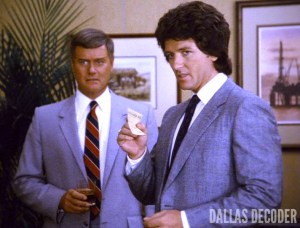
Of course, even though I like seeing the Ewing and Barnes women take center stage for a change, I can’t help but feel bad for J.R., who doesn’t have much to do in “The Buck Stops Here” except to stand by helplessly as Cliff steals another deal from him. In fact, Larry Hagman is completely absent from the episode’s fourth act, an extreme rarity on this show. It’s no fun to watch our hero get beat, but but I’m heartened by the scene where J.R. summons Harry McSween to his office to help him set a trap for his enemy. “I want that little insect to bite — and bite hard,” J.R. says. The line leaves me rubbing my hands in glee. J.R. vowing to exterminate Cliff? Oh, this is going to be fun!

Grade: B

_______________________________________________________________________________________________________________________________________________
Bobby Ewing, Dallas, Jenna Wade, Patrick Duffy, Priscilla Presley

Busy Bobby

‘THE BUCK STOPS HERE’

Season 7, Episode 10

Airdate: December 2, 1983

Audience: 22.3 million homes, ranking 3rd in the weekly ratings

Writer: Arthur Bernard Lewis

Director: Leonard Katzman

Synopsis: Peter tells Sue Ellen he loves her, but she insists it’s merely an infatuation. Pam sleeps with Mark after she spots Bobby kiss Jenna passionately. After J.R. loses another deal to Cliff, he realizes Ewing Oil has a mole.

Cast: Christopher Atkins (Peter Richards), Mary Armstrong (Louise), John Beck (Mark Graison), Tye Bell (Buzz), Morgan Brittany (Katherine Wentworth), James L. Brown (Detective Harry McSween), Jack Collins (Russell Slater), Joe Dorsey (Ben Kesey), Patrick Duffy (Bobby Ewing), Eric Farlow (Christopher Ewing), Linda Gray (Sue Ellen Ewing), Larry Hagman (J.R. Ewing), Susan Howard (Donna Krebbs), Steve Kanaly (Ray Krebbs), Omri Katz (John Ross Ewing), Ken Kercheval (Cliff Barnes), Audrey Landers (Afton Cooper), Roy McAdams (rodeo announcer), Andrea McCall (Tracy Anders), Shalane McCall (Charlie Wade), Priscilla Beaulieu Presley (Jenna Wade), Victoria Principal (Pam Ewing), Debbie Rennard (Sly), Danone Simpson (Kendall), Don Wood (Dan Fuller)

“The Buck Stops Here” is available on DVD and at Amazon.com and iTunes. Watch the episode and share your comments below.
Let’s Talk Turkey Tonight on #DallasChat

Cliff Barnes, Dallas, Ken Kercheval, TNT

Quit jiving us, Barnes

Our next #DallasChat on Twitter will be held Monday, November 25, from 9 to 10 p.m. Eastern time. Since Thanksgiving is later this week, our theme will be “Talkin’ Turkey.”

Here’s how #DallasChat works: I tweet a question roughly every five minutes for one hour. Each question is numbered and includes the hashtag #DallasChat, so your responses should do the same.

A sample exchange:

Q1. Who is “Dallas’s” biggest turkey? #DallasChat

A1. That’s easy: Cliff Barnes. He’s been jiving the Ewings for years. #DallasChat

Two pointers:

• During the discussion, enter #DallasChat in Twitter’s search field. This will help you watch the search results so you can follow the conversation. Click “All” to see all the related tweets.

• Include the hashtag #DallasChat in each tweet you send so others can see your contributions to the conversation. Feel free to start side conversations of your own, but be sure to include #DallasChat in those tweets too.

This will be a fun, festive chat. Don’t miss it!

Critique: ‘Dallas’ Episode 140 — ‘Morning After’

Christopher Atkins, Dallas, Linda Gray, Morning After, Peter Richards, Sue Ellen Ewing

Special needs

The characters on “Dallas” usually have affairs when they fall in lust or in love, but neither scenario is true for Sue Ellen Ewing and Peter Richards. Their romance is based on their mutual neediness. Sue Ellen, having been betrayed by J.R. once too often, needs to be reminded of what life was like before it turned into one extended heartache. Peter, a bright young man who is eager for the world to take him seriously, needs to feel like a grownup. Put another way: She needs to feel younger, he needs to feel older. This doesn’t make their relationship right, but I can see why they’re drawn to each other.

In “Morning After,” Sue Ellen and Peter finally acknowledge what’s happening between them. It begins when Peter visits Southfork and overhears J.R. and Sue Ellen arguing. J.R. wants his wife to sleep with him; when she refuses, he suggests it’s because Peter is “getting” to her. Sue Ellen insists this isn’t true but wonders if J.R. is jealous. His response: “Jealous? Are you kidding? The one thing I don’t have to worry about is a schoolboy with a crush on my wife.” The next day, Peter persuades Sue Ellen to meet him at a quiet pier, where he says he doesn’t think he should continue working with John Ross because he’s developed feelings Sue Ellen. She tells Peter it’s “not so unusual” for a young man to be attracted to an older woman, comparing him to a student who develops a crush on a teacher. Sue Ellen urges him to not “give up” on John Ross, who adores Peter and would be sad to lose him as his counselor. “It’ll all work out. You’ll see,” she says.

Except this is “Dallas,” and so of course things won’t work themselves out. To begin with, Sue Ellen is also attracted to Peter, although she doesn’t want to admit it. Why? Scriptwriter David Paulsen never makes this clear, but it seems safe to assume the always ladylike Sue Ellen believes it would be wrong for a woman in her 40s to desire a college student like Peter. Regardless of the character’s motivation, Linda Gray does a nice job bringing Sue Ellen’s conflicted feelings to light. This is especially true in the scene where Sue Ellen shoots down Lucy’s suggestion that Peter has a crush on her. Gray delivers her lines with just enough defensiveness in her voice to let the audience know that Sue Ellen doesn’t believe a word of what she’s saying. Charlene Tilton’s skepticism in this scene is also pitch-perfect. When Sue Ellen insists Peter is nothing more than John Ross’s friend, Lucy snaps, “He’s John Ross’s friend? John Ross is 5 years old. Peter is in college.”

Sue Ellen’s denials bring to mind one of “Dallas’s” earlier May/December romances: Jock’s affair-of-the-heart with Julie Grey. Like Sue Ellen does with Peter, Jock initially denies anything is happening between him and Julie, although he eventually realizes their relationship is wrong and ends it. Also, like Sue Ellen and Peter’s romance, Jock and Julie’s affair is rooted in mutual neediness: He needs Julie to help reclaim his vitality after his heart attack, while she needs Jock to validate her self-worth. One difference between the two relationships: Julie fools herself into thinking it’s OK to pursue Jock, but Peter does no such thing when it comes to his feelings toward Sue Ellen. Even after Peter eavesdrops on J.R. and Sue Ellen’s spat and realizes they aren’t the happy couple they pretend to be in public, Peter tells Sue Ellen their friendship can’t continue. “You’re married. I just don’t think anything should happen between us,” he says.

Ultimately, this is why Sue Ellen is so attracted to Peter: Unlike the husband who has caused her so much pain, Peter is principled. He still has some growing up to do, though. The day after Sue Ellen’s conversation with Peter at the pier, she drops John Ross off at camp and discovers Peter hasn’t shown up for work. Sue Ellen returns to the pier, where she finds Peter sitting on the dock, looking like a sad little boy. She again reassures him that everything will work itself out, then holds his hand and walks him toward her car, where, in the episode’s final scene, he kisses her. The sentimental underscore lends this scene a “Summer of ’42” vibe, and Christopher Atkins is earnest enough to make Peter’s kiss seem gentle and sweet. But isn’t it also kind of childish? For all of Sue Ellen’s talk about how mature Peter is, he apparently isn’t grown up enough to control his impulses.

Sue Ellen and Peter’s relationship will take more twists and turns as “Dallas’s” seventh season progresses, but by the end of “Morning After,” it feels like their affair is already doomed. The qualities that attract these characters to each other are the same qualities that seem destined to tear them apart them. Sue Ellen is drawn to Peter’s youth and, having had her first taste of self-empowerment in the previous episode, she seems to enjoy being the dominant player in their relationship. Notice how she goes to the pier to retrieve him, and she takes his hand and walks him to her car. Peter’s attraction to Sue Ellen, in the meantime, is based on how she treats him like a man. As their relationship deepens and she asserts herself more, will he still feel the same way?

Peter isn’t the only character who comes clean in “Morning After.” In one of this episode’s most interesting scenes, Katherine finally tells Bobby she loves him and is surprised to see the revelation shocks him. I suspect a lot of “Dallas” fans probably share Katherine’s surprise, although Bobby’s explanation (“You’re Pam’s sister. I could never think of you in any other way.”) seems reasonable to me. Regardless, I feel sorry for Katherine. Yes, she did an awful thing by working with J.R. to orchestrate Bobby and Pam’s breakup, but Morgan Brittany imbues her character with such sad desperation that she becomes a sympathetic figure. I also have to admire how Katherine goes after what she wants, unlike so many of the other women on this show who never seem fully in control of their own lives.

Other notable moments in “Morning After” include the scene where Cliff invites Pam to join him for a business dinner with Ben Kesey, whose oil company Cliff wants to buy. Of course, smarmy Cliff arrives late because he knows Kesey will be attracted to his sister and wants them to have plenty of time alone together. This won’t be the first time Cliff will use a woman named Pam in this manner, is it? Fortunately, in “Morning After,” Victoria Principal’s Pam is smart enough to figure out what’s happening and calls Cliff on his manipulation. Too bad Donna doesn’t demonstrate the same gumption in her scene with Paul Morgan. After she thanks Morgan for defending Ray during his murder trial, Morgan flirts with Donna shamelessly, predicting she’ll “wake up one day and leave that guy.” Why doesn’t Donna slug him? On the other hand, Morgan isn’t wrong, is he?

The other great scene in “Morning After” showcases Larry Hagman’s wonderful chemistry with Tilton. It begins when J.R. arrives for breakfast on the Southfork patio, ranting about his brawl with Cliff at the Oil Baron’s Ball the previous night. When J.R. reveals Cliff bit him, Lucy snickers. Says J.R.: “It’s not a laughing matter, young lady. A human bite is a very serious thing. Don’t you worry. I’ll take care of Cliff Barnes.” Lucy’s response: “Are you going to bite him back?”

Perfect.

Grade: B

_______________________________________________________________________________________________________________________________________________

Dallas, J.R. Ewing, Larry Hagman, Morning After

Who bit J.R.?

‘MORNING AFTER’

Season 7, Episode 9

Airdate: November 25, 1983

Audience: 21.2 million homes, ranking 3rd in the weekly ratings

Writer: David Paulsen

Director: Michael Preece

Synopsis: After Cliff is named oil baron of the year, he gets into a fistfight with the Ewings. Katherine declares her love to Bobby, who says he considers her a friend. Peter confesses his crush to Sue Ellen and kisses her. Cliff uses information from Sly to steal another deal from J.R.

Cast: Christopher Atkins (Peter Richards), John Beck (Mark Graison), Morgan Brittany (Katherine Wentworth), Glenn Corbett (Paul Morgan), Joe Dorsey (Ben Kesey), Patrick Duffy (Bobby Ewing), Linda Gray (Sue Ellen Ewing), Larry Hagman (J.R. Ewing), Susan Howard (Donna Krebbs), Steve Kanaly (Ray Krebbs), Omri Katz (John Ross Ewing), Ken Kercheval (Cliff Barnes), Audrey Landers (Afton Cooper), Shalane McCall (Charlie Wade), Priscilla Beaulieu Presley (Jenna Wade), Victoria Principal (Pam Ewing), Debbie Rennard (Sly), Charlene Tilton (Lucy Ewing), Debi Sue Voorhees (Caroline), Tom Williams (Joe Clooney), Morgan Woodward (Punk Anderson)

“Morning After” is available on DVD and at Amazon.com and iTunes. Watch the episode and share your comments below.
One Year Later, Larry Hagman’s Legacy Lives

Dallas, J.R. Ewing, Larry Hagman, TNT

Remember the titan

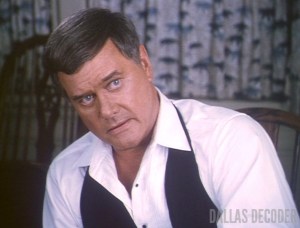
The first anniversary of Larry Hagman’s death is November 23, although to me, he never really went away. Hagman’s old “Dallas” episodes run on a seemingly endless loop in my house. I watch him all the time, and that would probably be true even if I didn’t write and edit this website. Larry Hagman still brings me joy. The other day, I re-visited the 1983 segment where J.R. goes to the Oil Baron’s Ball and slyly insults every relative seated near him. With each gleeful quip, Hagman’s smile couldn’t be contained. Neither could mine.

Do I wish Hagman were still around, filming new episodes of TNT’s “Dallas” revival? Of course, although given the remarkable body of work he left behind (more than 380 appearances as J.R. in the various “Dallas” shows, spinoffs and sequels), to want more from him feels almost greedy. Likewise, while I’ll always regret that I never met my hero, I did get to speak to him on the phone once. How lucky am I? By most accounts, Hagman was a hell of a guy — joyful, generous, wise, progressive, amusingly eccentric — and so one year after his death, whatever sadness I feel is reserved for the people who knew him best. As a fan, I lost an actor whose work I admired from afar. But Hagman’s family and friends? They lost a real, special man.

Don’t get me wrong: Hagman’s death upset me a year ago. He died on the day after Thanksgiving, giving Black Friday a whole other meaning. Now the timing feels kind of cosmic. The anniversary of his death will always come two days after the anniversary of the “Who Shot J.R.?” revelation and around Thanksgiving, reminding us to feel grateful for the wonderful performances he gave us. We can also feel thankful to the people who help keep Hagman’s memory alive, including the folks who run his Facebook page, which offers a treasure trove of rare photographs and other mementos. For that matter, we should also give thanks to the “Dallas” producers and cast members,  who have done an impressive job honoring their show’s biggest star. The episode where Hagman’s alter ego is laid to rest, “J.R.’s Masterpiece,” lived up to its title, but the tributes haven’t stopped there. Showrunner Cynthia Cidre has promised to keep Hagman’s name atop the production call sheets for the duration of the series, reminding the cast and crew that “Dallas” is the house Hagman built.

There are also hints that J.R. will figure into next season’s storylines, wheeling and dealing from beyond the grave, and a recent tweet from the set suggests Josh Henderson will sport his on-screen daddy’s signature wristwatch and belt buckle. If the producers are looking for one more way to honor Hagman, “Dallas” fan Joe Siegler has a nifty suggestion: Instead of continuing to have the cast take turns delivering each episode’s “Previously on ‘Dallas’” voiceover, why not use Hagman’s version exclusively? This would be a small gesture, but I can’t imagine a better way to start each new hour of “Dallas” than by hearing J.R.’s voice.

Of course, Hagman’s legacy extends beyond the show he made famous. We live in a golden age of television drama, populated by antiheroes like Walter White and Don Draper. None of them would exist if J.R. Ewing hadn’t come first. What a shame so many TV critics neglect to mention that. Even more shameful: Hagman’s omission from the special tributes during this year’s Emmy broadcast and his snub in the dramatic supporting actor race. Few performers deserved Emmy recognition more than Hagman this year — and not just because he didn’t receive a trophy during the original “Dallas’s” heyday. Hagman did some of the best work of his career on the TNT series. One example: last year’s “Family Business” episode, which showcased his powerful, poignant portrait of the aging J.R.

On the other hand: Who needs Emmys? If the past year has taught me anything, it’s how much affection “Dallas” fans have for Hagman. Our love for him is deep and real, and it will sustain his legacy for a long time to come. It’s another reason I don’t feel a strong sense of loss as the anniversary of his death approaches. The truth is, Larry Hagman isn’t really gone; he just lives in our hearts now.

How will you remember Larry Hagman and J.R. Ewing? Share your comments below and read more opinions from Dallas Decoder.

Tonight, #DallasChat Honors the Master

Dallas, False Confessions, J.R. Ewing, Larry Hagman, TNT

The one we love

Our next #DallasChat on Twitter will be held Monday, November 18, from 9 to 10 p.m. Eastern time. Since the first anniversary of Larry Hagman’s death is later this week, we’ll honor him with a special J.R.-themed discussion. The title: “The Master.”

Here’s how #DallasChat works: I tweet a question roughly every five minutes for one hour. Each question is numbered and includes the hashtag #DallasChat, so your responses should do the same.

A sample exchange:

Q1. What was Larry Hagman’s all-time funniest line as J.R. Ewing? #DallasChat

A1. When he told Lucy she should get her plastic surgeon husband to design her a new face … without a mouth! #DallasChat

Two pointers:

• During the discussion, enter #DallasChat in Twitter’s search field. This will help you watch the search results so you can follow the conversation. Click “All” to see all the related tweets.

• Include the hashtag #DallasChat in each tweet you send so others can see your contributions to the conversation. Feel free to start side conversations of your own, but be sure to include #DallasChat in those tweets too.

This will be another memorable chat. I hope you can participate!

Critique: ‘Dallas’ Episode 139 — ‘The Oil Baron’s Ball’

Dallas, Linda Gray, OIl Baron's Ball, Sue Ellen Ewing

Open door policy

J.R. and Sue Ellen’s relationship takes a lot of twists over the years, but nothing fascinates me more than when she starts emulating him. It begins during Linda Gray’s final seasons on the original “Dallas,” when Sue Ellen becomes a wheeler-dealer in business, and it continues on TNT’s sequel series, when we see her reach into J.R.’s bag of tricks to defeat enemies like Governor McConaughey. In “The Oil Baron’s Ball,” Sue Ellen’s transformation into J.R.’s protégé is still a few years away, but this episode nonetheless offers a glimpse of where Gray’s character is headed. By the end of the hour, we see just how much Sue Ellen is learning at the feet of the master.

Gray has three notable scenes in this episode. In the first, Sue Ellen is strolling through a park when she notices all the happy young couples surrounding her. Eventually, she comes across a group of attractive, shirtless men playing football and stops to watch. Writer-director Leonard Katzman shows the game in slow motion, allowing the camera to linger on the players. There’s no doubt what this scene is supposed to represent: Sue Ellen’s sexual desires, which have gone unfulfilled since she moved out of J.R.’s bedroom several episodes earlier. By today’s standards, the football scene seems a little campy — especially when all those half-naked, straight-from-the-80s hunks start falling all over each other — but it also strikes me as surprisingly progressive. Here’s “Dallas,” easily one of the era’s most chauvinistic TV shows, taking a moment to acknowledge that women don’t exist solely to please men; they have needs of their own. How can you not admire that?

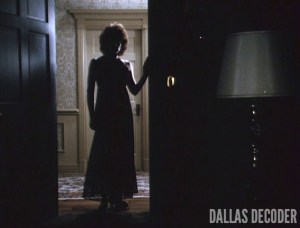
As soon as the football scene ends, Katzman cuts to Southfork that night, where J.R. is reading in bed. Suddenly, the door opens, revealing Sue Ellen’s silhouette. “Do you want something?” he asks. She strides into the room, flings the door closed behind her and climbs onto the bed. “Yes, I want something,” she says, taking the book out of J.R.’s hand and kissing him aggressively as the screen fades to black. The next time we see the couple, Sue Ellen is turning on the bedside lamp as a beaming J.R. watches from under the covers. When she tells him she’s going back to her room, he’s confused. Sue Ellen explains: “You see, J.R., I have no desire to live with you. Now, granted, from time to time, I may need you. And if and when that happens, then I’ll be back. But that’s all. That’s as close to being married as we will ever be.” J.R. is furious and accuses her of treating him like “some kind of stud service.” Her response: “What other possible use would I have for you?”

This is a terrific scene for a lot of reasons, beginning with Gray’s playfully sultry delivery. It’s a moment of triumph for Sue Ellen — and Gray savors every second of it. Indeed, consider how far her character has come: In “Spy in the House,” “Dallas’s” third episode, a sexually neglected Sue Ellen buys a negligee, hoping to get J.R.’s attention; when he calls it “cheap” and walks out on her, she collapses in tears. Sue Ellen soon begins turning to other men, but “The Oil Baron’s Ball” marks the first time we see her take charge of her sexual relationship with J.R. It puts her on the same page as Pam, who is the original “Dallas’s” most sexually liberated woman (occasionally incurring her own husband’s wrath). Perhaps more anything, J.R. and Sue Ellen’s bedroom scene is an exercise in poetic justice: The man who has treated countless mistresses as sexual playthings now gets a taste of his own medicine — and from his wife, no less.

Sue Ellen’s most J.R.-like moment in “The Oil Baron’s Ball” is yet to come. In the third act, our newly empowered heroine visits Windsor Meadow and sends John Ross to summon Peter, the camp counselor to whom she finds herself increasingly attracted. Sue Ellen asks Peter to escort Lucy to this year’s Oil Baron’s Ball, although it’s pretty obvious that Sue Ellen really wants Peter for herself, not for her niece. Peter is reluctant to accept — the young man harbors a secret crush on Sue Ellen and has never even met Lucy — but every time he comes up with an excuse to not go, Sue Ellen is one step ahead of him. When Peter tells her that he would feel out of place at the ball, she responds there’s no place he wouldn’t fit in perfectly. When he says he doesn’t own a dark suit, Sue Ellen reveals she has already arranged for him to visit J.R.’s tailor to be fitted for a tuxedo, compliments of her. Peter has no choice but to say yes, demonstrating once again how much she has learned from her husband. Sue Ellen has always had a manipulative streak, but her use of charm, confidence and gifts to bend Peter’s will comes straight from J.R.’s playbook.

The rest of “The Oil Baron’s Ball” is a mix of heavy drama and light moments. The episode picks up where the previous hour left off, with Lil taking the stand in Ray’s trial and revealing he did indeed pull the plug on Mickey, but only because she couldn’t bring herself to do it. This is a fake-out worthy of TNT’s “Dallas” (admit it: you thought Lil was the culprit), and Kate Reid does a nice job delivering her character’s monologue. The most moving moment, though, comes when Donna tells Ray that even though she believes he had no right to take Mickey’s life, she doesn’t want him to go prison for it. I love this scene because Susan Howard is so good in it — she makes me feel very ounce of Donna’s anguish — and also because it clearly spells out the character’s dilemma of reconciling her personal beliefs with her desire to stand by her husband.

Still, I can’t help but think this conversation between Ray and Donna should have occurred at the beginning of the “who killed Mickey?” mystery, not at the end. For that matter, I also wish this storyline should had been wrapped up in the previous episode, “Ray’s Trial.” No sooner has the judge handed down Ray’s sentence — parole, not jail (naturally) — then Ray and Donna are dancing at the glittery ball. It’s odd to see these characters move on so quickly. Likewise, we never see Lil bid farewell to the Krebbses; after the verdict is announced, Reid simply vanishes from “Dallas” (although she does pop up again briefly a few years later). After the trial, wouldn’t it have been nice to see Ray, Donna, Lil and Lucy visit Mickey’s grave? Besides giving the audience a sense of closure, it would have served as a nice bookend to the memorable Amos Krebbs’s funeral scene a year earlier, when the Trotters were introduced.

Even if the juxtaposition between the courtroom and the ball is jarring, I must admit: The latter scenes are awfully fun. Ken Kercheval somehow manages to make Cliff seem both humbled and overbearing in the instant when the character is named oilman of the year, and the clash between the Ewing and Barnes/Wentworth women in the powder room is delicious. Above all, I love the bon mots J.R. drops during the course of the ball. When Pam arrives and drops by the Ewing table, J.R. delights in re-introducing her to Bobby’s date, Jenna Wade. Bobby tells him to cut it out, but J.R. can’t help himself. “Well, for those who don’t have a program, I’m just going to have to announce the names of all the players, aren’t I?” he says. Larry Hagman’s smile is even more mischievous than usual.

Later, when J.R. sees how uncomfortable Bobby, Pam and Jenna are around each other, he declares this is going to be “one of the great nights of my life.” Leave it to Sue Ellen to put him in his place. “Nothing brings out the best in you like other peoples’ unhappiness,” she says. The line makes me think: Perhaps J.R. has a thing or two to learn from her too.

Grade: B

_______________________________________________________________________________________________________________________________________________

Dallas, Donna Krebbs, Oil Baron's Ball, Ray Krebbs, Steve Kanaly, Susan Howard

At last

‘THE OIL BARON’S BALL’

Season 7, Episode 8

Airdate: November 18, 1983

Audience: 23 million homes, ranking 2nd in the weekly ratings

Writer and Director: Leonard Katzman

Synopsis: After Lil testifies that Ray pulled the plug on Mickey at her request, Ray is found guilty but given parole. Sue Ellen treats J.R. like a sexual plaything and persuades Peter to escort Lucy to the Oil Baron’s Ball. At the ball, Pam and Jenna clash and Cliff is named oilman of the year.

Cast: Charles Aidman (Judge Emmett Brocks), Christopher Atkins (Peter Richards), John Beck (Mark Graison), Morgan Brittany (Katherine Wentworth), Delores Cantú (Doris), Roseanna Christiansen (Teresa), Glenn Corbett (Paul Morgan), Patrick Duffy (Bobby Ewing), Linda Gray (Sue Ellen Ewing), Larry Hagman (J.R. Ewing), Susan Howard (Donna Krebbs), Richard Jaeckel (Assistant District Attorney Percy Meredith), Steve Kanaly (Ray Krebbs), Omri Katz (John Ross Ewing), Ken Kercheval (Cliff Barnes), Audrey Landers (Afton Cooper), Timothy Patrick Murphy (Mickey Trotter), Priscilla Presley (Jenna Wade), Victoria Principal (Pam Ewing), Kate Reid (Lil Trotter), Debbie Rennard (Sly), Charlene Tilton (Lucy Ewing), Deborah Tranelli (Phyllis), Debi Sue Voorhees (Caroline), Morgan Woodward (Punk Anderson)

“The Oil Baron’s Ball” is available on DVD and at Amazon.com and iTunes. Watch the episode and share your comments below.
Today at 4 p.m.: ‘The Best of #DallasChat’

Dallas, Larry Hagman, Sins of the Father, TNT

Simply the best

Our next #DallasChat on Twitter will be Monday, November 11, from 4 to 5 p.m. Eastern time. I’m holding this week’s discussion a little earlier than usual so readers from other time zones can participate. I’ll also be asking some of my favorite questions from previous chats, so our theme will be “The Best of #DallasChat.”

Here’s how #DallasChat works: I tweet a question roughly every five minutes for one hour. Each question is numbered and includes the hashtag #DallasChat, so your responses should do the same. A sample exchange:

Q1. Which “Dallas” character could use a dunking in the Southfork swimming pool? #DallasChat

A1. Judith Ryland, of course. If she floats, we’ll know if she’s really a witch. #DallasChat

Two pointers:

• During the discussion, enter #DallasChat in Twitter’s search field. This will help you watch the search results so you can follow the conversation. Click “All” to see all the related tweets.

• Include the hashtag #DallasChat in each tweet you send so others can see your contributions to the conversation. Feel free to start side conversations of your own, but be sure to include #DallasChat in those tweets too.

This is going to be a fun chat. Don’t miss it!

Critique: ‘Dallas’ Episode 138 — ‘Ray’s Trial’

Dallas, Ray Krebbs, Ray's Trial, Steve Kanaly

His day in court

I always remembered the mystery surrounding Mickey Trotter’s death as boiling down to a single question: Did Ray or Lil pull the plug on him? Last week, when I re-watched “Ray’s Trial” for the first time in a few years, I realized “Dallas” also poses a second, more complicated question: Did Mickey want to live or die? Ray and Lucy each offer different answers during the course of the episode, and technically, both of their statements are accurate. Does that mean both statements are also true? I’m not sure anyone can answer that definitively, which makes the storyline feel a lot more interesting than I previously gave it credit for.

To appreciate this aspect of “Ray’s Trial,” it’s worth remembering two crucial scenes from the preceding episodes. In “My Brother’s Keeper,” when Mickey is struggling to come to grips with his paralysis, he pulls Ray aside and tells him, “The idea of living like a vegetable with some damn machine keeping me alive disgusts me. It’s the worst horror I can imagine. … If it happens, I hope and pray that no one’s going to let me live that way.” Later, in “The Quality of Mercy,” Mickey’s mood brightens when he realizes Lucy is determined to stand by him despite the fact that he’ll never walk again. “Who knows? Maybe we’ll get married yet,” Mickey tells her.

But this is “Dallas,” so of course that never happens. When Mickey slips into a coma, his respirator is disconnected off-screen by either Ray or Lil, the two people with him at the time. The district attorney charges Ray, although the show goes out of its way to drop hints that the real culprit is Lil and Ray is only covering up for her. “Dallas” doesn’t solve the mystery until the next episode, allowing the audience to spend “Ray’s Trial” pondering what Mickey wanted, which turns out to be the more interesting question anyway. At the top of the hour, Ray meets with his lawyer and recalls Mickey’s “worst horror” comment, holding this up as evidence that Mickey preferred death to being kept alive via medical machinery. Later, when Lucy testifies at Ray’s trial, she recalls the marriage plans she and Mickey were making before he slipped into the coma. “He wanted to live. He really did,” she says.

Once again, these are two characters offering two technically accurate but fundamentally different answers to the question of whether Mickey wanted to live or die. Who you choose to believe may come down to where you stand on the issue of euthanasia, which is where “Ray’s Trial” ultimately falls short. Scriptwriter Arthur Bernard Lewis doesn’t devote much time to examining the moral implications of Mickey’s death, which is somewhat surprising considering the difference of opinion Ray and Donna apparently bring to the issue. At one point, Ray tells his lawyer, “What I did was not immoral.” This seems to put him at odds with Donna, whose personal beliefs are hinted at in the previous episode when she declares, “Nobody has the right to play God.” So why doesn’t “Ray’s Trial” give us a scene of husband and wife debating the issue?

Even if the material feels incomplete, Steve Kanaly makes the most of it. In my recent interview with him, Kanaly recalled growing up watching westerns and admiring actors like Gary Cooper. The comment must have lodged itself in the back of my mind because when I watched “Ray’s Trial” a few days later, I was struck by how much Kanaly reminds me of Cooper. The actors share similarly quiet, dignified mannerisms, and both are able to say a lot without uttering a single line of dialogue. In Kanaly’s case, watch his haunted eyes in this episode and you’ll see everything that the script doesn’t tell us about what Ray is feeling.

The other performer to watch is Charlene Tilton, who appears only twice but makes a lasting impression. She does a beautiful job delivering Lucy’s tearful testimony, which supplies “Ray’s Trial” with its moment of emotional catharsis. My favorite scene, though, comes a few moments later, when Donna comforts Lucy in the courthouse corridor after Lucy reluctantly testifies against Ray. This is a brief scene and the script doesn’t give Tilton much dialogue, but none is needed. Her anguished expression says it all. The courtroom scenes also feature a couple of old pros — Richard Jaeckel as prosecutor Percy Meredith and Glenn Corbett as Paul Morgan, Ray’s defense lawyer — as well as a young Steven Williams, who appears here as a bailiff and later plays the police captain on “21 Jump Street.”

This episode’s other notable moments include Mark Graison’s polo match, which might be “Dallas’s” most thrilling horseback riding sequence since Jock Ewing surged across the Southfork plains at the beginning of the second-season classic “Bypass.” “Ray’s Trial” also marks Lois Chiles’ final appearance as Holly Harwood. In her last scene, Holly approaches J.R. in a cocktail lounge and taunts him over losing the battle for Ewing Oil. Besides giving Chiles one last opportunity to spar with Larry Hagman, I like how this scene mimics J.R. and Holly’s first on-screen encounter, which also takes place in a cocktail lounge.

The other highlight of “Ray’s Trial” is the arrival of Priscilla Presley, who makes her “Dallas” debut as Jenna Wade. It’s a fine first appearance, although it includes a bit of a curiosity. In one of Presley’s scenes, Bobby pulls up in front of Jenna’s home as she approaches the sidewalk. He invites her to join him for lunch, but when director Michael Preece offers us a close-up shot of Bobby’s car radio, we see the clock reads “5:45.” From this, we can deduce one of two things: Either Ewings eat lunch very late, which makes them a lot different than you and me, or Bobby has yet to figure out how to set the clock in his car, in which case he’s just like us.

Grade: B

_______________________________________________________________________________________________________________________________________________

Dallas, Jenna Wade, Priscilla Presley, Ray's Trial

Hello again

‘RAY’S TRIAL’

Season 7, Episode 7

Airdate: November 11, 1983

Audience: 22.4 million homes, ranking 2nd in the weekly ratings

Writer: Arthur Bernard Lewis

Director: Michael Preece

Synopsis: Ray goes on trial and frustrates Donna with his reluctance to defend himself. Bobby runs into Jenna, who now works as a waitress. J.R. woos the cartel.

Cast: Charles Aidman (Judge Emmett Brocks), Christopher Atkins (Peter Richards), John Beck (Mark Graison), Morgan Brittany (Katherine Wentworth), Lois Chiles (Holly Harwood), Glenn Corbett (Paul Morgan), Michael Cornelison (Dr. Snow), Patrick Duffy (Bobby Ewing), Eric Farlow (Christopher Ewing), Fern Fitzgerald (Marilee Stone), Steven Fuller (bailiff), Tony Garcia (Raoul), Linda Gray (Sue Ellen Ewing), Larry Hagman (J.R. Ewing), Susan Howard (Donna Krebbs), Richard Jaeckel (Assistant District Attorney Percy Meredith), Steve Kanaly (Ray Krebbs), Omri Katz (John Ross Ewing),  Howard Keel (Clayton Farlow), Ken Kercheval (Cliff Barnes), Audrey Landers (Afton Cooper), Joseph R. Maross (Dr. Blakely), Andrea McCall (Tracy Anders), Priscilla Presley (Jenna Wade), Victoria Principal (Pam Ewing), Kate Reid (Lil Trotter), Paul Sorensen (Andy Bradley), Don Starr (Jordan Lee), Charlene Tilton (Lucy Ewing)

“Ray’s Trial” is available on DVD and at Amazon.com and iTunes. Watch the episode and share your comments below.
Feel that Ryland Love Tonight on #DallasChat

Dallas, Furious and the Fast, Harris Ryland, Judith Light, Judith Brown Ryland, Mitch Pileggi, TNT

Love thy mama

Our next #DallasChat on Twitter will be held Monday, November 4, from 9 to 10 p.m. Eastern time. The theme will be “The Rylands,” which ought to tell you everything you need to know.

Here’s how #DallasChat works: I tweet a question roughly every five minutes for one hour. Each question is numbered and includes the hashtag #DallasChat, so your responses should do the same. A sample exchange:

Q1. Which Ryland is meaner: Harris or Judith? #DallasChat

A1. Harris is definitely meaner. He pushes people down stairs. She only takes them down verbally. #DallasChat

Two pointers:

• During the discussion, enter #DallasChat in Twitter’s search field. This will help you watch the search results so you can follow the conversation. Click “All” to see all the related tweets.

• Include the hashtag #DallasChat in each tweet you send so others can see your contributions to the conversation. Feel free to start side conversations of your own, but be sure to include #DallasChat in those tweets too.

This is going to be a fun chat. Don’t miss it!

Critique: ‘Dallas’ Episode 137 — ‘Check and Mate’

Bobby Ewing, Check and Mate, Dallas, J.R. Ewing, Larry Hagman, Patrick Duffy

Endgame

“Check and Mate” brings J.R. and Bobby’s contest for control of Ewing Oil to a satisfying but somewhat silly conclusion. In the final scene, the brothers learn J.R. boosted the company’s profits by $40 million, making him the clear-cut winner. With his victory clenched, J.R. announces he’s reneging on his earlier promise to split the company with Bobby, even if Bobby comes up short. Suddenly, Bobby receives some last-minute news: He just made a killing on his Canadian drilling deal, making him the contest’s winner. J.R. wants to go back to their original power-sharing deal — and of course Bobby agrees. Would we expect anything less from this show?

Indeed, this is another example of “Dallas’s” rather fanciful approach to big business. J.R. and Bobby receive the contest results while meeting with lawyer Harv Smithfield on the last day of the competition. Legally, shouldn’t this meeting have taken place the following day, when all the profits could have been counted? Also, in the previous episode, Bobby’s Canadian partner Thornton McLeish still hadn’t struck oil; now we learn Bobby and McLeish not only hit big, they managed to sell their shares to some bigger oil companies. Talk about a fast sale!

But even if this scene stretches credulity, it remains one of the best corporate showdowns from a series that practically invented them. Bobby’s 11th-hour victory is surprising and dramatic; I usually don’t like to see J.R. get beat, but when Bobby does it, I let it slide. Besides, Larry Hagman gets to show a lot of range here — unabashed smugness when J.R. thinks he’s won, muted humility when he realizes he’s lost — and that’s always fun to watch. (I also appreciate how the sequence includes one last letter from Jock, whose explanation that the true purpose of the contest was to bring his sons together makes the storyline feel like Jock’s version of J.R.’s master plan from the TNT series. Or maybe it’s the other way around.)

The lasting consequences of J.R. and Bobby’s fight yields mixed feelings too. There’s no doubt the battle has changed Bobby, who compromised his integrity in his quest for power and ended up losing his wife and son along the way. Bobby is now a damaged man, and Patrick Duffy does a nice job imbuing his character with a sad, soulful weariness. I wish we could say something similar about J.R. After the Southfork fire, J.R. had an attack of conscience and agreed to jointly run Ewing Oil with Bobby, regardless of which brother won the competition. He changed his mind pretty quickly and spent the episodes before “Check and Mate” secretly plotting to stab Bobby in the back when the final results were announced. No one wants to see J.R. turn into a good guy, but wouldn’t it have been more interesting to watch him wrestle with breaking his promise to Bobby? It would have revealed a new depth to J.R.’s character and made the yearlong battle for Ewing Oil, one of “Dallas’s” milestone moments, feel even more meaningful.

Even with these slight shortcomings, “Check and Mate” remains the seventh season’s strongest hour yet. With J.R. and Bobby’s war ending, the show shifts its attention to two supporting characters: Ray and Donna, whose marriage is rocked after Ray is arrested for Mickey’s mercy killing. (This makes Mickey one of the last casualties in the war for Ewing Oil, along with Rebecca Wentworth and Walt Driscoll.) Did Ray pull the plug? Or was it Lil, the only other person in the room at the time? Steve Kanaly is a portrait of quiet resolve as Ray goes through this episode refusing to discuss what happened in the moments before Mickey’s death. The silence is frustrating, but it’s also perfectly in keeping with the character of Ray, a laconic cowboy if ever there was one. Whether Ray pulled the plug himself or he’s simply taking the fall to protect Lil, we wouldn’t expect him to talk about it.

Even if Ray doesn’t have much to say, Kanaly still manages to give the audience a sense of Ray’s inner torment. In “Check and Mate’s” moving next-to-last scene, he sits at the patio table outside his home and asks the deeply depressed Lil for permission to bury Mickey at Southfork. Kanaly’s delivery breaks my heart, but as I watched this scene I remembered Ray and Jock’s memorable conversation at that very table in “The Fourth Son,” when the old man told Ray he was his son. It’s a subtle but poignant reminder of how Ray tried to take Mickey under his arm, the way Jock did with Ray, and how Ray’s efforts ultimately fell short. On the other hand, whether Ray killed his cousin himself or he’s just protecting Lil, is he not exhibiting a Jock-like sense of duty and honor?

Like Kanaly, Susan Howard also makes the most of her time in the spotlight. She has two terrific moments in “Check and Mate.” In the first act, Donna speaks to Ray in jail after his arrest; the glass partition separating the couple feels like a stand-in for the bigger barrier, which is Ray’s willingness to open up about the circumstances surrounding Mickey’s death. Donna seems to believe Ray disconnected Mickey’s life-support system, and Howard makes her character’s disappointment palpable. “Nobody has the right to play God,” she says with signature breathiness. Donna’s reaction makes sense, given the character’s strong moralistic bent. It’s another example of how well “Check and Mate” scriptwriter David Paulsen knows these characters.

Howard’s second great moment comes at the beginning of the third act, when Donna rides out to a Southfork pasture to confront Ray about his lack of willingness to defend himself. She reminds her husband that his only duty wasn’t to ease Mickey’s suffering; Ray also has an obligation to his marriage. Once again, Paulsen gives Howard a great line, and she delivers it beautifully: “You’re what I wanted all my life. You may not think your life is worth saving, but I sure as hell do.” With this single line, Paulsen manages to encapsulate Donna’s entire history with Ray, including her affair with him during her marriage to Sam Culver and when she rescued Ray from depression after Jock’s death.

The other great performance in “Check and Mate” comes from Charlene Tilton, who is moving and believable in the scene where Ray comes home from jail and is greeted by the Lucy, who in her grief-stricken rage beats on his chest and cries, “You murdered him!” It’s another example of how Tilton, when given good material, is a terrific actress. I also have to hand it once again to Howard, who allows the scene to end on a graceful note. “For God’s sake,” Donna says as she tries to comfort Lucy. “Don’t you know that it’s tearing him apart too?”

Like all great “Dallas” episodes, the details in “Check and Mate” are also worth paying attention to. Toward the end of the scene where Sue Ellen offers to throw a barbecue for Peter and his fellow camp counselors, Linda Gray touches Christopher Atkins’ shoulder; right at that moment, composer Bruce Broughton brings a few piano keys into the background score to ensure the audience doesn’t miss the significance of the gesture. Moments later, when Peter runs back into the building to retrieve John Ross, watch how Atkins bounds up the stairs. Peter is still a boy himself, isn’t he?

Elsewhere, director Leonard Katzman also gives us a great shot during the scene where Cliff approaches Sly as she leaves Ewing Oil for her lunch break. Debbie Rennard stands with her back to the building, facing Ken Kercheval, whose face is reflected in the façade. It’s a clever way to get both performers’ faces in the frame, but is it not also a symbol of how Cliff is increasingly reflecting the underhanded sensibilities of the enemy who works there?

Grade: A

_______________________________________________________________________________________________________________________________________________

Cliff Barnes, Dallas, Debbie Rennard, Ken Kercheval, Sly Lovegren

Two-faced

‘CHECK AND MATE’

Season 7, Episode 6

Airdate: November 4, 1983

Audience: 22.5 million homes, ranking 1st in the weekly ratings

Writer: David Paulsen

Director: Leonard Katzman

Synopsis: The contest for Ewing Oil ends with Bobby the winner, but he agrees to share the company with J.R. When Ray is arrested in Mickey’s death, Donna hires Paul Morgan to represent him, while Lil slips into a deep depression. Pam goes to work with Cliff, who uses inside information from Sly to steal a big deal out from under J.R. Bobby tells Holly can never date her.

Cast: Dan Ammerman (Neil), Christopher Atkins (Peter Richards), John Beck (Mark Graison), Morgan Brittany (Katherine Wentworth), Lois Chiles (Holly Harwood), Roseanna Christiansen (Teresa), Jack Collins (Russell Slater), Glenn Corbett (Paul Morgan), Patrick Duffy (Bobby Ewing), Eric Farlow (Christopher Ewing), Linda Gray (Sue Ellen Ewing), Larry Hagman (J.R. Ewing), John Hostetter (Gerber), Susan Howard (Donna Krebbs), Steve Kanaly (Ray Krebbs), Omri Katz (John Ross Ewing), Howard Keel (Clayton Farlow), Ken Kercheval (Cliff Barnes), Kenneth Kimmins (Thorton McLeish), Audrey Landers (Afton Cooper), George O. Petrie (Harv Smithfield), Victoria Principal (Pam Ewing), Kate Reid (Lil Trotter), Debbie Rennard (Sly), Bill Thurman (Allen Murphy), Charlene Tilton (Lucy Ewing), Morgan Woodward (Punk Anderson)

“Check and Mate” is available on DVD and at Amazon.com and iTunes. Watch the episode and share your comments below.