Dallas Scene of the Day: ‘I’m Back, Daddy’

His son, the father

His son, the father

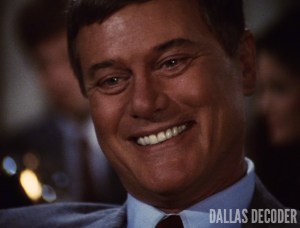
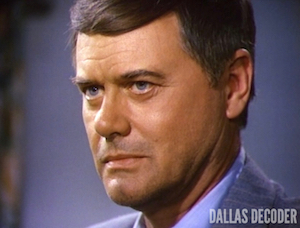
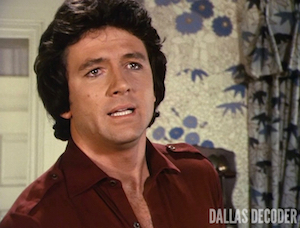
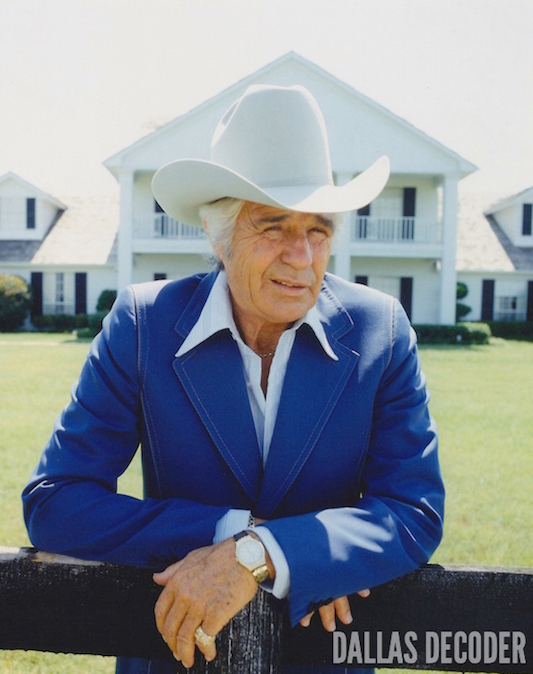
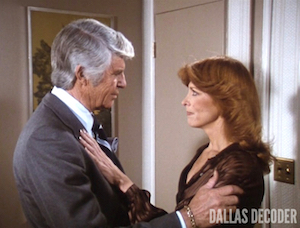
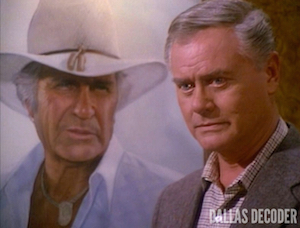
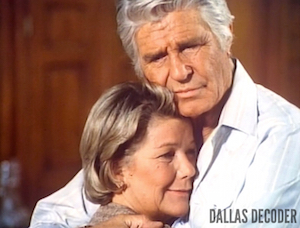
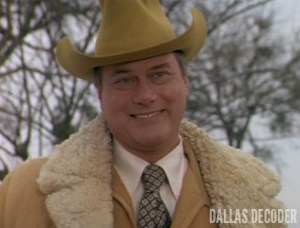
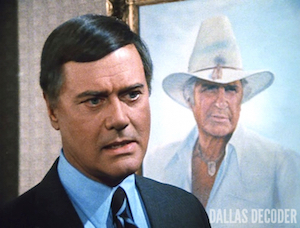
In “Dallas’s” fifth-season episode “The Phoenix,” J.R. (Larry Hagman) enters Jock’s empty office at Ewing Oil, walks slowly around the desk, grips the back of the chair and then steps toward the old man’s portrait.

J.R.: I’m sorry, Daddy. I let you down. I just flat gave up. Back there at that swamp, you were gone. It was all over. It didn’t seem like there was anything worth going on for for me. And I almost forgot: You left us something. You left us the company. You built Ewing Oil from the ground up. And whatever it took, you did it for Ewing Oil. And I’m going to do the same. I’m going to pass it on bigger and stronger to my son. … I’m back, Daddy. And nobody’s going to take Ewing Oil away from me. Or my son, or his son. I swear to you. By God, I’m going to make you proud of me.
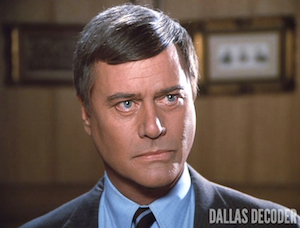
Critique: ‘Dallas’ Episode 93 – ‘The Phoenix’

Rising son

Rising son

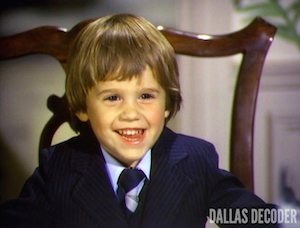
Two great scenes bookend “The Phoenix.” In the first, J.R. brings John Ross to Ewing Oil on a Sunday morning so the little boy can see where Daddy works. This is Larry Hagman at his most charming – and mischievous. As J.R. carries his son through the reception area, he points out where “Daddy’s pretty secretaries” sit, then nods toward the hallway and says, “That’s your Uncle Bobby’s office, where he does whatever he does around here.”

Moments later, J.R. shows John Ross his oil derrick model, then plops the child in his desk chair, gives it a few spins and waxes sentimental. “Your granddaddy taught me everything I know about this business,” J.R. says. “He’d be so proud if he knew I was doing the same with you.” It’s an unabashedly sweet moment.

In “The Phoenix’s” final scene, J.R. wanders into Jock’s office and delivers a stirring monologue while gazing at the Ewing patriarch’s famous portrait, which is seen for the first time since its debut before the closing credits in “The Search.” I’ve watched this scene a lot over the years, and the combination of Hagman’s conviction – especially when he delivers the final line (“By God, I’m going to make you proud of me”) – and Bruce Broughton’s rousing score never fails to give me chills.

(Of course, even though J.R.’s speech is moving, I can’t help but wonder why this is the first time we’ve seen Jock’s office. Did the producers build the set just so they could introduce the painting, which becomes “Dallas’s” most iconic prop? Also, pay attention to the nameplate on Jock’s office door. It reads “Jock Ewing” in the close-up and “J. Ewing” in the wide shot.)

Overall, “The Phoenix” is another solid hour from “Dallas’s” fifth season. I especially like Ray’s storyline. In this episode, he sleeps with Bonnie, the barfly who’s been keeping him company while he spends his nights wallowing in self-pity at the Longview bar. I used to find Ray’s marital lapse shocking, but now I realize it’s perfectly in keeping with his character. Ray has always struggled with feelings of self worth. By cheating, he’s not trying to hurt Donna. He’s trying to hurt himself.

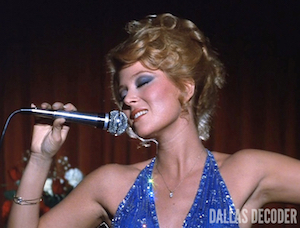
The other highlight of “The Phoenix” is Afton’s mesmerizing rendition of “All of Me” at the fancy nightclub where Cliff has gotten her a job. I always love hearing Audrey Landers perform on the show, and this might be her best number. It doesn’t hurt that Landers looks positively glamorous in that slinky blue sequined gown.

More than anything, I like how Afton stands up for herself when she realizes Cliff still pines for Sue Ellen. It makes me wonder: Does the title of this episode refer to J.R., who is rising from the ashes of his despair over Jock’s death – or is it meant to describe Afton, who is beginning to take flight as one of the great “Dallas” heroines?

Grade: A

_______________________________________________________________________________________________________________________________________________

Lady sings in blue

Lady sings in blue

‘THE PHOENIX’

Season 5, Episode 16

Airdate: January 29, 1982

Audience: 23.1 million homes, ranking 2nd in the weekly ratings

Writer: David Paulsen

Director: Harry Harris

Synopsis: J.R. decides he doesn’t want Jock’s will read because he fears John Ross could lose a portion of his inheritance. Ray sleeps with old flame Bonnie. Cliff dates Afton while pining for Sue Ellen. Pam urges Bobby to learn more about Christopher’s real parents. Roger stalks Lucy.

Cast: Robert Ackerman (Wade Luce), Tyler Banks (John Ross Ewing), Barbara Bel Geddes (Miss Ellie Ewing), Lindsay Bloom (Bonnie), Morgan Brittany (Katherine Wentworth), Susan Damante-Shaw (Carolyn Carter), Patrick Duffy (Bobby Ewing), Fern Fitzgerald (Marilee Stone), Linda Gray (Sue Ellen Ewing), Larry Hagman (J.R. Ewing), Dan Hamilton (Eric), Susan Howard (Donna Krebbs), Steve Kanaly (Ray Krebbs), Howard Keel (Clayton Farlow), Ken Kercheval (Cliff Barnes), Leigh McCloskey (Dr. Mitch Cooper), Priscilla Pointer (Rebecca Wentworth), Victoria Principal (Pam Ewing), Dennis Redfield (Roger Larson), Debbie Rennard (Sly), Paul Sorensen (Andy Bradley), Don Starr (Jordan Lee), Charlene Tilton (Lucy Cooper), Vernon Weddle (McGregor), K.C. Winkler (Melinda)

“The Phoenix” is available on DVD and at Amazon.com and iTunes. Watch the episode and share your comments below.

The Dallas Decoder Interview: Michael Preece

Michael Preece

Michael Preece

No one “shot” J.R. Ewing more often than Michael Preece, who directed more than 60 episodes of the original “Dallas” series. He graciously agreed to share some of his memories of working on the show and with its biggest star, Larry Hagman.

You probably worked with Larry Hagman more than any other director. How much direction did he need when he was playing J.R.?

There was a saying on the set that “Dallas” was director-proof. Larry knew his character. He had a tendency to go a little bigger than was needed, so you’d try to curb him a little bit. Or if he didn’t know his lines well, sometimes he would have them written on cue cards and I’d say, “Larry, you sound like you’re reading it.” But basically, he needed very little direction – and that was true of much of the cast. They made it easy.

Larry Hagman in “Changing of the Guard”

Larry Hagman in “Changing of the Guard”

Did you two ever have disagreements about how a scene should be played?

Once in awhile, but usually Larry would win. Sometimes we would need an interpretation of something and would call [executive producer] Leonard Katzman because I didn’t know what was going to happen in the next episode and Leonard did. But usually that was worked out before we started shooting. I never had an argument with Larry or Patrick [Duffy] or Linda [Gray]. Not one.

It sounds like it was a pleasant set to work on.

It was a wonderful atmosphere. And jokes, all day long. We never got a clean rehearsal, but when it came time to shoot, the cast would play it perfectly. Most television shows go to 7 o’clock or 8 o’clock at night. With “Dallas,” we’d be leaving the [studio] lot for the day when people on other shows were just breaking for lunch.

Do you have a favorite scene you remember directing?

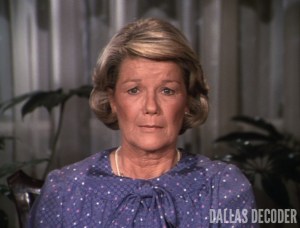
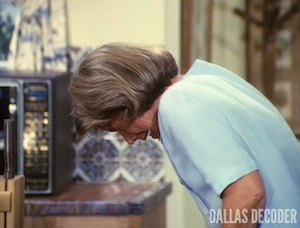
One scene stands out to me more than any other: when Barbara Bel Geddes goes into the kitchen and throws around the pots and pans after she realizes Jock is really dead. And the dining room scene prior to that, where she’s just sitting there thinking and the other people at the table are just babbling on.

That whole episode is wonderful!

Those dining room scenes were always chaotic. The boys – I call them the boys, Larry and Patrick – would always flick food at each other during rehearsal. So the night before we did that scene, Barbara called me and said, “You know, Michael, tomorrow is going to be difficult for me. Would you ask the boys to behave?” So I made the mistake of going to Larry and Patrick the next day. I said, “You know, this is a very important scene for her, so please, no fooling around.” And they said, “Don’t worry. We’re pros.” So we start the scene – this isn’t a rehearsal, we’re rolling – and the camera’s slowly moving in on Barbara and suddenly a pea hits her. I think it was right in the forehead.

Barbara Bel Geddes in “Acceptance”

Barbara Bel Geddes in “Acceptance”

Oh no!

She never broke. She just kept on acting. And she came back later and said, “I’m going to get you boys!” She had a terrific sense of humor. She loved to swear. I mean, she wasn’t like a sailor and she didn’t swear in anger so much, but she could get her swear words out.

It’s funny to imagine Miss Ellie cursing. She must have been fun to work with.

She was very professional. I would make a point of looking up her old movies and then I’d go up to her and I’d say, “Remember you worked with so and so.” She loved it. She’d tell stories about working with Hitchcock or someone else. A lot of those pictures, I’d never seen them. I learned about them from her.

What was it like when it came time to shoot the scene of her smashing the dishes? That must have been difficult.

Yeah, but only because it had to be precise. She didn’t want to do it over and over because she was crying, and you had to build up that momentum. I remember shooting it quite simply. But “Dallas” was shot very simply anyway. It wasn’t very artistic film-wise.

Was that frustrating? Did you ever think, “Gosh, I wish I could do something more creative here”?

Yeah, very much so. But “Dallas” was basically talking heads. We were able to make a shot once of someone coming out of the elevator, and then they go into one of the offices, and then they go into another office and then they come out [to the reception area] again. All in one shot. And when you see it, you don’t think, “Oh, wow, how’d they do that?” It didn’t draw attention, but it was different.

Mary Crosby’s legs in “Full Circle”

Mary Crosby’s legs in “Full Circle”

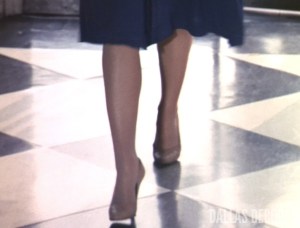
That reminds me: One of my favorite shots from one of your episodes is the scene where Mary Crosby’s character comes back to town and the first time we see her, the camera is following her legs across a hotel lobby.

I’m glad you remember that! We shot that at the Ambassador Hotel in Los Angeles. They wanted her return to be a little mysterious, so the script read something like, “She’s standing at the desk and turns and you see it’s Mary Crosby.” I remember thinking, “My, she has nice legs. Let’s follow her legs.” You don’t plan something like that.

You mentioned Leonard Katzman a little earlier. He really brought his own vision to the show, didn’t he?

Len would take situations that his family was going through and use them in the plot. I’d sit in on a story meeting and he’d say, “My daughter did this the other night. Let’s put that in a script and give it to Lucy.” Len and I were pretty close, and he would take things from my family too. He was always writing from real-life experiences, whether it was his own or mine or someone else’s. I think that’s the case with a lot of writers – they use what they know best.

It’s interesting to see “Dallas” being made without him. What do you think of the new show?

I want to see more of Larry and Patrick and Linda. I think the kids are good. I think some of them look too much alike, to be honest. [“Dallas” creator] David Jacobs said they should have switched and made Bobby’s son the bad one and J.R.’s son the good one. I thought that was a good idea when I heard it. But [the producers] wanted all-new ideas and new writers and directors, which I completely understand and kind of agree with.

Really?

Yeah. If they hired the writers and directors [from the original], you’d have a lot of, “Well, you know in the old days, we used to do it this way.” That’s the last thing you want to hear. [Laughter] I got into the business a long time ago – 1955 – and I remember hearing people say, “Oh, it’s not like the good old days.” And here it is many years later, people are still saying, “Oh, it’s not like the good old days!”

Well, I agree with you. I’d like to see more of the original stars too. It’s going to be hard to imagine “Dallas” without Larry Hagman.

He could still light up a screen. There are very few people like that. Steve McQueen, Clint Eastwood, Marlon Brando – they had that quality. Larry had it too.

Share your comments below and read more interviews from Dallas Decoder.

Dallas Scene of the Day: ‘It’ll Never Be the Same, Bob’

The mirror has two faces

The mirror has two faces

In “Dallas’s” fifth-season episode “Head of the Family,”  J.R. (Larry Hagman) sits on his bed drinking when Bobby (Patrick Duffy) enters and holds open the door.

J.R.: Well, Bob, I distinctly remember your room being down the hall. [Sips his drink]

BOBBY: Where were you tonight?

J.R.: Would you lay off about dinner?

BOBBY: It’s not about dinner. You think you’re the only one mourning Daddy, don’t you?

J.R.: Get the hell out of here, would you?

BOBBY: Well you’re not! [Slams the door behind him, steps into the room and rests his hand on a cabinet, looking away from J.R.] I miss him too. But I know what he’d want if he were alive. He’d want his boys up and doing. [Faces J.R.] And that includes running Ewing Oil the way he ran it.

J.R.: Bobby, the man is dead. It doesn’t matter anymore.

BOBBY: [Slams his fist on the cabinet] It does matter! If you let Ewing Oil die of neglect, you kill off everything he ever worked for.

J.R.: Leave me alone, will you? [Takes another sip]

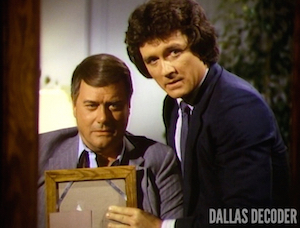
BOBBY: J.R., I’m doing everything I can. I need your cooperation. [Steps closer to the bed] And I’m hamstrung by Daddy’s letter and I think you know that. And frankly, I’m sick and tired of covering up for you. So do your job, damn you. [Grabs J.R., drags him to the mirror]

J.R.: Hey, hey.

BOBBY: Come here. Now look at yourself. Daddy didn’t build this company just for you and me. [Grabs a framed photograph of John Ross, shows it to J.R.] He expected it to be around for his grandkids. Maybe their kids too. [Slams the frame against J.R.’s chest] Get off your butt, J.R. We’ve got work to do. [Walks toward the door, opens it]

J.R.: It’ll never be the same, Bob.

BOBBY: Maybe it won’t. That’s no reason to do what you’re doing. If this family quits just because he’s gone, he didn’t leave us very much, did he? Some day you may want to tell John Ross just what his granddaddy spent his whole life building. How do you plan on doing that, J.R.? [He exits, leaving J.R. looking at the picture.]

Critique: ‘Dallas’ Episode 92 – ‘Head of the Family’

Down and out

Down and out

In “Head of the Family,” J.R. is depressed over Jock’s death and getting drunk in his bedroom when Bobby barges in and tells him to snap out of it. J.R. all but ignores his brother, so Bobby yanks him off the bed, drags him across the room and makes him look at himself in the mirror. “Daddy didn’t build this company just for you and me,” Bobby says. “He expected it to be around for his grandkids. Maybe their kids too.”

This is the most pivotal scene in one of “Dallas’s” most pivotal episodes. Until now, this has been a show rooted in its own past: Almost everything that happens to the Ewings and the Barneses can be traced to Jock and Digger’s falling out decades earlier. With “Head of the Family,” “Dallas” begins to move beyond its backstory and look toward the future.

No character demonstrates this shift better than J.R. Since the scene in “Digger’s Daughter” where he gleefully tells Jock about his scheme to bribe Pam, we’ve watched J.R. struggle to make his demanding daddy proud. In “Head of the Family,” with Jock gone, J.R. is forced to find new motivation. Instead of trying to impress Jock, J.R. decides to become Jock. Just as the older man devoted his life to building a legacy for his sons, J.R. sets out to do the same thing for John Ross.

This change – which will drive J.R. for the remainder of the original series – is symbolized in “Head of the Family’s” final scene, when a beaming J.R. watches John Ross climb into Jock’s empty chair at the Southfork dinner table. The child replaces his grandfather as the source of J.R.’s ambition.

Since the first season of TNT’s “Dallas” revival focused so heavily on the relationship between J.R. and his son, “Head of the Family” now feels a little like a template for the new show. Other themes from the TNT series are also present. J.R. is immobilized by depression in “Head of the Family,” just like he is when the new “Dallas” begins. Bobby spends this episode taking charge of the Ewings, just like he does three decades later. And when the newly single Sue Ellen’s first dinner party ends in disaster and she turns to Cliff for comfort, does it not presage the two-steps-forward-one-step-back pattern she comes to exhibit on TNT?

Even without these comparisons, “Head of the Family” remains one of the strongest hours from the classic show’s fifth season. This is the second “Dallas” script from Howard Lakin (“The Fourth Son” was his “Dallas” debut), who once again demonstrates a firm grasp of the show’s mythology. Patrick Duffy also does a nice job in his second turn in the “Dallas” director’s chair; I especially like Duffy’s overhead shot of Sue Ellen’s living room during the dinner party sequence.

Duffy shines in front of the camera too. The actor delivers some of his finest performances on “Dallas” in the episodes that deal with Jock’s death, including this one. In “Head of the Family,” Duffy brings to mind the best of his TV parents: He’s as commanding as Jim Davis and as compassionate as Barbara Bel Geddes. Watching Bobby struggle to keep the Ewings together is moving.

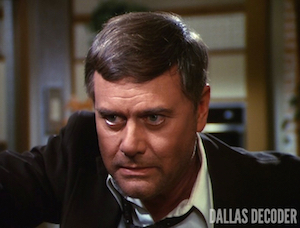
Of course, no one touches me in this episode quite like Larry Hagman, who is downright heartbreaking when Bobby confronts the depressed J.R. At the end of the scene, J.R. slumps onto the edge of his bed and tells his younger brother, “It’ll never be the same, Bob.” Thirty years ago, the line was merely sad. Now it feels prophetic.

Grade: A

_______________________________________________________________________________________________________________________________________________

Seat of power

Seat of power

‘HEAD OF THE FAMILY’

Season 5, Episode 15

Airdate: January 22, 1982

Audience: 25.3 million homes, ranking 4th in the weekly ratings

Writer: Howard Lakin

Director: Patrick Duffy

Synopsis: Bobby tells J.R. he must pull himself together to secure John Ross’s future. Ray alienates Bobby and Donna, whose publisher wants her to write another book. At her first dinner party, a friend’s husband makes a pass at Sue Ellen.

Cast: Tyler Banks (John Ross Ewing), Barbara Bel Geddes (Miss Ellie Ewing), Stephanie Blackmore (Serena), Lindsay Bloom (Bonnie), Patrick Duffy (Bobby Ewing), Linda Gray (Sue Ellen Ewing), Larry Hagman (J.R. Ewing), Susan Howard (Donna Krebbs), Steve Kanaly (Ray Krebbs), Howard Keel (Clayton Farlow), Ken Kercheval (Cliff Barnes), Diana McBain (Dee Dee Webster), Jim McKrel (Henry Webster), George O. Petrie (Harv Smithfield), Victoria Principal (Pam Ewing), Dennis Redfield (Roger Larson), Don Starr (Jordan Lee), Barbara Stock (Heather Wilson), Charlene Tilton (Lucy Cooper), Deborah Tranelli (Phyllis), Ray Wise (Blair Sullivan), Lynn Wood (Ms. Bruce), H.M. Wynant (Ed Chapman), Gretchen Wyler (Dr. Dagmara Conrad)

“Head of the Family” is available on DVD and at Amazon.com and iTunes. Watch the episode and share your comments below.

Dallas Scene of the Day: ‘This House is Still Jock’s House’

Deny thy mama

Deny thy mama

In “Dallas’s” fifth-season episode “Denial,” Bobby (Patrick Duffy) enters the Southfork kitchen, where Miss Ellie (Barbara Bel Geddes) holds a coffee cup.

ELLIE: Good morning, Bobby. I just made some coffee. Would you like some? And there’s juice in the refrigerator if you’d like it. [Touches his shoulder]

BOBBY: [Walks away] No, Mama, thank you. I don’t want anything.

ELLIE: What’s the matter, Bobby?

BOBBY: [Sits at the table] Mama, we have to talk.

ELLIE: [Sits across from him, serious] All right. What about?

BOBBY: Mama, we have to be realistic. Daddy is not coming back. And we all have to face that. Mama, you know how proud Daddy always was of Ewing Oil. Well, we can’t continue to run it the way he would have wanted it run – unless we settle things, legally and properly.

ELLIE: What are you saying, Bobby?

BOBBY: Mama, we have to go ahead with that hearing – and have Daddy declared legally dead.

ELLIE: [Crying] No. No. [Stands, walks toward the counter, rests her hands on it, turns to Bobby] This house is still Jock’s house. [Steps away] This family is Jock’s family. [Steps closer] You’re Jock’s son. And I’m Jock’s woman. And the rules we live by are the rules he made. And that’s the way it will be. [Walks away, stops, rests on the counter] He’s alive, Bobby.

BOBBY: [Stands] Mama!

ELLIE: As long as I believe he’s alive, he’s alive.

Critique: ‘Dallas’ Episode 91 – ‘Denial’

Sympathy for the devil

Sympathy for the devil

With Jock dead, J.R. goes through “Denial” deeply depressed. He shirks his duties at Ewing Oil and barely takes time to insult Cliff when he runs into him at the Cattlemen’s Club. The only time we see J.R.’s old spark in this episode comes during the final act, when he confronts Sue Ellen over John Ross. “I’m going to get that boy back,” J.R. tells her. “And until I do, you’re not going to know one moment’s peace on God’s green earth.”

As menacing as Larry Hagman is in this scene, he’s also remarkably sympathetic. Moments before J.R. delivers his threat, he backs Sue Ellen against a wall while recalling his complicated relationship with Jock. “All my life, I tried to make that man proud of me,” J.R. declares. “And because of you, he died thinking I’d let him down. He died thinking I allowed you to take my son off Southfork forever. You think I’m going to let you get away with that?”

This is Hagman at his most complex, but don’t overlook the moving performances Barbara Bel Geddes and Patrick Duffy deliver during “Denial’s” final scene, when Bobby sits with Miss Ellie in the Southfork kitchen and tells her the family must have Jock declared legally dead. Ellie, who has spent the whole episode refusing to deal with the loss of her husband, lets Bobby know she’s not ready to let go. “This house is still Jock’s house,” Ellie says, sobbing. “This family is Jock’s family. You’re Jock’s son. And I’m Jock’s woman. And the rules we live by are the rules he made.”

The drama here comes not just from the words and the way Bel Geddes delivers them, but also from her body language. Watch how the actress moves around the kitchen set during Ellie’s monologue. She rests her palms on the counter when she declares, “This house is still Jock’s house.” She pivots and takes a defiant step toward Duffy when she says, “You’re Jock’s son.” The choreography is riveting. It’s like a ballet of grief.

By the way: I don’t think it’s a coincidence that this scene, like all of Bel Geddes’ scenes in “Denial,” takes place in the kitchen. “Dallas” didn’t introduce this set until after Jim Davis left the show, so it’s the only room at Southfork where Jock’s ghost doesn’t linger. Keeping Ellie there symbolizes the protective cocoon she wraps herself in after his death.

Bobby and Ellie’s conversation also demonstrates why Duffy is “Dallas’s” most underrated performer. I love when the actor brings his hand to forehead and looks down when Bel Geddes begins tearing up. By glancing away for that split-second, Duffy lets the audience know Bobby is having a hard time facing his family’s turmoil too. Yet still he soldiers on.

In another good scene, Donna comes home excited after attending an “autographing party” for her book, only to find a depressed Ray getting drunk in their living room. Ray tells Donna her publisher called to inform her the book has cracked the bestsellers list, and Susan Howard’s eyes light up – but only for a moment. The actress knows Donna wouldn’t allow herself to bask in her own glory while her husband is struggling.

Like Duffy, Howard is a quiet force on “Dallas.” Their performances are so subtle, you sometimes forget to notice them. That’s what makes them so great.

Grade: A

_______________________________________________________________________________________________________________________________________________

The good son

The good son

‘DENIAL’

Season 5, Episode 14

Airdate: January 15, 1982

Audience: 25.3 million homes, ranking 1st in the weekly ratings

Writer: Linda Elstad

Director: Victor French

Synopsis: Bobby tries to persuade Miss Ellie to have Jock declared legally dead but she’s in denial, while J.R. and Ray both slip into depression. Cliff tries to reconnect with Sue Ellen. Roger offers to help Lucy become a model.

Cast: Barbara Bel Geddes (Miss Ellie Ewing), Stephanie Blackmore (Serena), Lindsay Bloom (Bonnie), Peter Brown (Tom), Patrick Duffy (Bobby Ewing), Phyllis Flax (Mrs. Chambers), Linda Gray (Sue Ellen Ewing), Larry Hagman (J.R. Ewing), Dan Hamilton (Eric), Susan Howard (Donna Krebbs), Steve Kanaly (Ray Krebbs), Ken Kercheval (Cliff Barnes), Audrey Landers (Afton Cooper), Diane McBain (Dee Dee), Leigh McCloskey (Dr. Mitch Cooper), Jim McKrell (Henry), George O. Petrie (Harv Smithfield), Victoria Principal (Pam Ewing), Dennis Redfield (Roger Larson), Dbbie Rennard (Sly), Ray Stewart (Mr. Hamilton), Charlene Tilton (Lucy Cooper), Deborah Tranelli (Phyllis), Morgan Woodward (Punk Anderson)

“Denial” is available on DVD and at Amazon.com and iTunes. Watch the episode and share your comments below.

The Dal-List: Jock Ewing’s 15 Greatest Moments

Dallas, Jim Davis, Jock Ewing

We still miss you, Daddy

Last month, Dallas Decoder critiqued “The Search,” the episode where “Dallas” bids farewell to the great Jim Davis. Here’s a look at 15 memorable moments featuring the actor and his mighty character, Jock Ewing.

Dallas, Jim Davis, Jock Ewing, John Ewing III Part 2,

Naming rights

15. Naming John Ross. The Ewings are in a waiting room at Dallas Memorial Hospital, where Sue Ellen has gone into labor. A nurse enters and tells J.R. his wife has given birth to a son, prompting a beaming Jock to declare, “John Ross Ewing III!” Did it ever occur to the Ewing patriarch that J.R. and Sue Ellen might want to choose their child’s name themselves? Do you think it would’ve mattered to him if they did? (“John Ewing III, Part 2”)

Charlene Tilton, Dallas, Jim Davis, Jock Ewing, Lucy Ewing, Prodigal Mother

Grandaddy knows best

14. Advising Lucy. The Ewings didn’t always want to hear Jock’s opinion, but usually he was right. Example: When Lucy (Charlene Tilton) was brooding after a spat with Mitch, Jock told her, “He’s a nice enough boy [but] you can do a lot better.” Lucy ignored Jock’s advice – she and Mitch got hitched – but she probably should’ve heeded Granddaddy’s wisdom. After all, the marriage lasted just 12 episodes. (“The Prodigal Mother”)

Dallas, Jim Davis, Jock Ewing,  Julie Grey, Julie's Return

Friends with no benefits

13. Leaving Julie. After Jock suffered a heart attack, the Ewings began treating him like an invalid, causing him to turn to flirty ex-secretary Julie (Tina Louise) for comfort. It looked like their relationship might become a full-fledged affair – but Jock knew his limits. “I appreciate your friendship,” he told Julie, adding that things couldn’t go further because it would “hurt Miss Ellie too much.” Smart man. (“Julie’s Return”)

Barbecue, Dallas, Jim Davis, Jock Ewing

Family man

12. Comforting Pam. During her first few weeks as a Ewing, poor Pam (Victoria Principal) was bullied, blackmailed, offered a bribe and held hostage. By the time J.R. caused her miscarriage, Bobby and his bride were ready to get the hell off Southfork – until Jock persuaded them to stay. “I want to keep my family together,” he told Pam as he sat at her bedside. It was our first glimpse of the tough Texan’s tender side. (“Barbecue”)

Bobby Ewing, Dallas, Jim Davis, Jock Ewing, Pam Ewing, Patrick Duffy, Victoria Principal, Reunion Part 2

Best. Screencap. Ever.

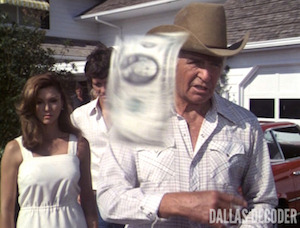
11. “Buying” Pam. Jock was chilling on the Southfork patio when drunk Digger roared into the driveway, demanding $10,000 for Pam. “Ten thousand! There’s a hundred,” Jock huffed as he tossed a C-note at his ex-partner, who eagerly scooped it up and pronounced his daughter “sold.” If Pam felt insulted, she shouldn’t have. When a Ewing is willing to negotiate your purchase price, you know they truly care. (“Reunion, Part 2”)

Barbara Bel Geddes, Dallas, Jim Davis, Jock Ewing, Miss Ellie Ewing, No More Mr. Nice Guy Part 1

You were thinking it too, Mama

10. Scolding Sue Ellen. Sue Ellen (Linda Gray) has just arrived at Dallas Memorial, where the Ewings are keeping vigil after J.R.’s shooting. Surely Jock will comfort his frantic daughter-in-law, right? Um, no. He accuses Sue Ellen of “gallivanting” while her husband is dying, prompting Kristin to defend Big Sis. “Sue Ellen was sick,” she says. Snaps Jock: “Sick? You mean drunk!” Harsh, but not untrue. (“No More Mr. Nice Guy, Part 1”)

Dallas, Dove Hunt, Jim Davis, Jock Ewing

Stare master

9. Confronting Owens. On a hunting trip, the Ewing men were ambushed by Tom Owens (Richard J. Wilkie), a farmer who claimed Jock ruined him decades earlier. Owens cocked his gun and aimed it at his wounded enemy, who didn’t blink. “If you’re gonna do it, do it!” Jock shouted, moments before the defeated Owens lowered the weapon and declared, “I’m not a killer.” You’re also no match for Jock Ewing, mister. (“The Dove Hunt”)

Dallas, David Wayne, Digger Barnes, Jim Davis, Jock Ewing

Frenemies forever

8. Destroying Digger. When Bobby and Pam announced her pregnancy at the Ewing Barbecue, Jock and Digger (David Wayne) shook hands and called a truce – which lasted all of three minutes. Digger broke the peace by criticizing Jock’s parenting skills, which prompted the Ewing patriarch to deliver a devastating takedown of his ex-partner (“He’s been a loser every day of his life.”) Yeah, it was cruel, but remember: Digger started it. (“Barbecue”)

Dallas, Jim Davis, Jock Ewing, J.R. Ewing, Larry Hagman, Silent Killer

Guts and glory

7. Joshing J.R. Jock spent a lot of time chewing out J.R. (Larry Hagman), but they had nice moments too. During one cocktail hour, when J.R. joked baby John Ross was becoming a “little fatty,” Jock playfully patted his eldest son’s belly and said, “Just like his daddy.” It was a reminder: Not only was Jock the only Ewing capable of reigning in J.R. – he was also the only one who could get away with razzing him. (“The Silent Killer”)

Daddy Dearest, Dallas, Jim Davis, Jock Ewing, J.R. Ewing, Larry Hagman

Ghost writer

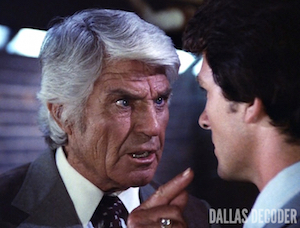
6. Inspiring J.R. Virtually every “Dallas” episode after Jim Davis’s death seems to depict one Ewing or another taking inspiration from Jock’s memory. In one instance, J.R. stands in front of his daddy’s portrait and reads one of his old letters, which offers classic bits of wisdom like, “Never let the bastards get you down.” This is what makes Jock so cool: He doesn’t need to be alive to keep his family in line. (“Daddy Dearest”)

Dallas, Jim Davis, Jock Ewing, Survival

Call waiting

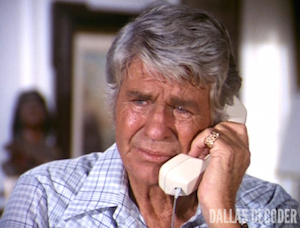
5. Dispatching Ray. Another glimpse of Jock’s softer side: When the Ewing plane went down in Louisiana swampland with J.R. and Bobby aboard, the Ewing patriarch sent ranch foreman Ray (Steve Kanaly) to find his sons. The family kept vigil at Southfork until Ray finally called with good news: J.R. and Bobby were alive. “Bring them home,” Jock said. Davis’s eyes were wet when he delivered the line. So were ours. (“Survival”)

Dallas, Fourth Son, Jim Davis, Jock Ewing, Ray Krebbs, Steve Kanaly

Daddy issues

4. Accepting Ray. In another beautiful performance from Davis, Jock tells Ray he just found out he’s his daddy. The humble cowboy offers to keep this a secret to spare Jock grief from his family, but instead Jock summons everyone to the living room and proudly announces Ray is his son. This was a hard truth for some to accept (cough, cough J.R.), but it demonstrates how Jock never took the easy way out. (“The Fourth Son”)

Dallas, Gary Ewing, Jock Ewing, Jim Davis, Return Engagements, Ted Shackelford

Hug it out, fellas

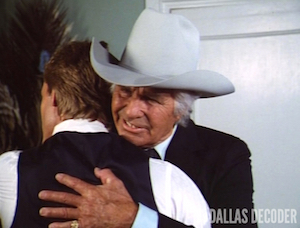
3. Celebrating Gary and Val. When Jock learned Gary and Val (Ted Shackelford, Joan Van Ark) were getting remarried, he declined to attend; there was too much bad blood between father and son. But moments before the ceremony began, in walked Jock. “I believe I have a son getting married here today,” he said. “I’d like to attend … if I’m welcome.” Awww. You’re always welcome, big guy. (“Return Engagements”)

Bobby Ewing, Dallas, Executive Wife, Jim Davis, Jock Ewing, Patrick Duffy

Power tip

2. Teaching Bobby. When Bobby (Patrick Duffy) felt Jock was undermining his authority at Ewing Oil, he loudly reminded his daddy that Jock “gave” him the power to run the company. In one of the all-time great “Dallas” scenes, Jock set his “boy” straight: “Nobody gives you power. Real power is something you take!” With those 10 words, Jock established the creed that would define the Ewings for generations to come. (“Executive Wife”)

Barbara Bel Geddes, Dallas, Jim Davis, Jock Ewing, Mastectomy Part 2, Miss Ellie Ewing

Jock the rock

1. Loving Ellie. Few things move me more than the way Jock stood by Ellie (Barbara Bel Geddes) when she had her mastectomy. While Ellie struggled to deal with the loss of her breast, Jock never left her side, offering her the support and comfort she needed. Jock may have been a rich oil baron and a stern father, but above all, he was a devoted husband and Ellie’s best friend. The way he loved her made us love him. Ellie never stopped missing him. Neither have we. (“Mastectomy, Part 2”)

What do you consider Jock Ewing’s greatest moments? Share your choices below and read more “Dal-Lists.”

The Dallas Decoder Interview: David Jacobs

David Jacobs

David Jacobs

Before J.R. Ewing appeared on our television screens, he existed in the mind of David Jacobs. I was honored last week to speak to Jacobs, who shared his memories of creating “Dallas” and its most famous character, as well as working with the actor who brought J.R. to life, Larry Hagman.

I’ve been thinking a lot about this amazing character, J.R. Ewing, since Larry Hagman’s death. How did you envision J.R. when you created him?

I envisioned him the way he became but not as radical; Larry brought something of his own to the role right away. In the first “Dallas” script [after Pam turns the tables on J.R.], Larry’s last line is, “Well, I underestimated the new Mrs. Ewing. I’ll never make that mistake again.” And the script says he smiles. But Larry didn’t smile. He laughed. It was a small laugh, but he laughed. And that changed it. He took possession of the character at that moment. Because the smile would have said, “Oh, I have a worthy adversary,” whereas the laugh meant, “Hold onto your hats, this is going to be fun.”

It’s funny to think Hagman wasn’t the first choice for the role.

We originally offered it to Robert Foxworth. The producers and I had a conference call with him and he wanted to know why J.R. was the way he was. And we said, you know, he’s made 10 times as much money for the family as his father ever did, yet his father still likes his brother better. Then Foxworth said, “Well, how are you going to make him more sympathetic?” And everyone in the room looked at me to answer that question. At me – this was probably the first conference call I’d been on in my life, and they were waiting for me to answer. And I said, “Well, we’re not. J.R. believes the way business works is, you screw them before they screw you. And he likes that. The process. He loves it.”

Was anyone else considered for the role?

No. After Foxworth passed, Barbara Miller, who was in charge of casting, said Larry Hagman wanted to come in. And my first reaction was, Larry Hagman? He was the Major [on “I Dream of Jeannie”]. I knew he was a good actor because I had seen him in “Harry & Tonto,” where he was just wonderful. And he has a very small role in “Fail Safe,” but it made a big impression on me. He was the translator [who tells the president of the United States about a nuclear disaster]. And Larry walks down the corridor to the president’s office and raises his hand to knock on the door – and he doesn’t. He smooths his hair back with his hand and takes a breath, and then he knocks. I always remembered that gesture.

J.R. (Larry Hagman) in 1978

J.R. (Larry Hagman) in 1978

But you didn’t think he was right for J.R.?

It was more like, “He really wants this role? Hmm.” So he came in the next day. I was sitting in [producer] Phil Capice’s office, with Phil and Mike Filerman, the executive I developed “Dallas” with, and of course Lenny Katzman. My back was to the doorway, and I noticed they all were looking past me, startled, almost. And I turned around and there, in the door was Larry Hagman, in a Stetson and boots. And he came in the room, in character with his Dallas accent. And within two minutes there was never any question J.R. would be played by anyone else.

Oh, wow! I don’t think I’ve heard this story.

It was an amazing performance. You know, he was an established actor. We wouldn’t have asked him to read for the role, but he did read in a sense. He just auditioned in character – for just a few minutes. And then he was back to being Larry Hagman. It was really shrewd of him – intuitively genius.

Now that Hagman’s gone, will you be sad to see this character you created come to an end?

Well, I’m sad that Larry’s gone. Yes, I created the character. And yes, I knew in the phone call with Foxworth the kind of unapologetic villain he should be. But don’t get me wrong: that guy belonged to Hagman. The synergy that created the character of J.R. was the synergy of actor and role more than it was the writer and the actor.

Do you have ideas about how you’d kill him off?

No. I haven’t thought about it. Who knows? I might come up with something brilliant if I thought about it. You know, when they brought back the show [on TNT], I thought about things that I would do differently, but Larry’s death is too fresh. It’s too raw.

How do you think J.R.’s death will affect the new show?

A lot of people have asked me that. I think they’ll probably get a [ratings] bump when they air the episodes that deal with J.R.’s death. But after that, to be perfectly honest, I think the “next generation” has to step up – like every “next generation.” I definitely think the show has the ingredients to stand on its own. Maybe they’re a little afraid of it, but maybe this will get them to do it.

Kind of like the mama bird pushing her baby out of the nest?

Exactly. And of course J.R.’s going to cast a shadow over it forever. But we’ll see.

Gary and Val (Ted Shackelford, Joan Van Ark) in 1979

Gary and Val (Ted Shackelford, Joan Van Ark) in 1979

How do you feel about Gary and Val’s upcoming visit to the new “Dallas”? You played with those characters for 14 seasons on “Knots Landing.” Now they’re going to be in the hands of other writers.

It’s OK. I’m not like [Aaron] Sorkin, whose characters speak Sorkinese and it’s brilliant. I always wrote very stylized dialogue and let fine actors like Joan Van Ark and Ted Shackelford make the words theirs. They’ll still be Val and Gary. So I don’t worry about it.

What do you think Leonard Katzman, the original “Dallas’s” longtime producer, would think of the new show?

He’d hate it.

Really? Why?

He just would. He hated the [original show’s “dream” season] after he’d walked away from it. That season has taken a rap that I don’t believe it deserves. It was trying to freshen up the act. But Leonard hated it.

Well, what about you? Do you like the new show?

I do. It’s great to see Southfork in H.D. and widescreen. Beautiful. I do wish they would slow things down. Mike and I were talking recently and said we could’ve gotten 10 shows from the first five. [Laughter] And not by stretching, but by making it more complex and by making the stories less plot-driven and more character-driven. I think it was Chekov who said plot is character. Whoever said it, I agree with.

Do you think there’s any chance of “Knots Landing” coming back?

No, I don’t think so. “Knots Landing” never had the ratings and the international appeal that “Dallas” had. “Knots” recreated would have to be five younger families living on the cul-de-sac – and not related to the older characters. Because if they were related it wouldn’t be believable. “Knots Landing” was always the hardest show to write because unlike “Dallas,” the conflict wasn’t built into the structure. You always wanted to ask the question: Why don’t they just move out? Why don’t they just stop talking to their neighbors like neighbors everywhere?

Getting back to “Dallas”: Your pilot script is dated December 10, 1977. Thirty-five years later, we’re still watching this show. How does that make you feel?

You know, while it was on the air, it was sort of a guilty pleasure because I wasn’t running it. It was my first show. Afterward I ran “Knots Landing” and my other shows, and “Dallas” was in the hands of Lenny Katzman. But later on, I realized “Dallas” really was the model for all the shows that came after it. Before “Dallas,” there was a great fear of serialization in prime time. Mike and I thought continuing drama was exactly the right form for television. And the form of “Dallas” became the model for all the continuing dramas that followed and are now dominant. So it really did change television in a very not-so-subtle, real way. And I like that.

Well, I know I speak for a lot of fans when I say we’re thankful to you for creating this really fun, fantastic show.

And I’m thankful to Larry Hagman. His loss means something to me. He was a nice man. He was a terrific actor. Absolutely underrated. But God knows he left this earth doing what he loved. A lot of us might wish to go that same way. So I’m glad I was able to provide him with the vehicle that he would use to display his great talent, and I’m certainly grateful to him for being the driving force of a show that has meant a lot to me.

Share your comments below and read more interviews from Dallas Decoder.

J.R. Ewing, Larry Hagman and Me

Dallas, J.R. Ewing, Larry Hagman, TNT

My hero

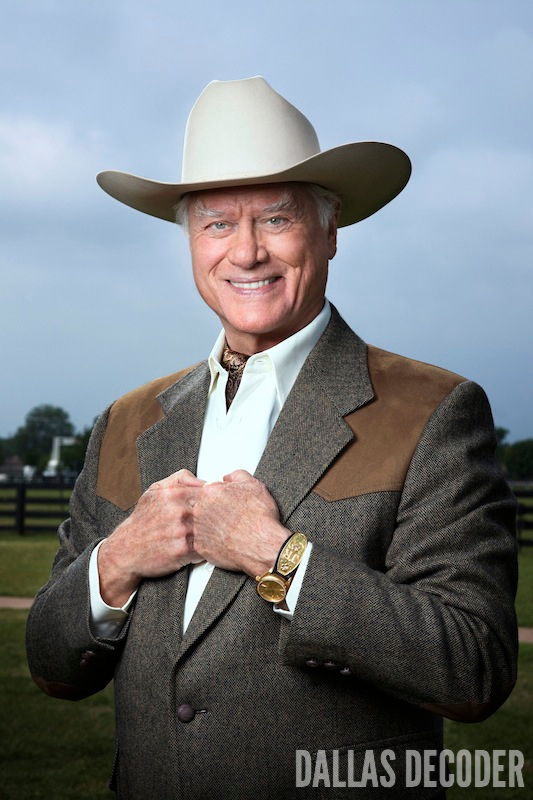
Like his famous alter ego, Larry Hagman dodged death so many times, I assumed he was going to live forever. Waking up to the news last Saturday morning that Hagman was suddenly gone left me feeling a little dazed. Without putting much thought into it, I grabbed an old J.R. Ewing publicity shot, scanned it and reached for my laptop to tap out a quick tribute for Dallas Decoder.

As fate would have it, my previous post was a transcription of the next-to-last scene from “The Search,” the “Dallas” episode where Jock is presumed dead. When I logged into my site, I was greeted by a shot of Bobby standing in the Southfork dining room, breaking the news to Miss Ellie that Daddy isn’t coming home. In that instant, I wondered: Where is Patrick Duffy right now, and does he look as heartbroken as he does in this old picture?

That’s when I lost it.

I couldn’t believe what was happening. I was weeping over the death of a television actor, a man I’d never met. Yes, I’m a “Dallas” fanatic, but I’m not much of a crier. So as I sat on my sofa shedding tears, I kept telling my husband Andrew how silly I felt. He held my hand and told me I shouldn’t feel embarrassed.

I see now that Andrew was right. Whether or not I knew Larry Hagman wasn’t the point. What mattered is that he had touched my life. Maybe J.R. Ewing wasn’t a real person, but the sense of loss I felt at that moment was very real.

It took me a few days to figure all this out and find the words to express it. The breakthrough came when I realized J.R. has been part of my world almost from the beginning. I don’t remember when I watched “Dallas” for the first time, but it must have been in the spring or summer of 1980, when the show was 2 and I was 6. I didn’t always understand the stories I saw on “Dallas,” but I couldn’t get enough of the glamorous trappings – the ranch, the offices, the cars. Mostly, though, I loved the rapscallion at the heart of it all.

J.R. Ewing was my hero. I can remember spending Saturday afternoons “playing ‘Dallas’” with Joanna, the girl who lived next door. Together, we would recreate the scenes I had watched on the show the night before. In our backyard world of make-believe, I always cast myself as J.R. Joanna was assigned all the other roles: Sue Ellen, Kristin, Cliff.

In middle school, my love of “Dallas,” “Knots Landing” and the era’s other prime time soaps was one of the things that made me realize I was different from the other boys. The other boys realized this too, and they made my life miserable. That’s when my appreciation for J.R. deepened. Even though I saw him do a lot of bad things each Friday night, I so admired how he carried himself. No one pushed J.R. around. Words never stung him. It was the kind of power I wanted for myself.

I used to fantasize about silencing my sixth-grade tormentors with clever, J.R.-style ripostes. Sometimes I’d imagine staging fiendish acts of revenge to make the mean kids sorry for picking on me. What these imaginary ploys entailed, I cannot recall. I couldn’t have been older than 11 or 12 at the time, so how devious could my maneuvers have been? Was I going to frame one of my bullies by making it look like he’d copied his homework?

I eventually outgrew my secret desire to plot and scheme like J.R., but I never outgrew my admiration for his swagger. J.R. never apologized for who he was, and eventually, I learned to be proud of who I am. Don’t get me wrong: I’m not the kind of person who brims with self-confidence. I’ll never have J.R.’s moxie. But I did learn a lot from him about standing up for yourself and having the courage to go after the things that matter to you.

Since I started Dallas Decoder and began re-watching the original series with fresh eyes, I’ve found myself thinking about Larry Hagman as much as I do J.R. What a phenomenal talent. Much has been made in recent days about Hagman’s gifts. There’s not much I can add here, except to say this: Larry Hagman wasn’t an actor. Larry Hagman was a wizard. He didn’t perform. He made magic.

People who knew Hagman have talked a lot this week about how the lines that distinguish him from J.R. blurred with time. I don’t doubt it. But I also believe there was a part of Hagman that was just plain Larry.

I thought about this a few days ago, when I watched the “Dallas Reunion: The Return to Southfork” retrospective. At the end of the special, Hagman and his longtime co-stars are sitting in front of an audience, reminiscing. At one point, the camera cuts to a shot of Hagman laughing. He’s so tickled, his eyes crinkle. This isn’t J.R.’s mischievous chuckle. It’s Larry’s hearty guffaw. It made me think: I know J.R. and I love him, but I wish I could have known Larry too.

I was lucky enough to have one encounter with Hagman. It happened during the fall of 2004, when I was working as a newspaper reporter. CBS announced a conference call for journalists to interview Hagman and Linda Gray about that “Return to Southfork” special, which was going to air in a few days. My editors weren’t interested in a story about a “Dallas” clip show, but I sure as hell wasn’t going to let that stop me from participating in the call. This was my chance to finally speak to my hero.

When the time came, I sat at my desk in the newsroom, dialed the number on the press release and listened to the moderator’s instructions. Each reporter would be allowed to pose a single question to Hagman and Gray. Fair enough. Except when it was my turn, I didn’t ask a question. Not really. I gushed. I went into full-fledged fanboy mode, telling Hagman and Gray how much I loved them, their characters and all things “Dallas.” At one point, I acknowledged I sounded like a sycophant. Hagman chuckled and called me “sickie.” J.R. Ewing took a shot at me! I was over the moon.

I’ve thought about that call a lot this week. I cherish the memory, but I also wish I could get a do-over. I wouldn’t gush this time, and I wouldn’t ask Hagman a question. I’d simply thank him.

What did Larry Hagman mean to you? Share your comments below and read more opinions from Dallas Decoder.