Critique: ‘Dallas’ Episode 34 – ‘The Kristin Affair’

Dallas, J.R. Ewing, Kristin Affair, Kristin Shepard, Mary Crosby

Eyes on the prize

“The Kristin Affair” is quintessential “Dallas.” This isn’t the show’s best episode, but it might be the episode that best captures “Dallas’s” essence during its heyday. Almost everything we love about the series is here.

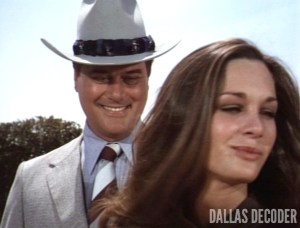
J.R. is “The Kristin Affair’s” center of attention. We see him clash with Bobby, snipe with Sue Ellen and plot Cliff’s ruin, all while pursuing Kristin, who becomes his secretary at the top of the hour and his mistress by the time the closing credits roll.

“The Kristin Affair”  also offers a rollicking Southfork dinner scene, some nice location shots at the ranch and in downtown Dallas, and another great score from Bruce Broughton. My favorite music during the episode: the ominous piano tune heard during the darkly lit scene where J.R. agrees to mortgage Southfork.

Notably, “The Kristin Affair” also shows the Ewings in the costumes they’re wearing in one of “Dallas’s” most famous cast shots, when the actors posed on Southfork’s front lawn. This photo – which is probably remembered as the one with Victoria Principal in the maroon dress, Linda Gray in the yellow blouse and Charlene Tilton in pigtails – is undoubtedly burnished in the minds of many “Dallas” fans, so watching “The Kristin Affair” is like seeing the picture spring to life.

Of course, no “Dallas” episode is perfect and “The Kristin Affair” is no exception. Ray is nowhere to be found here, Jock and Miss Ellie don’t have a meaningful scene together and it appears Pam has once again misplaced her backbone.

But “The Kristin Affair” has so much good stuff – and so many good J.R. scenes in particular – I’m willing to overlook its flaws.

My very favorite moment is very brief. It comes at the end of the scene where J.R. meets with his government mole and learns how much money he’ll need to win the bidding for the Asian drilling contract. “That’s a tidy little sum. Woo-wee!” J.R. says.

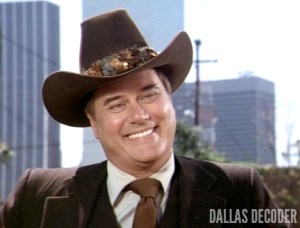
Larry Hagman delivers the dialogue under his breath, making me wonder if he ad-libbed it. Improvised or not, the actor seems to be having a ball playing J.R. In this episode, I have a ball watching him.

Grade: A

________________________________________________________________________________________________________________________________________________
Dallas, J.R. Ewing, Kristin Affair, Larry Hagman

Having a ball

‘THE KRISTIN AFFAIR’

Season 3, Episode 5

Airdate: October 19, 1979

Audience: 18.2 million homes, ranking 10th in the weekly ratings

Writer: Worley Thorne

Director: Irving J. Moore

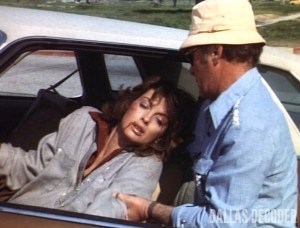
Synopsis: J.R. secretly mortgages Southfork to finance a risky oil deal in Asia, plots with his protégé Alan Beam to lure Cliff into a no-win congressional race and sleeps with Kristin, who becomes his secretary. Pam tells Bobby she is pregnant but doesn’t mention her genetic disease.

Cast: Robert Ackerman (Wade Luce), Barbara Bel Geddes (Miss Ellie Ewing), Mary Crosby (Kristin Shepard), Jim Davis (Jock Ewing), Patrick Duffy (Bobby Ewing), Hugh Gorrian (Lowell Hansen), Linda Gray (Sue Ellen Ewing), Larry Hagman (J.R. Ewing), Ken Kercheval (Cliff Barnes), Jeanna Michaels (Connie), Dennis Patrick (Vaughn Leland), Randolph Powell (Alan Beam), Victoria Principal (Pam Ewing), Martha Scott (Patricia Shepard), Paul Sorensen (Andy Bradley), Don Starr (Jordan Lee), Charlene Tilton (Lucy Ewing), Keenan Wynn (Digger Barnes)

“The Kristin Affair” is available on DVD and at Amazon.com and iTunes. Watch the episode and share your comments below.
The Dallas Decoder Interview: David W. of Dallas Divas Derby

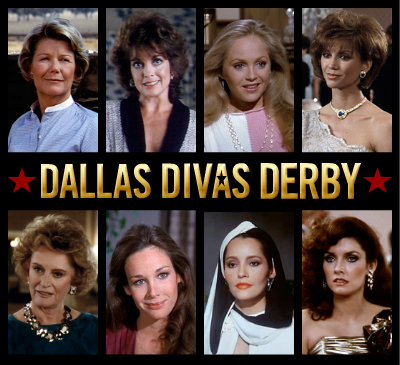
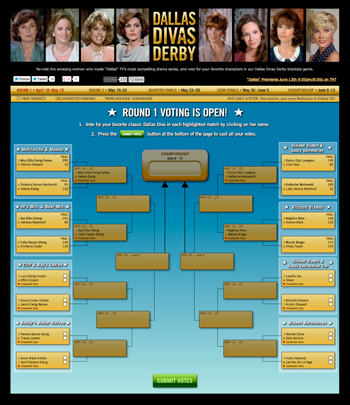
The best thing about starting Dallas Decoder has been meeting fellow “Dallas” fans like David W., the genius behind Dallas Divas Derby, a new online brackets game that pits the show’s women characters against each other. David has really interesting ideas about “Dallas” and graciously agreed to share some here. Read what he has to say – and be sure to visit his site to vote for your favorite diva.

Dallas Divas Derby is great! How did you come up with the idea for the site?

Oh, thank you. I’m a lifelong “Dallas” fan and an interactive designer in my previous professional life, and I’d been thinking for years that it would be fun to make an online interactive family tree for the Ewing and Barnes families. Other projects and life prevented me from realizing that, but when TNT’s new show was announced, it struck me that it might be interesting to create some kind of online activity for fans to refresh their memories about “Dallas” history.

I’d always felt pretty strongly that “Dallas’s” best years were seasons 1 through 9, when it focused on a well-rounded ensemble cast and featured strong writing for the men and women alike. If you watch the show in its entirety, you see that the writing for the women begins strong, if a little sexist in some instances, and grows steadily better, peaking during the dream season.

In the years since “Dallas” ended, much of the lore of the show had been framed around the Ewing brothers’ saga. We all know the story. It’s a good one, but it has been told over and over again from the same male perspective. As I watched the show in reruns and on DVD as an adult, I gained a whole new appreciation for the female characters and actresses. I learned about Barbara Bel Geddes, Alexis Smith, Priscilla Pointer and Martha Scott’s stage and film careers, and I appreciated their rich nuanced performances even more. And my admiration for Linda Gray, Victoria Principal and Susan Howard grew deeper watching them evolve over the years. And then you had amazing villains like Kristin and Katherine, which I loved as a boy and appreciated even more as an adult.

For me personally, those actresses made a huge impression when I watched the show as a kid, and I became really interested in looking back at “Dallas” from the perspective of the female characters somehow. When you do, you realize how vital they were to the show’s success. You see huge arcs like Sue Ellen going from repressed alcoholic beauty queen, to strong female executive and mother, and Pam from strong-willed poor country girl from the wrong side of the tracks, to successful, confident independent businesswoman. I think for me personally, I identified closely with those arcs.

Though not a huge sports fan, I’d worked previously on interactive ad campaigns for the March Madness NCAA college basketball games, and I learned about that whole brackets game phenomenon that’s so popular among fans and office pools.

While re-watching “Dallas” this spring, it dawned on me that when you watch over the years, you see some recurring character archetypes common among the women. So I started scribbling down character names and playing around with them on paper, and grouping them based on similarities, and bingo, my earlier ideas about an interactive family tree merged into the brackets game idea!

Talk a little bit about how you came up with your matchups. There seems to be a method to your madness.

I quickly surveyed the entire 14 seasons to see if there’d be enough interesting characters that would work, and there were! Then I researched about how teams are “seeded” in brackets games based on their wins and losses, and it dawned on me, the characters could be similarly “seeded” based on the number of episodes they’d been in. In essence, each episode they were in counted as a “win” for them.

When I did the math, the results were really interesting to me. Similar archetypes often ended up paired against each other, like the case of “Sinister Sisters” Katherine Wentworth and Jessica Montford. When I saw that, I knew I had to make the game, even if only other die-hard “Dallas” geeks would appreciate it. It interested me, so that’s what drove me. And I was unemployed, so that helped too.

Once I did all that math, things happened very quickly to build the site. I knew we’d need a database, so I met with a dear friend who is a Ruby on Rails developer, and he volunteered to help. He made it possible for me to make the site a reality.

You know the characters really well. It sounds like you’ve been a fan of the show for a long time.

I started watching “Dallas” almost at its beginning, even though I was only 8 at the time. My parents, usually very conservative in what they allowed us to watch as kids, were quickly fans of the show, and somehow let us watch along with them.

I remember in the late ’70s being fascinated by the idea of Southfork. I was growing up in suburban Detroit, so the idea of a ranch, with all that land and a big family living together really fascinated me.

I remember often watching the show on Friday nights, and then getting up early the next day to play with my Legos in front of Saturday morning cartoons. I’d sit there for hours building elaborate Lego Southforks and Southern Crosses, and then I’d use Matchbox cars that matched all of the main character’s cars, and I’d re-play “Dallas” all morning. I even built a replica of Sue Ellen’s condo because I thought it was so glamorous and I was so happy to see her on her own, away from evil J.R. Mind you, I was like 10 or something.

I became the go-to guy in the family for episode re-caps. If my grandmother missed an episode, she’d have me re-tell it all to her the next time I saw her. Later in junior high and high school, I’d have “Dallas” finale parties for my entire family, and make cakes with oil derricks on them and things like that. It was ridiculous.

I love it! In general, what do you think of the way “Dallas” depicts women?

I do think the show’s portrayal of women really mirrors the idea of women in our pop culture from the late ’70s through the mid-80s. Not all of that is good, but I think it was pretty spot on.

For example, for my mom and my friends’ moms who were middle-class suburban housewives negotiating the idea of entering the working world, the evolutions of Sue Ellen, Donna, Pam and others was something that resonated. It was the point in time when the option and expectation of being a stay-at-home mom started to evaporate for many American women due to economic needs.

On “Dallas,” much of the early writing for these women focuses on tension between them and their husbands about their roles in the family. Sue Ellen’s meant to be a society wife and crank out Ewing heirs. Her life is booze, ladies’ luncheons and affairs. Pam wants to keep working and hates the society life, but struggles with Bobby’s sexist expectations for her to stay at home, and Ray struggles hugely with the idea that Donna is making more money than him, and what that means for his masculinity. And of course, Ellie is the traditional heart of the show, a true grandmother archetype.

As the Regan era/corporate greed era takes hold in the ’80s, you see Pam, Donna and eventually Sue Ellen staking claim to a desire to be successful professionally in their own right. They each pursue it differently, but they all eventually challenge their partners for respect, and you get to see all these previously traditional men dealing with the idea that their women are becoming fiercely independent. I think again, that mirrored what was happening in society to a degree.

On the “villains” side, you see people like Marilee Stone, Holly Harwood, Kristin and others using their gender and sexuality to gain power, and as weapons. Some of that feels pretty sexist now, but if you look at mainstream films of the era, the meme was everywhere. The mainstream white male was intrigued by – and simultaneously threatened by – strong independent businesswomen.

Of course now, looking back, especially amongst many of the supporting females, you do see lots of stereotypically weak secretaries, hookers, tramps and thieves, and some of that feels dated and uninteresting.

Since voting began on Dallas Divas Derby, what’s been the biggest surprise? Has any diva done better than you expected?

Ha ha, yes! My developer partner and I have kept our hands out of the voting, but based on my personal preferences, I’m not a big Cally Harper fan, no offense to Cathy Podewell. I just thought, in reference to what we were just talking about, that Cally was written as this incredibly one-dimensional country girl caricature, and from a very older white urban male slant. I never really felt like she fit with the rest of the cast.

What we’ve heard from fans online and seen in the voting so far, though, is that she has more fans than haters. She won her Round 1 match against Kimberly Cryder and really never was behind in that vote based on what we saw. She was always the favorite, though the voting was close.

For the purposes of the game though, we’re actually quite happy that the two Mrs. J.R. Ewings will go head-to-head in Round 2 on May 16. It should be a good match for fans of both her and Sue Ellen.

You also had some “Dallas”-worthy drama with a hacker. What happened?

Yes, we did! Well, you know, I’m not a professional programmer, and I wanted to keep the game simple and easy for users. I underestimated the level of security we’d need at first though.

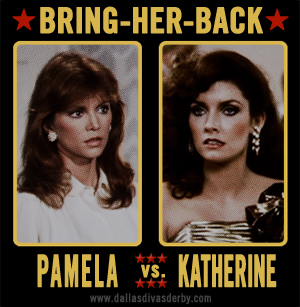
Our Bring Her Back vote was meant to be a straight-up horse race for fans to vote in real-time for any of the “living” characters they wanted to see back on the new series. Unlike the brackets game, where match results are revealed every Wednesday morning – to promote Wednesday as the new day for “Dallas” on TNT – the Bring Her Back vote is always live on the site, so users can see the actual vote numbers.

This bred some fierce rivalry between a few Katherine Wentworth and Lucy Ewing fans earlier this month. We saw first a huge, and rather humanly impossible, spike in BHB votes for Lucy overnight one night. And we started to get complaints from Katherine fans, so we investigated. We found that at least one person, if not a couple, had “hacked” the BHB voting overnight, and within hours we had numbers in the thousands jumping back and forth for Lucy and Katherine. It was headed to the stratosphere, but clear the votes weren’t “real.”

We’d like to think we’re that popular, and though we do allow users to vote more than once, it reached a humanly impossible rate of voting, based on our other stats. So we had to add some more protections to the voting code, to prevent over-the-top gaming of the system, while trying to keep it easy and fun for users.

Since we’d been watching the vote closely, we made the call to remove the hacked BHB votes from the system so our fans could continue to play the game and feel like they had a chance.

Luckily, none of that affected any numbers on the brackets game, so that voting to date hasn’t been compromised. This is just meant to be a fun thing for fans and we hope everyone who wants to participate can and express their preferences in the voting.

OK, I must ask: Do you have a personal favorite “Dallas” diva?

This is a hard one for me. We’re trying to remain agnostic in the vote, and there are so many different types of characters to choose from.

On the heroines’ side, Sue Ellen has been an icon for me since I was a kid. I related to her struggles and her growth towards independence. I still love her and am so happy she’s back.

On a more complicated level, it’s Pam for me. I loved her in the beginning of the show as the tough poor country girl arriving at Southfork, then lost a bit of interest during her obsession to have a baby and the weird writing around some of that, but loved her again in Seasons 7 through 9 as she returned to strength and came into her own. Victoria Principal’s performances leading up to and after Bobby’s death still haunt me today. Those were award worthy in my book. They made a huge impact on my psyche as a teen. In my opinion though, the writers ran Pam into a ditch in Season 10 though, moving her to the periphery and weakening her. The way Pam was written out made many fans dislike her, and I think that was a huge detriment to the show’s legacy. We’re supposed to believe the show’s original leading lady, who desperately fought to have a successful marriage to Bobby and have a child, suddenly decides to leave them to go die alone with a stranger? It was stupid writing and it hurt the character and the show.

On the villains’ side, Katherine was my number one favorite, followed closely by Jessica Montford and Kristin. All could’ve lasted on the show longer in my opinion. Heck, I even enjoyed Angelica Nero as a super-villain. It was fun to see a woman besting J.R. in scheming.

I think you’re wise to praise Angelica. If she doesn’t win her next round against Mandy Winger, she might start blowing stuff up again!

Ha ha, indeed! She was fantastic. I’m keeping my eye out for exploding briefcases. Luckily I don’t own a Ferrari. I will add this though, we’ve learned during the Derby to not underestimate Katherine Wentworth fans. Things could get interesting if Angelica and Katherine face-off later in the Derby. I’m secretly hoping they might.

The Art of Dallas: ‘The Silent Killer’

Sue Ellen (Linda Gray) is seen in this 1979 publicity shot from “The Silent Killer,” a third-season “Dallas” episode.

The Art of Dallas: ‘Whatever Happened to Baby John? Part 1’

J.R. and Sue Ellen (Larry Hagman, Linda Gray) are seen in this 1979 publicity shot from “Whatever Happened to Baby John? Part 1,”“Dallas’s” third-season opener.

Dallas Scene of the Day: ‘I Am No Longer for Sale’

Dallas, Linda Gray, Sue Ellen Ewing, Whatever Happened to Baby John Part 1

Oh, snap!

In “Whatever Happened to Baby John, Part 1,” “Dallas’s” third-season opener, J.R. (Larry Hagman) sits next to Sue Ellen (Linda Gray), who is lounging near the Southfork pool, reading Texas Homes magazine.

J.R.: Darling, I wish you’d try and take a little more interest in things.

SUE ELLEN: Interest? In what?

J.R.: Well, to start with, our child.

SUE ELLEN: [Flips a page] I don’t think he’s exactly suffering from lack of attention.

J.R.: You wanted that child so much, and now you just don’t seem to care at all.

SUE ELLEN: [Flips a page] Of course, I do.

J.R.: Well, it doesn’t look like it. That’s what I’m saying.

SUE ELLEN: Appearances can very often be deceiving.

J.R.: Honey, I know how – I know how hard this has been for you. How difficult the time it was to quit drinking and go cold turkey and I just want you to know that I admire you for it, Sue Ellen.

SUE ELLEN: [Looks up from the magazine] My drinking was never a problem. I kept trying to tell everybody that.

J.R.: And what I’m saying is, if we try, if we really try, we can solve all our other problems – and I want you to know I am going to try. I really am. [Takes the magazine from her, pulls a ring box out of his pocket] Sweetheart, I got a little present for you this morning. I dropped in a store downtown. [Opens the box] Jeweler calls it a maternity ring. [He holds open the box, smiling.]

SUE ELLEN: You bought me once, J.R. – and you can’t do it anymore. I am no longer for sale.

She snaps shut the box, gets up and walks away.

Dallas Scene of the Day: ‘Who is the Father of Your Baby?’

Bobby Ewing, Dallas, John Ewing III Part 2, Linda Gray, Patrick Duffy, Sue Ellen Ewing

Daddy issues

In “John Ewing III, Part 2,” “Dallas’s” second-season finale, Bobby and Sue Ellen (Patrick Duffy, Linda Gray) are seated on the bed in her room at the sanitarium, where she tells him she wants to come home.

BOBBY: [Holding her hand] Sue Ellen, they can help you here.

SUE ELLEN: They can’t help me.

BOBBY: It takes time. You have to give them a chance.

SUE ELLEN: [Stands, walks away from the bed] Yeah, time. Sure. Why not? That’s all I have, is time. That’s what I do all day, is try to figure out what I’m gonna do with my time. I wake up in the morning and I think, “What am I gonna do all day till I go to sleep – alone?”

BOBBY: Sue Ellen. [Looks away, then looks back at her]

SUE ELLEN: [Turns to face him] Am I embarrassing you, Bobby?

BOBBY: No. Yeah. Yes, you are a little, yeah.

SUE ELLEN: I sleep alone a lot, after J.R.’s been out with his sluts, comes home smelling like their perfume, and I just pretend I’m asleep – just blot the whole thing out.

BOBBY: [Stands and grabs her arm] Then why aren’t you having this conversation with him? Confront him with it.

SUE ELLEN: Oh I have, Bobby. I have often. But your brother has that wonderful knack of finding one’s weak spot – the Achilles’ heel. Takes the knife and goes right up to the hilt.

BOBBY: Sue Ellen, what is your Achilles’ heel?

SUE ELLEN: [Turns, walks away] Your mama and your daddy, and Pamela and Lucy, and even you. You think it’s Southfork, the Ewing money, the Ewing name. But you’re wrong. [Walks back to him, touches his face] If I’d only met you first, Bobby, I would’ve married you instead of J.R. You are so kind and strong and loving. Just like a man should be. [Begins crying, kisses him] You are so understanding, Bobby. [Turns away] My men are not understanding.

BOBBY: Your men? Sue Ellen, what are you talking about?

SUE ELLEN: Oh, Bobby. I have something the doctors won’t ever find a cure for. Let’s see, how am I gonna explain this to you? Your life is so simple. Pamela loves you, and you love Pamela. And I really do love J.R. But you know what? J.R. doesn’t love me. But I wanted to have his baby so bad. I even thought we would adopt a baby, but J.R. put a stop to that. Then I thought, “Well, Sue Ellen, just go out and get yourself pregnant.” And that’s what I did. And I just thought, “But maybe I can hurt J.R., hurt him real bad.” Instead, all I did was hurt me and my little baby – and the baby’s father.

BOBBY: You went out and got pregnant? Sue Ellen, what are you saying?

SUE ELLEN: Yeah, but it could’ve been J.R.’s. Chances are it’s J.R.’s.

BOBBY: [Turns her around to face him] Sue Ellen!

SUE ELLEN: [Crying harder] But Bobby, he hardly makes love to me anymore.

BOBBY: Who is the father of your baby?

SUE ELLEN: Cliff Barnes. Now do you see? That’s why no one can help me. No one in the world can help me. [She collapses into his arms.]

Critique: ‘Dallas’ Episode 29 – ‘John Ewing III, Part 2’

Dallas, John Ewing III Part 2, Linda Gray, Sue Ellen Ewing

Crash test mommy

What a difference a year makes!

Sue Ellen has just four lines in “Digger’s Daughter,” “Dallas’s” first episode, but “John Ewing III, Part 2,” which debuted 369 days later, features the character in almost every other scene.

My favorite: When Sue Ellen tells Bobby that Cliff may be the father of her unborn child. This really isn’t a conversation as much as it is a monologue. For four-and-a-half uninterrupted minutes, Linda Gray delivers almost 500 words of heart-wrenching dialogue. It’s a tour-de-force performance, and it makes me appreciate how far Gray has come from those first-season episodes, when all she had to do was gaze adoringly at J.R.

The most surprising moment during Sue Ellen’s monologue comes when she kisses Bobby. No matter how many times I see the scene, the kiss is always a little startling. I used to find it odd how Patrick Duffy barely reacts to it, but I’ve decided it’s because the kiss isn’t a romantic gesture as much as it is an expression of Sue Ellen’s desperate loneliness.

Gray dominates “John Ewing III, Part 2,” but the other actors have good moments, too.

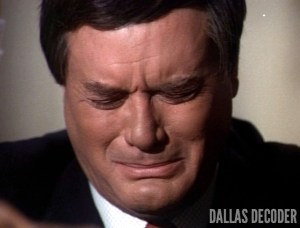
Larry Hagman’s performance in the final scene, when J.R. and Bobby sit at Sue Ellen’s bedside, is one of his most memorable. Despite all the rotten stuff J.R. does in the second season, it’s hard not to be moved when Hagman purses his lips, shuts his wet eyes and bows his head. J.R. has never seemed more human.

Ken Kercheval is equally moving in the penultimate scene, when Cliff sees Sue Ellen’s baby in the incubator and tearfully collapses into Pam’s arms. Like Duffy in Bobby’s scene with Sue Ellen, Victoria Principal doesn’t have much to do here, but she makes the most of it. I like how the actress moves from exasperation when Pam first spots Cliff in the hospital corridor to tears when he begins sobbing.

That Duffy and Principal shift so effortlessly from “Dallas’s” stars when the series begins to supporting roles in this episode reflect the cast’s evolution into a true ensemble.

What a difference a year makes, indeed.

Grade: A

________________________________________________________________________________________________________________________________________________

Dallas, John Ewing III Part 2, J.R. Ewing, Larry Hagman

Crying, shame

‘JOHN EWING III, PART 2’

Season 2, Episode 24

Airdate: April 6, 1979

Audience: 17.8 million homes, ranking 11th in the weekly ratings

Writer: Arthur Bernard Lewis

Director: Leonard Katzman

Synopsis: In the sanitarium, Sue Ellen bribes a nurse for booze, escapes and is injured in a car crash. Her doctors are forced to prematurely deliver her son, whom Jock names John Ross Ewing III. J.R. weeps as the lives of Sue Ellen and the baby hang in the balance.

Cast: Dimitra Arliss (Nurse Hatton), Barbara Bel Geddes (Miss Ellie Ewing), Karlene Crockett (Muriel Gillis), Jim Davis (Jock Ewing), Patrick Duffy (Bobby Ewing), Meg Gallagher (Louella), Ellen Geer (Dr. Krane), Linda Gray (Sue Ellen Ewing), Michael C. Gwynne (Dr. Rogers), Heidi Hagman (receptionist), Larry Hagman (J.R. Ewing), Peter Horton (Wayne), Dawn Jeffory (Annie Driscoll), Sherril Lynn Katzman (Susan), Ed Kenney (Senator Newberry), Ken Kercheval (Cliff Barnes), Jeanna Michaels (Connie), Victoria Principal (Pam Ewing), Alan Rachins (Dr. Miller), Charlene Tilton (Lucy Ewing)

“John Ewing III, Part 2” is available on DVD and at Amazon.com, iTunes and TNT.tv. Watch the episode and share your comments below.
Dallas Isn’t ‘Brokeback Southfork,’ But It’s Pretty Gay

Dallas, Linda Gray, Sue Ellen Ewing

You go, girl

By today’s standards, “Dallas” isn’t a “gay” show. Southfork never hosts a “Brokeback Mountain”-esque love story. There are no same-sex office romances at Ewing Oil. Dusty Farlow wears ascots to keep dust out of his face, not because he’s fabulous.

Yet “Dallas” is very much a show with gay sensibilities. It regularly explores themes – empowerment, identity, gender roles – that resonate with gay audiences, and often in ways that are surprisingly smart.

I didn’t catch a lot of this while watching the show in the 1980s, when I was a pretty confused gay kid. But when I think about those years now, I wonder if “Dallas’s” gay subtext helps explain its appeal to me. Maybe my middle-school gaydar was stronger than I realized.

Kit, But Not Much Kaboodle

“Dallas” makes subtle references to homosexuality in early episodes like “Election,” when J.R. questions Cliff’s close relationship with his male campaign manager, and “Call Girl,” when J.R. creates a scandal by making it look like Pam is involved in a three-way relationship with a man and another woman.

The show stops dancing around the issue in “Royal Marriage,” the 1979 episode where Kit Mainwaring, an oil-and-cattle heir who is secretly gay, breaks his engagement to Lucy and comes out of the closet. This episode, which reflects the ’70s trend toward “socially conscious” television (see also: “All in the Family,” “Lou Grant,” et. al.), is handled with surprising sophistication, making Kit one of prime-time television’s breakthrough gay characters.

Kit is also a footnote: “Dallas” ran 14 seasons and produced 357 episodes, yet he is the only character whose homosexuality is ever acknowledged on the show.

There are only fleeting gay allusions in later episodes. During the sixth season, Lucy wonders if John Ross’s camp counselor Peter Richards is gay because he doesn’t want to date her (she doesn’t realize Peter is in love with Sue Ellen), but the show never again identifies a character as being gay.

This isn’t altogether surprising. Prime-time television mostly retreated to the closet during the AIDS hysteria in the 1980s. Also, once “Dallas” became television’s most-watched show, it embraced its escapist bent and pretty much stopped doing “issues” stories. Both factors probably explain why the producers notoriously dropped plans to make villainess Angelica Nero a lesbian during the 1985-86 season.

Sue Ellen: Icon – and Avatar

The absence of gay characters on “Dallas” doesn’t mean the show lacks characters and storylines gay audiences could identify with. Consider Sue Ellen, whose boozing, philandering and sharp tongue make her an icon among gay fans who love camp.

But Sue Ellen shouldn’t be treated only as a joke. If you consider her arc during the course of the series, she makes an ideal avatar for gay audiences.

When “Dallas” begins, Sue Ellen is the show’s most sexually repressed character. In the first-season episode “Spy in the House,” she tries to spark J.R.’s interest with a sexy negligee, only to have him cast it aside and accuse her of being unladylike. J.R.’s rejection sends Sue Ellen into the shadows, where she finds sexual fulfillment with other men and develops her drinking problem. This double life must have felt familiar to gay men and women who spent the ’70s and ’80s trapped in the closet.

By the end of the Reagan era, when AIDS was galvanizing gay people and giving the gay rights movement new momentum, Sue Ellen finally begins pulling herself together. She quits drinking, embarks on a successful business career and leaves J.R. for good.

During Linda Gray’s final appearance on the show in 1989, Sue Ellen turns the tables on J.R. and tells him off, one last time (“You will be the laughingstock of Texas.”). All “Dallas” fans cheered this moment, but for gay viewers, I suspect it had special meaning. Sue Ellen was standing up to her oppressor at a time when many gay Americans were beginning to do the same – in the voting booth, in the workplace, in the streets.

There’s Something About Gary

“Dallas’s” gay viewers might see themselves in other characters, too.

The series often explores the theme of confused identities. Two notable examples: Pam and Ray each learn they were raised by people who aren’t their biological fathers, and for both characters, this discovery triggers a lot of angst.

“Dallas’s” recurring theme of estranged fathers and sons is probably familiar to a lot of gay men. At various points, Jock has tense relations with each of the Ewing boys, especially Gary.

In fact, the dialogue during Gary’s homecoming in the second-season “Reunion” episodes makes me wonder if the producers were considering making the character gay. Pam points out Gary is “different.” Bobby calls him “gentle.” Lucy says she hopes Val will “straighten” him out. Was this coded language, dropped into the scripts to lay the groundwork for Gary’s eventual coming out?

Maybe, maybe not. But a gay Ewing is an interesting idea to contemplate.

Are you listening, TNT?

Do you consider “Dallas” a gay-friendly show? Share your comments below and read more opinions from Dallas Decoder.

Dallas Scene of the Day: ‘This is a Mistake?’

Colleen Camp, Dallas, Kristin Shepard, Linda Gray, Sue Ellen Ewing, Sue Ellen's Sister

Hell, or high water?

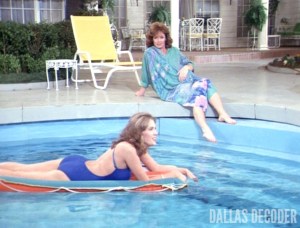
In “Sue Ellen’s Sister,” a second-season “Dallas” episode, Kristin (Colleen Camp) is in the Southfork swimming pool, lounging on a float, while Sue Ellen (Linda Gray) sits on the edge, dipping her toes into the water.

KRISTIN: You know, I could spend the rest of my life here, Sue Ellen, instead of a few days visiting you.

SUE ELLEN: No matter what Mama says, Kristin, money is not the most important thing in the world.

KRISTIN: That isn’t what you used to think.

SUE ELLEN: Well, I thought I could save you from repeating my mistakes.

KRISTIN: [Glancing around Southfork] This is a mistake?

SUE ELLEN: I might have made other choices – choices that would’ve made me happier.

KRISTIN: You don’t have to worry about me, Sue Ellen. I’ll be very happy. [Adjusts herself on her float] Happy and rich.

SUE ELLEN: You don’t like me very much, do you? Why? What have I ever done to you?

KRISTIN: You didn’t have to do anything. You were there. “Look how pretty your sister is, Kristin. Look how well-behaved she is. Why can’t you be well-behaved like that? No, you can’t have a new dress, Kristin. We’ll just make over one of Sue Ellen’s. It’ll be just fine.” No one paid any attention to me until after you married J.R.

SUE ELLEN: That’s not true, Kristin.

KRISTIN: Yes it is. I remember it very well, Sue Ellen, and I’m not playing second fiddle to you anymore. I’m not gonna be second best. I’m gonna get everything you’ve got and more – much more.

Dallas Scene of the Day: ‘Is That What I Am? The Marbles?’

Cliff Barnes, Dallas, For Love or Money, Ken Kercheval, Linda Gray, Sue Ellen Ewing

The biggest loser

In “For Love or Money,” a second-season “Dallas” episode, Cliff (Ken Kercheval) meets Sue Ellen (Linda Gray) in a park, where he ends their relationship.

SUE ELLEN: I thought you loved me.

CLIFF: I do, I do – in my own way. It’s just that J.R. made me realize that there are things that I need – and I can’t have them and you.

SUE ELLEN: And would it be so bad just to have me?

CLIFF: Look, if it stopped me from getting them, it would, because I might not ever be able to forgive myself – or you – for what our relationship might cost me.

SUE ELLEN: And what about what it would cost me?

CLIFF: Look, I can’t explain it. J.R. just pushes certain buttons and maybe I’ve got to learn to play the other man’s game.

SUE ELLEN: So that’s what it is? Just a game?

CLIFF: No.

SUE ELLEN: The winner takes the marbles and goes home? Is that what I am? Just the marbles?

CLIFF: Look, I’m sorry.

SUE ELLEN: You’re sorry? [Voice breaks] Yeah, so am I. You’ll never know how sorry.