Critique: TNT’s ‘Dallas’ Episode 20 – ‘Guilt and Innocence’

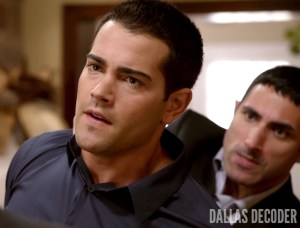
Christopher Ewing, Dallas, Guilt and Innocence, Jesse Metcalfe, TNT

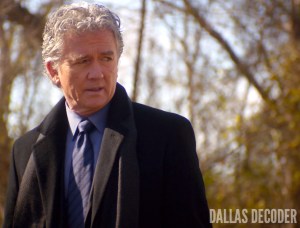
Man of the hour

“Dallas’s” second-season plotlines don’t advance much in “Guilt and Innocence,” which is disappointing to those of who are desperate for more clues in the “Who Killed J.R.?” mystery. On the other hand, this episode offers a nice showcase for the “Dallas” cast, which has become one of television’s most reliable ensembles. The most impressive performances come from Jesse Metcalfe, who is especially moving in the scene where the guilt-ridden Christopher weeps inside the hospital chapel, and Julie Gonzalo, who breaks my heart as Pamela suffers through the final hours of her doomed pregnancy.

The last scene in “Guilt and Innocence” is the most memorable. John Ross and Christopher rush into Pamela’s hospital room as her doctor and nurses scramble to save the lives of her unborn twins. Afton is there too, clutching her daughter’s hand. How many people are present altogether? I couldn’t tell you. Director Jesse Bochco unfurls the action in a series of quick cuts, making it feel chaotic and real. We catch glimpses of Pamela writhing in agony, John Ross and Christopher watching with worried expressions, the doctor barking orders. Someone yells, “Heart rate’s dropping on Baby A!” And then: “Heart rate’s dropping on Baby B!” The motion slows. The machinery buzzes. Soon there are no other sounds, except for a faint piano score. The final shot is the monitor as the two heart rates flatline, one by one.

Another dramatic highlight comes at the beginning, when a frantic Bobby races through the emergency room, calling the missing Ann’s name. Their reunion a few moments later, when Bobby forgives his wife for keeping so many secrets from him during their marriage, makes me realize how invested I’ve become in them as a couple. Robert Rovner’s script also gives us a handful of typically intense scenes with the schizoid Rylands, all three of whom grow a little weirder with each episode, as well as several lighter moments. The best of these: Linda Gray’s breezy exchange with Lee Majors, who proves as charismatic as ever; the moment John Ross calls Pamela “darlin’;” and Sue Ellen’s pot-calling-the-kettle-black description of Afton: “She’s drama.”

With Pamela and wild-haired Judith Ryland both laid up, almost all of the action in “Guilt and Innocence” takes place in the hospital. This makes the episode reminiscent of “Trial and Error,” an earlier second-season episode that unfolded almost entirely in the courthouse during Ann’s trial. In that installment, the legal proceedings ended up being less about Ann shooting Harris than her failings as a wife and mother. Similarly, Pamela’s pregnancy crisis becomes a vehicle for introspection. Christopher wonders if he took too many risks in his quest to build Ewing Energies, while Pamela questions her past schemes. In a poignant moment, she stares at the fetal heart monitor and asks John Ross, “Do you think this is karma … for all the bad that I’ve done?”

I wish “Guilt and Innocence” had taken this idea a little further. When Afton arrives at Pamela’s bedside, she refers to “all the bad choices” her daughter made in an attempt to “forge a relationship” with Cliff, but nothing more is said about Pamela’s deceptions, which aren’t trivial. This is a young woman who spent two years lying about her identity – then married Christopher – in order to infiltrate the Ewings. It makes Afton’s anger toward Christopher feel a little unfair. I understand that she blames him for Pamela’s accident, but shouldn’t she have a little sympathy for the man her daughter conned? (For that matter: Christopher and Pamela are still married? I thought their annulment occurred several episodes ago.)

Along these lines, while Sue Ellen’s lingering bitterness toward Afton is understandable, I’m a bit baffled by Bobby’s hostility toward her (“Pull in your claws, Afton”). Afton once saved his life; you’d think he’d be a little nicer. On the other hand: I like how “Guilt and Innocence” restores a little bit of the edge Afton displayed when she arrived on “Dallas” in the early ’80s. Bochco’s shot of Audrey Landers lurking around the hospital corner is inspired, recalling the way Afton used to slink around Southfork. I also applaud the scene where Afton serenades Pamela with her favorite childhood lullaby, a charming tribute to Afton’s roots as “Dallas’s” resident songstress. (I wonder if Josh Henderson, no slouch in the singing department himself, wanted to join in?)

The only thing that would’ve made Afton’s homecoming complete is having Cliff around. More than anything, I want to know how he feels about himself after endangering Pamela’s life. (I hope we get more than Harris’s one-sided conversation with Cliff in “Guilt and Innocence,” when he apparently expresses no regret for his actions.) I also believe the show could use Afton to shed a little light on what turned Cliff so dark, so hopefully “Dallas” will bring Landers and Ken Kercheval together in a later episode. Just please don’t make it a Gary-and-Valene-style drive-by reunion.

The other item on my “Dallas” wish list: More “Who Killed J.R.?” As much as I appreciate the tantalizing clue dropped at the end of “Guilt and Innocence” (Pam was alive in 1989!), I hope the show’s next episode will put the mystery surrounding J.R.’s death front and center. I realize the people who make “Dallas” are crafting this storyline on the fly, weaving it into scripts that were originally written to include Larry Hagman. But I can also feel the storyline losing momentum. The audience needs to see the Ewings get serious about finding the person responsible for the death of our hero. If it doesn’t happen soon, the question won’t be who killed J.R., but why doesn’t “Dallas” seem to care?

Grade: B

_______________________________________________________________________________________________________________________________________________
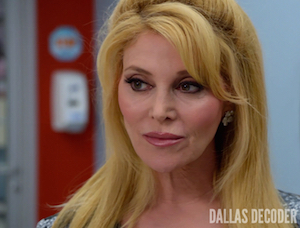
Afton Cooper, Audrey Landers, Dallas, Guilt and Innocence, TNT

Drama mama

‘GUILT AND INNOCENCE’

Season 2, Episode 10

Telecast: March 25, 2013

Writer: Robert Rovner

Director: Jesse Bochco

Audience: 2.6 million viewers on March 25

Synopsis: After the rig explosion, Pamela is rushed to the hospital. Afton arrives to comfort her daughter, who loses her unborn twins after emergency surgery. Bobby forgives Ann. Sue Ellen turns to old flame Ken Richards, chairman of the regulatory board investigating the explosion, who divulges the rig might have been sabotaged. John Ross and Christopher figure out Cliff is trying to devalue Ewing Energies, while guilt-ridden Drew threatens Vickers if he tries to expose Drew’s role in the bombing. While recovering from her fall, Judith tries to turn Emma against Harris, who responds by having Judith drugged and shipped to a rehabilitation center.

Cast: Kuno Becker (Drew Ramos), Emma Bell (Emma Brown), Jordana Brewster (Elena Ramos), Laura Kai Chen (Dr. Chang), Patrick Duffy (Bobby Ewing), Alex Fernandez (Roy Vickers), Marlene Forte (Carmen Ramos), Julie Gonzalo (Pamela Barnes), Linda Gray (Sue Ellen Ewing), Josh Henderson (John Ross Ewing), Shane Jacobsen (Zach McGuire), Audrey Landers (Afton), Judith Light (Judith Ryland), Lee Majors (Ken Richards), Jesse Metcalfe (Christopher Ewing), Mitch Pileggi (Harris Ryland), Brenda Strong (Ann Ewing), Annie Wersching (Alison Jones)

“Guilt & Innocence” is available at DallasTNT.com, Amazon.com and iTunes. Watch the episode and share your comments below.
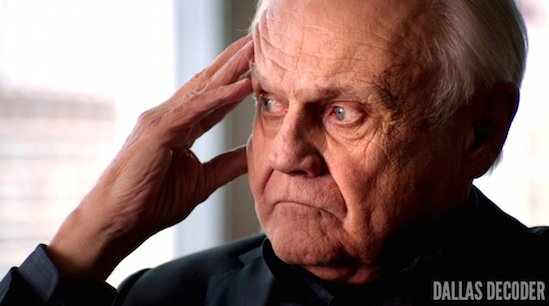
Critique: TNT’s ‘Dallas’ Episode 19 – ‘Ewings Unite!’

Cliff Barnes, Dallas, Ewings Unite, Ken Kercheval, TNT

The twist

There’s a lot to like about “Ewings Unite!,” including Ken Kercheval’s chilling performance in the final scene and the sensational, old-school soap opera showdown between Joan Van Ark and Linda Gray, which is destined to become a “Dallas” classic. Unfortunately, this episode also gives us plenty to lament. Valene’s eagerly awaited reunion with Gary never really happens, there’s seemingly little movement in the “Who Killed J.R.?” mystery, and the bombshell dropped during J.R.’s will reading is silly. This production isn’t just missing the old Hagman magic. Logic has taken a holiday too.

The will reading offers a welcome cameo from the wonderful Barry Corbin, who portrayed Sheriff Washburn on the old “Dallas” and appears here as J.R.’s lawyer. Bruce Rasmussen’s script honors J.R.’s mischievousness by having him leave a bottle of scotch to recovering alcoholic Gary, while Bobby inherits J.R.’s collection of cowboy boots. (This might be an inside joke. Hagman memorably called cowboy boots “the most uncomfortable mode of transport ever invented.”) I’m not going to complain about the omission of absent characters – a full recitation of J.R.’s bequests could have consumed half the episode – but I will gripe about the big surprise: It seems Miss Ellie waited until after J.R.’s death to leave half of Southfork to John Ross.

Ellie’s explanation comes in a letter read by Corbin’s character: “My son J.R. was many things, but he was not a rancher. That’s why I left my beloved Southfork to Bobby. But I hope you understand, Bobby, that J.R.’s sins should not be visited upon my grandson, John Ross.” Come again, Mama? As much as I like the idea of Ellie one-upping J.R. from beyond the grave, this defies belief. Set aside the fact that Ellie and second husband Clayton deeded Southfork to Bobby toward the end of the original series. In the new “Dallas’s” timeline, she left the ranch to Bobby upon her death more than a decade ago. Now Ellie is able to change those terms? I’m no lawyer, but how is this legally possible?

If the show’s goal is to pit John Ross against his uncle – effectively allowing John Ross to take his father’s place in this franchise’s central conflict of J.R. versus Bobby – then I’m all for it. I also like the idea that John Ross’s stake in the ranch means he’ll probably take up residence at Southfork, which I hope will set the stage for more old-fashioned Ewing family gatherings. Still, I wonder: Couldn’t the show have achieved this new power structure without sacrificing its credibility?

“Ewings Unite!” also suggests Cliff’s company, Barnes Global, is a rebranded version of the old Barnes/Wentworth conglomerate he ran on the old show. This also seems to contradict established “Dallas” lore – didn’t Cliff long ago relinquish his stake in those companies? – but I can live with this change since the composition of his corporate assets always seemed needlessly confusing. I’m more bothered by the revisionism in Elena’s storyline. When she challenges Christopher over his blackmail scheme, she declares, “This is why I wanted out of the company.” Whoa! Didn’t Sue Ellen oust Elena from the company against her will? Never mind the old show; if the new “Dallas” isn’t going to respect its own history – and by “history,” I mean stuff that happened three episodes ago – why should we?

The resolution of Gary’s mini-arc and Val’s return yield more mixed feelings. Van Ark is a hoot in the scene where Val confronts Sue Ellen (“Once a bitch, always a bitch!”), a marquee battle between two of television’s greatest soap queens. This doesn’t feel much like the Val I remember, but I like the idea that Van Ark’s character has grown stronger and more confident. “Poor Val” appears to be a memory. I also adore Ted Shackelford’s final scene with Gray, when Sue Ellen sweetly urges Gary to return to his wife before it’s too late. “One day she may be gone and you don’t want to regret the loss of every moment you could have spent with her,” Sue Ellen says. It’s a nice reminder of the wisdom Sue Ellen has gained, as well as the fact that her devious behavior in this episode stems from her grief.

But as much as I appreciate these moments, I want to shake my fist at “Dallas” for not giving us a scene where Gary and Val patch things up. Talk about a missed opportunity. Shackelford and Van Ark are every bit as iconic as “Dallas’s” other famous pairings. To split up the couple is one thing; to only give them a brief appearance together in the Southfork foyer and then leave the fate of their marriage unknown is something else. (So much for engendering goodwill among “Knots Landing” fans.) Of course, if the lack of closure means Gary and Val will return next season to resume their storyline, I’ll be the first to eat these words.

I don’t mean to dwell on my disappointments with “Ewings Unite!” There’s plenty here to admire, including seeing John Ross and Christopher work together; the scene where they gang up on Pamela showcases the nice chemistry between Josh Henderson and Jesse Metcalfe, who play off each other almost as easily as Hagman and Patrick Duffy did during “Dallas’s” heyday. I also appreciate Christopher’s flirtation with the dark side, and how the scene where Elena learns about his blackmail scheme echoes one from the old show where Pam tries to bring Bobby back from the edge. Other highlights include the pairing of impressive newcomers Kuno Becker and Emma Bell, as well as the addition of Annie Wersching, who I hope will stick around as sexy, scheming city transportation official Alison Jones.

More good stuff: the scene where Cliff and Harris form their Legion of Doom-style alliance, as well as when Harris dismisses his new partner in crime as a “paranoid old coot” while speaking to Vickers, who is poised to succeed Frank as this show’s go-to henchman. As far as Cliff’s decision at the end of episode to blow up the Ewing Energies rig, even though pregnant Pamela is on board: I wasn’t that shocked. The version of Cliff we see on TNT’s “Dallas” is more twisted and consumed than the one we remember. Like a lot of longtime fans, I wish I knew how Cliff got this way. Still, as ugly as his actions are, they seem perfectly in tune with the person he’s become.

Regardless, how fantastic is Kercheval in that scene? Everything about the actor’s body language – the fidgety hands, the shifty eyes – suggests the torment raging within Cliff in that instant. I also appreciate how director Steve Robin heightens the drama with a glimpse of pregnant Pamela’s belly before the bomb goes off, as well as the shot of Vickers kissing the cross around his neck before he pushes the detonation button.

I’m more surprised to see “Ewings Unite!” spend so little time on the “Who Killed J.R.?” mystery, which got off to such a riveting start at the end of the previous episode. After Bobby fills in John Ross and Christopher on the origin of Cliff’s company, he suggests J.R. was searching for Pam because she might be a “silent partner” in Barnes Global and casually reveals that Katherine is dead. Then again, as Dallas Decoder readers have pointed out, this show usually doesn’t mention older characters unless they’re going to figure into the storyline. Could Bobby’s reference to Katherine be the first step toward bringing Morgan Brittany to the new “Dallas”? Who knows? We might look back on this episode one day and realize it offers the biggest clue of all.

Grade: B

_______________________________________________________________________________________________________________________________________________

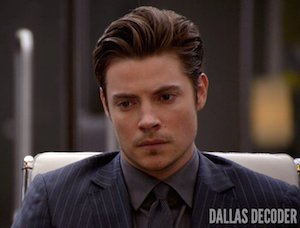
Dallas, Ewings Unite, John Ross Ewing, Josh Henderson, TNT

Inherit the earth

‘EWINGS UNITE!’

Season 2, Episode 9

Telecast: March 18, 2013

Writer: Bruce Rasmussen

Director: Steve Robin

Audience: 2.7 million viewers on March 18

Synopsis: J.R.’s will splits his share of the Southfork mineral rights between Sue Ellen and John Ross. A letter from Miss Ellie reveals John Ross will become co-owner of the ranch with Bobby. When Bobby decides to resume drilling on Southfork, Sue Ellen, who is still drinking, summons Valene to take Gary home. Cliff tries to undermine Ewing Energies’ bid for the city fuel contract, but John Ross and Christopher blackmail transportation official Alison Jones into giving them the contract. Judith threatens to oust Harris at Ryland Transport, then falls down the stairs. After Cliff and Harris join forces, Harris’s henchman Roy Vickers blackmails Drew into sabotaging the Ewing Energies methane extraction rig. Cliff orders Vickers to blow up the rig, even though it will endanger Pamela and the Ewings.

Cast: Kuno Becker (Drew Ramos), Emma Bell (Emma Brown), Jordana Brewster (Elena Ramos), Barry Corbin (J.R.’s lawyer), Patrick Duffy (Bobby Ewing), Alex Fernandez (Roy Vickers), Julie Gonzalo (Pamela Barnes), Linda Gray (Sue Ellen Ewing), Josh Henderson (John Ross Ewing), Jesse Metcalfe (Christopher Ewing), Kevin Page (Bum), Mitch Pileggi (Harris Ryland), Ted Shackelford (Gary Ewing), Brenda Strong (Ann Ewing), Charlene Tilton (Lucy Ewing), Joan Van Ark (Valene Ewing), Annie Wersching (Alison Jones)

“Ewings Unite!” is available at DallasTNT.com, Amazon.com and iTunes. Watch the episode and share your comments below.
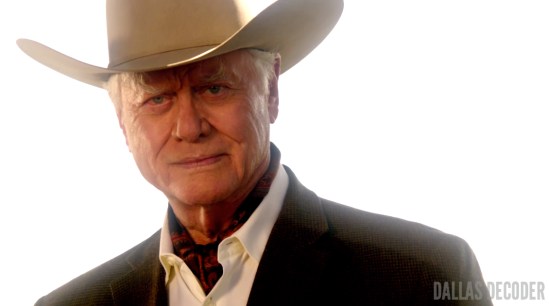
Critique: TNT’s ‘Dallas’ Episode 18 – ‘J.R.’s Masterpiece’

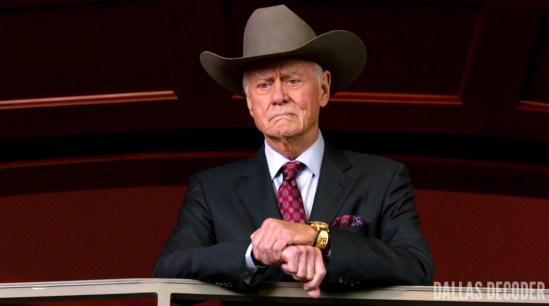
Dallas, J.R. Ewing, J.R.'s Masterpiece, Larry Hagman, TNT

Still here

It isn’t quite accurate to call “J.R.’s Masterpiece” the first “Dallas” episode without J.R. Ewing. Our hero is present, even if he isn’t physically there. We see Larry Hagman in the special opening credits, which offer a moving, mournful version of Jerrold Immel’s classic theme music and memorably end with J.R. disappearing into white light. Beyond that, we feel J.R.’s spirit in every scene, every line, every breath. It’s gratifying and even a little exhilarating to see the show honor this character so thoroughly. This will be remembered as the hour that Cynthia Cidre, Michael M. Robin and seemingly everyone else associated with “Dallas” rose to the occasion – and then surpassed it.

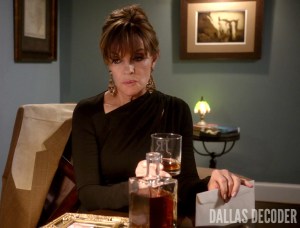
The two most unforgettable moments in “J.R.’s Masterpiece” belong to Linda Gray. In the first, Sue Ellen enters J.R.’s bedroom on the night before his funeral and removes from her purse the letter he sent her before his death. She sits at his table, looks at a framed photograph from their second wedding and smiles. Then she notices J.R.’s decanter of bourbon, emblazoned with his name. With the sad country tune “The Bottom” playing in the background, Sue Ellen pours herself a glass and contemplates it for a few moments, just like she did with the wineglass in “Venomous Creatures,” an earlier second-season episode. On that occasion, J.R. arrived on her doorstep and gave her the encouragement she needed to resist temptation. This time around, he isn’t here to save her. And so Sue Ellen downs the bourbon. Hard. And then she pours herself another glass. And then another.

It’s a tense, wrenching scene on its own, but I also appreciate how it echoes one of my favorite moments from TNT’s other great “Dallas” episode, the first-season entry “Family Business.” In that scene, J.R. sits at the same table, glances at a picture of Miss Ellie and takes a swig of bourbon before signing the Southfork deed over to Bobby. In a show where the booze flows as freely as ever, both scenes are about J.R. and Sue Ellen turning to the bottle to find courage they can’t muster on their own. He needs it to do the right thing, she needs it to just get through the night.

Seeing Sue Ellen fall off the wagon is tough for me and other longtime “Dallas” fans who remember how hard she fought to get sober. But I’m also the first to admit that her relapse makes riveting television. I have no idea where “Dallas” will take Gray’s character after “J.R.’s Masterpiece,” but my guess is she won’t return to the path of self-destruction. Sue Ellen isn’t the woman she used to be. She’s wiser, more confident, more aware. We see this during the episode’s other great moment: her mesmerizing eulogy at J.R.’s gravesite, where she confesses her relapse to the other Ewings. “I’m a bit drunk right now,” she says. This line startles me even more than the one at the top of the hour, when the Mexican policewoman announces J.R.’s death. I don’t think we’ve ever seen Sue Ellen acknowledge her demons so forthrightly, which makes me think she’ll find the courage to reclaim her sobriety sooner rather than later.

As remarkable as Sue Ellen’s admission is, the most emotional part of her speech comes when she reads aloud J.R.’s letter. He writes, “For me to apologize now for all the wrongs I’ve done you would take up all the time I’ve got left. So I’m hoping it will suffice for me to say that I was never worthy of you.” The note ends with a request: “When I get back to Dallas, will you have dinner with me?” But that’s not what J.R. is actually asking, is it? He really wants to know if Sue Ellen will forgive him for all those “wrongs.” She knows this too, which is why it’s so heartbreaking when she kneels, touches his casket and sobs, “Yes, yes, J.R. The answer is yes.”

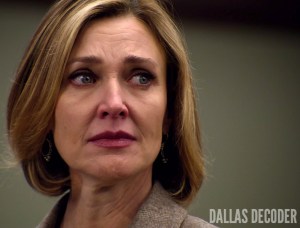
‘He Never Pretended’

Bobby Ewing, Dallas, J.R.'s Masterpiece, Patrick Duffy, TNT

Grand scheme

The other eulogies in Cidre’s script are beautifully written, capturing the essence of each character’s connection to J.R. with an impressive economy of words. In his speech, Bobby says, “Throughout my life, it’s pretty much been easy for me to do good, because I could always count on J.R. to do bad. … Now I have to figure out just what I’m supposed to do in this grand scheme of things.”

When I wrote down this line and looked at it, I realized it could be seen as Bobby’s response to J.R.’s admission last season, when he told Bobby, “I don’t know who I’d be without you.” The line acknowledged what the audience always knew – that J.R. was incapable of checking his worst impulses and needed Bobby to do it for him. Now, hearing Bobby wonder aloud what he’ll do without J.R. raises the intriguing prospect that Patrick Duffy, always the unsung hero of this franchise, will soon be able to show us other sides to his character.

In the other eulogies, Ray recalls fearing how he could never make his father proud the way J.R. did, which isn’t exactly how I remember Jock’s sentiments toward J.R. and Ray, but the speech nonetheless reflects the deep-seated insecurities that always haunted Steve Kanaly’s humble cowboy. Ted Shackelford also does a nice job delivering Gary’s single line (“Every step backwards or forward I ever took in my life was because of J.R.”), which perfectly fits his tortured character – and probably every other Ewing.

The most unexpected tribute comes from Lucy. “Things I thought were so horrible that J.R. did just seem honest now,” she says. “He never pretended to be anything other than himself.” It’s surprising to hear Lucy offer admiration for J.R., yet you can’t deny the profundity of her statement. I’m also touched by the shot Robin, the director, gives us of Lucy weeping during the funeral. Given Charlene Tilton’s well-known affection for Hagman in real life, I have no doubt those tears come from the actress’s heart.

It would be wrong to overlook the newer cast members, who are every bit as impressive as the “Dallas” veterans during this sequence. Jordana Brewster’s tears move me when Elena recalls the pep talk J.R. gave her after her father’s death (“Honey, how are you going to make your daddy proud?”), and I also appreciate Jesse Metcalfe’s Duffy-esque stoicism during Christopher’s speech, when he remembers J.R.’s attempt to comfort him after Pam abandoned the family: “I don’t know why your mama left, Christopher. Especially when she had such a good, smart little boy like you. But you’re a Ewing now. So stop crying and behave like one.”

It’s somewhat surprising that Josh Henderson has no lines at J.R.’s burial. Then again, are any needed? The dazed expression Henderson wears throughout this episode and especially at the funeral tells us everything we need to know about what John Ross is feeling.

‘What You Choose to Recall’

Dallas, J.R.'s Masterpiece, Linda Gray, Sue Ellen Ewing, TNT

The bottom

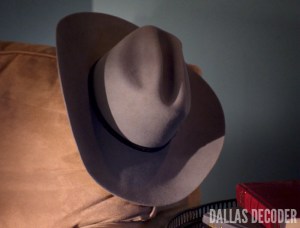
Not all of the dramatic moments in “J.R.’s Masterpiece” happen at the funeral. Duffy and Brenda Strong have a big fight scene that’s been a long time coming, as Bobby lashes out at Ann for keeping so many secrets from him during the course of their marriage. And as with all of the new “Dallas’s” best episodes, the smaller moments are touching too. Christopher comforts Sue Ellen when she breaks down in the morgue. Ray reaches for her hands as she returns to her seat after her eulogy. Bobby sits alone in J.R.’s room and notices his brother’s hat hanging on the back of the chair.

The lighter moments are welcome too. The best of these is seeing Sue Ellen commiserate with Cally and Mandy at the memorial, a surprisingly sweet scene that offers another reminder of how much Sue Ellen has grown. It’s also hard to not get a kick out of Ken Kercheval’s appearance, when Cliff crashes the memorial, ranting and raving about the Barnes/Ewing feud. As much as I’ve come to enjoy Kercheval’s performance on the new “Dallas” as the Godfather-like Cliff, it’s nice to be reminded of his character’s combustible side.

The other highlight of “J.R.’s Masterpiece”: the music. Merle Haggard’s “My Favorite Memory,” with its references to “what you choose to recall,” opens J.R.’s Petroleum Club memorial, setting the stage for the unexpectedly warm reminiscing that follows. I also like the foreboding strings at the top of the hour, when Bobby, Sue Ellen, John Ross and Christopher arrive in Mexico. Equally haunting: what sounds like Alison Krauss’s version of “Down to the River to Pray,” which is interspersed throughout the graveside eulogies. The most memorable song, though, remains Tara Holloway’s spectacular rendition of “The Bottom” during Sue Ellen’s relapse. Who will ever be able to listen to that song again without thinking of Linda Gray’s incredible performance in that scene?

As for the mystery that begins in the closing moments of “J.R.’s Masterpiece”? I’ll confess: When I read that Cidre, Robin and company planned to kill off Hagman’s character with another “Who Shot J.R.?” mystery, I cringed. I didn’t want my hero to go down in defeat. But the idea that J.R. spent his final days crafting a “masterpiece” scheme against his enemies – a grand plan that will now be carried out by his family – might mean ol’ J.R. will be able to go out on top after all.

All of the questions raised by the end of the episode are tantalizing. Why was J.R. tracking down Christopher’s “mother” – and which mother are we talking about: Kristin or Pam? Will John Ross end up using the gun that J.R. left him? Could there be significance to Christopher’s vow to help John Ross find J.R.’s killer so they can confront the bad guy (or gal) as “brothers”? What’s in the document that J.R. left for Bobby, and what should we make of Bobby’s tearful smile and last line: “I knew you’d have at least one more left up your sleeve, J.R. It is a good one. I love you brother.”

Until we get the answers, we won’t know what J.R.’s masterpiece will be. But at least we know what “Dallas’s” looks like.

Grade: A+

_______________________________________________________________________________________________________________________________________________

Dallas, J.R.'s Masterpiece, TNT

Hat tip

‘J.R.’s MASTERPIECE’

Season 2, Episode 8

Telecast: March 11, 2013

Writer: Cynthia Cidre

Director: Michael M. Robin

Audience: 3.6 million viewers on March 11

Synopsis: Bobby, Sue Ellen, John Ross and Christopher learn J.R. was shot and killed during a robbery in Mexico. Sue Ellen falls off the wagon. After the funeral, Bum reveals J.R. had been searching for Christopher’s mother and that he went to Mexico to follow a lead on Harris. J.R. also leaves a gun for John Ross and a document for Bobby, who refuses to reveal its contents to John Ross and Christopher.

Cast: Kuno Becker (Drew Ramos), Emma Bell (Emma Brown), Jordana Brewster (Elena Ramos), Mark Cuban (himself), Patrick Duffy (Bobby Ewing), Marlene Forte (Carmen Ramos), Julie Gonzalo (Pamela Barnes), Linda Gray (Sue Ellen Ewing), Castulo Guerra (Carlos del Sol), Josh Henderson (John Ross Ewing), Robert Anthony Hunt (minister), Jerry Jones (himself), Steve Kanaly (Ray Krebbs), Ken Kercheval (Cliff Barnes), Jesse Metcalfe (Christopher Ewing), Kevin Page (Bum), Hugo Perez (Dr. Garcia), Mitch Pileggi (Harris Ryland), Cathy Podewell (Cally), Mayor Mark Rawlings (himself), Tony Sears (George GIilchriest), Ted Shackelford (Gary Ewing), Deborah Shelton (Mandy), Brenda Strong (Ann Ewing), Charlene Tilton (Lucy Ewing)

“J.R.’s Masterpiece” is available at DallasTNT.com, Amazon.com and iTunes. Watch the episode and share your comments below.
Critique: TNT’s ‘Dallas’ Episode 17 – ‘The Furious and the Fast’

Dallas, Furious and the Fast, J.R. Ewing, Larry Hagman, TNT

One last shot

We know it’s coming, but still it shocks us. “The Furious and the Fast” ends with the murder of J.R. Ewing, or at least what looks like his murder. It’s jarring, chilling, sad. It’s also a technological feat. The producers apparently created the sequence using recycled footage and audio clips, although the Hollywood trickery is probably obvious only to the most eagle-eyed “Dallas” obsessives. Yet as impressive as the scene is, it isn’t the only reason to admire this episode, which is one of the new “Dallas’s” most entertaining hours yet.

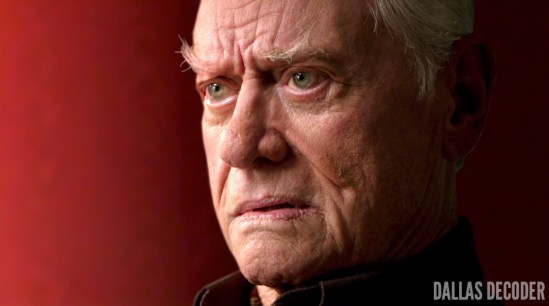
The historic final scene: John Ross is alone in the darkened Ewing Energies conference room, a drink in his hand, his shoes propped on the table. He receives a phone call from J.R., who wants an update on their latest plot against Bobby and Christopher. John Ross tells him the scheme failed, but J.R. is nonplussed: “Don’t you worry, son. I’ve got a plan. It’s going to be my masterpiece – because you shouldn’t have to pay for my sins.” John Ross looks puzzled and asks J.R. what he means. Another cryptic response: “Just remember: I’m proud of you. You’re my son, from tip to tail.” John Ross smiles, but when the camera cuts to J.R., the old man looks startled. Cut back to John Ross, who hears two gunshots and leaps to his feet. “Dad! Dad!” he exclaims. Then, finally: “Dad?”

“The Furious and the Fast” was filmed after Larry Hagman’s death last fall, and it appears as though the producers cobbled together J.R.’s final moments using bits and pieces from other recent scenes. The shots of him on the phone come from the “False Confessions” exchange where Frank calls J.R. to inform him that John Ross and Pamela have become lovers. (The original scene took place in J.R.’s bedroom; in the recycled version, the walls have been turned red.) Hagman’s dialogue, in the meantime, seems to have been pulled from a variety of episodes. J.R. delivered the “you shouldn’t have to pay for my sins” line in “The Price You Pay,” while the “masterpiece” bit comes from “Sins of the Father.” “Tip to tail” was memorably heard at the end of “Revelations,” the first-season finale.

I’m sure the “Dallas” producers would’ve preferred to film Hagman’s final performance as J.R. while the actor was still alive, or better yet, to never have occasion to create such a scene at all. This sequence represents their effort to make the best of a sad situation, so I salute them for coming up with something that not only looks and feels convincing, but also offers a fittingly mysterious beginning to the “Who Killed J.R.?” storyline that’s destined to dominate the rest of the season.

It also feels appropriate that J.R.’s final words are for his son since Josh Henderson sells this scene more than anyone. The smile that breaks across John Ross’s face when J.R. announces he’s proud of him is touching. You can also hear the heartbreak in Henderson’s voice when John Ross realizes what’s happening to his father on the other end of the phone. Credit also goes to director Rodney Charters, who pulls back the camera each time John Ross exclaims “Dad!” until we’re finally left with that wide shot of Henderson alone in the dark. The echo created by John Ross’s final “Dad?” is another nice touch.

Of course, even though I admire the audaciousness of trying to recapture the old “Who Shot J.R.?” magic, it’s a little unnerving to see the new “Dallas” shoot yet another character. J.R. is the fourth person on this show to take a bullet during the past eight episodes. It’s also worth noting how different this whodunit is from the one triggered by the 1980 episode “A House Divided.” Back then, J.R.’s shooting capped an hour in which several characters were each given a clear motivation for wanting him dead. This time around, there are no obvious suspects, although I’m sure they’ll emerge soon enough. Still, I wonder: What character in the “Dallas” mythology is big enough for this job? Who has the stature to take down J.R. Ewing?

I’ll save those worries for another day, though, because to focus only on the implications of “The Furious and the Fast’s” final scene would mean overlooking the rest of this excellent episode. Ted Shackelford’s return as Gary Ewing inspires many of the hour’s best moments, including his fun exchanges with Linda Gray. To get Gary to lower his defenses, Sue Ellen flirts shamelessly with him, allowing us to see a side of her that’s been dormant for much too long. How wonderful of “Dallas” to show that a woman in her 70s can still be sexy and playful. I also appreciate how Julia Cohen’s script has Sue Ellen and Gary acknowledge their past battles with the bottle, which seems to be a sly nod to the memorable scene in 1980 when Gary’s attempt to bond with fellow alcoholic Sue Ellen ended in disaster.

More highlights: John Ross’s bratty greeting to Uncle Gary (“Who the hell let you off the cul-de-sac?”) and Gary’s heart-to-heart with Bobby, when he reveals his fall from the wagon and split from Valene. Patrick Duffy and Shackelford slip comfortably into their familiar dynamic of the responsible baby brother and the all-too-human middle sibling. Isn’t it remarkable how two actors who look nothing alike can seem so believable as brothers? In my recent interview with Shackelford, he expressed his willingness to reprise his role beyond the three-episode stint that begins with this episode. Given how easily he interacts with Henderson, Gray and Duffy here, this seems like an idea worth serious consideration.

Indeed, if “The Furious and the Fast” does anything, it demonstrates how important it is to inject fresh blood (or in Shackelford’s case, familiar blood) into a show like this. I was apprehensive when I read last year about the producers’ plans to add newcomers like Kuno Becker and Emma Bell to the cast, fearing they would rob the core cast of screen time, which already feels too scarce. But I was wrong. Bell knocks me out as timid, confused Emma, and I’m completely charmed by Becker, whose effortless chemistry with Jordana Brewster might be the season’s nicest surprise.

Also fascinating: Mitch Pileggi and Judith Light as Harris and Judith Ryland, whose mother/son relationship grows weirder with each episode. (This episode’s best line: Judith’s frigid “Now pick that up” after Harris kicks over the chair in Emma’s bedroom.) Altogether, the “Dallas” cast now includes 11 regular cast members and several recurring guest stars, yet in this episode at least, no one gets shortchanged.

“The Furious and the Fast” also gets a big lift from Charters’ expertly executed racecar sequences, which generate genuine suspense and make the episode feel a little like this generation’s version of a Southfork rodeo. And even though it seems unlikely the city’s transportation chief would award Christopher the fuel contract on the basis of how many laps his methane-powered car can complete, you have to admit: The race offered a clever metaphor for the familial squabbling that is so central to this show. Like the Ewing Energies-sponsored car, John Ross and Christopher sometimes seem to go around in circles with their feuding, yet it rarely gets boring.

When I watched “The Furious and the Fast” for the first time the other night, I kept looking at the clock, expecting to see the show was almost ever. Some of this stemmed from the dread I was feeling, knowing this would be Hagman’s last episode. But my clock-watching was also done with a sense of wonder. This episode was so dense, every scene felt like it was bound to be the last one of the night. By the time those gunshots finally rang out, I was plenty sad, but I was also damn satisfied. J.R.’s final hour turned out to be one of “Dallas’s” finest.

Grade: A

_______________________________________________________________________________________________________________________________________________

Dallas, Furious and the Fast, Gary Ewing, Ted Shackelford, TNT

Return engagement

‘THE FURIOUS AND THE FAST’

Season 2, Episode 7

Telecast: March 4, 2013

Writer: Julia Cohen

Director: Rodney Charters

Audience: 2.8 million viewers on March 4

Synopsis: Gary Ewing returns to Dallas and votes with Bobby to stop drilling on Southfork, which Bobby and Christopher hope will force Sue Ellen to return her share of Ewing Energies to Elena. Sue Ellen flirts with Gary, hoping to break his alliance with Bobby. Harris and Judith try to send Emma back to London, but she runs away to Southfork. At J.R.’s behest, Bum digs for dirt on Harris. Drew and Elena discover there may be oil under the land their father sold to Bobby. Christopher is poised to clinch the city fuel contract after the Ewing Energies car wins a big race. John Ross speaks to J.R. on the phone, but the call is interrupted when it appears J.R. is shot.

Cast: Kuno Becker (Drew Ramos), Emma Bell (Emma Brown), Kenneth Wayne Bradley (Jim West), Jordana Brewster (Elena Ramos), Patrick Duffy (Bobby Ewing), Julie Gonzalo (Pamela Barnes), Linda Gray (Sue Ellen Ewing), Larry Hagman (J.R. Ewing), Cory Hart (Brett Cochran), Josh Henderson (John Ross Ewing), Judith Light (Judith Ryland), Jesse Metcalfe (Christopher Ewing), Kevin Page (Bum), Mitch Pileggi (Harris Ryland), Ricky Rudd (himself), Ted Shackelford (Gary Ewing), Brenda Strong (Ann Ewing), Curtis Wayne (Denny Boyd), Annie Wersching (Alison Jones)

“The Furious and the Fast” is available at DallasTNT.com, Amazon.com and iTunesWatch the episode and share your comments below.

Critique: TNT’s ‘Dallas’ Episode 16 – ‘Blame Game’

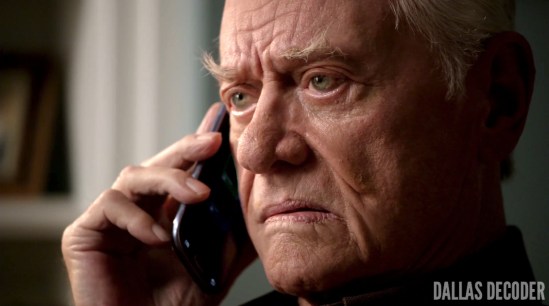
Blame Game, Dallas, J.R. Ewing, Larry Hagman, TNT

Once and again

I cringed when I saw J.R. and Bobby’s instant-messaging exchange in “Blame Game.” This episode was filmed after Larry Hagman’s death last fall, so I’m guessing the producers created the sequence using leftover footage of the actor. (J.R.’s presence during Ann’s sentencing appears to be recycled too.) I’m all for rescuing Hagman from the cutting room floor, but having J.R. send IMs to pester Bobby into watching an online video of a basketball-playing dog? That felt silly. It also reminded me of how the old show used one-sided telephone conversations to keep Jock around after Jim Davis died, which is one “Dallas” tradition I’d just as soon not continue.

By the end of “Blame Game,” though, I had a change of heart. I’m not sure why the show had Patrick Duffy shout Bobby’s responses to J.R.’s instant messages (even if J.R. was supposed to be down the hall, couldn’t Bobby have typed his answers?), but the revelation that the viral video was really a Trojan horse to erase Bobby’s notorious cloud drive was pretty nifty. J.R. pulled a fast one on Bobby, and “Dallas” pulled a fast one on its audience. I always fall for this show’s fake-outs, which either means I’m really gullible or the people who make the show are really clever. I’ll let you decide.

Overall, “Blame Game” is another solid hour of “Dallas.” The script comes from Gail Gilchriest, who also wrote last season’s “The Enemy of My Enemy,” the episode that brought Sue Ellen off the sidelines and got her involved in the Southfork oil saga. In “Blame Game,” Gilchriest once again demonstrates a knack for writing for “Dallas’s” first lady, giving Linda Gray some of her best material yet. I love the scene where Sue Ellen and Bobby lament the rivalry between their sons, as well the jailhouse pep talk Sue Ellen gives Ann. The friendship between these women has become one of my favorite relationships on the show. It feels believable, especially now that we know that Ann, like Sue Ellen, was once a less-than-perfect wife and mother. (As far as Ann’s release on probation: Yes, it’s a little convenient, but when has a Ewing ever gone to jail and stayed?)

I wish Sue Ellen hadn’t been so easily manipulated by John Ross into seizing Elena’s share of Ewing Energies, but I don’t really mind because it’s so much fun to see the return of the shrewd, bitchy Sue Ellen from the late ’80s. With J.R. exiting the stage, Sue Ellen is now poised to succeed him as John Ross’s mentor and the thorn in Bobby’s side. What a tantalizing prospect. Hopefully this will cement Gray’s place in the narrative for a long time to come. Likewise, I’m thrilled to see Pamela finally snag her piece of the company. Think about how entertaining the Ewing Energies’ board meetings will be once Sue Ellen and Pamela join the fray.

“Blame Game’s” other V.I.P.: Jesse Metcalfe, who has quietly become one of the new “Dallas’s” best performers. The actor has found the right balance between strength and sensitivity, much like Duffy did during the original series. I also like how Christopher has succeeded Bobby as “Dallas’s” resident action hero. In “Blame Game,” Christopher makes a valiant attempt to turn the tables on the thug holding him at gunpoint at Ewing Energies. Later, he shields Elena when Vicente points his gun at her. Jesse Bochco does a nice job directing both sequences, and he gets a big assist from “Dallas” composer Rob Cairns, whose score during the showdown with Vicente feels even more cinematic than usual.

It’s also nice to see Kuno Becker’s Drew Ramos take down Vicente, although the body count on this show is beginning to trouble me. During the past 10 hours of “Dallas,” Marta, Tommy, Frank and Vicente have died; Harris was gunned down but survived. On a lighter note, since Becker arrived a few episodes ago, I find myself looking forward each week to his scenes with Jordana Brewster. Drew brings out Elena’s feistiness in a way only a sibling could. Do I dare suggest these two are “Dallas’s” best brother/sister act since Victoria Principal and Ken Kercheval?

The rest of the “Blame Game” hostage crisis yields mixed feelings. In addition to the Sue Ellen/Bobby scene, I like the moment when Vicente realizes the Ewing cousins have traded romantic partners since his last encounter with them. (“You Ewing boys share after all! I love it!”) Likewise, it’s impossible to not cheer when John Ross and Christopher come together to overpower Vicente’s henchmen. As much fun as it is to see the Ewings squabble, it’s always more satisfying when they band together.

My gripes: The hostage sequences are too compressed. “Blame Game” invites comparisons to the classic “Winds of Vengeance,” an early “Dallas” episode where the Ewings are held hostage. (Fans of “Dallas” producer Cynthia Cidre’s previous series, “Cane,” will recall that show did a family-held-hostage episode too.) But the reason “Winds of Vengeance” succeeds is because the slower pace of 1970s television allowed the tension to build steadily. “Blame Game” squeezes its crisis into a roughly 15-minute period, and some of that time is taken up by Ann’s sentencing.

This is also one of those times I wish the new “Dallas’s” Southfork interiors more closely resembled those seen on the old show. The living room where the Ewings are held captive in “Blame Game” looks nothing like the one where the “Winds of Vengeance” hostage crisis unfolds. The only time you feel the history of this house is when you see it from the outside.

Of course, it’s not like I haven’t become attached to the new Southfork set too. The “Blame Game” scene where Bobby bursts into J.R.’s bedroom and finds it empty is surprisingly poignant. The brief glimpse of J.R.’s empty table is what moves me. This is where our hero glanced at Miss Ellie’s picture before signing over the Southfork deed to Bobby last season. It’s where he told John Ross to never take advantage of the family when they’re in the trouble, and where he learned to use his tablet. How sad to think we’ll never see him sit there again.

Grade: B

_______________________________________________________________________________________________________________________________________________

Blame Game, Christopher Ewing, Dallas, Jesse Metcalfe, TNT

Captive audience

‘BLAME GAME’

Season 2, Episode 6

Telecast: February 25, 2013

Writer: Gail Gilchriest

Director: Jesse Bochco

Audience: 2.6 million viewers on February 25

Synopsis: During mediation, Christopher agrees to give 10 percent of Ewing Energies to Pamela, who refuses to share it with John Ross. J.R. erases Bobby’s cloud drive and leaves Southfork unannounced. When Vicente stages an ambush on Southfork and tries to kidnap Elena, Drew shoots and kills him. Sue Ellen uses the morals clause in Elena’s contract to seize her shares in the company.

Cast: Kuno Becker (Drew Ramos), Emma Bell (Emma Brown), Carlos Bernard (Vicente Cano), Pablo Bracho (consul general), Jordana Brewster (Elena Ramos), Jesse Campos (Jose), Vanessa Cedotal (District Attorney), Damon Dayoub (Vicente’s henchman), Patrick Duffy (Bobby Ewing), Julie Gonzalo (Pamela Barnes), Linda Gray (Sue Ellen Ewing), Larry Hagman (J.R. Ewing), Josh Henderson (John Ross Ewing), Jason Kravitz (Pamela’s lawyer), Judith Light (Judith Ryland), Jesse Metcalfe (Christopher Ewing), Glenn Morshower (Lou Bergen), Mitch Pileggi (Harris Ryland), Freddie Poole (Ramon), Krishna Smitha (Shireen Patel), Brenda Strong (Ann Ewing), Rebekah Turner (Jury Forman), Wilbur Fitzgerald (Judge Wallace Tate)

“Blame Game” is available at DallasTNT.com, Amazon.com and iTunes. Watch the episode and share your comments below.
Critique: TNT’s ‘Dallas’ Episode 15 – ‘Trial and Error’

Dallas, J.R. Ewing, Larry Hagman, TNT, Trial and Error

Last stand

“Trial and Error” gives us the last scenes that Larry Hagman filmed as J.R. Ewing, including his poignant reconciliation with turncoat son John Ross, as well as a spirited clash with Sue Ellen that recalls the couple’s stormier days. But as much as I cherish these final, dwindling moments with my hero, I can’t deny that “Trial and Error” belongs to Brenda Strong. The actress is superb throughout this episode, especially when Ann testifies during her trial. Strong delivers more than 400 words of dialogue, and each one feels achingly real. It’s one of the most moving speeches in “Dallas” history.

Since the new “Dallas” began I’ve rooted for Ann, a modern Texas woman who is every bit as comfortable in pearls and heels as she is in boots and jeans. One of my favorite scenes during the show’s first season was Ann’s showdown with Harris, when she tricked him into confessing to money laundering and other crimes, then slugged him and warned him to stay away from her family. This is why I was so troubled when Ann shot Harris two episodes ago. A punch is one thing, but Harris doesn’t deserve a bullet to the chest. No one does.

“Trial and Error” marks the beginning of Ann’s redemption, although it feels like something even bigger is happening. Ann isn’t really being tried for shooting Harris; she’s on trial for being an imperfect wife and mother. The show isn’t asking us to forgive Ann as much as it’s asking us to accept her humanity. The character’s testimony, the highlight of “Dallas” newcomer John Whelpley’s script, is the crucial moment. During the course of this four-minute scene, Ann recalls being a tall, awkward girl who found love with Harris, only to have his controlling mother Judith undermine her. She also remembers giving birth to Emma and struggling with motherhood, then having the child snatched from her during a fateful visit to the state fair. It’s wrenching.

I suspect many members of the “Dallas” audience nod silently when they watch Ann’s testimony. The situations she describes might be melodramatic, but the feelings they evoke are easily recognizable. When Ann recalls how Judith made fun of her for not going to college, or how Harris chastised her for using the wrong fork at dinner, how can you not think about a time in your own life when you were made to feel inadequate? Likewise, if you’re a mom or dad, do Ann’s memories of Emma’s abduction remind you of a time when you made a parenting mistake? You’d have to reach far back into Ewing family lore – perhaps to Sue Ellen’s sanitarium meltdown during the original show’s third season – to find a “Dallas” monologue that yields so many genuine emotions.

Strong’s beautifully measured, heartfelt delivery provides “Trial and Error” with its moment of catharsis, but there are many other scenes I like. Several involve Jesse Metcalfe and newcomer Emma Bell. No one does impassioned earnestness better than Metcalfe, as we witness in the nice sequence where Christopher urges Emma to give Ann another chance. Metcalfe is also touching when the camera cuts to Christopher during Ann’s testimony and we see that his eyes are wet, as well as in the scene where Christopher puts his hand on Pamela’s pregnant belly and feels their unborn twins. Bell, in the meantime, reveals herself to be the rare actress who requires no dialogue to shine. Emma is a mostly a silent observer in the courtroom, but never once do we question what she’s thinking. Bell lets us see the doubt and confusion tormenting her character.

Millicent Shelton, a first-time “Dallas” director, also gives us some priceless courtroom reaction shots from Judith Light, who made her own mark in television with a classic witness stand breakdown on “One Life to Live” in 1979. While Light nibbles the scenery, Mitch Pileggi goes in another direction, offering expressions and gestures that seem to reveal Harris’s humanity. Notice how Pileggi bows his head when Ann mentions how Harris’s father committed suicide before he was born. Am I the only one who feels sorry for Harris at that moment?

I’m not sure why we never see Bobby testify on his wife’s behalf (or why he isn’t facing his own obstruction of justice trial for falsely confessing to Harris’s shooting). In the same spirit, it’s tempting to knock “Dallas” for offering up Sue Ellen (a disgraced politician) and Pamela (a recent murder suspect) as Ann’s character witnesses, but I’ll resist the urge because I like how it reminds us of the parallels between these flawed heroines. An especially nice touch: When Ann mentions suffering from post-partum depression after Emma’s birth, the camera cuts to Sue Ellen, who must be one of television’s most notorious sufferer of that disorder.

“Trial and Error” also gets a lift from Hagman, who filmed some of his scenes for this episode just days before his death last November – not that you’d know it by watching him here. Consider the shot of J.R. observing John Ross from the mezzanine inside the courthouse. Isn’t it amazing how Hagman can exert so much authority, just by standing silently? I also love J.R.’s quip-filled scene with John Ross in the men’s room (“We dinosaurs are known to bite”), even if it’s an odd place to stage their reconciliation, as well as the exchange where Sue Ellen gives her ex-husband a piece of her mind (“Fathers are supposed to take the high road when it comes to their sons. Forgive John Ross!”). J.R.’s surprise encounter with Cliff is old-school “Dallas” fun too, although I wish Hagman and Ken Kercheval could’ve done the scene face to face instead of over the phone.

This isn’t Hagman’s final “Dallas” appearance. A J.R. scene that was left over from a previous episode has reportedly been inserted into the next hour, “Blame Game,” although we probably won’t know what the moment entails until TNT telecasts it next week. This made watching “Trial and Error” a bit surreal. I wondered: Is J.R.’s exchange with Sue Ellen the last time we’ll see him share the screen with Linda Gray, or will we get one more chance to revel in their magic? What about Bobby and John Ross? Have we already seen J.R.’s final scenes with them too?

This feeling has plagued fans like me all season long, actually. Watching “Dallas” and knowing that our hero will soon go away is the worst of all possible spoilers. Part of me still refuses to believe it’s going to come true.

Grade: B

_______________________________________________________________________________________________________________________________________________

Ann Ewing, Brenda Strong, Dallas, TNT, Trial and Error

Her day in court

‘TRIAL AND ERROR’

Season 2, Episode 5

Telecast: February 18, 2013

Writer: John Whelpley

Director: Millicent Shelton

Synopsis: Ann proves she shot Ryland and goes on trial. During her testimony, she reveals her struggles as a young mother but refutes Harris’s accusation of neglecting Emma. The jury finds Ann guilty. Cliff tells J.R. that John Ross betrayed him, but Sue Ellen persuades J.R. to forgive their son. Christopher softens toward Pamela, who rejects John Ross’s romantic overtures. Drew is arrested for transporting stolen goods.

Cast: John Athas (Ellis), Kuno Becker (Drew Ramos), Emma Bell (Emma Brown), Carlos Bernard (Vicente Cano), Holt Boggs (state trooper), Jordana Brewster (Elena Ramos), Brett Brock (Clyde Marshall), Candice Coke (Tamera Carson), Patrick Duffy (Bobby Ewing), Rick Espaillat (Dr. LaFont), Wilbur Fitzgerald (Judge Wallace Tate), Julie Gonzalo (Pamela Barnes), Linda Gray (Sue Ellen Ewing), Larry Hagman (J.R. Ewing), Josh Henderson (John Ross Ewing), Ken Kercheval (Cliff Barnes), Judith Light (Judith Ryland), Jesse Metcalfe (Christopher Ewing), Glenn Morshower (Lou Bergen), Kevin Page (Bum), Mitch Pileggi (Harris Ryland), Brenda Strong (Ann Ewing), Brian Thornton (Detective Miles Danko), Rebekah Turner (jury foreman)

“Trial and Error” is available at DallasTNT.com, Amazon.com and iTunes. Watch the episode and share your comments below.
Critique: TNT’s ‘Dallas’ Episode 14 – ‘False Confessions’

Dallas, False Confessions, J.R. Ewing, Larry Hagman, TNT

J.R. Ewing here

You can feel the hate in “False Confessions.” This episode takes an unapologetically dark view of the Barnes/Ewing feud, which is fitting since the conflict has been going on for so long now it seems Biblical. The epic scope of Taylor Hamra’s script makes this one of “Dallas’s” most satisfying hours this season, which is a real achievement when you consider Larry Hagman appears in just three scenes, and never once does he come face to face with Ken Kercheval. Since Cliff isn’t expected to resurface until J.R.’s midseason funeral, this probably means we’ll never see these old enemies clash again. A sad thought, but one we better start getting used to.

More than anything, “False Confessions” demonstrates how much Cliff has changed. Yesterday’s needy neurotic has become today’s guileful Godfather. How? Why? When? The new “Dallas” has never spelled this out, which makes it tough for longtime fans to figure out what turned Cliff so … evil. I suppose it’s up to each of us to fill in the gaps ourselves, so here’s my theory: After the original “Dallas” ended and J.R. slipped into depression and isolation, Cliff lost his biggest distraction in life, liberating him to focus on building an empire of his own. He’s become one of the world’s richest men, but he’s still hell-bent on beating the Ewings for the same reason Mitt Romney kept running for president – because after you’ve conquered the rest of the world, what else is left?

Whatever the reason for Cliff’s metamorphosis, there’s no denying that “Fatal Confessions” turns him into “Dallas’s” most tragic figure. Cliff pulls out the stops to protect Pamela from prosecution – probably because he loves her, but also because she’s so crucial to his plot against the Ewings. To make matters worse, he forces his “son” Frank to fall on his sword, again to keep his revenge scheme moving forward. It’s hard to not see the parallels with Cliff’s father Digger, who relied on his son to settle his scores with the Ewings, just like Cliff has done with his own children. Of course, Digger was a broken drunk, while Cliff is global titan – but that only makes Cliff seem smaller.

This much is certain: Kercheval is as watchable as ever. I loved his flamboyant performances on the old show; you never knew how Kercheval would approach a scene, which made him “Dallas’s” most electric actor. Now, as the more restrained Cliff, Kercheval turns out to be just as fascinating. Consider the tense scene where Cliff persuades Frank to “do the honorable thing” and kill himself. I would never have dreamed Cliff could be this cold and calculating, but man, does Kercheval sell it. (Credit also goes to costume designer Rachel Sage Kunin, who has cleverly replaced Cliff’s flashy pocket squares with dark jackets and turtlenecks. It’s like an outward manifestation of the darkness that has consumed him.)

Not that Cliff is altogether unrecognizable in “False Confessions”: When he sees the TV news report about the police recovering Tommy’s body, his response (“Son of a bitch!”) brings to mind some of his exasperated reactions to J.R.’s one-upmanship from long ago. We also see a flash of the old Cliff’s shortsightedness in the great scene where John Ross comes to him, offering to betray J.R., only to be turned away because Cliff would never trust a Ewing. Contrast this with J.R. himself, who in the previous episode didn’t hesitate to enlist Frank in his plot against Pamela. Cliff might be richer, but J.R. will always be smarter.

Speaking of J.R.: Hamra deserves much praise for giving Hagman something to do besides deliver zingers. The exchange where J.R. comforts Bobby (“No baby brother of mine is going to spend his twilight years in jail”) showcases the effortless warmth between Hagman and Patrick Duffy, while once again casting J.R. in the unlikely role he’s come to play so well: defender of the family. Something similar happens in the equally wonderful scene where J.R. chastises John Ross for wanting to use Bobby’s misfortune for their gain. Not only does this echo a sweet moment from the original series, when J.R. told little John Ross it would be wrong to take advantage of Uncle Bobby after his shooting, it also recalls my favorite J.R./John Ross scene from last season. Back then, the roles were reversed: John Ross was the one who pleaded with J.R. to show “a little decency” where the cancer-stricken Bobby was concerned.

Hamra’s script includes many other nice touches that summon the show’s history and enduring themes of family and honor. I love when Sue Ellen recalls for John Ross how she was “nearly destroyed” when she got caught in the middle of J.R. and Cliff’s war. I also love the line where Cliff tells John Ross he only agreed to see him out of respect for his mother. There’s also Faran Tahir’s surprisingly heartbreaking performance during Frank’s jailhouse meeting with Cliff, as well as Judith Light’s big scene, when her character Judith comforts the comatose Harris. I know this one is supposed to creep me out, but heaven help me I find it kind of touching.

Stephen Herek, a first time “Dallas” director, makes “False Confessions” a technical achievement as much as anything. The autopsy-triggered musical montage is superbly executed, culminating in the new “Dallas’s” best fakeout (the cops were coming to arrest Frank, not Pamela!) since the end of “Changing of the Guard,” when we discovered J.R. was in cahoots with Marta. I also love the crosscutting between the scene where Ann finally admits to shooting Harris and the moment Harris wakes up and fingers Bobby for the crime.

While we’re on the subject of Bobby: His top-of-the-hour confession to shooting Harris has all the casualness of someone admitting to leaving the cap off the milk carton. I’m also bothered by Ann’s response, which is to say she has none. As difficult as it is for me to accept that this strong, loving wife would resort to shooting her ex-husband, it’s even harder for me to believe she’d allow Bobby to take the rap for it. I’m glad when Ann finally pipes up at the end of the episode, but I wonder if this is going to be enough to make the audience forgive her.

When I asked Brenda Strong about this last week, she expressed her confidence in the show’s writers to redeem Ann, saying they “are holding the big picture in mind.” I suppose that’s enough for me to give them the benefit of the doubt. After all, they haven’t done much to disappoint me this season.

Grade: A

_______________________________________________________________________________________________________________________________________________

Cliff Barnes, Dallas, False Confessions, Ken Kercheval, TNT

Changed man

‘FALSE CONFESSIONS’

Season 2, Episode 4

Telecast: February 11, 2013

Writer: Taylor Hamra

Director: Stephen Herek

Audience: 2.4 million viewers on February 11

Synopsis: To protect Ann, Bobby confesses to shooting Harris. Later, Bobby recants his confession, but when Harris emerges from his coma, he tells the police that Bobby was the shooter. Drew fires Bubba, the foreman that John Ross bribed to sabotage Elena’s drilling project. After Frank digs up Tommy’s body and tells J.R. about John Ross and Pamela’s relationship, J.R. orders his son to stay away from her. Cliff has Tommy’s murder pinned on Frank and persuades him to commit suicide.

Cast: Amber Bartlett (Jill), Kuno Becker (Drew Ramos), Jordana Brewster (Elena Ramos), Brett Brock (Clyde Marshall), Pam Dougherty (Judge Barbara Hirsch), Akai Draco (Sheriff Derrick), Patrick Duffy (Bobby Ewing), Alex Fernandez (Roy Vickers), Mike Gassaway (Henry Mott), Julie Gonzalo (Pamela Barnes), Linda Gray (Sue Ellen Ewing), Larry Hagman (J.R. Ewing), Josh Henderson (John Ross Ewing), Danny Hunter (Judge Leonard Knox), Ken Kercheval (Cliff Barnes), Judith Light (Judith Ryland), Marcua M. Mauldin (Detective Ronnie Bota), Jesse Metcalfe (Christopher Ewing), Mitch Pileggi (Harris Ryland), Matthew Posey (Bubba), Brenda Strong (Ann Ewing), Faran Tahir (Frank Ashkani), Brian Thornton (Detective Miles Danko)

“False Confessions” is available at DallasTNT.com, Amazon.com and iTunes. Watch the episode and share your comments below.
Critique: TNT’s ‘Dallas’ Episode 13 – ‘Sins of the Father’

Dallas, J.R. Ewing, Larry Hagman, Sins of the Father, TNT

The master

Larry Hagman supplies “Sins of the Father” with its best moments, including the cool scene where J.R. pressures Frank to betray Cliff, as well as the surprisingly sentimental one where he vows to help Bobby get revenge against Ryland. But for once, Hagman isn’t the only great thing about the new “Dallas.” Every member of the ensemble shines in this episode, especially Brenda Strong, whose performances are pitch perfect. This is the first time I’ve cared about Ann’s storyline this season, and that’s mostly because Strong does such a beautiful job selling it.

Strong has always had the most thankless job on this show because Ann has been assigned a dual role previously occupied by two of the most beloved figures in the “Dallas” mythos. Not only has Ann succeeded Pam as Bobby’s wife, she’s also assumed Miss Ellie’s mantle as the first lady of Southfork. Now, in “Sins of the Father,” with all her secrets seemingly exposed, Ann finally begins to feel like her own woman. She repeatedly calls Harris a “son of a bitch,” lobs a few barbs at Judith, and then confesses to Emma her past addiction to tranquilizers. We’re not in Pam or Ellie territory anymore.

I applaud the “Dallas” writers for turning Ann into a flawed heroine, but Strong gets the credit for making the character so convincingly human. Ann’s tears during her reunion with Emma at the end of “Battle Lines,” the second-season premiere, seemed to exceed what the moment called for, but I never get that feeling watching her in “Sins of the Father.” Strong strikes the right balance between regret and resolve in this episode’s Ann/Emma scene, making me believe Ann is a woman who hasn’t forgotten her mistakes, even if she’s risen above them.

Strong is downright mesmerizing at the end of “Sins of the Father,” when Ann confronts Harris and shoots him. It’s unsettling to see Ann behave so coldly, although I can’t say the shooting shocked me since TNT’s second-season promos included a glimpse of her brandishing a gun. I also can’t help but notice how closely Ann’s shooting of Harris mirrors Pamela’s shooting of Tommy in last season’s “Family Business,” right down to the victim’s slow-motion fall to the floor. There’s one big difference, of course: Pamela’s shooting was an act of self-defense, while Ann shoots Harris in cold blood. How’s the show going to redeem her after this?

Even though Strong dominates “Sins of the Father,” this is a solid hour for all the “Dallas” women. For me, seeing Sue Ellen march into Ewing Energies and threaten to call in Elena’s loan was a little metaphysical: Suddenly it was the 1980s again and I was back in my parents’ living room, watching Sue Ellen square off against one of her rivals, except this time the fight was over her son, not J.R. The role of Mama Bear fits Linda Gray well, although I think this moment would’ve been more effective if Sue Ellen had taken it upon herself to go after Elena instead of being manipulated into it by John Ross. Regardless, I welcome the return of the take-no-prisoners Sue Ellen, and I’m thrilled to see her get involved with the family business. At long last, the new “Dallas” seems to have figured out how to put Gray’s gifts to good use.

As for Elena: How nice is it to see her do something besides moon over John Ross and/or Christopher? Jordana Brewster is an actress with tremendous poise and grace, and I’m glad the writers are turning Elena into such a smart, savvy businesswoman. She keeps her cool when Sue Ellen confronts her (Elena: “I’m not sure where all this anger is coming from, but if this is about something more personal, we should talk about it”), but Elena would be dull if she was perfect, and in “Sins of the Father” she isn’t. Brother Drew’s return rattles her, although I also feel the warmth between the characters during their heart-to-heart in the Southfork pasture. I hope the show will continue to develop Elena and Drew’s relationship with each other, as well as the one they share with mama Carmen. Between the three of them, Brewster, Kuno Becker (a promising addition to the show) and Marlene Forte have the potential to turn the Ramoses into a meaningful presence at Southfork.

Let’s also hear it for John Ross and Pamela. Their first scene in “Sins of the Father,” when they frolic in bed, arguing over who gets to be on top, is fun, and their repeated use of “Dallas’s” most enduring term of endearment – “darlin’” – is cute. On the other hand, John Ross’s worried expression over Pamela’s connection to Tommy’s death at the end of the episode feels a little out of place. I like the idea of him falling for Pamela, but isn’t it a little soon? For that matter, I also don’t buy the notion that the detective investigating Tommy’s death would call Christopher to the crime scene for a chit-chat (shouldn’t Christopher be a suspect too?), and I wonder if Harris would really be beyond punishment for kidnapping Emma. The criminal justice system on this show seems to be exist in another dimension.

Of course, every time “Dallas” offers head-scratchers like these, it usually cuts to something wonderful – like Hagman’s scenes. Director Jesse Bochco smartly shrouds Hagman and Faran Tahir in darkness during J.R.’s exchange with Frank, which makes it feel that much more mysterious. I also love how scriptwriter Bruce Rasmussen peppers J.R.’s dialogue with an extra dash of homey references (church socials, lapdogs), which allows Hagman to play off the suave Tahir. My gut tells me Frank isn’t long for this world, which is too bad because of all the new show’s villains, he’s the most menacing.

Hagman’s other highlight: the scene where Bobby asks J.R. to help him get revenge against Harris. Besides capitalizing on the chemistry between Hagman and Patrick Duffy, the scene also draws upon the deep familiarity between these characters. J.R.: “I’ve seen that look before. You go over there to get justice and you’re likely to beat him to death.” Bobby: “That’s why I need you. Help me find a way to bring him down.”

I wish the show had allowed the audience to savor the idea of J.R. and Bobby joining forces against a common enemy; instead, it cut to the scene of Ann shooting Harris, which kind of undermines any threat J.R. might pose. Then again, something tells me Mr. Ryland is going to be just fine (please note: Mitch Pileggi was added to this show’s opening credits two episodes ago), so J.R. might yet get his chance to stage his “masterpiece” against Harris. Rarely have I wanted to see anything more.

Grade: A

_______________________________________________________________________________________________________________________________________________

Ann Ewing, Brenda Strong, Dallas, Sins of the Father, TNT

Woman on the edge

‘SINS OF THE FATHER’

Season 2, Episode 3

Telecast: February 4, 2013

Writer: Bruce Rasmussen

Director: Jesse Bochco

Audience: 2.2 million viewers on February 4

Synopsis: When the police begin to suspect Pamela killed Tommy, J.R. urges Frank to betray her. After Christopher warns Becky she’s in danger, she receives a visit from Frank and disappears. At John Ross’s urging, Sue Ellen threatens to call in Elena’s loan, prompting Elena to turn to her estranged brother Drew for help striking oil. Ann tries to connect with Emma but is once again rejected. Bobby asks J.R. to help him get revenge against Harris, unaware Ann has shot him.

Cast: Amber Bartlett (Jill), Kuno Becker (Drew Ramos), Emma Bell (Emma Brown), Jordana Brewster (Elena Ramos), Patrick Duffy (Bobby Ewing), Marlene Forte (Carmen Ramos), Julie Gonzalo (Pamela Rebecca Barnes), Linda Gray (Sue Ellen Ewing), Larry Hagman (J.R. Ewing), Josh Henderson (John Ross Ewing), Judith Light (Judith Ryland), Alex McKenna (Becky Sutter), Marcus M. Mauldin (Detective Ronnie Bota), Jesse Metcalfe (Christopher Ewing), Mitch Pileggi (Harris Ryland), Matthew Posey (Bubba), Brenda Strong (Ann Ewing), Faran Tahir (Frank Ashkani)

“Sins of the Father” is available at DallasTNT.com, Amazon.com and iTunes. Watch the episode and share your comments below.

Critique: TNT’s ‘Dallas’ Episode 12 – ‘Venomous Creatures’

Dallas, J.R. Ewing, Larry Hagman, TNT, Venomous Creatures

Changing course

The boldest thing about the new “Dallas” isn’t the salty language or randy sex scenes – it’s the show’s willingness to let J.R. grow as a character. Larry Hagman’s iconic villain threw audiences for a loop last year when he returned ownership of Southfork to Bobby, and he surprises us again in “Venomous Creatures” when he fights to keep Sue Ellen out of jail. No one expects “Dallas” to turn J.R. into a full-fledged hero before he heads into the sunset later this season, but you must admit: Every time he becomes a better man, this becomes a better show.

Aaron Allen’s “Venomous Creatures” script gives Hagman some of his richest material since the new “Dallas” began, and the actor makes the most of it. J.R.’s most revealing moment in this episode comes near the top of the hour, when he tries to buck up Sue Ellen after her electoral defeat. “The best decision you ever made was the day you walked away from me,” J.R. tells her before ticking off a list of her achievements since their divorce. When Sue Ellen informs him the state prosecutor wants to indict her in the bribery scandal, he offers to intervene on her behalf, but she refuses. “I broke the law, and I wouldn’t learn my lesson if I tried to squirm out of this,” she says. J.R.’s winking response: “That’s why you have me, darlin’. I never learn my lesson.”

You don’t have to be a fan of the original “Dallas” to appreciate what’s happening here, but it helps. J.R. Ewing, the scoundrel who once tossed his wife into a sanitarium, has become the savior who’s eager to fight for her freedom. This isn’t the first time we’ve seen him use his power to help someone else, nor is it the first demonstration of the love J.R. feels for Sue Ellen (who has experienced her own share of changes over the years). J.R. had moments like these on the old show too, but they occur more frequently now. This makes J.R. more sympathetic, but it also makes him more believable. It’s as if time and circumstance have humbled him, the way they would any man who has lived a life like his. No matter what J.R. says, he has learned a lesson or two.

By embracing J.R.’s softer side, “Dallas” is taking a creative risk. For almost 35 years, this has been the villain audiences love to hate. Do fans want to see him acting heroically? I hope so. If nothing else, J.R. and Sue Ellen’s “Venomous Creatures” scenes – including the infinitely sweet moment when he shows up on her doorstep and receives that peck on the cheek – allow the new show to capitalize on the radiant warmth between Hagman and Linda Gray. And does it really matter if J.R. is using his power for good or evil? Isn’t seeing him triumph the thing we enjoy most?

Besides, it’s not like all the devilry has been exorcised from this character. J.R. keeps Sue Ellen out of jail not by hiring an army of lawyers to defend her, but by blackmailing the prosecutor into letting her off the hook. “Venomous Creatures” also shows him urging John Ross to embrace his dark side, including that delicious scene before the opening credits when J.R. finds his embittered son watching Christopher and Elena canoodling in the Southfork driveway. “Love. Hate. Jealousy. Mix ’em up and they make a mean martini,” J.R. says.

Later, in my favorite scene from “Venomous Creatures,” J.R. reminds Julie Gonzalo’s character of his track record when it comes to ridding his family of women named Pamela Barnes. This is a wonderful homage to one of the all-time great “Dallas” rivalries, but it also offers another hint of how J.R. has changed. When he tells Pamela to stay away from Ewing Energies and she points out he isn’t “part of that company,” he responds: “No, but I’m part of that family.” Usually when J.R. claims he’s protecting the Ewings, he doesn’t mean it. This time, I believe he does.

Hagman supplies “Venomous Creatures” with most of its great moments, but not all of them. The sequence where John Ross storms off the elevator to get to Pamela is electric, evoking the famous “Body Heat” scene where William Hurt smashes the window to get to Kathleen Turner. Pairing J.R.’s son and Cliff’s daughter is inspired, and it doesn’t hurt that Josh Henderson and Julie Gonzalo have undeniable chemistry. I also love how director Steve Robin stages the beginning of the scene, with the two characters circling the room – never taking their eyes off each other – as they dicker over the terms of their alliance. Also: How great is it that Pamela is the one who summons John Ross back to the penthouse to, um, seal their deal?

More highlights: The crosscutting in the scenes between Sue Ellen and Ann at Southfork and J.R. and the prosecutor on the golf course is beautifully executed. I especially love when Sue Ellen compares being tempted by the glass of wine to the temptation to allow J.R. rescue her (“For the first time in his damn life, J.R. was the lesser of two evils”). Meanwhile, Jesse Metcalfe and Jordana Brewster continue to charm as super-couple-in-the-making Christopher and Elena, even if the outcome of his annulment hearing defies logic.

The other fun moment in “Venomous Creatures” is the introduction of Judith Light’s character, Judith Brown Ryland. In my interview last week with Allen, the “Venomous Creatures” scriptwriter, he predicted “Dallas” fans will love watching Light “swing for the fences” with this role. I don’t doubt it. Light is irresistibly watchable in her “Dallas” debut, but she’s not the only reason this scene works. Pay attention to Patrick Duffy, who keeps Bobby’s confrontation with Judith rooted in reality. Our hero’s indignation is righteous, but it’s also nicely measured.

It takes a great actor to hold his own against a scene-stealer like Light, but if anyone is up to the task, it’s Duffy. He’s certainly had plenty of practice.

Grade: A

_______________________________________________________________________________________________________________________________________________

Dallas, Judith Brown Ryland, Judith Light, TNT, Venomous Creatures

Swing!

‘VENOMOUS CREATURES’

Season 2, Episode 2

Telecast: January 28, 2013

Writer: Aaron Allen

Director: Steve Robin

Audience: 2.9 million viewers on January 28

Synopsis: Following Sue Ellen’s defeat in the gubernatorial race, the state prosecutor threatens to indict her, but J.R. blackmails him into letting her off the hook. After the Ewings agree to make Elena a full partner in Ewing Energies, Pamela and John Ross become lovers and form a secret alliance to snag a piece of Christopher’s share during the divorce. Christopher discovers Becky was part of Pamela and Tommy’s con. Bobby learns Emma was kidnapped by Harris and raised by his mother, Judith Brown Ryland.

Cast: Amber Bartlett (Jill), Devin Bonnée (courier), Jordana Brewster (Elena Ramos), Akai Draco (Sheriff Derrick), Patrick Duffy (Bobby Ewing), Julie Gonzalo (Pamela Barnes), Linda Gray (Sue Ellen Ewing), Larry Hagman (J.R. Ewing), Josh Henderson (John Ross Ewing), Jason Kravitz (Pamela’s lawyer), Judith Light (Judith Ryland), Alex McKenna (Becky Sutter), Jesse Metcalfe (Christopher Ewing), Liz Mikel (Judge Rhonda Mason), Natalie Quintanilla (John Ross’s secretary), Brenda Strong (Ann Ewing), Faran Tahir (Frank Ashkani), Todd Terry (State’s Attorney Peter Bedford)

“Venomous Creatures” is available at DallasTNT.com, Amazon.com and iTunes. Watch the episode and share your comments below.

Critique: TNT’s ‘Dallas’ Episode 11 – ‘Battle Lines’

Battle Lines, Dallas, J.R. Ewing, Larry Hagman, TNT

The last hurrah

“Battle Lines” is the first hour of the new “Dallas’s” second season and the beginning of Larry Hagman’s last hurrah as J.R. Ewing. The actor filmed this episode about two months before his death last fall, but you wouldn’t know he was nearing the end of his life by watching him here. Hagman looks thin and sounds a little raspy, but the light in his eyes hasn’t dimmed. Not one bit.

J.R. appears four times in “Battle Lines.” Predictably, they are the best scenes in the episode. In the first, John Ross strides through the reception area at Ewing Energies and is greeted by his assistant, who apologizes for the unexpected visitor waiting for him in his office. “Don’t worry about it. I know how slippery snakes can be,” John Ross says, and as he enters the room, we find J.R. with his boots propped up on junior’s desk. “Is that any way to talk about your father?” the old man asks with a smirk.

The first time I watched “Battle Lines” and saw Hagman sitting there, I almost got teary. But as the scene played out, with J.R. and John Ross plotting against Bobby and Christopher, I saw how much fun Hagman seemed to be having, and pretty soon, I was enjoying the ride. J.R.’s dialogue is a little corny (“Just remember my boy, vengeance is a dish best served cold”), but that’s OK. What J.R. says has never mattered as much as how Hagman says it, and his delivery here is flawless. Every line drips with equal parts honey and venom.

Hagman also supplies “Battle Lines” with its most poignant moment, when J.R. hangs his head in sorrow after watching the TV news report about Sue Ellen’s Election Day scandal. The actor also gets two scenes with Patrick Duffy, and both sequences cast J.R. as the impolitic octogenarian and Bobby as his eye-rolling straight man. Here’s J.R. explaining the reason for his visit to Ewing Energies: “I came over to deliver some muffins to the pretty little secretaries. Who could’ve guessed so many would turn out to be men?” And here he is offering his prescription for dealing with Cliff Barnes: “We should hire some roughnecks, take him for a long ride.” Cue Bobby’s exasperated reaction, and then J.R.’s kicker: “I’m just putting it on the table, Bobby.”

But even though Hagman is the best thing about “Battle Lines,” he isn’t the only good thing. Josh Henderson looks like he’s having as much fun as his on-screen daddy, although if the younger actor feels any temptation to imitate Hagman, he’s wisely resisting it. Hagman swaggers, but Henderson struts. J.R. is confident, but John Ross is cocky. Both actors have charm to spare, but Henderson is giving John Ross his own brand of cool. He gives me hope for the post-J.R. era of “Dallas.”

The other actor to watch in “Battle Lines” is Julie Gonzalo, who transforms desperate Rebecca into driven Pamela. Gonzalo gets an assist from costume designer Rachel Sage Kunin, who has skillfully traded Rebecca’s cheery dresses for Pamela’s dark suits, but the wardrobe change isn’t the only reason this metamorphosis succeeds. Gonzalo now carries herself with unflinching resolve, although she offers enough of a hint of vulnerability to suggest Pamela’s quest for revenge has more to do with her own broken heart than her daddy’s vendetta against the Ewings. It’s a clever performance.

I also appreciate the classic “Dallas” shorthand that Cynthia Cidre and Robert Rovner drop into their “Battle Lines” script, including Pamela’s references to her namesake aunt and mother Afton, as well as the mention of Westar during Elena’s business meeting. (And is that the old Oil Baron’s Club building I spot through the office window in that scene?) The other “Battle Lines” highlights are Christopher and Elena’s sexy romp in the Southfork swimming pool (turns out the new show’s first pool scene was worth the wait), and the introduction of Christopher’s racecar subplot, which is an intriguing way to continue last season’s alternative fuels saga. I also like this story because it gives the underappreciated Jesse Metcalfe something to do besides reacting to Henderson. Metcalfe looks like he’s having a lot of fun in those racetrack scenes. Isn’t it nice to see Christopher smile for a change?

Not everything in “Battle Lines” works. Director Michael M. Robin does a nice job bringing the sleek Ewing Energies set to life, but the CGI skyline outside the windows looks, well, like CGI. (I’m not buying that logo on the outside of the Barnes Global building either.) More bothersome: the plot holes in Brenda Strong’s storyline. I’m glad we now know Ann’s secret – when she was married to Harris, they had a daughter who was snatched from her stroller at the Texas State Fair – although I’m not sure why Ann kept this from Bobby, or why Bobby wouldn’t know in the first place. Don’t the Ewings ever check out the people they marry?

The revelation of Sue Ellen’s blackmail scheme doesn’t ring true either. She learns the medical examiner has ratted her out while watching a TV news report that includes a sound bite from her gubernatorial opponent’s camp. Shouldn’t the reporter have contacted Sue Ellen for comment too? And while we’re on this subject: I had hoped Sue Ellen’s campaign would become a metaphor for the character’s redemption after her scandalous behavior on the old show. Imagine if the car accident that led to Mickey Trotter’s death had become Sue Ellen’s Chappaquiddick, or if the new series had used her past affairs to say something about the double standard that so many women politicians encounter in real life. Think about what Linda Gray could have done with material like that.

Or maybe don’t think about it. Season premieres are about moving forward, and that’s what “Battle Lines” does. This episode feels like the work of storytellers who are more confident than they were at the outset of last season. They seem to have a better understanding of what they want “Dallas” to be, and also what diehards like me want to see. More and more, those things don’t seem mutually exclusive.

Grade: B

_______________________________________________________________________________________________________________________________________________

Battle Lines, Dallas, John Ross Ewing, Josh Henderson, TNT

Revelations

‘BATTLE LINES’

Season 2, Episode 1

Telecast: January 28, 2013

Writers: Cynthia Cidre and Robert Rovner

Director: Michael M. Robin

Audience: 2.9 million viewers on January 28

Synopsis: Rebecca reveals she is Pamela Rebecca Barnes, Cliff and Afton’s daughter, and tells Christopher she wants partial ownership of Ewing Energies. Christopher brings Tommy’s sister Becky to Dallas to testify at his annulment hearing, but she secretly aligns with John Ross, who wants to use Pamela and Becky to maneuver Christopher out of the company. Ann tells Bobby she and Harris have a daughter, Emma, who was kidnapped as a child, but when Ann tracks down the young woman, Emma rejects her. Sue Ellen’s blackmail scheme is exposed on Election Day.

Cast: Amir Arison (Dr. Varun Rasmussen), Emma Bell (Emma), Jordana Brewster (Elena Ramos), Brett Brock (Clyde Marshall), Caitlin Custer (Brandee Cartwell), Jason Douglas (Erik Allen), Patrick Duffy (Bobby Ewing), Marlene Forte (Carmen Ramos), Julie Gonzalo (Pamela Barnes), Eddie Gossage (himself), Linda Gray (Sue Ellen Ewing), Larry Hagman (J.R. Ewing), Josh Henderson (John Ross Ewing), Sean Hennigan (Robert Cartwell), Jesse Metcalfe (Christopher Ewing), Alex McKenna (Becky Sutter), Glenn Morshower (Lou Bergen), Tammy Nguyen (Charlotte), Marco Perella (Mark), Mitch Pileggi (Harris Ryland), Natalie Quintanilla (John Ross’s secretary), Ricky Rudd (himself), Brenda Strong (Ann Ewing), Faran Tahir (Frank Ashkani)

“Battle Lines” is available at DallasTNT.com, Amazon.com and iTunes. Watch the episode and share your comments below.