Critique: ‘Dallas’ Episode 135 — ‘My Brother’s Keeper’

Bobby Ewing, Dallas, J.R. Ewing, Larry Hagman, My Brother's Keeper

Brotherly love

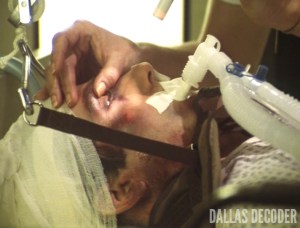
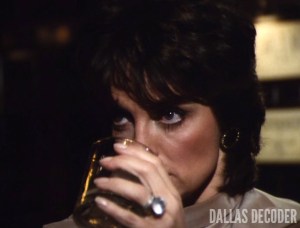
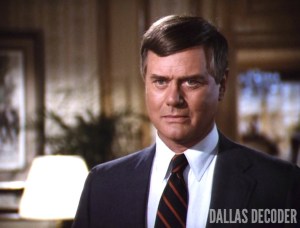
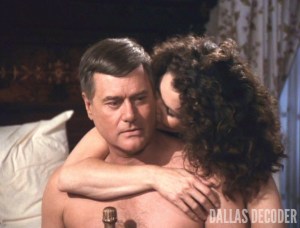
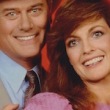
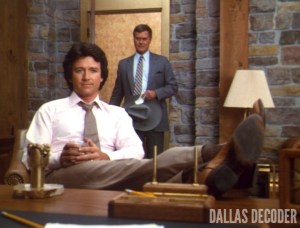
J.R. goes through “My Brother’s Keeper” trying to buck up Bobby, who’s feeling down as his divorce date approaches. In a memorable scene, the brothers go out for a night on the town, where J.R. arranges for Bobby to bump into a call girl he hired to take Bobby’s mind off his troubles. Does it matter that J.R. is also secretly plotting to shut Bobby out of Ewing Oil, or that J.R. knows Pam will be at the restaurant and will spot her estranged husband dining with the other woman? Of course it matters. But even though J.R. has ulterior motives, the concern he displays for his brother in this episode feels very real.

It’s another example of what makes J.R. a forerunner for the protagonists of modern television drama. As critic Matt Zoller Seitz recently noted, one of the reasons the final hours of “Breaking Bad” were so riveting is because they showed how Walter White, the loving husband and father, and Heisenberg, his ruthless alter ego, had come to co-exist within the same mind and body. You can say something similar about J.R. Even though he’s scheming against Bobby and helped orchestrate the breakup of his marriage, he genuinely loves his brother and wants to help him cope with the loss of Pam and Christopher. J.R. is nothing if not a compartmentalist.

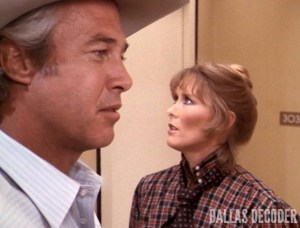
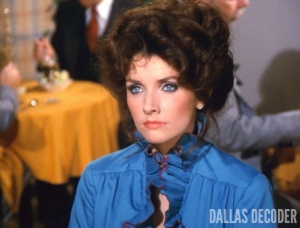
Like J.R., Cliff also balances his love for a sibling with his desire to advance his own agenda. In Cliff’s case, he wants Pam to divorce Bobby so she can marry Mark and pave the way for Cliff, Pam and Mark to form a business partnership. But unlike J.R.’s relationship with Bobby, Cliff’s affection for Pam feels a little less complicated. Watch the sweet scene in “My Brother’s Keeper” where Cliff insists on accompanying Pam to the courthouse for her divorce hearing. The warm rapport between Ken Kercheval and Victoria Principal makes me believe Cliff’s concern for Pam trumps everything else. (Interestingly enough, J.R. and Cliff essentially switch roles on TNT’s “Dallas,” where J.R. extols the virtues of putting family first and Cliff is willing to sacrifice his own daughter in his war against the Ewings.)

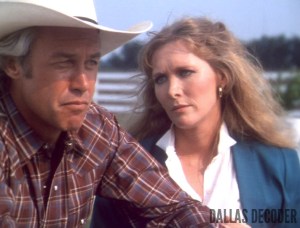
Three more scenes in “My Brother’s Keeper” deserve mentioning. In the first, Donna stands with Ray at a fence outside their house as he laments the tragedy that has befallen his family since Amos Krebbs’ funeral a year earlier. The shot echoes one from “Where There’s a Will,” the sixth-season episode where Ray and Donna stand in the same spot as he debates whether to attend the funeral. I also like the “My Brother’s Keeper” scene where Bobby and Pam sit silently in an office while their lawyers politely discuss the terms of their divorce. Patrick Duffy and Victoria Principal avoid eye contact throughout this sequence, making it feel even sadder than their farewell conversation at the end of the previous episode.

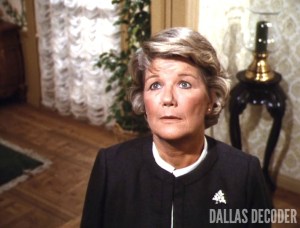
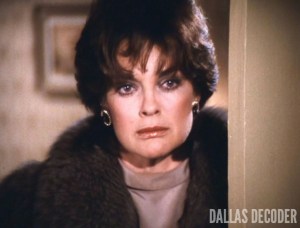
My other favorite scene from “My Brother’s Keeper” is also notable for what isn’t said. It comes at the end of the second act, when Katherine answers a knock on Pam’s hotel room door. “Who is it?” Katherine asks. The voice on the other side of the door belongs to Cliff, who jovially asks: “Who are you?” The eye roll that Morgan Brittany offers in response is priceless. In an episode that leaves us pondering sibling connections, this scene is a reminder that some of these relationships aren’t complicated at all.

Grade: B

_______________________________________________________________________________________________________________________________________________
Dallas, Donna Krebbs, Ray Krebbs, Steve Kanaly, Susan Howard

Don’t fence him in

‘MY BROTHER’S KEEPER’

Season 7, Episode 4

Airdate: October 21, 1983

Audience: 21.2 million homes, ranking 2nd in the weekly ratings

Writer: Arthur Bernard Lewis

Director: Leonard Katzman

Synopsis: Bobby and Pam’s divorce is finalized. J.R. and Bobby learn their battle has depleted Ewing Oil’s reserves. Mickey tells Ray he doesn’t want to live as an invalid. Sue Ellen gets to know Peter.

Cast: Christopher Atkins (Peter Richards), John Beck (Mark Graison), Stephanie Blackmore (Serena Wald), Morgan Brittany (Katherine Wentworth), Lew Brown (Clarence Colby), Roseanna Christiansen (Teresa), Glenn Corbett (Paul Morgan), Patrick Duffy (Bobby Ewing), Eric Farlow (Christopher Ewing), Linda Gray (Sue Ellen Ewing), Larry Hagman (J.R. Ewing), Susan Howard (Donna Krebbs), Steve Kanaly (Ray Krebbs), Omri Katz (John Ross Ewing), Ken Kercheval (Cliff Barnes), Audrey Landers (Afton Cooper), Sean McGraw (Moran), Timothy Patrick Murphy (Mickey Trotter), Victoria Principal (Pam Ewing), Kate Reid (Lil Trotter), Debbie Rennard (Sly), Tracy Scoggins (Diane Kelly), Harold Suggs (Judge Thornby), Charlene Tilton (Lucy Ewing), Danone Simpson (Kendall), Deborah Tranelli (Phyllis), Chana Vowell (Dee)

“My Brother’s Keeper” is available on DVD and at Amazon.com and iTunes. Watch the episode and share your comments below.
Critique: ‘Dallas’ Episode 134 — ‘The Letter’

Bobby Ewing, Dallas, Letter, Pam Ewing, Patrick Duffy, Victoria Principal

This is how it ends

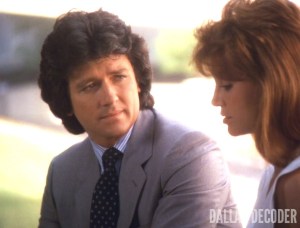
In “The Letter,” Katherine forges a note from Pam in which she “confesses” she no longer wants to be married to Bobby. When Bobby sees the note, he’s so distraught he resolves to give his wife the divorce he’s been tricked into believing she wants. It’s another example of a “Dallas” character making a major life decision based on half-truths and false assumptions, and yet Patrick Duffy manages to sell it. He makes Bobby’s anguish feel real and believable; I’ve never wanted to reach through my screen and give a television character a hug as much as I do during this episode’s final scene, when Bobby tells Pam he’s decided to let her go.

Of course, Duffy gets help from scriptwriter David Paulsen, whose dialogue casts Bobby as the more sympathetic spouse. The scene opens with him sitting in Thanks-Giving Square, a downtown Dallas plaza, waiting for Pam to arrive and watching a young mother read to her child. When Pam finally shows up, she cheerfully recalls how she used to visit the square with Liz and Jackie, her coworkers from the Store. Bobby’s response: “I know. I used to meet you here too. Remember?” The exchange leaves me with the impression Bobby and Pam’s marriage meant more to him than it did to her. For Bobby, the square holds memories of the times he spent there with his wife. For Pam, it’s notable mostly as the site of workday lunch breaks.

No mention is made of Katherine’s letter during this scene because really, it isn’t all that important; the letter is merely the plot device that brings Bobby and Pam to the moment of truth in their relationship. The real breaking point came during the middle of “Dallas’s” sixth season, when Pam left Bobby because she felt he was too preoccupied with his fight for control of Ewing Oil. This represented a significant change of tune for Pam, who once urged Bobby to take his role within the family business more seriously. In the Thanks-Giving Square scene, Paulsen seems to have Pam allude to this when she mentions how much she and Bobby have changed. Says Bobby: “I don’t think people change so much, really, Pam. It’s feelings that change.”

This is the line that best captures the spirit of the scene, although the dialogue that “Dallas” fans seem to remember most is Bobby’s declaration that his and Pam’s feelings for each other are “just yesterday’s memories.” It sounds harsh until you consider what Bobby is doing: He’s pushing Pam away because he believes it’s what she wants. Regardless, I appreciate how Paulsen doesn’t cast blame for the marriage’s failure on either spouse. Yes, Bobby comes off as the more sympathetic figure, and he sacrifices his own happiness when he agrees to let Pam go. And yes, Pam’s shifting values and dawdling about whether or not to return to Bobby makes her seem a bit wishy-washy. But how can you not feel sorry for both characters in the final shot, when husband watches wife walk away in tears? Katherine’s manipulations notwithstanding, this marriage failed because the spouses grew apart. It’s a breakup with no real villains — just two victims.

Nevertheless, “The Letter” is Katherine’s finest hour. Even if she isn’t the root cause of Bobby and Pam’s split, she still gets bragging right for breaking them up, something J.R. himself couldn’t achieve. I get a kick out watching Katherine slink around Pam’s hotel room in this episode, playing the role of supportive sister while secretly plotting against her. And even though I generally prefer “Dallas” when it resists its campier impulses, I love when Katherine fools Pam into signing the forged letter, then steps into the hallway and says — to herself — “I think you may have just signed away your marriage, sister dear.” It reminds me of something you would see in an old black-and-white potboiler, which is why casting Morgan Brittany was so brilliant. Brittany, with her striking features and piercing eyes, has always exuded old Hollywood glamour. Other actresses could have played this role, but no one but Brittany could have made Katherine this delicious.

“The Letter” is notable for a few other reasons. Composer Bruce Broughton won an Emmy for this episode’s underscore, which soars during Bobby and Pam’s Thanks-Giving Square scene. The episode also marks Christopher Atkins’ debut as fair-haired camp counselor Peter Richards, and seeing him come face to face with Larry Hagman for the first time is a little like watching Luke Skywalker clash with Darth Vader. Speaking of J.R.: My other favorite moment in this episode is the scene where he visits Serena, his favorite call girl, and laments the turn his life has taken. It’s a rare moment of introspection for the character, and it also makes him seem like as a bit of a hypocrite, given his opposition to sending John Ross to therapy. After all, what is Serena, if not J.R.’s headshrinker?

Grade: B

_______________________________________________________________________________________________________________________________________________

Dallas, Katherine Wentworth, Letter, Morgan Brittany

Counterfeit correspondence

‘THE LETTER’

Season 7, Episode 3

Airdate: October 14, 1983

Audience: 18 million homes, ranking 12th in the weekly ratings

Writer: David Paulsen

Director: Nick Havinga

Synopsis: Katherine forges a letter from Pam in which she confesses she no longer loves Bobby. When Katherine shows him the note, he tells Pam he wants a divorce. To help John Ross deal with his emotional problems, J.R. and Sue Ellen enroll him in a day camp, where they meet counselor Peter Richards.

Cast: Christopher Atkins (Peter Richards), John Beck (Mark Graison), Stephanie Blackmore (Serena), Morgan Brittany (Katherine Wentworth), Diana Douglas (Dr. Suzanne Lacey) Roseanna Christiansen (Teresa), Patrick Duffy (Bobby Ewing), Eric Farlow (Christopher Ewing), Tony Garcia (Raoul), Linda Gray (Sue Ellen Ewing), Larry Hagman (J.R. Ewing), Susan Howard (Donna Krebbs), Steve Kanaly (Ray Krebbs), Omri Katz (John Ross Ewing), Ken Kercheval (Cliff Barnes), Audrey Landers (Afton Cooper), Timothy Patrick Murphy (Mickey Trotter), Victoria Principal (Pam Ewing), Kate Reid (Lil Trotter), Debbie Rennard (Sly), Charlene Tilton (Lucy Ewing), Deborah Tranelli (Phyllis)

“The Letter” is available on DVD and at Amazon.com and iTunes. Watch the episode and share your comments below.
Critique: ‘Dallas’ Episode 133 — ‘The Long Goodbye’

Dallas, J.R. Ewing, Larry Hagman, Long Goodbye, Pam Ewing, Victoria Principal

This time, it’s personal

J.R. Ewing is a man with many enemies, but his conflict with Pam is unique because it reveals his otherwise well-concealed insecurities. When Pam arrives at Southfork, J.R. fears she and Bobby will beat him and Sue Ellen in the “race” to produce the Ewings’ first grandson. It doesn’t happen, but Pam manages to solidify her position within the family nonetheless. One by one, she wins the hearts of the people J.R. loves most: first Bobby, then Jock and Miss Ellie and eventually Sue Ellen. Even John Ross enjoys a special bond with Aunt Pam, at least for a while. In J.R.’s eyes, the family’s affection for Pam gives her power. That’s what makes her dangerous.

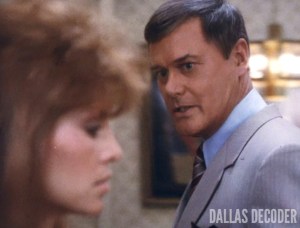
The final scene in “The Long Goodbye” draws upon all of this subtext, resulting in one of the all-time great “Dallas” moments. It begins when J.R. turns up unexpectedly on Pam’s doorstep and asks to speak to her. She reluctantly lets him in; little does she realize he’s about to get inside her head too. After exchanging acidic “pleasantries,” J.R. lets Pam know that he’s aware of her plans to reconcile with Bobby. He then tells her that if she doesn’t go through with the divorce, he’ll destroy the people she loves most — beginning with Bobby. “I’ll call off this truce that exists between him and me. We’ll end up in a dogfight that will make what went on before look like a love match,” J.R. says.

Everything about this scene works. Leonard Katzman, who wrote and directed “The Long Goodbye,” has Larry Hagman deliver his lines while slowly circling Victoria Principal, making J.R. seem downright predatory. The dialogue itself is some of Katzman’s sharpest, and Hagman seems to relish every syllable. My favorite exchange: Pam mocks J.R.’s interest in her “happiness” and he responds, “Oh, no. I don’t give a damn about you or your happiness, honey. But I do care what’s good for me.” Principal, in the meantime, gives as good as she gets. When the scene begins, she counters Hagman’s winking bravado with steely sarcasm. But as J.R.’s language grows more venomous, Pam’s face falls, her shoulders drop and her eyes shift downward. By the time he slithers out of the room, she looks genuinely rattled — even though J.R. is probably the one who feels more threatened.

This is the kind of “Dallas” scene you can call up on DVD and enjoy any time, although it’s best appreciated when you consider it within the context of what was happening on the show at the time. Three episodes earlier, at the end of “Dallas’s” sixth season, J.R. had an attack of conscience as his battle with Bobby for control of Ewing Oil reached its destructive crescendo. In “The Road Back” and “The Long Goodbye,” the first two hours of the seventh season, J.R. calls a truce with Bobby and tries to patch up his broken marriage to Sue Ellen. It’s always nice to see “Dallas” showcase J.R.’s softer side, but no one wants J.R. go warm and fuzzy. This is why his confrontation with Pam at the end of “The Long Goodbye” is so crucial. It’s the moment J.R. gets his groove back.

It’s worth considering the scene from Pam’s point of view too. More than anything, Katzman designs “The Long Goodbye” to remind us what a terrific couple Bobby and Pam make. The characters share several charming scenes throughout this episode, including one at Southfork where Pam watches as Bobby returns from a horseback ride with little Christopher. Later, Bobby and Pam spend a night out on the town, where they reflect on their many years together. It feels like “Dallas” is paving the way for the star-crossed lovers to finally reunite. So when J.R. turns up on Pam’s doorstep and throws cold water on their reconciliation, it packs an emotional punch.

“The Long Goodbye” also includes a good scene where Afton accuses Cliff of wanting Pam to divorce Bobby because it will free her to marry Mark, thus allowing Cliff, Mark and Pam to form a business partnership. Cliff concedes his ambition often gets the better of him, but adds that he honestly believes Pam is better off without the Ewings. Ken Kercheval’s delivery here is so sincere, I believe every word Cliff says. In another highlight, Clayton tells Bobby that Miss Ellie is counting on him to be Southfork’s caretaker in her absence, presaging the role Patrick Duffy would go on to fill many years later on TNT’s “Dallas.”

“The Long Goodbye” also delivers another fun scene featuring Sue Ellen, who has been on a roll for the past two episodes, striking her husband with one wicked zinger after another. In this episode, J.R. drops by the pool at the Quorum, the hotel where he’s staying with his wife and John Ross during the reconstruction of Southfork. Sue Ellen tells J.R. she plans to go to the ranch to pick out the new wallpaper for their bedroom, along with a new bedroom for herself. “A new bedroom? What’s wrong with the old one?” J.R. asks. “You’re in it,” she responds. It’s a delicious quip, although I must admit: I cringe when Katzman cuts to a reaction shot from little John Ross, who sits there helplessly as his mother explains she will no longer sleep with her husband.

The things this poor kid witnessed during his childhood. No wonder he grew up to become the man he is today.

Grade: A

_______________________________________________________________________________________________________________________________________________

Dallas, Linda Gray, Long Goodbye, Sue Ellen Ewing

Zing!

‘THE LONG GOODBYE’

Season 7, Episode 2

Airdate: October 7, 1983

Audience: 19.9 million homes, ranking 2nd in the weekly ratings

Writer and Director: Leonard Katzman

Synopsis: Pam considers returning to Bobby, upsetting Katherine, Cliff, Mark and J.R., who tells her he’ll destroy everyone she cares about if she reconciles with his brother. Sue Ellen decides she’ll remain married to J.R., but they’ll have separate bedrooms and separate personal lives. A hopeful Mickey proposes to Lucy and she accepts, but his mood dims when he learns his paralysis is permanent.

Cast: Mary Armstrong (Louise), John Beck (Mark Graison), Morgan Brittany (Katherine Wentworth), John Devlin (Clouse), Patrick Duffy (Bobby Ewing), Linda Gray (Sue Ellen Ewing), Larry Hagman (J.R. Ewing), Susan Howard (Donna Krebbs), Steve Kanaly (Ray Krebbs), Omri Katz (John Ross Ewing), Howard Keel (Clayton Farlow), Ken Kercheval (Cliff Barnes), Joe Maross (Dr. Blakely), Timothy Patrick Murphy (Mickey Trotter), Victoria Principal (Pam Ewing), Kate Reid (Lil Trotter), Debbie Rennard (Sly), Danone Simpson (Kendall), Charlene Tilton (Lucy Ewing), George Wallace (accountant)

“The Long Goodbye” is available on DVD and at Amazon.com and iTunes. Watch the episode and share your comments below.
Critique: ‘Dallas’ Episode 132 — ‘The Road Back’

Bobby Ewing, Dallas, J.R. Ewing, Larry Hagman, Patrick Duffy, Road Back

What hath they wrought?

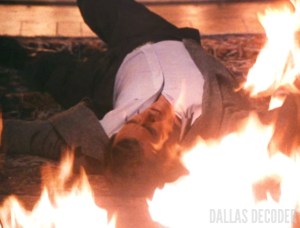
With “The Road Back,” “Dallas” delivers the first hour of its seventh season and the most thrilling opening in its history. It begins with a nighttime shot of Southfork, which looks familiar against the dark sky except for the flames shooting out of the roof. Director Nick Havinga then brings us inside the house, where we find the occupants right where we left them at the end of “Ewing Inferno,” the previous season’s cliffhanger: Sue Ellen and John Ross are asleep in their beds, each unaware of the smoke filling their rooms; Ray is unconscious in the foyer; and J.R. has collapsed in a hallway. Next, we see Bobby zipping down Braddock Road in his red convertible. When he spots the blaze, he slows down and stares for a moment. “Oh, my God,” he says.

And then, the rescue sequence: As Jerrold Immel’s underscore surges, Bobby guns the car down the driveway and screeches to a halt near the garage. He leaps out of the vehicle and dives into the swimming pool, then runs into the house, where he finds Ray awakening. Together, the two men race upstairs and drag the dazed J.R. down the hall and through the doors to the balcony. Bobby and Ray go back into the house and retrieve Sue Ellen and John Ross, and when they return to the terrace, Ray orders everyone into the pool below. With sirens wailing in the background, J.R. cradles the screaming John Ross and jumps into the water.

When I revisited “The Road Back” for this critique, I had no doubt these scenes would retain their emotional value, but I was surprised by how well they hold up from a technical perspective. The wide shots of the burning house look a little crude by today’s standards, but they still work. Likewise, the scenes inside the home are as chaotic and scary now as they were three decades ago. “Dallas” producer Leonard Katzman built replicas of the Southfork sets so he could burn them down, so those are real flames you see surrounding Patrick Duffy, Steve Kanaly and Larry Hagman. I’m guessing “The Road Back’s” opening was filmed at the same time as the final scenes in “Ewing Inferno,” although if it turned out Katzman staged one fire for the cliffhanger and another for the resolution, I wouldn’t be surprised. This man had a DeMillian appreciation for spectacle.

“The Road Back” also includes a fantastic scene where Bobby summons J.R. to a Southfork pasture to broker a truce between him and Ray, whose beef with J.R. caused the fire in the first place. Ray angrily reminds J.R. how he made an enemy of Walt Driscoll, the vengeful bureaucrat who tried to kill J.R. but ended up injuring Ray’s cousin Mickey instead. J.R. responds by pointing out that Bobby and Ray had a hand in ruining Driscoll too. “None of us have clean hands, boys. None of us,” J.R. says, and for once, he isn’t twisting the truth. In another poignant moment, J.R. and Bobby stand inside the charred Southfork living room and survey the damage. “We sure made a mess out of everything. Ewing Oil, Southfork, the family. Every damn thing,” J.R. says. It’s nice to see him humbled for a change, no?

I also like the scenes in “The Road Back” that show J.R being nice to the embittered Sue Ellen, not just because it’s good to see his compassionate side, but also because it allows Linda Gray to deliver some terrific zingers. In my favorite exchange, J.R. gets a call from Bobby and rushes out of the hotel room where he’s staying with his wife and son. “I’ll be back as soon as I can,” J.R. says. “Don’t remind me,” Sue Ellen responds. Later, when J.R. encourages Sue Ellen to get some rest, she turns to Pam and quips, “Isn’t it wonderful how thoughtful he can be when he’s caught with his boots parked under the wrong bed?”

(J.R. and Sue Ellen’s dynamic here brings to mind the third-season opener “Whatever Happened to Baby John, Part 1,” when he makes a sincere attempt to patch up his broken marriage, only to discover she’s unwilling to forgive him. Other scenes in “The Road Back” also harken to earlier “Dallas” moments. For example, when J.R. drives away from his meeting with Bobby and Ray, the shot of his Mercedes rolling across the Southfork plains recalls a similar shot at the end of “Digger’s Daughter.” Also, during “The Road Back’s” cattle drive sequence, we hear Ray speak on his walkie-talkie to Hal, a ranch hand seen during the first season, while Miss Ellie and Clayton spend this episode at Lake Takapa, the subject of a major fourth-season storyline.)

Of course, even though the tragic events of the previous season reveal J.R.’s humanity in “The Road Back,” this episode makes it clear he hasn’t been fully redeemed. In one scene, he schemes with Katherine Wentworth to ensure Bobby and Pam don’t reunite. Later, after Sue Ellen delivers her “boots-parked-under-the-wrong-bed” remark, J.R. and Pam get into a nasty spat. (J.R.: “I’ve never heard a woman open her mouth more and say less.”) His most mischievous moment comes in the final scene, when J.R. and Bobby visit Harv Smithfield and tell him they want to call off their fight for Ewing Oil. I believe J.R. feels genuine regret, but when Harv tells the brothers that it’s legally impossible to end their contest, notice the slight, ever-so-subtle smile that break across J.R.’s face. My guess is this is Hagman’s way of signaling to the audience that even though J.R. feels bad about everything that’s transpired, he’s glad he’s going to have a chance to beat Bobby after all.

“The Road Back” also offers the classic scene where Pam takes Sue Ellen to a French fashion boutique to rebuild her wardrobe after the fire, only to watch in horror as Sue Ellen lustily accepts the glass of champagne offered by snooty Madam Claude. Says Sue Ellen when Pam suggests they should leave: “Pam, don’t be a nag.” This episode is also chockablock with casting trivia: Omri Katz makes his first appearance as John Ross; Dan Ammerman, who originated the role of Ewing family physician Dr. Danvers in the second-season episode “Bypass,” shows up here as the Farlows’ doctor; and daytime soap opera star Stephen Nichols (“Days of Our Lives,” “General Hospital”) and Fox News Channel anchor Arthel Neville have bit roles.

“The Road Back” also marks the debut of my favorite version of the “Dallas” title sequence music, the one that features the synthesized riff when the signature three-way split screens begin. The sound effect is pure ’80s, which his probably why I love it so. “The Road Back” is also the first “Dallas” episode to feature the work of cinematographer Bradford May, whose camerawork gives the show a rich, textured look. It’s a dramatic contrast from other years, especially toward the end of “Dallas’s” run, when the show looks flat and washed out. Sadly, May is with “Dallas” for just 27 episodes. I’m not sure why he didn’t last the whole seventh season — there are conflicting explanations for his departure — but one thing is certain: Thanks to him, “Dallas” finally looks as good as it is.

Grade: A

_______________________________________________________________________________________________________________________________________________

Dallas, John Ross Ewing, Omri Katz, Ray Krebbs, Steve Kanaly

Hot heir

‘THE ROAD BACK’

Season 7, Episode 1

Airdate: September 30, 1983

Audience: 23 million homes, ranking 2nd in the weekly ratings

Writer: Arthur Bernard Lewis

Director: Nick Havinga

Synopsis: Bobby rescues J.R., Sue Ellen, John Ross and Ray from the fire and later brokers a truce between his feuding brothers. J.R. and Bobby tell Harv they want to call off the contest, but Harv informs them it’s legally impossible. Sue Ellen discovers the car accident wasn’t her fault. Mickey emerges from his coma. Mark fears the fire will reunite Bobby and Pam, while J.R. and Katherine agree to work together to keep them apart. Clayton tells the Ewings that Miss Ellie needs rest and won’t return to Southfork for awhile.

Cast: Dan Ammerman (Neal), Mary Armstrong (Louise), John Beck (Mark Graison), Morgan Brittany (Katherine Wentworth), John Devlin (Clouse), Patrick Duffy (Bobby Ewing), Eric Farlow (Christopher Ewing), Dana Gibson (Ellison), Linda Gray (Sue Ellen Ewing), Larry Hagman (J.R. Ewing), Gloria Hocking (Madam Claude), Anna Kathryn Holbrook (Ann), Susan Howard (Donna Krebbs), Steve Kanaly (Ray Krebbs), Omri Katz (John Ross Ewing), Howard Keel (Clayton Farlow), Ken Kercheval (Cliff Barnes), Betty King (Groves), Kay E. Kuter (Sampson), Michael Krueger (Henri), Timothy Patrick Murphy (Mickey Trotter), Arthel Neville (waitress), Stephen Nichols (paramedic), George O. Petrie (Harv Smithfield), Victoria Principal (Pam Ewing), Kate Reid (Lil Trotter), David Sanderson (Buck), Charlene Tilton (Lucy Ewing)

“The Road Back” is available on DVD and at Amazon.com and iTunes. Watch the episode and share your comments below.
Critique: ‘Dallas’ Episode 131 — ‘Ewing Inferno’

Dallas, Ewing Inferno, J.R. Ewing, Larry Hagman

Surprise, surprise

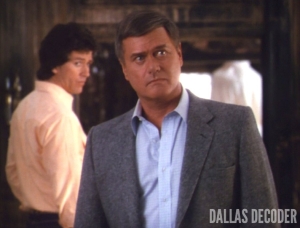
“Ewing Inferno” famously ends with J.R., Sue Ellen, Ray and John Ross trapped inside Southfork as fire sweeps through the house. I wonder: When this episode debuted in 1983, did anyone doubt all four characters would escape the blaze? After all, three of them appear in the opening credits and the fourth is a child; by the conventions of 1980s television, their survival seems assured. Not that I’m complaining. This may not be “Dallas’s” most suspenseful cliffhanger, but it does put a poetic punctuation mark on the sixth season. After a year in which everything goes to hell for the Ewings, what could be more fitting than seeing them surrounded by flames?

Besides, it’s not like “Ewing Inferno” doesn’t deliver its share of surprises, especially where J.R. is concerned. When the episode begins, he’s business as usual, demanding $20 million from Holly to leave her company. Later, in one of their classic clashes, J.R. lobs such ugly insults at Pam that she slaps him. (“Damn, I hate that woman,” he says as she stomps away.) Then, in the second act, J.R. has an honest-to-goodness epiphany. He brings little John Ross into the bedroom to give Sue Ellen a goodnight kiss, only to find her passed out, an empty bottle of booze at her side. J.R. sends the boy away, sits on the bed and gazes at his wife. “I know you’ll never trust me again, Sue Ellen,” he says. “But I love you. … We should’ve had a wonderful life together. What have I done to you?” The monologue brings to mind the second-season finale, when J.R. sits at the hospital bedside of a comatose Sue Ellen and laments the turn their marriage has taken. Now here he is, four years later, delivering a similar speech. As Miss Ellie wondered a few episodes ago: Doesn’t he ever learn?

Perhaps he does. In the next scene, Bobby comes home and finds J.R. alone in the Southfork living room. The mood is somber, serious. Bobby asks how Sue Ellen is doing. “Not good,” J.R. responds. He tells Bobby that he’s been thinking “real hard” about their fight for Ewing Oil, and the toll it has taken on the people around them. Both brothers’ marriages have suffered. Miss Ellie is heartbroken. Rebecca Wentworth is dead. Mickey Trotter is dying. “I’m not sure that this fight between us is worth what it cost the family,” J.R. says. Bobby is stunned and asks J.R. if he wants to end the contest. J.R.’s response: “By my calculation, I’m way ahead of you, but I really don’t give a damn.”

I really don’t give a damn. Not since J.R. slipped into his deep depression after Jock’s death has our hero seemed so unmoored.

‘Into Oblivion’

Dallas, Ewing Inferno, Linda Gray, Sue Ellen Ewing

But not oblivious

J.R. and Bobby don’t get around to finishing this conversation, but no matter. There’s no doubt J.R. has been humbled. Consider the third act’s final scene. After ordering Teresa to lock up the liquor, J.R. finds Sue Ellen getting drunk in the living room, having swiped a bottle of burgundy from the kitchen. The confrontation that follows plays like something out of “Who’s Afraid of Virginia Woolf?” As J.R. stands still and stares ahead, Sue Ellen circles him, a glass in one hand, the wine bottle in the other, and releases her fury. She references his marital sins (“Did you find someone new to sleep with today? Or did you have to rely on one of your old mistresses?”) and tells him he “ruined” her life. Then, to show how she has stopped giving a damn, Sue Ellen moves closer to J.R. and whispers, “Now, why don’t you do one kind little thing for me, hmm? Unlock the liquor, because I’m going to drink myself into oblivion.”

Linda Gray and Larry Hagman are magnificent in this scene. Every one of her lines drips with acid, while his stoic expression makes this a cathartic moment for the audience. J.R. doesn’t fight back because he knows he’s wrong. He accepts Sue Ellen’s punishing words because he deserves them. Even at the end of the scene, when Sue Ellen flings the bottle at him and it smashes against the wall, J.R. barely flinches. Where his wife is concerned, J.R. simply doesn’t have any fight left in him — although as the big red stain on the wallpaper foreshadows, a different kind of battle is about to come to him.

‘The Last Person in the World’

Dallas, Ewing Inferno, J.R. Ewing, Larry Hagman, Ray Krebbs, Steve Kanaly

Daddy’s watching

J.R.’s chastening during the course of “Ewing Inferno” is thorough but incomplete. In the final scene, when Ray arrives at Southfork to confront him, J.R. offers his half-brother a typically frosty greeting. “Ray, you’re about the last person in the world I needed to see tonight,” he says. I usually laugh when Hagman delivers a line like this, but there’s nothing funny about J.R.’s dark mood. Before long, the two men are scuffling, and even though the fight scene isn’t exactly credible — stuntmen are clearly substituting for Hagman and Steve Kanaly in the wide shots, J.R. knocks out Ray with a plastic telephone — there’s something deeply poignant about Ray’s attempt to avenge Mickey and J.R.’s determination to rescue his family once the fire starts. How can you not feel moved when he notices the blaze, cries out for his wife and son and braves the flames to try to save them?

Also, consider this: For two seasons, J.R. and Ray have each struggled to honor the dead father they worshipped. J.R. tries to do it through business, while Ray tries to emulate Jock by taking Mickey under his wing, just like Jock did with young Ray. I suppose that’s why it’s so fitting that J.R. and Ray’s fight occurs under the watchful gaze of Jock’s portrait, which looms in the background of so many crucial scenes during the sixth season, including the will reading and J.R. and Sue Ellen’s spat after she catches him in bed with Holly. What hath Jock wrought?

‘Our Marriage Doesn’t Work’

Bobby Ewing, Dallas, Ewing Inferno, Patrick Duffy

Cry, Bobby

For all its poignancy, the true cliffhanger in “Ewing Inferno” has nothing to do with the Southfork fire. The question I’m left asking is this: What will Bobby do? After J.R. offers to call off their fight, Bobby receives a phone call from Pam, who tells him she’s decided to give him the Tundra Torque, the experimental drill bit he needs to move forward with his Canadian oil venture. Since the deal is a guaranteed blockbuster, it will almost certainly allow Bobby to clinch victory over J.R. Bobby now has a dilemma: Should he make peace with his brother, or should he see the contest through until the end, knowing he has what it takes to finally beat J.R.?

By the end of the episode, Bobby’s decision isn’t clear, although his conversation with Katherine in the next-to-last scene suggests he will indeed use the drill bit. Regardless, I wish scriptwriter Arthur Bernard Lewis had paid more attention to this subplot and shown Bobby weighing his choices. After a season of tough ethical compromises, wouldn’t this be Bobby’s biggest decision yet?

On the other hand: Lewis has a lot of narrative ground to cover, and he does a nice job bringing the other storylines to a climactic finish. The cast does good work too. The scene where Pam tells Bobby she wants a divorce (“Our marriage doesn’t work anymore”) is very moving, especially when that single tear begins its slow journey down Patrick Duffy’s cheek. I also love when Pam tells Cliff and Katherine that she’s decided to give Bobby the drill bit. What’s more fun: Ken Kercheval’s combustible response or Morgan Brittany’s sly smirk? The guest stars shine too: Kate Reid is mesmerizing when she delivers Aunt Lil’s weary monologue, Ben Piazza is the profile in agony when Driscoll visits Mickey’s bedside, and thanks to Barry Corbin, I feel every bit of Sheriff Washburn’s frustration when Ray goes rogue during the investigation into Mickey’s accident.

Like so many other “Dallas” episodes during the sixth season, “Ewing Inferno” also makes me appreciate the technical expertise behind the camera. Fred W. Berger, the editor, won an Emmy for this episode. Surely director Leonard Katzman deserves one too. In the fourth act, I like how he shows J.R. escorting Dr. Danvers out of the bedroom, through the hall and down the stairs into the foyer. The sequence establishes how these spaces fit together, so that during the fire, when J.R. races up the steps and collapses, we understand his proximity to his wife and son.

You also have to admire Katzman’s lack of restraint. According to Barbara A. Curran’s 2004 book “Dallas: The Complete Story of the World’s Favorite Prime-Time Soap,” Katzman built a replica of the Southfork foyer, just so he could burn it down for this episode’s final scene. That’s pretty spectacular, even if it isn’t all that suspenseful.

Grade: A+

_______________________________________________________________________________________________________________________________________________

Dallas, Ewing Inferno, J.R. Ewing, Larry Hagman

Welcome to Hell

‘EWING INFERNO’

Season 6, Episode 28

Airdate: May 6, 1983

Audience: 20.3 million homes, ranking 2nd in the weekly ratings

Writer: Arthur Bernard Lewis

Director: Leonard Katzman

Synopsis: J.R. offers to end the contest for Ewing Oil. Pam decides to divorce Bobby but gives him the Tundra Torque, enraging Cliff. Driscoll kills himself after revealing he drove the car that struck Sue Ellen and Mickey’s vehicle because he thought J.R. was behind the wheel at the time. After Ray learns of Driscoll’s role in the crash, he gets into a fight with J.R. During the scuffle, Southfork catches fire, trapping J.R., Sue Ellen, Ray and John Ross.

Cast: Tyler Banks (John Ross Ewing), John Beck (Mark Graison), Barbara Bel Geddes (Miss Ellie Ewing), Morgan Brittany (Katherine Wentworth), Lois Chiles (Holly Harwood), Roseanna Christiansen (Teresa), Barry Corbin (Sheriff Fenton Washburn), John Devlin (Clouse), Patrick Duffy (Bobby Ewing), Eric Farlow (Christopher Ewing), Linda Gray (Sue Ellen Ewing), Larry Hagman (J.R. Ewing), Susan Howard (Donna Krebbs), Steve Kanaly (Ray Krebbs), Howard Keel (Clayton Farlow), Ken Kercheval (Cliff Barnes), Audrey Landers (Afton Cooper), Kate Reid (Lil Trotter), Ben Piazza (Walt Driscoll), Victoria Principal (Pam Ewing), Debbie Rennard (Sly), Danone Simpson (Kendall), Charlene Tilton (Lucy Ewing), Deborah Tranelli (Phyllis), John Zaremba (Dr. Harlan Danvers)

“Ewing Inferno” is available on DVD and at Amazon.com and iTunes. Watch the episode and share your comments below.
Critique: ‘Dallas’ Episode 130 — ‘Penultimate’

Barbara Bel Geddes, Dallas, Linda Gray, Miss Ellie Ewing, Penultimate, Sue Ellen Ewing

Mama’s here

“Penultimate” is an hour of misery and pain, but it contains love too. The story begins where “Dallas’s” previous episode ends, when Sue Ellen drives drunk and crashes J.R.’s car. The accident leaves her with a broken arm and some scrapes and bruises, while passenger Mickey Trotter fares much worse: He slips into a coma after his spinal cord is injured. This leads to tense scenes, like the one where Lucy calls Sue Ellen a “lousy drunk” and blames her for the crash. Mostly, though, “Penultimate” depicts the Ewings and Krebbses as people who are willing to set aside old hurts and day-to-day grievances to help each other get through a crisis. It’s the kind of thing we routinely witness on this show, yet it never fails to move me.

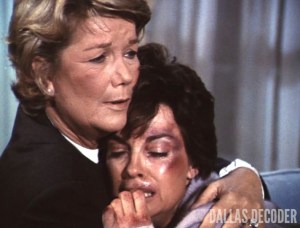
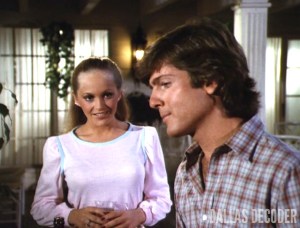
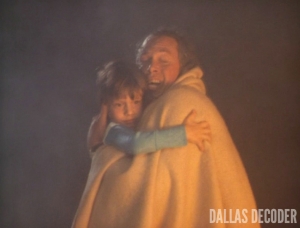
Howard Lakin’s smart script ensures Sue Ellen remains a sympathetic figure, even though it seems like she did indeed cause the accident. Lakin gives us a scene where a guilt-ridden Sue Ellen apologizes to Lucy and pleads for forgiveness, and even though Lucy refuses to listen, other characters don’t hesitate to show Sue Ellen compassion. The crucial moment comes in the first act, when a sore, stiff Sue Ellen comes home from the hospital and goes to her bedroom with Miss Ellie, who offers to help her change into a nightgown. When Sue Ellen begins to cry, Ellie takes her into her arms and holds her close. It’s a touching scene, and also a clever one. If Ellie is willing to forgive Sue Ellen, why shouldn’t we?

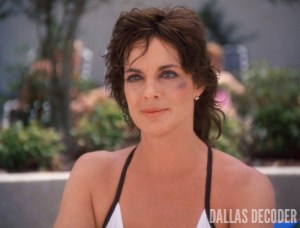
Of course, Linda Gray keeps the audience on Sue Ellen’s side too. Throughout “Penultimate,” Gray carries herself like a woman full of regret; we never doubt that Sue Ellen feels terrible about what she’s done. It doesn’t hurt that she looks awful. Sue Ellen’s face is purple and swollen, her arm is in a cast and in the first few scenes, her sweater is torn and stained with blood. How can you not feel bad for this woman? In the same spirit, how can you not admire Gray? Remember, “Penultimate” was made in an era when television audiences demanded gloss and glamour from their favorite actresses, so Gray’s willingness to be seen in such an unflattering light feels like an act of courage. (Other stars soon followed Gray’s lead. The year after “Penultimate” aired, Farrah Fawcett wore a black eye when she played a battered wife in the TV movie “The Burning Bed.”)

Gray’s most impressive performance in “Penultimate” comes in the final scene, when J.R. enters his bedroom late at night and finds Sue Ellen waiting up for him. She calmly asks why he remarried her if he had no intention of being faithful, and when he begins to speak, she cuts him off. “Stop it! Stop it! I don’t want to hear any more from you!” she shouts. But J.R. continues, telling Sue Ellen that he never meant to hurt her. “Believe me when I say that I love you. I truly love you,” he says. Larry Hagman’s delivery is sincere, but Gray is the one we can’t take our eyes off of. When J.R. professes his love, Gray turns away from Hagman and faces the camera. She’s silent, yet her expression tells us how tormented Sue Ellen feels at that moment. Despite the pain J.R. has caused her, is there any doubt she loves him too?

Cry, Cry Again

Charlene Tilton, Dallas, Lucy Ewing, Penultimate

Tracking her tears

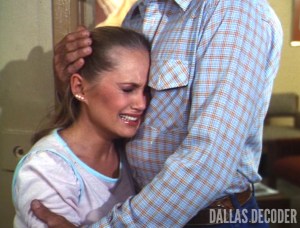
Charlene Tilton supplies “Penultimate” with its other emotional highpoints. After Lucy lashes out at Sue Ellen and calls her a drunk, she bursts into tears and collapses into Ray’s arms. Later, Lucy is with Ray, Donna and Aunt Lil when the doctor informs them Mickey will probably be paralyzed. Once again, Lucy weeps. Both scenes remind us how Tilton always rises to the occasion when she’s given good material, which happens too infrequently on “Dallas.” I also admire how Steve Kanaly makes us feel every ounce of Ray’s anger and frustration over the tragedy that has befallen Mickey, as well as the guilt consuming Ray over bringing his cousin to Texas in the first place. The other performer to watch in these scenes is Kate Reid, who doesn’t have a lot of dialogue, but who doesn’t need any. Her sad, solemn expression says it all.

Not all of the scenes in “Penultimate” are quite so agonizing. When J.R. goes to Holly’s house to confront her over her attempt to ruin his marriage, we expect J.R. to be full of rage. Instead, he plays it cool, politely offering to give up his share of Harwood Oil — if Holly pays him $20 million, that is. Holly balks, and so J.R. leaves her with a not-so-subtle threat. “Holly, you won a hand in a game of poker,” he says. “You’re seeing me in a mood that you’ll never see again. I strongly advise you to take advantage of it, because considering what it’ll cost if you don’t” — here, Hagman pauses — “twenty million dollars will be chickenfeed.”

Later, Bobby urges Holly not to give J.R. the money until after the contest for Ewing Oil ends. Frankly, of all the surprising moves Bobby makes during the sixth season, this one shocks me most. It’s one thing for Bobby to blackmail George Hicks, the crooked energy regulator, or to stage a sting against Walt Driscoll, J.R.’s accomplice in the illegal Cuban oil deal. But after all the suffering the battle for Ewing Oil has caused, Bobby is still willing to wheel and deal to win the contest? Maybe Pam is right. Maybe her husband really has changed.

Hear the Trumpets

Dallas, Donna Krebbs, Ray Krebbs, Steve Kanaly, Susan Howard

Eye to eye

Like all great “Dallas” episodes, “Penultimate” is a creative achievement on multiple levels. Along with the strong performances and writing, Richard Lewis Warren’s underscore is essential to the episode’s success. In several scenes, a few piano keys give way to the mournful blaring of trumpets. It fits the somber mood perfectly, not that any of us should be surprised. Warren’s music never gets in the way of the storytelling but helps it along, which is why he’s one of my favorite “Dallas” composers.

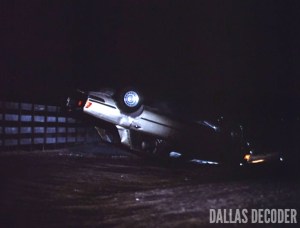
“Penultimate” also offers some of the sixth season’s niftiest camerawork. The episode opens at the site of the car accident, as an ambulance pulls away and a tow truck backs up to J.R.’s overturned Mercedes. Southfork looms in the distance, lit up in the black sky, until the camera slowly zooms in for a close-up. I also like how director Nick Havinga opens one scene with a tight shot of the Ewings’ liquor cart. In the background, Sue Ellen enters the room and gradually comes into focus as she approaches the booze and reaches for a bottle. Havinga also plays with our depth perception in a shot in the hospital where Kanaly stands in the foreground and exchanges dialogue with Susan Howard, whose position in the background makes Donna look like she’s a few feet shorter than Ray.

Lakin and Havinga also do a nice job keeping the audience in the dark about the extent of Sue Ellen and Mickey’s injuries when “Penultimate” begins. The first scene in the emergency room shows a medical team tending to an unseen patient. Amid the beeps and whirs of the machinery, one of the doctors drops references to irregular breathing patterns and a possible spinal injury. “Looks like there’s a bad fracture in the right leg,” a nurse announces. Says the doctor: “Yeah, we’ll worry about that later. Right now, let’s just try to keep this patient alive.” Moments later, we see J.R. escort a shaken Sue Ellen into a hospital corridor, and only then do we realize Mickey is the patient in critical condition.

This turns out to be the episode’s most suspenseful moment. The only other mystery presented here is the identity of the driver of the car that struck Sue Ellen and Mickey’s vehicle, which won’t be revealed until the next episode. Indeed, “Penultimate” serves mostly as a prelude to that installment — not that I’m complaining. The season’s plot lines may not advance much during this hour, but the characters do. Isn’t that more interesting anyway?

Grade: A+

_______________________________________________________________________________________________________________________________________________

Dallas, Mickey Trotter, Timothy Patrick Murphy

Critical condition

‘PENULTIMATE’

Season 6, Episode 27

Airdate: April 29, 1983

Audience: 19 million homes, ranking 3rd in the weekly ratings

Writer: Howard Lakin

Director: Nick Havinga

Synopsis: While Mickey lies in a coma, doctors determine he’ll likely be paralyzed. Sheriff Washburn tells J.R. that Sue Ellen will be charged with manslaughter if Mickey dies. Ray urges Washburn to find the driver of the car that struck Sue Ellen and Mickey’s vehicle. After J.R. invites Holly to buy him out of her company, Bobby urges her to delay her payment to him until the contest for Ewing Oil is over. Cliff pressures Pam not to give Bobby the drill bit.

Cast: John Beck (Mark Graison), Barbara Bel Geddes (Miss Ellie Ewing), Lois Chiles (Holly Harwood), Roseanna Christiansen (Teresa), Barry Corbin (Sheriff Fenton Washburn), Michael Cornelison (Dr. Snow), Patrick Duffy (Bobby Ewing), Eric Farlow (Christopher Ewing), Linda Gray (Sue Ellen Ewing), Larry Hagman (J.R. Ewing), Alice Hirson (Mavis Anderson), Susan Howard (Donna Krebbs), Steve Kanaly (Ray Krebbs), Howard Keel (Clayton Farlow), Ken Kercheval (Cliff Barnes), Joe Maross (Dr. Blakely), Timothy Patrick Murphy (Micheky Trotter), Victoria Principal (Pam Ewing), Kate Reid (Lil Trotter), Danone Simpson (Kendall), Charlene Tilton (Lucy Ewing), Deborah Tranelli (Phyllis), Morgan Woodward (Punk Anderson), John Zaremba (Dr. Harlan Danvers)

“Penultimate” is available on DVD and at Amazon.com and iTunes. Watch the episode and share your comments below.

Critique: ‘Dallas’ Episode 129 — ‘Things Ain’t Goin’ Too Good at Southfork’

Dallas, Linda Gray, Sue Ellen Ewing, Things Ain't Goin' Too Good at Southfork

The bottom

Linda Gray always hits her marks on “Dallas,” but she’s especially effective when Sue Ellen is hitting the bottle. Unlike so many other actors who go overboard playing drunks, Gray is precise: never too slurry, never too silly, never too sullen. She gets it right, every time. Because her performances are so convincing, the audience never loses sight of Sue Ellen’s humanity, ensuring she remains a sympathetic character. This is a creative achievement, but it’s something else too: Given “Dallas’s” popularity, I’m convinced Gray has contributed to our understanding of alcoholism as a disease. I often refer to Sue Ellen as a heroine, but when you think about it, the same thing can be said of Linda Gray.

I offer these observations because Gray’s heartbreaking depiction of Sue Ellen’s fall from the wagon in “Things Ain’t Goin’ Too Good at Southfork” is one of the milestone moments in the life of the character. The episode opens where the previous one left off, with Sue Ellen spying J.R. in bed with Holly Harwood. Sue Ellen flees to a cocktail lounge, where she takes her first drink since the end of the third season. And then she has another, and then another. Sue Ellen drinks so much that the bar manager cuts her off, which sends her running into the arms of Clayton, who gently rejects her advances but allows her to spend the night in his hotel room. The next morning, Sue Ellen is embarrassed and promises Clayton she won’t drink again. Yet before he knows it, she has emptied one of his vodka bottles. Eventually, Ellie retrieves her troubled daughter-in-law and brings her home to Southfork, where Sue Ellen is once again full of regret. “Miss Ellie, I just want you to know that I never meant to hurt you,” she says.

The more Sue Ellen drinks in this episode, the more her spirit deteriorates. She goes from giggly in the bar to flirty in Clayton’s hotel room to depressed at Southfork. Her pattern with alcohol — relapse, recovery, repeat — mimics the rhythms of her marriage, which is an endless series of rifts and reconciliations. Listen to what Sue Ellen tells Clayton in this episode while she’s nursing her hangover. “I believed him,” she says, referring to J.R. “He promised me there would be no games, and no other women. And I did believe him until last night. I saw him with my very own eyes, and all those vows and promises didn’t mean anything.” This dialogue reminds us that alcohol isn’t Sue Ellen’s only addiction; she’s powerless where J.R. is concerned too.

On the Rocks

Dallas, J.R. Ewing, Larry Hagman, Things Ain't Goin' Too Good at Southfork

Caught

As we watch Sue Ellen’s spiral in this episode, we know she’s eventually going to have to come face to face with J.R. It’s the moment we dread and anticipate at once. Scriptwriter Leonard Katzman wisely saves the confrontation for the next-to-last scene, when J.R. arrives home and finds Sue Ellen drinking in the living room. By this point, the booze has lost its numbing properties. She lets J.R. have it (“You bastard!”) and tells him she knows he slept with Holly. J.R. tries to deny he cheated, believing his wife only saw his car parked outside of Holly’s house. Soon, he realizes Sue Ellen knows the ugly truth. Her rage turns to tears, and when J.R. tries to comfort her, she tosses her drink in his face, grabs his car keys and rushes out of the room.

This is a short scene, lasting less than two minutes, but it tells us so much about the characters, as well as the actors who play them. When the scene begins, we want Sue Ellen to give J.R. hell, and Gray doesn’t disappoint. Her voice is full of incredulity and also clarity, even as she slurs her words. But then her voice cracks, and we realize Sue Ellen is in too much pain for this to be a moment of triumph. Seeing Gray go from wrathful to weepy is one of the episode’s most moving moments. Larry Hagman is impressive too, of course. J.R. is stunned to discover Sue Ellen knows he cheated with Holly, but listen closely to the inflection in his voice when he says, “Sue Ellen, don’t fly off the handle. I can explain all of this.” It’s always hard to know what J.R. is really thinking at a given moment, but in this instance, Hagman makes me the believe his character isn’t trying to save his own skin as much as he’s trying to shield Sue Ellen from more pain. J.R.’s love for his wife is clear, even if his respect for their marriage isn’t.

Collision Course

Barbara Bel Geddes, Dallas, Miss Ellie Ewing, Things Ain't Goin' Too Good at Southfork

No saving the day this time

“Things Ain’t Goin’ Too Good at Southfork” is a whimsical title for an episode that’s anything but. The director is Gunnar Hellström, who also helmed the third-season classic “Ellie Saves the Day,” another dark hour in Ewing family history. In that chapter, J.R.’s business dealings brought the family to the brink of financial disaster. This time around, the fallout from his scheming is personal. J.R.’s own marriage suffers, and so do the relationships of most of the show’s other couples.

The first act includes a terrific scene where Pam, who has left Bobby because she feels he’s too preoccupied with defeating J.R., confronts her husband about his relationship with her sister Katherine. Bobby says Katherine is nothing more than a friend — and then he asks Pam if she can say the same thing about her relationship with Mark Graison. It’s a damning moment for Pam, who admits she is confused about her feelings toward Mark, but it’s a great moment for Bobby, whose righteousness feels absolutely justified when he calls out his wife’s hypocrisy. (To that end: Does anyone do marital indignation better than Patrick Duffy?)

Later, Ellie is understandably rattled when she shows up at Clayton’s hotel room and finds Sue Ellen there, drunk and wearing nothing more than one of Clayton’s dress shirts. Barbara Bel Geddes does a beautiful job conveying Ellie’s quiet dismay here, but the actress is at her best a few moments later when Ellie gives Sue Ellen a much-needed dose of tough love. “Sue Ellen, now you listen to me,” Bel Geddes says, grabbing Gray by the arms and glaring at her. “Get into bed and sleep. Try to sober up. And then we’re taking you home!”

By the end of this episode, the war for Ewing Oil touches Lucy and Mickey’s lives too. The young lovers are grilling hamburgers on the Southfork patio and playfully planning their future when Sue Ellen staggers out of the house after her fight with J.R. She climbs behind the wheel of his Mercedes and begins to drive away, prompting Lucy to order Mickey to stop Sue Ellen before she hurts someone. Mickey hops into the passenger seat and pleads with Sue Ellen to pull over. She refuses, and as the Mercedes exits the Southfork driveway, another car strikes the vehicle, flipping it on its side. Freeze frame, roll credits — and if you’re watching this scene on DVD, try to resist the temptation to flip over the disc and immediately begin watching the next episode.

Wrecked

Charlene Tilton, Dallas, Lucy Ewing, Mickey Trotter, Things Ain't Goin' Too Good at Southfork, Timothy Patrick Murphy

What future?

Sue Ellen and Mickey’s accident puts a dramatic punctuation mark on “Things Ain’t Goin’ Too Good at Southfork,” even as it demonstrates the limits of ’80s era television production. When the car begins to roll, a chain attached to the vehicle can be seen on the underside. I assume the chain played some role in creating the stunt, and even though it probably wasn’t noticeable on analog TVs three decades ago, it’s as clear as day when I watch this episode today. Similarly, the car accident is shot from a wide angle so we never get a close-up of Sue Ellen and Mickey inside the Mercedes — except for a the moment of impact, when we catch a glimpse of the stuntmen sitting in for Gray and Timothy Patrick Murphy.

But these are quibbles. The car wreck remains about as fitting an ending as I can imagine. It perfectly encapsulates how the Ewings’ world is beginning to crash down around them. And when you stop and think about it, the whole episode is the “Dallas” equivalent of rubbernecking: No matter how much misery the Ewings experience during the course of this hour, we can’t bring ourselves to look away.

Grade: A+

_______________________________________________________________________________________________________________________________________________

Dallas, Things Ain't Goin' Too Good at Southfork

The upside of down

‘THINGS AIN’T GOIN’ TOO GOOD AT SOUTHFORK’

Season 6, Episode 26

Airdate: April 15, 1983

Audience: 20 million homes, ranking 3rd in the weekly ratings

Writer: Leonard Katzman

Director: Gunnar Hellström

Synopsis: Sue Ellen resumes drinking and seeks comfort from Clayton, which drives a wedge between him and Miss Ellie. Later, Mickey tries to stop Sue Ellen from driving drunk, but their vehicle is involved in a serious accident. Pam returns home, where Katherine denies being interested in Bobby. Cliff pressures Pam to side with him in the fight over the Tundra Torque.

Cast: Barbara Bel Geddes (Miss Ellie Ewing), Morgan Brittany (Katherine Wentworth), Delores Cantú (Doris), Lois Chiles (Holly Harwood), Roseanna Christiansen (Teresa), Patrick Dollaghan (bartender), Patrick Duffy (Bobby Ewing), Eric Farlow (Christopher Ewing), Linda Gray (Sue Ellen Ewing), Larry Hagman (J.R. Ewing), Susan Howard (Donna Krebbs), Steve Kanaly (Ray Krebbs), Howard Keel (Clayton Farlow), Ken Kercheval (Cliff Barnes), Kenneth Kimmins (Thornton McLeish), Audrey Landers (Afton Cooper), Timothy Patrick Murphy (Mickey Trotter), Victoria Principal (Pam Ewing), Kate Reid (Lil Trotter), Debbie Rennard (Sly), Charlene Tilton (Lucy Ewing), Deborah Tranelli (Phyllis)

“Things Ain’t Goin’ Too Good at Southfork” is available on DVD and at Amazon.com and iTunes. Watch the episode and share your comments below.
Critique: ‘Dallas’ Episode 128 — ‘Tangled Web’

Dallas, Linda Gray, Sue Ellen Ewing, Tangled Web

Truth hurts

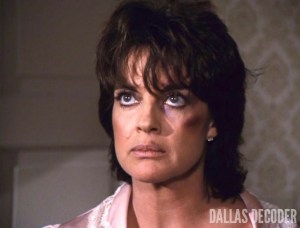
Sue Ellen refuses to believe Holly Harwood’s claim that she’s sleeping with J.R., so Holly invites her to visit her home and see for herself. At the end of “Tangled Web,” Sue Ellen accepts the challenge. Our heroine, clad in a huge fur coat, parks her car in Holly’s driveway, where J.R.’s Mercedes sits. She exits the vehicle and slowly walks toward the house, her heels clicking and clacking with every step. The door is unlocked, and for a moment, Sue Ellen seems to lose her nerve. But she presses on, and in the final shot, she stands silently in the bedroom doorway and sees her husband making love to Holly.

This is a brilliant, devastating sequence. The shots of Sue Ellen are interspersed with scenes of J.R. and Holly in bed; the audience knows what Sue Ellen is going to see before she does, allowing the tension to build until it’s almost unbearable. Director Nicholas Sgarro shows Sue Ellen parking her car, and then he cuts to J.R., wrapped in a bed sheet, popping open a fresh bottle of champagne as Holly massages his shoulders. We see Sue Ellen begin to cross the driveway, and then we cut to Holly pulling J.R. close. For most of Sue Ellen’s scenes, there is no underscore; the only sounds we hear are her heels on the driveway, some crickets in the distance and the soft music playing in Holly’s bedroom. And then, the final shot: a tight close-up of Linda Gray’s tear-streaked face. In a poignant touch, we hear her sniffle as the frame freezes and the credits flash.

When I listed “Dallas’s” 35 greatest moments in the spring, I ranked this scene at No. 20. I now wonder if I should have moved it a little higher. The sequence is much more artistic than what we usually see from “Dallas” and other early ’80s television dramas. The toggling between Sue Ellen in the driveway and J.R. and Holly in bed reminds me of the crosscuts that have become a signature of TNT’s “Dallas,” although if these scenes were produced today, it almost certainly wouldn’t be so eerie and quiet. The sequence also makes me wish Sgarro had directed more episodes of the original series. “Tangled Web” is his only “Dallas” credit, although he helmed 54 hours of “Knots Landing” and no doubt had a hand in establishing that show’s stylish look.

“Tangled Web’s” ending is easily this episode’s best moment, but it isn’t the only good one. I also like when Miss Ellie questions Clayton about his relationship with Sue Ellen. Barbara Bel Geddes stammers through her dialogue, as Ellie gradually musters the courage to ask Clayton if Sue Ellen is the mystery woman he once loved. Bel Geddes’ halting delivery is her trademark and one of the reasons Ellie always feels so believable. She speaks the way people do in real life. The actress also possesses a sincerity that other “Dallas” cast members, no matter how wonderful they are, lack. Consider the “Tangled Web” scene where Ray tells Aunt Lil that Jock was his father. This is another moving scene, and Kate Reid is quite good here, but her delivery feels more deliberate than Bel Geddes’. When I watch Reid, I never forget I’m seeing an actress affecting a homespun, humble sensibility, whereas Bel Geddes regularly disappears into her role. In other words: Lil comes off like a character, while Ellie feels like a person.

“Tangled Web” also offers several fun moments, including the scene where J.R., returning from his triumphant tour of the Caribbean, sweeps into the Ewing Oil offices with presents for the secretaries and a box of cigars for Bobby. “That little deal I made down in Cuba is going to make me the new daddy of Ewing Oil. Have a Havana?” J.R. says, reaching into his suit pocket and retrieving a cigar for his brother. (I wonder how Larry Hagman, an anti-smoking zealot, felt about that line?) Indeed, David Paulsen’s script is chock full of terrific one-liners. Katherine to Cliff, after he denies Bobby the use of the Tundra Torque: “You vicious little man!” Clayton to Sue Ellen, after she’s told him about J.R.’s trip: “Doggone, old J.R. went to Cuba. And they let him out?” Afton, after Cliff laments that he thought of himself “for once” in his life: “For once? No, not for once. For always! Cliff, you are the only person you ever do think of!”

“Tangled Web” also marks the end of Pam’s vacation on the French Riviera, one of my least favorite sixth-season subplots. Pam has left Bobby, but is it really appropriate for her to travel halfway around the world with Mark Graison, a man who quite obviously has designs on her? Toward the end of “Tangled Web,” Pam seems poised to sleep with Mark, but the mood is killed when Afton calls to warn her that Katherine has set her sights on Bobby. It reminds me of the fourth-season episode “Start the Revolution With Me,” when a tipsy Pam is having a jolly time in her hotel room with Alex Ward — until Bobby calls from Dallas.

Perhaps Pam should stop answering the phone call when she goes away. Better yet, maybe she should stop traveling with men who aren’t her husband.

Grade: A

_______________________________________________________________________________________________________________________________________________

Dallas, Holly Harwood, J.R. Ewing, Larry Hagman, Lois Chiles, Tangled Web

Exposed

‘TANGLED WEB’

Season 6, Episode 25

Airdate: April 1, 1983

Audience: 21.3 million homes, ranking 4th in the weekly ratings

Writer: David Paulsen

Director: Nicholas Sgarro

Synopsis: J.R. is released from the Cuban jail, collects his $40 million and returns to Dallas. Sue Ellen walks in on J.R. and Holly in bed. Bobby plans to ask for Pam’s help getting the Tundra Torque, but Katherine tells him that Pam is in France with Mark. Afton calls Pam to warn her about Katherine’s interest in Bobby, prompting Pam to cut short her vacation. Clayton tells Miss Ellie that he once loved Sue Ellen. Ray tells Lil that Jock was his father.

Cast: Tyler Banks (John Ross Ewing), John Beck (Mark Graison), Barbara Bel Geddes (Miss Ellie Ewing), Morgan Brittany (Katherine Wentworth), William Bryant (Jackson), Lois Chiles (Holly Harwood), Patrick Duffy (Bobby Ewing), Nate Esformes (Perez), Linda Gray (Sue Ellen Ewing), Larry Hagman (J.R. Ewing), Dennis Holahan (George Walker), Susan Howard (Donna Krebbs), Steve Kanaly (Ray Krebbs), Howard Keel (Clayton Farlow), Ken Kercheval (Cliff Barnes), Kenneth Kimmins (Thornton McLeish), Audrey Landers (Afton Cooper), Cindy Landis (waitress), Tom McFadden (Jackson’s partner), Santos Morales (Cuban leader), Marnie Mosiman (manicurist), Victoria Principal (Pam Ewing), Kate Reid (Lil Trotter), Debbie Rennard (Sly), Jacqueline Ray Selleck (Marie Walker), Danone Simpson (Kendall), Charlene Tilton (Lucy Ewing)

“Tangled Web” is available on DVD and at Amazon.com and iTunes. Watch the episode and share your comments below.
Critique: ‘Dallas’ Episode 127 — ‘Cuba Libre’

Cuba Libre, Dallas, J.R. Ewing, Larry Hagman

Black box

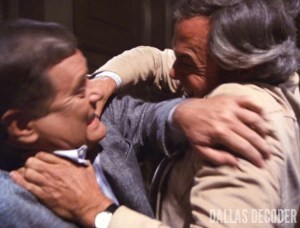
J.R. hopscotches across the Caribbean in “Cuba Libre,” making this one of the first “Dallas” episodes that require location subtitles. Our hero flies first to Puerto Rico, where he persuades Garcia, the greedy middleman in his Cuban oil deal, to slash his “fee” by 90 percent. Next, J.R. visits Havana to claim the $40 million owed to him by the mysterious moneyman Perez. This trip doesn’t go as smoothly. As soon as J.R. arrives at the airport, Cuban soldiers seize him with no explanation. J.R. protests his treatment loudly, and in the memorable final scene, as the soldiers toss him into a jail cell and slam the door, we hear him shout, “Hey! Hey! My name is J.R. Ewing!”

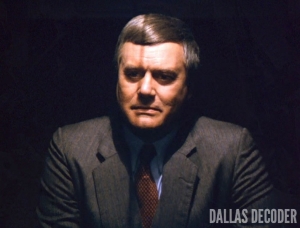
None of J.R.’s scenes are actually filmed in foreign locales, but the producers do an adequate job faking it. (This is also true of the scenes involving Pam, who spends this hour in the French Riviera, where Mark Graison shamelessly ignores his promise to leave her alone while she’s on vacation.) Stock footage is used for the establishing shots, with most of the scenes filmed on soundstages. One shot is nifty. Before the Cubans jail J.R., they interrogate him in a room that is pitch black, except for the ceiling light that shines on him. Filmmakers have been using this trick in interrogation scenes for years, but when it’s a scowl-faced Larry Hagman surrounded by darkness, the effect is especially sinister. (Almost three decades later, Marc Roskin would discover this for himself when he shoots a wizened Hagman in a pitch-black room in the TNT episode “The Last Hurrah.”)

The international intrigue in “Cuba Libre” is nicely balanced with several scenes that showcase the warmth within the family Ewing. Donna encourages Miss Ellie to admit that she might be developing feelings for Clayton, while Ray gently assures Mickey that his visiting mother, the homespun Lil Trotter, will have no trouble fitting in with the wealthy Ewings. I also like the scene where Sue Ellen visits Ewing Oil to quiz Bobby about J.R.’s relationship with Holly Harwood. The exchange, which draws on the easy rapport between Linda Gray and Patrick Duffy, ends with Bobby admiring Sue Ellen’s loyalty to her husband. “It’s not very often that I envy J.R. Maybe today I do, just a little,” he says before giving her a sweet peck on the cheek.

Duffy and Gray also figure into this episode’s sharpest scenes. In the first, Bobby visits the Cattleman’s Club and runs into Cliff, who offers to buy his frozen Canadian property. “Barnes, hell will freeze a lot colder than that field before I sell anything to you,” Bobby says. Cliff’s below-the-belt response: “So will your marriage.” Meanwhile, Sue Ellen visits Holly and tells her she doesn’t believe Holly’s claim that she’s having an affair with J.R. “You are a very sick little girl,” Sue Ellen seethes. I probably should feel sorry for Sue Ellen in this scene, since her faith in her husband is obviously misplaced. Yet somehow, this feels like a moment of triumph for Sue Ellen. Maybe it’s because no one delivers bitchy dialogue better than Gray.

The true champ in “Cuba Libre,” though, is Katherine Wentworth. She arranges for Bobby to use the Tundra Torque, an experiment drill bit developed by Wentworth Tool and Die, to penetrate his frozen Canadian field. Cliff finds out and refuses to give his blessing, but no matter. Bobby still seems mighty impressed by Katherine’s efforts to help him win the contest for Ewing Oil. Indeed, twice in this episode, Katherine brings high-ranking executives from the Wentworth companies to Bobby’s office to help him solve his Canadian drilling problem. Neither meeting lasts more than two minutes, making me wonder why these conversations couldn’t have been conducted over the phone.

Maybe these men know something the “Dallas” characters have yet to figure out: When Katherine Wentworth asks you to do something, you don’t turn her down.

Grade: B

_______________________________________________________________________________________________________________________________________________

Cuba Libre, Dallas, Katherine Wentworth, Morgan Brittany

Never say never

‘CUBA LIBRE’

Season 6, Episode 24

Airdate: March 25, 1983

Audience: 20.9 million homes, ranking 3rd in the weekly ratings

Writer: Leonard Katzman

Director: Robert C. Thompson

Synopsis: J.R. pays off Garcia and travels to Cuba, where he’s thrown in jail. Katherine tells Bobby he can use the Tundra Torque, a cold-weather drill bit being developed by Wentworth Tool and Die, but Cliff refuses to give his blessing. After Bobby tells Sue Ellen that Holly has a vendetta against J.R., Sue Ellen concludes Holly is lying about her affair with J.R. Mark charms Pam during their trip to France. Lil visits and questions Mickey’s relationship with Lucy.

Cast: John Anderson (Richard McIntyre), Rita Rogers Aragon (Cuban guide), Terrence Beasor (businessman), John Beck (Mark Graison), Barbara Bel Geddes (Miss Ellie Ewing), Morgan Brittany (Katherine Wentworth), Lois Chiles (Holly Harwood), Roseanna Christiansen (Teresa), Henry Darrow (Garcia), Patrick Duffy (Bobby Ewing), Erwin Fuller (businessman), Linda Gray (Sue Ellen Ewing), Larry Hagman (J.R. Ewing), Alice Hirson (Mavis Anderson), Susan Howard (Donna Krebbs), Steve Kanaly (Ray Krebbs), Howard Keel (Clayton Farlow), Ken Kercheval (Cliff Barnes), Audrey Landers (Afton Cooper), Britt Leach (Sperry), Santos Morales (Cuban leader), Timothy Patrick Murphy (Mickey Trotter), Robert Pinkerton (Elliot), Victoria Principal (Pam Ewing), Kate Reid (Lil Trotter), Debbie Rennard (Sly), Hansford Rowe (Andrew Forrest), Susan Saldivar (Maria), Danone Simpson (Kendall), Don Starr (Jordan Lee), Thomas Thomas (businessman), Charlene Tilton (Lucy Ewing), Deborah Tranelli (Phyllis), Morgan Woodward (Punk Anderson)

“Cuba Libre” is available on DVD and at Amazon.com and iTunes. Watch the episode and share your comments below.
Critique: ‘Dallas’ Episode 126 — ‘Hell Hath No Fury’

Dallas, Hell Hath No Fury, Linda Gray, Sue Ellen Ewing

Those eyes

Sue Ellen is the perfect wife, living the perfect life, when “Hell Hath No Fury” begins. She fusses over J.R. at breakfast, smiles when he brings Roy Ralston home for dinner and gazes at him adoringly during his latest appearance on Ralston’s TV show. Of course, this is “Dallas,” so Sue Ellen’s bliss doesn’t last. During a visit to the hair salon, she runs into Holly Harwood, who later confesses to Sue Ellen that she’s having an affair with J.R. Sue Ellen doesn’t want to believe it, so Holly tells her to go home and check his shirt collar. Sure enough, the collar is smeared with Holly’s lipstick. The episode ends with our heroine clutching the garment and sobbing quietly.
Beauty parlor run-ins, lipstick-smeared collars, tear-streaked faces: If this sounds like the stuff of 1950s and 1960s soap operas, I suspect it’s purely intentional. “Dallas” routinely honors the tropes of daytime dramas and Douglas Sirk movies (witness Rebecca Wentworth’s weepy deathbed scene a few episodes earlier). This is something I’ve always admired about the show. The homage presented in “Hell Hath No Fury” is especially fitting: J.R. and Sue Ellen have an old-fashioned marriage; of course it should collapse under old-fashioned circumstances.
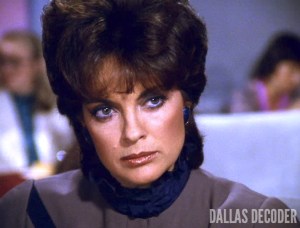
I also love how Lois Chiles and Linda Gray handle the material. Chiles is deliciously cunning as Holly, who wants to destroy J.R.’s marriage to get back at him for costing her company millions of dollars in a bungled deal. In the lunch scene, Chiles smiles — ever so slightly — when Holly sees how much her confession hurts Sue Ellen. Gray is wonderful too. This is another example of Gray using her big, expressive eyes to convey the depth of Sue Ellen’s pain. (I’m usually not one to notice makeup, but Gray’s blue eye shadow in this scene is a work of art. Eat your heart out, Donna Mills.) Even more moving: “Hell Hath No Fury’s” closing moments, when Sue Ellen retrieves J.R.’s shirt from the laundry basket, sees the lipstick and weeps. There’s no dialogue, but none is needed. Gray’s tears say it all.

If Sue Ellen’s marital turmoil in “Hell Hath No Fury” has an unmistakable retro vibe, then Pam’s feels slyly modern. Pam, who is now living in a hotel because she feels Bobby’s ambition has changed him, calls her husband at the office and invites him over for a drink. The couple spends the evening reminiscing, but when Bobby tries to leave, Pam kisses him passionately until they slump back onto the sofa. The next morning, she awakens to find Bobby planning her move back to Southfork. Pam corrects him: Just because she spent the night with Bobby doesn’t mean she’s ready to take him back. Bobby is aghast. “You make me feel like I should give you a bill for services rendered,” he seethes.

Oh, how I love this. How often have we seen the men of “Dallas” treat women as vessels for sexual satisfaction? Isn’t it refreshing to see a woman do the same thing? This entire sequence is about Pam acknowledging that she has sexual needs and fulfilling them. She calls Bobby and invites him over for a drink. When he declares it’s time to go home, she lets him know that she wants him to stay. And in the morning, when Bobby assumes Pam will now come back to him, she sets him straight. Don’t get me wrong: I feel bad for Bobby when he brushes past that chump Mark Graison on his way out of the hotel, and I believe Pam is wrong later in the episode when she agrees to accompany Mark to France. She is married, after all, and if she believes Mark is going to keep his promise to leave her alone during the trip, she’s a fool. Nevertheless, I applaud “Dallas” for depicting Pam as a woman who isn’t afraid to express her sexuality.

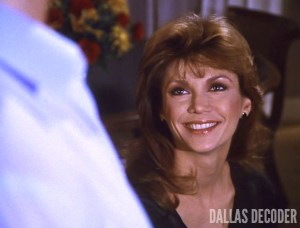
I’m also charmed by the scene where Bobby and Pam recall the first time they met. Patrick Duffy and Victoria Principal’s chemistry is effortless, and I love how Arthur Bernard Lewis’s dialogue honors “Dallas” history. Pam remembers arriving at a Ewing barbecue on Ray’s arm and being surprised to discover the family isn’t as monstrous as Digger led her to believe. I also like how the scene ends with Duffy reaching behind him to turn off the lamp while locking lips with Principal. She does something similar during another reunion with Bobby in the eighth-season finale “Swan Song.” Along these lines, I also chuckle when Bobby greets Pam in “Hell Hath No Fury” with a winking “good morning.” This won’t be the last time he’ll say these words to her, will it?

The other highlight of “Hell Hath No Fury”: J.R.’s latest appearance on “Talk Time,” Ralston’s TV show. In typical J.R. style, the guest spot is part of a convoluted scheme. J.R. needs to find a way to visit Cuba so he can claim millions of dollars owed to him in an illegal deal, but of course Uncle Sam doesn’t know allow just anyone to visit the communist outpost. So J.R. goes on Ralston’s show and talks up the need for “businessmen” to get more involved in foreign affairs, apparently hoping his comments will inspire the State Department to send him to Cuba on a diplomatic mission. Whatever. Forget this absurd backstory and focus instead on how J.R. describes for Ralston his philosophy of government. “Government is big business. The biggest,” he says. “They’re in the police business and the land management business, the health and education business. All those bureaus are just departments of one big department store.” Does this not sound like the kind of rhetoric we’ve heard from real-life politicians for years?

Lewis’s script also offers a couple of pop culture references that make me smile. When Ralston visits Southfork, he suggests filming an interview with J.R. and Sue Ellen at the ranch, the way Edward R. Murrow once conducted interviews with celebrities in their living rooms on “Person to Person.” TV historians will recall Murrow’s show was a Friday night staple on CBS in the 1950s, a few decades before “Dallas” became a Friday fixture. In another scene, Holly lashes out at Bobby for interfering with J.R.’s Cuban deal. “You had to play James Bond and prevent the deal from going through,” she fumes. The line, which is clearly a reference to Chiles’s role in “Moonraker,” raises a question: If Bobby is Bond, does that make J.R. Blofeld?

Grade: B

_______________________________________________________________________________________________________________________________________________

Dallas, Hell Hath No Fury, Pam Ewing, Victoria Principal

That smile

‘HELL HATH NO FURY’

Season 6, Episode 23

Airdate: March 18, 1983

Audience: 20.8 million homes, ranking 3rd in the weekly ratings

Writer: Arthur Bernard Lewis

Director: Ernest Pintoff

Synopsis: J.R. schemes to get the government’s permission to visit Cuba. To get back at J.R., Holly tricks him into believing she wants him, then lies and tells Sue Ellen that J.R. is her lover. Mark talks Pam into letting him accompany her on a trip to France. Bobby worries his Canadian field won’t come in. Lucy and Mickey continue to date.

Cast: John Anderson (Richard McIntyre), John Beck (Mark Graison), Barbara Bel Geddes (Miss Ellie Ewing), Morgan Brittany (Katherine Wentworth), James Brown (Detective Harry McSween), William Bryant (Jackson), Lois Chiles (Holly Harwood), Roseanna Christiansen (Teresa), Patrick Duffy (Bobby Ewing), Linda Gray (Sue Ellen Ewing), Larry Hagman (J.R. Ewing), Fay Hauser (Annie), Susan Howard (Donna Krebbs), Steve Kanaly (Ray Krebbs), Howard Keel (Clayton Farlow), Ken Kercheval (Cliff Barnes), Kenneth Kimmins (Thornton McLeish), Audrey Landers (Afton Cooper), Tom McFadden (Jackson’s partner), Timothy Patrick Murphy (Mickey Trotter), Ben Piazza (Walt Driscoll), Ron Ellington Shy (singer), Victoria Principal (Pam Ewing), John Reilly (Roy Ralston), Charlene Tilton (Lucy Ewing), Deborah Tranelli (Phyllis)

“Hell Hath No Fury” is available on DVD and at Amazon.com and iTunes. Watch the episode and share your comments below.