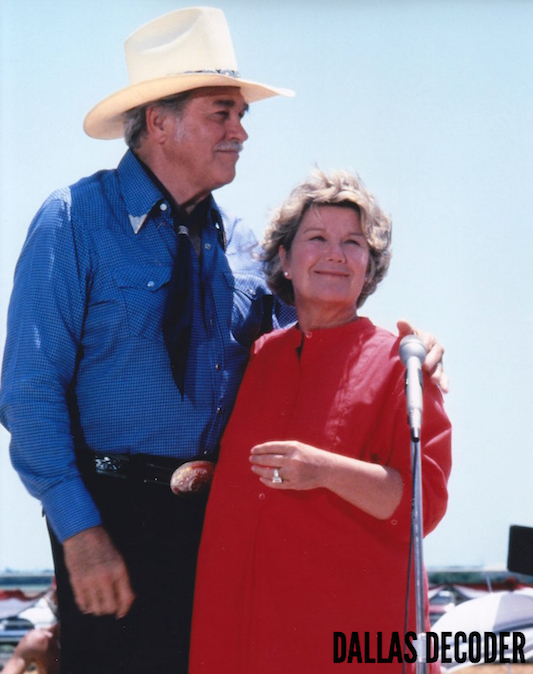
The Dal-List: 19 Reasons to Love ‘Dallas’s’ Ninth Season

Barbara Bel Geddes, Clayton Farlow, Dallas, Howard Keel, Miss Ellie Ewing Farlow

Dream on

Dallas Decoder will soon begin critiquing the original show’s ninth season, which aired from 1985 to 1986. Here are 19 reasons to love it.
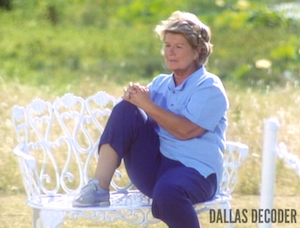
Barbara Bel Geddes, Dallas, Miss Ellie Ewing Farlow

True blue

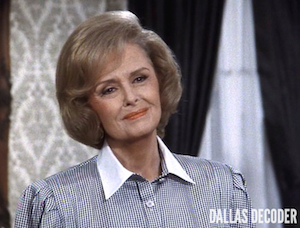
19. Mama returns. We never needed her more.
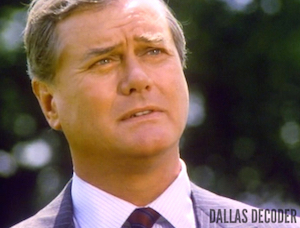
Dallas, J.R. Ewing, Larry Hagman

Mourning in America

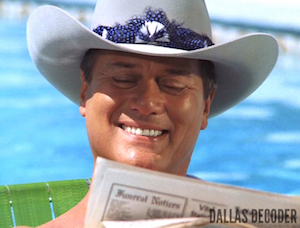
18. J.R. says goodbye. Does anyone do the single tear thing better than Larry Hagman?
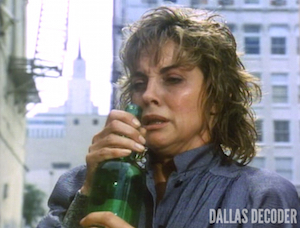
Dallas, Linda Gray, Sue Ellen Ewing

Blitzed

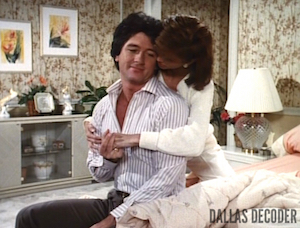
17. Sue Ellen relapses. Linda Gray’s tour de force.
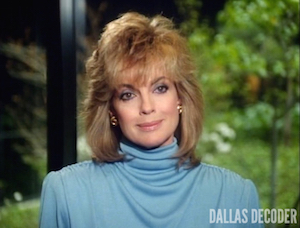
Dallas, Linda Gray, Sue Ellen Ewing

Blonde

16. Sue Ellen recovers. The most satisfying storyline in “Dallas” history?
Dallas, Linda Gray, Lou Diamond Phillps, Sue Ellen Ewing

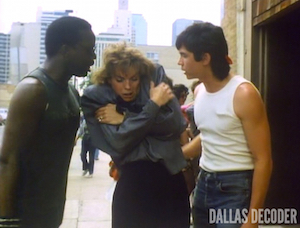
Welcome to the jungle

15. La Bamba shows up. Arriba y arriba!
Bibi Besche, Dallas

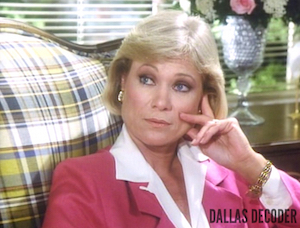
Genesis of the matter

14. And so does Dr. Carol Marcus. Can she analyze or can’t she?
Dallas, Russell Johnson

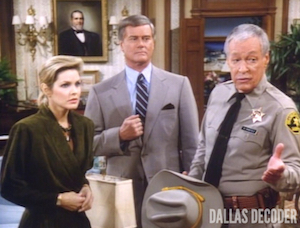
Coconuts

13. The Professor’s here too. But where was he when Julie Grey needed him?
Dallas, Pam Ewing, Victoria Principal

The widow Ewing

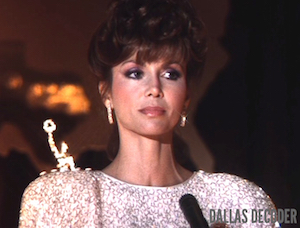
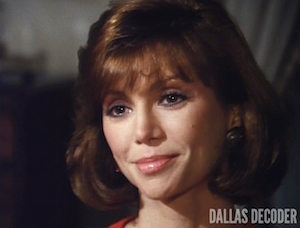
12. Pam’s speech. Chills!
Dallas, Linda Gray, Sue Ellen Ewing

Wake up, darlin’

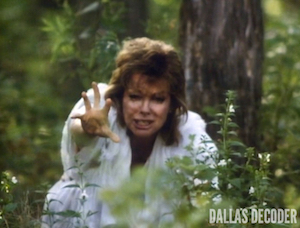
11. Sue Ellen’s nightmare. A dream-within-a-dream. Meta!
Dallas, Jenna Wade, Priscilla Beaulieu Presley

Post-Bobby Stress Syndrome

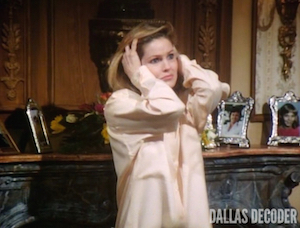
10. Jenna’s flashback. Hyper-meta!
Dack Rambo, Dallas

Ewing genes

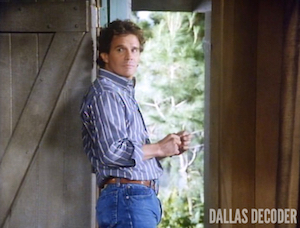
9. Dack’s rambo. Talk about an Alaskan pipeline.
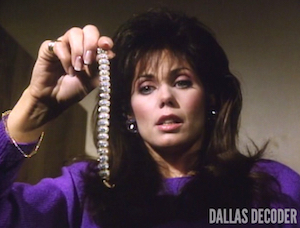
Dallas, Deborah Shelton, Mandy Winger

Super bowl

8. Mandy’s flush. Oh, honey. That’s not how you clean jewelry.
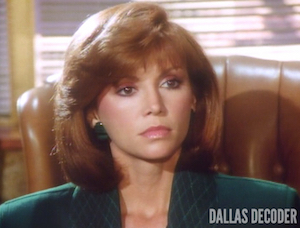
Dallas, Pam Ewing, Victoria Principal

Bag it, J.R.

7. “Phyllis, I’d like a cup of tea — a cup of herbal tea.” But hold the eggs and toast, please.
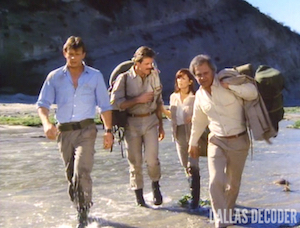
Cliff Barnes, John Beck, Ken Kercheval, Marc Singer, Mark Graison, Matt Cantrell, Dallas, Pam Ewing, Victoria Principal

Dorothy and friends

6. South America. Pam, Cliff, Mark and Matt search for emeralds. It’s “Dallas’s” version of “The Wizard Oz.”
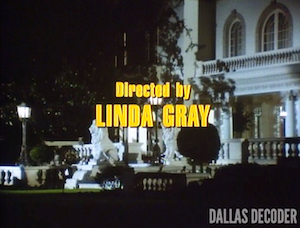
Dallas, Just Desserts, Linda Gray

Direct hit

5. “Just Desserts.” Victory!
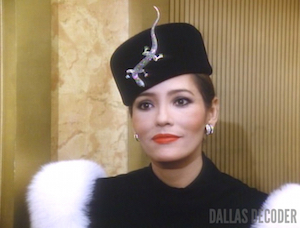
Angelica Nero, Barbara Carrera, Dallas

“L” word

4. This hat. Even Katherine wouldn’t dare.
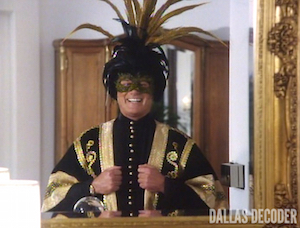
Dallas, J.R. Ewing, Larry Hagman

Cock of the walk

3. This mask. Who feathered J.R.?
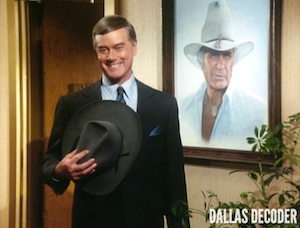
Dallas, J.R. Ewing, Larry Hagman

Next: The world!

2. Total control of Ewing Oil. Who has the heart to tell him it’s just a dream?
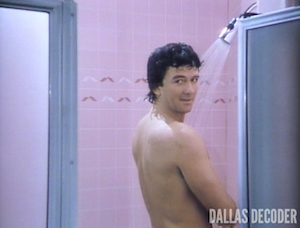
Bobby Ewing, Dallas, Patrick Duffy

Rub-a-dub-dub

1. Bobby’s back! His chest and arms too!

Why do you love “Dallas’s” ninth season? Share your comments below and read more “Dal-Lists.”
The Best & Worst of Dallas: Season 8

“Dallas’s” eighth season had its share of ups and downs. Here are the highs and lows.

Performances

Dallas, Pam Ewing, Victoria Principal

Principal player

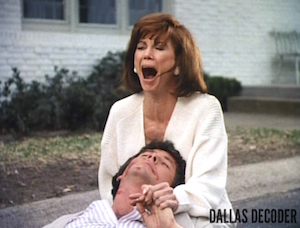
Victoria Principal does her best work during “Dallas’s” eighth season, a.k.a. The Year Pam Gets Her Groove Back. The actress displays her old fire during Pam’s clashes with J.R., but nothing beats her performance during Bobby’s season-ending death. Principal took heat for campaigning for an Emmy after that episode, which seems unfair in retrospect. I bet most folks can’t remember a thing about the actresses who were nominated, but no one will ever forget Pam crawling to Bobby in the driveway.

Episodes

You don’t need me to explain again why “Swan Song” is the best “Dallas” episode ever made, do you? There are several choices for worst episode, unfortunately, but I’ll go with “Trial and Error,” the nadir of the dreary Jenna-on-trial saga.

Scenes

Bobby Ewing, Dallas, Patrick Duffy, Swan Song

Bye bye, Bobby

Bobby’s deathbed farewell in “Swan Song” is the best, of course, followed closely by the moment he pushes Pam out of the path of Katherine’s speeding car and his sweet, touching proposal to Pam earlier in the episode. Other runners-up: Sue Ellen visiting John Ross in the hospital, Pam confronting J.R. over his scheme to send her around the world searching for Mark, and Afton’s big goodbye. One scene I could do without: J.R. making fun of Jamie’s appearance. Now that’s just mean.

Storylines

I appreciate what “Dallas” tries to achieve with the legal battle over Ewing Oil, which offers an inverse of J.R. and Bobby’s sixth-season contest for control of the company. Instead of the family fighting each other, the Ewings band together to defeat Cliff Barnes. Too bad this requires rewriting “Dallas” history by inventing a dead brother for Jock and a long-lost cousin for J.R. and Bobby. I ended up preferring Clayton’s difficulty adjusting to life at Southfork, a relatively minor subplot that’s poignant nonetheless, thanks to the reliable Howard Keel. I also like Lucy’s waitressing storyline, which allows Charlene Tilton’s character to finally grow up.

My choice for worst storyline? That’s easy: Jenna’s season-long odyssey from bride-to-be to kidnapping victim to murder trial defendant to jailbird to biggest loser in the Bobby Ewing love sweepstakes. Talk about a bad dream.

Supporting Players

Dallas, Donna Reed, Miss Ellie Ewing Farlow

Other mother

This category is usually reserved for actors who don’t appear in the opening credits, but I’m going to make an exception and honor Donna Reed. She’s sometimes stiff as Miss Ellie, but she also possesses grace and warmth, and she has a nice rapport with Keel. Above all, I give Reed credit for having the courage to replace Barbara Bel Geddes — an impossible task — and for being smart enough to not imitate her predecessor. Runner-up: Stephen Elliott as southern fried lawyer Scotty Demarest.

Behind the Scenes

Patrick Duffy isn’t just one of “Dallas’s” best actors — he’s also one of the show’s best directors. Duffy helmed three episodes this season, bringing an inventive touch to each production. My favorite: “The Brothers Ewing,” a dark, ominous hour that finds J.R., Bobby and Ray scheming to hide Ewing Oil assets from Cliff. When I interviewed Duffy earlier this year, he downplayed his storytelling skills, citing as an example “War of the Ewings,” the 1998 reunion movie he produced with Larry Hagman. Duffy is too modest. He’s a creative force in his own right, as his behind-the-scenes work this season demonstrates.

Costumes

Dallas, Jenna Wade, Linda Gray, Priscilla Beaulieu Presley, Sue Ellen Ewing

Pillow talk

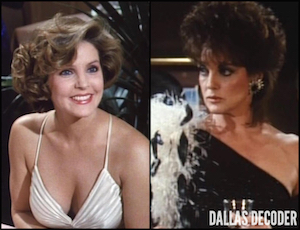
Season 8 brings us “Dallas’s” most famous costume designer: Travilla, who immediately cranks up the glam factor. His looks are often classy, such as the timeless white gown Priscilla Beaulieu Presley sports in “Deliverance” and “Swan Song.” Other Travilla creations are woefully wrong. Example: Linda Gray’s feathery “Deliverance” / “Swan Song” number. Yeah, it’s fun, but it’s also damn distracting. Instead of focusing on Sue Ellen’s meltdown, I keep wondering: How many pillows died to create this dress?

Quips

As much as I love Lucy’s memorable description of rival waitress Betty (“All she can do is sling hash and make love!”) and Sue Ellen’s famous defense of her drinking habits (“Joan or Arc would have been a drunk if she had been married to you”), this category will always belong to J.R. This season, he expressed his concern for an ex-sister-in-law (“I don’t give a damn about Pam”) and offered a helping hand to soaked strumpet Marilee (“You all right honey? Did it go up your nose?”), although my favorite line comes when Pam confronts J.R. over his wild-goose-chase scheme and he plays dumb: “I never liked you a hell of a lot, you know that, Pam? But I never thought you were stupid until now.”

The audience knows it’s an outright lie, but Hagman delivers it with such conviction, we almost believe him. That’s his genius, isn’t it?

What do you love and loathe about “Dallas’s” eighth season? Share your comments below and read more “Best & Worst” reviews.

Critique: ‘Dallas’ Episode 191 — ‘Swan Song’

Bobby Ewing, Dallas, Patrick Duffy, Swan Song

Exit the hero

“Swan Song” is a masterpiece. This is the best “Dallas” episode ever made because it dares to set aside so many of the show’s conventions — wheeling, dealing, double-crossing — to focus on what matters most: the characters and their relationships. Mostly, “Swan Song” tells the story of Bobby and Pam’s long-awaited reunion, which is cut short when he sacrifices his life to save hers. It’s pure soap opera, yet the performances from Patrick Duffy, Victoria Principal and the other actors are so heartfelt, every emotion rings true. Even though it’s 30 years later, and even though Bobby’s death later turned out to be a dream, “Swan Song” still moves me.

Like “A House Divided,” the 1980 segment that kicked off the “Who Shot J.R.?” phenomenon, “Swan Song” deserves to be remembered as a watershed moment for “Dallas.” Not only was this supposed to be Duffy’s final appearance as Bobby, it also was intended as the last hurrah for producer Leonard Katzman, who wrote and directed the episode before departing to run his own show on another network. Both men eventually returned to Southfork, which would have been unthinkable when the cameras were rolling on this episode in March 1985. (I examine the backstage drama in a companion post, “‘Swan Song: Making a ‘Dallas’ Classic.”) Watching it today, you get the impression everyone involved wanted to send Duffy and Katzman off on a high note. Did they ever.

More than anything, “Swan Song” is remembered for two scenes: Bobby pushing Pam out of the path of the speeding car and his deathbed farewell to his family. Neither sequence would pack as much punch if weren’t for two earlier, quieter moments. First, Pam summons Bobby to her home to discuss their future. The couple has been divorced for years, and now he’s engaged to Jenna Wade, one of the show’s other long-suffering heroines. Bobby tells Pam he still loves her, but she says it will destroy Jenna if he doesn’t go through with the wedding. “As much as I love you, you have to marry her,” Pam says. It’s a line straight out of a Douglas Sirk movie, but it’s crucial to our understanding of Principal’s character — and Duffy’s, for that matter. Bobby and Pam have always been willing to sacrifice their own happiness to spare the feelings of others. That’s what makes them perfect for each other.

Later, Bobby returns to Pam’s home and tells her he’s decided it would be wrong to marry one woman when he’s in love with another. This is something the audience has known for a long time, but “Dallas” fans are always one step ahead of the characters in matters of the heart. Finally, Bobby asks the question Pam — and the audience — has longed to hear: “Will you … marry me … again?” Duffy delivers the line with a sweet, almost nervous enthusiasm, while Principal responds by simultaneously bursting into tears and laughter. The characters kiss, and she elegantly reaches behind her head to turn off the lamp. It’s “Swan Song’s” most romantic moment — until Katzman kills the mood by cutting to the scene outside, where the mysterious driver who’s been following Bobby silently pounds her fists onto the steering wheel.

End of the road

Bobby Ewing, Dallas, Pam Ewing, Patrick Duffy, Swan Song, Victoria Principal

Scream queen

“Swan Song’s” climactic action sequence begins the morning after Bobby’s proposal. A landscaper arrives at Pam’s house and parks his vehicle next to Bobby’s (this will be important later), while inside, the happy couple are beginning to plan their future together. After carrying little Christopher downstairs to breakfast — eggs and toast, not that you need to be reminded — Pam walks Bobby outside. She tells him how bad she feels for Jenna. He reassures her they’re doing the right thing, kisses her goodbye and walks to his car. In the distance, the stalker starts her ignition. Through her windshield we see Pam run over to give Bobby one more kiss, and then the stalker’s car begins moving. The motion slows, our hearts race. Bobby spots the speeding car and shouts Pam’s name. As she turns, he pushes her out of the way, allowing the vehicle to strike him. He rolls over the hood, the roof, the trunk. When he finally hits pavement, we hear the thud.

What happens next is seared into the memories of “Dallas” fans. Pam — dressed in that beautiful white sweater and pants — crawls to Bobby, turns him over and rests his bloodied head on her lap. It’s not unlike Jackie Kennedy cradling her husband in the moments after his assassination. Our point of view switches to the stalker’s car, which has slammed into the landscaper’s truck. He rushes over, reaches inside and pulls off the woman’s blonde wig, which turns her head toward the camera. Katherine Wentworth’s eyes — lifeless, yet still crazed — stare back at us. We then return to Bobby and Pam, who emits a guttural scream. In my behind-the-scenes post, Duffy says the sound she produced made his ears ring. I believe it. Principal has ceased being an actress at this moment. She is Pam Ewing, clutching the hand of the man she loves as he lay dying.

‘It’s Bobby’

Dallas, J.R. Ewing, Larry Hagman, Swan Song

Last call

If “Swan Song” had ended here, we’d still remember it as a great hour of television. But “Dallas” doesn’t let us off the hook that easily. The episode now shows us the characters finding out what’s happened to Bobby. Cliff is standing in his living room, arguing with his new wife Jamie and her brother Jack, when a radio bulletin announces the “bizarre turn of events” that’s caused Bobby to be rushed to the hospital. (This is the same radio voice that announced Bobby’s shooting at the beginning of this season, by the way.) When the newsman says the incident occurred at the home of “Mr. Ewing’s ex-wife,” Ken Kercheval closes his eyes and winces. The announcer may be puzzled by what’s happened, but Cliff knows.

Across town, J.R. is awakening in the home of his mistress, Mandy Winger. He’s decided to spend the day with her, so he calls Ewing Oil to let the secretaries know he won’t be coming into work. At the office, Phyllis is hunched over her desk, sobbing. Sly answers the phone and tells J.R. that everyone has been trying to reach him. He asks why she’s upset, but we don’t get to hear Deborah Rennard’s character break the news. Instead, Katzman holds the camera on Larry Hagman as J.R.’s face falls. In the background, we hear a few solemn notes of the “Dallas” theme. “It’s Bobby,” J.R. says as he puts down the phone, grabs his hat and rushes out the door.

This is one of the most powerful moments in the episode. Much credit goes to Hagman, whose reaction is flawless, and composer Lance Rubin, who was smart enough to use the theme music to signal the gravity of the situation. But don’t overlook Deborah Tranelli, the actress who plays Phyllis. More than anyone else in this episode, she serves as a stand-in for the audience. Bobby was Phyllis’s boss, but she also knew him the way we do — as a friend. Phyllis’s tears are ours. Without saying a word, Tranelli delivers one of “Swan Song’s” most haunting performances.

Death is but a dream

Dallas, Ray Krebbs, Steve Kanaly, Swan Song

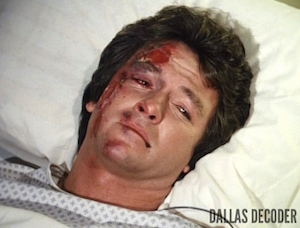
Sob brother

The deathbed farewell is a familiar trope in drama, but the “Dallas” cast infuses Bobby’s goodbye with heart and grace. This was a company of actors who cared about each other and their work, and in this scene, it shows. Steve Kanaly’s sobbing is touching, and so is the single tear that streams down Hagman’s face. This also is one of Donna Reed’s best performances as Miss Ellie. Yes, Bobby’s death would have been even more memorable if it had featured Barbara Bel Geddes, but Reed looks believably stricken. Of course, nothing gets me like the moment Bobby’s monitor flat lines, jolting Pam. I don’t know if Principal did this instinctively or if she was following Katzman’s direction, but seeing Pam almost jump out of her skin makes the shock of Bobby’s death palpable. I also love what Principal does next, throwing back her head in quiet agony. It’s an exquisite performance.

Perhaps no one rises to the occasion, though, quite like Duffy. It would have been easy to overplay a scene like this, as we’ve all seen actors in other movies and TV shows do. But Duffy strikes every note perfectly, from his groggy greeting upon waking up (“Hey, Ray”) to the break in voice when he addresses Ellie (“Oh, Mama, I’m sorry”). Duffy brings to bear all the years he spent creating this character; if Bobby’s death feels like the loss of a real person, it’s because of the actor playing him. It’s also worth noting how smartly Katzman wrote this scene. He injects a little mystery into the exchange by having Bobby declare, “All that wasted time. We should have been married.” Is he speaking to Pam or Jenna? It seems clear now, but I can remember debating this with my mom in 1985. On the other hand, when Bobby says, “Be good to each other. Be a family,” do we have any doubt which Ewing that line is directed toward?

Never the same

Bobby Ewing, Dallas, Patrick Duffy, Swan Song

Bye, Bob

There’s much more to love about “Swan Song.” This episode also gives us one of the great bedroom fights between J.R. and Sue Ellen (“Joan of Arc would have been a drunk if she had been married to you”); another touching moment from Kanaly when Ray pleads with his estranged wife Donna to come back to him; and Lucy’s sentimental farewell to the Ewings after remarrying Mitch. “I’m going to miss you all. I’ll never be the same again,” she says. I have no doubt the line describes Charlene Tilton’s own sentiments as much as it does her character’s. (Although this was Tilton’s swan song too, she eventually returned, like Duffy and Katzman.)

And yet “Swan Song” isn’t flawless, is it? During the proposal scene, the shadows on Duffy’s face are distracting, Katherine’s wig and her tomato juice throwing scene are undeniably campy, and there’s at least one glaring continuity error: On the morning of the accident, we see Bobby putting on brown boots — but when he’s run over in the driveway a few minutes later, he’s wearing black shoes. The show also gives away quite a bit of the plot in the pre-credits roll, although I suppose that doesn’t matter now that we know how the story ends. Some fans also gripe that “Dallas” was foolish to kill off Bobby in the first place since Duffy ended up returning, but I admire the boldness of his death. Killing major characters is common on television today, but it didn’t happen so much in the 1980s. And let’s face it: “Dallas” handles Bobby’s demise much better than it did Jock’s, which dragged on far too long.

Does it matter that the most memorable parts of “Swan Song” later turned out to be one character’s dream? Not really. Yes, Bobby’s death has gone down in television history with an asterisk next to it, but that doesn’t diminish the quality of the production and the amount of heart that went into honoring the character by giving him a meaningful sendoff. It brings to mind something I learned reading comic books as a kid: So what if this is an imaginary story. Aren’t they all?

Grade: A+

_______________________________________________________________________________________________________________________________________________

Dallas, Pam Ewing, Swan Song, Victoria Principal

Death becomes her

‘SWAN SONG’

Season 8, Episode 30

Airdate: May 17, 1985

Audience: 23.3 million homes, ranking 1st in the weekly ratings

Writer and Director: Leonard Katzman

Synopsis: Sue Ellen asks Dusty to help her get sober. Donna tells Ray she’s pregnant. Cliff contemplates ending his marriage to Jamie. Lucy and Mitch are remarried. Bobby proposes to Pam and she accepts, but a vengeful Katherine mows him down in the driveway. At the hospital, Bobby bids farewell to his family before dying.

Cast: Mary Armstrong (Louise), Morgan Brittany (Katherine Wentworth), Roseanna Christensen (Teresa), Pat Colbert (Dora Mae), Patrick Duffy (Bobby Ewing), Walker Edmiston (Parson Carson), Eric Farlow (Christopher Ewing), Linda Gray (Sue Ellen Ewing), Larry Hagman (J.R. Ewing), Jenilee Harrison (Jamie Barnes), Susan Howard (Donna Krebbs), Steve Kanaly (Ray Krebbs), Omri Katz (John Ross Ewing), Howard Keel (Clayton Farlow), Ken Kercheval (Cliff Barnes), Jared Martin (Dusty Farlow), Shalane McCall (Charlie Wade), Leigh McCloskey (Dr. Mitch Cooper), Priscilla Beaulieu Presley (Jenna Wade), Victoria Principal (Pam Ewing), Dack Rambo (Jack Ewing), Donna Reed (Miss Ellie Farlow), Debbie Rennard (Sly), Deborah Shelton (Mandy Winger), Charlene Tilton (Lucy Ewing), Deborah Tranelli (Phyllis), David White (Mark)

“Swan Song” is available on DVD and at Amazon and iTunes. Watch the episode and share your comments below.

Swoon Over ‘Swan Song’ During Our Sept. 18 #DallasChat

Bobby Ewing, Dallas, Pam Ewing, Patrick Duffy, Swan Song

Love story

You’re invited to a special #DallasChat on Twitter to mark the 30th anniversary of “Swan Song,” the classic episode that features Bobby and Pam’s tragic reunion and his famous “deathbed” scene.

Let’s all watch “Swan Song” beginning Friday, September 18, at 8 p.m. Eastern. During the episode, share your memories and observations on Twitter using the #DallasChat hashtag.

It’ll be like live tweeting a current TV show — except instead of a network broadcasting the episode for us, it’s up to each of us to play it on the device (TV, tablet, laptop, smartphone) of our choice.

Here’s how you can participate:

• Get the episode. You’ll find “Swan Song” on the “Dallas: The Complete Eighth Season” DVD set, which is available from Amazon, WB Shop and many other online retailers. You can also purchase the episode from Amazon and iTunes.

• Watch it. No matter what device you use, don’t hit play until September 18 at 8 p.m. Eastern (7 p.m. Central, 6 p.m. Mountain, 5 p.m. Pacific). The show starts with brief preview scenes — the first thing you’ll see is Pam saying, “I’m not trying to be noble. As much as I love you, you have to marry her!” — followed by the opening credits, a recap and then the episode itself. It’s important we all start watching at the same time so we’re in sync.

• Discuss it. Once the show begins, go to Twitter and join the conversation. Include #DallasChat in all your tweets, and enter #DallasChat in Twitter’s search field to see what other fans are saying. Click “All” to see all the related tweets. (I’ll be tweeting from my Twitter handle, @DallasDecoder.)

“Swan Song” will always be a watershed moment in “Dallas” history, featuring beautiful performances from Patrick Duffy, Victoria Principal and the rest of the cast. Let’s relive the magic together. Don’t forget the Kleenex!

Got questions about #DallasChat? Leave them in the comments section below.

‘Road to Happiness’ Casts Linda Gray in a New Role: Teacher

Dallas, Linda Gray, Road to Happiness is Always Under Construction

Terrific explainer

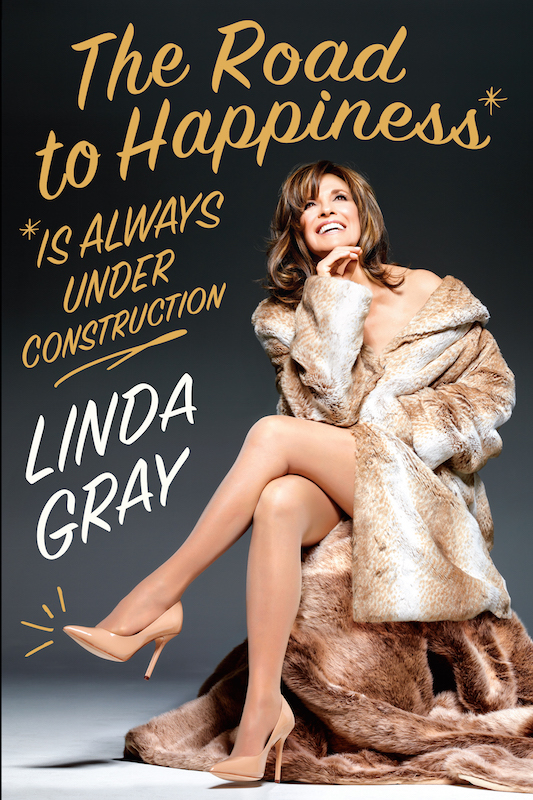
Start reading Linda Gray’s new book, “The Road to Happiness is Always Under Construction,” and you might be struck by how much the actress has in common with her most famous character, Sue Ellen Ewing. Each woman’s life was touched by alcoholism (Sue Ellen suffered from the disease, while Gray is the daughter of an alcoholic), both had unhappy marriages, and professional success didn’t come easy for either of them. By the time you finish the book, though, there’s no mistaking this fact: While Gray and Sue Ellen had similar experiences, they came out of them as very different people.

Unlike her fictional counterpart, Gray learns from her mistakes — and she’s eager to share those lessons with her readers. This is what makes “The Road to Happiness” unique. To describe the book as a memoir doesn’t do it justice. Yes, Gray writes about her ups and downs, but she also tells you what she took away from each experience and offers advice on how you can apply her wisdom in your life. If the concept sounds preachy, don’t worry: Gray is remarkably down to earth, so her lessons come off more like helpful reminders than commandments from Mount Celebrity. This is a self-help book from an author who isn’t self-important.

True to its title, “The Road to Happiness” covers Gray’s 75-year journey. You’ll read how she overcame polio as a child and extreme shyness as a teenager to become a top model in advertising. You’ll also learn about her troubled marriage to album designer Ed Thrasher, including how she defied him by enrolling in the acting class that eventually led to her casting on “Dallas.” (Gray’s lesson here: Never ask permission for something you really want.) Not everything in the book is flattering — Gray concedes she was driven by ego when she took a starring role on the ill-fated “Models Inc.” — nor is everything serious. I won’t give away the details, but there’s an excellent reason Gray’s impromptu lunch with Elizabeth Taylor yields this bit of advice: Always check your face before you sit down to eat with people.

Of course, the book has plenty for “Dallas” diehards too. You’ll read how Gray aced her audition for Sue Ellen and how growing up with an alcoholic mother shaped her portrayal of the character, as well as her four favorite “Dallas” moments. There’s also quite a bit more to one of the topics Gray discussed in our recent interview: her behind-the-scenes campaign to direct an episode of the series. In fact, a lot of the “Dallas” material in “The Road to Happiness” was new to me. I didn’t realize, for example, that Gray knew Patrick Duffy before doing the show. (This always irked Larry Hagman, she jokes.) I also was surprised to learn the actress has no qualms about dating younger men, another point of departure from Sue Ellen. Gray describes filming the 1984 scene in which Sue Ellen is mortified to be mistaken for the mother of her college-age lover, Peter Richards. “Yup, this is called acting,” she writes.

The biggest surprise of all — for me, anyway — is how much I enjoyed the non-“Dallas” stuff. I’ve spent a long time admiring Gray’s acting talent. Now I appreciate her on another level. This is a smart lady with a lot of wisdom to share, and it’s easy to see why she bonded with the Zen-like Duffy and the free-spirited Hagman. In fact, reading “The Road to Happiness,” my mind kept drifting back to Hagman’s famous mantra: “Don’t worry, be happy, feel good.” I’ve always admired that sentiment and wondered how to achieve it. Now here’s Gray to explain it.

Make no mistake: Although the September 8 release date for “The Road to Happiness” is timed to coincide with Gray’s 75th birthday four days later, there’s something serendipitous about the fact that the publication date also falls during what’s traditionally back-to-school week. Linda Gray, it turns out, is a hell of a teacher.

Pre-order your copy of “The Road to Happiness is Always Under Construction” online, share your comments below and read more opinions from Dallas Decoder.

Critique: ‘Dallas’ Episode 190 — ‘Deliverance’

Bobby Ewing, Charlie Wade, Dallas, Deliverance, Jenna Wade, J.R. Ewing, Larry Hagman, Patrick Duffy, Priscilla Beaulieu Presley, Shalane McCall

To the victors

“Deliverance” is the next-to-last episode from “Dallas’s” eighth season, but if you didn’t know better, you might think it was the finale. By the end of the hour, the year’s two major storylines are resolved: Cliff and Jamie’s lawsuit to claim two-thirds of Ewing Oil ends in humiliating defeat, while Jenna gets out of prison when Naldo’s killer confesses. I can’t remember how I felt when this episode debuted 30 years ago, but I would imagine it befuddled more than a few viewers. They must have thought, “If the show is going to tie up all its loose ends here, what’s left for the season finale?”

The answer, of course, is that “Dallas” would end the year with Bobby’s death in “Swan Song,” which would become one of the show’s finest installments. “Deliverance” can’t match the power of that episode, but at least it rewards the viewers who stuck with the series throughout its eighth season. The scenes that resolve Naldo’s murder mystery are particularly satisfying, thanks almost entirely to Patrick Duffy. When Bobby finally comes face to face with Schumann, the hit man who framed Jenna for the killing, he offers to set up the man’s wife with a fat bank account if Schumann confesses. “You help my lady and I’ll help yours,” Bobby says. This is one of those lines that Duffy delivers in his signature, Eastwoodian whisper, which never fails to give me chills.

Since Schumann already is facing life in prison for another murder, he agrees to help Bobby and explains how he killed Naldo and framed Jenna. As he confesses, we see flashbacks that fill in the gaps surrounding the shooting. Not everything holds up, though. According to this episode, when Naldo enters the hotel room where he’s eventually murdered, Schumann knocks him out, places his body on a table and then grabs Jenna from behind while she’s waiting in the hall. When the killing occurs in “Odd Man Out,” however, Jenna is yanked into the room mere seconds after Naldo enters. It’s also a little silly how quickly the police accept Schumann’s confession, but no matter. At least this storyline is finally over.

I’m also not going to complain about the trial to determine Ewing Oil’s ownership, which is completed in record time. Wally Windham, the mysterious character introduced in the previous episode, testifies that he purchased Digger and Jason’s shares of Ewing Oil in 1931 — only to sell them to Jock the following year. Windham is the only witness at the trial, and despite his earlier assertion that his story was long and complicated, he manages to tell it pretty succinctly here. Likewise, am I the only who finds it absurd that Jock left the bill of sale giving him ownership of a multi-billion-dollar corporation with his ex-wife Amanda, who lives in a mental hospital? Once again, I suppose I shouldn’t quibble. The lawsuit over Ewing Oil wasn’t as dreary as the Naldo murder mystery, but it wasn’t a shining moment in “Dallas” history, either. What’s important now is that it’s over.

Given the sense of finality in “Deliverance,” it’s no wonder the producers decided to end this episode with a Ewing victory bash at the Oil Baron’s Club. This is a fun sequence because it brings together so many different characters — including Jordan and Marilee, who were rooting for Cliff and Jamie in the fight over the company. (During the trial, Jordan even shows his solidarity with Cliff by offering him a fist pump.) I also get a kick out of Marilee making a beeline for handsome Jack the moment he arrives at the party, although I’m equally intrigued by another shot that shows her chatting with Ray. In fact, the only character who seems to be missing from the celebration is Jenna’s lawyer Scotty Demarest. This is an especially egregious oversight when you consider all of Scotty’s theories about the case were proven correct, right down to the fact the murder weapon was equipped with a sy-lun-suh.

“Deliverance” also brings us more evidence of Sue Ellen’s sad spiral: J.R. finds her passed out drunk in her bed at the beginning of the episode, and later, she discreetly nips from her flask in the courthouse corridor. (Shades of Sue Ellen sneaking a drink during “Jock’s Trial, Part Two.”) Shockingly, Linda Gray has only one line of dialogue in “Deliverance” — at the party, Sue Ellen says hello to Phyllis and Sly — although Gray’s limited screen time underscores how her character is receding into the shadows. Besides, Sue Ellen’s drinking will be dealt with more in “Swan Song,” along with the identity of the mystery woman who rips up the newspaper article about Jenna’s release (is there any doubt who’s under the blond wig?) and Bobby and Pam’s reunion, which the producers set up in “Deliverance” by having the characters finally admit that they still love each other.

Along these lines, this episode also finds J.R. telling Sly he’s glad Jenna will soon get out of jail because it means she can marry Bobby. “J.R., I thought you wanted Bobby and Pam to get back together,” Sly says. His response: “Well, that was last week.” Yes, it’s an amusing line, especially when Larry Hagman punctuates it with his chuckle, but it’s also a little too self-aware for my taste. Perhaps the producers need to indulge their campy impulses one last time before returning to serious dramatic territory in “Swan Song.” If that’s the case, all is forgiven.

Grade: B

_______________________________________________________________________________________________________________________________________________

Charlene Tilton, Clayton Farlow, Dack Rambo, Dallas, Deborah Tranelli, Deliverance, Don Starr, Donna Culver Krebbs, Donna Reed, Dr. Mitch Cooper, Fern Fitzgerald, George O. Petrie, Harv Smithfield, Howard Keel, Leigh McCloskey, Dr. Mitch Cooper, Jack Ewing, Jordan Lee, Marilee Stone, Phyllis Wapner, Ray Krebbs, Steve Kanaly, Susan Howard

Toast of the town

‘DELIVERANCE’

Season 8, Episode 29

Airdate: May 10, 1985

Audience: 19.2 million homes, ranking 2nd in the weekly ratings

Writer: Peter Dunne

Director: Nick Havinga

Synopsis: At the trial, Windham testifies that he bought Digger and Jason’s Ewing Oil shares and later sold them to Jock. Jenna is freed after Bobby persuades Schumann to confess to Naldo’s murder, but the assassin is unable to say who hired him. Dusty spots Sue Ellen drinking at the Oil Baron’s Club. Mitch asks Lucy to move to Atlanta.

Cast: Sam Anderson (Inspector Frank Howard), Mary Armstrong (Louise), Rod Arrants (Andre Schumann), Roseanne Christiansen (Teresa), Robert Clarke (Mason), Pat Colbert (Dora Mae), Patrick Duffy (Bobby Ewing), Eric Farlow (Christopher Ewing), Fern Fitzgerald (Marilee Stone), Linda Gray (Sue Ellen Ewing), Larry Hagman (J.R. Ewing), Jenilee Harrison (Jamie Barnes), Susan Howard (Donna Krebbs), Steve Kanaly (Ray Krebbs), Howard Keel (Clayton Farlow), Ken Kercheval (Cliff Barnes), John Larch (Wally Windham), Jared Martin (Dusty Farlow), Shalane McCall (Charlie Wade), Leigh McCloskey (Dr. Mitch Cooper), George O. Petrie (Harv Smithfield), Daniel Pilon (Renaldo Marchetta), Priscilla Beaulieu Presley (Jenna Wade), Victoria Principal (Pam Ewing), Dack Rambo (Jack Ewing), Donna Reed (Miss Ellie Farlow), Debbie Rennard (Sly), Sherril Lynn Rettino (Jackie Dugan), Dean Santoro (Raymond Furguson), Deborah Shelton (Mandy Winger), Don Starr (Jordan Lee), Charlene Tilton (Lucy Ewing), Deborah Tranelli (Phyllis), Harvey Vernon (Judge Harding)

“Deliverance” is available on DVD and at Amazon and iTunes. Watch the episode and share your comments below.

Critique: ‘Dallas’ Episode 189 — ‘Deeds and Misdeeds’

Dallas, Deeds and Misdeeds, Linda Gray, Sue Ellen Ewing

Bottle shock

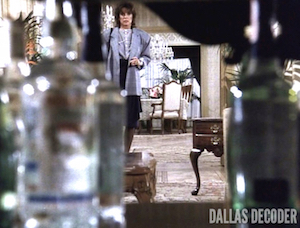
Sue Ellen’s scenes in “Deeds and Misdeeds” aren’t easy to watch. The previous episode ended with her taking her first drink in almost two years, and in this hour, she continues slipping back into her old habits. Sue Ellen leads everyone to believe her relapse was only temporary, yet she swipes a bottle of vodka from the living room and stuffs it in her purse when no one is looking. Alcohol is once again overpowering her, which director Michael Preece brilliantly symbolizes in one scene by filming Linda Gray through the bottles on the Southfork liquor cart. It’s as if the booze is bigger than she is.

As much as I love this shot, no moment in “Deeds and Misdeeds” is more powerful than Sue Ellen’s visit to John Ross in the hospital. She’s wracked with guilt — the reason she fell off the wagon in the first place is because J.R. accused her of being a neglectful mother when their son fell ill with appendicitis — and Gray’s tentative body language does as much to convey her character’s remorse as her tears. Sue Ellen approaches the child slowly, then tenderly strokes his hair and says, “I’m so sorry. Mommy should have been here so you didn’t have to go through that operation alone.” John Ross tells her that “it wasn’t your fault” and wraps his arms around her neck, which might be the saddest thing I’ve ever witnessed on this show. This sweet little boy isn’t hesitating to forgive his mother, yet we know it’ll be a long time before she can forgive herself.

Although it’s hard to see Sue Ellen fall behind after making so much progress during the past two seasons, I’m glad “Dallas” is finally showcasing Gray, who’s been relegated to the background for too long. “Deeds and Misdeeds” continues the show’s late-season course correction in other areas too, including the storyline over the lawsuit to control Ewing Oil. The mysterious Jack brings his cousins J.R., Bobby and Ray to California to meet wealthy Wallace Windham, a figure from Jock’s past who has information that could tilt the suit in the Ewings’ favor. The audience won’t discover what Windham knows until the next episode, but no matter. At least we get to see the Ewing men looking cooler than ever as they stroll across Windham’s driveway. It’s not as neat as the slow-motion walk from “Reservoir Dogs,” but it’ll do.

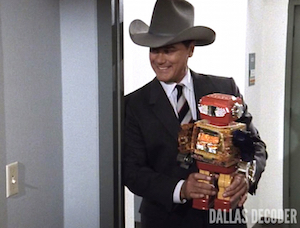
“Deeds and Misdeeds” also features a cute scene in which J.R. shows up in John Ross’s hospital room with a toy robot — Daddy looks awfully pleased with himself, doesn’t he? — as well as the impromptu wedding of Cliff and Jamie, which demonstrates how isolated Ken Kercheval’s character is from the rest of the show. Cliff asks Jordan Lee to be his best man, a somewhat surprising choice since I rarely think of these two characters as being particularly close. Other oddities include Clayton expressing surprise to learn Jock was married before Ellie — how has she not mentioned this before? — as well as Mandy’s near-orgasmic reaction when J.R. embraces her during a visit to her dressing room. If this is all it takes for J.R. to send a woman into a fit of ecstasy, no wonder he’s such a popular fellow.

Speaking of unsubtle moments: Let’s discuss the dramatic encounter between Mitch, his ex-wife Lucy and his current squeeze Joanna. It begins with Mitch and Lucy chatting in the hospital corridor about how much they’ve matured since their divorce. When she says she’s proud of him and offers a friendly hug, he notices Joanna is watching and calls her over. “Hi, Joanna,” Mitch says. “I’d like to introduce you to Lucy Ewing. Lucy, this is Joanna Pearce.” Actress Cynthia Leake says, “Hello,” … and then she delivers a Shatner-esque pause while cutting Charlene Tilton the most withering glare in the history of 1980s prime-time soap operas. This is what the kids now refer to as “throwing shade,” except that doesn’t do it justice. Tilton does a nice job looking appropriately rattled, which Joanna ignores as she turns to Mitch and says, “Well, I’ll talk to you later.” Leake then exits the scene, but not before Joanna looks Lucy up and down one last time.

This is Leake’s second “Dallas” appearance — she also played one of Peter’s fellow camp counselors in the seventh-season episode “My Brother’s Keeper” — and it demonstrates how actors in small roles can leave lasting impressions on “Dallas.” In a way, it also speaks to the resiliency of Tilton’s character. If Lucy can survive a look this dirty, she might be the hardiest Ewing of all.

Grade: B

_______________________________________________________________________________________________________________________________________________

Dallas, Deeds and Misdeeds, J.R. Ewing, Larry Hagman

Tin men

‘DEEDS AND MISDEEDS’

Season 8, Episode 28

Airdate: May 3, 1985

Audience: 18.2 million homes, ranking 3rd in the weekly ratings

Writer: David Paulsen

Director: Michael Preece

Synopsis: Jack introduces the Ewing brothers to Wallace Windham, who supplies them with evidence Jock owned Ewing Oil. After falling off the wagon, Sue Ellen hides her drinking from the Ewings. Cliff marries Jamie.

Cast: Roseanne Christiansen (Teresa), Patrick Duffy (Bobby Ewing), Eric Farlow (Christopher Ewing), Susan French (Amanda Ewing), Paul Gleason (Lieutenant Lee Spaulding), Linda Gray (Sue Ellen Ewing), Larry Hagman (J.R. Ewing), Jenilee Harrison (Jamie Ewing), Susan Howard (Donna Krebbs), Steve Kanaly (Ray Krebbs), Omri Katz (John Ross Ewing), Howard Keel (Clayton Farlow), Ken Kercheval (Cliff Barnes), John Larch (Wally Windham), Shalane McCall (Charlie Wade), Leigh McCloskey (Dr. Mitch Cooper), Priscilla Beaulieu Presley (Jenna Wade), Victoria Principal (Pam Ewing), Dack Rambo (Jack Ewing), Donna Reed (Miss Ellie Farlow), Debbie Rennard (Sly), Sherril Lynn Rettino (Jackie Dugan), Deborah Shelton (Mandy Winger), Don Starr (Jordan Lee), Charlene Tilton (Lucy Ewing)

“Deeds and Misdeeds” is available on DVD and at Amazon and iTunes. Watch the episode and share your comments below.

Critique: ‘Dallas’ Episode 188 — ‘The Ewing Connection’

Clayton Farlow, Dallas, Donna Reed, Ewing Connection, Howard Keel, John Ross Ewing, Miss Ellie Ewing Farlow, Omri Katz, Ray Krebbs, Steve Kanaly

Emergency, plus four

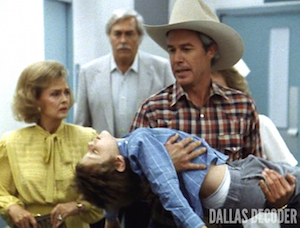
No matter how many times I see the “Dallas” characters come together during a medical crisis, it never seems to lose its dramatic punch. In “The Ewing Connection,” John Ross’s appendicitis produces one chills-inducing scene after another: Miss Ellie rushing upstairs after hearing the little boy screaming in pain, Ray bursting through the emergency room doors carrying the child’s limp body, J.R. dropping everything at the office when he receives the call informing him his son is sick. These moments underscore the ties that bind this family, reminding us that despite all their bickering, the Ewings genuinely care about each other.

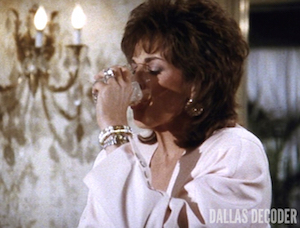
John Ross’s illness also provides “Dallas” with an opportunity send Sue Ellen on what will become one of her final benders. Linda Gray’s character demonstrates surprising strength throughout the eighth season, continually resisting the urge to drink as her marriage unravels for the umpteenth time. “The Ewing Connection” even takes a few moments to celebrate Sue Ellen’s success in the scene where she attends group therapy and tearfully describes how she stayed on the wagon despite another nasty spat with J.R. Gray’s performance during the therapy scene is beautiful and moving, allowing us to feel proud of Sue Ellen not only for staying sober, but also for having the courage to share the experience with a roomful of strangers. This is what makes the episode’s ending so heartbreaking. After J.R. lashes out at her because she wasn’t with John Ross when he got sick, Sue Ellen picks up a glass of bourbon, tentatively brings it to her lips and finally gulps it down.

Sue Ellen’s downfall raises a few questions that aren’t easily answered. First, is J.R. right when he says she should have stayed home with John Ross? The script has the child’s illness play out gradually. He begins complaining about having a stomachache at breakfast, so Sue Ellen says he should stay home from school. Later, John Ross tells her he’s feeling better, so she decides to not take him to the doctor, saying he can spend the rest of the day in bed. She also points out that Miss Ellie will be around if he needs anything. Sue Ellen then goes to her group and returns home that evening toting a couple of shopping bags, explaining that she decided to buy herself a few things after her therapy session. This is when J.R. tells her John Ross’s appendix almost ruptured, calls her an unfit mother and storms off, leaving her alone to drink. Is J.R. unnecessarily cruel? Yes, but does he have a point about her parental judgment? Or is it unfair to blame Sue Ellen for something she couldn’t control?

This brings us to another point that’s open to interpretation. When Sue Ellen arrives home, J.R. is fixing a drink in the living room. He breaks the news about John Ross as only he can (“While you were out seeking help for your psyche and boosting the economy of the more fashionable boutiques of Dallas, your son was being rushed into surgery”) and she tries to defend herself, saying John Ross seemed fine when she left. The spouses move from the living room to the foyer, and as he calls her “a totally unfit mother,” he sets down the drink and marches upstairs. The question is: Why doesn’t J.R. take his drink with him? Does he leave it behind because he’s too angry to think straight? Or does he set down the glass, hoping Sue Ellen will drink it? Did he pour it for her in the first place? Is J.R. hoping she’ll relapse so he can divorce her, gain custody of John Ross and be free to pursue Mandy Winger?

Besides Sue Ellen’s relapse, “The Ewing Connection” includes two other moments of consequence: Donna learns she’s pregnant (Susan Howard does a nice job conveying her character’s mixed emotions in this scene), and J.R. and Bobby sign over 10 percent of Ewing Oil to their newly discovered cousin Jack in exchange for his promise to prove Cliff and Jamie have no ownership claim on the company. This is another example of one of my least favorite “Dallas” tropes from the later years, when the characters exchange stakes in this multi-billion-dollar company the way kids once traded baseball cards in schoolyards. Mercifully, Bobby persuades J.R. that the two of them should each give up 5 percent instead of asking the other shareholders (Miss Ellie, Gary and Ray) to sacrifice a portion of their shares. It doesn’t make much sense, but at least the math is easy to follow.

Finally, “The Ewing Connection” gives us two reunions, beginning with Lucy and Mitch’s appropriately awkward dinner in Atlanta. The characters make meaningless small talk, although one line of dialogue feels weightier now than it did when this episode debuted three decades ago. Lucy asks Mitch about his mother and sister; Mitch responds both are doing fine, which doesn’t tell the whole story, at least where Afton is concerned. Given what we now know about Audrey Landers’ character’s timeline, she was probably getting ready to give birth to her secret daughter Pamela Rebecca Cooper around this time. Maybe Mitch decides not to tell Lucy because he’s afraid she’ll go home and blab the news to everyone, which actually seems pretty likely when you stop and think about it.

The more meaningful reunion comes when Bobby and Pam spend an evening reminiscing about their marriage, sealing the conversation with a brief kiss. The producers wisely keep Priscilla Beaulieu Presley out of this episode, giving Bobby and Pam the room they need to begin finding their way back to each other. The kiss also foreshadows the characters’ reconciliation in the eighth-season finale, “Swan Song.” In fact, there’s a lot about “The Ewing Connection” that reminds me of that episode. The scene where J.R. rushes out of the room after receiving the call about John Ross is similar to the “Swan Song” moment in which J.R. gets the call that Bobby’s been hurt, and Howard Keel seems to sport the same shirt and jacket in both episodes. Likewise, when Sue Ellen comes home with her shopping bags, it’s not unlike the ninth-season scene in which she strolls into the living room, blissfully unaware that Bobby has died.

I know, I know. I’m getting ahead of myself again. What can I say? If “The Ewing Connection” is a trial run for “Swan Song,” then I’m more ready than ever to see the real thing.

Grade: B

_______________________________________________________________________________________________________________________________________________

Dallas, Ewing Connection, Linda Gray, Sue Ellen Ewing

Last hurrah

‘THE EWING CONNECTION’

Season 8, Episode 27

Airdate: April 19, 1985

Audience: 17.9 million homes, ranking 5th in the weekly ratings

Writer: Arthur Bernard Lewis

Director: Nick Havinga

Synopsis: J.R. and Bobby reluctantly agree to give Jack 10 percent of Ewing Oil in exchange for information to squash Cliff’s lawsuit. Sue Ellen falls off the wagon after John Ross is rushed to the hospital with appendicitis. Bobby and Pam kiss. Donna learns she’s pregnant. Lucy meets Mitch in Atlanta. The police track down Andre Schumann, the assassin who likely murdered Naldo.

Cast: Roseanna Christensen (Teresa), Patrick Duffy (Bobby Ewing), Eric Farlow (Christopher Ewing), Paul Gleason (Lieutenant Lee Spaulding), Linda Gray (Sue Ellen Ewing), Larry Hagman (J.R. Ewing), Jenilee Harrison (Jamie Ewing), Susan Howard (Donna Krebbs), Steve Kanaly (Ray Krebbs), Omri Katz (John Ross Ewing), Howard Keel (Clayton Farlow), Ken Kercheval (Cliff Barnes), Shalane McCall (Charlie Wade), Leigh McCloskey (Dr. Mitch Cooper), George O. Petrie (Harv Smithfield), Nicholas Pryor (Nathan Billings), Victoria Principal (Pam Ewing), Dack Rambo (Jack Ewing), Donna Reed (Miss Ellie Farlow), Sherril Lynn Rettino (Jackie Dugan), Barry Sattels (Greg Rupp), Charlene Tilton (Lucy Ewing), John Zaremba (Dr. Harlan Danvers)

“The Ewing Connection” is available on DVD and at Amazon and iTunes. Watch the episode and share your comments below.

Heard the News? The Next #DallasChat is Friday, Aug. 21

Dallas, J.R. Ewing, Larry Hagman

Read all about it

Dallas Decoder’s next #DallasChat on Twitter will be Friday, Aug. 21, from 8 to 9 p.m. Eastern time.

Since summer is the season of sequels, this chat will be a follow-up to our recent “Super Summer Spectacular.” Expect more questions about Southfork sunshine, swimsuits and sweaty Ewings.

Are you new to #DallasChat? Here’s how it works: During each hour-long discussion, I tweet 10 questions from my Twitter handle, @DallasDecoder. Fans respond to the questions and comment on each other’s answers, making each chat a fun, freewheeling group conversation.

Here’s a sample exchange:

Q1. How come J.R. never spent much time in the Southfork swimming pool? #DallasChat

A1. Miss Ellie wouldn’t let J.R. use the pool. She was afraid he’d leave an oily ring around it. #DallasChat

New to #DallasChat or need a refresher? Here are three tips:

• Each #DallasChat question is numbered (Q1, Q2, etc.), so your responses should include the corresponding number (A1, A2, etc.).

• Include the hashtag #DallasChat in your tweets.

• During the discussion, enter #DallasChat in Twitter’s search field. This will help you watch the search results so you can follow the conversation. Click “All” to see all the related tweets.

Let’s send summer out in style. See you Friday!

Got suggestions for #DallasChat questions? Leave them in the comments below.

Critique: ‘Dallas’ Episode 187 — ‘Terms of Estrangement’

Dack Rambo, Dallas, Jack Ewing, Jenilee Harrison, Terms of Estrangement

Hello, stranger

Jack Ewing is a bad boy who makes a good impression. “Terms of Estrangement” introduces the character, a long-lost cousin who comes to town offering to sell J.R. information that could undermine Cliff’s efforts to snag a piece of Ewing Oil. Is Jack telling the truth? Who knows, and who cares? The newcomer, played with roguish charm by Dack Rambo, injects an element of unpredictability into “Dallas’s” ho-hum eighth season. By the time this episode debuted in 1985, the show had added several new faces to its cast, each with mixed results. Finally, here’s one that works from the get-go.

Make no mistake: Rambo’s debut deserves to rank alongside Susan Howard’s and Howard Keel’s as one of “Dallas’s” best. Many fans never warmed to Rambo three decades ago, mostly because he was hired to replace the soon-to-depart Patrick Duffy as the show’s romantic male lead. It’s easier to judge Rambo on his own merits today. The actor has a natural charisma that makes Jack instantly appealing, even when we don’t know much about him. In “Terms of Estrangement,” he arrives as a stranger who summons J.R. to the Oil Baron’s Club and offers to help him squash Cliff’s lawsuit — in exchange for 10 percent of the company. Rambo holds his own against Larry Hagman throughout the scene, making it a fun exchange between two scoundrels. It reminds me of the first time J.R. tussled with Clayton Farlow during the fifth season. I didn’t mind seeing Clayton one-up J.R. then, and I don’t mind seeing Jack do it now. That’s as good measure of a new character’s potential as I can think of.

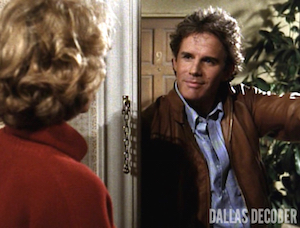
Rambo also is effective in this episode’s final scene, when his character unexpectedly shows up on Jamie’s doorstep. She’s packing her belongings to move and seems less than pleased to see him, and for the first few moments, it seems as if Rambo’s character is an ex-lover who’s come to upset Jamie’s relationship with Cliff. We soon discover the mystery man is Jack, Jamie’s estranged brother, a good twist that shifts the dynamics of the scene. Once we know the characters are siblings, his attempts to needle her come off as playful, not threatening. The scene ends with Jack letting her know he plans to stick around (“I kind of like it here in Dallas”), raising hopes his presence will help the series continue to recover from the Jenna Wade murder trial that dragged down the preceding episodes.

Indeed, “Terms of Estrangement” offers other signs “Dallas” is getting its act together. J.R. is crueler than ever: He ridicules Sue Ellen’s decision to join group therapy — which are held at the delightfully dippy “Institute for Advanced Awareness” — and shoves a glass of bourbon in her face, saying, “The only institute that works for you is this.” The show is always better when these characters are at war, although it’s also good to see Sue Ellen pour out the drink without taking a sip. (Her decision to dump it in a potted plant in the Southfork living room is another matter altogether.) Later, Sue Ellen and Donna — two characters who don’t interact much — commiserate about their troubled marriages over a post-midnight plate of cookies. Sue Ellen refers to their fates as “the curse of the Ewings,” prompting Donna’s poignant response (“It wasn’t supposed to happen to me”), which Susan Howard delivers with breathy perfection.

Meanwhile, Jenilee Harrison’s character continues to come into her own. In addition to her reunion with Jack, Jamie receives a surprisingly charming marriage proposal from Cliff and has a good scene with Sue Ellen. The latter begins when Jamie arrives at Southfork to mend fences with her friend, only to be told by Teresa that Sue Ellen doesn’t want to see her. Jamie refuses to take no for an answer and barges into Sue Ellen’s room, where she gives her a much-needed talking to. In a similar spirit, I love the small scene in which Sue Ellen calls John Ross out of the kitchen and tells him it’s time to go to school. With a lunchbox in one hand, Omri Katz marches around the breakfast table and receives a hug from Donna Reed, a high-five from Patrick Duffy and a pat on the bottom from Howard Keel. It’s an early glimpse of the swagger John Ross would one day exhibit on TNT’s sequel series.

“Terms of Estrangement” has its share of novelties too. Priscilla Beaulieu Presley appears only in one scene, but she now sports a stylish bob. Perhaps the hairdresser who famously gave Sue Ellen a makeover in the hospital has now worked his magic on Jenna in jail? This episode also features two actors from John Hughes movies: Lyman Ward, the dad from “Ferris Bueller’s Day Off,” plays the airline executive who gives Bobby the tape that shows Veronica Robinson being murdered on the plane, while Paul Gleason, the principal from “The Breakfast Club,” plays the police detective who investigates the crime. (Andre Schumann, the hit man seen on the tape, is played by Rod Arrants of “Search for Tomorrow.”)

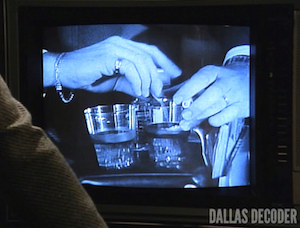
Speaking of that tape: Ward’s character tells Bobby that the airlines are beginning to install hidden cameras on planes to deter hijackings. It’s prescient — in real life, TWA Flight 847 was hijacked in Athens two months after this episode aired — and also a little silly. The tape offers a fixed, wide angle view of the plane’s interior cabin, making it look like the kind of surveillance video that one would have expected to see in the mid-1980s. However, once Schumann takes his seat next to Veronica and poisons her drink, the camera suddenly zooms in for a close-up of Schumann’s hands. It’s one of those only-on-television moments, although I wouldn’t be surprised if the cameras trained on the public today are zooming in and zooming out on us all the time.

Grade: B

_______________________________________________________________________________________________________________________________________________

Dallas, Terms of Estrangement

Close at hand

‘TERMS OF ESTRANGEMENT’

Season 8, Episode 26

Airdate: April 12, 1985

Audience: 18.7 million homes, ranking 6th in the weekly ratings

Writer: Peter Dunne

Director: Alexander Singer

Synopsis: Jamie accepts Cliff’s marriage proposal and receives a visit from her brother Jack, who approaches J.R. and offers to sell him information that could prove Cliff and Jamie have no legal claim on Ewing Oil. Bobby uncovers videotape that shows assassin Andre Schumann murdering Veronica on the plane, but Jenna refuses to believe she’ll get out of prison. Sue Ellen begins group therapy. Lucy receives a letter from Mitch.

Cast: Rod Arrants (Andre Schumann), Roseanna Christiansen (Teresa), Pat Colbert (Dora Mae), Ben Cooper (Parris), Patrick Duffy (Bobby Ewing), Paul Gleason (Lieutenant Lee Spaulding), Linda Gray (Sue Ellen Ewing), Larry Hagman (J.R. Ewing), Jenilee Harrison (Jamie Ewing), Susan Howard (Donna Krebbs), Steve Kanaly (Ray Krebbs), Omri Katz (John Ross Ewing), Stacy Keach Sr. (Waldron), Howard Keel (Clayton Farlow), Ken Kercheval (Cliff Barnes), Anne C. Lucas (Cassie), Laura Malone (Janice Hopper), Priscilla Beaulieu Presley (Jenna Wade), Victoria Principal (Pam Ewing), Dack Rambo (Jack Ewing), Donna Reed (Miss Ellie Farlow), Debbie Rennard (Sly), Sherril Lynn Rettino (Jackie Dugan), Barry Sattels (Greg Rupp), Deborah Shelton (Mandy Winger), Gail Strickland (Veronica Robinson), Charlene Tilton (Lucy Ewing), Lyman Ward (Norman)

“Terms of Estrangement” is available on DVD and at Amazon and iTunes. Watch the episode and share your comments below.