Critique: ‘Dallas’ Episode 131 — ‘Ewing Inferno’

Dallas, Ewing Inferno, J.R. Ewing, Larry Hagman

Surprise, surprise

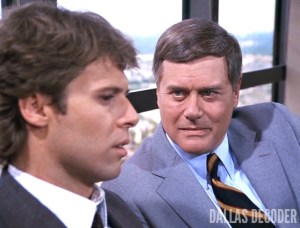
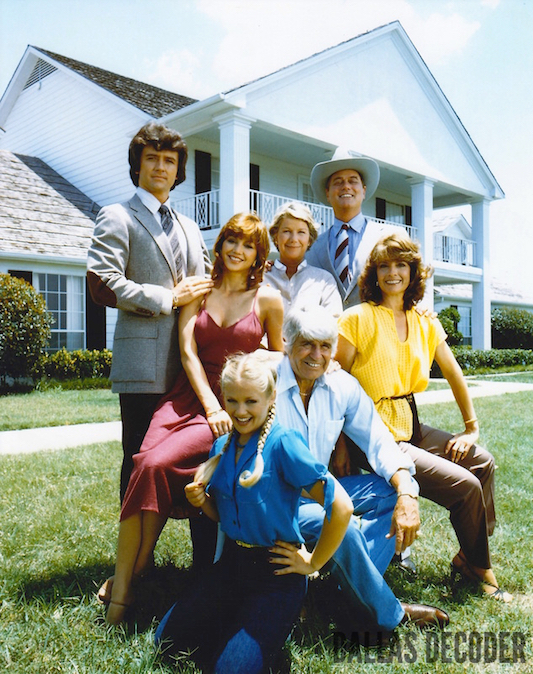
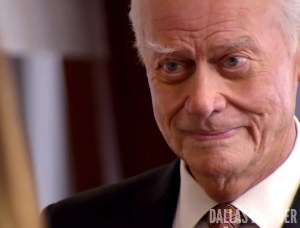
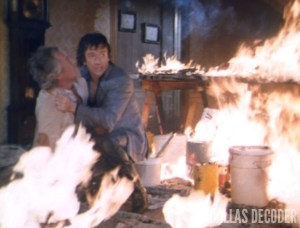
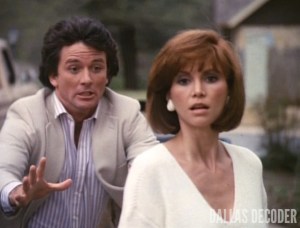
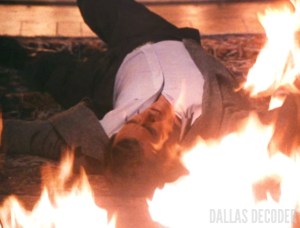
“Ewing Inferno” famously ends with J.R., Sue Ellen, Ray and John Ross trapped inside Southfork as fire sweeps through the house. I wonder: When this episode debuted in 1983, did anyone doubt all four characters would escape the blaze? After all, three of them appear in the opening credits and the fourth is a child; by the conventions of 1980s television, their survival seems assured. Not that I’m complaining. This may not be “Dallas’s” most suspenseful cliffhanger, but it does put a poetic punctuation mark on the sixth season. After a year in which everything goes to hell for the Ewings, what could be more fitting than seeing them surrounded by flames?

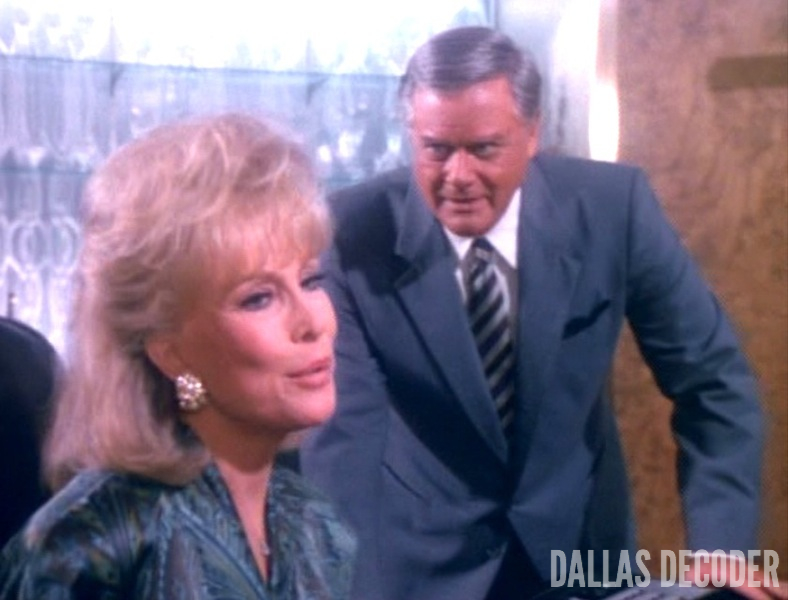
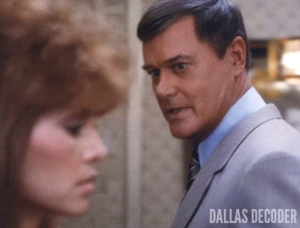
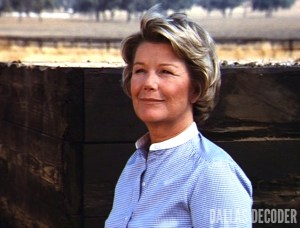
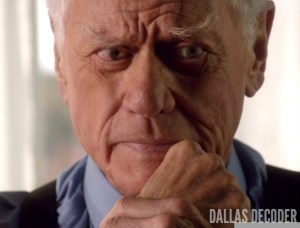
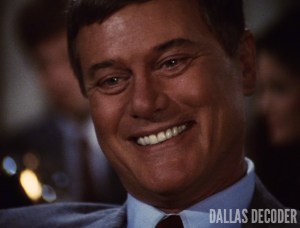
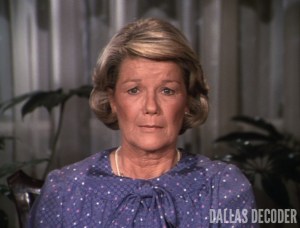
Besides, it’s not like “Ewing Inferno” doesn’t deliver its share of surprises, especially where J.R. is concerned. When the episode begins, he’s business as usual, demanding $20 million from Holly to leave her company. Later, in one of their classic clashes, J.R. lobs such ugly insults at Pam that she slaps him. (“Damn, I hate that woman,” he says as she stomps away.) Then, in the second act, J.R. has an honest-to-goodness epiphany. He brings little John Ross into the bedroom to give Sue Ellen a goodnight kiss, only to find her passed out, an empty bottle of booze at her side. J.R. sends the boy away, sits on the bed and gazes at his wife. “I know you’ll never trust me again, Sue Ellen,” he says. “But I love you. … We should’ve had a wonderful life together. What have I done to you?” The monologue brings to mind the second-season finale, when J.R. sits at the hospital bedside of a comatose Sue Ellen and laments the turn their marriage has taken. Now here he is, four years later, delivering a similar speech. As Miss Ellie wondered a few episodes ago: Doesn’t he ever learn?

Perhaps he does. In the next scene, Bobby comes home and finds J.R. alone in the Southfork living room. The mood is somber, serious. Bobby asks how Sue Ellen is doing. “Not good,” J.R. responds. He tells Bobby that he’s been thinking “real hard” about their fight for Ewing Oil, and the toll it has taken on the people around them. Both brothers’ marriages have suffered. Miss Ellie is heartbroken. Rebecca Wentworth is dead. Mickey Trotter is dying. “I’m not sure that this fight between us is worth what it cost the family,” J.R. says. Bobby is stunned and asks J.R. if he wants to end the contest. J.R.’s response: “By my calculation, I’m way ahead of you, but I really don’t give a damn.”

I really don’t give a damn. Not since J.R. slipped into his deep depression after Jock’s death has our hero seemed so unmoored.

‘Into Oblivion’
Dallas, Ewing Inferno, Linda Gray, Sue Ellen Ewing

But not oblivious

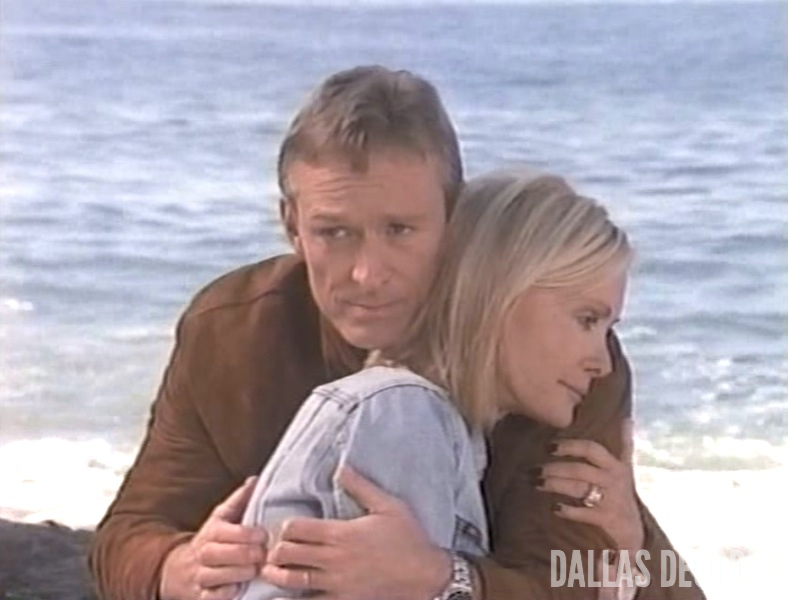
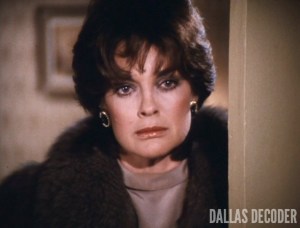
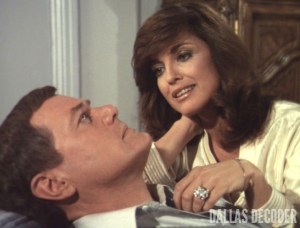
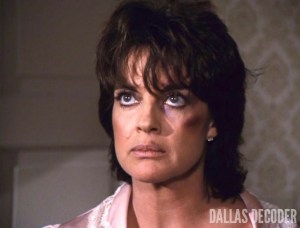
J.R. and Bobby don’t get around to finishing this conversation, but no matter. There’s no doubt J.R. has been humbled. Consider the third act’s final scene. After ordering Teresa to lock up the liquor, J.R. finds Sue Ellen getting drunk in the living room, having swiped a bottle of burgundy from the kitchen. The confrontation that follows plays like something out of “Who’s Afraid of Virginia Woolf?” As J.R. stands still and stares ahead, Sue Ellen circles him, a glass in one hand, the wine bottle in the other, and releases her fury. She references his marital sins (“Did you find someone new to sleep with today? Or did you have to rely on one of your old mistresses?”) and tells him he “ruined” her life. Then, to show how she has stopped giving a damn, Sue Ellen moves closer to J.R. and whispers, “Now, why don’t you do one kind little thing for me, hmm? Unlock the liquor, because I’m going to drink myself into oblivion.”

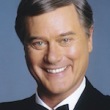
Linda Gray and Larry Hagman are magnificent in this scene. Every one of her lines drips with acid, while his stoic expression makes this a cathartic moment for the audience. J.R. doesn’t fight back because he knows he’s wrong. He accepts Sue Ellen’s punishing words because he deserves them. Even at the end of the scene, when Sue Ellen flings the bottle at him and it smashes against the wall, J.R. barely flinches. Where his wife is concerned, J.R. simply doesn’t have any fight left in him — although as the big red stain on the wallpaper foreshadows, a different kind of battle is about to come to him.

‘The Last Person in the World’
Dallas, Ewing Inferno, J.R. Ewing, Larry Hagman, Ray Krebbs, Steve Kanaly

Daddy’s watching

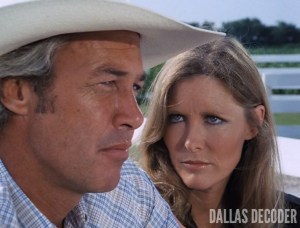
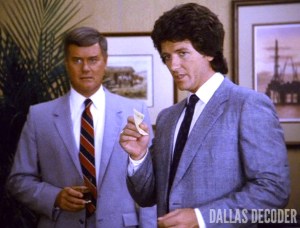
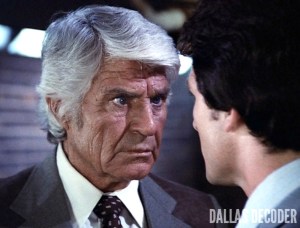
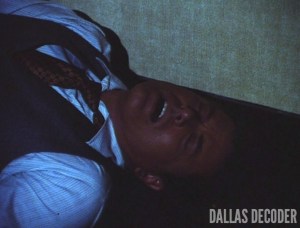
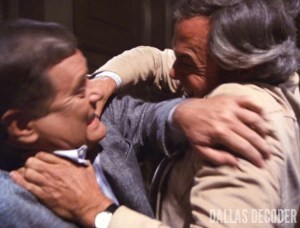
J.R.’s chastening during the course of “Ewing Inferno” is thorough but incomplete. In the final scene, when Ray arrives at Southfork to confront him, J.R. offers his half-brother a typically frosty greeting. “Ray, you’re about the last person in the world I needed to see tonight,” he says. I usually laugh when Hagman delivers a line like this, but there’s nothing funny about J.R.’s dark mood. Before long, the two men are scuffling, and even though the fight scene isn’t exactly credible — stuntmen are clearly substituting for Hagman and Steve Kanaly in the wide shots, J.R. knocks out Ray with a plastic telephone — there’s something deeply poignant about Ray’s attempt to avenge Mickey and J.R.’s determination to rescue his family once the fire starts. How can you not feel moved when he notices the blaze, cries out for his wife and son and braves the flames to try to save them?

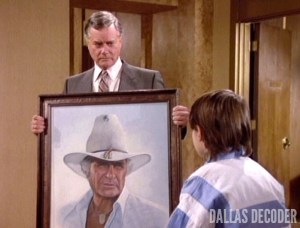
Also, consider this: For two seasons, J.R. and Ray have each struggled to honor the dead father they worshipped. J.R. tries to do it through business, while Ray tries to emulate Jock by taking Mickey under his wing, just like Jock did with young Ray. I suppose that’s why it’s so fitting that J.R. and Ray’s fight occurs under the watchful gaze of Jock’s portrait, which looms in the background of so many crucial scenes during the sixth season, including the will reading and J.R. and Sue Ellen’s spat after she catches him in bed with Holly. What hath Jock wrought?

‘Our Marriage Doesn’t Work’
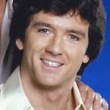
Bobby Ewing, Dallas, Ewing Inferno, Patrick Duffy

Cry, Bobby

For all its poignancy, the true cliffhanger in “Ewing Inferno” has nothing to do with the Southfork fire. The question I’m left asking is this: What will Bobby do? After J.R. offers to call off their fight, Bobby receives a phone call from Pam, who tells him she’s decided to give him the Tundra Torque, the experimental drill bit he needs to move forward with his Canadian oil venture. Since the deal is a guaranteed blockbuster, it will almost certainly allow Bobby to clinch victory over J.R. Bobby now has a dilemma: Should he make peace with his brother, or should he see the contest through until the end, knowing he has what it takes to finally beat J.R.?

By the end of the episode, Bobby’s decision isn’t clear, although his conversation with Katherine in the next-to-last scene suggests he will indeed use the drill bit. Regardless, I wish scriptwriter Arthur Bernard Lewis had paid more attention to this subplot and shown Bobby weighing his choices. After a season of tough ethical compromises, wouldn’t this be Bobby’s biggest decision yet?

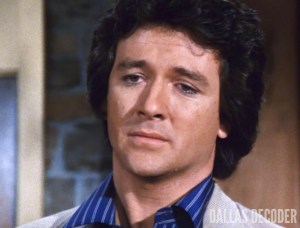
On the other hand: Lewis has a lot of narrative ground to cover, and he does a nice job bringing the other storylines to a climactic finish. The cast does good work too. The scene where Pam tells Bobby she wants a divorce (“Our marriage doesn’t work anymore”) is very moving, especially when that single tear begins its slow journey down Patrick Duffy’s cheek. I also love when Pam tells Cliff and Katherine that she’s decided to give Bobby the drill bit. What’s more fun: Ken Kercheval’s combustible response or Morgan Brittany’s sly smirk? The guest stars shine too: Kate Reid is mesmerizing when she delivers Aunt Lil’s weary monologue, Ben Piazza is the profile in agony when Driscoll visits Mickey’s bedside, and thanks to Barry Corbin, I feel every bit of Sheriff Washburn’s frustration when Ray goes rogue during the investigation into Mickey’s accident.

Like so many other “Dallas” episodes during the sixth season, “Ewing Inferno” also makes me appreciate the technical expertise behind the camera. Fred W. Berger, the editor, won an Emmy for this episode. Surely director Leonard Katzman deserves one too. In the fourth act, I like how he shows J.R. escorting Dr. Danvers out of the bedroom, through the hall and down the stairs into the foyer. The sequence establishes how these spaces fit together, so that during the fire, when J.R. races up the steps and collapses, we understand his proximity to his wife and son.

You also have to admire Katzman’s lack of restraint. According to Barbara A. Curran’s 2004 book “Dallas: The Complete Story of the World’s Favorite Prime-Time Soap,” Katzman built a replica of the Southfork foyer, just so he could burn it down for this episode’s final scene. That’s pretty spectacular, even if it isn’t all that suspenseful.

Grade: A+

_______________________________________________________________________________________________________________________________________________
Dallas, Ewing Inferno, J.R. Ewing, Larry Hagman

Welcome to Hell

‘EWING INFERNO’

Season 6, Episode 28

Airdate: May 6, 1983

Audience: 20.3 million homes, ranking 2nd in the weekly ratings

Writer: Arthur Bernard Lewis

Director: Leonard Katzman

Synopsis: J.R. offers to end the contest for Ewing Oil. Pam decides to divorce Bobby but gives him the Tundra Torque, enraging Cliff. Driscoll kills himself after revealing he drove the car that struck Sue Ellen and Mickey’s vehicle because he thought J.R. was behind the wheel at the time. After Ray learns of Driscoll’s role in the crash, he gets into a fight with J.R. During the scuffle, Southfork catches fire, trapping J.R., Sue Ellen, Ray and John Ross.

Cast: Tyler Banks (John Ross Ewing), John Beck (Mark Graison), Barbara Bel Geddes (Miss Ellie Ewing), Morgan Brittany (Katherine Wentworth), Lois Chiles (Holly Harwood), Roseanna Christiansen (Teresa), Barry Corbin (Sheriff Fenton Washburn), John Devlin (Clouse), Patrick Duffy (Bobby Ewing), Eric Farlow (Christopher Ewing), Linda Gray (Sue Ellen Ewing), Larry Hagman (J.R. Ewing), Susan Howard (Donna Krebbs), Steve Kanaly (Ray Krebbs), Howard Keel (Clayton Farlow), Ken Kercheval (Cliff Barnes), Audrey Landers (Afton Cooper), Kate Reid (Lil Trotter), Ben Piazza (Walt Driscoll), Victoria Principal (Pam Ewing), Debbie Rennard (Sly), Danone Simpson (Kendall), Charlene Tilton (Lucy Ewing), Deborah Tranelli (Phyllis), John Zaremba (Dr. Harlan Danvers)

“Ewing Inferno” is available on DVD and at Amazon.com and iTunes. Watch the episode and share your comments below.
Critique: ‘Dallas’ Episode 129 — ‘Things Ain’t Goin’ Too Good at Southfork’

Dallas, Linda Gray, Sue Ellen Ewing, Things Ain't Goin' Too Good at Southfork

The bottom

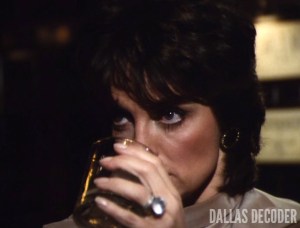
Linda Gray always hits her marks on “Dallas,” but she’s especially effective when Sue Ellen is hitting the bottle. Unlike so many other actors who go overboard playing drunks, Gray is precise: never too slurry, never too silly, never too sullen. She gets it right, every time. Because her performances are so convincing, the audience never loses sight of Sue Ellen’s humanity, ensuring she remains a sympathetic character. This is a creative achievement, but it’s something else too: Given “Dallas’s” popularity, I’m convinced Gray has contributed to our understanding of alcoholism as a disease. I often refer to Sue Ellen as a heroine, but when you think about it, the same thing can be said of Linda Gray.

I offer these observations because Gray’s heartbreaking depiction of Sue Ellen’s fall from the wagon in “Things Ain’t Goin’ Too Good at Southfork” is one of the milestone moments in the life of the character. The episode opens where the previous one left off, with Sue Ellen spying J.R. in bed with Holly Harwood. Sue Ellen flees to a cocktail lounge, where she takes her first drink since the end of the third season. And then she has another, and then another. Sue Ellen drinks so much that the bar manager cuts her off, which sends her running into the arms of Clayton, who gently rejects her advances but allows her to spend the night in his hotel room. The next morning, Sue Ellen is embarrassed and promises Clayton she won’t drink again. Yet before he knows it, she has emptied one of his vodka bottles. Eventually, Ellie retrieves her troubled daughter-in-law and brings her home to Southfork, where Sue Ellen is once again full of regret. “Miss Ellie, I just want you to know that I never meant to hurt you,” she says.

The more Sue Ellen drinks in this episode, the more her spirit deteriorates. She goes from giggly in the bar to flirty in Clayton’s hotel room to depressed at Southfork. Her pattern with alcohol — relapse, recovery, repeat — mimics the rhythms of her marriage, which is an endless series of rifts and reconciliations. Listen to what Sue Ellen tells Clayton in this episode while she’s nursing her hangover. “I believed him,” she says, referring to J.R. “He promised me there would be no games, and no other women. And I did believe him until last night. I saw him with my very own eyes, and all those vows and promises didn’t mean anything.” This dialogue reminds us that alcohol isn’t Sue Ellen’s only addiction; she’s powerless where J.R. is concerned too.

On the Rocks

Dallas, J.R. Ewing, Larry Hagman, Things Ain't Goin' Too Good at Southfork

Caught

As we watch Sue Ellen’s spiral in this episode, we know she’s eventually going to have to come face to face with J.R. It’s the moment we dread and anticipate at once. Scriptwriter Leonard Katzman wisely saves the confrontation for the next-to-last scene, when J.R. arrives home and finds Sue Ellen drinking in the living room. By this point, the booze has lost its numbing properties. She lets J.R. have it (“You bastard!”) and tells him she knows he slept with Holly. J.R. tries to deny he cheated, believing his wife only saw his car parked outside of Holly’s house. Soon, he realizes Sue Ellen knows the ugly truth. Her rage turns to tears, and when J.R. tries to comfort her, she tosses her drink in his face, grabs his car keys and rushes out of the room.

This is a short scene, lasting less than two minutes, but it tells us so much about the characters, as well as the actors who play them. When the scene begins, we want Sue Ellen to give J.R. hell, and Gray doesn’t disappoint. Her voice is full of incredulity and also clarity, even as she slurs her words. But then her voice cracks, and we realize Sue Ellen is in too much pain for this to be a moment of triumph. Seeing Gray go from wrathful to weepy is one of the episode’s most moving moments. Larry Hagman is impressive too, of course. J.R. is stunned to discover Sue Ellen knows he cheated with Holly, but listen closely to the inflection in his voice when he says, “Sue Ellen, don’t fly off the handle. I can explain all of this.” It’s always hard to know what J.R. is really thinking at a given moment, but in this instance, Hagman makes me the believe his character isn’t trying to save his own skin as much as he’s trying to shield Sue Ellen from more pain. J.R.’s love for his wife is clear, even if his respect for their marriage isn’t.

Collision Course

Barbara Bel Geddes, Dallas, Miss Ellie Ewing, Things Ain't Goin' Too Good at Southfork

No saving the day this time

“Things Ain’t Goin’ Too Good at Southfork” is a whimsical title for an episode that’s anything but. The director is Gunnar Hellström, who also helmed the third-season classic “Ellie Saves the Day,” another dark hour in Ewing family history. In that chapter, J.R.’s business dealings brought the family to the brink of financial disaster. This time around, the fallout from his scheming is personal. J.R.’s own marriage suffers, and so do the relationships of most of the show’s other couples.

The first act includes a terrific scene where Pam, who has left Bobby because she feels he’s too preoccupied with defeating J.R., confronts her husband about his relationship with her sister Katherine. Bobby says Katherine is nothing more than a friend — and then he asks Pam if she can say the same thing about her relationship with Mark Graison. It’s a damning moment for Pam, who admits she is confused about her feelings toward Mark, but it’s a great moment for Bobby, whose righteousness feels absolutely justified when he calls out his wife’s hypocrisy. (To that end: Does anyone do marital indignation better than Patrick Duffy?)

Later, Ellie is understandably rattled when she shows up at Clayton’s hotel room and finds Sue Ellen there, drunk and wearing nothing more than one of Clayton’s dress shirts. Barbara Bel Geddes does a beautiful job conveying Ellie’s quiet dismay here, but the actress is at her best a few moments later when Ellie gives Sue Ellen a much-needed dose of tough love. “Sue Ellen, now you listen to me,” Bel Geddes says, grabbing Gray by the arms and glaring at her. “Get into bed and sleep. Try to sober up. And then we’re taking you home!”

By the end of this episode, the war for Ewing Oil touches Lucy and Mickey’s lives too. The young lovers are grilling hamburgers on the Southfork patio and playfully planning their future when Sue Ellen staggers out of the house after her fight with J.R. She climbs behind the wheel of his Mercedes and begins to drive away, prompting Lucy to order Mickey to stop Sue Ellen before she hurts someone. Mickey hops into the passenger seat and pleads with Sue Ellen to pull over. She refuses, and as the Mercedes exits the Southfork driveway, another car strikes the vehicle, flipping it on its side. Freeze frame, roll credits — and if you’re watching this scene on DVD, try to resist the temptation to flip over the disc and immediately begin watching the next episode.

Wrecked

Charlene Tilton, Dallas, Lucy Ewing, Mickey Trotter, Things Ain't Goin' Too Good at Southfork, Timothy Patrick Murphy

What future?

Sue Ellen and Mickey’s accident puts a dramatic punctuation mark on “Things Ain’t Goin’ Too Good at Southfork,” even as it demonstrates the limits of ’80s era television production. When the car begins to roll, a chain attached to the vehicle can be seen on the underside. I assume the chain played some role in creating the stunt, and even though it probably wasn’t noticeable on analog TVs three decades ago, it’s as clear as day when I watch this episode today. Similarly, the car accident is shot from a wide angle so we never get a close-up of Sue Ellen and Mickey inside the Mercedes — except for a the moment of impact, when we catch a glimpse of the stuntmen sitting in for Gray and Timothy Patrick Murphy.

But these are quibbles. The car wreck remains about as fitting an ending as I can imagine. It perfectly encapsulates how the Ewings’ world is beginning to crash down around them. And when you stop and think about it, the whole episode is the “Dallas” equivalent of rubbernecking: No matter how much misery the Ewings experience during the course of this hour, we can’t bring ourselves to look away.

Grade: A+

_______________________________________________________________________________________________________________________________________________

Dallas, Things Ain't Goin' Too Good at Southfork

The upside of down

‘THINGS AIN’T GOIN’ TOO GOOD AT SOUTHFORK’

Season 6, Episode 26

Airdate: April 15, 1983

Audience: 20 million homes, ranking 3rd in the weekly ratings

Writer: Leonard Katzman

Director: Gunnar Hellström

Synopsis: Sue Ellen resumes drinking and seeks comfort from Clayton, which drives a wedge between him and Miss Ellie. Later, Mickey tries to stop Sue Ellen from driving drunk, but their vehicle is involved in a serious accident. Pam returns home, where Katherine denies being interested in Bobby. Cliff pressures Pam to side with him in the fight over the Tundra Torque.

Cast: Barbara Bel Geddes (Miss Ellie Ewing), Morgan Brittany (Katherine Wentworth), Delores Cantú (Doris), Lois Chiles (Holly Harwood), Roseanna Christiansen (Teresa), Patrick Dollaghan (bartender), Patrick Duffy (Bobby Ewing), Eric Farlow (Christopher Ewing), Linda Gray (Sue Ellen Ewing), Larry Hagman (J.R. Ewing), Susan Howard (Donna Krebbs), Steve Kanaly (Ray Krebbs), Howard Keel (Clayton Farlow), Ken Kercheval (Cliff Barnes), Kenneth Kimmins (Thornton McLeish), Audrey Landers (Afton Cooper), Timothy Patrick Murphy (Mickey Trotter), Victoria Principal (Pam Ewing), Kate Reid (Lil Trotter), Debbie Rennard (Sly), Charlene Tilton (Lucy Ewing), Deborah Tranelli (Phyllis)

“Things Ain’t Goin’ Too Good at Southfork” is available on DVD and at Amazon.com and iTunes. Watch the episode and share your comments below.
Critique: ‘Dallas’ Episode 115 — ‘Barbecue Three’

Barbecue Three, Dallas, J.R. Ewing, Larry Hagman

Mr. Right

In “Barbecue Three,” J.R. finally reveals his plan to win the contest for Ewing Oil: He begins flooding the market with cut-rate gasoline, hoping to drive up his half of the company’s profits. This ignites a firestorm within the cartel, prompting Cliff and a band of angry oilmen to come to the annual Southfork barbecue and demand J.R. stop lowering prices. The Ewings don’t like what J.R.’s doing either, but to everyone’s surprise, they close ranks around him when the confrontation with the cartel threatens to turn violent. “If you want to get to J.R., you’re going to have to come through us,” Bobby tells the group.

Like Ellie’s defense of J.R. in the fifth-season classic “Waterloo at Southfork,” this is another example of the Ewings circling the wagons against outsiders, one of “Dallas’s” hallmarks. There’s another reason this scene is satisfying: For once, J.R. isn’t wrong. Sure, he pulled some dirty tricks to get his hands on the crude he needed to produce all that cheap gas, but the cartel has no right to complain about it. J.R. is selling his product at a lower price than his competitors. Who are they to tell him to stop? (On another note: Why doesn’t Marilee Stone join her fellow cartel members in confronting J.R.? Surely it isn’t because she’s a woman. If you ask me, Marilee is much more intimidating than mild-mannered Jordan Lee, who stands alongside Cliff in this scene.)

To be fair, the other characters’ objections to J.R.’s scheme feel a little more justified than the cartel’s. Before the barbecue, Bobby complains J.R. will show “huge short-term profits and deplete our reserves,” which seems like a reasonable concern. Meanwhile, Donna, now a member of the Texas Energy Commission, becomes irritated when her fellow regulators backtrack on their opposition to J.R. As Donna explains to Punk Anderson, “Some of the members of the commission have political ambitions. They’re not about to vote against lower gasoline prices, even if it means conserving our oil reserves.” Fair enough, although the comment feels a little hypocritical coming from the widow of a governor and the stepmother of a senator.

Indeed, Arthur Bernard Lewis’s script covers so many different reactions to J.R.’s cheap gas gambit — his family, his competitors in the cartel and the politicians all weigh it —“Barbecue Three” feel like a lesson in capitalism. Lewis even manages to reflect the consumers’ point of view, albeit subtly. J.R. announces his cut-rate gas plan at the opening of the first J.R. Ewing-branded gas station, where we see a couple of attendants lowering the per-gallon price from $1.21 to 89 cents. Later, the TV news coverage shows long lines of motorists waiting to fill up. There’s also a scene where Sly, J.R.’s secretary, tells her boss she thinks what he’s doing is “terrific” and hopes he can “keep it up.” (Seeing Deborah Rennard deliver this line, I couldn’t help but imagine Sly’s everyday working-class drudgeries: fighting traffic during morning rush hour, standing in line at the bank to deposit her paycheck, shopping for bargains at The Store.)

“Barbecue Three” also delivers two Lucy/Mickey scenes that showcase the nice chemistry between Charlene Tilton and Timothy Patrick Murphy. In the first, Mickey asks Lucy on a date, only to be introduced to her cold shoulder. Later, at the barbecue, he tries again to charm her and begins to realize her snobbish demeanor masks deeper problems. Patrick Duffy also has several good moments in this episode, including a monologue in which Bobby promises Pam he won’t lose the fight for Ewing Oil: “Daddy taught me a lot of tricks in my early days with the company. Things that I hated doing. But I learned. And I learned real good. And I can get right down in the mud if I have to.” It’s a nice reminder that Bobby’s recent discovery of his inner junkyard dog on TNT’s “Dallas” has precedence.

I also appreciate the details in “Barbecue Three.” The scene leading up to the first Texas Energy Commission meeting is expertly executed. Director Leonard Katzman shows us Ray and Donna (looking chic in her red hat) arriving at the municipal building and being greeted by a throng of news reporters, which helps lend the moment a sense of drama and suspense. You get the feeling something big is about to happen, a notion that’s reinforced by the sight of so many familiar oil industry leaders in the audience. And even though the “Dallas” producers actually make us sit through the commission members reciting the pledge of allegiance, it really doesn’t slow down the momentum. Later, when J.R. is planning his press conference, I like his brief exchange with his public relations chief. Sometimes you get the feeling Ewing Oil has no other employees besides the people who work in J.R. and Bobby’s executive suite, so it’s nice to see the show acknowledge that the Ewing brothers don’t do everything themselves.

There are a couple of nice touches during the barbecue sequences too. Debra Lynn Rogers, who played Toni, the woman Ray flirted with during the previous season’s “Barbecue Two,” plays the role again in this episode, except now she’s dancing with Mickey. Meanwhile, Peyton E. Park, who played Larry, the Ewings’ caterer in “Barbecue Two,” reprises the role here. In “Barbecue Three,” we also meet a woman who appears to be Jordan’s wife. He introduces her as Evelyn, although in the third-season episode “Paternity Suit,” Jordan seemed to refer to his spouse as “Sara.” Is this a continuity error, or are they two different women? If it’s the latter, I have to wonder: Between Sara, Kristin and now Evelyn, is Jordan trying to give J.R. a run for his money as “Dallas’s” biggest lothario?

Grade: A

_______________________________________________________________________________________________________________________________________________

Barbecue Three, Dallas, J.R. Ewing, Larry Hagman

Gasman cometh

‘BARBECUE THREE’

Season 6, Episode 12

Airdate: December 17, 1982

Audience: 21.8 million homes, ranking 1st in the weekly ratings

Writer: Arthur Bernard Lewis

Director: Leonard Katzman

Synopsis: The Texas Energy Commission revokes J.R.’s variance but faces public backlash when he opens a chain of popular cut-rate gas stations. Holly asks Bobby to help her get J.R. out of her company. Mickey realizes Lucy is troubled. After angry oilmen confront J.R. at the Ewing Barbecue, Miss Ellie vows to go to court to break Jock’s will and sell Ewing Oil.

Cast: E.J. André (Eugene Bullock), Barbara Bel Geddes (Miss Ellie Ewing), Lois Chiles (Holly Harwood), Patrick Duffy (Bobby Ewing), Ken Farmer (oilman), Fern Fitzgerald (Marilee Stone), Linda Gray (Sue Ellen Ewing), Larry Hagman (J.R. Ewing), Alice Hirson (Mavis Anderson), Susan Howard (Donna Krebbs), Steve Kanaly (Ray Krebbs), James Karen (Elton Lawrence), Howard Keel (Clayton Farlow), Ken Kercheval (Cliff Barnes), Audrey Landers (Afton Cooper), Julio Medina (Henry Figueroa), Peyton E. Park (Larry), Timothy Patrick Murphy (Mickey Trotter), Priscilla Pointer (Rebecca Wentworth), Victoria Principal (Pam Ewing), Debbie Rennard (Sly), Debra Lynn Rogers (Toni), Kirk Scott (Buchanan), Danone Simpson (Kendall), Arlen Dean Snyder (George Hicks), Don Starr (Jordan Lee), Robert Swick (Ewing Oil employee), Charlene Tilton (Lucy Ewing), Deborah Tranelli (Phyllis), Morgan Woodward (Punk Anderson)

“Barbecue Three” is available on DVD and at Amazon.com and iTunes. Watch the episode and share your comments below.
Critique: ‘Dallas’ Episode 113 — ‘The Wedding’

Dallas, Cliff Barnes, J.R. Ewing, Ken Kercheval, Larry Hagman, Linda Gray, Sue Ellen Ewing, Wedding

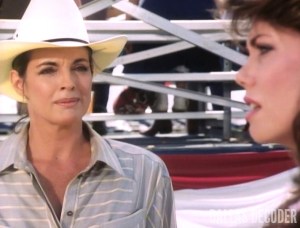
What is she thinking?

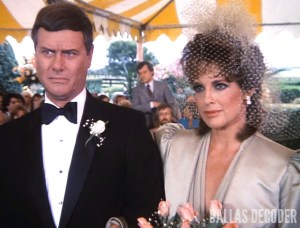
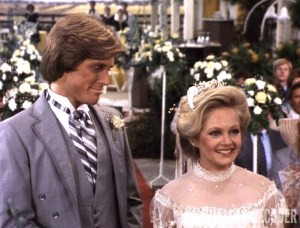
“The Wedding” is a strong episode with a silly ending. In the final scene, J.R. and Sue Ellen stand under a big tent in the Southfork driveway, where a minister is conducting their second marriage ceremony. He asks “if there be any man” who can say why the couple shouldn’t be remarried. Cliff, who is seated in the audience, suddenly springs to his feet. The camera zooms in on Ken Kercheval, the music swells and Philip Capice’s closing credit flashes onto the screen. That’s it.

This is less of a cliffhanger than a pause. Since there was no doubt in 1982 that J.R. and Sue Ellen were indeed going to be remarried, I wonder: What about this scene was supposed to be suspenseful? How big of a jackass Cliff would make of himself when the story resumed the following week? Indeed, most of what everyone remembers about J.R. and Sue Ellen’s second trip to the altar — her dance with Cliff, J.R. and Cliff’s fistfight, the scene where half the actors wind up in the Southfork swimming pool — happens in the follow-up segment, “Post Nuptial.” Couldn’t the “Dallas” producers have put some of that good stuff in “The Wedding”?

Of course, even if the final scene is underwhelming, you have to appreciate the lavishness of J.R. and Sue Ellen’s ceremony. At this point during “Dallas’s” run, Southfork had hosted only one other wedding: Lucy and Mitch’s, which was shot on the show’s Hollywood soundstage. J.R. and Sue Ellen’s nuptials were filmed at the “real” ranch. This makes their event look and feel like an honest-to-goodness outdoor affair, with real blue skies and actual wind blowing through the actors’ hair. When it comes to Southfork, there’s no substitution for the real thing.

“The Wedding” also reminds us how much TV weddings have changed over the years. Director Leonard Katzman shows us every step of Sue Ellen’s walk down the aisle and allows us to hear all the vows recited by the minister (who, by the way, is played by Parley Baer, the veteran character actor who portrayed the hard-of-hearing man J.R. encounters in the “Knots Landing” episode “A Family Matter”). Three decades later, when Christopher and Pamela Rebecca were married in the first episode of TNT’s “Dallas,” their ceremony was depicted in a musical montage set to an Adele song. There was no need to hear the wedding march or the vows because at this point, TV audiences have been “trained” to understand how weddings work.

Besides the ending, my only other gripe with “The Wedding” is the lack of attention paid to Sue Ellen. Here’s a woman who is about to remarry a man who has caused her tremendous pain, yet we never see her question if she’s doing the right thing or reflect on what she learned during the season-and-a-half she spent away from him. Don’t get me wrong: “Dallas” makes a smart decision by reuniting these characters, who are always more entertaining together than they are apart. I just wish Will Lorin’s script had given us a clearer understanding of what’s going on inside Sue Ellen’s head. Then again, maybe she isn’t sure either.

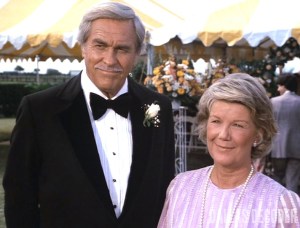
Besides, Miss Ellie and Clayton are the real star attraction of “The Wedding.” He comes to Southfork to escort Sue Ellen down the aisle but winds up spending most of his time with Ellie. Their scenes together showcase the warm rapport between Barbara Bel Geddes and Howard Keel and make it clear to the audience how well-suited their characters are for each other: Clayton laments never having a large family, while Ellie confides her fear that J.R. and Bobby’s contest will tear the Ewings apart. The only moment that rings false occurs when Ellie tells Clayton how much he reminds her of Jock. If you ask me, Keel was an ideal replacement for Jim Davis because their characters were so different. Whereas Jock was rough around the edges, Clayton was a refined gentleman. And yet isn’t it impressive how easily Clayton slides into Jock’s place? By the end of the hour, Clayton is stepping between J.R. and Bobby to keep them from scuffling during a rowdy Southfork cocktail hour and standing at Ellie’s side as she greets the wedding guests. These are things Jock once did, but Clayton handles them well.

Other highlights of “The Wedding” include Lucy’s encounter in the Southfork kitchen with Mickey, where the ranch’s resident rebels take an instant dislike to each other. (Except not really. Like Ellie and Clayton, it’s pretty clear Lucy and Mickey are destined for romance.) I also like J.R.’s visit to Holly, where he recommends she sell one of her company’s divisions to Petro State. Notice that Lorin doesn’t feel obligated to remind us what Petro State is; the “Dallas” producers trust the audience to remember J.R. set up this dummy corporation a few episodes ago. And even though Cliff’s big move at the end of “The Wedding” isn’t all that dramatic, I can’t help but enjoy the scene where J.R. invites his nemesis to the ceremony. Yes, it’s a cruel thing for J.R. to do, but how can you not love seeing the delicious smile Larry Hagman flashes when he encourages Cliff to come watch him marry the woman who dumped him?

The other actor to watch in “The Wedding:” the bearded extra who pops up throughout this episode. He first appears as a patron in the restaurant where Punk summons J.R. for a drink. Later, when Bobby, Pam, Ray and Donna head to the nightclub, we see the bearded man boogeying on the dance floor. Finally, he plays one of the guests at J.R. and Sue Ellen’s wedding. (In the image above, you can see the man’s face behind Sue Ellen’s right shoulder.) Forget whether or not Cliff is going to disrupt the wedding; the real cliffhanger is: Who is this bearded man, and why is he stalking the Ewings?

Grade: A

_______________________________________________________________________________________________________________________________________________

Barbara Bel Geddes, Clayton Farlow, Dallas, Miss Ellie Ewing, Wedding

Golden couple

‘THE WEDDING’

Season 6, Episode 10

Airdate: December 3, 1982

Audience: 23.6 million homes, ranking 1st in the weekly ratings

Writer: Will Lorin

Director: Leonard Katzman

Synopsis: Clayton visits Southfork and spends time with Miss Ellie, which hurts Rebecca. At J.R.’s behest, Holly prepares to sell part of her company, unaware the buyer is J.R.’s dummy corporation. Dave persuades Donna to join the new Texas Energy Commission. Lucy and Mickey meet and instantly dislike each other. At J.R. and Sue Ellen’s wedding, when the minister asks for objections, Cliff rises.

Cast: Parley Baer (minister), Tyler Banks (John Ross Ewing), Barbara Bel Geddes (Miss Ellie Ewing), Lois Chiles (Holly Harwood), Patrick Duffy (Bobby Ewing), Tom Fuccello (Senator Dave Culver), Linda Gray (Sue Ellen Ewing), Larry Hagman (J.R. Ewing), Alice Hirson (Mavis Anderson), Susan Howard (Donna Krebbs), Steve Kanaly (Ray Krebbs), Howard Keel (Clayton Farlow), Ken Kercheval (Cliff Barnes), Audrey Landers (Afton Cooper), Doug McGrath (Gentry), Timothy Patrick Murphy (Mickey Trotter), Priscilla Pointer (Rebecca Wentworth), Victoria Principal (Pam Ewing), Danone Simpson (Kendall), Don Starr (Jordan Lee), Charlene Tilton (Lucy Ewing), Deborah Tranelli (Phyllis), Ray Wise (Blair Sullivan), Morgan Woodward (Punk Anderson)

“The Wedding” is available on DVD and at Amazon.com and iTunes. Watch the episode and share your comments below.
The Dallas Decoder Interview: Lisa Seidman

Lisa Seidman

Lisa Seidman

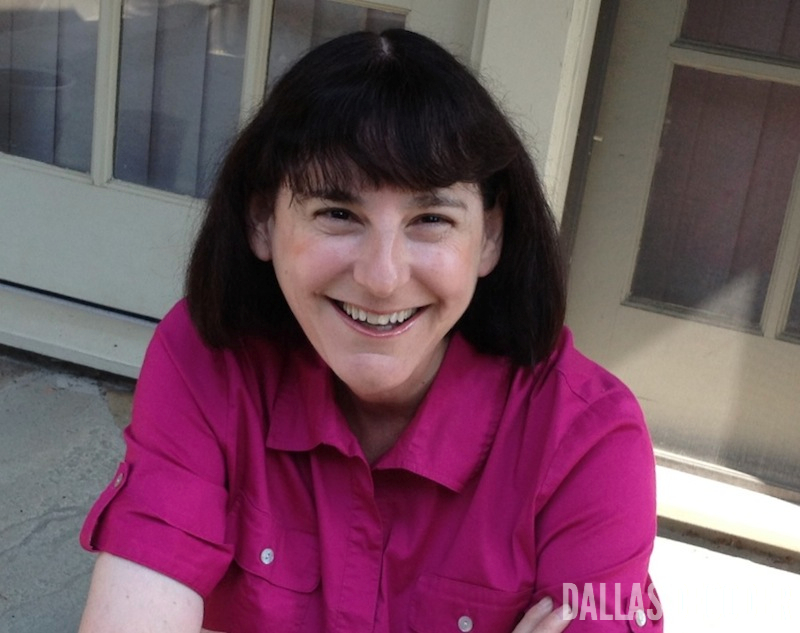
Lisa Seidman was a writer on the original “Dallas” during its final two seasons and penned many of the show’s best episodes from that era. She later wrote for “Knots Landing” and now serves as associate head writer for “The Young and the Restless.” I was thrilled when she agreed to answer some of my questions about writing for three of my favorite TV series.

“Dallas” was one of the first shows you ever wrote for. How did you get the job?  Howard Lakin and I worked together on “Falcon Crest.” He moved on to “Dallas” and when CBS told Len Katzman, the executive producer, they wanted a female writer on the show, Howard recommended me. Len read and liked a spec script I had written, a murder mystery that Patrick Duffy eventually optioned, which he planned to direct and star in, but alas, he moved on to “Step by Step” so it fell through. I met with Len, he liked me, and the rest as they say….

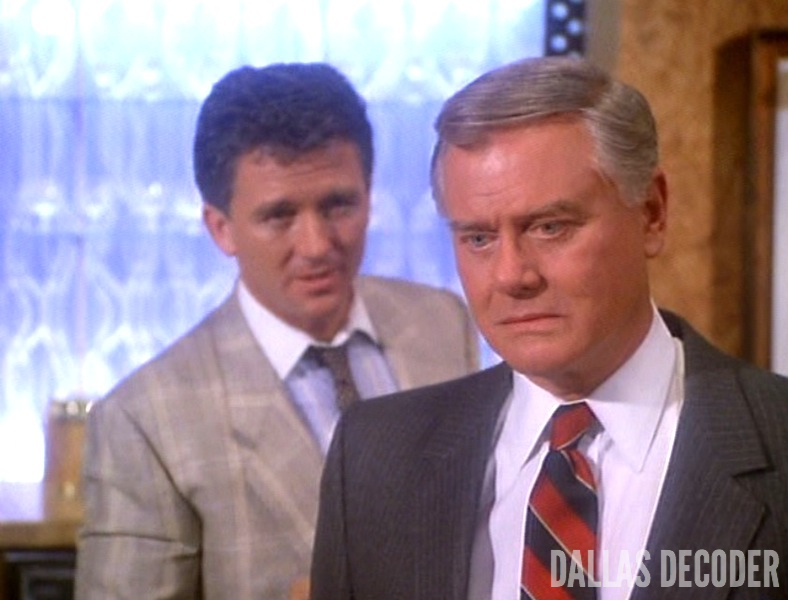
Bobby and J.R. in “Cry Me a River of Oil,” Seidman’s first “Dallas” episode

Bobby and J.R. in “Cry Me a River of Oil,” Seidman’s first “Dallas” episode

History, indeed! What was it like to work on “Dallas” as it was nearing the end of its run? Was it a struggle to come up with new things for the characters to do?

At the time, we didn’t know the show was nearing the end of its run. We were hoping the show would be picked up for another year but knowing there was a possibility it would not be, the mood was wistful, bittersweet. While I remember days when we struggled to come up with story, I don’t think it was any more difficult than any other show I’d been on before or after — except for the final, two-hour show. Now that was a struggle. Len really wanted to go out with a bang and I remember long, frustrating story meetings where we were really trying to find that great hook.

Oh, wow. Do you remember the other ideas for the series finale that you considered but discarded? And what did you think of the final product?

Unfortunately, I don’t remember the other ideas, although I remember exactly where I was sitting in Len’s office as we plotted out the “It’s a Wonderful Life”-themed finale: on his sofa, which is a strange thing to remember as I usually sat in the chair next to him while Howard sat on the sofa and [producer] Ken Horton was in the armchair across from Len and me. As far as the final product: At the time, I thought it was a terrific idea, but in retrospect I see the flaws. J.R. learns that people led happier lives without him so he was going to kill himself in despair and Bobby had to save his life. It was an anti-J.R. story.

Cliff in “The Decline and Fall of the Ewing Empire,” Seidman’s final “Dallas”

Cliff in “The Decline and Fall of the Ewing Empire,” Seidman’s final “Dallas”

Did you have a favorite character to write for? 

Cliff Barnes. What a kick! The character would do or say anything. He had no filters. I loved it. I loved him. I also loved writing the female characters: Cally, April, Michelle, Lucy. Sadly, Linda Gray left the season before I came on so I never got to write Sue Ellen. I was always sorry about that.

Are there any scenes or episodes that you are particularly proud of? 

The scene between J.R. and Lee Ann De La Vega in “Designing Women.” First, I got to write for Larry Hagman and Barbara Eden, who had both been in “I Dream of Jeannie,” a show I loved as a kid. What a thrill! Second, Lee Ann is confronting J.R. about their shared past, and I remember how much I loved her getting back at J.R. for how he screwed up her life. I watched them shoot the scene and it was exciting to see how they both got into it.

Lee Ann and J.R. in “Designing Women”

Lee Ann and J.R. in “Designing Women”

That scene contains one of my favorite J.R. quotes. I love when he tells Lee Ann and Michelle, “You two belong together, hatching your silly little plots in your silly little heads.” I’ve been quoting that line for 22 years!

Funny you should bring that up. I have all drafts of the script in front of me. In the writer’s draft, J.R. said, “Hatching your puny little plots in that empty brain of yours.” In the first draft it became, “Hatching your puny little plots in that empty head of yours” — suggested to me by Len — where it remains in the final draft, so Larry Hagman obviously changed it on set to the line you love.

After “Dallas,” you wrote for “Knots Landing.” How were those experiences similar? How were they different? 

Writing for “Knots” and “Dallas” were similar in that both shows had strong writer-producers — Ann Marcus and Len Katzman, respectively — who respected their writers and never micro-managed us. What you saw on air was the writer’s work, not a rewrite by either Ann or Len. They were different in that Len preferred to be in charge of the production of each script while Ann let each writer attend casting, tone meetings, production meetings. If the actors had concerns about their story on “Dallas” they went to Len. If the “Knots” actors had concerns they went straight to the particular writer of the script. On both shows, stories were created and laid out with all the writers in the room. While Len and Ann had the final say, they listened to all their writers’ contributions. Both were fantastic bosses!

Gary and Val in “Knots Landing: Back to the Cul-de-sac”

Gary and Val in “Knots Landing: Back to the Cul-de-Sac”

What are your memories of co-writing the “Knots Landing” reunion miniseries?

Where do I begin? Ann Marcus taught me so much about structure, high stakes, letting character drive story. We wrote the miniseries in her home office and I remember spending a lot of the time staring at her Emmy for “Mary Hartman, Mary Hartman,” feeling incredibly lucky that I was getting to write with Ann, who is still a dear friend. Ann would come in with a lot of ideas and then we would discuss each one at length, discarding what didn’t work and developing in more detail what did.

Do you watch the new “Dallas”? What’s your opinion?

Fantastic. Fun. It’s great to see how the series successfully uses J.R., Bobby, Sue Ellen and Cliff with the young ’uns. It’s a kick.

You’ve written a lot for daytime television too. How is that different from writing for prime-time television? 

Daytime TV is much harder to write than anybody thinks. You’re writing a detailed outline or a script every week while in prime time you’re writing one script a month or even less, depending on how many writers are on staff. You have two days to write an 11-page outline on daytime, whereas in primetime you have a week or a week and a half to write your script. In daytime you have many more characters to deal with — at least 10 to 15 — and you have to know all their voices, their stories. You have to know their histories from before you went on the show — and those histories are much more complicated than prime time back story because these characters have been on the air anywhere from 10 to 40 years!

In daytime, is it hard to balance giving fans what they want and trying to pursue your own artistic vision? 

Yes, absolutely, because the reality is you can’t really give the fans what they want, which is happy couples. Once a couple is happy, they’re boring. So the writers have to keep creating complications for characters that keep couples apart while at the same time keeping fans wanting to watch every day, rooting for them to get together.

You’re currently writing for “The Young and the Restless.” If J.R. Ewing had ever faced off against Victor Newman in business, who do you think would win?

Ha! Good question. Neither of them would ever have a total win. J.R. might defeat Victor in some aspect of business but then Victor would pick himself up, dust himself off and go after J.R. with a vengeance. Neither would be down for long. The battle would go on forever!

Share your comments below and read more interviews from Dallas Decoder.

Critique: ‘Dallas’ Episode 107 — ‘The Big Ball’

Barbara Bel Geddes, Bobby Ewing, Big Ball, Dallas, J.R. Ewing, Larry Hagman, Miss Ellie Ewing, Patrick Duffy

Mama’s family

No matter how often I see it, the next-to-last scene in “The Big Ball” always gives me goose bumps. Punk Anderson stands before a packed ballroom of tuxedo-clad oilmen and their gussied up wives and announces the establishment of the Jock Ewing memorial scholarship. “I don’t know what old Jock would have said about this, but … maybe Miss Ellie could speak for him,” Punk says. The camera cuts to the Ewing matriarch, who is weeping at a table with her family. Silence. Slowly, Bobby rises and begins clapping, followed — one by one — by J.R., Pam and Sue Ellen. Finally, the entire room erupts as Ellie’s sons escort her to the stage.

The speech that follows proves worthy of the dramatic setup. “Jock Ewing was a great man, measured in the only true value of a man. Not in money or power, but in friends,” Ellie says. This is my favorite line in Leonard Katzman’s script. I don’t remember watching “The Big Ball” on the night it debuted in 1982, but I remember reading that statement a few years later in Laura von Wormer’s “Dallas” book. I’ve never forgotten it. I also love how Barbara Bel Geddes delivers the line and the rest of the speech. This is one of those moments when Bel Geddes makes me forget I’m watching an actress playing a TV character. In that moment, she is a Texas widow eulogizing her husband in front of their family and friends. It’s a beautiful, moving performance.

“The Big Ball” is the first “Dallas” episode set at the Oil Baron’s Ball, which became one of the show’s best-loved traditions. In later years, the ball is the setting for big, dramatic showdowns and even a food fight or two, but the affair depicted here is rather subdued. Not that I’m complaining. The real appeal of the Oil Baron’s Ball episodes has always come from seeing the entire “Dallas” universe in one room. From this perspective, “The Big Ball” doesn’t disappoint. In addition to Ellie and her sons and their significant others, this ball brings together Cliff, Rebecca, Clayton, Jordan, Marilee, Holly and an interesting newcomer: Frank Crutcher, played by the old western actor Dale Robertson, who had recently concluded a brief-but-memorable run on rival soap “Dynasty.”

The ballroom sequences contrast nicely with the scenes set in Emporia, Kansas, where Ray and Donna attend the funeral of Amos Krebbs. I don’t know where these scenes were shot — my guess is they were filmed somewhere in North Texas — but it looks and feels like a sleepy town in the Midwest. When Ray and Donna arrive at Aunt Lil’s house, notice the neighbors sitting on the front porch across the street. The guest stars lend an air of authenticity too: Kate Reid is utterly believable in her second appearance as humble, homespun Lil, while Timothy Patrick Murphy is terrific in his “Dallas” debut as cocky, restless Mickey.

I also can’t help but feel touched by Steve Kanaly’s heartfelt performance in the scene where Amos is buried. Ray, who doesn’t want his Kansas relatives to know that he was really Jock Ewing’s son, kneels at his mother Margaret’s tombstone. “Probably better that it happened this way, Mama,” Ray says. “Nobody knows the truth. Chances are old Amos is probably headed in the opposite direction than you anyhow.” Besides serving as this episode’s other great speech, Ray’s monologue puts a nice punctuation mark on the saga of Jock, Amos and Margaret, which was revealed in the fourth-season classic “The Fourth Son.” The funeral might be for Amos, but Margaret is the one we end up mourning in this scene.

“The Big Ball” also features Jared Martin’s first appearance on “Dallas” since Dusty bid Sue Ellen farewell in the fifth-season episode “Starting Over.” I’ve always loved Martin’s chemistry with Linda Gray, but frankly their characters annoy me a little here. Dusty rides out to a Southern Cross pasture to find Sue Ellen, they have a heart-to-heart talk and then they return together to the house where — surprise! — he introduces her to his new wife. It makes for a dramatic moment, but couldn’t Dusty have found a kinder way to let Sue Ellen know he has married another woman? The disappointment ends up sending Sue Ellen back to Southfork, and not a moment too soon. After all, she does have a child to raise, doesn’t she?

Grade: A

_______________________________________________________________________________________________________________________________________________

Big Ball, Dallas, Kate Reid, Lil Trotter, Ray Krebbs, Steve Kanaly

No place like home

‘THE BIG BALL’

Season 6, Episode 4

Airdate: October 22, 1982

Audience: 20.7 million homes, ranking 3rd in the weekly ratings

Writer and Director: Leonard Katzman

Synopsis: Sue Ellen leaves the Southern Cross after Dusty visits with his new wife. Ray and Donna go to Kansas for Amos’s funeral, where they meet Mickey Trotter, Ray’s angry young cousin. At the Oil Baron’s Ball, Miss Ellie meets Frank Crutcher and Pam discovers her mother is dating Clayton. After the ball, Ellie decides to have Jock declared legally dead.

Cast: Melody Anderson (Linda Farlow), Barbara Bel Geddes (Miss Ellie Ewing), Lois Chiles (Holly Harwood), Roseanna Christiansen (Teresa), Patrick Duffy (Bobby Ewing), Fern Fitzgerald (Marilee Stone), Linda Gray (Sue Ellen Ewing), Larry Hagman (J.R. Ewing), Alice Hirson (Mavis Anderson), Susan Howard (Donna Krebbs), Steve Kanaly (Ray Krebbs), Howard Keel (Clayton Farlow), Ken Kercheval (Cliff Barnes), Audrey Landers (Afton Cooper), Jared Martin (Dusty Farlow), Timothy Patrick Murphy (Mickey Trotter), Priscilla Pointer (Rebecca Wentworth), Victoria Principal (Pam Ewing), Kate Reid (Lil Trotter), Dale Robertson (Frank Crutcher), Don Starr (Jordan Lee), Charlene Tilton (Lucy Cooper), Morgan Woodward (Punk Anderson)

“The Big Ball” is available on DVD and at Amazon.com and iTunes. Watch the episode and share your comments below.
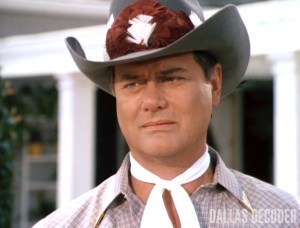
Critique: ‘Dallas’ Episode 105 — ‘Where There’s a Will’

Dallas, John Baxter, J.R. Ewing, Larry Hagman, Robin Strand, Where There's a Will

Let us prey

Larry Hagman has no scenes with his main co-stars in “Where There’s a Will,” but this is still a terrific hour of “Dallas.” The fun comes from watching J.R. scheme to sneak a peek at Jock’s will before the document is unsealed for the rest of the family. Usually when J.R. hatches a plot like this, it takes a few episodes to execute it. Here, J.R. puts his plan in motion in the first scene and completes his mission right before the closing credits roll. The efficient storytelling reminds me of “Dallas’s” earliest episodes, before the show became serialized.

J.R. has two foils in “Where There’s a Will.” The first is Harv Smithfield, the Ewings’ ethical consigliere, who refuses J.R.’s demands to see Jock’s will. In one of George O. Petrie’s many great scenes during his long run on “Dallas,” Harv removes his pince-nez spectacles, looks his bull-headed client in the eye and tells him: “I was your daddy’s attorney before you were born, J.R. My allegiance is to his memory. I will follow his instructions to the letter. No one will see that will until such time as it is read to the entire family.”

J.R. pretends to respect Harv’s decision (“I admire your loyalty to my daddy. Believe me. I’ll never mention that will again.”), but the glint in Hagman’s eye lets us know J.R. isn’t going to give up that easily. Enter Foil No. 2: John Baxter, Harv’s new son-in-law and the latest addition to the Smithfield & Bennett law firm. After Harv turns J.R. down, we see J.R. call John and invite him to lunch at 1 o’clock. Seconds later, J.R. places a call to someone else — we don’t see who it is — and instructs the person on the other line to meet him at the same restaurant at 1:05. “You know what to wear,” J.R. says.

Once we see J.R.’s favorite call girl Serena show up at the restaurant and pretend to be an old Ewing family friend, we have a pretty good idea of what J.R.’s up to. Sure enough, J.R. is conveniently called away from the restaurant, leaving John and Serena alone. The next time we see them, they’re at the Ewing condo, where J.R. walks in on them in bed together. Leonard Katzman, who wrote and directed “Where There’s a Will,” gives this scene enough humor to amuse the audience without letting things devolve into slapstick. “I’m a firm believer in the sanctity of marriage — and I’m damned disappointed in you,” J.R. says before the shirtless John scoops up his clothes and dashes out of the room.

In the final act, J.R. summons John to the restaurant where this scheme began. (These scenes appear to have been filmed in a real-life white-tablecloth eatery with impressive views of downtown Dallas.) J.R. tells John he’ll keep his fling with Serena secret — if John shows him Jock’s will. Guest star Robin Strand is terrific in this scene. The boyishly handsome, fair-haired actor loosens his necktie as his character begins to feel the weight of J.R.’s pressure. When John tells J.R. that showing him the will would be “betraying a trust,” Hagman licks his lips and waits a beat before delivering J.R.’s next line: “Now, what do you call cheating on your wife? Or more to the point, what would Harv call that?”

Other highlights of “Where There’s a Will” include the scene where Ray tells Donna he’s decided to send money to his Aunt Lil, who is caring for his ill “father” Amos. Steve Kanaly does a nice job conveying Ray’s conflicted feelings, but I also love what Susan Howard does with Donna’s line, “You’re not going to call her and talk to her?” If another actress delivered this dialogue, it might make Donna seem like a nag, but Howard never makes her character seem like anything less than a wise, caring spouse. Patrick Duffy also does a nice job in the scene where Bobby politely brushes off Carl Daggett, the harmlessly sleazy chap looking to drum up business for his escort service.

This episode’s other highlight is the final sequence, when John brings Jock’s will to the darkened Ewing Oil office after hours so J.R. can finally see it. We don’t discover what the document says in this scene, but after we see J.R. smile, cast his eyes upwards and thank Jock, we know whatever’s in the will makes our hero happy. And by golly, hasn’t he earned it?

Grade: A

_______________________________________________________________________________________________________________________________________________

Dallas, Donna Krebbs, Ray Krebbs, Steve Kanaly, Susan Howard, Where There's a Will

The good wife

‘WHERE THERE’S A WILL’

Season 6, Episode 2

Airdate: October 8, 1982

Audience: 19.2 million homes, ranking 3rd in the weekly ratings

Writer and Director: Leonard Katzman

Synopsis: J.R. blackmails Harv’s son-in-law into showing him Jock’s will before the document is unsealed for the rest of the family. Lucy tells Pam she’s pregnant and that she’s decided to have an abortion. Sue Ellen visits the Southern Cross. Marilee offers Cliff a job. Ray learns Amos has fallen ill in Kansas.

Cast: Barbara Bel Geddes (Miss Ellie Ewing), Stephanie Blackmore (Serena), Patrick Duffy (Bobby Ewing), Fern Fitzgerald (Marilee Stone), Linda Gray (Sue Ellen Ewing), Larry Hagman (J.R. Ewing), Alice Hirson (Mavis Anderson), Susan Howard (Donna Krebbs), Steve Kanaly (Ray Krebbs), Howard Keel (Clayton Farlow), Ken Kercheval (Cliff Barnes), Audrey Landers (Afton Cooper), Joseph Miller (bartender), Charles Napier (Carl Daggett), George O. Petrie (Harv Smithfield), Priscilla Pointer (Rebecca Wentworth), Victoria Principal (Pam Ewing), Debbie Rennard (Sly), Danone Simpson (Kendall), Robin Strand (John Baxter), Charlene Tilton (Lucy Cooper), Deborah Tranelli (Phyllis), Aarika Wells (Millie Laverne), Morgan Woodward (Punk Anderson)

“Where There’s a Will” is available on DVD and at Amazon.com and iTunes. Watch the episode and share your comments below.
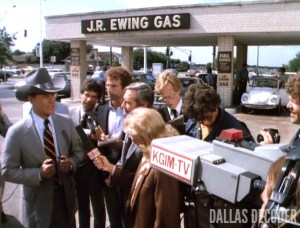
The Dal-List: ‘Dallas’s’ 35 Greatest Moments (So Far)

Barbara Bel Geddes, Bobby Ewing, Charlene Tilton, Dallas, Jim Davis, Jock Ewing, J.R. Ewing, Larry Hagman, Linda Gray, Lucy Ewing, Miss Ellie Ewing, Pam Ewing, Patrick Duffy, Sue Ellen Ewing, Victoria Principal

Icons

“Dallas” debuted 35 years ago today. To commemorate its anniversary, here’s my list of the franchise’s 35 greatest moments.

Dallas, Digger's Daughter, J.R. Ewing, Larry Hagman

Gripping grin

35. J.R. meets his match. “Dallas’s” first episode ends with Pam turning the tables on J.R. (Larry Hagman) after he tries to make it look like she was cheating on Bobby with Ray. “Looks like I underestimated the new Mrs. Ewing,” J.R. declares as he watches his baby brother and sister-in-law drive away. “I surely won’t do that again.” Hagman then smiles, ever so slightly. It lets us know J.R. has finally found a worthy adversary – and he couldn’t be happier about it.

Dallas, J.R. Ewing, Larry Hagman, TNT, Venomous Creatures

Here we go again

34. Rivalry redux. When the truth comes out that Rebecca Sutter Ewing is actually Pamela Rebecca Barnes, J.R. pops into her office for a tête-à-tête. She turns out to be as ballsy as her namesake aunt, telling J.R.: “I must have done something right to deserve a visit from you.” J.R., for his part, shows he hasn’t lost his step. “You’re not the first Pam to fox her way into the henhouse,” he tells her with a sly grin. “I’m 1 for 1 on flushing out Pamelas. And I plan on being 2 for 2.” Fabulous.

Cliff Barnes, Dallas, Full Circle, Ken Kercheval, Priscilla Pointer, Rebecca Wentworth

All is forgiven

33. The “licorice scene.” Cliff (Ken Kercheval) invites estranged mom Rebecca (Priscilla Pointer) to his apartment. Nervous small talk gives way to anger, as Cliff tells Rebecca how much her abandonment hurt him. She begins to leave, but Cliff stops her. “Mama,” he says, his voice cracking. “You didn’t take any licorice, and I remembered you liked it.” The music swells, mother and son embrace and we’re reminded why Cliff is the original “Dallas’s” most human character.

Ann Ewing, Brenda Strong, Dallas, TNT, Trial and Error

True confessions

32. Ann testifies. After shooting ex-husband Harris, Ann (Brenda Strong) goes on trial. In stirring testimony, she recalls how he and his mother Judith tormented her, but Ann also concedes her own failings – including how her pill addiction led to daughter Emma’s abduction. “God had punished me by taking my baby,” Ann says through tears. Before this scene, I wondered how we could forgive Ann for her crime. Afterward, I wondered how we couldn’t.

Barbara Bel Geddes, Bobby Ewing, Clayton Farlow, Dallas, Howard Keel, J.R. Ewing, Larry Hagman, Miss Ellie Farlow, Patrick Duffy, Ray Krebbs, Steve Kanaly, Sting

Adios, Ray

31. Ray rides into the sunset. After Ray (Steve Kanaly) returns to Southfork and helps the Ewings win a range war, they bid him adieu as John Parker’s piano music plays in the background. Ray’s final moments with Ellie, Clayton, Bobby and even J.R. are touching, but the most moving part comes when he looks around and declares, “There’s a part of me that’s never going to leave here.” When major characters depart “Dallas,” the show usually screws it up. Not this time.

Close Encounters, Dallas, Deborah Shelton, Linda Gray, Mandy Winger, Sue Ellen Ewing

Get smart

30. Sue Ellen meets Mandy. At the Ewing Rodeo, Sue Ellen (Linda Gray) runs into Mandy (Deborah Shelton), J.R.’s latest mistress, and offers her some advice: Get away while you can. It’s our first glimpse of a newly sober, newly wise Sue Ellen, but Mandy refuses to listen and turns to leave. That’s when Sue Ellen delivers a zinger: “Isn’t it strange how the mistress always thinks she’s smarter than the wife? If she’s so smart, why is she the mistress?” She’s got you there, darlin’.

Bobby Ewing, Dallas, Jim Davis, Jock Ewing, Pam Ewing, Reunion Part 2, Victoria Principal

Sale of the century

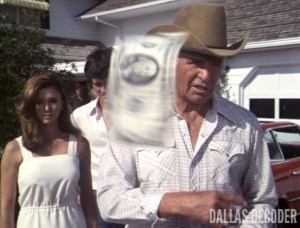
29. “Sold!” After Bobby marries Pam, a drunken Digger barrels onto Southfork and recounts everything Jock “took” from him – including Pam, for whom Digger demands $10,000. “She was a Barnes and now she’s a Ewing, just like the oil wells,” he says. Bobby and Pam watch in horror as Jock (Jim Davis) tosses a $100 bill at Digger, who scoops it up. “Sold!” he declares as he leaves. Harsh? Yes, but after this scene, there was no doubt which family Pam belonged with.

Charlene Tilton, Dallas, End of the Road Part 2, Leigh McCloskey, Lucy Ewing, Mitch Cooper

Pomp and circumstance

28. The royal wedding. The marriage of Lucy and Mitch (Charlene Tilton, Leigh McCloskey) was doomed from the start, but man, aren’t their nuptials fun? The two-part episode gives us lots of “Dallas” firsts, including the first Southfork wedding, the first time someone gets dunked in the pool (Lucy pushes Mitch) and the first appearance of Afton, who sleeps with J.R. during the reception – in his own marital bed! No wonder Sue Ellen still holds a grudge.

Dallas, Quality of Mercy, Ray Krebbs, Steve Kanaly

Have mercy

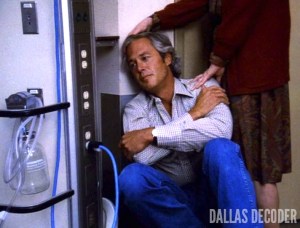
27. Who killed Mickey Trotter? When the plug is pulled on his comatose cousin Mickey, Ray blocks the door to his hospital room so the doctors can’t enter and revive him. It’s the beginning of a medical mystery that yields riveting performances from Kanaly, Tilton and Kate Reid as Lil, Mickey’s mom. Only at Ray’s murder trial do we learn the truth: He did disconnect Mickey’s life support, but only because Lil didn’t have the strength to do the mercy killing herself.

Barbara Bel Geddes, Dallas, Miss Ellie Ewing, Ray Krebbs, Steve Kanaly, Survival

Stop! Or Mom will shoot

26. Ellie grabs her gun. The Ewings are awaiting word on J.R. and Bobby after their plane crashed in Cato Swamp. Miss Ellie (Barbara Bel Geddes) answers the door to find a snoopy reporter. “Ray, get me the shotgun out of the hall closet,” she says, then tells the newshound: “Anybody on my land, without invitation, is a trespasser. So unless I see your tail heading out of here … I’m going to blow it off.” It’s classic “Dallas”: Modern Texans defending old traditions like land and family.

Barbara Bel Geddes, Dallas, Miss Ellie Farlow, Pam Ewing, Winds of Change, Victoria Principal

Queens’ speeches

25. Pam’s surprise. After Bobby’s “death,” Ellie eulogizes him at the Oil Baron’s Ball, followed by Pam (Victoria Principal), who stuns everyone by announcing she won’t sell her shares of Ewing Oil to Westar as planned. J.R. is overjoyed, assuming this means Pam will sell them to him. She sets him straight: “I’m not selling at all. From now on, it’s going to be you and me. I’ll see you at the office, partner.” It’s one of many great moments from the unjustly maligned “dream season.”

Barbara Bel Geddes, Dallas, Miss Ellie Ewing, Requiem

Southfork soothsayer

24. Mama sees all. In 1983, when Sue Ellen tried to justify J.R.’s latest quest for power, Ellie delivered a spot-on prophesy: “Think ahead, Sue Ellen. Think 25 or 30 years ahead. I won’t be here then. And the fight won’t be between J.R. and Bobby. It’ll be between John Ross and Christopher. … Your loyalty to your husband is a wonderful thing. But you’re a mother too. And where will this all end?” Impressive, huh? Too bad no one ever thought to ask her where Pam is.

Ann Ewing, Brenda Strong, Dallas, Revelations, TNT

Bra-vo!

23. Sting! When Harris tries to blackmail Sue Ellen into aiding his dirty dealings, Ann begs him to stop. Harris confirms his crimes and suggests he’ll ease up on Sue Ellen – if Ann sleeps with him. Slowly, Ann unbuttons her blouse … and reveals a hidden mic. “Extortion, blackmail and a confession to money laundering, all recorded,” she says triumphantly. Ann then slugs Harris and hints she’ll shoot him if he doesn’t leave the Ewings alone. She wasn’t kidding, was she?

Adoption, Dallas, Donna Krebbs, Susan Howard,

Armor on

22. Pow! Donna (Susan Howard) is none too happy when Ray begins an affair with barfly Bonnie. Fed up with his philandering, she dons her fur coat, heads to the saloon and offers Bonnie $15,000 to leave Texas. Bonnie agrees, so Donna cuts the offer by a third. “Now that we know what you are, let’s haggle over your fee,” she says. Bonnie tosses a drink in Donna’s face – and then Donna belts her. Who knew “Dallas’s” classiest leading lady possessed such a mean right hook?

Bobby Ewing, Dallas, Ray Krebbs, Road Back, Steve Kanaly

Open flames

21. Bobby to the rescue. “Dallas’s” sixth season ends with J.R., Sue Ellen, John Ross and Ray trapped inside Southfork as flames sweep through the house. We knew they’d survive; we just didn’t know how. The seventh-season premiere supplies our answer: In “Dallas’s” most thrilling opening, quick-thinking Bobby comes home, soaks himself in the pool and dashes into the house, where he rescues everyone. We should’ve known: Bobby always saves the day.
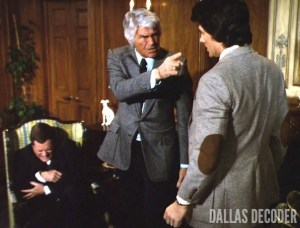
Dallas, Linda Gray, Sue Ellen Ewing, Tangled Web

Face of fear

20. Sue Ellen’s discovery. Sue Ellen doesn’t want to believe it when Holly Harwood tells her she’s sleeping with J.R., but she agrees to come by the vixen’s house, where Holly says Sue Ellen will find J.R. in her bed. The audience watches as the fur-clad Sue Ellen arrives at Holly’s, slowly crosses the driveway (click clack go the heels), turns the front door knob and finally reaches the bedroom, where her worst fears are confirmed. It’s a brilliant, devastating sequence.

Barbara Bel Geddes, Brother Can You Spare a Child?, Cliff Barnes, Dallas, Miss Ellie Farlow

Making peace

19. Cliff asks for forgiveness. After Dandy Dandridge accuses Cliff of trying to cheat him out of their big gas strike, Cliff begins to see his daddy’s feud with Jock in a new light. Summoning Ellie to a Dallas park, Cliff extends a long-overdue olive branch. “Digger was wrong, and I was wrong. If it’s not too late. I’d like to make peace. I’d like to ask you to forgive me,” he says. It’s my favorite performance from Kercheval and a consequential moment in “Dallas” history.

Bobby Ewing, Dallas, Jim Davis, Jock Ewing, J.R. Ewing, Larry Hagman, Patrick Duffy, Wheeler Dealer

Honor thy daddy

18. Molotov cocktails. “Dallas’s” best cocktail scene: Ellie worries Sue Ellen didn’t get enough to eat at dinner. J.R. waves around a liquor bottle and declares his wife “gets all the nourishment she needs from this.” He then declares Pam is “cracking up” and calls her daddy “a saddle tramp and a thief” and her mama “a whore.” That’s when Bobby (Patrick Duffy) punches J.R., forcing a furious Jock to separate them. Don’t you wish your family gatherings were this much fun?

Barbara Bel Geddes, Dallas, Jim Davis, Jock Ewing, Mastectomy Part 2, Miss Ellie Ewing

Great performances

17. Ellie gets cancer. Ellie gets breast cancer in the 1979 “Mastectomy” two-parter, which won Bel Geddes an Emmy. It’s a brave performance from the actress, who had been treated for the disease in real life. Davis is equally moving as Jock struggles to comfort his wife. In one scene, he tells her it “doesn’t matter” that she’s lost a breast. “Because I’m not young anymore?” she snaps. “Don’t you think I care the way I look?” Rarely has “Dallas” felt so real.

Dallas, Family Ewing

Bye, Bobby

16. Bobby’s funeral. After Bobby “dies” saving Pam, the Ewings bury him in a lush Southfork pasture, near the treehouse that Jock built for him as a boy. All of Bobby’s loved ones are there, including Pam, whose Jackie Kennedy-esque pillbox hat reinforces the idea that “Dallas’s” version of Camelot is ending. As the gathering disperses, J.R. movingly tells Bobby he wishes he’d taken the time to let him know how much he loved him. It’s one of the few times we see J.R. cry.

Dallas, John Ross Ewing, J.R. Ewing, Larry Hagman, Paternity Suit, Tyler Banks

Welcome to fatherhood

15. J.R. becomes a daddy. When the Ewings learn the results of the paternity test that proves J.R., not Cliff, fathered John Ross, J.R. enters the Southfork nursery, picks up his son, holds him close and kisses him. According to “Dallas” historian Barbara A. Curran, CBS received 10,000 positive letters in response to J.R.’s embrace of his son. Later, David Jacobs, the show’s creator, called it “Dallas’s” best scene: “Just a private moment between J.R. and 100 million people.”

Dale Midkiff, Dallas, Dallas: The Early Years, Jock Ewing, Miss Ellie Ewing, Molly Hagan

When they were young

14. In the beginning. “Dallas: The Early Years,” Jacobs’ 1986 prequel movie, ends at a 1951 Southfork barbecue, where Jock and Ellie (Dale Midkiff, Molly Hagan) embrace as a teenaged J.R. spars with bratty Cliff. Moments later, Cliff drags kid sister Pammy away from her new playmate: Little Bobby. Jerrold Immel’s theme swells, the camera pulls back for a bird’s eye view of the ranch and then the familiar shots from “Dallas’s” famous titles sweep across the screen. Perfect.

Barbara Bel Geddes, Dallas, Miss Ellie Ewing, Waterloo at Southfork

Mad mama

13. Mama vs. the cartel. When J.R.’s latest plot backfires and the cartel takes advantage of him, Ellie comes to junior’s defense. She summons the group to the Ewing Oil offices, where she blasts them, one by one. “I don’t apologize for what my son did,” Ellie says. “It’s a family matter. We may be wrong and we may be right, but we’re Ewings. We stick together – and that’s what makes us unbeatable.” Foolish oil barons. Shouldn’t they know better than to mess with mama?

Dallas, J.R. Ewing, Larry Hagman, Long Goodbye, Pam Ewing, Victoria Principal

Prey, meet hawk

12. A classic clash. During Bobby and Pam’s separation, J.R. tells her if she doesn’t go through with the divorce, he’ll destroy Bobby, Cliff and everyone else she cares about. “You’ve known me long enough to know I don’t make idle threats,” J.R. says as he circles her. The chilling moment tells us much about their rivalry. Cliff might have been J.R.’s most persistent enemy and Jeremy Wendell might have been the most powerful, but no one threatened J.R. quite like Pam.

Blast from the Past, Bobby Ewing, Dallas, Patrick Duffy,

Good morning indeed

11. Bobby’s back! (Or is he?). CBS announced Duffy would return to “Dallas” a few weeks before the 1985-86 season finale aired, but no one knew how he’d come back or who he’d play. In the episode’s last scene, Pam awakens and finds Bobby – or someone who looks an awful lot like him – lathering up in her shower. No matter how you feel about the notorious “dream” twist, you have to admit: It was nice to have Duffy back on the show – and in his birthday suit no less!

Changing of the Guard, Dallas, J.R. Ewing, Larry Hagman, Leonor Varela, Marta del Sol, TNT, Veronica Martinez

Welcome back

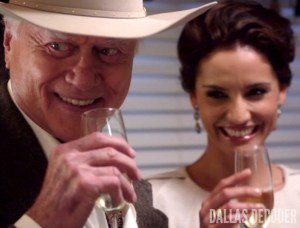
10. J.R. returns. TNT’s first episode ends with John Ross visiting J.R. in the nursing home. The younger man is dejected because Uncle Bobby just sold Southfork to conservationist Marta del Sol. But wait, what’s this? J.R. is sipping champagne with Marta! It turns out the two are in cahoots. “Bobby may not be stupid, but I’m a hell of a lot smarter,” J.R. tells his son as he doffs his Stetson and flashes his grin. For me, this is the moment I knew “Dallas” was truly back.

Dallas, J.R. Ewing, Larry Hagman, Linda Gray, New Beginnings, Sue Ellen Ewing

Two of a kind

9. J.R. and Sue Ellen reminisce. After putting John Ross to bed, J.R. and Sue Ellen retreat to their room, where they recall their courtship in warm, nostalgic terms. For a couple that is usually at war with each other, this scene is about the characters taking off their armor – symbolized by Sue Ellen’s dressing gown and J.R.’s removal of his coat and tie – and showing each other they still care. You can’t understand their love story until you’ve seen this moment.

Bobby Ewing, Check and Mate, Dallas, Larry Hagman, J.R. Ewing, Patrick Duffy

Lose some, win some

8. Bobby beats J.R. After a yearlong contest for control of Ewing Oil, Harv Smithfield declares J.R. the winner. But wait, what’s this? Here comes Thornton McLeish with news that Bobby’s Canadian fields have come in, making Bobby the victor. The twist concluded one of “Dallas’s” greatest storylines, an arc that touched all the characters and made “Tundra Torque” part of every “Dallas” diehard’s vocabulary. We never like to see J.R. get beat, but when Bobby does it, we let it slide.

Barbara Bel Geddes, Dallas, Ellie Saves the Day, Miss Ellie Ewing

To the rescue

7. Ellie saves Southfork. J.R. secretly mortgages Southfork to finance a risky deal, only to have it blow up in his face. With the loans due, the Ewings scramble to pay the banks but come up empty. After a stroll around the ranch, Ellie gathers everyone and announces she’ll raise the cash by allowing Ewing Oil to drill on the land. It’s an early example of an enduring “Dallas” theme: Sometimes you have to set aside your principles to protect your family.

Dallas, Fall of the House of Ewing, John Ross Ewing, J.R. Ewing, Larry Hagman, Omri Katz

Don’t forget it, boy

6. J.R. schools John Ross. J.R. is giving John Ross one last look around Ewing Oil when Wendell, the new owner, orders them off the premises. “Take this eyesore with you,” he says as he reaches for Jock’s portrait. J.R. is incensed: “Touch that painting and I’ll kill where you stand!” J.R. takes the picture off the wall, holds it aloft and – with trumpets blaring in the background – declares: “John Ross, this is Ewing Oil.” I dare you to watch this scene without getting chills.

Bobby Ewing, Dallas, Executive Wife, Jim Davis, Jock Ewing, Patrick Duffy

Word

5. Jock schools Bobby. Bobby, furious that Jock has yanked millions of dollars out of Ewing Oil without telling him, interrupts Daddy’s lunch at the Cattlemen’s Club. “You gave me the power to run that company, and damn it, I intend to run it,” Bobby fumes. “Let me tell you something, boy,” Jock huffs. “If I did give you power, you got nothing. Nobody gives you power. Real power is something you take!” Six words that sum up the Ewing creed – and “Dallas” itself.

Dallas, Family Business, J.R. Ewing, Larry Hagman, TNT

The man

4. The man comes around. The TNT episode “Family Business” ends on a thrilling note: With Johnny Cash’s “The Man Comes Around” playing in the background, Rebecca shoots Tommy, while back at the ranch, seriously ill Bobby collapses. The most poignant moment of all comes before the montage, when J.R. glances at Ellie’s picture, takes a shot of bourbon and signs the Southfork deed, returning ownership to Bobby. In that instant, our hero grows. So does “Dallas.”

Dallas, J.R.'s Masterpiece, Linda Gray, Sue Ellen Ewing, TNT

Farewell, J.R.

3. J.R.’s funeral. “Dallas” bids farewell to J.R. with a moving, instant-classic episode featuring Emmy-worthy performances from Gray and Duffy. Who’ll ever forget Sue Ellen getting drunk in J.R.’s bedroom the night before his burial, or her heartbreaking eulogy? What about the poignant final scene, when Bobby spots J.R.’s hat and tearfully declares, “I love you brother.” This is the moment the TNT series rose to the occasion – and then surpassed it.

Bobby Ewing, Dallas, Pam Ewing, Swan Song, Victoria Principal

Saving the day, again

2. “Swan Song.” Leonard Katzman’s masterpiece. Donna reveals her pregnancy to Ray. J.R. threatens to send Sue Ellen back in the sanitarium. Pam nobly tells Bobby to go back to Jenna, but he chooses Pam instead. It culminates with the dramatic driveway sequence in which Katherine runs over Bobby, followed by his deathbed farewell, the most moving scene in “Dallas” history. It’s all so beautifully done, it’s almost enough to make you regret it turned out be a dream.

Dallas, House Divided, J.R. Ewing, Larry Hagman

Top gun

1. “Who Shot J.R.?” “Dallas’s” most famous storyline is also its greatest extended moment, and not just because it sparked a worldwide phenomenon. Nothing better demonstrates the show’s ability to create multi-dimensional characters who fascinate audiences and make us care. Despite his dastardliness, after J.R. was shot, we couldn’t help but feel sympathetic toward him as he struggled to regain his ability to walk and cope with his exile from Ewing Oil. Likewise, once Kristin was identified as his assailant – in a broadcast watched by 83 million people – how could you not feel sorry for her, especially after J.R. vowed to “handle” her his “own way”? Will “Dallas” ever top this moment? Who knows? I just hope the people who make the show never stop trying.

Now it’s your turn. Share your choices for “Dallas’s” greatest moments below and read more “Dal-Lists.”

The Dallas Decoder Interview: Michael Preece

Michael Preece

Michael Preece

No one “shot” J.R. Ewing more often than Michael Preece, who directed more than 60 episodes of the original “Dallas” series. He graciously agreed to share some of his memories of working on the show and with its biggest star, Larry Hagman.

You probably worked with Larry Hagman more than any other director. How much direction did he need when he was playing J.R.?

There was a saying on the set that “Dallas” was director-proof. Larry knew his character. He had a tendency to go a little bigger than was needed, so you’d try to curb him a little bit. Or if he didn’t know his lines well, sometimes he would have them written on cue cards and I’d say, “Larry, you sound like you’re reading it.” But basically, he needed very little direction – and that was true of much of the cast. They made it easy.

Larry Hagman in “Changing of the Guard”

Larry Hagman in “Changing of the Guard”

Did you two ever have disagreements about how a scene should be played?

Once in awhile, but usually Larry would win. Sometimes we would need an interpretation of something and would call [executive producer] Leonard Katzman because I didn’t know what was going to happen in the next episode and Leonard did. But usually that was worked out before we started shooting. I never had an argument with Larry or Patrick [Duffy] or Linda [Gray]. Not one.

It sounds like it was a pleasant set to work on.

It was a wonderful atmosphere. And jokes, all day long. We never got a clean rehearsal, but when it came time to shoot, the cast would play it perfectly. Most television shows go to 7 o’clock or 8 o’clock at night. With “Dallas,” we’d be leaving the [studio] lot for the day when people on other shows were just breaking for lunch.

Do you have a favorite scene you remember directing?

One scene stands out to me more than any other: when Barbara Bel Geddes goes into the kitchen and throws around the pots and pans after she realizes Jock is really dead. And the dining room scene prior to that, where she’s just sitting there thinking and the other people at the table are just babbling on.

That whole episode is wonderful!

Those dining room scenes were always chaotic. The boys – I call them the boys, Larry and Patrick – would always flick food at each other during rehearsal. So the night before we did that scene, Barbara called me and said, “You know, Michael, tomorrow is going to be difficult for me. Would you ask the boys to behave?” So I made the mistake of going to Larry and Patrick the next day. I said, “You know, this is a very important scene for her, so please, no fooling around.” And they said, “Don’t worry. We’re pros.” So we start the scene – this isn’t a rehearsal, we’re rolling – and the camera’s slowly moving in on Barbara and suddenly a pea hits her. I think it was right in the forehead.

Barbara Bel Geddes in “Acceptance”

Barbara Bel Geddes in “Acceptance”

Oh no!

She never broke. She just kept on acting. And she came back later and said, “I’m going to get you boys!” She had a terrific sense of humor. She loved to swear. I mean, she wasn’t like a sailor and she didn’t swear in anger so much, but she could get her swear words out.

It’s funny to imagine Miss Ellie cursing. She must have been fun to work with.

She was very professional. I would make a point of looking up her old movies and then I’d go up to her and I’d say, “Remember you worked with so and so.” She loved it. She’d tell stories about working with Hitchcock or someone else. A lot of those pictures, I’d never seen them. I learned about them from her.

What was it like when it came time to shoot the scene of her smashing the dishes? That must have been difficult.

Yeah, but only because it had to be precise. She didn’t want to do it over and over because she was crying, and you had to build up that momentum. I remember shooting it quite simply. But “Dallas” was shot very simply anyway. It wasn’t very artistic film-wise.

Was that frustrating? Did you ever think, “Gosh, I wish I could do something more creative here”?

Yeah, very much so. But “Dallas” was basically talking heads. We were able to make a shot once of someone coming out of the elevator, and then they go into one of the offices, and then they go into another office and then they come out [to the reception area] again. All in one shot. And when you see it, you don’t think, “Oh, wow, how’d they do that?” It didn’t draw attention, but it was different.

Mary Crosby’s legs in “Full Circle”

Mary Crosby’s legs in “Full Circle”

That reminds me: One of my favorite shots from one of your episodes is the scene where Mary Crosby’s character comes back to town and the first time we see her, the camera is following her legs across a hotel lobby.

I’m glad you remember that! We shot that at the Ambassador Hotel in Los Angeles. They wanted her return to be a little mysterious, so the script read something like, “She’s standing at the desk and turns and you see it’s Mary Crosby.” I remember thinking, “My, she has nice legs. Let’s follow her legs.” You don’t plan something like that.

You mentioned Leonard Katzman a little earlier. He really brought his own vision to the show, didn’t he?

Len would take situations that his family was going through and use them in the plot. I’d sit in on a story meeting and he’d say, “My daughter did this the other night. Let’s put that in a script and give it to Lucy.” Len and I were pretty close, and he would take things from my family too. He was always writing from real-life experiences, whether it was his own or mine or someone else’s. I think that’s the case with a lot of writers – they use what they know best.

It’s interesting to see “Dallas” being made without him. What do you think of the new show?

I want to see more of Larry and Patrick and Linda. I think the kids are good. I think some of them look too much alike, to be honest. [“Dallas” creator] David Jacobs said they should have switched and made Bobby’s son the bad one and J.R.’s son the good one. I thought that was a good idea when I heard it. But [the producers] wanted all-new ideas and new writers and directors, which I completely understand and kind of agree with.

Really?

Yeah. If they hired the writers and directors [from the original], you’d have a lot of, “Well, you know in the old days, we used to do it this way.” That’s the last thing you want to hear. [Laughter] I got into the business a long time ago – 1955 – and I remember hearing people say, “Oh, it’s not like the good old days.” And here it is many years later, people are still saying, “Oh, it’s not like the good old days!”

Well, I agree with you. I’d like to see more of the original stars too. It’s going to be hard to imagine “Dallas” without Larry Hagman.

He could still light up a screen. There are very few people like that. Steve McQueen, Clint Eastwood, Marlon Brando – they had that quality. Larry had it too.

Share your comments below and read more interviews from Dallas Decoder.

The Dallas Decoder Interview: David Jacobs

David Jacobs

David Jacobs

Before J.R. Ewing appeared on our television screens, he existed in the mind of David Jacobs. I was honored last week to speak to Jacobs, who shared his memories of creating “Dallas” and its most famous character, as well as working with the actor who brought J.R. to life, Larry Hagman.

I’ve been thinking a lot about this amazing character, J.R. Ewing, since Larry Hagman’s death. How did you envision J.R. when you created him?

I envisioned him the way he became but not as radical; Larry brought something of his own to the role right away. In the first “Dallas” script [after Pam turns the tables on J.R.], Larry’s last line is, “Well, I underestimated the new Mrs. Ewing. I’ll never make that mistake again.” And the script says he smiles. But Larry didn’t smile. He laughed. It was a small laugh, but he laughed. And that changed it. He took possession of the character at that moment. Because the smile would have said, “Oh, I have a worthy adversary,” whereas the laugh meant, “Hold onto your hats, this is going to be fun.”

It’s funny to think Hagman wasn’t the first choice for the role.

We originally offered it to Robert Foxworth. The producers and I had a conference call with him and he wanted to know why J.R. was the way he was. And we said, you know, he’s made 10 times as much money for the family as his father ever did, yet his father still likes his brother better. Then Foxworth said, “Well, how are you going to make him more sympathetic?” And everyone in the room looked at me to answer that question. At me – this was probably the first conference call I’d been on in my life, and they were waiting for me to answer. And I said, “Well, we’re not. J.R. believes the way business works is, you screw them before they screw you. And he likes that. The process. He loves it.”

Was anyone else considered for the role?

No. After Foxworth passed, Barbara Miller, who was in charge of casting, said Larry Hagman wanted to come in. And my first reaction was, Larry Hagman? He was the Major [on “I Dream of Jeannie”]. I knew he was a good actor because I had seen him in “Harry & Tonto,” where he was just wonderful. And he has a very small role in “Fail Safe,” but it made a big impression on me. He was the translator [who tells the president of the United States about a nuclear disaster]. And Larry walks down the corridor to the president’s office and raises his hand to knock on the door – and he doesn’t. He smooths his hair back with his hand and takes a breath, and then he knocks. I always remembered that gesture.

J.R. (Larry Hagman) in 1978

J.R. (Larry Hagman) in 1978

But you didn’t think he was right for J.R.?

It was more like, “He really wants this role? Hmm.” So he came in the next day. I was sitting in [producer] Phil Capice’s office, with Phil and Mike Filerman, the executive I developed “Dallas” with, and of course Lenny Katzman. My back was to the doorway, and I noticed they all were looking past me, startled, almost. And I turned around and there, in the door was Larry Hagman, in a Stetson and boots. And he came in the room, in character with his Dallas accent. And within two minutes there was never any question J.R. would be played by anyone else.

Oh, wow! I don’t think I’ve heard this story.

It was an amazing performance. You know, he was an established actor. We wouldn’t have asked him to read for the role, but he did read in a sense. He just auditioned in character – for just a few minutes. And then he was back to being Larry Hagman. It was really shrewd of him – intuitively genius.

Now that Hagman’s gone, will you be sad to see this character you created come to an end?

Well, I’m sad that Larry’s gone. Yes, I created the character. And yes, I knew in the phone call with Foxworth the kind of unapologetic villain he should be. But don’t get me wrong: that guy belonged to Hagman. The synergy that created the character of J.R. was the synergy of actor and role more than it was the writer and the actor.

Do you have ideas about how you’d kill him off?

No. I haven’t thought about it. Who knows? I might come up with something brilliant if I thought about it. You know, when they brought back the show [on TNT], I thought about things that I would do differently, but Larry’s death is too fresh. It’s too raw.
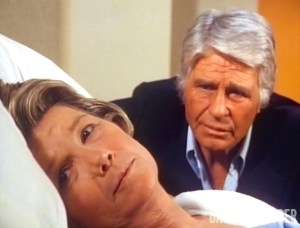
How do you think J.R.’s death will affect the new show?

A lot of people have asked me that. I think they’ll probably get a [ratings] bump when they air the episodes that deal with J.R.’s death. But after that, to be perfectly honest, I think the “next generation” has to step up – like every “next generation.” I definitely think the show has the ingredients to stand on its own. Maybe they’re a little afraid of it, but maybe this will get them to do it.
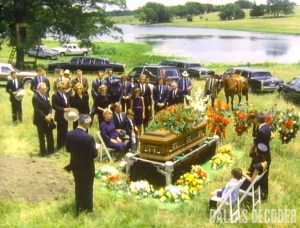
Kind of like the mama bird pushing her baby out of the nest?

Exactly. And of course J.R.’s going to cast a shadow over it forever. But we’ll see.

Gary and Val (Ted Shackelford, Joan Van Ark) in 1979

Gary and Val (Ted Shackelford, Joan Van Ark) in 1979

How do you feel about Gary and Val’s upcoming visit to the new “Dallas”? You played with those characters for 14 seasons on “Knots Landing.” Now they’re going to be in the hands of other writers.

It’s OK. I’m not like [Aaron] Sorkin, whose characters speak Sorkinese and it’s brilliant. I always wrote very stylized dialogue and let fine actors like Joan Van Ark and Ted Shackelford make the words theirs. They’ll still be Val and Gary. So I don’t worry about it.

What do you think Leonard Katzman, the original “Dallas’s” longtime producer, would think of the new show?

He’d hate it.

Really? Why?

He just would. He hated the [original show’s “dream” season] after he’d walked away from it. That season has taken a rap that I don’t believe it deserves. It was trying to freshen up the act. But Leonard hated it.

Well, what about you? Do you like the new show?

I do. It’s great to see Southfork in H.D. and widescreen. Beautiful. I do wish they would slow things down. Mike and I were talking recently and said we could’ve gotten 10 shows from the first five. [Laughter] And not by stretching, but by making it more complex and by making the stories less plot-driven and more character-driven. I think it was Chekov who said plot is character. Whoever said it, I agree with.

Do you think there’s any chance of “Knots Landing” coming back?

No, I don’t think so. “Knots Landing” never had the ratings and the international appeal that “Dallas” had. “Knots” recreated would have to be five younger families living on the cul-de-sac – and not related to the older characters. Because if they were related it wouldn’t be believable. “Knots Landing” was always the hardest show to write because unlike “Dallas,” the conflict wasn’t built into the structure. You always wanted to ask the question: Why don’t they just move out? Why don’t they just stop talking to their neighbors like neighbors everywhere?

Getting back to “Dallas”: Your pilot script is dated December 10, 1977. Thirty-five years later, we’re still watching this show. How does that make you feel?

You know, while it was on the air, it was sort of a guilty pleasure because I wasn’t running it. It was my first show. Afterward I ran “Knots Landing” and my other shows, and “Dallas” was in the hands of Lenny Katzman. But later on, I realized “Dallas” really was the model for all the shows that came after it. Before “Dallas,” there was a great fear of serialization in prime time. Mike and I thought continuing drama was exactly the right form for television. And the form of “Dallas” became the model for all the continuing dramas that followed and are now dominant. So it really did change television in a very not-so-subtle, real way. And I like that.

Well, I know I speak for a lot of fans when I say we’re thankful to you for creating this really fun, fantastic show.

And I’m thankful to Larry Hagman. His loss means something to me. He was a nice man. He was a terrific actor. Absolutely underrated. But God knows he left this earth doing what he loved. A lot of us might wish to go that same way. So I’m glad I was able to provide him with the vehicle that he would use to display his great talent, and I’m certainly grateful to him for being the driving force of a show that has meant a lot to me.

Share your comments below and read more interviews from Dallas Decoder.