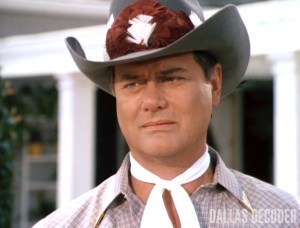
Critique: ‘Dallas’ Episode 115 — ‘Barbecue Three’

Barbecue Three, Dallas, J.R. Ewing, Larry Hagman

Mr. Right

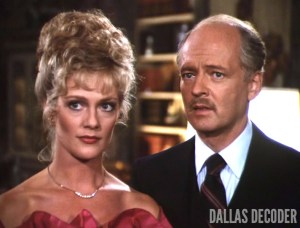
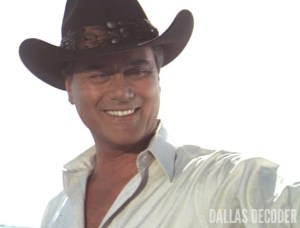
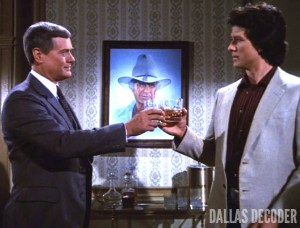
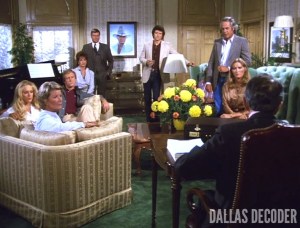
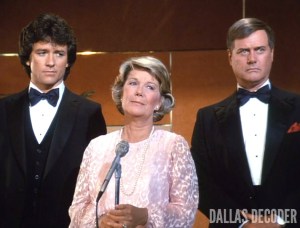
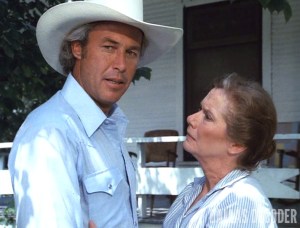
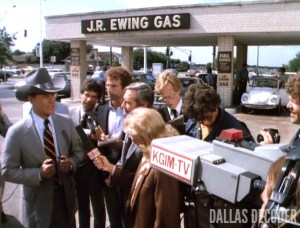
In “Barbecue Three,” J.R. finally reveals his plan to win the contest for Ewing Oil: He begins flooding the market with cut-rate gasoline, hoping to drive up his half of the company’s profits. This ignites a firestorm within the cartel, prompting Cliff and a band of angry oilmen to come to the annual Southfork barbecue and demand J.R. stop lowering prices. The Ewings don’t like what J.R.’s doing either, but to everyone’s surprise, they close ranks around him when the confrontation with the cartel threatens to turn violent. “If you want to get to J.R., you’re going to have to come through us,” Bobby tells the group.

Like Ellie’s defense of J.R. in the fifth-season classic “Waterloo at Southfork,” this is another example of the Ewings circling the wagons against outsiders, one of “Dallas’s” hallmarks. There’s another reason this scene is satisfying: For once, J.R. isn’t wrong. Sure, he pulled some dirty tricks to get his hands on the crude he needed to produce all that cheap gas, but the cartel has no right to complain about it. J.R. is selling his product at a lower price than his competitors. Who are they to tell him to stop? (On another note: Why doesn’t Marilee Stone join her fellow cartel members in confronting J.R.? Surely it isn’t because she’s a woman. If you ask me, Marilee is much more intimidating than mild-mannered Jordan Lee, who stands alongside Cliff in this scene.)

To be fair, the other characters’ objections to J.R.’s scheme feel a little more justified than the cartel’s. Before the barbecue, Bobby complains J.R. will show “huge short-term profits and deplete our reserves,” which seems like a reasonable concern. Meanwhile, Donna, now a member of the Texas Energy Commission, becomes irritated when her fellow regulators backtrack on their opposition to J.R. As Donna explains to Punk Anderson, “Some of the members of the commission have political ambitions. They’re not about to vote against lower gasoline prices, even if it means conserving our oil reserves.” Fair enough, although the comment feels a little hypocritical coming from the widow of a governor and the stepmother of a senator.

Indeed, Arthur Bernard Lewis’s script covers so many different reactions to J.R.’s cheap gas gambit — his family, his competitors in the cartel and the politicians all weigh it —“Barbecue Three” feel like a lesson in capitalism. Lewis even manages to reflect the consumers’ point of view, albeit subtly. J.R. announces his cut-rate gas plan at the opening of the first J.R. Ewing-branded gas station, where we see a couple of attendants lowering the per-gallon price from $1.21 to 89 cents. Later, the TV news coverage shows long lines of motorists waiting to fill up. There’s also a scene where Sly, J.R.’s secretary, tells her boss she thinks what he’s doing is “terrific” and hopes he can “keep it up.” (Seeing Deborah Rennard deliver this line, I couldn’t help but imagine Sly’s everyday working-class drudgeries: fighting traffic during morning rush hour, standing in line at the bank to deposit her paycheck, shopping for bargains at The Store.)

“Barbecue Three” also delivers two Lucy/Mickey scenes that showcase the nice chemistry between Charlene Tilton and Timothy Patrick Murphy. In the first, Mickey asks Lucy on a date, only to be introduced to her cold shoulder. Later, at the barbecue, he tries again to charm her and begins to realize her snobbish demeanor masks deeper problems. Patrick Duffy also has several good moments in this episode, including a monologue in which Bobby promises Pam he won’t lose the fight for Ewing Oil: “Daddy taught me a lot of tricks in my early days with the company. Things that I hated doing. But I learned. And I learned real good. And I can get right down in the mud if I have to.” It’s a nice reminder that Bobby’s recent discovery of his inner junkyard dog on TNT’s “Dallas” has precedence.

I also appreciate the details in “Barbecue Three.” The scene leading up to the first Texas Energy Commission meeting is expertly executed. Director Leonard Katzman shows us Ray and Donna (looking chic in her red hat) arriving at the municipal building and being greeted by a throng of news reporters, which helps lend the moment a sense of drama and suspense. You get the feeling something big is about to happen, a notion that’s reinforced by the sight of so many familiar oil industry leaders in the audience. And even though the “Dallas” producers actually make us sit through the commission members reciting the pledge of allegiance, it really doesn’t slow down the momentum. Later, when J.R. is planning his press conference, I like his brief exchange with his public relations chief. Sometimes you get the feeling Ewing Oil has no other employees besides the people who work in J.R. and Bobby’s executive suite, so it’s nice to see the show acknowledge that the Ewing brothers don’t do everything themselves.

There are a couple of nice touches during the barbecue sequences too. Debra Lynn Rogers, who played Toni, the woman Ray flirted with during the previous season’s “Barbecue Two,” plays the role again in this episode, except now she’s dancing with Mickey. Meanwhile, Peyton E. Park, who played Larry, the Ewings’ caterer in “Barbecue Two,” reprises the role here. In “Barbecue Three,” we also meet a woman who appears to be Jordan’s wife. He introduces her as Evelyn, although in the third-season episode “Paternity Suit,” Jordan seemed to refer to his spouse as “Sara.” Is this a continuity error, or are they two different women? If it’s the latter, I have to wonder: Between Sara, Kristin and now Evelyn, is Jordan trying to give J.R. a run for his money as “Dallas’s” biggest lothario?

Grade: A

_______________________________________________________________________________________________________________________________________________
Barbecue Three, Dallas, J.R. Ewing, Larry Hagman

Gasman cometh

‘BARBECUE THREE’

Season 6, Episode 12

Airdate: December 17, 1982

Audience: 21.8 million homes, ranking 1st in the weekly ratings

Writer: Arthur Bernard Lewis

Director: Leonard Katzman

Synopsis: The Texas Energy Commission revokes J.R.’s variance but faces public backlash when he opens a chain of popular cut-rate gas stations. Holly asks Bobby to help her get J.R. out of her company. Mickey realizes Lucy is troubled. After angry oilmen confront J.R. at the Ewing Barbecue, Miss Ellie vows to go to court to break Jock’s will and sell Ewing Oil.

Cast: E.J. André (Eugene Bullock), Barbara Bel Geddes (Miss Ellie Ewing), Lois Chiles (Holly Harwood), Patrick Duffy (Bobby Ewing), Ken Farmer (oilman), Fern Fitzgerald (Marilee Stone), Linda Gray (Sue Ellen Ewing), Larry Hagman (J.R. Ewing), Alice Hirson (Mavis Anderson), Susan Howard (Donna Krebbs), Steve Kanaly (Ray Krebbs), James Karen (Elton Lawrence), Howard Keel (Clayton Farlow), Ken Kercheval (Cliff Barnes), Audrey Landers (Afton Cooper), Julio Medina (Henry Figueroa), Peyton E. Park (Larry), Timothy Patrick Murphy (Mickey Trotter), Priscilla Pointer (Rebecca Wentworth), Victoria Principal (Pam Ewing), Debbie Rennard (Sly), Debra Lynn Rogers (Toni), Kirk Scott (Buchanan), Danone Simpson (Kendall), Arlen Dean Snyder (George Hicks), Don Starr (Jordan Lee), Robert Swick (Ewing Oil employee), Charlene Tilton (Lucy Ewing), Deborah Tranelli (Phyllis), Morgan Woodward (Punk Anderson)

“Barbecue Three” is available on DVD and at Amazon.com and iTunes. Watch the episode and share your comments below.
Critique: ‘Dallas’ Episode 114 — ‘Post Nuptial’

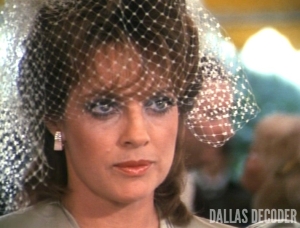
Dallas, Linda Gray, Post Nuptial, Sue Ellen Ewing

December bride

“Post Nuptial” picks up where the previous “Dallas” episode left off, as the Ewings and their guests wait to see what will happen after Cliff stands up during the middle of J.R. and Sue Ellen’s wedding ceremony. The answer: Not much. After a few moments of cringe-worthy silence, Cliff walks to the bar and pours himself a drink while the minister completes the vows and announces that J.R. and Sue Ellen are once again husband and wife. If there’s a lesson here for “Dallas” fans, it might be this: Lackluster cliffhangers are bound to produce underwhelming resolutions.

Of course, Cliff hasn’t caused his last scene. At the reception, he refuses Pam and Afton’s pleas to leave, then asks Sue Ellen to dance. Sue Ellen looks rattled and reluctantly accepts Cliff’s offer, which stretches credibility a little too thinly for my taste. It was one thing for Sue Ellen to quietly renew her relationship with Cliff while she was a divorcee, but to dance with him on the day she remarries J.R.? That seems like a lot for the audience to swallow. Don’t forget: This is the man who once sued J.R. and Sue Ellen for custody of John Ross, claiming he was the child’s biological father.

More than anything, Cliff and Sue Ellen’s scene at the reception is a plot device to squeeze a fight scene into this episode. When J.R. spots his wife and his enemy on the dance floor, he approaches Cliff and punches him, which leads to a brawl that ends with almost every lead actor on the show falling or being pushed into the Southfork swimming pool. A confession: I’ve never loved these “dunkings” as much as other fans seem to. It’s always seemed a little silly to me, and by the end of the series, the pool fights had become pretty predictable. Since this is one of the first, though, I can appreciate how much fun it must have been in 1982 to see the tuxedo-clad Ewings and Cliff splashing around the pool. The best part is when Mickey Trotter joins the fracas, seemingly for the hell of it.

(You also have to enjoy J.R. and Mickey’s encounter earlier at the reception, when the young ranch hand makes the mistake of asking J.R. about Lucy’s whereabouts. Larry Hagman and Timothy Patrick Murphy both have charm to spare and good chemistry together; what a shame this is one of the few scenes their characters share during Murphy’s too-brief tenure on the show.)

The wedding scenes in “Post Nuptial” are limited to the first act, allowing scriptwriter David Paulsen to devote the remainder of the hour to advancing the season’s storylines. Naturally, J.R. remains the center of the action and keeps the audience guessing. He whisks Sue Ellen away on a quick honeymoon to a waterfront resort, where she tells him she wants “a total commitment” from him. “No other women, no games,” she says. This seems like the kind of conversation the couple should have had before they walked down the aisle, but no matter. J.R. assures Sue Ellen he’s not going to repeat the mistakes he made during their first go-round as husband and wife. “I promise you,” he says.

Does he mean it? I believe he does. After all, J.R. resisted the temptation to cheat with Holly in “The Ewing Touch,” one of the previous episodes. The audience is less sure of J.R.’s sincerity at the end of “Post Nuptial,” when Bobby — having snooped around into J.R.’s business dealings — confronts him with evidence that suggests J.R. is selling oil to countries on the government’s embargo list. “You’re talking about an illegal act, Bob. … I assure you, a thought like that never crossed my mind,” J.R. says. He sounds sincere, but since “Dallas” hasn’t revealed the reason he’s pumping so much extra oil, we can’t quite be sure if he’s telling the truth this time.

I also like the “Post Nuptial” scene where Afton vows to leave Cliff after the brouhaha he caused at the wedding. In a tense moment, she also comes close to confessing her recent indiscretion with Gil Thurman, only to chicken out at the last minute and collapse into Cliff’s arms. I’m a fan the Ken Kercheval/Audrey Landers pairing over the long haul, but this is one point in their relationship where I don’t understand why she sticks with him.

Thank goodness we have Sue Ellen around to cheer on. In addition to the scene where she demands that “total commitment” from J.R., we get to see her accompany him to the refinery he wants to buy. When the refinery owner informs the couple his business isn’t for sale, Sue Ellen pipes up with, “You haven’t even heard our offer yet.” It’s an early glimpse of the shrewd energy executive she’ll one day become. Too bad it takes a few decades for it to happen.

Grade: B

_______________________________________________________________________________________________________________________________________________

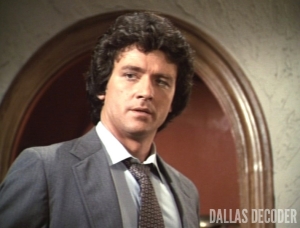
Bobby Ewing, Dallas, Patrick Duffy, Post Nuptial

Who do you trust?

‘POST NUPTIAL’

Season 6, Episode 11

Airdate: December 10, 1982

Audience: 21.8 million homes, ranking 2nd in the weekly ratings

Writer: David Paulsen

Director: Michael Preece

Synopsis: After J.R. and Sue Ellen are married, Afton decides to leave Cliff but doesn’t follow through. Holly tells Bobby about her connection to J.R. Bobby fears J.R. may be illegally selling oil to countries on the State Department’s embargo list. Donna, now a member of the Texas Energy Commission, vows to rescind J.R.’s variance to pump excess oil. Lucy rejects the advances of her client, Bill Johnson.

Cast: E.J. André (Eugene Bullock), Parley Baer (minister), Tyler Banks (John Ross Ewing), Barbara Bel Geddes (Miss Ellie Ewing), Ivan Bonar (Perkins), Lois Chiles (Holly Harwood), Jon Cypher (Jones), Patrick Duffy (Bobby Ewing), Fern Fitzgerald (Marilee Stone), Tom Fuccello (Senator Dave Culver), Gerry Gibson (Jimmy Otis), Linda Gray (Sue Ellen Ewing), Larry Hagman (J.R. Ewing), Nicholas Hammond (Bill Johnson), Alice Hirson (Mavis Anderson), Susan Howard (Donna Krebbs), Steve Kanaly (Ray Krebbs), Howard Keel (Clayton Farlow), Ken Kercheval (Cliff Barnes), Audrey Landers (Afton Cooper), Timothy Patrick Murphy (Mickey Trotter), Priscilla Pointer (Rebecca Wentworth), Victoria Principal (Pam Ewing), Paul Sorensen (Andy Bradley), Don Starr (Jordan Lee), Charlene Tilton (Lucy Ewing), Deborah Tranelli (Phyllis), Morgan Woodward (Punk Anderson)

“Post Nuptial” is available on DVD and at Amazon.com and iTunes. Watch the episode and share your comments below.
Critique: ‘Dallas’ Episode 113 — ‘The Wedding’

Dallas, Cliff Barnes, J.R. Ewing, Ken Kercheval, Larry Hagman, Linda Gray, Sue Ellen Ewing, Wedding

What is she thinking?

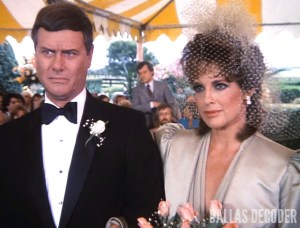
“The Wedding” is a strong episode with a silly ending. In the final scene, J.R. and Sue Ellen stand under a big tent in the Southfork driveway, where a minister is conducting their second marriage ceremony. He asks “if there be any man” who can say why the couple shouldn’t be remarried. Cliff, who is seated in the audience, suddenly springs to his feet. The camera zooms in on Ken Kercheval, the music swells and Philip Capice’s closing credit flashes onto the screen. That’s it.

This is less of a cliffhanger than a pause. Since there was no doubt in 1982 that J.R. and Sue Ellen were indeed going to be remarried, I wonder: What about this scene was supposed to be suspenseful? How big of a jackass Cliff would make of himself when the story resumed the following week? Indeed, most of what everyone remembers about J.R. and Sue Ellen’s second trip to the altar — her dance with Cliff, J.R. and Cliff’s fistfight, the scene where half the actors wind up in the Southfork swimming pool — happens in the follow-up segment, “Post Nuptial.” Couldn’t the “Dallas” producers have put some of that good stuff in “The Wedding”?

Of course, even if the final scene is underwhelming, you have to appreciate the lavishness of J.R. and Sue Ellen’s ceremony. At this point during “Dallas’s” run, Southfork had hosted only one other wedding: Lucy and Mitch’s, which was shot on the show’s Hollywood soundstage. J.R. and Sue Ellen’s nuptials were filmed at the “real” ranch. This makes their event look and feel like an honest-to-goodness outdoor affair, with real blue skies and actual wind blowing through the actors’ hair. When it comes to Southfork, there’s no substitution for the real thing.

“The Wedding” also reminds us how much TV weddings have changed over the years. Director Leonard Katzman shows us every step of Sue Ellen’s walk down the aisle and allows us to hear all the vows recited by the minister (who, by the way, is played by Parley Baer, the veteran character actor who portrayed the hard-of-hearing man J.R. encounters in the “Knots Landing” episode “A Family Matter”). Three decades later, when Christopher and Pamela Rebecca were married in the first episode of TNT’s “Dallas,” their ceremony was depicted in a musical montage set to an Adele song. There was no need to hear the wedding march or the vows because at this point, TV audiences have been “trained” to understand how weddings work.

Besides the ending, my only other gripe with “The Wedding” is the lack of attention paid to Sue Ellen. Here’s a woman who is about to remarry a man who has caused her tremendous pain, yet we never see her question if she’s doing the right thing or reflect on what she learned during the season-and-a-half she spent away from him. Don’t get me wrong: “Dallas” makes a smart decision by reuniting these characters, who are always more entertaining together than they are apart. I just wish Will Lorin’s script had given us a clearer understanding of what’s going on inside Sue Ellen’s head. Then again, maybe she isn’t sure either.

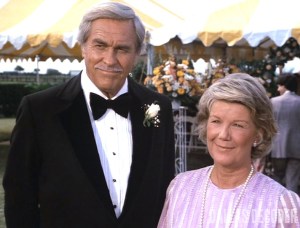
Besides, Miss Ellie and Clayton are the real star attraction of “The Wedding.” He comes to Southfork to escort Sue Ellen down the aisle but winds up spending most of his time with Ellie. Their scenes together showcase the warm rapport between Barbara Bel Geddes and Howard Keel and make it clear to the audience how well-suited their characters are for each other: Clayton laments never having a large family, while Ellie confides her fear that J.R. and Bobby’s contest will tear the Ewings apart. The only moment that rings false occurs when Ellie tells Clayton how much he reminds her of Jock. If you ask me, Keel was an ideal replacement for Jim Davis because their characters were so different. Whereas Jock was rough around the edges, Clayton was a refined gentleman. And yet isn’t it impressive how easily Clayton slides into Jock’s place? By the end of the hour, Clayton is stepping between J.R. and Bobby to keep them from scuffling during a rowdy Southfork cocktail hour and standing at Ellie’s side as she greets the wedding guests. These are things Jock once did, but Clayton handles them well.

Other highlights of “The Wedding” include Lucy’s encounter in the Southfork kitchen with Mickey, where the ranch’s resident rebels take an instant dislike to each other. (Except not really. Like Ellie and Clayton, it’s pretty clear Lucy and Mickey are destined for romance.) I also like J.R.’s visit to Holly, where he recommends she sell one of her company’s divisions to Petro State. Notice that Lorin doesn’t feel obligated to remind us what Petro State is; the “Dallas” producers trust the audience to remember J.R. set up this dummy corporation a few episodes ago. And even though Cliff’s big move at the end of “The Wedding” isn’t all that dramatic, I can’t help but enjoy the scene where J.R. invites his nemesis to the ceremony. Yes, it’s a cruel thing for J.R. to do, but how can you not love seeing the delicious smile Larry Hagman flashes when he encourages Cliff to come watch him marry the woman who dumped him?

The other actor to watch in “The Wedding:” the bearded extra who pops up throughout this episode. He first appears as a patron in the restaurant where Punk summons J.R. for a drink. Later, when Bobby, Pam, Ray and Donna head to the nightclub, we see the bearded man boogeying on the dance floor. Finally, he plays one of the guests at J.R. and Sue Ellen’s wedding. (In the image above, you can see the man’s face behind Sue Ellen’s right shoulder.) Forget whether or not Cliff is going to disrupt the wedding; the real cliffhanger is: Who is this bearded man, and why is he stalking the Ewings?

Grade: A

_______________________________________________________________________________________________________________________________________________

Barbara Bel Geddes, Clayton Farlow, Dallas, Miss Ellie Ewing, Wedding

Golden couple

‘THE WEDDING’

Season 6, Episode 10

Airdate: December 3, 1982

Audience: 23.6 million homes, ranking 1st in the weekly ratings

Writer: Will Lorin

Director: Leonard Katzman

Synopsis: Clayton visits Southfork and spends time with Miss Ellie, which hurts Rebecca. At J.R.’s behest, Holly prepares to sell part of her company, unaware the buyer is J.R.’s dummy corporation. Dave persuades Donna to join the new Texas Energy Commission. Lucy and Mickey meet and instantly dislike each other. At J.R. and Sue Ellen’s wedding, when the minister asks for objections, Cliff rises.

Cast: Parley Baer (minister), Tyler Banks (John Ross Ewing), Barbara Bel Geddes (Miss Ellie Ewing), Lois Chiles (Holly Harwood), Patrick Duffy (Bobby Ewing), Tom Fuccello (Senator Dave Culver), Linda Gray (Sue Ellen Ewing), Larry Hagman (J.R. Ewing), Alice Hirson (Mavis Anderson), Susan Howard (Donna Krebbs), Steve Kanaly (Ray Krebbs), Howard Keel (Clayton Farlow), Ken Kercheval (Cliff Barnes), Audrey Landers (Afton Cooper), Doug McGrath (Gentry), Timothy Patrick Murphy (Mickey Trotter), Priscilla Pointer (Rebecca Wentworth), Victoria Principal (Pam Ewing), Danone Simpson (Kendall), Don Starr (Jordan Lee), Charlene Tilton (Lucy Ewing), Deborah Tranelli (Phyllis), Ray Wise (Blair Sullivan), Morgan Woodward (Punk Anderson)

“The Wedding” is available on DVD and at Amazon.com and iTunes. Watch the episode and share your comments below.
Critique: ‘Dallas’ Episode 112 — ‘Fringe Benefits’

Afton Cooper, Audrey Landers, Dallas, Fringe Benefits

Savvy

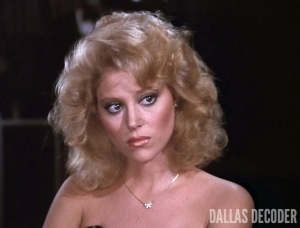
In “Fringe Benefits,” Afton sleeps with sleazy Gil Thurman to ensure he’ll sell his lucrative oil refineries to her boyfriend Cliff. Is this yet another example of Afton allowing a man to use her, like she did when she had her doomed fling with J.R.? Perhaps. But Afton’s actions also demonstrate how much she has learned since then. You may not approve of her choices in this episode, but you can’t deny she’s become one of “Dallas’s” savviest characters.

The plot is set in motion when Cliff persuades the cartel to join him in bidding against J.R. for Thurman’s refineries. The prospect of beating J.R. — and proving himself as an oilman — gets Cliff’s juices flowing for the first time since his suicide attempt at the end of the previous season. This, in turn, lifts the spirits of Afton, who has loyally stood by Cliff and struggled to help him recover his spark. But Afton’s excitement is dashed when Thurman tells her he’ll only sell to Cliff if she sleeps with him. Afton reluctantly yields to Thurman’s demands, and in the episode’s next-to-last scene, he drops by Cliff’s office to tell him the refineries are his.

Tellingly, Afton realizes Thurman is a creep the moment she meets him and tries to keep her distance. Contrast this with Cliff, who is oblivious to Thurman’s true nature and his barely concealed interest in Afton. J.R. doesn’t “get” Thurman either. As his competition with Cliff intensifies, J.R. invites Thurman to dine with him and Sue Ellen at her townhouse, even dictating the menu and her choice of outfit — as if these things would matter to a man like Thurman. On the night of the dinner, Thurman arrives before J.R. and propositions Sue Ellen, who practically has to fight him off. Later that evening, when Sue Ellen tells J.R. that Thurman made a pass at her, J.R. reveals he knew Thurman was a womanizer but had no idea he’d come on so strongly. The unquestioned sincerity in Larry Hagman’s voice lets the audience know that J.R. — in this instance, at least — is telling the truth.

So only Afton has Thurman’s number from the get-go. Not that this should come as a surprise. As Dallas Divas Derby has pointed out, Afton’s ability to “read” people is one of her defining traits. During the fifth season, she’s the first to realize Clayton has fallen for Sue Ellen. Later, she figures out long before anyone else that Katherine is up to no good. Afton’s insightful nature makes me wonder: Could she have her own motivation for sleeping with Thurman? Yes, her actions help Cliff seal a major deal, which gives him the ego boost he needs to snap out of his depression. But Cliff’s victory also upsets J.R.’s apple cart, a fitting comeuppance for the man who dumped Afton so cruelly. Could getting back at J.R. be a “fringe benefit” of Afton’s actions?

We may not know for sure if Afton has revenge on her mind, but the other emotions she experiences in this episode aren’t up for debate: She loves Cliff and is desperate to help him succeed, and she is disgusted by Thurman and hates the idea of having to sleep with him. Now stop and ask yourself how you know this. Is it because there’s a scene where Afton confides her feelings in a girlfriend, a therapist, a hairdresser? Do we hear her pouring out her heart in voiceover narration? No. Everything we know about Afton’s emotional state comes from Audrey Landers. Because Afton is a supporting character who doesn’t interact much with the other players, Landers must rely on facial expressions and body language to let us know what’s going on inside Afton’s head.

Contrast this with the lead actors on “Dallas.” In a typical episode, there might be a scene where Miss Ellie confides her latest worries in Donna, or where J.R. lets his secretary Sly in on one of his business secrets. These scenes allow the audience to understand the characters’ motivations. But Landers rarely gets scenes like this, and certainly not in “Fringe Benefits.” Since we never even see Afton sleep with Thurman, it’s up to Landers to let us know that Afton did indeed give in to him, which the actress achieves with a single shamed expression toward the end of the episode. Landers’ ability to do so much with so little makes her one of “Dallas’s” most impressive performers.

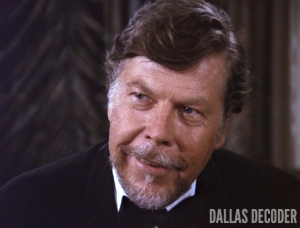
The other V.I.P. in “Fringe Benefits:” Albert Salmi, whose crooked smirk and leering eyes make Gil Thurman perhaps the most loathsome creature to slither into the lives of the Barneses and Ewings. Salmi appeared in a lot of episodic television before “Dallas,” including several guest spots on “The Twilight Zone.” It’s hard to imagine any role topping this one. (In real life, Salmi, who suffered from clinical depression, died in 1990 after he shot and killed his wife, then turned the gun on himself.) I also love Ken Kercheval’s performance in “Fringe Benefits,” especially in the scene where Thurman tells Cliff he won the bidding for the refineries. Kercheval pumps his fists in the air like a little boy who has just experienced some minor playground triumph. It’s almost sweet.

The other highlight of “Fringe Benefits” is the fun scene where Sue Ellen and Pam realize how far they’ve come since their early days together at Southfork. As much as I enjoy Sue Ellen’s bitchy attitude toward Pam during “Dallas’s” first few seasons, it’s even nicer to see the women finally getting long and supporting each other. I had forgotten about this scene until I saw “Fringe Benefits” again recently for the first time in several years; it now stands out as one of my favorite “re-discoveries” since starting Dallas Decoder.

I also love this episode’s scenes between Barbara Bel Geddes and Dale Robertson, who makes his last appearance on “Dallas” as Frank Crutcher, the gentle widower who was so sweet on Ellie. Robertson was a fine actor and would have made an interesting addition to the “Dallas” cast, although looking back, it’s pretty clear the producers only intended Crutcher to be a temporary character. (Even the character’s name is apt: He was merely a “crutch” for Ellie to lean on as she emerged from her mourning of Jock.) I’ll miss Frank, although I also know someone even better is waiting around the bend for Mama.

Grade: A

_______________________________________________________________________________________________________________________________________________

Albert Salmi, Dallas, Fringe Benefits, Gil Thurman

Slimy

‘FRINGE BENEFITS’

Season 6, Episode 9

Airdate: November 26, 1982

Audience: 17.9 million homes, ranking 5th in the weekly ratings

Writer: Will Lorin

Director: Michael Preece

Synopsis: Cliff wins a competition to purchase Gil Thurman’s refineries, unaware Afton slept with Thurman so he could seal the deal. Punk urges Bobby to find out why J.R. is pumping beyond capacity during an oil glut. Donna becomes more involved with a legislative effort to tighten oil industry regulations. Miss Ellie tells Frank she’s only interested in being his friend.

Cast: Barbara Bel Geddes (Miss Ellie Ewing), Jack Collins (Russell Slater), Patrick Duffy (Bobby Ewing), Fern Fitzgerald (Marilee Stone), Linda Gray (Sue Ellen Ewing), Larry Hagman (J.R. Ewing), Susan Howard (Donna Krebbs), Steve Kanaly (Ray Krebbs), Ken Kercheval (Cliff Barnes), Kenneth Kimmins (Thornton McLeish), Audrey Landers (Afton Cooper), Priscilla Pointer (Rebecca Wentworth), Michael Prince (John Macklin), Victoria Principal (Pam Ewing), Dale Robertson (Frank Crutcher), Albert Salmi (Gil Thurman), Carol Sanchez (maid), Paul Sorensen (Andy Bradley), Don Starr (Jordan Lee), Morgan Woodward (Punk Anderson)

“Fringe Benefits” is available on DVD and at Amazon.com and iTunes. Watch the episode and share your comments below.
Critique: ‘Dallas’ Episode 111 — ‘The Ewing Touch’

Barbara Bel Geddes, Dallas, Ewing Blues, Miss Ellie Ewing,

Word from a mother

In “The Ewing Touch’s” most memorable moment, Miss Ellie warns Rebecca not to cross her family. “Other people have fought the Ewings before — and they’ve regretted it,” Ellie says. This is a great scene for several reasons, not the least of which is the fun that comes from seeing two old pros like Barbara Bel Geddes and Priscilla Pointer square off against each other. Moreover, I like how the exchange recalls Ellie’s famous admonishment of the cartel, when the tiny matriarch chastised a roomful of powerful oilmen with a similar don’t-mess-with-the-Ewings speech. Ellie’s latest clash pits her against a fellow grandmother, but the confrontation is no less satisfying. Think about it: Rebecca wants revenge against the Ewings because she blames J.R. for Cliff’s suicide attempt. Her vendetta is as irrational as it is unfair. She deserves Ellie’s rebuke.

Of course, as terrific as this scene is, don’t allow it to overshadow the rest of Bel Geddes’ work in “The Ewing Touch,” which is typically wonderful. Most of Ellie’s scenes show how she is resuming her life after Jock’s death. We see her happily toasting Christopher’s adoption, attending a “political meeting” with Donna and, in the most surprising turn, hosting a dinner party at Southfork so her family can meet Frank Crutcher, the gentleman she met at the Oil Baron’s Ball. Frank’s presence at Southfork makes her sons uncomfortable, but Ellie later assures Bobby that she thinks of Frank only as a friend. Nevertheless, the fact remains: Ellie is making room in her life for a man who isn’t Jock.

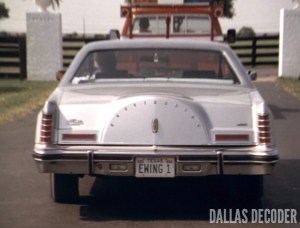
This transitional phase in the life of the Ewings is symbolized by a moving sequence involving, of all things, Jock’s car. At the beginning of “The Ewing Touch’s” third act, Ellie is quietly surveying the Southfork landscape when Bud, who owns the garage where Jock had his prized Lincoln Continental worked on, arrives and reminds Ellie that the car is overdue for servicing. Bud suggests Ellie might want to sell the vehicle, but she dismisses the idea. “You take it in and do whatever Jock would have done to it,” Ellie tells him. We then cut to a scene of Ray preparing to teach Mickey to ride a horse — a subtle reminder that Ray is following in Jock’s footsteps by taking a younger man under his wing — and then we return to Ellie standing in the driveway, watching as Bud drives away in Ewing 1. The family, like the car, is moving on.

The other highlight in “The Ewing Touch” is the scene where J.R. drops by Holly’s house and pokes fun of the shirtless hunk lounging near her swimming pool. “Traveling with the intellectual set, I see,” J.R. quips. Holly flirts with J.R. — which is a bit odd, given the brush-off she gave him a few episodes earlier — and even suggests he “stretch out” and spend some time with her by the pool. To the surprise of the audience and perhaps even to himself, J.R. rejects Holly’s offer, telling her he’s trying to “stay pure” for his wedding. Besides, he says, “I wouldn’t want to confuse Bonzo.”

The rest of “The Ewing Touch” is a bit uneven. Cliff gets angry at Pam for helping Bobby going into business with the McLeish brothers, even though she had no idea Cliff was interested in a deal with them too. This is a little irrational, even for Cliff. My feelings about Lucy’s storyline are mixed too: I like how she resists her client Bill Johnson’s attempt to date her — it seems she learned a valuable lesson about mixing business with pleasure when she got involved with Roger Larson in the previous season — but the Shirley Temple getup that Lucy sports during her photo shoot is more than a little creepy.

“The Ewing Touch” also offers two casting milestones. First, Tami Barber makes her final appearance as Bev, Lucy’s girlfriend, when she sits silently next to Ellie at Lucy’s final divorce hearing. Second, Josef Rainer makes his first appearance on “Dallas” as Runland, the parts supplier who gives Bobby the run-around. Rainer later appears in the “Dallas: The Early Years” TV movie as Sam Culver, Donna’s first husband, then returns to the show as Mr. Barton, Sue Ellen’s business advisor. His fourth and most famous “Dallas” role is Dr. David Gordon, the plastic surgeon who treats Pam after her car accident. According to TV Guide, the producers of TNT’s “Dallas” hoped Rainer would play Gordon again two recent episodes of the new show, and when they were unable to track him down, they recast the role with Sam Anderson.

Too bad. One actor playing four roles in two “Dallas” series and a movie? That might have been a record.

Grade: A

_______________________________________________________________________________________________________________________________________________

Dallas, Ewing Blues

Moving on

‘THE EWING TOUCH’

Season 6, Episode 8

Airdate: November 19, 1982

Audience: 20.9 million homes, ranking 5th in the weekly ratings

Writer: Howard Lakin

Director: Leonard Katzman

Synopsis: Driscoll gives J.R. permission to pump more oil and leaves town. Miss Ellie invites Frank to dinner and warns Rebecca about crossing the Ewings. Cliff is furious when he learns Pam helped Bobby land the McLeish deal. Christopher’s adoption and Lucy’s divorce are finalized.

Cast: Thomas Babson (Barry Archer), Tami Barber (Bev), Barbara Bel Geddes (Miss Ellie Ewing), Norman Bennett (Bud), John Carter (Carl Hardesty), Roseanna Christiansen (Teresa), Lois Chiles (Holly Harwood), Patrick Duffy (Bobby Ewing), Fern Fitzgerald (Marilee Stone), Tom Fuccello (Senator Dave Culver), Linda Gray (Sue Ellen Ewing), Larry Hagman (J.R. Ewing), Nicholas Hammond (Bill Johnson), Fay Hauser (Annie), Alice Hirson (Mavis Anderson), Susan Howard (Donna Krebbs), Steve Kanaly (Ray Krebbs), Howard Keel (Clayton Farlow), Ken Kercheval (Cliff Barnes), Kenneth Kimmins (Thornton McLeish), Audrey Landers (Afton Cooper), John Larroquette (Phillip Colton), J. Patrick McNamara (Jarrett McLeish), Timothy Patrick Murphy (Mickey Trotter), Ben Piazza (Walt Driscoll), Priscilla Pointer (Rebecca Wentworth), Victoria Principal (Pam Ewing), Josef Rainer (Runland), Debbie Rennard (Sly), Dale Robertson (Frank Crutcher), Albert Salmi (Gil Thurman), Paul Sorensen (Andy Bradley), Don Starr (Jordan Lee), Harold Suggs (Judge Thornby), Charlene Tilton (Lucy Cooper), Ray Wise (Blair Sullivan), Morgan Woodward (Punk Anderson)

“The Ewing Touch” is available on DVD and at Amazon.com and iTunes. Watch the episode and share your comments below.
Critique: ‘Dallas’ Episode 110 — ‘Hit and Run’

Dallas, Hit and Run, J.R. Ewing, Larry Hagman

Shady

To fully appreciate how much composer Richard Lewis Warren contributes to “Hit and Run,” I challenge you to an experiment. First, turn off the volume and watch the sequence where reckless driver Carol Driscoll strikes the pedestrian. Without music, it plays like a series of disjointed shots: Here’s Carol leaving the beauty parlor, there she is getting behind the wheel of her Cadillac Seville, now she’s screaming as a body smashes her windshield. Next, watch the scene again with the volume up. Warren’s dramatic strings unite the images into a narrative, lending the scene urgency, tension and suspense. The music, more than anything else, makes this the episode’s most memorable moment.

Of course, the scheme behind Carol’s mishap is pretty compelling too. J.R. wants to blackmail her husband Walt, an ethical state government official, into doing him a favor. To gain leverage, J.R. taps dirty cop Harry McSween to orchestrate Carol’s collision, which ends with the pedestrian’s “friend” assuring Carol that the man she struck is perfectly fine and that Carol should go home — which she does, foolishly. Little does she know the two men are part of a scheme to ensnare her husband. In the episode’s closing moments, J.R. happens to be visiting the Driscolls when McSween arrives and announces Carol is in big trouble for fleeing an accident scene. J.R. offers to intervene — and Walt eagerly accepts. “J.R., if you could get my wife out of this, I’d owe you. I really would,” he says.

Ben Piazza and Martha Smith are terrific as the naïve, desperate Driscolls, but this moment, like so many others in “Hit and Run,” belongs to Larry Hagman. In the final shot, Walt and Carol stand together as J.R. faces them, grips their shoulders and gazes into their eyes. It’s the kind of sincere, everything’s-going-to-be-OK gesture that Bill Clinton used when comforting disaster victims during his presidency. “Carol, Walt, what are friends for?” J.R. says. As Hagman delivers the line, Warren brings back the dramatic strings from the accident scene and lets it play through the freeze frame of J.R.’s self-satisfied half-smile. This is a great ending.

The other subplot in “Hit and Run” has Bobby weighing whether to join the McLeish brothers in their Canadian drilling venture. Bobby’s dilemma: The deal is all-but-guaranteed to produce a big windfall, but the money might not start rolling in until after the contest for Ewing Oil ends. “I refuse to make a perfect deal just so J.R. can inherit it,” Bobby tells Pam. Scriptwriter Howard Lakin does a nice job making sure we understand the risk Bobby faces. At the end of the episode, when Bobby announces he’s going to take a chance and join the McLeish deal, it feels like a moment of high drama.

In the meantime, “Hit and Run” gives Victoria Principal some of the best scenes she’s had at this point during “Dallas’s” sixth season. I like Pam’s cute exchange with Bobby in the Southfork living room, as well as the scene where she entertains the McLeish brothers, which foreshadows the business savvy she’ll demonstrate in later seasons. Principal’s best moment, though, is Pam’s confrontation with Rebecca, who is consumed with getting Cliff to resume his fight with the Ewings. “Mother, you’ve always had strength. You proved that when you left your children to go out and start a new life. It’s a cold, calculating kind of strength. Is that what you want for Cliff?” Pam asks. Principal delivers the line sharply, and it’s nice to see the “Dallas” producers haven’t forgotten Rebecca’s sins.

Other highlights of “Hit and Run” include the first appearance of Annie, Lucy’s photographer. Fay Hauser plays the role in three guest spots, becoming one of the few African American actors to appear with anything approaching regularity on “Dallas.” The episode also gives us John Larroquette’s debut as Lucy’s lawyer, Philip Colton. It’s a small role, but Larroquette manages to give us a glimpse of the charm that would later make him one of television’s most popular actors.

But make no mistake: The only scenes stolen in “Hit and Run” have Hagman’s fingerprints on them. In addition to the sequence where J.R. comes to the rescue of the hapless Driscolls, this episode gives us J.R.’s classic first encounter with Ray’s cousin and Southfork’s newest ranch hand, Mickey Trotter. When J.R. says it’s good to know there’s “a whole wagonload of Krebbses running the ranch now,” Mickey points out that he doesn’t share Ray’s last name. “Oh, well,” J.R. responds. “I’m bound to sleep more soundly tonight knowing that.”

Grade: A

_______________________________________________________________________________________________________________________________________________

Ben Piazza, Carol Driscoll, Dallas, Hit and Run, Martha Smith, Walt Driscoll

Suckers

‘HIT AND RUN’

Season 6, Episode 7

Airdate: November 12, 1982

Audience: 20.6 million homes, ranking 4th in the weekly ratings

Writer: Howard Lakin

Director: Michael Preece

Synopsis: J.R. secretly orchestrates a hit-and-run accident involving Driscoll’s wife, then offers to get her out of trouble with the police. Bobby joins the McLeish deal. Cliff begins his job as president of Barnes-Wentworth Oil. Pam objects to Rebecca’s vow to get revenge against the Ewings. Lucy prepares for her divorce.

Cast: Barbara Bel Geddes (Miss Ellie Ewing), James Brown (Detective Harry McSween), Paul Carr (Ted Prince), Roseanna Christiansen (Teresa), Patrick Duffy (Bobby Ewing), Fern Fitzgerald (Marilee Stone), Tom Fuccello (Senator Dave Culver), Linda Gray (Sue Ellen Ewing), Larry Hagman (J.R. Ewing), Nicholas Hammond (Bill Johnson), Fay Hauser (Annie), Susan Howard (Donna Krebbs), Steve Kanaly (Ray Krebbs), Ken Kercheval (Cliff Barnes), Kenneth Kimmins (Thornton McLeish), Audrey Landers (Afton Cooper), John Larroquette (Phillip Colton), J. Patrick McNamara (Jarrett McLeish), Timothy Patrick Murphy (Mickey Trotter), George O. Petrie (Harv Smithfield), Ben Piazza (Walt Driscoll), Priscilla Pointer (Rebecca Wentworth), Victoria Principal (Pam Ewing), Debbie Rennard (Sly), Dale Robertson (Frank Crutcher), Martha Smith (Carol Driscoll), Paul Sorensen (Andy Bradley), Don Starr (Jordan Lee), Charlene Tilton (Lucy Cooper), Deborah Tranelli (Phyllis), Ray Wise (Blair Sullivan), Morgan Woodward (Punk Anderson)

“Hit and Run” is available on DVD and at Amazon.com and iTunes. Watch the episode and share your comments below.
Critique: ‘Dallas’ Episode 109 — ‘Aftermath’

Aftermath, Dallas, J.R. Ewing, Larry Hagman

Staying afloat

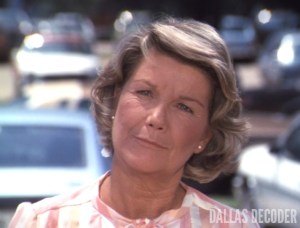
“Aftermath” lets the audience into J.R.’s head in a way other “Dallas” episodes don’t. In the most revealing scene, J.R. and Sue Ellen sweep into a fancy French restaurant, where the dinnertime crowd congratulates our hero on his recent return to power at Ewing Oil. The handshakes and backslaps end when J.R. and Sue Ellen encounter Rebecca, who interrupts her meal with Clayton to remind J.R. that she still blames him for Cliff’s attempted suicide and wants revenge. “Since the only way to your heart is through your company, I intend to make that company bleed,” Rebecca says.

J.R. plays it cool, telling Rebecca she has her work cut out for her, but when he and Sue Ellen are alone at their table, we see how rattled he is. “I can take Bobby with one hand tied behind me, but I get the distinct feeling there’s an army mobilizing against me,” J.R. says. It’s a reminder that he isn’t impervious. Not that this moment of vulnerability lasts long. A few scenes later, J.R. is all smiles as he tries to persuade state government official Walt Driscoll to allow him to pump more oil than the law allows. Stop and think about what Larry Hagman does here: He plays a man who appears to be brimming with bravado, even though he’s secretly afraid his enemies are out to get him. It’s a tricky performance, but of course Hagman does it beautifully.

The scene with Driscoll is also interesting because it underscores the sexism in which “Dallas” seems to revel. J.R. meets Driscoll on Holly’s yacht, where J.R. refers to her as a “pretty little thing” and suggests she’d be willing to sleep with Driscoll. “She has a thing for men our age,” J.R. says. Driscoll demurs, telling J.R. that he’s happily married. Later, after J.R. has asked Harry McSween to dig up dirt on Driscoll, the detective reports Driscoll’s wife has been arrested a few times for reckless driving. “Boy, you follow that lady for a couple of blocks and you’ll see why,” McSween says. Watching this exchange, I can’t help but feel like the people who make “Dallas” are having a little too much fun playing up old stereotypes about women behind the wheel.

The other women in “Aftermath” don’t come off much better. After Rebecca threatens J.R. in the restaurant, she buys Wade Luce’s oil company; the suggestion is she plans to use the business as a weapon in her war with the Ewings. I like seeing Rebecca depicted as a woman who is so successful, she can buy an oil company on a whim, but her obsession with revenge makes her seem irrational. Likewise, I appreciate how the opening scenes of “Aftermath” show how J.R., Bobby and Ray are each sorting through the implications of Jock’s will with help from the women in their lives. But wouldn’t it be nice if the women had a little more to do than listen to their men? At least in J.R. and Sue Ellen’s scene, she figures out he knew what was in Jock’s will before anyone else.

Even though Pam doesn’t have much to do in her scene with Bobby besides express her worry about the contest, the couple’s exchange is still worth paying attention to. “Pam,” Bobby says, “J.R. doesn’t want that company just for himself. He wants it for John Ross. And you and I have a son too. And I’m not going to sit back and watch J.R. steal something that rightfully belongs to Christopher.”

Oh, Bobby. If you only knew how right you are.

Grade: B

_______________________________________________________________________________________________________________________________________________

Aftermath, Dallas, Priscilla Pointer, Rebecca Wentworth

Out for revenge

‘AFTERMATH’

Season 6, Episode 6

Airdate: November 5, 1982

Audience: 20.3 million homes, ranking 3rd in the weekly ratings

Writer: David Paulsen

Director: Leonard Katzman

Synopsis: J.R. returns to Ewing Oil and pressures state regulator Walt Driscoll for permission to pump more oil than is allowed, but Driscoll turns him down. The McLeish brothers invite Bobby to join them in a Canadian oil venture, but he fears the wells won’t come in before his contest with J.R. ends. Rebecca buys Wade Luce’s oil company and asks Cliff to run it. Lucy decides to resume her modeling career.

Cast: Robert Ackerman (Wade Luce), Barbara Bel Geddes (Miss Ellie Ewing), James L. Brown (Detective Harry McSween), Danone Camden (Kendall), Lois Chiles (Holly Harwood), Patrick Duffy (Bobby Ewing), Linda Gray (Sue Ellen Ewing), Larry Hagman (J.R. Ewing), Susan Howard (Donna Krebbs), Steve Kanaly (Ray Krebbs), Howard Keel (Clayton Farlow), Ken Kercheval (Cliff Barnes), Kenneth Kimmins (Thornton McLeish), Audrey Landers (Afton Cooper), J. Patrick McNamara (Jarrett McLeish), Timothy Patrick Murphy (Mickey Trotter), Paul Napier (Harold Boyd), George O. Petrie (Harv Smithfield), Ben Piazza (Walt Driscoll), Priscilla Pointer (Rebecca Wentworth), Victoria Principal (Pam Ewing), Debbie Rennard (Sly), Charlene Tilton (Lucy Cooper), Deborah Tranelli (Phyllis), Ray Wise (Blair Sullivan), Morgan Woodward (Punk Anderson)

“Aftermath” is available on DVD and at Amazon.com and iTunes. Watch the episode and share your comments below.
Critique: ‘Knots Landing’ Episode 59 — ‘New Beginnings’

J.R. Ewing, Knots Landing, Larry Hagman, New Beginnings

Home field advantage

“New Beginnings” is chockablock with trivia. Larry Hagman and Patrick Duffy both guest star in this “Knots Landing” episode, the only time two marquee players from “Dallas” appear in the same hour of the spinoff series. (Eric Farlow, who was little Christopher Ewing on “Dallas,” pops up too, along with Philip Levien, who had two roles on “Dallas” and appears here as a record producer.) “New Beginnings” also marked the only time “Knots Landing” followed its parent show in CBS’s Friday night lineup. Not only did this allow the spinoff to crack Nielsen’s weekly top 10 for the first time, the episode’s audience — viewers in 21.3 million homes tuned in — makes “New Beginnings” the most-watched “Knots Landing” broadcast ever.

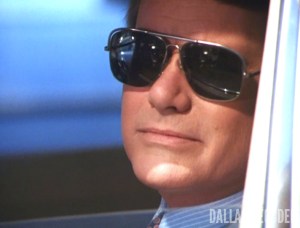
This also happens to be one of Hagman’s most satisfying “Knots Landing” guest spots. In most of J.R.’s earlier visits to the show, the writers strained to come up with excuses to bring the Texas oil baron to the suburbs of Southern California. (The biggest eye-roller: J.R. shows up to steal the prototype for the environmentally friendly car engine that Sid Fairgate is building in his garage.) “New Beginnings” deftly avoids this dilemma by having all of J.R. and Bobby’s scenes take place in Dallas, where Gary has come for the reading of Jock’s will. This solution is so simple — instead of bringing J.R. to “Knots Landing,” take “Knots Landing” to him — you have to wonder why the producers didn’t try it sooner.

Even though J.R. and Bobby are on their home turf, scriptwriter Mann Rubin keeps the spotlight on Gary, whose storyline dominates this episode. In “Jock’s Will,” the “Dallas” segment that sets up “New Beginnings,” Gary learns his late father left him $10 million, but the inheritance comes with strings attached: For the first few years, Gary is entitled only to the interest the money earns. Gary then spends most of “New Beginnings” pouting about the terms of the will, until he finally realizes he isn’t angry at Jock; he’s sad that his dad is dead.

The scene where Gary explains this epiphany to his girlfriend Abby is quite poignant. Jock and Gary never quite figured out how to relate to each other; now they’ll never get another chance to try. Shackelford is adept at making the audience feel the rage that’s always brewing within Gary, but he also does a nice job in scenes like this, which demonstrates how much of his character’s anger is rooted in heartbreak. Later, when Gary stands up to J.R., you can tell Shackelford is enjoying the opportunity to remind the audience that his character does, in fact, have a backbone. Shackelford also has a good scene at the top of the hour, when Bobby gently reminds Gary that his inheritance, even though it comes with strings, is nothing to scoff at. (More trivia: This will be Duffy and Shackelford’s last scene together until their recent reunion on TNT’s “Dallas.”)

In addition to bringing Abby into the mix, Rubin’s script makes room Gary’s other love, estranged wife Valene. In the episode’s first scene, after director Lorraine Senna shows us a sweeping aerial shot of the Dallas skyline while the familiar “Dallas” theme music plays, we watch as Abby arrives at Gary’s hotel to surprise him. Unbeknownst to them, Val is also staying at the hotel while in town to publicize her new Ewing-inspired novel, “Capricorn Crude.” The two women have several close calls throughout the episode but never run into each other until the last scene, when they both respond to a bellhop’s page for “Mrs. Gary Ewing.” The exchange that follows is appropriately bitchy (“Success seems to agree with you” says Abby; “I might say the same about you,” replies Val), but it’s also kind of bittersweet. This is especially true when the slow, sentimental version of the “Knots Landing” theme begins playing under the dialogue.

Of course, Donna Mills and Joan Van Ark have their best moments with Hagman. When Gary leaves the hotel to visit Southfork, J.R. visits Abby, who asks him why he feels so threatened by his ne’er-do-well middle brother. J.R.’s response is revealing. “That man is full of anger and frustration. Maybe even hatred, I don’t know. If he ever channeled all that energy … well, it could make my life miserable,” he says. Later, Val is signing books in the hotel gift shop when she looks up and sees the next person in line is none other than J.R. “I bought it fair and square with the promise that you’d autograph it for me,” he says with mock innocence. Her hissed response: “You are disgusting.”

The scene really does nothing to advance the storyline in this episode, yet it’s still the most entertaining exchange during the hour. This is the last time we ever see Val clash with J.R., which might make the scene kind of sad — if it wasn’t so much fun.

Grade: A

_______________________________________________________________________________________________________________________________________________

Gary Ewing, Knots Landing, New Beginnings, Ted Shackelford

Man of the hour

‘NEW BEGINNINGS’

“Knots Landing” Season 4, Episode 6

Airdate: October 29, 1982

Audience: 21.3 million homes, ranking 4th in the weekly ratings

Writer: Mann Rubin

Director: Lorraine Senna

Synopsis: Gary is angry about the strings attached to his inheritance from Jock but comes to accept it with help from Abby. J.R. tells Val he bought the company that published her book.

Cast: Rita Crafts (customer), Kevin Dobson (Mack MacKenzie), Patrick Duffy (Bobby Ewing), Reynaldo Duran (bellhop), Eric Farlow (Christopher Ewing), Larry Hagman (J.R. Ewing), Julie Harris (Lilimae Clements), Lisa Hartman (Ciji Dunne), James Houghton (Kenny Ward), Dudley Knight (bookstore manager), Michele Lee (Karen Fairgate), Philip Levien (Andy), Claudia Lonow (Diana Fairgate), Donna Mills (Abby Cunningham), Pat Petersen (Michael Fairgate), Michael Sabatino (Chip Roberts), Ted Shackelford (Gary Ewing), Louise Sorel (Bess Riker), Steve Shaw (Eric Fairgate), Joan Van Ark (Valene Ewing), James Winkler (desk clerk)

Share your comments about “New Beginnings” below.

Critique: ‘Dallas’ Episode 108 — ‘Jock’s Will’

Bobby Ewing, Dallas, Jock's Will, J.R. Ewing, Larry Hagman, Patrick Duffy

Let the games begin

At the end of “Jock’s Will,” the Ewings gather in the Southfork living room to hear Harv Smithfield read the family patriarch’s last will and testament. Everyone is present — even Gary, who has flown in from “Knots Landing” for the occasion. The scene is tense, dramatic and historic. Besides being one of the few times we see almost all of the original cast members in the same place at the same time, this also marks the beginning of “Dallas’s” greatest storyline: J.R. and Bobby’s epic battle for control of Ewing Oil.

The scene, which lasts about seven minutes, is also a showcase for Michael Preece, one of the original “Dallas’s” most skilled directors. He begins with a wide shot of the actors positioned in front of George O. Petrie, who sits at a desk that seems to have magically appeared in the living room for this scene. (I suppose the desk is like the Ewings’ television set, which only pops up when the plot calls for someone in the family to watch it.) Only four actors here have dialogue: Barbara Bel Geddes, Larry Hagman, Patrick Duffy and Petrie, who delivers almost 700 words, far more than any of the others. Even though the rest of the cast is silent, we never question what their characters are thinking, thanks to Preece’s reaction shots. When Harv announces Gary’s inheritance comes with strings attached, we see Ted Shackelford clench his jaw. Charlene Tilton’s eyes bulge when Lucy learns she’s become a multi-millionaire. Victoria Principal’s jaw drops when Pam realizes Bobby is going to have to fight J.R. for the company.

Bel Geddes gets the most dramatic response. When Ellie hears Jock’s line that Ewing Oil can only be run by “the man that wants it the most,” she furrows her brow and whispers gravely, “Oh, Jock. No.” I wonder: What are Preece and scriptwriter David Paulsen are trying to convey here? Is Ellie afraid Jock is about to return control of the company to J.R., whom she recently ousted from the president’s chair? Or does she sense — even before Harv announces it — that Jock is about to pit their sons against each other?

(In the same spirit, the announcement of the contest forces us to reconsider the end of “Where There’s a Will,” when J.R. sneaks a peek at Jock’s will. In that scene, J.R.’s reaction — “Thank you, Daddy, thank you” — leads us to believe Jock has left him the company. In “Jock’s Will,” the audience finally catches up and learns what J.R. did: that Jock wants him to compete with Bobby for control of Ewing Oil. So why does J.R. thank his daddy? Is he so confident he’ll beat Bobby that he considers the contest a mere formality? Or could it be that J.R. simply loves a good fight, and he’s thanking Jock for giving him one?)

As far as the contest itself: Some might see Jock’s decision to not choose a successor as a copout, but I believe it fits his character perfectly. Of course the old man would want his sons to duke it out to determine, once and for all, who is the better businessman. The contest also ends up producing some of the best storytelling seen on “Dallas,” as well as “Knots Landing.” (But don’t take my word for it: Hill Place, an always-interesting TV and movie blog, recently published a thorough examination of the long-range ramifications of Jock’s will on both shows.)

There’s also quite a bit of poignancy to the end of the will-reading scene. Jock’s final words are ominous: He declares that if J.R. or Bobby die before the contest is over, the remaining son will automatically take over the company. This prompts J.R. to turn to his younger brother, raise a glass of bourbon and say, “Well, Bobby, to your good health and very long life.” Three seasons later, after Duffy’s character had been killed off, J.R.’s toast seemed prescient. Now that Hagman is gone, the line feels bittersweet. I also can’t help but note the parallels between Jock’s will, which leads to the high point in their rivalry, and the letter that Bobby reads at the end of the new “Dallas’s” second season, which effectively brings their warring to an end.

The other highlight of “Jock’s Will” is the courtroom scene where the Ewing patriarch is declared dead. As the judge announces his decision (“The judgment of this court is that John Ross Ewing Sr. died in a place unknown, in the jungles of South America”), Preece gives us a tight shot of each Ewing seated in the gallery: First Pam, then Bobby, J.R., Sue Ellen and finally Ellie. Everyone looks stricken — and none more so than Mama, whose tears flow freely — but don’t overlook Bruce Broughton’s mournful background music, which also lends this scene power.

Other good scenes in “Jock’s Will” include the sequences set in Kansas, where Ray’s struggle to connect with cocky Mickey strains his relationship with Donna. I also like J.R. and Sue Ellen’s night on the town (especially the nifty overhead shot that Preece gives us of Hagman and Linda Gray on the nightclub dance floor), as well as the scene where the couple sets the date for their second wedding. Or, to be more precise: J.R. sets the date by presenting Sue Ellen with an invitation to their first wedding, with the original date (February 15, 1970) scratched out and the new one (December 3, 1982) penciled in.

I can’t help but think there’s plenty of room on that invitation for a third wedding date. How sad that we never got to see it.

Grade: A

_______________________________________________________________________________________________________________________________________________

Barbara Bel Geddes, Bobby Ewing, Charlene Tilton, Dallas, Donna Krebbs, Gary Ewing, George O. Petrie, Harv Smithfield, J.R. Ewing, Linda Gray, Larry Hagman, Lucy Cooper, Miss Ellie Ewing, Patrick Duffy, Ray Krebbs, Steve Kanaly, Sue Ellen Ewing, Susan Howard, Ted Shackelfod

Gang’s all here

‘JOCK’S WILL’

Season 6, Episode 5

Airdate: October 29, 1982

Audience: 23.6 million homes, ranking 1st in the weekly ratings

Writer: David Paulsen

Director: Michael Preece

Synopsis: The Ewings have Jock declared legally dead and learn his will sets up a yearlong contest between J.R. and Bobby for control of Ewing Oil. J.R. and Sue Ellen set a wedding date. Ray and Donna bring Mickey home with them to Southfork. Pam urges Lucy to snap out of her depression.

Cast: Robert Ackerman (Wade Luce), Tyler Banks (John Ross Ewing), Barbara Bel Geddes (Miss Ellie Ewing), Roseanna Christiansen (Teresa), George Cooper (Lee Evans), Patrick Duffy (Bobby Ewing), Phyllis Flax (Mrs. Chambers), Linda Gray (Sue Ellen Ewing), Larry Hagman (J.R. Ewing), Alice Hirson (Mavis Anderson), Peter Hobbs (Judge Karns), Susan Howard (Donna Krebbs), Steve Kanaly (Ray Krebbs), Ken Kercheval (Cliff Barnes), Kenneth Kimmins (Thornton McLeish), Audrey Landers (Afton Cooper), Timothy Patrick Murphy (Mickey Trotter), George O. Petrie (Harv Smithfield), Priscilla Pointer (Rebecca Wentworth), Victoria Principal (Pam Ewing), Kate Reid (Lil Trotter), Dale Robertson (Frank Crutcher), Ted Shackelford (Gary Ewing), Don Starr (Jordan Lee), Charlene Tilton (Lucy Cooper), Morgan Woodward (Punk Anderson)

“Jock’s Will” is available on DVD and at Amazon.com and iTunes. Watch the episode and share your comments below.
Critique: ‘Dallas’ Episode 107 — ‘The Big Ball’

Barbara Bel Geddes, Bobby Ewing, Big Ball, Dallas, J.R. Ewing, Larry Hagman, Miss Ellie Ewing, Patrick Duffy

Mama’s family

No matter how often I see it, the next-to-last scene in “The Big Ball” always gives me goose bumps. Punk Anderson stands before a packed ballroom of tuxedo-clad oilmen and their gussied up wives and announces the establishment of the Jock Ewing memorial scholarship. “I don’t know what old Jock would have said about this, but … maybe Miss Ellie could speak for him,” Punk says. The camera cuts to the Ewing matriarch, who is weeping at a table with her family. Silence. Slowly, Bobby rises and begins clapping, followed — one by one — by J.R., Pam and Sue Ellen. Finally, the entire room erupts as Ellie’s sons escort her to the stage.

The speech that follows proves worthy of the dramatic setup. “Jock Ewing was a great man, measured in the only true value of a man. Not in money or power, but in friends,” Ellie says. This is my favorite line in Leonard Katzman’s script. I don’t remember watching “The Big Ball” on the night it debuted in 1982, but I remember reading that statement a few years later in Laura von Wormer’s “Dallas” book. I’ve never forgotten it. I also love how Barbara Bel Geddes delivers the line and the rest of the speech. This is one of those moments when Bel Geddes makes me forget I’m watching an actress playing a TV character. In that moment, she is a Texas widow eulogizing her husband in front of their family and friends. It’s a beautiful, moving performance.

“The Big Ball” is the first “Dallas” episode set at the Oil Baron’s Ball, which became one of the show’s best-loved traditions. In later years, the ball is the setting for big, dramatic showdowns and even a food fight or two, but the affair depicted here is rather subdued. Not that I’m complaining. The real appeal of the Oil Baron’s Ball episodes has always come from seeing the entire “Dallas” universe in one room. From this perspective, “The Big Ball” doesn’t disappoint. In addition to Ellie and her sons and their significant others, this ball brings together Cliff, Rebecca, Clayton, Jordan, Marilee, Holly and an interesting newcomer: Frank Crutcher, played by the old western actor Dale Robertson, who had recently concluded a brief-but-memorable run on rival soap “Dynasty.”

The ballroom sequences contrast nicely with the scenes set in Emporia, Kansas, where Ray and Donna attend the funeral of Amos Krebbs. I don’t know where these scenes were shot — my guess is they were filmed somewhere in North Texas — but it looks and feels like a sleepy town in the Midwest. When Ray and Donna arrive at Aunt Lil’s house, notice the neighbors sitting on the front porch across the street. The guest stars lend an air of authenticity too: Kate Reid is utterly believable in her second appearance as humble, homespun Lil, while Timothy Patrick Murphy is terrific in his “Dallas” debut as cocky, restless Mickey.

I also can’t help but feel touched by Steve Kanaly’s heartfelt performance in the scene where Amos is buried. Ray, who doesn’t want his Kansas relatives to know that he was really Jock Ewing’s son, kneels at his mother Margaret’s tombstone. “Probably better that it happened this way, Mama,” Ray says. “Nobody knows the truth. Chances are old Amos is probably headed in the opposite direction than you anyhow.” Besides serving as this episode’s other great speech, Ray’s monologue puts a nice punctuation mark on the saga of Jock, Amos and Margaret, which was revealed in the fourth-season classic “The Fourth Son.” The funeral might be for Amos, but Margaret is the one we end up mourning in this scene.

“The Big Ball” also features Jared Martin’s first appearance on “Dallas” since Dusty bid Sue Ellen farewell in the fifth-season episode “Starting Over.” I’ve always loved Martin’s chemistry with Linda Gray, but frankly their characters annoy me a little here. Dusty rides out to a Southern Cross pasture to find Sue Ellen, they have a heart-to-heart talk and then they return together to the house where — surprise! — he introduces her to his new wife. It makes for a dramatic moment, but couldn’t Dusty have found a kinder way to let Sue Ellen know he has married another woman? The disappointment ends up sending Sue Ellen back to Southfork, and not a moment too soon. After all, she does have a child to raise, doesn’t she?

Grade: A

_______________________________________________________________________________________________________________________________________________

Big Ball, Dallas, Kate Reid, Lil Trotter, Ray Krebbs, Steve Kanaly

No place like home

‘THE BIG BALL’

Season 6, Episode 4

Airdate: October 22, 1982

Audience: 20.7 million homes, ranking 3rd in the weekly ratings

Writer and Director: Leonard Katzman

Synopsis: Sue Ellen leaves the Southern Cross after Dusty visits with his new wife. Ray and Donna go to Kansas for Amos’s funeral, where they meet Mickey Trotter, Ray’s angry young cousin. At the Oil Baron’s Ball, Miss Ellie meets Frank Crutcher and Pam discovers her mother is dating Clayton. After the ball, Ellie decides to have Jock declared legally dead.

Cast: Melody Anderson (Linda Farlow), Barbara Bel Geddes (Miss Ellie Ewing), Lois Chiles (Holly Harwood), Roseanna Christiansen (Teresa), Patrick Duffy (Bobby Ewing), Fern Fitzgerald (Marilee Stone), Linda Gray (Sue Ellen Ewing), Larry Hagman (J.R. Ewing), Alice Hirson (Mavis Anderson), Susan Howard (Donna Krebbs), Steve Kanaly (Ray Krebbs), Howard Keel (Clayton Farlow), Ken Kercheval (Cliff Barnes), Audrey Landers (Afton Cooper), Jared Martin (Dusty Farlow), Timothy Patrick Murphy (Mickey Trotter), Priscilla Pointer (Rebecca Wentworth), Victoria Principal (Pam Ewing), Kate Reid (Lil Trotter), Dale Robertson (Frank Crutcher), Don Starr (Jordan Lee), Charlene Tilton (Lucy Cooper), Morgan Woodward (Punk Anderson)

“The Big Ball” is available on DVD and at Amazon.com and iTunes. Watch the episode and share your comments below.