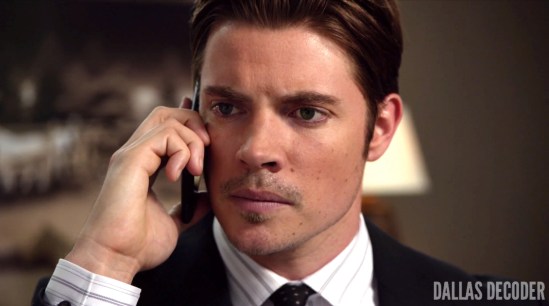
Critique: TNT’s ‘Dallas’ Episode 30 — ‘D.T.R.’

Dallas, D.T.R., Linda Gray, Sue Ellen Ewing, TNT

Woman of the hour

Let’s get this out of the way first: “D.T.R.” stands for “define the relationship,” as Christopher’s new girlfriend Heather helpfully explains in the scene where they get to know each other better in the bar. I wasn’t familiar with the expression until recently and neither were a lot of “Dallas” fans, judging by the reactions I’m seeing on Twitter. But no matter. This episode is really about the “Dallas” characters trying to dominate their relationships. Everyone is vying for control of everyone else, demonstrating once again that the real commodity on this show is power, not oil.

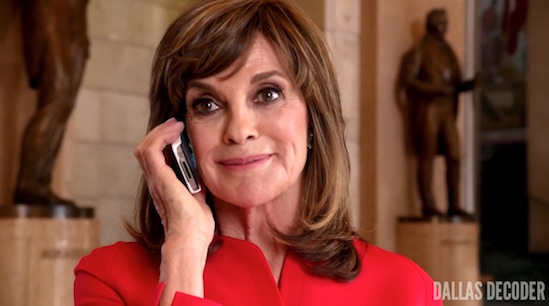
At the center of it all is Sue Ellen, a woman who spent years struggling to take charge of her own life. Now she’s trying to reign in John Ross, not just because he’s beginning to remind her of J.R., but also because he’s beginning to remind her of herself. Sue Ellen sees her son becoming addicted to feeding his own ego, just like she’s hooked on the booze inside her flask. This point is underscored in the scene where she tells John Ross that he’s being “reckless” by cheating on Pamela. Sue Ellen might as well be describing the person she used to be, during her own self-destructive phase, before she became the much more functional alcoholic we see today.

John Ross ends this scene by accusing his mother of taking out on him her lingering anger toward J.R. “Guess what, Mama? I’m not J.R.,” he says. These are surprising words coming from a young man who struts around wearing Daddy’s wristwatch and belt buckle, but they show how John Ross has picked up another one of Sue Ellen’s old habits: her penchant for denying the truth. Indeed, what fascinates me most about John Ross and Sue Ellen’s relationship this season is how they’re both borrowing different pages from J.R.’s playbook in their quest for the upper hand in their relationship. In the previous episode, John Ross showed he could treat Sue Ellen as cruelly as J.R. once did; in “D.T.R.,” Sue Ellen blackmails McConaughey in a bid to undermine her son. J.R. Ewing lives on through the people he loved most.

But even without these allusions to our hero, Sue Ellen and John Ross’s storyline is absorbing and effective. Much of this has to do with Linda Gray and Josh Henderson, who do remarkable work in “D.T.R.” Gray enlivens every scene she’s in through the sheer force of her presence; it’s become cliché to say she lights up the screen each time she appears, but I can think of no better way to describe what she brings to this show. Henderson, in the meantime, is nothing less than outstanding: In his hands, John Ross has become dark and dangerous. It doesn’t hurt that both actors receive wonderful material from scriptwriter Aaron Allen, who helps make the characters feel real and knowable. Strip away all the references to “fracking” and the “Arctic play” and it’s easy to see this is the story of a mother trying to save her son from himself.

Allen — who also wrote “Let Me In,” the episode where Harris stifles Emma’s bid for independence — uses “D.T.R.” to return to the power struggles within the Ryland family too. As John Ross points out, Emma is supposed to control Judith, who is supposed to control Harris, although it’s hard to figure out who really runs the show. Here’s what I find most interesting about these characters: As deceptive as they are, they use the truth to emotionally bludgeon each other. In “D.T.R.,” when Ann declares her “role” at Southfork is to care for her loved ones, Emma reminds her mother that she “lied to her husband about my very existence.” It’s harsh, but is it inaccurate? Similarly, in the tense scene where Judith and Emma haggle over Harris’s files, is Judith wrong when she tells Emma that she “degrades” herself by sleeping around?

The Rylands always give us plenty to ponder, but there’s no questioning the quality of the actors’ performances. Judith Light makes it clear Judith loves her rebellious granddaughter, while Emma Bell never lets us forget her character has vulnerabilities, no matter how wicked she behaves. I also love Brenda Strong, who knocks me out in the scene where Ann angrily kicks Emma off Southfork, although she’s equally good when Ann warily welcomes her daughter home. It’s also nice to see Steven Weber take another turn as the slick Governor McConaughey, as well as Todd Terry, who returns as hapless State’s Attorney Peter Bedford, one of the last people to have the honor of being blackmailed by J.R. Ewing. Speaking of J.R.’s victims: The “D.T.R.” scene where Cliff calls Pamela and tries to mend fences with her restores a shred of humanity to the character, but I mostly love the scene because it allows Ken Kercheval to revive his mantra from the second season: “I did not kill J.R.!”

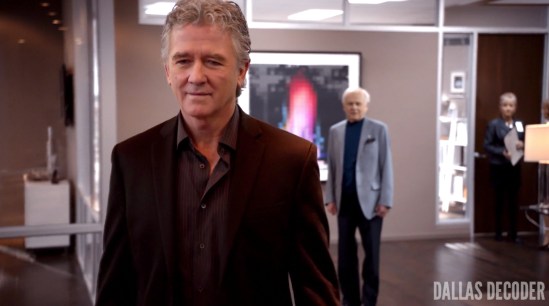
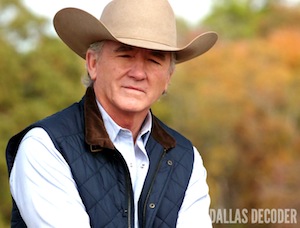
There’s much more to like about “D.T.R.,” especially where Patrick Duffy is concerned. I love how cinematographer Rodney Charters, who doubles as this episode’s director, gives us a shot of solemn, solitary Bobby on horseback watching the smug John Ross inspect the Southfork drill site. It makes Bobby’s end-of-the-episode speech about upholding the Southworth traditions that much more poignant. It’s also a kick to see Bobby and Sue Ellen in the back of the van, eavesdropping on McConaughey, as well as the big reveal at the press conference, when Bobby steps forward as the new railroad commissioner. (Between this scene and the one in “Playing Chicken” where Bobby steps out of Rhonda’s car, Duffy is becoming “Dallas’s” master of the grand entrance.)

“D.T.R.’s” use of the J.R. Ewing Bourbon bottle is also inspired: The revelation that the cork is bugged is the third season’s best twist yet, but I also love how the bottle practically becomes a stand-in for J.R. himself. Gray has a Hagman-esque twinkle in her eye when Sue Ellen gives the bourbon to McConaughey at the top of the hour and reminds him that “good blackmail never sours.” The twinkle is there at the end of the episode too, when Sue Ellen reveals the dirt on McConaughey and he slides the bottles across his desk toward her and says, “This is why politicians should never accept gifts — especially gifts with J.R.’s name on them.”

The only thing missing from this scene is seeing J.R.’s smile, although I must say: Sue Ellen’s sly grin is pretty wonderful too. Of course, that’s always been true, hasn’t it?

Grade: A

_______________________________________________________________________________________________________________________________________________
Bobby Ewing, Dallas, D.T.R., Patrick Duffy

The steward

‘D.T.R.’

Season 3, Episode 5

Telecast: March 24, 2014

Audience: 1.79 million viewers on March 24

Writer: Aaron Allen

Director: Rodney Charters

Synopsis: Sue Ellen blackmails McConaughey into removing Babcock from the Railroad Commission and replacing him with Bobby. Emma blackmails Judith into giving John Ross access to Ryland Transport’s ships and tells him she wants a piece of the Arctic drilling venture. Harris blackmails the CIA into giving his family extra protection. Cliff urges Elena and Nicolas to turns John Ross against Pamela, and when Nicolas examines photographs of J.R.’s autopsy, he notices an unusual incision on his chest. Christopher learns Heather is divorced from Bo and that they have a young son, Michael.

Cast: Amber Bartlett (Jill), Emma Bell (Emma Ryland), Donny Boaz (Bo McCabe), Jordana Brewster (Elena Ramos), Candace (Jude Demorest), Juan Pablo Di Pace (Nicolas Treviño), Patrick Duffy (Bobby Ewing), Julie Gonzalo (Pamela Ewing), Linda Gray (Sue Ellen Ewing), Josh Henderson (John Ross Ewing), Ken Kercheval (Cliff Barnes), AnnaLynne McCord (Heather McCabe), Jesse Metcalfe (Christopher Ewing), Gino Anthony Pesi (George Tatangelo), Mitch Pileggi (Harris Ryland), Brenda Strong (Ann Ewing), Todd Terry (State’s Attorney Peter Bedford), Steven Weber (Governor Sam McConaughey)

“D.T.R.” is available at DallasTNT.com, Amazon.com and iTunes. Watch the episode and share your comments below.

Critique: TNT’s ‘Dallas’ Episode 29 — ‘Lifting the Veil’

Dallas, John Ross Ewing, Josh Henderson, Lifting the Veil, Linda Gray, Sue Ellen Ewing, TNT

Long time coming

“Lifting the Veil” reveals new truths about several “Dallas” characters, beginning with John Ross. We’ve always known he was as ambitious and as charming as J.R., but in the scene where Sue Ellen confronts him about his infidelity and he treats her cruelly, we discover the son can also be as mean as the father. This episode offers fresh insight into Sue Ellen’s psyche as well. It’s clear now that she’s having trouble letting go of the past, although to be fair, every time she takes a nip from her flask, we’re reminded that the past has a pretty firm grip on her too.

The confrontation between mother and son is the hands-down highlight of “Lifting the Veil,” an hour that brims with history and heartache. The scene begins when Sue Ellen enters John Ross’s bedroom while he’s getting ready for his wedding and tells him she knows he’s been cheating with Emma. John Ross dismisses the relationship as “just business,” which only disgusts Sue Ellen further. “Just like your daddy, finding a way to explain infidelity,” she says. John Ross responds by pointing out the smell of alcohol on his mother’s breath, but she doesn’t back down and threatens to tell Pamela about his affair. John Ross is nonplussed. He brushes past Sue Ellen and delivers his lowest blow yet: “You have looked the other way you’re whole life, Mama. One more time’s not going to hurt.”

Josh Henderson does a nice job bringing John Ross’s dark side into the light, just like Larry Hagman used to do with J.R. For Henderson, though, this amounts to a creative risk: Until now, he’s played John Ross as a (mostly) likable rapscallion, but in this scene, the actor shows us he’s equally adept at making his character seem like an unapologetic jerk. Henderson makes John Ross’s ever-growing hubris feel believable throughout this episode (including during his pre-wedding visit to the brothel), but especially in this scene. Linda Gray, in the meantime, is as magnificent as ever. You can feel Sue Ellen’s pain when Gray delivers that “just like your daddy” line; it’s the character’s saddest moment since her graveside eulogy for her ex-husband in “J.R.’s Masterpiece.” In some ways, “Lifting the Veil” serves as a kind of companion piece to the funeral episode. The first one shows Sue Ellen grieving the loss of J.R.; in the second, she mourns his “return” through the sinful nature of their son.

I also like how Bethany Rooney, a first-time “Dallas” director, stages John Ross and Sue Ellen’s confrontation. The conversation unfolds while he’s fastening his cuff links and putting on his jacket; the casualness of his actions makes his words seem even more devastating. This is one of those times I wish TNT’s Southfork sets more closely resembled those used on the original “Dallas.” J.R. and Sue Ellen’s old bedroom was such a battleground; how cool would it have been to see John Ross and Sue Ellen clash in that setting? On the other hand: the newer bedroom has become a consequential place in its own right. This is where Sue Ellen once slapped J.R. and where she got drunk on the night before his funeral. It’s where John Ross defended his relationship with Pamela to his father and now, it’s where he defends his unfaithfulness to her to his mother.

Speaking of Pamela: I also like the “Lifting the Veil” scene where John Ross pleads with her to go through with their wedding, despite the fact that he was missing for much of the day. Henderson is so heartfelt, it almost inoculates John Ross from the anger we feel toward him after he’s mean to his mama. (Emphasis on “almost.”) Julie Gonzalo makes Pamela’s disappointment palpable, and I like how Taylor Hamra’s script gives her a line where she notes how much John Ross’s apologies sound like the ones Cliff used to offer her. It’s a subtle reminder that Pamela is still haunted by her daddy, just like John Ross is haunted by his.

This brings me to a gripe: I wish “Lifting the Veil” played up the old Barnes/Ewing feud a little more. The wedding of J.R.’s son and Cliff’s daughter is a moment of consequence to students of “Dallas” mythology; I’m glad Rooney gave us a glimpse of the framed photograph of J.R., but I would’ve also loved a shot of Cliff, stewing in his Mexican jail cell, knowing his daughter was marrying a Ewing back home. Likewise, “Dallas” does such a nice job of incorporating Audrey Landers into the narrative whenever she guest stars — Sue Ellen and Afton’s bitchy exchange was a special treat for longtime fans — so I can’t help but wonder why the show seems to struggle to find meaningful things for Steve Kanaly and Charlene Tilton to do when Ray and Lucy visit.

Additionally, it’s worth noting this episode takes place in a single day — you’d have to dig deep into “Dallas’s” past, all the way back to 1978’s “Barbecue,” to find another — although I wish the focus remained on the doings at Southfork the way it does in the early episode. I could do without most of the “Lifting the Veil” scenes set at the brothel (the fanciest little whorehouse in Texas?), especially the silly bit with the railroad commissioner and his canine fetish. The revelation that Judith Ryland is the madam is also a bit much, especially when you consider the show has already established her as a drug smuggler. Does Mother Ryland rob banks too? On the other hand: I like the twist that Harris is secretly working with John Ross’s secretary, Candace, although I’m not wild about his scheme to use her to collect, uh, DNA evidence from John Ross in order to frame him for a sex crime.

My reservations about the Rylands aside, you’ve got to love Judith Light’s 1980s lion’s–mane hair in her brothel scene, as well each actor’s pitch-perfect look at the wedding. Since interviewing “Dallas” costume designer Rachel Sage Kunin and hairstylist Charles Yusko, I’ve developed a much greater appreciation for how crucial the wardrobe and hair teams are to establishing each character’s persona. To see what I mean, go watch the wedding scenes at the end of the new show’s first episode, “Changing of the Guard.” Notice how much more sophisticated and womanly Gonzalo’s character looks in “Lifting the Veil” when compared to the earlier wedding? The two sequences were filmed just two years apart, so the change in the actress’s appearance is achieved mostly through Yusko and Kunin’s magic.

In a show that has more than its share of big stars, it’s always worth remembering that some of the brightest work behind the scenes.

Grade: B

_______________________________________________________________________________________________________________________________________________

Afton Cooper, Audrey Landers, Dallas, Julie Gonzalo, Lifting the Veil, Pamela Rebecca Barnes Ewing, TNT

Like father, like husband

‘LIFTING THE VEIL’

Season 3, Episode 4

Telecast: March 17, 2014

Audience: 1.8 million viewers on March 17

Writer: Taylor Hamra

Director: Bethany Rooney

Synopsis: John Ross blackmails a Texas land-use commissioner into giving him a permit to drill on Southfork, while Harris tells Judith he’s secretly working with Ewing Energies secretary Candace, who’s going to help Harris frame John Ross so he can blackmail him and reclaim his files. Sue Ellen confronts John Ross about his affair with Emma, but John Ross dismisses his mother’s concerns and exchanges vows with Pamela. Christopher returns from Mexico and warns Elena that Nicolas is married, but Nicolas assures Elena he’s getting a divorce. Later, Lucia arrives in Dallas and threatens to expose secrets from Nicolas’s past if he doesn’t reconcile with her, while Christopher and Heather make love.

Cast: Kuno Becker (Drew Ramos), Emma Bell (Emma Ryland), Jordana Brewster (Elena Ramos), Angélica Celaya (Lucia Treviño), Candace (Jude Demorest), Juan Pablo Di Pace (Nicolas Treviño), Patrick Duffy (Bobby Ewing), Julie Gonzalo (Pamela Ewing), Currie Graham (Commissioner Stanley Babcock), Linda Gray (Sue Ellen Ewing), Josh Henderson (John Ross Ewing), Steve Kanaly (Ray Krebbs), Audrey Landers (Afton Cooper), Judith Light (Judith Ryland), AnnaLynne McCord (Heather), Jesse Metcalfe (Christopher Ewing), Mitch Pileggi (Harris Ryland), Brenda Strong (Ann Ewing), Charlene Tilton (Lucy Ewing), Denyse Tontz (Chastity), Erika Page White (Sapphire)

“Lifting the Veil” is available at DallasTNT.com, Amazon.com and iTunes. Watch the episode and share your comments below.
Critique: TNT’s ‘Dallas’ Episode 28 — ‘Playing Chicken’

Bobby Ewing, Patrick Duffy, Playing Chicken, TNT

Always the winner

Bobby Ewing plays two games of chicken in “Playing Chicken,” and of course he wins both. First, Bobby uses — forgive me for this — fowl means to foil John Ross’s latest scheme to drill on Southfork. Later, when Nicolas tries to prove the Ewings framed Cliff for J.R.’s “murder,” Bobby faces off against the younger man and forces him to blink first. Both scenes are a kick, reminding us how essential Patrick Duffy is to “Dallas.” They also demonstrate Duffy’s versatility; no matter what the script calls for, this man always delivers — and he always looks damn cool doing it.

The scene with John Ross opens with Josh Henderson’s character giving his crew of ranch-hands-turned-roughnecks a pep talk when a cheerful Uncle Bobby shows up toting a cage with a big bird inside. Bobby proceeds to give his ambitious nephew a lesson on the plight of the “lesser prairie chicken,” explaining how it’s an endangered species whose presence on Southfork means the government will deny John Ross’s request for a drilling permit, lest he disturb the creature’s natural habitat. John Ross fumes; Bobby smiles. “He is awful cute, though, isn’t he?” Bobby asks, motioning toward the cage.

I love this scene mostly because it’s nice to see “Dallas” lighten up, but also because it recalls all the times Bobby bested J.R. with a wink and a grin. The role of happy warrior has always suited Duffy well, and his timing here is as sharp as ever. Everyone else seems to get into the spirit too: Henderson shows he can deadpan with the best of them, while director Jesse Bochco delivers a whimsical shot of John Ross from inside the chicken’s cage. (Shades of the “horse-cam” used to shoot Emma Bell last year.) Even composer Rob Cairns has a little fun with this scene; his underscore is noticeably jauntier than usual.

Bobby’s other big scene begins with Nicolas arriving in a darkened parking lot to meet Rhonda Simmons, the club hostess whose testimony helped convict Cliff. Nicolas believes Rhonda is going to turn against the Ewings; when he finds her standing near her car, he congratulates her and tells her she’s made “the right decision.” Suddenly, the passenger door opens and out steps … Bobby, who makes it clear Rhonda isn’t changing her story after all. This would be a triumphant moment no matter which Ewing had emerged from Rhonda’s car, but the fact that it’s Bobby makes it especially satisfying. He’s always been our white knight, and frankly he’s the only Ewing with the moral authority to make framing Cliff for murder seem like the right thing to do.

But even though Patrick Duffy is the indisputable man of the hour in “Playing Chicken,” Gail Gilchriest’s terrific script ensures no one gets shortchanged. It’s especially nice to see lots of scenes with the always wonderful Brenda Strong, whose character gets to demonstrate a little personal growth. When Sue Ellen confides in Ann her fears about John Ross and Emma, I expect Ann to dismiss the suggestion outright. Instead, she says, “I know I’ve been defensive about Emma’s behavior in the past. You were right about her drug use. Maybe you’re right this time too.” Strong always makes Ann feel like one of the grownups in the room, but the job is easier when she has smart writing like this to work with.

It’s also interesting to see Ann turn to Harris to help reign in Emma. I love Duffy and Strong together, but there’s also no denying the actress’s chemistry with Mitch Pileggi. Does this scene suggest Ann is softening toward her ex-husband? Or is the show merely using Ann to smooth Harris’s rough edges? During their conversation, Ann urges Harris to come clean to Emma about his connection to the CIA; he rejects that suggestion, but he nonetheless reveals a little humility: “I never meant to put the people that I love in danger, Annie. As awful as you think I am, I do love our daughter.” Who knew the “l” word was in Harris’s vocabulary? Also, notice how he says “the people that I love.” Does that include Ann?

Other highlights: Sue Ellen’s masterful manipulation of Bum, as well as the scene where he shows up on her doorstep and confesses his deception. I’m delighted “Dallas” is exploring the relationship between these characters, not just because they have such an opposites attract charm — the uptown lady and the downtown private eye — but also because Kevin Page might be the only actor on this show who comes close to matching Linda Gray’s soulfulness. I have no idea where Sue Ellen and Bum are headed, but whether they remain friends or become something more, I hope we keep seeing a lot of scenes between them.

I’m a little less enthralled with the romance that develops in “Playing Chicken” between Elena and Nicolas, especially since we’ve been told their characters grew up thinking of each other as siblings. On the other hand, I’m more impressed than ever with Juan Pablo Di Pace: Nicolas is so suave and charming in his first two “Dallas” appearances, but in “Playing Chicken,” there are times he seems downright sinister. At the end of this episode, we learn Nicolas has a wife — Angélica Celaya makes an intriguing debut as Lucia Treviño — and I have no doubt we’re going to learn he’s hiding even more.

I also like “Playing Chicken’s” scenes of Christopher sleuthing around Mexico, as well as the fun Gilchriest has with John Ross’s complicated love life. No one delivers oh-no-she-didn’t moments better than Bell: What makes us despise Emma Ryland more, when she accompanies Pamela on the shopping trip and brags about her lover’s sexual prowess, or when she shows up at John Ross’s office wearing the same emerald corset that Pamela is planning to surprise him with? Fans are directing a lot of venom at Bell’s character on social media these days, and I hope the actress is wearing it as a badge of honor. She’s doing a fantastic job making Emma a vixen we love to hate.

I’m also left pondering the scene where John Ross rejects Pamela’s romantic overtures. Is this an attack of conscience, or is he beginning to realize Emma is dangerous? Whatever the reason, John Ross’s personal entanglements are probably going to be the least of his worries. In “Playing Chicken’s” most chilling scene, Harris tells Judith that the files in his safe — which include “unflattering” information about her — are now in John Ross’s possession. Says Judith: “I’m sure we can find something to compromise young Mr. Ewing enough to convince him to return those files. And by ‘we,’ of course I mean ‘me.’” If you were John Ross, what would make your heart drop more — hearing Judith say she wants to “convince” you of something or hearing her earlier statement that she thinks you’re “a nice-looking young man.” Shudder.

More than anything, this episode demonstrates how “Dallas” is finding a new rhythm in its third season. The first hour, “The Return,” took its time establishing the year’s themes and plotlines; the second episode, “Trust Me,” delivered the twists and turns we’ve come to expect from the TNT series (Judith does coke! Harris is CIA!); and “Playing Chicken” slows down the action once more to allow the audience to catch its breath. If the pattern holds, does that mean the next installment will be another roller coaster? I wouldn’t bet against it, especially now that we know Judith Ryland has John Ross in her crosshairs. Let the battle of the “J.R.s” begin.

Grade: A

_______________________________________________________________________________________________________________________________________________

Emma Bell, Emma Ryland, Playing Chicken, TNT

Good at being bad

‘PLAYING CHICKEN’

Season 3, Episode 3

Telecast: March 10, 2014

Audience: 1.9 million viewers on March 10

Writer: Gail Gilchriest

Director: Jesse Bochco

Synopsis: Christopher investigates Nicolas in Mexico, where he meets Lucia, Nicolas’s wife. Bobby foils John Ross’s attempt to drill on Southfork and Nicolas’s attempt to turn Rhonda against the Ewings. Later, Nicolas reveals long-hidden feelings to Elena and they have sex. Bum admits to Sue Ellen that John Ross is sleeping with Emma. When Harris tells Judith that Emma gave damaging files about her to John Ross, Judith vows to “convince” John Ross to give back the documents. Bobby promises Ann he’ll keep her and Emma safe following Harris’s revelation that he’s working with the CIA to bring down the drug cartel.

Cast: Emma Bell (Emma Ryland), Donny Boaz (Bo McCabe), Jordana Brewster (Elena Ramos), Angélica Celaya (Lucia Treviño), Juan Pablo Di Pace (Nicolas Treviño), Patrick Duffy (Bobby Ewing), Julie Gonzalo (Pamela Ewing), Currie Graham (Commissioner Stanley Babcock), Linda Gray (Sue Ellen Ewing), Josh Henderson (John Ross Ewing), Ken Kercheval (Cliff Barnes), Emily Kosloski (Rhonda Simmons), Judith Light (Judith Ryland), Jesse Metcalfe (Christopher Ewing), Scott Mullins (Nate), Kevin Page (Bum), Mitch Pileggi (Harris Ryland), Geoffrey Rivas (shopkeeper), Aaron Spivey-Sorrells (ranch hand), Brenda Strong (Ann Ewing), Michael Swanner (Dewey Templeton)

“Playing Chicken” is available at DallasTNT.com, Amazon.com and iTunes. Watch the episode and share your comments below.
Critique: TNT’s ‘Dallas’ Episode 27 — ‘Trust Me’

Dallas, Harris Ryland, Judith Light, Judith Ryland, Mitch Pileggi, TNT, Trust Me

Snow job

Is “Trust Me” the most audacious episode in “Dallas” history? It’s hard to think of another one that shocked me more. Judith Ryland seals a deal with a Mexican drug lord by snorting a few lines of coke, Harris Ryland is revealed as a CIA informant — these are not the kinds of things we’re used to seeing on this show. Some fans are upset with the producers for taking our beloved franchise in such wild directions, but you’ll hear no complaints from me. “Dallas” measures its longevity in decades; at this point, I’d be disappointed if the people in charge weren’t exploring fresh storytelling terrain.

Besides, it’s not like the twists and turns come from out of nowhere. Both scenes fit with the theme of “Trust Me,” which shows how the characters deal with the people who doubt them — and how they deal with their doubts about themselves. The word “trust” pops up repeatedly: Harris tells Judith that Emma can’t be trusted. Elena and Nicolas each tell Carmen to trust their choice to work against the Ewings. Elena tells Christopher to trust her ability to handle Nicolas. Bobby wonders if the old Southfork seismographs can be trusted. Even when “trust” isn’t used, it’s implied: Witness the scene where John Ross stands in front of Pamela, raises his right hand and swears he isn’t cheating with his new secretary. Talk about splitting hairs.

And then there’s Judith’s coke-snorting scene. It’s inexplicably staged in some kind of dirt-floored equestrian arena, where the Mexican drug lord Luis is surrounded by an entourage that includes a young man holding a golden box of cocaine, several thugs toting big guns and two costumed rodeo performers who stand on horses, twirling lassos. A setting like this wouldn’t feel out of place in a Tarantino film. Judith and Harris arrive to meet with Luis, and before you know it, she’s putting Luis’s hands all over her body and talking about the importance of trust in business relationships. Judith implies the point of her self-directed pat down is to prove she’s not wearing a wire, but does anyone doubt she’s also seeking cheap thrills? For that matter, isn’t she also telegraphing a message about her mettle to Harris, who stands next to her, his mouth agape?

The scene continues with Judith shrewdly explaining how she’s going to use shell companies, wastewater trucks and unmapped roads to smuggle Luis’s drugs into Texas — and then we get to the moment that sent “Dallas” fans into a tweeting frenzy on the night “Trust Me” debuted. Judith leans into Luis’s cocaine box, snorts, throws back her head and delivers her hashtag-ready exclamation: “Hot damn! Mama like.” She even rubs a little coke on her gums for good measure. I suppose this is another way for Judith to prove her trustworthiness to the cartel, but let’s not kid ourselves: “Dallas” is trying to shock us — not that there’s anything wrong with that. I love this show’s insistence on being unpredictable. If this scene does nothing else, it demonstrates how eager the people who make “Dallas” are to entertain us. How can you not appreciate that?

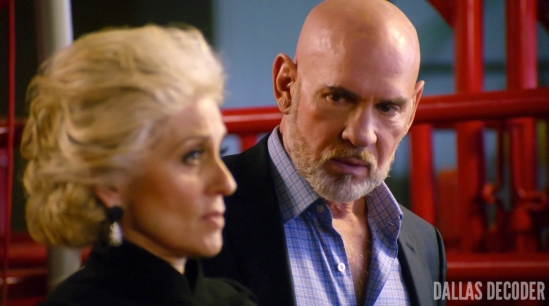
As much as I admire Judith Light’s fearlessness in this scene, I have to hand it to Mitch Pileggi, whose reaction shots are priceless. (Director Millicent Shelton, who also helmed last season’s Harris-centric “Let Me In,” is smart enough to keep cutting back to him throughout Judith’s antics in the arena.) I also love how Light and Pileggi play off each other in their other scene in “Trust Me,” when Judith returns to the Ryland roost and announces she’s taking charge of the family trucking — er, transportation — business. Bruce Rasmussen’s script gives Light one delicious line after another, including an allegory that could have rolled off the silver tongue of J.R. Ewing: “Money and morality are like two cars on a one-lane road. When they meet, morality’s going to end up in the ditch.” Light savors every syllable, and once again, Pileggi holds his own. I think it’s telling that after I saw “Trust Me,” I spent more time quoting one of Harris’s lines (“You think you know what you’re getting into, but you don’t”) than any of Judith’s. I don’t know what I love more: Pileggi’s Texas accent, or the way he snarls his dialogue.

It’s also worth noting how much “Trust Me” humanizes Harris Ryland. In the scene where Judith negotiates the new deal with the cartel, notice how Harris doesn’t say a word until Luis implies he’ll hurt Emma if the Rylands don’t hold up their end of the bargain. “My daughter has nothing to do with this!” he says. For that matter, notice how Harris keeps a framed photograph of Ann with baby Emma in his office. This is a man who cares about the women in his life, even if he sometimes calls them names. (Pileggi’s other great line in this episode describes Emma: “She’s a little monster who put me in jail.”)

This also explains why I welcome the episode-ending revelation about Harris’s connection to the CIA, which requires more than a little trust on Bobby and Ann’s behalf. Like Larry Hagman, Pileggi is such a charismatic actor you can’t help but root for his character, no matter how wicked he becomes. I was having a hard time cheering for Harris, though, knowing that he was a drug trafficker. Now I’m glad I can cast those concerns aside. (I can cast them aside, right “Dallas”?) I don’t think there’s any danger of Harris turning into a white knight, but I’m glad to know there are lines he won’t cross.

Of course, as much as the Rylands fascinate me, I would be remiss if I didn’t point out how good the rest of “Trust Me” is. The Southfork barbecue scenes evoke the spirit — if not the down-home grandeur — of Ewing shindigs from days gone by. It’s fun to see John Ross rankle all the women in his life — mother, wife, mistress — by chatting up the other pretty ladies. (One is played by “Survivor” contestant Andrea Boehlke, who is Josh Henderson’s girlfriend in real life.) The only thing I enjoy more is Pamela’s hot dance with the ever-intriguing Nicolas Treviño — not just because it’s good to see Pamela give her flirtatious husband a taste of his own medicine, but also because it demonstrates why the magnetic Juan Pablo Di Pace is such a smart addition to this show. Di Pace enlivens every scene he appears in; as one of my fellow fans pointed out on Twitter the other night, he has chemistry with everyone, including Jesse Metcalfe’s Christopher, whose tête-à-tête with Nicolas over a couple of Miller Lites is another barbecue highlight.

Rasmussen’s script allows “Dallas’s” supporting performers to shine too. No one impresses me more than Kevin Page, whose character Bum has become the conscience of this show. Besides Judith Light’s dialogue, Page has the episode’s most memorable line when he shows John Ross the pictures he took of him and Emma and says, “Grow into your father’s greatness, not his weakness.” Bum’s mysterious-but-strong connection to J.R. makes him the only character on this show who can get away with putting John Ross in his place; he could become an even more effective surrogate father than Uncle Bobby. It’s tempting to chastise Bum for deceiving Sue Ellen about John Ross’s adultery, except there’s no doubt he’s only trying to spare her heartache. And am I the only one who wants to see more scenes between Page and Linda Gray?

This episode’s other M.V.P.: Marlene Forte, who has two great scenes. In the first, Carmen is aghast to learn Elena is working against the family to whom Carmen has pledged her loyalty; in the second, Carmen comes face to face with Nicolas, a boy she helped raise who is now Elena’s partner in crime. I love when Carmen touches the medal around Nicolas’s neck and tells him, “If even for a moment I sense that you are leading either of my children into the darkness, not even St. Christopher will be able to save you.” I’ve always believed Carmen has the potential to become one of this show’s moral centers, and now it looks like that might be happening.

It’s true that Nicolas’s backstory with the Ramoses is a little odd: I suppose we’re meant to believe Carmen and her husband raised him in Mexico but left him behind when they moved to Texas with their biological children, which is why Nicolas isn’t familiar to the Ewings. It’s another example of how the details on this show are sometimes fuzzy, although I’ve learned it’s not worth sweating the small stuff because the new “Dallas” almost always gets the big picture right. Will I still feel that way at the end of this season? Who knows? I have no idea where this series is headed next, but after watching its first 27 hours, I have faith in the people who make it. They’ve earned my respect — and my trust.

Grade: A

_______________________________________________________________________________________________________________________________________________

Bum, Dallas, Kevin Page, TNT, Trust Me

Independent lens

‘TRUST ME’

Season 3, Episode 2

Telecast: March 3, 2014

Audience: 1.9 million viewers on March 3

Writer: Bruce Rasmussen

Director: Millicent Shelton

Synopsis: At Sue Ellen’s request, Bum follows John Ross, but Bum lies and tells her there’s no evidence her son is cheating on Pamela. At the Ewing Barbecue, Christopher and Heather grow closer and Pamela arouses John Ross’s jealousy by dancing with Nicolas. Elena snoops around Bobby’s laptop and discovers an email that connects him and Carlos to Rhonda. Judith takes over Harris’s drug trafficking operation and negotiates a new deal with the cartel. When Bobby and Ann begin investigating Harris’s release from jail, Harris reveals the truth to them: He’s secretly working with the CIA to bring down the cartel.

Cast: John Athas (U.S. Attorney Ellis Larsen), Emma Bell (Emma Ryland), Andrea Boehlke (barbecue guest), Jordana Brewster (Elena Ramos), Christian Clemenson (Howard Rieder), Candace (Jude Demorest), Juan Pablo Di Pace (Nicolas Treviño), Akai Draco (Sherriff Derrick), Patrick Duffy (Bobby Ewing), Julie Gonzalo (Pamela Ewing), Linda Gray (Sue Ellen Ewing), Josh Henderson (John Ross Ewing), Antonio Jaramillo (Luis), Judith Light (Judith Ryland), AnnaLynne McCord (Heather), Jesse Metcalfe (Christopher Ewing), Kevin Page (Bum), Gino Anthony Pesi (George Tatangelo), Mitch Pileggi (Harris Ryland), Brenda Strong (Ann Ewing)

“Trust Me” is available at DallasTNT.com, Amazon.com and iTunes. Watch the episode and share your comments below.
Critique: TNT’s ‘Dallas’ Episode 26 – ‘The Return’

Dallas, John Ross Ewing, Josh Henderson, Return, TNT

That smile

Now that “Dallas” fans know who killed J.R., we can turn our attention to a much trickier question: Who’ll be J.R.? We all realize Larry Hagman is irreplaceable, but we also understand TNT’s sequel series needs a character who can keep the plots — and on this show, that means the plottin’ and the schemin’ — moving forward the way J.R. did. Last year, the producers seemed to toy with several possible successors — even white-knight father/son duo Bobby and Christopher got in touch with their inner J.R.s — but in “The Return,” John Ross emerges as Daddy’s true heir. It’s the obvious choice. It’s also the smart one.

I’ve been a fan of Josh Henderson’s sly performance from the beginning, even comparing him to “Dallas’s” most famous alum, Brad Pitt, in my first review of the TNT series. Most of what I wrote then remains true: Henderson still has an effortless, seductive charm, and even when John Ross is up to no good, you still find him alluring. But it’s no longer accurate to call Henderson or his character “boyish,” as I did two years ago. Maybe it’s the fact that John Ross is now married and a big-shot oilman in his own right — or maybe it’s the fact that Henderson’s pecs have seemingly grown three cup sizes, as Entertainment Weekly cheekily pointed out last week — but John Ross is now much more man than boy.

Wisely, “The Return” wastes no time establishing him as “Dallas’s” new J.R., who turns out be a lot like the old one. John Ross frolics with his mistress in a hotel room, comes home and lies to his wife about his whereabouts (he says he was in Houston, buying her a “proper” engagement ring), sweet talks his mama when she frets about his ambition, clashes with Bobby over Southfork’s future (To remodel or not to remodel? To drill or not to drill?) and wheels and deals in the boardroom, where he enthusiastically declares Ewing Global is going to be “bigger than Exxon and BP combined.” (Shades of J.R.’s oft-repeated vow to make Ewing Oil the “biggest independent oil company in the state of Texas.”) John Ross even sports J.R.’s wristwatch and belt buckle, and even though the latter looks kind of big on him, is that so bad? I see it as a symbol of how carrying J.R.’s legacy will always be a burden for John Ross, no matter how muscular he gets.

What impresses me most about Henderson — in this episode and others — is how he evokes Hagman’s spirit without ever resorting to imitating the actor. Like Hagman, Henderson possesses one of the great smiles in television, but he uses it differently than the way Hagman used his. Whereas J.R.’s smile often concealed his intentions, John Ross’s lets us know what’s going on inside his head. In “The Return,” Henderson arches his eyebrow and smirks when he’s sparring with Patrick Duffy, but when John Ross is on bended knee proposing to Pamela, watch how the actor’s whole face lights up. This is a smile to melt your heart, reminding us that there’s a sensitive soul beneath all that bravado.

Of course, even though Henderson has become the new face of this franchise, “Dallas” remains a group effort, as “The Return” makes clear. This episode gives almost every member of the ensemble a nice moment or two, although special mention goes to Jordana Brewster, who is such a good actress, she makes Elena’s overnight transformation — literally — into a Ewing enemy seem believable, if not altogether reasonable. (Is Elena unaware of Cliff’s role in blackmailing Drew into blowing up the rig last season?) Brewster’s character has become the latest in a long line of “Dallas” heroines to do Cliff’s dirty work, and I love how the actress holds her own against Ken Kercheval, who is as electric as ever in Cliff’s jailhouse scenes.

I also applaud the introduction of Juan Pablo Di Pace, who makes one of the all-time great “Dallas” debuts when the oh-so-suave Nicolas Treviño sweeps into the Ewing Global boardroom and upsets the family’s apple cart. Treviño has the potential to become an altogether different kind of “Dallas” villain: richer than Jeremy Wendell and Carter McKay and every bit as calculating, but also a heck of a lot hotter. (No offense, William Smithers and George Kennedy.) I’ll never understand how the Ewings lack the “supermajority” they need to sell a division in their own company — just like the whole matter about the Southfork surface rights seems like a bunch of hooey — but let’s face it: “Dallas” has always existed in a universe where the legal realities bear little resemblance to our own.

Besides, I’d rather focus on the other ways in which “The Return” lives up to its title. This episode marks a return to many of the “Dallas” hallmarks that so many of us love, beginning with the revival of the classic three-way split-screen title sequence, which has received widespread acclaim from fans. Under Steve Robin’s direction, “The Return’s” pacing also feels a little more deliberate; there are more old-school, quiet scenes like the one where the women of Southfork sit around the patio and plan Pamela’s wedding; and there are more sequences set outdoors on the ranch, which cinematographer Rodney Charters always showcases in all of its high-definition, green-grass/blue-sky glory. No matter where the characters go on Southfork — whether it’s to the wood-chopping pile or to the “shale formation” where the cattle graze — Charters makes us feel like we’re right there with them.

I also appreciate how this episode’s script, written by co-executive producers Cynthia Cidre and Robert Rovner, is sprinkled with dialogue that pays homage to classic “Dallas” themes. One example: The tension between moving forward and clinging to old traditions has always been central to the “Dallas” mythology, which we see in Bobby and John Ross’s argument over remodeling Southfork. “It’s about time you learn to respect the past, boy,” Bobby says. John Ross’s cutting response: “The past is what holds us back, Uncle Bobby.” If I heard that line a season or two ago, I might worry it signaled this franchise was going to abandon its history, except the people in charge have long since demonstrated their commitment to preserving “Dallas’s” heritage, even if they sometimes play a little loose with the continuity.

Nothing demonstrates this better than all the references to J.R. in “The Return.” I counted at least 13 instances where he’s mentioned by name, and that doesn’t include lines like the one where Sue Ellen catches John Ross sneaking out of Emma’s bedroom and says, “What’s the matter, Mama? You look like you just seen a ghost.” There are also plenty of visual reminders: the wristwatch, the belt buckle, the gravestone and most importantly, the much-improved portrait hanging in the background at Ewing Global, which makes it seem like J.R. is always peering over someone’s shoulder.

Indeed, as tempting as it is to think of “Dallas’s” third season as the beginning of the post-Hagman era, is such a thing even possible? “The Return” keeps our hero’s memory alive, not that it was in any danger of fading in the first place.

Grade: B

_______________________________________________________________________________________________________________________________________________

Dallas, Elena Ramos, Jordana Brewster, Return, TNT

Look who’s lurking

‘THE RETURN’

Season 3, Episode 1

Telecast: February 24, 2014

Audience: 2.7 million viewers on February 24

Writers: Cynthia Cidre and Robert Rovner

Director: Steve Robin

Synopsis: Elena forms a secret alliance with Cliff, takes a job at the newly renamed Ewing Global and recruits Nicolas Treviño, a childhood friend who is now a billionaire, to serve as Cliff’s proxy. Emma, Ryland Transport’s new chief executive, gives John Ross control of the company’s drilling and cargo ships so Ewing Global can tap oil and methane reserves in the Arctic. When Nicolas tries to scuttle the Arctic deal, John Ross suggests drilling on Southfork to finance the project, but Bobby disagrees. The Mendez-Ochoa cartel bribes a judge to get Harris out of jail and threatens to kill Emma if Harris doesn’t resume his drug shipments. Christopher meets Heather, a spirited ranch hand.

Cast: Amber Bartlett (Jill), Emma Bell (Emma Ryland), Donny Boaz (Bo McCabe), Jordana Brewster (Elena Ramos), Juan Pablo Di Pace (Nicolas Treviño), Patrick Duffy (Bobby Ewing), Marlene Forte (Carmen Ramos), Julie Gonzalo (Pamela Ewing), Linda Gray (Sue Ellen Ewing), Josh Henderson (John Ross Ewing), Ken Kercheval (Cliff Barnes), AnnaLynne McCord (Heather), Jesse Metcalfe (Christopher Ewing), Kevin Page (Bum), Mitch Pileggi (Harris Ryland), Brenda Strong (Ann Ewing)

“The Return” is available at DallasTNT.com, Amazon.com and iTunes. Watch the episode and share your comments below.
Critique: TNT’s ‘Dallas’ Episode 25 – ‘Legacies’

Bobby Ewing, Dallas, Legacies, Patrick Duffy, TNT

Brother’s keeper

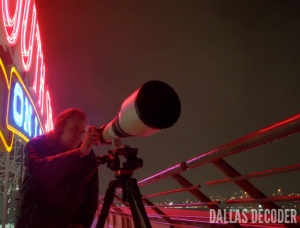
Will it surprise you to learn that I like “Legacies”? Probably not, judging by some of the comments I’ve received on this website and others lately. Some of you seem to think I’m too generous to the new “Dallas.” If I am, it’s only because I genuinely love the show. I’m also the first to admit it isn’t perfect, as “Legacies” demonstrates. This isn’t the finest hour in “Dallas” history, but it does a nice job resolving the “Who Killed J.R.” mystery and giving his death meaning. Ultimately, isn’t that what all of us want when we lose a loved one?

The episode’s best scene takes place in the Southfork graveyard, where John Ross and Christopher listen as Bobby finally reads aloud the letter J.R. left him. We learn J.R. was dying of cancer and put his master plan in motion because he wanted to end the Barnes/Ewing feud. The plan itself: J.R. had Bum shoot him so Cliff could be framed for J.R.’s “murder.” Outlandish? Sure, but there’s also something profound about the idea that J.R., the ultimate warrior, died wanting to make peace. It’s not out of character either. This is who J.R. was at the end of his life: a kinder, gentler scoundrel who wanted to protect his family, especially when it gave him an excuse to dig into his old bag of tricks.

The letter to Bobby is the centerpiece of Cynthia Cidre and Robert Rovner’s script. Even though Patrick Duffy and Jesse Metcalfe take turns reading the words, Larry Hagman’s voice is the one I hear. In my favorite passage, J.R. acknowledges the “terrible, hurtful” things he did to Bobby over the years, then adds: “I hope in the quiet place in your heart, where the truth lives, that my jealousy, as powerful as it was, was nothing compared to my love for you.” This isn’t the first time we’ve heard J.R. declare his love for his youngest brother, but it might be the first time Bobby has heard it. (In the past, Bobby was “dead” or unconscious when J.R. poured out his heart to him.) Anyone who has loved and lost a brother will find meaning in this moment.

The gravesite scene also gives us two unforgettable performances. The first comes from Duffy, whose tears move me like nothing else I’ve seen on “Dallas” this season. Bobby is usually such a pillar of strength; to see him lose his composure is touching. I’m also impressed with Kevin Page, who chokes up when Bum tells John Ross that he was the one who ended J.R.’s life. If you buy the premise that J.R. arranged his own death and that Bum pulled the trigger, it’s probably because Page is so convincing in this scene. Did you ever imagine you’d want to give Bum a hug?

“Legacies’” other big revelation comes at the top of the hour, when Christopher learns: a) his mother died of pancreatic cancer, and b) Cliff paid her doctor to create the illusion she was alive so Christopher couldn’t inherit her shares of Barnes Global. I wanted Victoria Principal to return to “Dallas” as much as anyone, but I also appreciate how this twist honors “Dallas” continuity. We last saw Pam in 1988, when we learned she had months to live. Now we find out she died in 1989. The math works. Much more importantly, this scenario redeems Pam. It always seemed out of character for her to abandon her family, so Cidre and Rovner’s script reveals Pam was undergoing experimental treatments so she could reunite with them. If nothing else, the new “Dallas” deserves credit for making sense of Pam’s absence, which was always one of the old show’s biggest blunders.

“Legacies” offers no such redemption for Cliff. To make the J.R.-killed-J.R. twist work, “Dallas” had to turn Cliff into a monster; otherwise, there was no chance the audience would accept the idea of the Ewings framing him for J.R.’s murder. A lot of fans are having a hard time believing Bobby would go along with this. I understand their incredulity, as well as their frustration with the historical rewriting that went into Cliff’s transformation. (His scheme to defraud Christopher must have started toward the end of the original show, when Cliff had become a pretty good guy.) Still, given the severity of Cliff’s crimes, is there any doubt he belongs in jail?

Even if you don’t like what happened to Cliff, you can’t deny Ken Kercheval gave the performance of his career this season. In “Legacies,” Kercheval makes you feel Cliff’s desperation and anger when the police drag him away in handcuffs (“I did not kill J.R.! I did not kill J.R.!”). There’s also something poignant about the scene where Bobby visits Cliff in that dingy Mexican jail. Here’s a son of Jock, giving the son of Digger one last chance to make peace. Confess to your real crimes, Bobby says, and I’ll help you beat this murder rap. But Cliff is defiant to the bitter end: “I have never done anything that the Ewings asked me to do, and I’m not going to start today.”

As far as I’m concerned, Cliff has to stay in jail for the duration of “Dallas.” If he gets out, J.R.’s master plan will fail and our hero’s final “victory” will be nullified. Of course, this doesn’t mean Kercheval can’t continue to appear in jailhouse scenes like the one we get at the end of “Legacies,” when Cliff anoints Elena (of all people!) as the Ewings’ latest antagonist by revealing J.R. cheated her father out of oil-rich land. This is an interesting twist, although the scene ends with a silly sound effect: After Kercheval delivers the last line (“Make the Ewings pay for the sins against your family”), listen closely and you’ll hear Hagman’s cackle mixed into the background music. (While we’re on the subject of poorly executed J.R. tributes, the painting of him revealed at the end of this episode is atrocious.)

“Legacies” director Steve Robin also gives us two memorable musical montages, one of the new show’s best signatures. The first sequence depicts the daughters of “Dallas” betraying their daddies: While Pamela plants the gun in Cliff’s trunk, Emma spikes Harris’s pancake batter, knocking him out long enough to sneak into his safe and swipe the evidence of his drug trafficking. These scenes play out to a reprise of “Liar,” the bluesy number from the Unknown that was previously heard in “False Confessions” when the police arrest Frank for Tommy’s murder.

The second “Legacies” montage, set to the Mavericks’ “Come Unto Me,” shows Elena visiting the heavily guarded compound of Joaquin, a mysterious friend from her childhood. Meanwhile, John Ross visits Emma, who gives him the rest of the papers she stole from Harris. I wasn’t crazy about the idea of John Ross cheating on Pamela, but once I saw the Hagman-esque glint in Josh Henderson’s eye and heard him deliver the scene’s kicker – “Just don’t tell my wife” – I was sold. (On a related note: Is that J.R.’s watch on John Ross’s wrist?)

Does “Legacies” have plot holes? You bet. It appears the police exhume J.R.’s body, pull the slugs out of the chest cavity (shouldn’t this have been done before the burial, by the way?) and match the bullets to Cliff’s gun, all in the time it takes Cliff and Pamela to fly from Dallas to Mexico and check into their hotel. That’s mighty swift police work, even by TV standards. Also, if the police decide to check out Cliff’s claims that he was framed, they could start by talking to the people who work at the bank where John Ross and Pamela planted the belt buckle in Cliff’s safe deposit box.

I suppose finding flubs like these is its own kind of joy, but I got a much bigger kick out of playing detective and trying to solve the “Who Killed J.R.” mystery. Don’t forget: This storyline was created on the fly by people who were working under tight pressure while simultaneously mourning the biggest star “Dallas” will ever know. All things considered, I think Cidre and company did a hell of a job. This was the most fun I had watching television in a long time. Isn’t that the point?

Grade: A

_______________________________________________________________________________________________________________________________________________

Cliff Barnes, Dallas, Ken Kercheval, Legacies, TNT

The bitter end

‘LEGACIES’

Season 2, Episode 15

Telecast: April 15, 2013

Writers: Cynthia Cidre and Robert Rovner

Director: Steve Robin

Audience: 2.9 million viewers on April 15

Synopsis: Christopher learns Pam died in 1989 and that Cliff has been paying her doctor to create the illusion she’s alive to prevent Christopher from inheriting her third of Barnes Global. Vickers is killed on Cliff’s orders. After John Ross and Pamela plant evidence to lead the police to Cliff, he’s arrested for J.R.’s murder. John Ross and Christopher persuade Bobby to read J.R.’s letter, which reveals he was dying of cancer and had Bum shoot him so Cliff could be framed. Harris is arrested after Emma exposes his role in the drug trafficking. Cliff sends Elena documents that prove J.R. stole oil-rich land from her father, prompting her to visit someone from her past named Joaquin. John Ross cheats with Emma, who brings him documents from Harris’s safe.

Cast: Sam Anderson (Dr. David Gordon), Emma Bell (Emma Brown), Karen Borta (reporter), Jordana Brewster (Elena Ramos), Cody Daniel (deliveryman), Akai Draco (Sheriff Derrick), Patrick Duffy (Bobby Ewing), Alex Fernandez (Roy Vickers), Marlene Forte (Carmen Ramos), Julie Gonzalo (Pamela Barnes), Linda Gray (Sue Ellen Ewing), Larry Hagman (J.R. Ewing), Josh Henderson (John Ross Ewing), Annalee Jefferies (Carina), Ken Kercheval (Cliff Barnes), Marcus M. Mauldin (Detective Bota), Benito Martinez (policeman), Jesse Metcalfe (Christopher Ewing), Kevin Page (Bum), Mitch Pileggi (Harris Ryland), Brenda Strong (Ann Ewing)

“Legacies” is available at DallasTNT.com, Amazon.com and iTunes. Watch the episode and share your comments below.
Critique: TNT’s ‘Dallas’ Episode 24 – ‘Guilt by Association’

Christopher Ewing, Dallas, Guilt By Association, Jesse Metcalfe, TNT

Not the mama

Oh, how I wanted Victoria Principal to be under that hat.

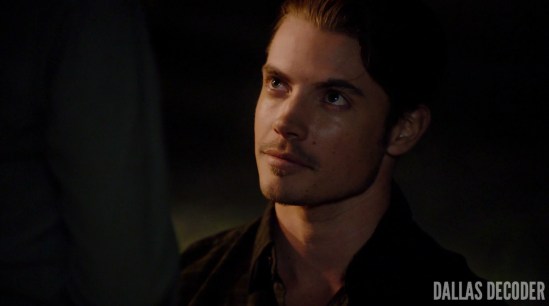
“Guilt by Association,” the “Dallas” episode that promised to reveal Pam Ewing’s fate, ends with Christopher spotting the woman he believes is his mother in the lobby of a Zurich bank. She’s wearing a wide-rimmed hat and walking alongside the doctor that Christopher believes she married. Christopher runs after the woman, grabs her shoulder, spins her around and comes face to face with … a stranger. “Who are you? Where’s my mother?” he demands. Cut to John Ross and Pamela in the vault of another bank, where they’ve just stumbled across a death certificate for Pamela’s namesake aunt. “Christopher’s mother is dead,” Pamela announces.

Talk about feeling deflated! Don’t get me wrong: I’m not a blind loyalist to Pam Ewing. I adored the character when the original “Dallas” began but always regretted how the show turned her into the saint of Southfork in her later years. I suppose that’s the main reason I hoped Principal would reprise the role: so that she could take Pam back to her scrappy, sexy roots. And even though I read the actress’s recent statement in which she eschewed the idea of playing Pam again – and even though I remembered that the last time we saw the character, she was, you know, dying – I still held out hope that somehow, in some way, Principal might actually resurface at the end of this episode.

Of course, “Guilt by Association” leaves me feeling as disappointed for Christopher as I do for myself. He goes through this episode insisting the only reason he wants to find his mother is so he can get his hands on her shares of Barnes Global and stop Cliff’s war against the Ewings. But clearly this is about more than business for Christopher. We see his true feelings when he begins to weep after Dr. Gordon tells him that Pam never wants to see him again. We also hear the hope in Christopher’s voice when he catches up with the mystery woman and says, hopefully, “Mom!” Is there anything more heartbreaking than a Ewing who misses his mama?

This makes “Guilt by Association” another showcase for Jesse Metcalfe, who has quietly established himself as a forceful presence in “Dallas’s” post-Hagman era. But this episode is also historic. Pam Ewing, “Dallas’s” original heroine, is dead. We don’t find out the details of her demise until the next episode, “Legacies,” but there’s no doubt we’re witnessing a moment of consequence. Symbolism abounds. Notice how Taylor Hamra’s smart script allows Cliff’s daughter to announce the death of Digger’s. I also appreciate how “Guilt by Association” mimics “The Prodigal Mother,” the classic “Dallas” episode in which Pam goes to Houston to confront her long-lost mother, Rebecca Wentworth. Director Jesse Bochco even gives us a shot of Christopher sitting in a car, scoping out Dr. Gordon’s house, that recalls a similar scene from the earlier episode of Pam spying on the Wentworth mansion.

The other highlight of “Guilt by Association:” the sly, sexy confrontation where Sue Ellen marches into the governor’s office and blackmails him into abandoning his scheme to prevent the Ewings from pumping oil out of their land. The exchange reminds us how much Sue Ellen learned from J.R., but it also demonstrates how essential Linda Gray has become to the new “Dallas.” You could have given this scene to another Ewing, but would it have been nearly as much fun? I also love Steven Weber, who plays Governor McConaughey to smirking perfection. I hope he returns in the show’s third season. What a great foil.

“Guilt by Association” also gives us the cool car chase that ends with a signature “Dallas” fake-out – that’s not Drew on the motorcycle, it’s his very blond friend! – as well as a memorable guest turn from reliable Sam Anderson, who takes over the role of Pam’s plastic surgeon Dr. Gordon, played on the original series by Josef Rainer. Anderson also made a couple of appearances on the old “Dallas” as a cop who investigated the death of the star witness in Jenna Wade’s murder trial, beginning with a 1985 segment called “Dead Ends.” Come to think of it, that would have made a fitting title for this episode too.

Grade: A

_______________________________________________________________________________________________________________________________________________

Dallas, David Gordon, Guilt By Association, Sam Anderson, TNT

Another dead end

‘GUILT BY ASSOCIATION’

Season 2, Episode 14

Telecast: April 15, 2013

Writer: Taylor Hamra

Director: Jesse Bochco

Audience: 2.8 million viewers on April 15

Synopsis: In Zurich, Christopher discovers Elena has been protecting Drew and sends her home, then comes face to face with the woman he thought was Pam. When John Ross and Pamela conclude Cliff killed J.R., they work with Bobby to plant evidence that will lead the police to Cliff. Sue Ellen uses information from Ken to persuade McConaughey to ease up on the Ewings. After the Ewings bail out Emma, she moves back in with Harris, who later finds her snooping in his office. The police nab Vickers after Drew plants cocaine in his car.

Cast: Sam Anderson (Dr. David Gordon), Kuno Becker (Drew Ramos), Emma Bell (Emma Brown), Jordana Brewster (Elena Ramos), Patrick Duffy (Bobby Ewing), Marlene Forte (Carmen Ramos), Julie Gonzalo (Pamela Barnes), Linda Gray (Sue Ellen Ewing), Josh Henderson (John Ross Ewing), Micky Hoogendijk (Mikki), Annalee Jeffries (Carina), Emily Kosloski (Rhonda Simmons), Lee Majors (Ken Richards), Jesse Metcalfe (Christopher Ewing), Kevin Page (Bum), Mitch Pileggi (Harris Ryland), Brenda Strong (Ann Ewing), Steven Weber (Governor Sam McConaughey)

“Guilt by Association” is available at DallasTNT.com, Amazon.com and iTunes. Watch the episode and share your comments below.
Critique: TNT’s ‘Dallas’ Episode 23 – ‘Love and Family’

Bobby Ewing, Cliff Barnes, Dallas, Ken Kercheval, Love and Family, Patrick Duffy, TNT

Walking tall

The final moments in “Love and Family” give me chills. Bobby tells Sue Ellen they need to act like J.R. and let Cliff believe he’s won, and then as a rousing rock tune rises in the background, Bobby raises a glass of bourbon to a framed photograph of his beaming big brother. Cut to John Ross and Pamela standing before a justice of the peace (John Ross: “You doing this because you love me, or because you hate your father?” Pamela: “I do.”), then to Cliff as he sweeps into Ewing Energies and takes the keys from Bobby. “I can only imagine the look on J.R.’s face right about now,” Cliff smirks. “Me too,” Bobby responds. As our hero walks away in slow motion, a sly smile breaks across his face, the drumbeat builds, the screen fades to black, and all I can think is: Damn, this show is cool.

Patrick Duffy’s smile recalls all the classic “Dallas” episodes that end with J.R.’s grin, but we feel the character’s presence throughout this episode. Christopher’s obsession with beating Cliff recalls J.R.’s own efforts to outmaneuver him during the original series. Likewise, John Ross’s ploy to snag a piece of Barnes Global by marrying Pamela bears the hallmarks of an old-school, whatever-it-takes J.R. scheme. Even the way Bobby subtly pressures John Ross into the marriage is a little J.R.-esque. Perhaps the lesson here is that J.R.’s values weren’t his alone; they belong to the whole Ewing family. This is why we shouldn’t question “Dallas’s” ability to keep going after Larry Hagman’s death. His loss leaves a hole that will never be filled, but the “Dallas” themes have always been bigger than any one character. So far the new show has done a hell of a good job reminding us of this.

In addition to keeping J.R.’s spirit alive, “Love and Honor” director Randy Zisk also showcases Brenda Strong and Emma Bell, who deliver standout performances during Ann’s confrontation with her daughter at the scene of Emma’s car wreck. My heart breaks for Emma when she lashes out at Ann for allowing the controlling Rylands to take her away when she was a child (“You escaped! You did four years! I did 20, Ann!”). I also cheer when Ann tells her daughter she won’t bail her out until she agrees to get help for her addictions. “Why are you doing this?” Emma screams as Sheriff Derrick leads her away in handcuffs. “Because I’m your mother!” Ann responds. This is probably Bell’s best scene yet and Strong’s finest moment since Ann’s testimony in “Trial and Error.” (Perhaps not coincidentally, that episode, like “Love and Family,” was written by John Whelpley, who joined the “Dallas” writing team this season.)

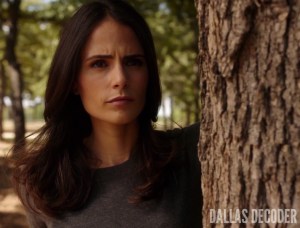
“Love and Family’s” other great performances come from Jordana Brewster and Kuno Becker, who knock me out in the scene where Drew finally confesses his role in the rig explosion to Elena. Brewster has to convey a lot of emotions – shock, anger, disappointment – all in the same breath. She sells every one. Likewise, Becker makes me feel Drew’s anguish and guilt. These two actors have another terrific scene at the end of the episode when Elena and Carmen (Marlene Forte, who holds her own against her on-screen children) bring Drew money and bid him farewell as he sets off to find Harris’s missing henchman, Roy Vickers. It’s a measure of how much I’ve come to like Becker that as I watch Drew ride away on his motorcycle, I find myself worried for the character.

The same thing can’t be said about Cliff. The scene where we learn Katherine willed her share of the Barnes-Wentworth empire to him raised the ire of “Dallas” diehards who remember there was never any love lost between those two characters. I suspect we’re going to find out there’s more to this story. Perhaps Cliff cheated Katherine out of her share, or maybe she faked her death and is in cahoots with him in his plot against the Ewings. (On “Dallas,” stranger alliances have occurred.) Either way, this seems to be another nail in Cliff’s coffin. The character has turned so villainous; it’s hard for me to imagine how the show can redeem him.

More and more, I wonder if we might be witnessing the last hurrah of Cliff Barnes. Ken Kercheval was positively chilling at the beginning of the season, when Cliff was so focused on bringing down the Ewings, he allowed Frank to kill himself rather than disrupt his schemes. Since J.R.’s death, Kercheval has given us glimpses of the man Cliff used to be – a sweeping hand gesture here, a self-satisfied smirk there – which is a clever way of signaling how Cliff is letting his guard down. (Costume designer Rachel Sage Kunin’s choices for Cliff’s wardrobe might be telling too. Notice how his all-black outfits are slowly giving way to more colorful garments. Even the old pocket squares are back.) With the Rylands now established as potent Ewing foes, I wonder if John Ross and Pamela’s wedding in this episode will mark the beginning of a new chapter in the Barnes/Ewing feud – or will it serve as a kind of denouement?

With these questions on my mind, I can’t help but find Bobby’s slow-motion walk away from Cliff at the end of this episode kind of poignant. After all these years, Cliff has gotten his revenge. (Tellingly, the title of the terrific song that plays during this sequence is “My Time Has Come” by the Bowery Riots.) Even if you don’t like Cliff, you have to admire his persistence. You also have to admit: It’s going to be mighty satisfying to see the Ewings take this bastard down.

Grade: A

_______________________________________________________________________________________________________________________________________________

Dallas, John Ross Ewing, Josh Henderson, Julie Gonzalo, Love and Family, Pamela Barnes, TNT

Here we go again?

‘LOVE AND FAMILY’

Season 2, Episode 13

Telecast: April 8, 2013

Writer: John Whelpley

Director: Randy Zisk

Audience: 2.4 million viewers on April 8

Synopsis: John Ross marries Pamela after she persuades Cliff to give her one-third of Barnes Global. Cliff takes control of Ewing Energies. After Emma gets high and wrecks her car, Ann refuses to bail her out. Drew confesses his role in the bombing to Elena, who gives him money after he goes on the run to find the missing Vickers. Christopher and Elena leave for Zurich to find Pam.

Cast: Kuno Becker (Drew Ramos), Will Beinbrink (Curran), Emma Bell (Emma Brown), Jordana Brewster (Elena Ramos), Ralph Brown (justice of the peace), Ron Corning (news anchor), Jerry Cotton (judge), Akai Draco (Sheriff Derrick), Patrick Duffy (Bobby Ewing), Todd Everett (prosecutor), Alex Fernandez (Roy Vickers), Marlene Forte (Carmen Ramos), Julie Gonzalo (Pamela Barnes), Linda Gray (Sue Ellen Ewing), Josh Henderson (John Ross Ewing), Cynthia Izaguirre (news anchor), Ken Kercheval (Cliff Barnes), Jesse Metcalfe (Christopher Ewing), Kevin Page (Bum), Mitch Pileggi (Harris Ryland), Brenda Strong (Ann Ewing), Steven Weber (Governor Sam McConaughey)

“Love and Family” is available at DallasTNT.com, Amazon.com and iTunes. Watch the episode and share your comments below.
Critique: TNT’s ‘Dallas’ Episode 22 – ‘A Call to Arms’

Call to Arms, Dallas, John Ross Ewing, Josh Henderson, TNT

Cry wolf

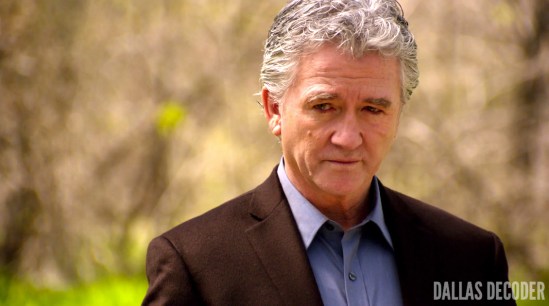
The new “Dallas” often feels like more of an ensemble show than the original series did. Every member of the endlessly growing cast generally gets a meaningful scene or two in each episode, although there are times when one actor seems to leave a bigger impression than others. In “A Call to Arms,” Josh Henderson is the one to watch. With help from Gail Gilchriest and Julia Cohen’s solid script, Henderson gives us a fresh look at John Ross’s vulnerabilities as the character struggles with Pamela’s rejection and begins to question his decision to follow in J.R.’s footsteps as Southfork’s schemer-in-chief. It’s a terrific performance.

My favorite scene is John Ross’s exchange with Uncle Bobby. The younger man sits in the bedroom he inherited from J.R., drinking his father’s bourbon and feeling regretful because Pamela didn’t believe him when he tried to tell her about Cliff’s machinations. “For once in my damn life, I told the truth. And she thought it was a move. I guess I’m the like boy who cried wolf,” John Ross says. This line reminds us how different John Ross is from his father. J.R. had plenty of moments of introspection on the old show, but we didn’t see him wrestle too often with feelings of self-doubt or remorse. John Ross, on the other hand, feels a little more moralistic. We saw this for the first time last season, when he tried to persuade J.R. to give up his battle for Southfork, and now we see it again in this scene with Uncle Bobby.

I also like this exchange because it does such a nice job honoring “Dallas” history. Bobby recalls his marriage to his Pamela, and the glint in Patrick Duffy’s eye suggests his character isn’t just nostalgic for those days; I get the feeling he’s still carrying a torch for his first wife. The conversation also acknowledges the special bond that has always existed between Bobby and John Ross, as longtime fans who remember Duffy’s scenes with young Omri Katz can attest. Between “A Call to Arms” and the previous episode, when Bobby shakes John Ross’s hand and welcomes him home to Southfork, I have a feeling the relationship between uncle and nephew is going to take on greater prominence as the new “Dallas” progresses.

We also see a more mature John Ross in the scene where Cliff sweeps into the Ewing Energies conference room and announces he’s taken over the company’s bank loan. When Christopher calls Cliff a “son of a bitch” and begins to lunge at him, it’s John Ross who puts his hand on his cousin’s shoulder and eases him back into his seat. The moment echoes the beginning of the brawl at the memorial service in “J.R.’s Masterpiece,” when Christopher rushes to John Ross’s side (“I’ve got this, cousin”) after one of the mourners insults J.R.’s memory. I know this truce between John Ross and Christopher isn’t going to last, but isn’t it nice to see them getting along? It makes both characters feel less like boys and more like men.

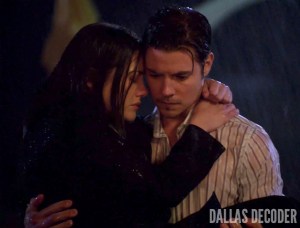
Henderson has two more moments in “A Call to Arms” that stand out: the swoon-worthy scene where he sweeps Julie Gonzalo’s Pamela off her feet in the pouring rain, which might symbolize the storm swirling around the Ewings as their enemies descend upon them. (The scene also makes me appreciate the technical mastery of the people who work behind the camera on this show. My guess is the crew, led by first-time “Dallas” director Ken Topolsky, had to create that rain.) I also like the opening scene, when John Ross dramatically removes his sunglasses in front of McConaughey and recalls how J.R. took down three senators, two governors and a vice president (!), adding: “He taught me everything he knows. Your head’s going to look real nice above my fireplace, governor.” Even though I’m glad John Ross hasn’t become a carbon copy of his father, a little Hagman-esque flair is nice now and then, and Henderson nails it in that sequence.

Other good moments: Sue Ellen’s scene with Bum, which demonstrates the unexpectedly charming rapport between Linda Gray and Kevin Page; the chilling final scene, where Christopher and Elena learn his mother may be alive and living under the alias “Patricia Barrett” in Zurich; and all those what-will-she-do-next sequences with wild child Emma, including the kinky scene where she entices a rodeo cowboy into snagging some painkillers for her by biting his lip. I also got a chuckle from Ken Kercheval’s deliciously malevolent delivery when Cliff announces he’s picked up the Ewings’ bank note; the actor’s line – “I love a good fire sale” – might be a sly tribute to Cliff’s skinflint tendencies on the old show.

“A Call to Arms’” other highlight: Steven Weber, who gives another nicely measured performance as the corrupt McConaughey. If Weber feels any temptation to chomp scenery, he wisely resists it. The actor gets one of this episode’s best lines – “I guaran-damn-tee!” – but he avoids going over the top when he delivers it. I hope he’s going to be with “Dallas” for awhile.

I also appreciate how “A Call to Arms” brings back Jason Douglas as McConaughey’s aide, who first appeared in the TV news report about Sue Ellen’s imploding political campaign at the end of the second-season premiere, “Battle Lines.” Some trivia: When TNT sent a preview of that episode to critics and bloggers, Douglas was identified in the fictional newscast as “Sam McConaughey;” by the time the episode was telecast, the reporter’s voiceover narration and on-screen graphics had been changed to refer to him as the McConaughey campaign’s chief of staff.

Interesting, huh? Makes me wonder if there might be more recasts in this show’s future.

Grade: B

_______________________________________________________________________________________________________________________________________________

Call to Arms, Dallas, John Ross Ewing, Josh Henderson, Julie Gonzalo, Pamela Barnes, TNT

Perfect storm

‘A CALL TO ARMS’

Season 2, Episode 12

Telecast: April 8, 2013

Writer: Gail Gilchriest and Julia Cohen

Director: Ken Topolsky

Audience: 1.9 million viewers on April 8

Synopsis: McConaughey uses the Henderson property to build a pipeline. Cliff buys the Ewings’ bank note and vows to take control of Ewing Energies if the family doesn’t repay the loan within one day. Vickers foils the Ewings’ attempt to discover what’s in Ryland’s cargo from Mexico. Pamela learns Cliff was behind the rig explosion and turns to John Ross. Christopher discovers his mother may be alive and living under a different name in Zurich. Sue Ellen asks Bum to find Ken. After Emma promises Ann she’ll give up her pills, she buys painkillers from a ranch hand and tries to drive away Drew.

Cast: John Athas (Ellis), Amber Bartlett (Jill), Kuno Becker (Drew Ramos), Emma Bell (Emma Brown), Donny Boas (McCabe), Jordana Brewster (Elena Ramos), Jason Douglas (Erik Allen), Akai Draco (Sheriff Derrick), Patrick Duffy (Bobby Ewing), Alex Fernandez (Roy Vickers), Julie Gonzalo (Pamela Barnes), Linda Gray (Sue Ellen Ewing), Josh Henderson (John Ross Ewing), Bob Hess (Alan Westing), Ken Kercheval (Cliff Barnes), Jesse Metcalfe (Christopher Ewing), Mitch Pileggi (Harris Ryland), Kevin Page (Bum), Brenda Strong (Ann Ewing), Steven Weber (Governor Sam McConaughey)

“A Call to Arms” is available at DallasTNT.com, Amazon.com and iTunes. Watch the episode and share your comments below.
Critique: TNT’s ‘Dallas’ Episode 21 – ‘Let Me In’

Dallas, Emma Bell, Emma Ryland, Harris Ryland, Let Me In, Mitch Pileggi, TNT

You’re a mean one, Mr. Ryland

“Let Me In” solves the dilemma of who will fill J.R. Ewing’s boots on “Dallas.” The answer: the audience, at least for now. By shifting the focus to the “Who Killed J.R.?” mystery and its corollaries, “Where’s Pam?” and the Barnes-Ryland conspiracy, this masterfully crafted episode gives us a chance to piece together a puzzle and try to outsmart everyone else, just like our hero used to do. Despite my own attempts to analyze the latest evidence, I still have no idea where “Dallas” is going with all of this, but I’m having a hell of a lot of fun trying to figure it out.

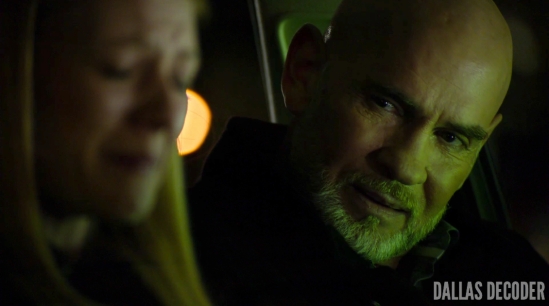
Beyond the mysteries, “Let Me In” allows the audience to get inside the heads of several characters, beginning with Harris. His most revealing moment occurs during the scene with Emma in the darkened parking garage. They sit together in his SUV as Harris recalls the first horse Emma fell in love with as a little girl, and how it injured her when she ignored his orders to stay away from it. It doesn’t take long to realize the story parallels Emma’s relationship with Drew, who she is dating against her father’s wishes. This is why it’s so chilling when Harris reminds Emma how he had the horse put down (“that dirty animal”), and then flicks on his truck’s headlights to reveal Drew, lying on the floor of the garage, bloodied and beaten as two of Harris’s thugs hover nearby.

Everything about this scene is superb: scriptwriter Aaron Allen’s taut dialogue, Mitch Pileggi’s pitch-perfect delivery, Emma Bell’s convincing tears, the way director Millicent Shelton pans her camera across the garage and brings the SUV into the center of the shot. I also love how Pileggi and Bell are cast in a green glow, which lends the scene a kind of cinematic quality. The color might also symbolize the envy that motivates Harris. He doesn’t want Emma to stay away from Drew just because he believes the young man isn’t good enough for her; Harris is jealous of Drew, just like he’d be jealous of anyone who receives attention from his daughter.

This scene also resonates because it reflects one of “Dallas’s” central themes, which is how generational patterns are seemingly impossible to break. Cliff inherits Digger’s enmity toward the Ewings. John Ross strives to escape J.R.’s shadow while simultaneously trying to emulate him. Now we see history repeating itself within the family Ryland: Harris’s preoccupation with Emma is awfully reminiscent of his mother’s obsession with him. Yet it also seems as though Harris genuinely loves his daughter, even if he expresses it through control and manipulation. It allows us to feel a twinge of sympathy for him. (I’m not sure this show’s other villainous daddy, Cliff, loves his daughter Pamela, but that’s a debate for another day.)

Regarding Pamela: “Let Me In” does a nice job showing us her struggle to cope with the loss of her unborn children. In the nifty opening scene, we see alternating shots of Christopher tearing down the nursery at Southfork while Pamela assembles the babies’ room in her penthouse. She then sits alone amid the crib and stuffed animals, which tells us everything we need to know about her state of mind. It also offers a subtle nod to Pamela’s namesake aunt, who demonstrated similarly distressing behavior during her obsessive baby phase on the old show.

Rather smartly, “Let Me In” uses Pamela’s tragedy to generate sympathy for her character, who has engaged in some pretty unsavory practices since the new “Dallas” began. (In much the same way, Drew’s savage beating in this episode makes it easier to forgive him for his role the bombing of the Ewing Energies rig.) In this spirit, “Let Me In” also gives us the lovely scene where John Ross finds Pamela alone on her balcony, wraps his coat around her and brings her in from the cold. Allen, the scriptwriter, referred to this on Twitter the other night as an homage to “St. Elmo’s Fire,” but it also works as a metaphor for John Ross and Pamela’s relationship. These two bring out the warmth in each other. The passion they ignited at the beginning of the season has turned into something deeper, which is why the couple seems to have so many supporters among “Dallas” fans. I’m one of them. I started off rooting for John Ross and Pamela because I loved the idea of J.R. and Cliff’s children falling for each other, but now I see their relationship would make sense no matter what their last names are. They’re both driven characters with daddy issues. Of course they’d be drawn to each other.

“Let Me In” also gives us many moments of Ewing togetherness, beginning with the sequence where Bobby, Sue Ellen and the cousins huff out of the meeting with the state official who investigated the rig explosion. I don’t know about you, but I’m also enjoying the reprieve from Josh Henderson and Jesse Metcalfe’s on-screen bickering; the scene where John Ross expresses concern for Christopher after the loss of the twins makes the characters feel like real, mature men. There’s also the terrific sequence where Sue Ellen warns Lee Majors’ character, Ken Richards, about crossing the family, which recalls one of Miss Ellie’s most memorable moments from the old show. I also like when Sue Ellen spots Emma in the bar, and when she tells Ann about it later. A lot of fans have noted the similarities between Lucy and Emma, but I wonder if Sue Ellen recognizes a little of herself in Emma’s self-destructive tendencies?

“Let Me In’s” other highlights include the arrival of Governor McConaughey, played to smirking perfection by Steven Weber, as well as the second appearance from Majors, whose conflicted character gets to become a hero when he alerts Sue Ellen to Harris’s connection to McConaughey. The captivating Emily Kosloski (Patrick Duffy’s daughter-in-law), in the meantime, does a brief-but-memorable turn as Rhonda, the club hostess who may or may not be the last woman to see J.R. alive.

I also love “Let Me In’s” two episode-ending montages. In the first, Bobby lets Sue Ellen in on the secret that J.R. was devising a master plan against the family’s enemies when he died. Duffy delivers his character’s recap over slow-motion scenes of Bobby and Sue Ellen examining the evidence. In the second montage, Harris sits in the governor’s office and gives McConaughey a lesson on the hunting habits of the Komodo dragon, explaining how it injects its prey with venom and waits for its slow death. As Harris speaks, we watch the Ewings make the unsettling discovery that the governor has used his office to stop the flow of oil from Southfork, effectively cutting off the family’s fortune.

This dramatic ending leaves me wondering how the Ewings are going to get out of this latest jam. I wonder something else too. What does Pileggi savor more: the nuts he’s munching in this scene or the delicious dialogue Allen has written for him?

Grade: A

_______________________________________________________________________________________________________________________________________________

Dallas, Ken Richards, Lee Majors, Let Me In, TNT

Enter the hero

‘LET ME IN’

Season 2, Episode 11

Telecast: April 1, 2013

Writer: Aaron Allen

Director: Millicent Shelton

Audience: 2.6 million viewers on April 1

Synopsis: The state concludes a technical glitch is to blame for the rig explosion and fines Ewing Energies $1 billion. After Governor Sam McConaughey forces him to resign from his post, Ken lets Sue Ellen know the governor is in Harris’s pocket. Later, McConaughey’s administration seizes the Henderson property, cutting off the flow of oil from Southfork. Bobby determines Christopher will inherit Pam’s share of Barnes Global if she’s dead. Harris has Drew beaten when Emma refuses to stop seeing him.

Cast: Kuno Becker (Drew Ramos), Emma Bell (Emma Brown), Jordana Brewster (Elena Ramos), Patrick Duffy (Bobby Ewing), Alex Fernandez (Roy Vickers), Julie Gonzalo (Pamela Barnes), Linda Gray (Sue Ellen Ewing), Castulo Guerra (Carlos del Sol), Christian Heep (Travis), Josh Henderson (John Ross Ewing), Emily Kosloski (Rhonda), Lee Majors (Ken Richards), Jesse Metcalfe (Christopher Ewing), Jack O’Donnell (Emma’s friend), Mitch Pileggi (Harris Ryland), Natalie Quintanilla (Stacy), Jeffrey Schmidt (Scott Taylor), Brenda Strong (Ann Ewing), Steven Weber (Governor Sam McConaughey)

“Let Me In” is available at DallasTNT.com, Amazon.com and iTunes. Watch the episode and share your comments below.